Lisa Reviews An Oscar Nominee: Quo Vadis (dir by Mervyn LeRoy)


The 1951 best picture nominee, Quo Vadis, is actually two movies in one.

The first movie is a rather stolid historical epic about life in ancient Rome.  The handsome but kind of dull Robert Taylor plays Marcus Vinincius, a Roman military officer who, after serving in Germany and Britain, returns to Rome and promptly falls in love with the virtuous Lygia (Deborah Kerr).  Complicating Marcus and Lygia’s relationship is the fact that Lygia is a devout Christian and a friend to Peter (Finlay Currie) and Paul (Abraham Sofaer).

Marcus’s uncle, meanwhile, is Petronius (Leo Genn), a government official who has a reputation for being a bon vivant.  In real-life, Petronius is believed to have been the author of the notoriously raunchy Satyricon.  You would never guess that from the way that Petronius is portrayed in Quo Vadis.  We’re continually told that Petronius is a notorious libertine but we don’t see much evidence of that, beyond the fact that he lives in a big palace and he has several slaves.  In fact, Petronius even falls in love with one of his slaves, Eunice (Marina Berti).

The second movie, which feels like it’s taking in a totally different cinematic universe from the adventures of Marcus and Lygia, deals with all of the intrigue in Nero’s court.  Nero (Peter Ustinov) is a giggling madman who dreams of rebuilding Rome in his image and who responds to almost every development by singing a terrible song about it.  Nero surrounds himself with sycophants who continually tell him that his every idea is brilliant but not even they can resist the temptation to roll their eyes whenever Nero grabs his lyre and starts to recite a terrible poem.  Nero is married to the beautiful but evil Poppaea (Patricia Laffan) and there’s nothing that they love more than going to the arena and watching people get eaten by lions.  It disturbs Nero when people sing before being eaten.  “They’re singing,” he says, his voice filled with shock an awe.

It’s difficult to describe just how different Ustinov’s performance is from everyone else’s in the film.  Whereas Taylor and even the usually dependable Deborah Kerr are stuck playing thin characters and often seem to be intimidated by playing such devout characters, Ustinov joyfully chews on every piece of scenery that he can get his hands on.  Nero may be the film’s villain but Ustinov gives a performance that feels more like it belongs in a silent comedy than a biblical epic.  Ustinov bulges his eyes.  He runs around the palace like he forgot to take his Adderall.  While Rome burns, Nero grins like a child who has finally figured out a way to outsmart his parents.  “You won’t give me more money?  I’ll just burn down the city!”

And the thing is — it all works.  The contrast between Ustinov and the rest of the characters should doom this film but, instead, it works brilliantly.  Whenever Ustinov’s performance gets to be too much, Robert Taylor and Leo Genn pop up and ground things.  Whenever things start to get too grounded, Ustinov throws everything back up in the air.  The conflict between the early Christians and the Roman Empire is perfectly epitomized in the contrast between Robert Taylor and Peter Ustinov.  It makes for a film that is entertaining almost despite itself.

Quo Vadis was nominated for best picture but lost to An American In Paris.

Film Review: Simon of the Desert (dir by Luis Bunuel)


1965’s Simon of the Desert opens deep in the Syrian desert, where a man named Simon (played by Claudio Brook) stands atop a column.  He’s spent 6 years, 6 weeks, and 6 days at the top of that column.  Simon spends his days praying, not only for himself but also the world.  We’re told that he’s the son of St. Simeon Stylites, who spent 37 years atop a small column outside of Aleppo.

(Of course, St. Simeon died in 459 and Simon appears to be living in the 19th century so maybe Simon has been misinformed.)

Sometimes, people gather around the column and beg Simon to perform a miracle.  Strangely, when Simon does what they want and heals an amputee, no one is particularly impressed or grateful.  Occasionally, priests gather around the pole and offer to make Simon one of them.  Simon, however, always refuses.  He’s not worthy, he says.  Plus, he feels that the local priest is a bit too vain.

What quickly becomes obvious is that, while Simon is a man of great faith, he’s also a bit of a self-righteous jerk.  Simon is quick to pass judgment on those who come to stare at him but, at the same time, one gets the feeling that he would equally offended if nobody stared.  Simon may claim that standing on the column has brought him closer to God but, over the course of the film, it’s only the devil (played by Silvia Pinal) who comes to visit him.

In order to taunt and tempt Simon, Satan takes on different forms.  At one point, she appears as a teenage girl skipping across the desert.  At another point, she appears as Jesus.  Towards the end of the film, she rides a coffin across the desert.  Simon proves to be stubborn in his faith, or at least he is until Satan offers him a glimpse of his future and the film’s present….

Directed by the Mexican surrealist Luis Bunuel, Simon of the Desert is a 45-minute look at faith, stupidity, and rock music.  (That’ll make sense if you watch the film.  It’s on YouTube.)  An outspoken atheist, Bunuel goes beyond merely criticizing organized religion and instead further suggests that Simon is an idiot for spending six years praying to a God who doesn’t care about him.  Bunuel does not even allow Simon to reach the status of “holy fool.”  Instead, Simon is portrayed as being just a fool.

Not surprisingly for a Bunuel film, Simon of the Desert is full of striking images, from that coffin moving across the desert to Simon standing atop the column and waiting for some sort of sign.  Claudio Brook and Silvia Pinal both give great performances and have enough chemistry that you can’t help but suspect that Simon and Satan might secretly be in love with each other.  The film ends on a properly surreal note, one that suggests that the all the contemplation of the world cannot bring a stop to the inevitable dance of death.

Dream-like and sharply satiric, Simon of the Desert is a film that you won’t forget.

Lisa Reviews An Oscar Nominee: Ivanhoe (dir by Richard Thorpe)


Welcome to England in the 12th century!

That’s the setting of the 1952 best picture nominee, Ivanhoe.  It’s a green and healthy land, full of chivalrous knights and corrupt royalty and outlaws who steal from the rich and give to the poor.  King Richard the Lion Heart (Norman Wooland) left on a crusade and he hasn’t been seen for a while.  Richard’s evil brother, the cowardly King John (Guy Rolfe), rules the country and has little interest in making sure that Richard returns.  Even when Wilfred of Ivanhoe (Robert Taylor) discovers that Richard is being held for ransom, John declines to do anything about it.

Ivanhoe is determined to raise the money to pay the ransom and restore Richard to the throne of England, even if he has to secretly compete in a tournament to do it.  Of course, before he can do that, he’ll have to buy a horse and some armor.  Fortunately, he comes across Isaac (Felix Aylmer) and his daughter, Rebecca (Elizabeth Taylor).  Isaac and Rebecca give Ivanhoe the money necessary to purchase a good horse and equipment.  Rebecca falls in love with Ivanoe, despite the fact that Ivanhoe is in love with Rowena (Joan Fontaine, who spends most of the movie looking rather bored).

Speaking of love, the king’s favorite knight — the hot-headed but honorable Sir Brian De Bois-Guilbert (George Sanders) — has fallen in love with Rebecca.  That, of course, complicates matters when the anti-Semitic King John attempts to have the Jewish Rebecca burned at the stake for witchcraft.  When Ivanhoe invokes the “wager of challenge,” in an effort to save Rebecca’s life, Sir Brian is chosen as the court’s champion.  Needless to say, this leads to some awkward moments….

Listen, I would be lying if I said that it was easy for me to follow the plot of Ivanhoe.  It seemed like every few minutes, someone else was plotting against either Ivanoe or King John and it got a bit difficult to keep track of what exactly everyone was trying to accomplish.  By the time Robin Hood (Harold Warrender) showed up, I have given up trying to make sense of the plot.

Instead of worrying about the exact details of the plot, I decided to just enjoy the film as a spectacle.  If nothing else, Ivanhoe is gorgeous to look at.  The colors are lush and full and the costumes and the sets are all wonderfully ornate.  Apparently, 12 Century England was a very colorful place.  There’s a lot of battles and jousts and sword fights.  I couldn’t always keep track of who was fighting who but at least the film moved at a steady pace.

Robert Taylor and Joan Fontaine make for a dull leading couple but a young Elizabeth Taylor is stunning in the role of Rebecca and George Sanders transforms Sir Brian into a truly tragic figure.  Guy Rolfe is memorably evil as King John, though he’s perhaps not as much fun as Oscar Isaac was in Robin Hood.  Everyone in the movie looks good in their period costuming.  Really, that’s the most important thing.

Ivanhoe was nominated for Best Picture but lost to The Greatest Show On Earth.

Film Review: Westworld (dir by Michael Crichton)


“Draw,” says Yul Brynner.

“Whatever,” says a tourist who has spent a lot of money to spend their vacation at the Delos amusement park.

BANG!  Down goes the tourist, as the robot revolution of 1983 begins.

Recently, TCM broadcast the 1973 science fiction thriller, Westworld.  Since I am absolutely obsessed with the more recent HBO revival, there was no way I could resist watching the original film.  It was an interesting experience.  While the film is far more simpler and straight-forward than the television series, they both essentially tell the same story.  A bunch of rich humans pay a lot of money to pretend to be either cowboys or knights or Roman citizens for a week.  Everyone has a great time until, eventually, the robots stop doing what they were supposed to do and instead, begin to fight back.

One thing that the movie and the series definitely shared is a less-than-positive view of humanity.  The movie focuses on two businessmen.  Peter (Richard Benjamin) is the nerdy one.  John (James Brolin) is the hypermasculine one.  Peter is visiting Westworld for the first time.  John is a frequent guest who loves gunning down any robots who looks at him the wrong way.  Neither one of these characters is particularly likable.  Peter starts out as a self-righteous hypocrite who ends up sleeping with a sexbot, despite being married.  John brags about how easy it is to kill the robots, mostly because the robot’s are programmed to not fight back.

Meanwhile, the human engineers who work behind-the-scenes and keep Delos running are all blandly incompetent.  When the robots start to malfunction, the engineers can only shrug and wonder why.  They’re so ineffective that, halfway through the movie, they get sealed up in their own control room, slowly suffocating to death while the park collapses around them.

As opposed to the TV series, the robots in Westworld never achieve any sort of real consciousness.  Even when they malfunction, it doesn’t lead to a true rebellion as much as it just causes them to ignore any previous directives about killing the guests.  When the Gunslinger (Yul Brynner) starts stalking Peter and John across the park, it’s not an act of ideology or, for that matter, even revenge.  It’s simply that the Gunslinger has been programmed to be a killer and this is what a killer does.

It all leads to an extended chase sequence involving the Gunslinger and Peter and, despite the fact that it doesn’t have much of a personality, it’s hard not to be on The Gunslinger’s side.  If nothing else, the Gunslinger is at least good at what it does.  Peter, on the other hand, is perhaps one of the most incompetent heroes to ever show up in a movie.  After spending the first half of the movie being smug and dealing with robots programmed not to fight back, Peter now has to try to win on an even playing field.

Westworld was the directorial debut of writer Michael Crichton.  The film’s flaws are largely the flaws that you would expect from a first-time director.  Occasionally, the pacing falters and the first half of the film sometimes moves a bit too slowly.  (There’s one saloon fight that seems to go on forever.)  During the first half of the film, there’s several scenes involving another tourist (played by Dick Van Patten) who seems like he’s going to play a major role in the film but, after the first hour, the character literally vanishes from the film.

Despite those flaws, Westworld remains an exciting mix of suspense and science fiction.  Though his actual screentime is rather limited, Yul Brynner easily dominates the entire film.  In the role of the Gunslinger, Brynner is a relentless killing machine.  What makes the character especially disturbing is that Brynner plays him without a hint of emotion or expression.  The Gunslinger gets no pleasure out of killing nor does he seek to accomplish any sort of identifiable goal.  The Gunslinger simply kills because that’s what he was programmed to do.

While I prefer the HBO series, the original Westworld is still an exciting and entertaining film, one that probably seems a lot more plausible today than when it was first released 46 years ago.  Watch it the next time your home robot gets bored.

Film Review: To Die For (dir by Gus Van Sant)


The 1995 satire, To Die For, is a very clever film about some seriously stupid people.

Of course, you could debate whether or not Suzanne Stone-Maretto (Nicole Kidman) is actually dumb or not.  Suzanne may not know much about anything that isn’t on TV but she does have a natural understanding for what makes a good story.  She knows exactly the type of story that the public wants to hear and she does a good job of faking all of the right emotions.  As she proves throughout the course of the film, she’s also very good at convincing people to do stuff.  Whether it’s convincing the local television station to put her on the air as a weather person or convincing two teenagers to murder her husband, Suzanne always seems to get what she wants.

Of course, what Suzanne really wants is to be a celebrity.  She wants to be a star.  As she explains it, that’s the greatest thing about America.  Anyone can become a star if they just try hard enough and find the right angle.  If the film were made today, Suzanne would be a social media junkie.  Since the movie was made in 1995, she has to settle for talk shows and murder.

So maybe Suzanne isn’t that dumb but her husband, Larry (Matt Dillon) …. well, if we’re going to be honest, Larry’s more naive than dumb.  He’s the favored son of a big Italian family and it’s obviously never occurred to him that a woman would possibly want something more than just a husband and a lot of children.  He thinks it’s cute that Suzanne’s on TV but he’s also fully convinced that she’s going to eventually settle down and focus on starting a family.  It never occurs to him that his wife would be willing to sacrifice him on her way to stardom.

Of course, if you really want to talk about dumb, just check out the teenagers who Suzanne recruits to kill her husband.  They’ve been appearing in a documentary that Suzanne’s been shooting.  The documentary’s title is “Teens Speak Out,” which is something of an ironic title since none of the teens that Suzanne interviews really has anything to say.  Lydia (Allison Folland) is just happy that the “glamorous” Suzanne is pretending to care about her.  Russell (Casey Affleck) is the type of grinning perv who drops a pen just so he can try to get a peek up Suzanne’s skirt while he’s on the floor retrieving it.  And then there’s Jimmy (Joaquin Phoenix), with his flat voice and his blank stare.  Jimmy is briefly Suzanne’s lover before he ends up in prison for murdering her husband.  It doesn’t take much to convince Jimmy to commit murder, either.  Apparently, all you have to do is dance to Lynard Skynard while it’s raining outside.  Media interviews with Lydia, Jimmy, Suzanne, and Larry’s sister (Ileana Douglas) are sprinkled throughout the film and Jimmy continues to insist that he will always love Suzanne.

As for Suzanne, she’s got stardom to worry about….

Though the subject matter is a bit familiar and the film, made before the age of Twitter and Instagram, is a bit dated, To Die For‘s satire still carries a powerful bite.  One need only watch A&E or the Crime and Investigation network to see that Suzanne was absolutely correct when she decided that killing her husband would make her a star.  If To Die For were made today, you could easily imagine Suzanne leveraging her infamy into an appearance on Dancing With The Stars and maybe Celebrity Big Brother.  At the very least. she could get her own house hunting show on HGTV.  Delivering her often sociopathic dialogue with a perky smile and a positive attitude, Nicole Kidman is absolutely chilling as Suzanne.  Meanwhile, Joaquin Phoenix’s blank stare will continue to haunt you long after the film ends.

And speaking of endings, To Die For has a great one.  You’ll never hear Season of the Witch the same way again!

Film Review: One Potato, Two Potato (dir by Larry Peerce)


The 1964 film, One Potato, Two Potato, is the story of two people who fall in love.

Julie Cullen (Barbara Barrie) was previously married to Joe (Richard Mulligan).  She’s divorced now and raising her daughter, Ellen (Marti Mericka), on her own.  Ellen was barely a year old when Joe abandoned his family and she’s never known her father.  Perhaps that’s for the best because, as we later see firsthand, Joe was an immature and abusive man.

Frank Hamilton (Bernie Hamilton) is quiet, responsible, and mild-mannered.  For the majority of the movie, the only time that we see Frank show any emotion is when he’s playing football with coworkers.  However, he’s obviously a sensitive and intelligent man.  He and Julie begin a relationship, tentatively at first.  But soon, they’re very much in love and planning to get married.

And really, there’s nothing unusual about either one of them.  They’re two genuinely nice people who met and fell in love.  The only thing that sets their romance apart from so many other romances is that Julie’s white and Frank’s black.  For that reason, Frank and Julie get harassed by the police when they try to enjoy a romantic stroll at night.  For that reason, Frank’s parents (played by Robert Earl Jones and Vinette Carroll) object to their relationship, saying that all the love in the world can’t overcome prejudice.  For that reason, when Frank and Julie do get married, hardly anyone comes to the wedding and the one bridesmaid glares at them throughout the ceremony.  Frank and Julie end up living on a farm with Frank’s parents, in love but practically isolated from the world.  (Tellingly, the “friend” who first introduced them doesn’t want to visit them after they marry.)  When Joe suddenly shows up and discovers that Julie has not only remarried but that her new husband is black, he goes to court and demands custody of his daughter.

It’s interesting think that, in 2019, it’s very easy to take interracial relationships (not to mention interracial marriages) for granted.  And yet, it wasn’t until 1967 (three years after the release of One Potato, Two Potato), that the U.S. Supreme Court officially ruled that laws against interracial marriage were unconstitutional.  One Potato, Two Potato was an early independent film, precisely because none of the major studios were willing to deal with an issue as controversial as interracial marriage.  (When the studios finally did deal with it, the end result was Guess Who’s Coming To Dinner, a film that was as safe and mild as One Potato, Two Potato was brave and angry.)  Barbara Barrie did win the best actress award at Cannes and the film itself received an Oscar nomination for Best Original Screenplay but otherwise, it’s a sadly neglected piece of film history.  If I hadn’t recorded it off of TCM, I probably never would have seen or even heard of this film.

And that would have been a shame because, along with being a valuable historical document, One Potato, Two Potato is a compelling and heartbreaking drama.  The film approaches its subject matter with a maturity and an honesty that probably stunned audiences back in 1964.  This film refuses to give into any of the well-intentioned clichés that often dominated films about racism in the 60s and 70s.  There are no sympathetic whites (à la Gregory Peck in To Kill A Mockingbird) willing to argue for Frank and Julie’s right to raise Ellen.  (In fact, the lawyer that they hire gets angry when Frank first approaches him and advises them to leave the state.)  It does Frank no good to be dignified and patient.  The racism in One Potato, Two Potato does not come from a handful of ignorant souls.  Instead, it’s built into the very system to which Frank and Julie are now having to appeal.

One Potato, Two Potato is also a rarity in that it’s a film that allows a black man to get angry about the way he’s being treated, even if it means making whites in the audience uncomfortable.  One need only compare the hopeful ending of Guess Who’s Coming To Dinner with the heart-breaking conclusion of One Potato, Two Potato.  Whereas Guess Who’s Coming To Dinner highlighted Sidney Poitier saying, in his dignified manner, that he has no interest in fighting the battles of the past, One Potato, Two Potato finds a distraught Bernie Hamilton watching a western and finally breaking down as he yells, “Kill that white bastard!”

One Potato, Two Potato ends with a title card that informs us that the story that we’ve seen is fictional but that the laws and the issues discussed in the film are real.  55 years after it was released, One Potato, Two Potato remains a compelling drama and an important historical document.


Film Review: Before I Fall (dir by Ry Russo-Young)


One of my favorite films of 2017 was Before I Fall, which was kind of a combination of Mean Girls, Groudhog Day, and Happy Death Day.  Two years later, it remains one of my favorite movies, even if I do end up crying whenever I watch it.

The film begins with an ordinary teenager named Samantha Kingston (Zooey Deutsch) waking up on February 12th.  We follow her throughout her day and watch her deal with family, friends, teachers, and all the drama that goes along with all of that.  We meet her boyfriend, Rob (Kian Lawley) and we automatically know that she needs to dump his jock ass.  (Whenever we hear him glibly say, “Love ya,” it’s like nails on a chalkboard.)  We all know that Sam should be with Kent (Logan Miller), who is sweet and sensitive and gives her a white rose for Cupid’s Day.  We also meet and get to know her friends, Allie (Cynthia Wu), Elody (Medalion Rahimi), and especially Lindsay (Halston Sage).  While being a close friend to Sam, Lindsay is still the stereotypical popular, mean girl, the one who decides who is accepted and who is destined to forever to be an outsider.  Sam, on the other hand, is not a mean girl (or, at the very least, she’s a not-as-mean girl).  Instead, she’s the girl who simply goes along with what everyone else is doing.  She may not instigate any bullying but she doesn’t do anything to stop it either.

February 12th was the night that Sam had been planning on losing her virginity to Rob but Rob pretty much ruins that by getting drunk and acting like an asshole.  Instead, at a party at Kent’s house, Sam watches as Lindsay humiliates an outsider named Juliet (Elena Kampouris).  After leaving the party, Sam, Lindsay, Elody, and Allie drive down a dark road.  They listen to music.  They talk about how stupid everyone at the party was.  And, eventually, the car crashes and….

Suddenly, Sam’s waking up in her bedroom!  And it’s February 12th all over again!  That’s right, Sam is in a time loop, destined to continually relive the final day of her life until she makes things right.  In the 2010 novel that this film is based on, author Lindsay Olivier makes it pretty clear that each time Sam relives her day, she’s going through another stage of grief, moving from denial to acceptance.  While the film doesn’t make that point quite as clearly as the book, it does do a good job of showing us how, each time that Sam is forced to relive that day, she comes out of it as a changed person.  She discovers that Rob wasn’t worthy of her love and that Kent was.  She discovers that her family wasn’t as terrible as she assumed.  And, perhaps most importantly, she learns that being a friend does not mean excusing casual cruelty.

Watching Before I Fall is always an emotional experience for me.  A lot of it is because I can relate to Sam.  In many ways, back in high school, I was Sam.  But, even beyond that, the theme of Before I Fall is universal.  It doesn’t matter how old you are or what your background may be.  It doesn’t matter if you were popular in high school or if you were one of the outsiders.  Everyone — every single one of us — has done something that they regret.  All of us have one day that we wish we could travel back to and do things differently.

Well-directed by Ry Russo-Young and featuring a lot of beautiful Canadian scenery (the film was shot in British Columbia and Vancouver), Before I Fall is a poignant and touching film.  Zooey Deutch, Halston Sage, Cynthia Wu, and Medalion Rahimi are all believable as longtime friends and, to the film’s credit, no one — not even Lindsay — can be reduced to a mere stereotype.  Before I Fall is a film about regret, denial, anger, acceptance, and finally, peace.  No wonder it makes me cry.

Film Review: The Butterfly Effect 2 (dir by John R. Leonetti)


“Hey, everyone!  Let’s remake The Butterfly Effect, just without any of the goofiness that made the first film so enjoyable!”

That would seem to be the logic behind 2006’s The Butterfly Effect 2.  Since the first Butterfly Effect was a minor hit (I saw it in the theaters!), it was inevitable that there would be a sequel.  And since the first Butterfly Effect is currently on Netflix, it’s also inevitable that the sequel would follow it.

Anyway, Butterfly Effect 2 is just like Butterfly Effect except, instead of a guy trying to fix his entire screwed-up childhood, the sequel is about an office worker named Nick (Eric Lively) who has just had a really bad year.  His girlfriend and his two best friends were killed in a traffic accident.  He lost a big promotion at work.  His apartment is a mess and he keeps having these hella icky nosebleeds.  Agck!  Nick, however, discovers that if he stares at an old picture, he can be transported back to the moment that the picture was taken.

Since Nick obviously didn’t see the first movie, he proceeds to start changing the past.  He prevents the deaths of all of his friends but now, in the new timeline, he actually has to work with them and this results in him getting fired.  He then goes back in the past to keep a jerk from getting a promotion but this leads to Nick getting the promotion instead, breaking up with his girlfriend, and becoming an ennui-stricken bachelor.  Apparently, being a wealthy bachelor means doing business with organized crime because Nick soon has people trying to kill him.  Maybe there’s no way to create a perfect present, the film suggests.

And the film might be right but that doesn’t make it any less boring to sit through.  The Butterfly Effect 2 is just never as much fun as the first film.  It lacks the goofy charm of Ashton Kutcher and most of the timeline changes are rather dull.  The sequel never matches the glory of Ashton Kutcher waking up to discover that he’s gone from being a disheveled psych major to being a clean-cut, sweater-wearing frat boy.

The Butterfly Effect 2 was directed by John Leonetti, who would later direct the genuinely creepy Annabelle.  Of course, he also directed the absolutely awful Wolves at the Door.  As for The Butterflyn Effect 2, it’s not creepy but it’s also not awful enough to be memorable.  More than anything, it’s a bland movie.  It’s just kind of there, floating in direct-to-video, Netflix limbo.

Film Review: The Butterfly Effect (dir by Eric Bress and J. Mackye Gruber)


How many different ways can Ashton Kutcher fuck up time and space?

That’s the question asked in the gloriously silly The Butterfly Effect, a film that was a minor hit back in 2004.  Ashton plays Evan Treborn, a disheveled college student who is studying how memory works.  All through his life, Evan has suffered from seizures that are triggered by stress.  Evan has a lot of stress because apparently, there’s not a single bad thing that didn’t happen to him when he was a child.

Crazy father who tried to strangle Evan before being gunned down in front of his son’s terrified eyes?  Yep.

Sexual molestation at the hands of a suburban drunk?  Yep.

A best friend who blew up not only a mailbox but also a mother and a baby?  Yep.

A dog that was set on fire by a neighborhood bully?  Yep.

Another friend who was driven into a catatonic state by all the madness around him?  Yep.

A girlfriend who, due to family tragedy, had to move away?  Yep.

However, things seem to be getting better for Evan.  Now, he’s a psychology major with a bright future.  His professors love him.  He’s even got a roommate named Thumper (played, somewhat inevitably, by Ethan Suplee).   And, as he’s soon to discover, he possesses a special power.  All he has to do is read his old journals and, for a limited time, he can go into the past and change his history.

Of course, it turns out that changing history is a lot more complicated than it looks.  Evan goes back into the past and confronts the pervy suburban drunk.  He then goes back to the present and discovers that he’s now a shallow frat boy who is hated by both his professors and Thumper!  Even worse, he eventually ends up in prison for killing a man.  Going back into the past and saving his dog leads to his friend Lenny (Elden Hansen) spending the rest of his life imprisoned.  Another trip to the past results in Evan waking up as a double amputee.  Depending on what Evan does, his friend Kayleigh (Amy Smart) either becomes a shallow sorority princess or a drug-addicted prostitute.  Meanwhile, Kayleigh’s brother (William Lee Scott) goes from being a psychotic murderer to a clean-cut religious guy.

Thumper never changers, though.  Thumper endures.

This, of course, is a lot of pressure to put on any character played by Ashton Kutcher and soon, Evan is having nosebleeds and migraines.  Every time he changes the past, his brain is flooded with 20 years worth of new memories.  His brain might explode before he can fix all the damage that he’s done….

Watching The Butterfly Effect is an odd experience because, on the one hand, the premise is genuinely intriguing but, on the other hand, the film stars the reliably goofy Ashton Kutcher.  Ashton grows a beard and doesn’t wash his hair for the first half of the movie, which is the film’s way of letting us know that we’re meant to take him seriously but it doesn’t change the fact that he’s still Ashton Kutcher.  Even when playing the most dramatic of scenes, Ashton tends to deliver every line as if it’s the set up for a punch line.  It’s not surprising that the best part of The Butterfly Effect is when Ashton wakes up and discovers that he’s now a frat boy.  Those scenes are intentionally funny and they take advantage of what Ashton Kutcher is actually good at.

At the same time, it’s hard not to get into The Butterfly Effect.  It’s a mess but it’s a likable mess and it’s undeniably enjoyable to see how everyone’s life changes as a result of Ashton’s constant meddling.  (William Lee Scott especially has fun, switching between being full-blown psycho and full-blown religious.)  The Butterfly Effect may be dumb but it’s fun.  It’s a film that’s best watched with your snarkiest friends.

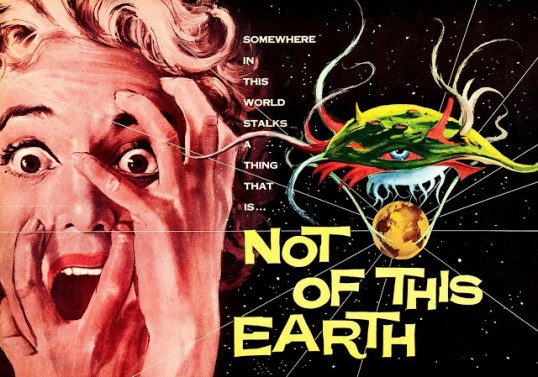
Film Review: Not Of This Earth (dir by Roger Corman)


Originally released in 1957, Roger Corman’s Not Of This Earth is about a man named Mr. Johnson (played, in a nicely creepy performance, by Paul Birch).

At first glance, Mr. Johnson may look like your typical dark-suited, 1950s businessman but, on closer examination, there’s definitely something off about him.  Why does he always wear those dark sunglasses?  Why is he so sensitive to loud noise?  Why does he move stiffly, as if he’s still getting used to his ody?  And when he speaks, why is his tone always so formal and correct?  Never trust anyone who doesn’t use a contraction or two.  Why is it that Mr. Johnson seems to spend all of his time in his mansion, only venturing outside so that he can visit the local blood banks?

Could it be that Mr. Johnson is …. not of this earth!?

Well, yes, of coursem he’s an alien.  I mean, it says so right in the title of the movie!  It turns out that Mr. Johnson comes from a planet called Davanna.  The inhabitants of Davanna are dying of a mysterious blood disease so he’s been sent to Earth so that he can run tests on human blood.  Needless to say, Mr. Johnson is under constant pressure from his bosses back home.  They expect Johnson to find a cure but there’s only one problem.  Human blood is sometimes hard to come by.

Oh sure.  Johnson can always go to the local doctor (William Roerick) and get a transfusion.  But, unfortunately, Johnson is often forced to deal with his need for blood by murdering anyone who happens to be near the house, whether it be a teenager or a vacuum cleaner salesman.  Like a vampire, Johnson drains them of their blood before retreating to the safety of his mansion.

Paul Birch gives a wonderfully odd performance in the role of Mr. Johnson, playing him in such a way that suggests that Mr. Johnson is still not quite comfortable with his human disguise.  When he starts speaking with his stilted and awkward syntax, he’s like a man who has just learned how to speak another language.  On the one hand, it’s tempting to feel sorry for Mr. Johnson because he’s desperately trying to save his people.  On the other hand, he does end up killing a lot of people.

Beverly Garland and Morgan Jones play Nadine and Harry, a nurse and a policeman who stumble across the truth of Mr. Johnson’s origins.  Beverly Garland was one of those confident, no-one-is-going-to-conquer-my-planet actresses who could elevate any film by her presence alone and, as this film shows, if you’re trying to stop the aliens from stealing all of Earth’s blood, Beverly Garland was someone who you would want on your side.

With the exception of a scene featuring Dick Miller as a slick salesman, director Roger Corman plays the material straight and the end result is a quickly paced and, at times, genuinely creepy little sci-fi/horror hybrid.  Corman makes good use of his low-budget and even the film’s cheap look ultimately works to its advantage.  The stark black-and-white cinematography perfectly captures the harshness of Mr. Johnson’s mission.  This an effective and enjoyable B-movie.

Finally, since this is a Roger Corman production, be sure to look for all of the usual suspects.  As mentioned above, Dick Miller plays a salesman.  (Before becoming an actor, Miller actually did work as a door-to-door salesman and he ad libbed the majority of his dialogue.)  Jonathan Haze appears as one of Mr. Johnson’s servants.  And, of course, the film was written by Corman’s longtime collaborator, Charles B. Griffith.  Three years after making Not Of This Earth, Corman, Haze, Miller, and Griffith would collaborate on the somewhat more light-hearted Little Shop of Horrors.