Film Review: Long Arm of the Godfather (dir by Nardo Bonomi)


Like all good Italian crime films, 1972’s Long Arm of the Godfather opens with an absurdly over-the-top act of violence.  In this case, a young gangster names Vincenzo (Peter Lee Lawrence) masterminds the hijacking of a delivery of Italian army weapons.  It’s gangsters versus soldiers as a ludicrous amount of bullets are fired and even a few grenades are tossed through the air.  The violence goes on for so long that actually starts to feel as if the film has become self-aware and is parodying the expectations of the audience.  The film seems to be saying, “You want violence?  Take this!”

That said, Vincenzo eventually does get away with a truck of weapons.  He’s suppose to deliver the truck to Don Carmelo (Adolfo Celi, who is probably best-known for playing James Bond’s nemesis in Thunderball) but Vincenzo has other ideas.  After running Carmelo off the road, Vincenzo drives off on his own.  His plan is to sell the weapons and use the money to start a new life with prostitute girlfriend, Sabina (Erika Blanc).  Unfortunately, because Vincenzo doesn’t have any money, he can’t pay anyone to help him unload the truck.  Eventually, he deals with that problem by stealing and selling Sabina’s jewelry.  Understandably, Sabina is not happy about this but Vincenzo has an even bigger problem to deal with.

It turns out that Don Carmelo is still alive.  Even when Vincenzo and Sabina leave Italy for North Africa and attempt to make a deal to sell the weapons to a group of terrorists, Don Carmelo and his men are following close behind.  It all leads to even more violence and an appropriately fatalistic ending.  The film’s ultimate message is that there is no escape from a life of crime.  There is no way to avoid the long of arm of the godfather.

Perhaps the most interesting thing about the film is that all of the characters pretty much hate each other even before the inevitable betrayals begin.  Don Carmelo appears to dislike all of his men and most of his men appear to dislike him to.  Even the people who help Vincenzo make little secret of the fact that they can’t stand to be around him.  The main exception to all of this mutual dislike is Vincenzo himself.  Vincenzo appears to sincerely like (if not quite love) Sabina.  Sabina, on the other hand, spends the majority of the film talking about how everything is Vincenzo’s fault.  She knows that Vincenzo is in over his head but, at the same time, she also knows that there’s a chance Vincenzo could make a lot of money so she sticks with him.  As for Vincenzo, he’s an eternal optimist, trying to find hope even when its clear that there’s none left.  Vincenzo may be clever but he’s not particularly smart and that is destined to be his eventual downfall.

Long Arm of the Godfather is an unapologetically pulpy thriller, one in which both the violence and the melodrama are frequently over the top.  It’s a film that will be appreciated by fans of hard-boiled crime fiction and Italian exploitation films.  Celi is properly intimidating as Don Carmelo while Peter Lee Lawrence gives a charismatic performance as Vincenzo.  Tragically, Lawrence would die two years after starring in Long Arm of the Godfather, a victim of a brain tumor that went undetected until it was too late.  He was 30 years old and, had he lived, he undoubtedly would have been a big star in European cinema.  Fortuntely, one can still watch him in a film like this and see hints of what could have been.

Here Are Your Oscar Winners


Best Picture — Everything Everywhere All At Once

Best Director — The Daniels, Everything Everywhere All At Once

Best Actor — Brendan Fraser, The Whale

Best Actress — Michelle Yeoh, Everything Everywhere All At Once

Best Supporting Actor — Ke Huy Quan, Everything Everywhere All At Once

Best Supporting Actress — Jamie Lee Curtis, Everything Everywhere All At Once

Best Adapted Screenplay — Women Talking

Best Original Screenplay — Everything Everywhere All At Once

Best Animated Feature Film — Guillermo Del Toro’s Pinocchio

Best International Film — All Quiet On The Western Front

Best Documentary Feature Film — Nalvany

Best Live Action Short — An Irish Goodbye

Best Animated Short — The Boy, The Mole, The Fox, and The Horse

Best Documentary Short — The Elephant Whisperers

Best Original Score — All Quiet On The Western Front

Best Original Song — RRR

Best Cinematography — All Quiet On The Western Front

Best Costume Design — Black Panther: Wakanda Forever

Best Editing — Everything Everywhere All At Once

Best Makeup and Hairstyling — The Whale

Best Production Design — All Quiet On The Western Front

Best Sound — Top Gun: Maverick

Best Visual Effects — Avatar: The Way of Water

Film Review: Mr. Mean (dir by Fred Williamson)


In the 1977 film, Mr. Mean, Fred Williamson plays the title role.

He’s a former employee of the Cosa Nostra who now works as a sort of private investigator.  He’s cool.  He’s hip.  He’s sexy.  He’s Fred Williamson!  But the best thing about him is that his name actually is Mr. Mean.  Everyone in the film literally calls him “Mr. Mean.”  He introduces himself as being “Mr. Mean.”  The people who are closest to him occasionally leave out the “Mister” and just call him “Mean.”

The film begins with a woman approaching Fred Williamson on a basketball court and saying to him, “Hey, is your name Mr. Mean?”

Later, when he calls his office to check his messages, he tells his secretary, “This is Mr. Mean.”

When he goes to his favorite bar, he’s approached by two members of Ohio Players, the band behind Fire and Love Rollercoaster.  They tell him that they are such big fans of him and his reputation that they’ve actually written a song about him.  The song is called “Mr. Mean.”  They proceed to play the song over the opening credits.  For his part, Mr. Mean does not appear to be impressed.  That said, I imagine the Ohio Players were probably happier to be playing for Mr. Mean and than for the Brady Bunch.

Mr. Mean is summoned to Italy by a mob boss who wants Mr. Mean to do one last job.  He wants Mr. Mean to assassinate a rival gangster, Huberto (Lou Castel).  Mr. Mean explains that he may be a fighter and lover but he’s not a killer.  However, Mr. Mean then learns that Huberto has been running a scam charity, stealing money that people are donating to help fight hunger in Africa.  Mr. Mean takes on the contract.  However, Huberto knows that Mr. Mean is in Italy to take him out so Huberto hires an assassin named Rommell (Raimund Harmstorf) to take out Mr. Mean first.

Judging from the endless shots of Mr. Mean casually walking through Rome, it doesn’t appear that either man is in much of a hurry to get the job done.  Mr. Mean even takes time to pursue a romance with the mysterious Rene (Crippy Yocard).  What little action there is comes to a complete halt so the film can give us a lengthy scene of Mr. Mean and Rene walking along the beach.  Eventually, it turns out that Rene has a secret of her own and, for a few minutes, it seems like Mr. Mean might become yet another Fred Williamson film to feature a sudden downbeat finale.  But no worries!  Mr. Mean may be mean but he’s also clever!

(Actually, Mr. Mean turns out to be a surprisingly nice guy so I’m not really sure how he got that nickname.)

The film’s plot is next to impossible to really summarize because the plot doesn’t make any sense.  The story feels like it was made up on the spot, probably because it was.  Reportedly, Fred Williamson shot this film while he was in Italy to make Inglorious Bastards.  He would spend the week working on Bastards and then, on the weekend, he would borrow the film’s equipment and crew and secretly work on Mr. Mean.  He wrote the script while filming.  The result is a film that meanders without adding up to much.  The main theme of Mr. Mean appears to be that Fred Williamson was Fred Williamson’s biggest fan.

Mr. Mean is one of Fred Williamson’s lesser films.  Though he didn’t necessarily have a wide range as an actor, Fred Williamson had charisma and a lot of style and confidence.  All of that is on display in Mr. Mean but the film itself is impossible to follow and ultimately just feels like an extended home movie.  Mr. Mean just isn’t mean enough to be memorable.

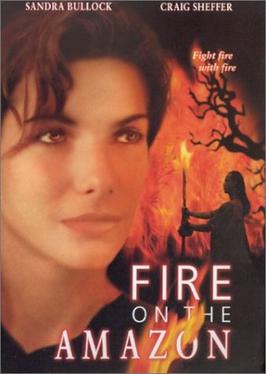
Film Review: Fire on the Amazon (dir by Luis Llosa)


Released in 1993 and produced by none other than Roger Corman, Fire on the Amazon takes place in Bolivia.  Despite the protests of the indigenous population and the environmental activists who have flown down to support them, the Rain Forest is being destroyed by corporations, cattle ranchers, and military units.  After an activist named Rafael Santos (Eduardo Cesti) is assassinated, photojournalist R.J. O’Brien (Craig Sheffer) comes down to document the accused assassin’s trial.

R.J. tries to remain detached from the injustices that he sees around him.  Much like Robert Forster in Medium Cool, R.J. claims to be an observer and not a participant.  But then he meets an environmentalist named Alyssa Rothman (a pre-stardom Sandra Bullock) and he comes to realize that the Bolivian government is covering up the details of Santos’s death.  R.J. and Alyssa go deep into the Rain Forest, searching for evidence that can prove that the military was behind the assassination.  The military, of course, is determined to keep them from doing that.

Fire on the Amazon is a Roger Corman films with a social conscience.  It features several speeches about the importance of the Rain Forest and it ends with a title card informing viewers of how much of the Rain Forest was destroyed on a daily basis in 1993.  Whatever else one might have to say about the films that Corman has either produced or directed, he has always seemed very sincere when it comes to his messages.  That said, Corman has also always been very sincere in his belief that movies should make money and Fire on the Amazon doesn’t allow its environmental message to get in the way of the sex and violence that most of the film’s viewers were probably looking for.  The film actually feels a bit like a companion piece to The Forbidden Dance.  Yes, saving the Rain Forest is importance but so is doing the Lambada.

Today, if Fire on the Amazon is known for anything, it’s probably for the rather random sex scene featuring Sandra Bullock and Craig Sheffer.  To be honest, while the scene is graphic and lengthy, the only thing that sets it apart from other low-budget sex scenes is the fact that it features a future Oscar winner.  A huge problem with the scene is that there are next to no romantic sparks between Bullock and Craig Sheffer.  Indeed, Sheffer gives such a lifeless performance that, at one point, it appears that he’s actually fallen asleep during the big sex scene.  Fortunately, Sheffer sticks out his tongue long enough to let us know that he’s still alive.

Make no mistake about it, while Sandra Bullock may be the name that’s highlighted whenever this film shows up on a streaming site, Craig Sheffer is the star of the film.  The majority of the film focuses on him as he wanders around Bolivia and whines about having to do his job.  Though he’s certainly not helped by the film’s script, Sheffer gives a performance that alternates between sleep-walking and histrionic shouting.  The problem is that the only time Sheffer shows any emotion is when his character has been inconvenienced.  He can watch the police beat up a man without barely lifting an eyebrow but, as soon as he’s arrested and put in a cell, the audience is subjected to over a minute of Sheffer shrilly screaming, “Call the embassy!”

It would be nice to say that Sandra Bullock gives a performance that transcends the material but, unfortunately, she’s miscast as a somber activist and, worst of all, she gets stuck with the film’s worst line when she tells Sheffer to write about what “you feel and not what you see.”  It seems like better advice would be to do both but what do I know?  I mean, as of right now, it seems like people focusing on what they feel as opposed to what they see has led to a lot of problems but maybe the 90s were a simpler time.

Just a year after this film was released, Sandra Bullock would star in Speed and become a star.  This meant that Bullock would no longer be filming sex scenes in Roger Corman-produced eco-thrillers.  It also meant that Fire on the Amazon would forever be promoted on DVD and Blu-ray as being a “Sandra Bullock film” while Craig Sheffer would often go unmentioned.  (In Sheffer’s defense, he’s still acting and has given many performances that are a hundred times better than his work in Fire on the Amazon.)  If you want to see a good film about Sandra Bullock in the jungle, check out The Lost City.  If you want to see an entertaining environmentally-themed thriller from director Luis Llosa, check out Anaconda.  Worthy intentions aside, Fire on the Amazon is best avoided.

Film Review: The Mad Bomber (dir by Bert I. Gordon)


Haunted by the death of his teenage daughter and the subsequent collapse of his marriage, William Dorn (Chuck Conners) feels that society is changing too quickly.  He misses the days when people were polite and followed the law.  Now, he’s upset that he can’t even walk around Los Angeles without seeing people littering.  The waitress at the local diner has forgotten the importance of smiling while taking her customer’s order.  Hospitals are full of doctors who don’t care about their patients.  The colleges are full of long-haired drug pushers.  His ex-wife is attending a consciousness raising seminar.  William has had it with the 1970s so he decides to start blowing stuff up.

William starts to wander around Los Angeles.  Usually, he’s carrying a brown paper sack and, inside the sack, he’s got a ticking time bomb.  He always wears the same suit and thick glasses and yet, somehow, no one ever seems to notice or remember him.  Even though all of his bombs are timebombs, they still go off within seconds of him planting them, which means that he’s usually only standing a few feet away with they explode.  William also sends the police tape-recorded manifestos without making any effort to disguise his voice.  William may not be the smartest criminal around but that still doesn’t stop him from terrorizing the city.

Detective Geronimo Minelli (Vince Edwards) is determined to track down the mad bomber, even if it means yelling at everyone that he meets.  Minelli is one of those intense detectives who doesn’t care about what the Supreme Court has to say about the rights of suspects and the accused.  Unfortunately, the only witness who can identify the bomb is George Fromley (Neville Brand), a sex offender who doesn’t want to admit that he saw the bomber blow up a hospital because he was busy assaulting one of the patients at the time.  Can Minelli convince Fromley to provide a physical description of the bomber?  And will William Dorn ever realize that it’s probably not a good idea to store a bunch of ticking time bombs in his basement?

First released in 1972 and also known as The Police Connection, Bert I. Gordon’s The Mad Bomber is unique amongst Gordon’s films in that it doesn’t feature any giant animals or killer bugs.  In this film, the monsters are all human and don’t have any convenient excuses for their behavior.  Though Neville Brand does a good job with the role, George Fromley is still probably one of the most unlikable and despicable characters to ever appear in the movie.  Meanwhile. Vince Edwards plays Minelli as being the type of cop who is one bad day away from massively violating someone’s civil rights during a traffic stop.  The film does build up some sympathy for William Dorn, with still shots of his daughter used to show us what’s going through Dorn’s mind as he plants his bombs.  But then it tosses all that sympathy away by having him target a meeting of feminists, apparently because he blames them for his wife leaving him.

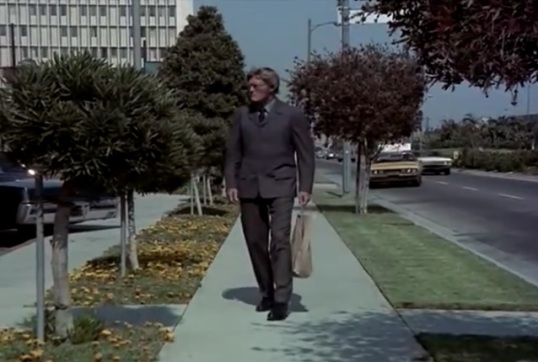
The main problem with the film is that we’re expected to believe that someone who looks like this would be able to walk around Los Angeles and plant bombs without anyone noticing.

That’s nothing against Chuck Conners, who does a good job of portraying William’s frustration with the world.  But still, it’s hard to believe that no one is going to notice a dude who is nearly seven feet tall and who is carrying a ticking shopping bag.

Flaws and all, The Mad Bomber is a watchable and occasionally even an engrossing film.  It’s certainly one Gordon’s better efforts and Gordon does a good job of creating and maintaining a properly ominous atmosphere, even if it sometimes hard to take seriously the sight of Chuck Conners, lumbering around in his suit and trying to discreetly drop off bombs.  In many ways, it’s a film that still feels relevant today. William, like so many. is trying to forcefully stop the world from changing around him.  He’s a man who has lost anything and has decided that it’s the fault of everyone else.  (In many ways, he’s like Rainn Wilson in Super, ragefully reacting to a world is not as simple as he believes it should be.)  The Mad Bomber may not be as much fun as Gordon’s giant monster films but it’s still a film that has something to say.

Film Review: The Black Godfather (dir by John Evans)


The 1974 film, The Black Godfather, opens with two black men attempting to break into the house of a white drug dealer.  Unfortunately, the drug dealer happens to be home.  Both of the men are shot.  One dies in the alley.  The other, J.J. (Rod Perry), is shot in the arm but survives.

J.J. may not have been able to rob the dealer but his bravery impresses Nate Williams (Jimmy Whitherspoon), a powerful neighborhood crime lord.  Nate allows J.J. to hide out at his place and, while J.J. heals, Nate offers up some advice on how to survive on the streets.  J.J. says that he’s only interested in making some “bread,” but Nate thinks that J.J. has what it takes to become one of the top men in his organization.

One opening credits montage later and J.J. has indeed become a powerful man on the streets.  Though he may sell drugs, J.J. is a gangster with a conscience.  As he explains to his old friend, Diablo (Damu King), there’s no way to create change unless you make some money beforehand.  Diablo is a political militant who has no interest in working with J.J. until he discovers that J.J. is planning on running Tony (Don Chastain) out of the neighborhood.  Tony is a white gangster who has made a fortune by destroying black communities with heroin.  Diablo and his followers become J.J.’s enforcers as he wages war against Tony.

Unfortunately, the always pragmatic Nate doesn’t want J.J. to wage war against Tony.  Nate believes that it is important to keep the peace.  That Nate is tying to prevent a war doesn’t matter to Tony, of course.  As soon as Tony finds out that J.J. has been seeing Nate’s daughter, Yvonne (Diane Sommerfeld), he makes his move.

Made at the height of the Blaxploitation era, The Black Godfather‘s title brings to mind memories of Don Corleone, Michael, Sonny, and Tom Hagen.  And it is true that the wise and patient Nate does, in many ways, come across like a black version of Don Corleone.  Nate is pragmatic and cautious almost to a fault.  Just as Don Corleone resisted going to the war with the Tattaglias, Nate resists going to war with Tony.  (And, much like the Tattaglias, Tony proves himself to be unworthy of Nate’s generosity.)  However, J.J. has far more in common with Sonny than with Michael.  Unlike the  calculating and patient Michael, J.J. is in a hurry to prove that he’s the most powerful gangster in the community.  Like Sonny, J.J. doesn’t hesitate before striking back at his enemies.

Unfortunately, despite having an intriguing premise, The Black Godfather is a bit of a chore to sit through.  The story moves slowly and even the scenes of gangster violence feel rather rudimentary.  Rod Perry projects a confident charisma and Jimmy Witherspoon does a good job as the wise Nate but otherwise, the cast is stiff and unconvincing.  It’s a shame.  The mix of crime and militant politics had potential.  Early on, Diablo and J.J. debate whether or not good can come out of bad, with J.J. arguing that money can get a lot more done than idealism.  It’s a debate that’s still relevant today but it’s also an issue that the film abandons fairly quickly.  Based on the film’s title, I had some hope for The Black Godfather but, in the end, it’s just too slow and amateurish to really be memorable.

10 Oscar Snubs From The 2010s


And now, we reach the present day!  A lot has changed over the past few decades but one thing has remained consistent.  No matter how hard the Academy tries, some good movies and performances are always going to get snubbed.  Here are ten snubs from the previous decade.

2011: Shame Is Totally Ignored

Despite being critically acclaimed and receiving nominations from other groups, Steve McQueen’s Shame was totally ignored by the Academy.  My theory is a lot of people looked at Michael Fassbender playing an emotionally detached, self-destructive sex addict and they basically saw aspects of themselves that they didn’t want to acknowledge.  Shame caused too much shame amongst the voters.

2012: The Master Is Not Nominates For Best Picture

When The Master was first released, a lot of people didn’t really know what to make of Paul Thomas Anderson’s barely disguised portrait of Scientology.  The film received only three nominations, for Joaquin Phoenix, Philip Seymour Hoffman, and Amy Adams.  It deserved quite a bit more but, in 2012, I imagine the film’s portrait of a charismatic cult leader taking advantage of his wealthy followers seemed a bit too familiar to some voters.

2013: Tom Hanks Is Not Nominated For Best Actor For Captain Phillips

Looking over today’s list of snubs, a recurring theme seems to be actors who were not nominated because the Academy took them and their talent for granted.  That’s the only possible reason that I can come up with for the Academy to have not nominated Tom Hanks for his outstanding lead performance in Captain Phillips.  Just consider the scene at the end of the film, when the shellshocked and exhausted Captain Phillips is examined by a nurse and he can’t stop talking about the blood on his clothes.  It’s a devastating scene, largely because the audience doesn’t feel as if they’re watching Tom Hanks give a performance.  At that moment, they feel that they are watching a man who has just been through the worst experience of his life and who, even though he is now safe, will be forever haunted by what he has witnessed.

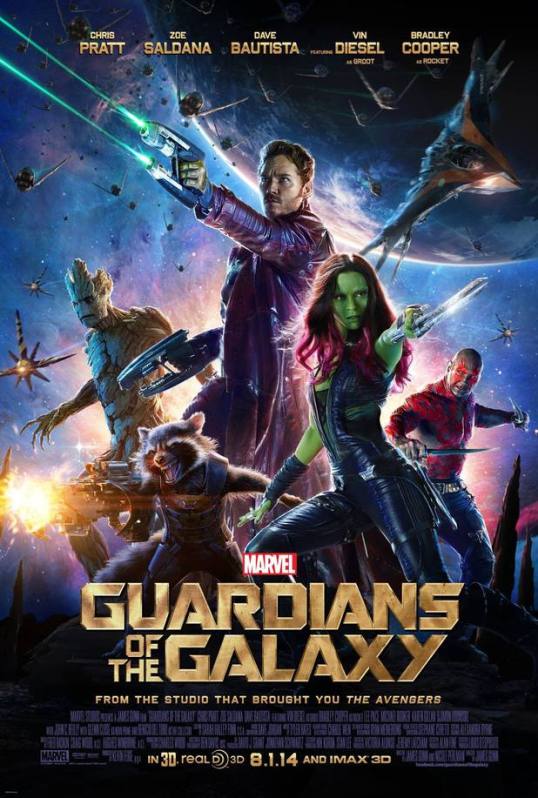
2014: Guardians of the Galaxy Is Not Nominated For Best Picture

Seriously, if any MCU film deserved to be nominated for Best Picture, it was Guardians of the Galaxy.  It was a fun movie with a charismatic cast and, despite what some critics claimed, it actually did have something to say about the importance of tolerance and individual freedom.  It even holds up well to repeat viewings, which is not exactly something that you can say about a few of the other MCU film.

2016: Amy Adams Is Not Nominated For Best Actress For Arrival

Much as they did with Tom Hanks and his performance in Captain Phillips, the Academy took Amy Adams for granted and failed to nominate her for Arrival, despite the fact that it was her best performance to date.  At this point, if I’m Amy Adams, I would be wondering just what it is that I’m going to have to do to finally get my Oscar.

2017: Ethan Hawke Is Not Nominates For Best Actor For First Reformed

This is another snub that I can’t get my head around.  Ethan Hawke has been nominated in the past.  The Academy is obviously not resistant to honoring Ethan Hawke.  So how was it that one of his best performances went unnominated?  For that matter, how is it that First Reformed itself only received one Oscar nomination?

2019: The Souvenir Is Ignored

Despite being one of the best films of the past ten years, The Souvenir was ignored by Academy.  The things that made the film work, like its low-key but honest performances and its refusal to pass easy judgment on its characters, are probably the same things that caused the Academy to overlook it.

2020: The Assistant Is Ignored

This was a powerful film and it featured an award-worthy performance from Julia Garner.  It was also about Harvey Weinstein so I guess I shouldn’t be too shocked that the Academy snubbed it.  The Assistant is a film that probably hit too close to home for many members of the Academy.

2021: Val Is Not Nominated For Best Documentary Feature

Val is one of the most affecting documentaries that I’ve ever seen but the Documentary Branch failed to even give it a nomination.  Maybe, like The Assistant, Val just hit too close to home for some of the voters.

2021: Mass Is Ignored

Again, I will never understand how the Academy can fail to give even one nomination to a film as good as Mass.  As with The Souvenir, I can only guess that the Academy did not know how to react to Mass’s honest approach to its subject matter.  Mass worked because it avoided easy judgments and solutions.  That’s probably the same thing that led to the Academy ignoring both the film and its outstanding cast.

Agree?  Disagree?  Do you have any bigger Oscar snub that you’d like to mention?  Let us know in the comments!

And now, get ready to enjoy the show!  And, if you don’t care about the Oscars, fear not!  My review of The Black Godfather will be posting in an hour.

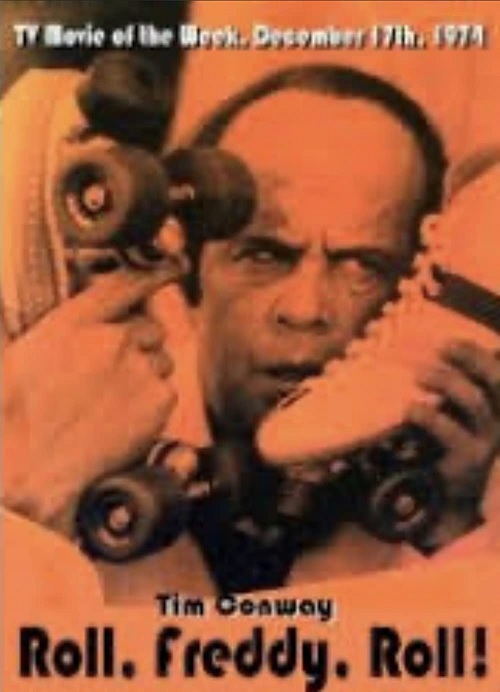
Retro Television Review: Roll, Freddy, Roll (Dir by Bill Persky)


Welcome to Retro Television Reviews, a feature where we review some of our favorite and least favorite shows of the past!  On Sundays, I will be reviewing the made-for-television movies that used to be a primetime mainstay.  Today’s film is 1974’s Roll, Freddy, Roll!  It  can be viewed on YouTube!

Poor Freddy Menlo!

Played by Tim Conway, Freddy is a well-meaning guy who gets absolutely zero respect from the rest of the world.  He works as a computer programmer but his boss (Henry Jones) doesn’t think much of him and an attempt to score a contract with the U.S. Navy falls through when Admiral Norton (Scott Brady) announces that he doesn’t think much of computers.  Meanwhile, his ex-wife (Ruta Lee) has fallen in love with and married “Big Sid” Kane (Jan Murray).  Big Sid is a millionaire who made his fortune selling used cars.  Big Sid is seen every day on television.  And, due to catching the biggest bluefish tuna on record while on his honeymoon, Big Sid Kane is now in the Guinness Book of the World Records.

A lesser engineer would crack under the pressure and go on a rampage through Los Angeles, Falling Down-style.  But Freddy just wants to be a good father.  He just wants his son, Tommy (Moosie Drier), to look up to him the way that he now looks up to Big Sid.  Freddy takes Tommy to a roller skating rink and awkwardly skates around while Tommy talks about how much he enjoys going to Big Sid’s car lot.  When it’s time to leave the rink, Freddy is informed that his shoes have been lost.  An angry Freddy refuses to return the rink’s skates until he gets back his shoes.  Freddy then takes Tommy down to Big Sid’s used car lot, where Big Sid has invited other people to come and try to set world records of their own.  A local news reporter sees that Freddy is on roller skates and announces that Freddy is seeking to set the world record for the most time spent rolling around!  Finally, Freddy has found a way to impress his son!

Excuse me while I catch my breath.  That was a lot of plot to cram into just two paragraphs.

Roll, Freddy, Roll is not a particularly complicated movie.  For the most part, it exists solely so that Tim Conway can do some mild physical comedy while trying to balance himself on roller skates.  It only has a 73-minute run time and it basically feels like an extended episode of an old sitcom.  With all that in mind, it still seems like it takes forever to actually get Freddy into those roller skates and once he does put them on, the movie keeps up coming with implausible excuses to keep him from taking them off until he finally decides to go for the world record.  The story would have been stronger if Freddy has been the one to look at his feet and say, “I’m going to set a world record,” as opposed to him just being bullied into it by a news reporter.  Tim Conway’s likable but there’s only so many times you can watch someone fall on roller skates before the joke starts to wear thin.

It would not surprise me if Roll, Freddy, Roll was meant to be a pilot for a sitcom.  It’s easy to imagine Tim Conway trying to impress his son and win back his wife by doing something stupid on a weekly basis.  As far as I know, Roll, Freddy, Roll did not lead to a television series and that’s probably a good thing.  Freddy had a hard enough time just rolling around Los Angeles for two days!  Who knows what would have happened if he had tried to do it on a weekly basis!?

10 Oscar Snubs From The 2000s


Welcome to the aughts. The new century started out with the terror of 9-11 and it ended with the collapse of the world’s economy. In between, a lot of films were released. Some of them were really good. A few of them were nominated for Best Picture. Most of them were not.  As always, there were snubs aplenty.

2000: Michael Douglas Is Not Nominated For Wonder Boys

I recently saw someone online bemoaning the fact that Michael Douglas appears to be fated to end his career as a supporting character in the MCU as opposed to playing the type of “mature” roles with which he made his reputation.  And I actually think that person had a good point.  Michael Douglas, whose performances once epitomized the last few decades of the 20th Century, does seem a bit out of place surrounded by CGI and responding to the overly quippy dialogue of the MCU.  If you want to see a truly good Michael Douglas performance that doesn’t involve anyone shrinking, check him out in Curtis Hanson’s Wonder Boys.  Though Wonder Boys won the Oscar for Best Original Song and picked up nominations for Editing and Adapted Screenplay, Michael Douglas’s wonderful lead performance was overlooked.

2001: Mulholland Drive Is Almost Totally Ignored

Considering the reverence with which it is now viewed, it’s interesting to note that Mulholland Drive only received one Oscar nomination, for David Lynch’s direction.  The film was not nominated for Best Picture.  Naomi Watts and Laura Harring both went unnominated.  At the time, I imagine the film was too strange for Academy voters and its origin as a television pilot probably worked against it.  Today, it is regularly cited as one of the best films ever made.

2002: Leonardo DiCaprio and Tom Hanks Are Not Nominated For Catch Me If You Can

Catch Me If You Can was that rarest of movies, an underrated Steven Spielberg production.  Christopher Walken was nominated for Best Supporting Actor and the film’s score was nominated as well.  But both Leonard DiCaprio and Tom Hanks went unnominated, despite doing some of the best work of their careers.

2002: Robin Williams Is Not Nominated For One Hour Photo

One Hour Photo featured what I consider to be Robin Williams’s best and most poignant performance.  It was also perhaps his most frightening performance, which probably explains why the Academy shied away from honoring it.

2003: Scarlet Johansson Is Not Nominated For Best Actress For Lost In Translation

Though Bill Murray got most of the awards attention, Scarlet Johansson’s performance was just as important to the success of Lost In Translation.

2004: Eternal Sunshine of the Spotless Mind Is Not Nominated For Best Picture or Best Actor

Even before he decided to present himself as being an expert on vaccines and modern art, I wasn’t a huge fan of Jim Carrey’s.  That said, even I have to admit that he deserved a nomination for Eternal Sunshine of the Spotless Mind.  The film itself was only nominated for two Oscars.  Kate Winslet was nominated for Best Actress and Charlie Kaufman won the Oscar for Original Screenplay.  The film deserved quite a bit more.

2007: Once Is Not Nominated For Best Picture

This is one snub that I haven’t quite gotten over.  Once, a beautiful independent film from Ireland, deserved far more love than it received from the Academy.  That said, it did win the Oscar for Best Original Song and Glen Hansard gave one of the best acceptance speeches in Oscar history.  So, there is a little justice.

2008: The Dark Knight Is Not Nominated For Best Picture

If ever there was a comic book movie that deserved to be nominated for Best Picture, it was this one. To me, I think the main reason why The Dark Knight is superior to so many other comic book movies is because, even with Batman and the Joker running around, it still feels as if it’s taking place in the real world.  The smartest decision that Christopher Nolan made was to use a real city for Gotham instead of constructing a phony-looking set.  The fact that The Dark Knight received 8 nominations without also receiving a nomination for Best Picture leaves little doubt that the film’s lack of a nomination was due to its origins as a comic book movie.  There was such an uproar about The Dark Knight failing to pick up a Best Picture nomination that the Academy increased the number of Best Picture nominees to ten.  (Of course, that’s didn’t do much to help anything.)

2008: Robert Downey, Jr. Is Not Nominated For Best Actor For Iron Man

The MCU is now so big that it’s easy to forget that, if Robert Downey, Jr. hadn’t been a convincing Tony Stark in 2008, the whole thing would have never happened.  Going back and watching the early MCU films, before they got bogged down in their own formula, can be an eye-opening experience.  Downey’s performance in the first Iron Man holds up extremely well.  He goes from being an irresponsible businessman to being a hero and he’s convincing at every turn.  He gave such a good performance that it convinced even those of us who weren’t comic book readers to stick around and see what was coming up next in the Marvel Cinematic Universe.

2009: George Wyner Is Not Nominated For Best Supporting Actor For A Serious Man

Not all snubs involve big stars or famous actors.  Some of them involve talented character actors like George Wyner who totally knock their one scene out of the park but who still don’t get the recognition that they deserve.  In A Serious Man, Wyner plays the rabbi who tells Larry Gopnik (Michael Stuhlbarg) the parable of the dentist who found Hebrew phrases on the teeth of one of his patients.  It’s a mesmerizing scene, thanks to George Wyner’s skill as a storyteller.

Agree?  Disagree?  Have a snub of your own that you’d like to mention?  Let us know in the comments!

Coming up next, we go from the 2010s to the present day!

10 Oscar Snubs From the 1990s


Ah, the 90s. Some would say that this was the last good decade that the world would ever experience. It was certainly a good decade for films!  Still, there were some notable Oscar snubs during this decade.  Here are ten of them.

1990: Ray Liotta Is Not Nominated For Goodfellas

The fact that Ray Liotta did not even receive a nomination for playing Henry Hill in Goodfellas will always astound me.  While the film did receive several nominations (and really, it should have won the majority of them), Ray Liotta was snubbed despite the fact that it was his performance that pretty much held the film together.  Alec Baldwin, Tom Cruise, and Val Kilmer were among those who were considered for the role before Liotta received it.  They’re all fine actors but it’s hard to imagine any of them bringing Henry to life quite as well as Ray Liotta.

1991: John Goodman is Not Nominated for Barton Fink

“I WILL SHOW YOU THE LIFE OF THE MIND!”

It’s a little bit amazing that John Goodman has never received an Oscar nomination.  I don’t think he’s ever been scarier (and, in his way, more poignant) than when he played Charley “Mad Man Mundt” Meadows in Barton Fink.

1993: The Age of Innocence Is Not Nominated For Best Picture

While we’re on the subject of Scorsese films that were snubbed by the Academy, it’s amazing to me that Scorsese’s witty, smart, and visually stunning adaptation of The Age of Innocence did not receive a Best Picture nomination.

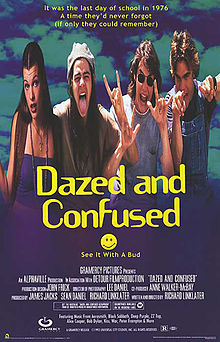
1993: Dazed and Confused Is Completely Snubbed

Okay, maybe this one isn’t as surprising as the Academy snubbing as Scorsese picture.  Even today, it’s doubtful that the Academy would embrace a film about a bunch of stoned Texas high school kids.  Still, it bothers me that Dazed and Confused received not a single nomination.  It’s certainly better remembered than many of the films that were nominated that year.

1995: Heat Is Completely Ignored

Considering that the film is now regularly cited as one of the best crime films ever made, it’s interesting to note that the Academy totally ignored Heat.  The film received no acting nominations.  Michael Mann was not nominated for his skill in juggling several different storylines.  The film didn’t even receive any technical nominations.  The cinematography was ignored.  You would think that the massive shoot-out would have gotten the film a nomination for Best Sound Editing but, even in that category, Heat was ignored.

Needless to say, Heat was not nominated for Best Picture.  The 1995 Best Picture line-up has always seemed like an odd mix of films, with Babe, Apollo 13, Sense and Sensibility, and Il Postino all losing out to Mel Gibson’s Braveheart.  Apollo 13 and Sense and Sensibility didn’t even receive nominations for their directors, Ron Howard and Ang Lee.  It was an odd year, I guess.  Heat was not the only acclaimed film to miss out on a Best Picture nomination but at least Casino, Leaving Las Vegas, and Dead Man Walking still received nominations in other categories.  Heat was totally snubbed.

1996: Steve Buscemi Is Not Nominated For Fargo

Despite being a cultural institution, Steve Buscemi has never received an Oscar nomination.  I would have nominated him for Fargo.

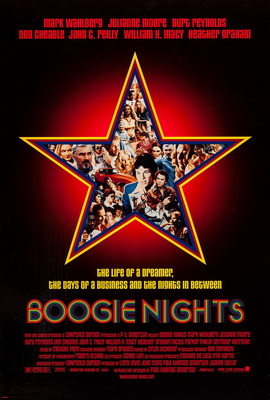
1997: Boogie Nights Is Not Nominated For Best Picture, Best Director, or Best Actor

Despite receiving two acting nominations for Burt Reynolds and Julianne Moore and a screenplay nomination, Boogie Nights missed out on the big award.  To be honest, I have a feeling that the film would have been nominated if it had been released today.  But, in the year of Titanic, the Academy may not have been ready to embrace a film about the Golden Age of Porn.  And they certainly weren’t ready to embrace Mark Wahlberg, despite his award-worthy performance of The Touch.  Given a choice, the Academy will always embrace the James Camerons of the world before it embraces the Jack Horners.  That said, as we saw in the film, Dirk and Angels Live In My Town swept the AFAA awaards and that’s the important things.

1997: Billy Zane Is Not Nominated For Titanic

C’mon, he was the best thing about the movie!  If Billy Zane can’t receive a nomination for shouting, “I hope you’ll be very happy together!” while chasing Leo and Kate through a sinking ship, what is the point of even having the Oscars?

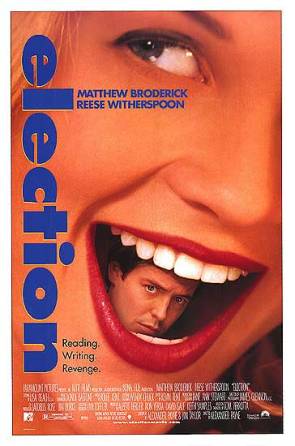
1999: Reese Witherspoon Is Not Nominated For Best Actress For Election

Reese Witherspoon’s performance as Tracey Flick is iconic precisely because it feels so real.  Everyone has known as Tracey Flick.  Everyone has been annoyed by a Tracey Flick.  Everyone has hoped for a Tracey Flick to fail.  And everyone has inwardly lost a little faith in karma as the Tracey Flicks of the world have continued to find work as mid-level bureaucrats.  In fact, I imagine that might be the reason why Reese Witherspoon was not nominated for her outstanding performance in Election.  No one wanted to reward Tracey Flick.

1999: Bruce Willis Is Not Nominated For Best Actor For The Sixth Sense

Seriously, everyone really took him for granted.  Just try to imagine The Sixth Sense with someone else in his role.

Agree?  Disagree?  Do you have an Oscar snub that you think is even worse than the 10 listed here?  Let us know in the comments!

Up next: A new century brings new snubs!