Lisa Marie Reviews An Oscar Nominee: The Thin Red Line (dir by Terrence Malick)


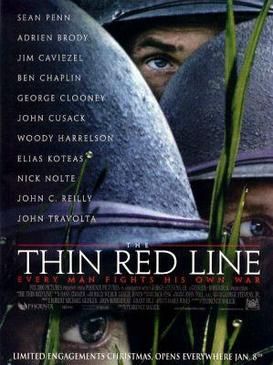
Based on a novel by James Jones (and technically, a sequel of sorts to From Here To Eternity), 1998’s The Thin Red Line is one of those Best Picture nominees that people seem to either love or hate.

Those who love it point out that the film is visually stunning and that director Terrence Malick takes a unique approach to portraying both the Battle of Guadalcanal and war in general.  Whereas Steven Spielberg’s Saving Private Ryan told a rather traditional story about the tragedy of war (albeit with much more blood than previous World War II films), The Thin Red Line used the war as a way to consider the innocence of nature and the corrupting influence of mankind.  “It’s all about property,” one shell-shocked soldier shouts in the middle of a battle and later, as soldiers die in the tall green grass of the film’s island setting, a baby bird hatches out of an egg.  Malick’s film may have been an adaptation of James Jones’s novel but its concerns were all pure Malick, right down to the philosophical voice-overs that were heard throughout the film.

Those who dislike the film point out that it moves at a very deliberate pace and that we don’t really learn much about the characters that the film follows.  In fact, with everyone wearing helmets and running through the overgrown grass, it’s often difficult to tell who is who.  (One gets the feeling that deliberate on Malick’s point.)  They complain that the story is difficult to follow.  They point out that the parade of star cameos can be distracting.  And they also complain that infantrymen who are constantly having to look out for enemy snipers would not necessarily be having an inner debate about the spirituality of nature.

I will agree that the cameos can be distracting.  John Cusack, for example, pops up out of nowhere, plays a major role for a few minutes, and then vanishes from the film.  The sight of John Travolta playing an admiral is also a bit distracting, if just because Travolta’s mustache makes him look a bit goofy.  George Clooney appears towards the end of the film and delivers a somewhat patronizing lecture to the men under his command.  Though his role was apparently meant to be much larger, Adrien Brody ends up two lines of dialogue and eleven minutes of screentime in the film’s final cut.

That said, The Thin Red Line works for me.  The film is not meant to be a traditional war film and it’s not necessarily meant to be a realistic recreation of the Battle of Guadalcanal.  Instead, it’s a film that plays out like a dream and, when viewed a dream, the philosophical voice overs and the scenes of eerie beauty all make sense.  Like the majority of Malick’s films, The Thin Red Line is ultimately a visual poem.  The plot is far less important than how the film is put together.  It’s a film that immerses you in its world.  Even the seeming randomness of the film’s battles and deaths fits together in a definite patten.  It’s a Malick film.  It’s not for everyone but those who are attuned to Malick’s wavelength will appreciate it even if they don’t understand it.

And while Malick does definitely put an emphasis on the visuals, he still gets some good performances out of his cast.  Nick Nolte is chilling as the frustrated officer who has no hesitation about ordering his men to go on a suicide mission.  Elias Koteas is genuinely moving as the captain whose military career is ultimately sabotaged by his kind nature.  Sean Penn is surprisingly convincing as a cynical sergeant while Jim Caviezel (playing the closest thing the film has to a main character) gets a head start on humanizing messianic characters by playing the most philosophical of the soldiers.  Ben Chaplin spends most of his time worrying about his wife back home and his fantasies give us a glimpse of what’s going on in America while its soldiers fight and die overseas.

The Thin Red Line was the first of Terrence Malick’s films to be nominated for Best Picture and it was one of three World War II films to be nominated that year.  However, it lost to Shakespeare In Love.
Film Review: Tucker: The Man and His Dream (by Francis Ford Coppola)


First released in 1988, Tucker: The Man and His Dream is a biopic about Preston Tucker.

Tucker was an engineer in Detroit who went from designing vehicles for the Army during World War II to trying to launch his own car company.  His ideas for an automobile don’t sound particularly radical today.  He wanted every car to have seat belts.  He wanted a windshield that popped out as a safety precaution.  He want brake pads and he also wanted a car that looked sleek and aerodynamic, as opposed to the old boxy cars that were being pushed out be Detroit.  He wanted a car that got good mileage and he wanted one that could be taken just about anywhere.  Unfortunately, Tucker’s dreams were cut short when he was indicted for stock fraud, a prosecution that most people agree was a frame-up on behalf of the Big Three auto makers.  Tucker was eventually acquitted but his car company went out of business.  Of the 50 cars that Tucker did produce, 48 of them were still on the road and being driven forty years later.

The film stars Jeff Bridges as Preston Tucker, Joan Allen as his wife, Christian Slater and Corin Nemec as two of his sons, Lloyd Bridges as the senator who tried to take Tucker down, Martin Landau as Tucker’s business partner, and Dean Stockwell as Howard Hughes, who shows up for a few minutes to encourage Tucker to follow his dreams regardless of how much the government tries to stop him.  One gets the feeling that the film was a personal one for director Francis Ford Coppola, a filmmaker who has pretty much spent his entire career fighting with studios while trying to bring his vision to the screen.  Tucker fought for seat belts.  Coppola fought for a mix of color and black-and-white in Rumble Fish.  Tucker stood up for his business partner.  Francis Ford Coppola stood up for Al Pacino when no one else could envision him as Michael Corleone.  As is the case with many of Coppola’s films, Tucker: The Man And His Dream is a film that Coppola spent years trying to get made.  It was the film that Coppola originally intended to be the follow-up to The Godfather, with Marlon Brando projected for the lead role of Tucker.  After watching the Tucker, it’s hard not to feel that it worked out for the best that Coppola was not able to make the film in 1973.  It’s impossible to imagine anyone other than Jeff Bridges in the role of Preston Tucker.

“Chase that tiger….chase that tiger….chase that tiger….” It’s a song that Tucker sings constantly throughout the film as the camera spins around him and how you react to Tucker: The Man And His Dream will largely depend on how tolerant you are of Coppola’s stylistic flourishes.  Coppola directs the film as a combination of Disney fairy tale and film noir.  The opening of the film, with Tucker running around in almost a manic state and excitedly telling everyone about his plans, is presented with vibrant colors and frequent smiles and an almost overwhelming air of cheerful optimism.  As the film progresses and Tucker finds himself being targeted by both the government and the other auto companies, the film gets darker and the viewer starts to notice more and more shadows in the background.  The moments of humor become less and less and there’s a heart-breaking moment where Martin Landau, in one of his best performances, reveals just how far the government will go to take down Tucker’s company.  But, in the end, Tucker refuses to surrender and Jeff Bridges’s charming smile continues to fill the viewer with hope.  The film becomes about more than just cars.  It’s a film that celebrates all of the innovators who are willing to defy the establishment.

There’s a tendency to dismiss the majority of Coppola’s post-Apocalypse Now films.  However, Tucker: The Man And His Dream is a later Coppola film that deserves to be remembered.

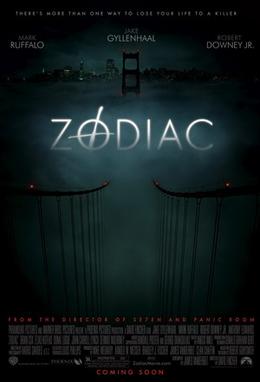
October True Crime: Zodiac (dir by David Fincher)


Who was the Zodiac Killer?

That is a question that has haunted journalists, cops, and true crime fans since the late 60s.  It is known that the Zodiac Killer murdered at least five people in Northern California in 1968 and 1969.  He targeted young couples, though he is also thought to have murdered on taxi driver as well.  What set Zodiac apart from other killers is that he was a prolific letter writer, who sent cards and ciphers to the police and the journalists who were reporting on his crimes.  In one of his ciphers, Zodiac claimed that he had killed 37 people.  Cartoonist Robert Graysmith later wrote two books about his personal obsession with the case.  He estimated that the Zodiac may have been responsible for hundred of murders, up through the 80s.  Of course, reading Graysmith’s first Zodiac book, it’s also easy to suspect that Graysmith reached a point where he saw the Zodiac’s hand in every unsolved murder in the San Francisco area.  Of all the unidentified serial killers in American history, Zodiac is one that most haunts us.  Zodiac was a serial killer who operated in an era when such things were still considered to be uncommon.  Much as Jack the Ripper did during the Victorian Age, Zodiac announced the arrival of a new age of evil.

Zodiac wrote about being a film fan and he was probably happy about the fact that he inspired quite a few films.  1971’s The Zodiac Killer came out while Zodiac was still sending letters to the police and cops actually staked out the theaters showing the film just to see if he  would show up.  Dirty Harry‘s Scorpio Killer was also based on Zodiac, right down to the taunting letters that he sent the mayor and again, one has to wonder if Zodiac ever showed up to watch Clint Eastwood take him down.

And, if Zodiac survived into the 21st Century, one has to wonder if he showed up in the theaters for 2007’s Zodiac.

One of the best true crime films ever made, Zodiac not only recreates the crimes of the Zodiac but it also examines the mental price of obsessing over the one unknown force of evil.  Mark Ruffalo plays Dave Toschi, the celebrity cop who nearly sacrificed his professional reputation in his search for the identity of the killer.  Jake Gyllenhaal plays cartoonist Robert Graysmith, who spends over a decade searching for the Zodiac’s identity and who loses his wife (Chloe Sevigny) in the process.  And Robert Downey, Jr. plays Paul Avery, the crime reporter to whom the Zodiac wrote and who sunk into paranoia and addiction as a result.  This is a film that is less about the Zodiac’s crime and more about how this unknown killer seemed to unleash a darkness that would come to envelope first a city and eventually an entire nation.

As one might expect from a film directed by David Fincher, Zodiac plays out like a filmed nightmare with the starkly portrayed murders being all the more disturbing because they often take place outside, where people would think they would be safe.  (The second murder is especially terrifying, as it plays out without even the sound of background music to allow us the escape of remembering that it’s only a movie.)  Fincher heightens our paranoia but having a different actor play the killer in each scene, reminding us that the Zodiac could literally be anyone.  Indeed, one of the scarier things about Zodiac is that, in the course of his investigation, Graysmith meets so many different people who seem like they could be the killer.  Even if they aren’t the Zodiac, the viewer is left with the feeling that the world is full of people who are capable of committing the same crimes.  The film becomes a journey into the heart of darkness, with the Zodiac becoming both a malevolent force and potentially your next door neighbor.  And with the film’s detailed recreation of the 60s and the 70s, the film becomes a portrait of a country on the verge of changing forever with the Zodaic and his crimes representing all the fear waiting in the future.

Again, as one might expect from a Fincher film, it’s a well-acted film, especially by Robert Downey, Jr.  Zodiac came out a year before Iron Man, when Downey was still better known for his personal troubles than for his talent.  Downey perfect captures his character’s descent into self-destruction, as he goes from being cocky and self-assured to being so paranoid that he’s carrying a gun.  (Paul Avery’s actual colleagues have disputed the film’s portrayal of Avery being mentally destroyed by the Zodiac.)  Ruffalo and Gyllenhaal also do a good job of portraying Toschi and Graysmith’s growing obsession with the case while Charles Fleischer and John Carroll Lynch both make strong (and creepy) impressions as two men who might (or might not) be the killer.

Though the film was not a success at the box office and it was totally ignored by the Academy, Zodiac has built up a strong reputation in the years since its released.  It’s inspired a whole new generation of web sleuths to search for the killer’s identity.  Personally, my favored suspect is Robert Ivan Nichols, an enigmatic engineer who abandoned his former life and changed his name to Joseph Newton Chandler III in the 70s and who committed suicide in 2002.  I think much like Jack the Ripper, the Zodiac’s identity will never be definitely known.  There have been many compelling suspects but most of the evidence seems to be circumstantial.  (That’s certainly the case when it comes to Nichols.)  The Zodiac was thought to be in his 30s or even his early 40s in 1969 so it’s doubtful that he’s still alive today.  In all probability, his identity and his motive will forever remain an unsolvable mystery.

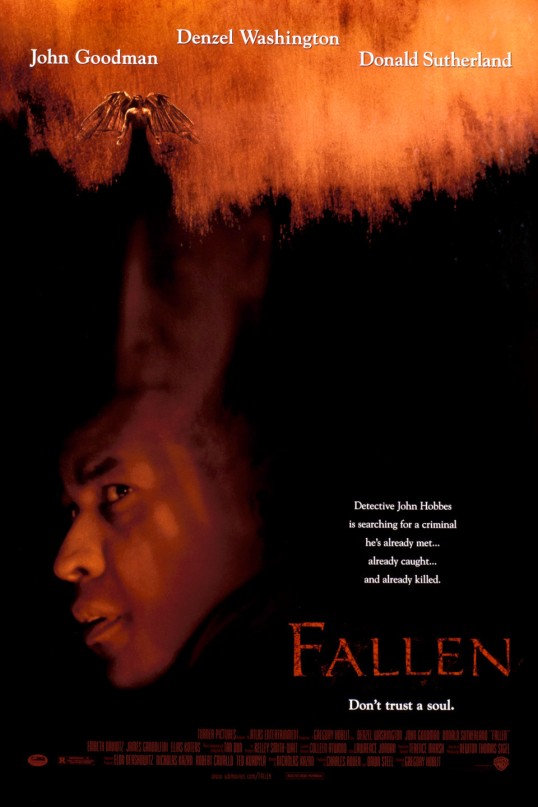
Horror Film Review: Fallen (dir by Gregory Hobilt)


“Time is on my side….” sings an ancient Sumerian demon, who is apparently a huge fan of the Rolling Stones.

“Do you like cream?” asks a possibly crooked detective who is played by a slightly less heavy than usual James Gandolfini.

Donald Sutherland walks through a shadowy police station and flashes his big smile.

A detective played by John Goodman talks on the phone and makes cheery jokes while investigating a brutal murder.

A demon jumps from person to person, possessing everyone for a matter of seconds, just so he can freak out one specific person.

“Beware my wrath,” a white-haired businessman says to Denzel Washington.

There’s no way to deny it.  1998’s Fallen is a film that’s full of strange moments.  Some of it works and some of its doesn’t but it’s never boring.  Denzel Washington plays John Hobbes, a Philadelphia detective who has achieved a small amount of fame as the result of capturing serial killer Edgar Reese (Elias Koteas).  Reese asks to see Hobbes before he’s executed and it turns out that, for a man about to pay the ultimate price for his crimes, he’s in a surprisingly good mood.  Before he goes in the gas chamber, Reese chants something in Aramaic.

Soon, new murders are being committed in Phladelphia.  Hobbes and his partner, Jonesey (John Goodman at his most Goodmanesque), suspect that the killer is a copycat, trying to capture some of Reese’s notoriety for himself.  Gretta Milano (Embeth Davidtz), the daughter of a detective who committed suicide after being accused of committing a series of murders, tells Hobbes that the new killings are actually being committed by a demon named Azazel.  Azazel can jump from body to body and can compel people to do terrible things.  Gretta asks Hobbes if he belives in God.  Hobbes says it’s hard to have faith when you deal with murder every day, a somewhat clichéd line that Washington makes work through the absolute conviction of his delivery,

Denzel Washington is the key to this film’s success.  Sure, there’s a lot of murders and a lot of twists and a lot of possessions and there’s a lot of scenes that are shot from the point of view of the demon but, in the end, Fallen works because Washington is absolutely convincing as a man who is facing an evil that is beyond human understanding.  Washington gives a very naturalistic and grounded performance, one that keeps an element of reality in Fallen regardless of how messy the story may get.  When it becomes apparent that the demon is going to try to harm his brother and his nephew, Washington’s fury feels real.  When Hobbes discovers that the demon has gotten to one of them, Washington’s underplayed reaction makes the scene even more poignant and painful.  It’s hard to imagine Fallen being anywhere near as effective with an actor other than Denzel Washington in the lead role.

Fallen is a twisty movie.  The demon moves quickly and it always seems to have a backup plan.  He manipulates Hobbes into doing some things that are so terrible that you’re not sure that Hobbes is every going to recover, even if he does somehow manage to defeat Azazel.  Hobbes and Azazel are worthy adversaries and, as a result, the film gets away with a lot of stuff that wouldn’t otherwise work.  Even the use of Time Is On My Side pays off, as the one character who you don’t want to hear sing the song suddenly starts doing a Mick Jagger impersonation and you’re just like, “Oh no, what’s going to happen now?”  The film’s high point is a lengthy sequence where Hobbes stands on a busy street and watches as Azazel jumps from body to body.  Everyone who passes Hobbe gives him a death glare.  It’s a frightening moment, one in which Fallen captures the intensity of a nightmare.

I watched Fallen earlier today.  I can’t really say that I was expecting much from it but I was surprised.  It’s actually one of the better horror films that I’ve watched for the first time this month.  It’s big and strange and creepy and it’s got Denzel Washington doing what he does best.  What more could you ask for?

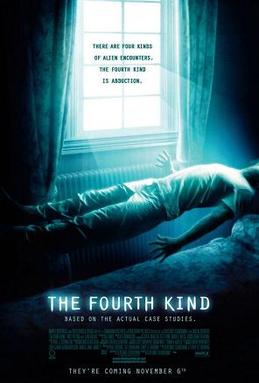
Horror Film Review: The Fourth Kind (dir by Olatunde Osunsanmi)


“I’m actress Milla Jovovich, and I will be portraying Dr. Abigail Tyler in The Fourth Kind. This film is a dramatization of events that occurred October 1st through the 9th of 2000, in the Northern Alaskan town of Nome. To better explain the events of this story, the director has included actual archived footage throughout the film. This footage was acquired from Nome psychologist Dr. Abigail Tyler, who has personally documented over 65 hours of video and audio materials during the time of the incidents. To better protect their privacy, we have changed the names and professions of many of the people involved. Every dramatized scene in this movie is supported by either archived audio, video or as it was related by Dr. Tyler during extensive interviews with the director. In the end, what you believe is yours to decide. Please be advised, that some of what you’re about to see is extremely disturbing.”

And so began the 2009 film, The Fourth Kind!  Milla Jovovich plays Dr. Abbey Tyler, who is still emotionally devastated by the murder of her husband and who finds herself interviewing a lot of potential UFO abductees in Nome, Alaska.  You may remember that, when this film came out, there was a lot of online debate over whether or not it was based on a true story.  That’s because the film was advertised as containing actual “documentary footage” of Dr. Tyler talking to hypnotized alien abductees.  Often times, during the film, a split screen was used so you could watch the “original” Dr. Tyler interviewing a patient while, at the same time, Milla Jovovich and an actor “recreated” the scene for the film.

Of course, the really interesting question here isn’t whether or not the documentary footage was real.  Instead, to me, the real mystery of the film is why, if you had all of this amazing footage of real people freaking out under hypnosis, would you then make a movie starring Milla Jovovich, Will Patton, and Elias Koteas?  It seems like a better idea would be to just make a documentary and save a lot of money on paying the cast.

Anyway, as you probably already guesses, the documentary footage was faked as well and there is no Dr. Abigail Tyler.  Still, you have to admire the amount of effort that director Olatunde Osunsanmi put into trying to convince us that we were watching something based on a true story.  I mean, he went far beyond just using the whole shaky cam stuff that most found footage horror movies fall back on.  Wisely, Onsunsanmi made sure that none of the actors in the found footage were more attractive than the actors in the movie that was supposedly based upon it.  Anyone who has seen enough “based on a true story” movies knows that the real people never look as good as the people hired to play them.  I mean, honestly, this is a gimmick that Orson Welles would probably have appreciated.  That said, Welles probably would have gotten better performances out of the actors in his fake documentary.  When Milla Jovovovich is more convincing as a psychologist than the woman who were told actually is a psychologist, it’s a problem.

As for the film itself, it has a few effective jump scares.  There’s a lot of people yelling in strange voices and, when Abbey’s daughter vanishes, Milla Jovovich does a good enough job communicating the anguish that any mother would feel if her child was abducted by aliens.  Dependable actors like Will Patton and Elias Koteas show up and do what they can with underwritten roles.  The Fourth Kind isn’t a bad movie but its storyline and characters are never as interesting as its gimmick.  It’s the type of horror film that might make you jump while you’re watching but, a week later, all you’ll remember is Milla Jovovich introducing herself.


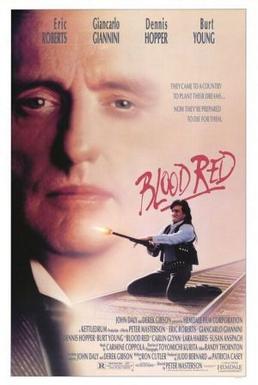
Film Review: Blood Red (1989, directed by Peter Masterson)


The time is the 1890s.  The place is California.  Sicilian immigrant Sebastian Collogero (Giancarlo Giannini) has just been sworn in as an American citizen and owns his own vineyard.  When Irish immigrant William Bradford Berrigan (Dennis Hopper) demands that Sebastian give up his land so Berrigan run a railroad through it, Sebastian refuses.  Berrigan hires a group of thugs led by Andrews (Burt Young) to make Sebastian see the error of his ways.  When Sebastian ends up dead, his wayward son, Marco (Eric Roberts), takes up arms and seeks revenge.
Have you ever wondered what would have happened if the famously self-indulgent directors Michael Cimino and Francis Ford Coppola teamed up to make a movie about the American Dream?  The end result would probably be something like Blood Red.  Like Cimino’s The Deer Hunter and Heaven’s Gate, Blood Red begins with a lengthy celebration (in this case, in honor of Sebastian’s naturalization ceremony) that doesn’t have much to do with the rest of the film but which is included just to make sure we know that what we’re about to see is more than just a mere genre piece.  Like many of Coppola’s films, Blood Red features a tight-knit family, flowing wine, and a score composed by Carmine Coppola.  The only difference between our hypothetical Cimino/Coppola collaboration and Blood Red is that the Cimino/Coppola film would probably be longer and more interesting than Blood Red.  Blood Red is only 80 minutes long and directed by Peter Masterson, who seems lost.  There’s a potentially interesting story here about two different immigrants fighting to determine the future of America but it gets lost in all of the shots of Eric Roberts flexing his muscles.

For an actor known for his demented energy, Eric Roberts is surprisingly dull as the lead but Blood Red is a film that even manages to make veteran scenery chewers like Dennis Hopper and Burt Young seem boring.  (Hopper’s bizarre attempt at an Irish brogue does occasionally liven things up.)  The cast is full of familiar faces like Michael Madsen, Aldo Ray, Marc Lawrence, and Elias Koteas but none of them get to do much.  Of course, the most familiar face of all belongs to Eric’s sister, Julia.  Julia Roberts made her film debut playing Marco’s sister, Maria.  (Because the film sat on the shelf for three years after production was completed, Blood Red wasn’t released until after Julia has subsequently appeared in Mystic Pizza and Satisfaction.)  She gets three lines and less than five minutes of screen time but she does get to briefly show off the smile that would later make her famous.  Today, of course, that smile is the only reason anyone remembers Blood Red.

Embracing the Melodrama Part II #119: Shutter Island (dir by Martin Scorsese)


Shutter IslandThe 2010 film Shutter Island finds the great director Martin Scorsese at his most playful.

Taking place in 1954, Shutter Island tells the story of two detectives, Teddy Daniels (Leonardo DiCaprio, giving an excellent performance that, in many ways, feels like a test run for his role in Inception) and Chuck Aule (Mark Ruffalo, also excellent), who take a boat out to the Ashecliffe Hospital for The Criminal Insane, which is located on Shutter Island in Boston Harbor.  They are investigating the disappearance of inmate Rachel Solando, who has been incarcerated for drowning her three children.

Ashecliffe is one of those permanently gray locations, the type of place where the lights always seem to be burned out and the inmates move about like ghostly visions of sins brought to life.  It’s the type of place that, had this movie been made in the 50s or 60s, would have been run by either Vincent Price or Peter Cushing.  In this case, the Cushing role of the cold and imperious lead psychiatrist is taken by Ben Kingsley.  Max Von Sydow, meanwhile, plays a more flamboyantly sinister doctor, the role that would have been played by Vincent Price.

When a storm strands Teddy and Chuck on the island, they quickly discover that neither the staff nor the patients are willing to be of any help when it comes to tracking down Rachel.  As Teddy continues to investigate, he finds himself stricken by migraines and haunted by disturbing images.  He continually sees a mysterious little girl.  He has visions of his dead wife (Michelle Williams).  A horribly scarred patient in solitary confinement (Jackie Earle Haley) tells him that patients are regularly taken to a lighthouse where they are lobotomized.  When Teddy explores more of the island, he comes across a mysterious woman living in a cave and she tells him of even more sinister activity at Ashecliffe.  Meanwhile, Chuck alternates between pragmatic skepticism and flights of paranoia.

And I’m not going to share anymore of the plot because it would be a crime to spoil Shutter Island.  This is a film that you must see and experience for yourself.

This is one of Martin Scorsese’s most entertaining films, an unapologetic celebration of B-movie history. He knows that he’s telling a faintly ludicrous story here and, wisely, he embraces the melodrama.  Too many directors would try to bring some sort of credibility to Shutter Island by downplaying the film’s more melodramatic moments.  Scorsese, however, shows no fear of going over the top.  He understands that this is not the time to be subtle.  This is the time to go a little crazy and that’s what he does.

Good for him.

Embracing the Melodrama Part II #112: The Curious Case of Benjamin Button (dir by David Fincher)


Curious_case_of_benjamin_button_ver32010 will always be considered, by many of us, to be the year that Oscar journalism first jumped the shark.  That was the year that a group of self-styled award divas (which Awards Daily’s Sasha Stone being the most obnoxious culprit) went batshit crazy over a film called The Social Network.  

From the minute that David Fincher-directed film premiered, the Sasha Stones in the world not only declared it to be the greatest film ever made but also insinuated that anyone who disagreed had to be stupid, crazy, and evil.  It actually got rather silly after a while.  That is until The Social Network lost best picture to The King’s Speech.  Suddenly, what was once merely enthusiastic advocacy transformed into fascistic fanaticism.  Suddenly, these people started to view the 2010 Oscar race (and each subsequent Oscar race) as a rather tedious battle between good and evil.  For these people, David Fincher represented the forces of good.  And Tom Hooper, the director of The King’s Speech, represented all that was evil.  They took this to such an absurd extreme that they not only subsequently heaped undeserved praise on Fincher’s bastardization of The Girl With The Dragon Tattoo but also unnecessary scorn on Hooper’s Les Miserables.

Of course, what was forgotten in all of that drama was that — before Hooper and The King’s Speech came along, the 2010 Oscar race was predicted be some to be a rematch between Fincher and Danny Boyle (whose 2010 film, 127 Hours, was indeed nominated for best picture, alongside The Social Network, King’s Speech, and Black Swan).  When Fincher and Boyle previously competed during the 2008 Oscar race, Danny Boyle’s Slumdog Millionaire defeated Fincher’s The Curious Case of Benjamin Button.

And indeed, the case of Benjamin Button was curious one!

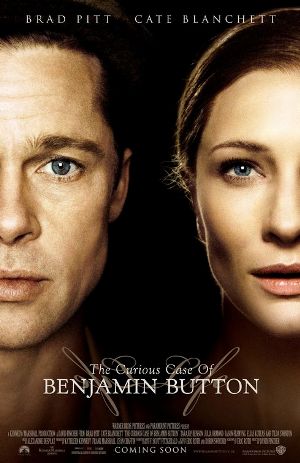
Loosely based on a short story by F. Scott Fitzgerald, The Curious Case of Benjamin Button told the story of a man who aged in reverse.  When Benjamin is a baby, he has the wrinkled face of an elderly man.  When he’s a teenager, he’s walking with a cane.  When he’s middle-aged, he looks like Brad Pitt in Legends of the Fall.  (In that regard, it helps that Benjamin is played by Brad Pitt.)  And when he’s an old man, he’s a baby.  Though the film, wisely, refrains from offering up a definite reason why Benjamin ages in reverse, it hints that it could have something to do with a clock that was built to run backwards as an anti-war statement.

Benjamin is born in New Orleans in 1918 and raised in a nursing home by Queenie (Oscar nominee and future Empire star Taraji P. Henson).  The love of Benjamin’s life is Daisy Fuller (Elle Fanning when young, Cate Blanchett as an adult), a dancer who also loves Benjamin but who, unlike him, is not aging in reverse.  For this reason, Benjamin and Daisy cannot be together.  That’s the way tragic love works.

The film itself features a framing device.  Daisy, now an elderly woman, is dying and gives her estranged daughter, Caroline (Julia Ormond), the diary of Benjamin Button.  As Caroline reads, Hurricane Katrina rages outside.  I’ve never really been comfortable with the way that the film uses Katrina as a plot point, for much the same reason that it bothered me when Hereafter used the real-life Thailand typhoon and London terrorist bombings to tell its story.  The real-life tragedy of Katrina feels out-of-place in a story about Brad Pitt aging backwards.

As for the rest of the film, The Curious Case of Benjamin Button is … well, it’s a curious film.  Visually, it’s definitely a David Fincher film but, at the same time, there’s something curiously impersonal about it.  You almost get the feeling that this was Fincher’s attempt to show that he was capable of making a standard big budget Hollywood film without getting too Fincheresque about it.  Brad Pitt and Cate Blanchett have chemistry and they look good together but Fincher has never been a sentimental director and his heart never truly seems to be in their love story.  (Ben Affleck and Rosamund Pike in Gone Girl feel more like a natural couple than Brad Pitt and Cate Blanchett do in this film.)  There’s only a few scenes, mostly dealing with the more morbid aspects of Benjamin’s odd condition, towards which Fincher really seems to feel any commitment.

As a result, The Curious Case of Benjamin Button becomes a curious misfire.  It’s a film that struggles with the big picture but is occasionally redeemed by some of its smaller moments.  (The scenes with the elderly Benjamin as a dementia-stricken baby are haunting and unforgettable.)  Ultimately, The Curious Case of Benjamin Button is probably the weakest of the five 2008 films nominated for best picture but it’s still an interesting film to watch.

Film Review: Devil’s Knot (dir by Atom Egoyan)


After having spent close to a year hearing only negative things about it, I finally watched Atom Egoyan’s Devil’s Knot last night.  On the basis of what a lot of critics had said about the film, I have to admit that I was mostly watching it to see if I needed to include it on my upcoming list of the 16 worst films of 2014.

But you know what?

Devil’s Knot really isn’t a bad film.  It’s just an extremely unnecessary one.

Devil’s Knot opens with a title card that reads, “Based on a true story.”  Honestly, the title card could have just as easily read, “Based on a true story and if you doubt it, there’s four other movies you can watch.”  The trial, conviction, and subsequent imprisonment of the West Memphis Three is perhaps the most famous miscarriage of justice in recent history precisely because so many documentaries have been made about it.  Paradise Lost and Paradise Lost Part Three are two of the most disturbing true crime documentaries ever made.

(As for Paradise Last Part Two, it displays a stunning lack of self-awareness as it attempts to prove the guilt of John Mark Byers by using many of the same techniques that were used to convict the West Memphis Three.  The less said about it, the better.)

The story is so well-known that I almost feel like retelling it would be like taking the time to inform you that George Washington was our first president.  But here goes — in 1993, 3 eight year-old boys were murdered in the small town of West Memphis, Arkansas.  Three teenagers were arrested for the crime and, on the flimsiest of evidence, were convicted.  As is seen in the documentaries, their conviction had more to do with community hysteria and paranoia than anything else.  The supposed leader of the West Memphis Three, Damien Echols, was accused of being a Satanist.  Why?  Mostly because he wore black clothing.

Eventually — and largely as a result of the documentaries made about the case — the West Memphis Three would be freed from prison.  (However, their convictions would still legally stand, meaning that their exoneration would be limited to the court of public opinion.)  Devil’s Knot, however, doesn’t deal with any of that, beyond a lengthy scroll of “this is what happened after the movie” information that rolls up the screen after the final scene.  Instead, Devil’s Knot deals with the first trial of the West Memphis Three and the small town atmosphere of fear and hysteria that led to them being convicted in the first place.

And — though the film is surprisingly conventional when you consider the reputation of director Atom Egoyan — it’s all fairly well-done.  As a former resident of and frequent visitor to Arkansas, I was happy to see that Egoyan didn’t indulge in as many stereotypes as I feared he would.  (One need only watch the self-important Northern activists in Paradise Lost Two to see the attitude that I feared Egoyan would bring to the project.)  Reese Witherspoon is perfectly cast as the mother of one of the murdered boys.  Kevin Durand is properly intimidating at John Mark Byers.  Even Colin Firth manages to make for a convincing Arkansan.

But, ultimately, Devil’s Knot just feels so unnecessary.  It doesn’t bring anything new to the story and there’s ultimately nothing here that you couldn’t have learned from the original Paradise Lost.

Probably the best thing that I can say about Devil’s Knot is that it’s better than Paradise Lost Part Two.

Back to School #44: Some Kind of Wonderful (dir by Howard Deutch)


some_kind_of_wonderful

For the past two and a half weeks, I’ve been reviewing, in chronological order, some of the best, worst, most memorable, and most forgettable teen films ever made.  We started with two films from 1946 and now, we find ourselves coming to the close of the decade that is often considered to be the Golden Age of teen films, the 1980s.  For our 44th entry in Back to School, we take a quick look at 1987’s Some Kind of Wonderful.

Why a quick look?

Because, quite frankly, there’s not that much to say about it.

Some Kind of Wonderful is a story about an artistic, lower-class misfit who has a crush on one of the popular kids.  The only problem is that the popular kid is being cruelly manipulated by one of the richest students in school.  The misft also has a best friend who is totally in love with the misfit but the misft has somehow failed to notice this.  Eventually, the misfit does get to date the popular kid.  Both the popular kid and the misft are given a hard time by the members of their collective clique but they still manage to go on one truly amazing date.  Finally, the film ends with a big show down at a party and two people kissing outside.

Sound familiar?

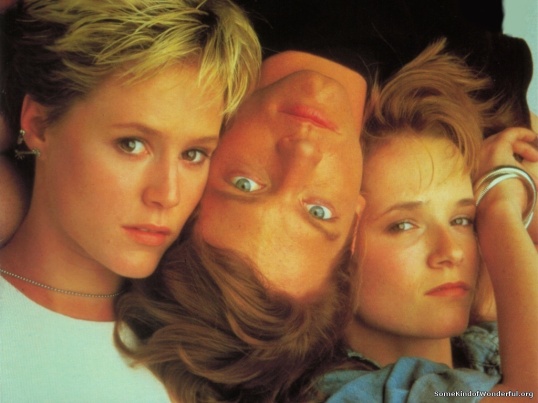
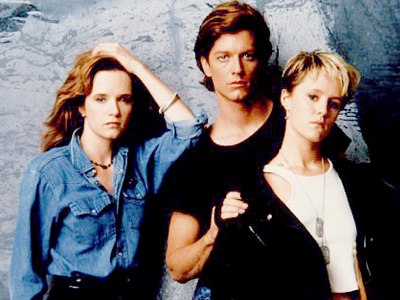
If it does, that probably means that you’ve seen Pretty In Pink.  Some Kind of Wonderful is basically a remake of Pretty In Pink, the only difference being that the genders have been reversed and that the film is a lot more heavy-handed (and predictable) when it comes to examining class differences.   (Not coincidentally, both films were written by John Hughes and directed by Howard Deutch and it must be said that when it comes to Some Kind of Wonderful, it’s easy to feel that both of them were simply going through the motions.)  The misfit is an aspiring painted named Keith (Eric Soltz).  His best friend is a drummer named Watts (Mary Stuart Masterson).  The object of Keith’s affection is Amanda (Lea Thompson).  Unfortunately, even though she lives in the same poor neighborhood as Keith and Watts, Amanda is dating the rich (and therefore, evil) Hardy (Craig Sheffer).

Some-Kind-of-Wonderful-some-kind-of-wonderful-2841626-1024-768

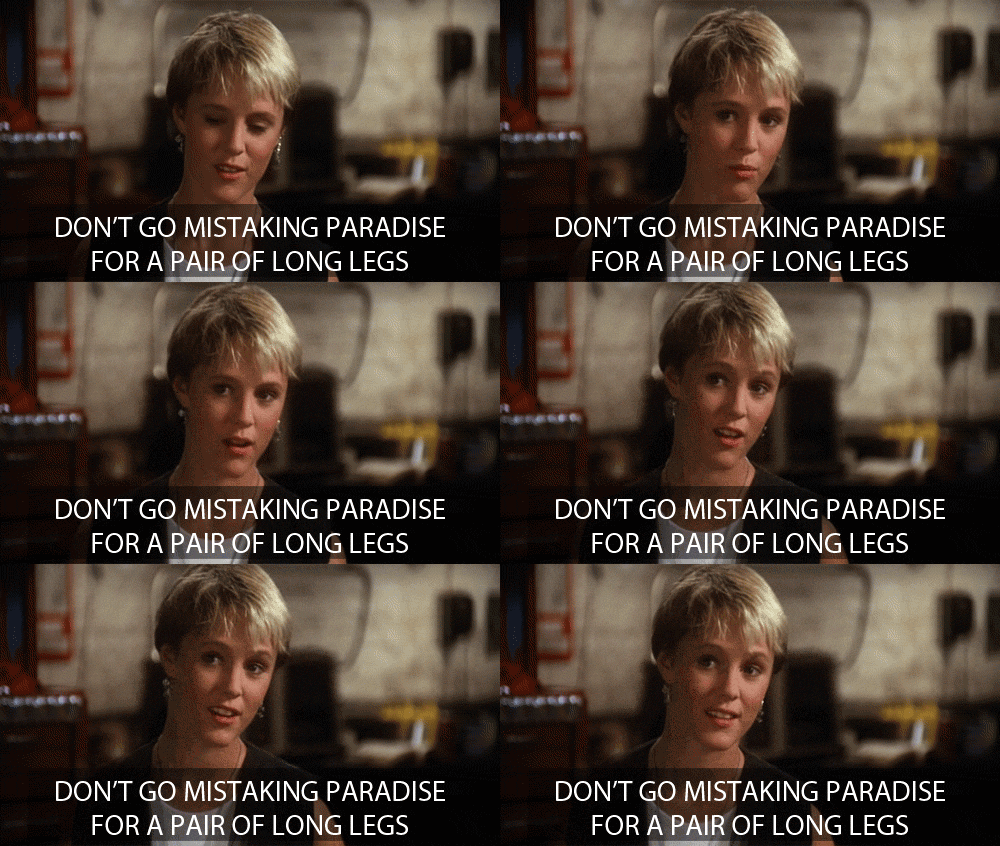
When Keith finally works up the nerve to ask out Amanda, he doesn’t realize that she’s just broken up with Hardy and is on the rebound.  Watts is skeptical, telling Keith, “Don’t go mistaking paradise for a pair of long legs,” and I’m just going to admit that, as the proud owner of a pair of long legs, that line really annoyed me.  I guess it’s because I’ve known people like Watts, who always act like there’s something wrong with wanting to look good.

Shut up, Watts.

Shut up, Watts.

With the help of Watts and Duncan (Elias Koteas), the school bully that Keith managed to befriend in detention, Keith takes Amanda out on an amazing date and shows her a wonderful portrait that he’s painted of her.  At the same time, Hardy — angry because someone from a lower class is now dating his ex-girlfriend — starts to plot his own revenge…

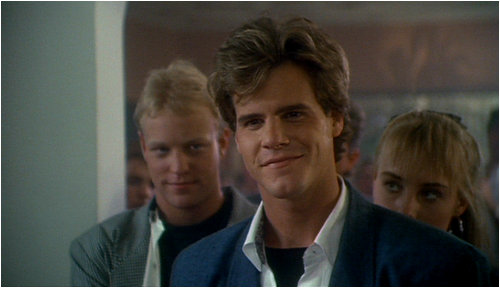
There are some positive things about Some Kind of Wonderful.  There are two really good and memorable scenes that, momentarily, manage to elevate the entire film.  There’s the moment when Keith shows Amanda the painting.  And then there’s the erotically charged scene in which Keith and Watts practice how to kiss.  Koteas, Thompson, and Masterson all gives good performances.  Eric Stoltz is, at times, a bit too intense to sell some of the film’s more comedic moments but overall, he’s well-cast here.  (In fact, the only performance that I really didn’t care for was Craig Sheffer’s.  Sheffer one-dimensional villain only served to remind me of how good James Spader was in Pretty In Pink.)

That's no James Spader

That’s no James Spader

And yet, there’s just something missing from Some Kind of Wonderful, something that keeps this film from being … well, wonderful.  I have to wonder if I had never seen Pretty In Pink, would I have thought more of Some Kind of Wonderful?  Perhaps.  Whereas Pretty In Pink was full of the type of small details and clever moments that make it a joy to watch and rewatch, Some Kind of Wonderful is one of those films that you can watch once and enjoy it without ever necessarily feeling the need to ever watch it again.

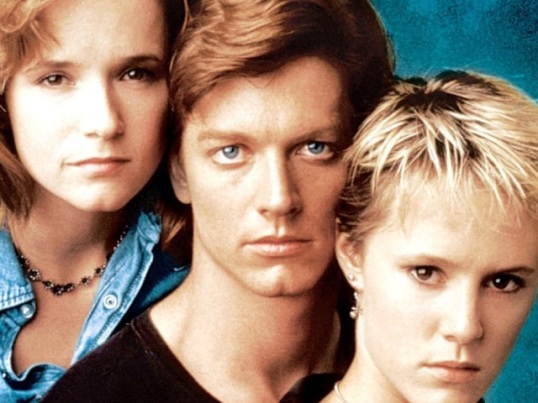
Eric Stoltz is going to kill someone