The Eric Roberts Collection: Best of the Best II (dir by Bob Radler)


Eric Roberts, Phillip Rhee, Simon Rhee, and Chris Penn all return for more martial arts action in 1993’s Best Of The Best II!

In the years since the American team’s quasi-victory over the Korean team in the first Best Of The Best, Travis (Chris Penn) has fallen on hard times.  While his former teammates, Alex (Eric Roberts) and Tommy (Phillip Rhee) attend to the day-to-day operations of running a martial arts studio in Las Vegas, Travis spends his time fighting in underground “colosseum” matches.  These matches, hosted by Weldon Mardano (Wayne Newton), are modern-day gladiatorial contests where the fighters often battle to the death while a bunch of rich people watch and cheer.  (We can tell they’re rich because they all wear tuxedos).  “There are no rules!” the crowd shouts as Travis defeats opponent after opponent.

Travis is convinced that he can defeat the colosseum’s German champion, fearsome Gustave Brakus (Ralf Moeller).  It turns out that Travis is wrong.  Travis loses to Brakus and is promptly killed after the crowd starts to chant, “Die!  Die!  Die!”  (In Brakus’s defense, he may have thought they were just chanting, “The!  The!  The!”)  (Actually, don’t ask me how that works in Brakus’s defense.  I really didn’t think that joke through.)  Travis’s death is witnessed by Alex’s young son, Walter (Edan Gross).  Travis, Walter, and Tommy go on the run, ending up at Tommy’s boyhood home.  Tommy, it turns out, is half-Native American and his bitter uncle, James (Sonny Landham), trains Tommy and Alex for their inevitable fight against Brakus.  Dae-han Park (Simon Rhee) also shows up, saying that he owes Tommy a debt for not killing him at the end of the previous film.

Best of the Best II is an improvement on the first film, if just because it doesn’t take itself seriously at all and it cheerfully embraces and celebrates the absurdity at the heart of the storyline.  Just the fact that one of the film’s villains is played by Wayne Newton should tell you everything you need to know about this film’s style.  This is a pure Vegas film, full of glitz and neon and plenty of tuxedos.  Eric Roberts even wears a tux at the end of the movie.  Just as in the first film, Roberts does most of the acting while Phillip Rhee supplies the action.  Roberts is a bit less emotional in this film.  If he spent the first film continually on the verge of tears, he spends the second one trying not to smile at the silliness of it all.  Towards the end of the film, you can actually see him starting to laugh at Wayne Newton’s over-the-top performance and it’s actually kind of a nice moment.  Don’t take this too seriously, the film seems to be saying, We’re not!  Just enjoy the fights!

Best of the Best II is definitely an improvement over the first one, even if it is unfortunate that neither James Earl Jones nor Sally Kirkland returned.  (Then again, if you were the Tony-winning, widely-celebrated, universally-beloved, and very much in-demand James Earl Jones, would you have returned?)   Best of the Best II doesn’t take itself too seriously and, as a result, it’s far more entertaining than you might otherwise expect.

Previous Eric Roberts Films That We Have Reviewed:

  1. Star 80 (1983)
  2. Runaway Train (1985)
  3. Best of the Best (1989)
  4. Blood Red (1989)
  5. The Ambulance (1990)
  6. The Lost Capone (1990)
  7. Love, Cheat, & Steal (1993)
  8. Voyage (1993)
  9. Love Is A Gun (1994)
  10. Sensation (1994)
  11. Dark Angel (1996)
  12. Doctor Who (1996)
  13. Most Wanted (1997)
  14. Mercy Streets (2000)
  15. Raptor (2001)
  16. Rough Air: Danger on Flight 534 (2001)
  17. Wolves of Wall Street (2002)
  18. Border Blues (2004)
  19. Mr. Brightside (2004)
  20. Six: The Mark Unleased (2004)
  21. We Belong Together (2005)
  22. Hey You (2006)
  23. Depth Charge (2008)
  24. Amazing Racer (2009)
  25. In The Blink of an Eye (2009)
  26. Bed & Breakfast (2010)
  27. Enemies Among Us (2010)
  28. The Expendables (2010) 
  29. Sharktopus (2010)
  30. Beyond The Trophy (2012)
  31. The Dead Want Women (2012)
  32. Deadline (2012)
  33. The Mark (2012)
  34. Miss Atomic Bomb (2012)
  35. Assault on Wall Street (2013)
  36. Bonnie And Clyde: Justified (2013)
  37. Lovelace (2013)
  38. The Mark: Redemption (2013)
  39. The Perfect Summer (2013)
  40. Self-Storage (2013)
  41. A Talking Cat!?! (2013)
  42. This Is Our Time (2013)
  43. Inherent Vice (2014)
  44. Road to the Open (2014)
  45. Rumors of War (2014)
  46. Amityville Death House (2015)
  47. Deadly Sanctuary (2015)
  48. A Fatal Obsession (2015)
  49. Las Vegas Story (2015)
  50. Stalked By My Doctor (2015)
  51. Enemy Within (2016)
  52. Joker’s Poltergeist (2016)
  53. Prayer Never Fails (2016)
  54. Stalked By My Doctor: The Return (2016)
  55. The Wrong Roommate (2016)
  56. Dark Image (2017)
  57. Black Wake (2018)
  58. Frank and Ava (2018)
  59. Stalked By My Doctor: Patient’s Revenge (2018)
  60. Clinton Island (2019)
  61. Monster Island (2019)
  62. The Reliant (2019)
  63. The Savant (2019)
  64. Seven Deadly Sins (2019)
  65. Stalked By My Doctor: A Sleepwalker’s Nightmare (2019)
  66. The Wrong Mommy (2019)
  67. Exodus of a Prodigal Son (2020)
  68. Free Lunch Express (2020)
  69. Her Deadly Groom (2020)
  70. Top Gunner (2020)
  71. Deadly Nightshade (2021)
  72. The Elevator (2021)
  73. Just What The Doctor Ordered (2021)
  74. Killer Advice (2021)
  75. Night Night (2021)
  76. The Poltergeist Diaries (2021)
  77. The Rebels of PT-218 (2021)
  78. A Town Called Parable (2021)
  79. Bleach (2022)
  80. My Dinner With Eric (2022)
  81. 69 Parts (2022)
  82. D.C. Down (2023)
  83. Aftermath (2024)
  84. Bad Substitute (2024)
  85. Devil’s Knight (2024)
  86. The Wrong Life Coach (2024)
  87. When It Rains In L.A. (2025

The Eric Roberts Collection: Best of the Best (dir by Bob Radler)


“No!” James Earl Jones says towards the end of 1989’s The Best of the Best, his already deep voice made even more imposing by the use of slow motion.

“No, Tommy, no!” Eric Roberts joins in as he watches martial artist Tommy Lee (Phillip Rhee) internally struggle with whether or not to strike a blow that will definitely kill his opponent and, if James Earl Jones is all gravitas and stern wisdom, Eric Roberts is all emotion and desperation.

The Best of the Best is a bit of an oddity, in that the script features just about every martial arts tournament cliche imaginable (right down to the other “bad” team having a history of killing people in the ring) but those cliches are all acted out by a surprisingly distinguished cast.  I counted four Oscar nominees (and one winner) in the cast.  James Earl Jones (nominated for The Great White Hope) plays Coach Couzo, who gets a team of Americans prepared to fight in an international tournament.  Sally Kirkland (nominated for Anna) plays their trainer, who worries not just about the team’s physical health but also their mental burdens.  Eric Roberts (nominated for Runaway Train) is Alex Grady, the former martial arts champion-turned-auto worker who makes the team despite having a bad shoulder.  Louise Fletcher (who won for One Flew Over The Cuckoo’s Nest) plays Alex’s mother, who looks after his son while Alex is off getting ready to face the Korean team.  And then there’s Chris Penn  (who seems like, if not for his early death, he would have eventually been nominated for something) as the arrogant Travis, a cowboy who can throw a punch.

(The American team is filled out by John Dye as Virgil, an intellectual Buddhist, David Agresta as Sonny “I’m Italian” Grasso, and Phillip Rhee, who not only plays Tommy but also wrote the film’s script.)

Roberts gets top-billing in this and he does get a lot of important moments, including a scene where he breaks the Coach’s rules so that he can visit his son in the hospital.  That said, the story centers around Phillip Rhee’s Tommy.  Tommy’s older brother was killed in the ring by the one-eyed Dae Han Park (Simon Rhee) and — wow, what a coincidence! — that just happens to be who Tommy needs to beat for the Americans to win the big tournament.  Both of the Rhee brothers actually are martial artists and they are very convincing in the fight scenes, which is good because neither Phillip nor Simon Rhee were particularly strong actors.  Eric Roberts is not a particularly convincing martial artist but it doesn’t matter because he acts the Heck out of every scene in which he appears.  What happens when you bring method intensity to the type of martial arts film that Jean-Claude Van Damme would later make his specialty?  You get scenes of a heavily-bruised Eric Roberts crying but, because Roberts is a good actor, the tears feel earned.  Still, whenever I saw Alex’s eyes starting to glisten, I imagined James Earl Jones saying, “Noooooooo!”  How can you win the world’s greatest tournament when you’re constantly on the verge of tears?  Well, maybe you don’t need to win.  Maybe you just need to show that you have more honor than anyone else there.

Best of the Best is a classic of its kind.  There’s nothing surprising about it but it’s entertaining in its own dumb way and, in the end, it reminds us that America doesn’t need medals to be the best.  It just needs Eric Roberts.

Previous Eric Roberts Films That We Have Reviewed:

  1. Star 80 (1983)
  2. Runaway Train (1985)
  3. Blood Red (1989)
  4. The Ambulance (1990)
  5. The Lost Capone (1990)
  6. Love, Cheat, & Steal (1993)
  7. Voyage (1993)
  8. Love Is A Gun (1994)
  9. Sensation (1994)
  10. Dark Angel (1996)
  11. Doctor Who (1996)
  12. Most Wanted (1997)
  13. Mercy Streets (2000)
  14. Raptor (2001)
  15. Rough Air: Danger on Flight 534 (2001)
  16. Wolves of Wall Street (2002)
  17. Border Blues (2004)
  18. Mr. Brightside (2004)
  19. Six: The Mark Unleased (2004)
  20. We Belong Together (2005)
  21. Hey You (2006)
  22. Depth Charge (2008)
  23. Amazing Racer (2009)
  24. In The Blink of an Eye (2009)
  25. Bed & Breakfast (2010)
  26. Enemies Among Us (2010)
  27. The Expendables (2010) 
  28. Sharktopus (2010)
  29. Beyond The Trophy (2012)
  30. The Dead Want Women (2012)
  31. Deadline (2012)
  32. The Mark (2012)
  33. Miss Atomic Bomb (2012)
  34. Assault on Wall Street (2013)
  35. Bonnie And Clyde: Justified (2013)
  36. Lovelace (2013)
  37. The Mark: Redemption (2013)
  38. The Perfect Summer (2013)
  39. Self-Storage (2013)
  40. A Talking Cat!?! (2013)
  41. This Is Our Time (2013)
  42. Inherent Vice (2014)
  43. Road to the Open (2014)
  44. Rumors of War (2014)
  45. Amityville Death House (2015)
  46. Deadly Sanctuary (2015)
  47. A Fatal Obsession (2015)
  48. Las Vegas Story (2015)
  49. Stalked By My Doctor (2015)
  50. Enemy Within (2016)
  51. Joker’s Poltergeist (2016)
  52. Prayer Never Fails (2016)
  53. Stalked By My Doctor: The Return (2016)
  54. The Wrong Roommate (2016)
  55. Dark Image (2017)
  56. Black Wake (2018)
  57. Frank and Ava (2018)
  58. Stalked By My Doctor: Patient’s Revenge (2018)
  59. Clinton Island (2019)
  60. Monster Island (2019)
  61. The Reliant (2019)
  62. The Savant (2019)
  63. Seven Deadly Sins (2019)
  64. Stalked By My Doctor: A Sleepwalker’s Nightmare (2019)
  65. The Wrong Mommy (2019)
  66. Exodus of a Prodigal Son (2020)
  67. Free Lunch Express (2020)
  68. Her Deadly Groom (2020)
  69. Top Gunner (2020)
  70. Deadly Nightshade (2021)
  71. The Elevator (2021)
  72. Just What The Doctor Ordered (2021)
  73. Killer Advice (2021)
  74. Night Night (2021)
  75. The Poltergeist Diaries (2021)
  76. The Rebels of PT-218 (2021)
  77. A Town Called Parable (2021)
  78. Bleach (2022)
  79. My Dinner With Eric (2022)
  80. 69 Parts (2022)
  81. D.C. Down (2023)
  82. Aftermath (2024)
  83. Bad Substitute (2024)
  84. Devil’s Knight (2024)
  85. The Wrong Life Coach (2024)
  86. When It Rains In L.A. (2025

Guilty Pleasure No. 60: The Running Man (dir by Paul Michael Glaser)


“Killian, here’s your Subzero… now plain zero!”

Uhm, excuse me, Mr. Schwarzenegger, but a man just died.  He probably had a family who just watched you kill him on national television….

Oh well, it happens!  In the role of Ben Richards, Arnold Schwarzenegger kills quite a few people over the course of the 1987 film, The Running Man, but they were all bad.  In fact, when we first meet Ben Richards, he’s a cop who is trying to save lives.  His superiors want him to open fire on a bunch of protestors who simply want enough food to eat.  When Richards refuses to do it, he is framed for perpetrating “the Bakersfield Massacre” and is sent to prison.  When he is recaptured after escaping, he is given a chance to compete on America’s number one game show, The Running Man!  Hosted and produced by Damon Killian (Richard Dawson, oozing smarm in a performance that — in a fair world — would have received Oscar consideration), The Running Man is a show in which prisoners are given a chance to win prizes like a trial by jury or maybe even a pardon.  While the audience cheers and puts down bets, the prisoners are stalked by professional killers like Buzzsaw (Gus Rethwisch), Dynamo (Erland Van Lidth), Fireball (Jim Brown), and Sub-Zero (Professor Toru Tanaka).  Along with Killian, Captain Freedom (Jesse Ventura) provides commentary and analysis on how the game is going.  Ben soon finds himself joined by Amber (Maria Conchita Alonso), who proves herself to be just as tough as he is.

Seen today, The Running Man feels more than a bit prophetic.  Due to worldwide economic collapse, the poor are getting poorer while the rich are getting richer.  The American government has become both increasingly corporate and increasingly authoritarian.  The citizens are entertained and manipulated by “reality” programming.  On camera, Killian is a charismatic host who delivers his lines with faux sincerity and who loves to meet and give away prizes to the public.  (There’s something both undeniably creepy and also rather familiar about the way that Killian sniffs the hair, rubs the shoulders and holds the arms of the audience members to whom he’s speaking.  It’s all very calculated and one gets the feeling that Killian washes his hands as soon as the camera are off of him.)  Behind the scenes, he drinks, smokes, curses, and is full of contempt for everyone around him.  He may not be happy when Ben outsmarts and kills the show’s stalkers but he definitely cheers up when he hears how good the ratings are.  The film is set in 2017, which was 30 years in the future when The Running Man was first released.  Seen today, The Running Man’s 2017 feels a lot like our 2017….

That said, The Running Man is also a big, flamboyant, and undeniably entertaining film.  It’s also surprisingly funny, at times.  Living in a dystopia ahs turned everyone into a quip machine.  None of the bad guys die without Schwarzenegger making a joke about it.  (“Buzzsaw?  He had to split.”  Yes, he did.)  The show’s vapid studio audience, who go from cheering the prospect of witnessing a bloody death to crying when their favorite stalker is killed, is both disturbing and humorous.  (Also memorable is the faux somber dance number that is performed while the show memorializes all the dead stalkers.)  For all the costumed heroes and villains, the film is practically stolen by an older woman named Agnes who becomes Ben Richards’s favorite fan.  The gaming “quads” may be dark and dangerous and full of angry people but they’re also full of advertisements for Cadre Cola.  Dey Young of Rock and Roll High School and Strange Behavior fame has a cameo as Amy, who pays six dollars for a can of Cadre.  (That may seem like a lot for a can of anything but Cadre is the official cola of The Running Man!  Damon Killian endorses it!  And, of course, when The Running Man was produced, the studio was owned by Coca-Cola so the jokes about Cadre’s corporate dominance also serve as a “take that” towards the corporation who put up money for the film.  Either that or Cadre is stand-in for Pepsi.)

It’s easy to compare The Running Man to The Hunger Games films but The Running Man is infinitely more fun, if just because it doesn’t make the mistake of taking itself as seriously as The Hunger Games did.  (Add to that, The Running Man manages to wrap up its story in 90 minutes, whereas The Hunger Games needed four movies.)  Like The Hunger Game, The Running Man is based on a book, in this case a very loose adaptation of one of the pulpy novels that Stephen King wrote under the name of Richard Bachman.  While King said that he enjoyed the film, he also asked that his real name not be listed in the credits because the film had little in common with his book, which is fair enough.  The Running Man may have been inspired by a Stephen King novel but it’s an Arnold Schwarzenegger production through-and-through.

Previous Guilty Pleasures

  1. Half-Baked
  2. Save The Last Dance
  3. Every Rose Has Its Thorns
  4. The Jeremy Kyle Show
  5. Invasion USA
  6. The Golden Child
  7. Final Destination 2
  8. Paparazzi
  9. The Principal
  10. The Substitute
  11. Terror In The Family
  12. Pandorum
  13. Lambada
  14. Fear
  15. Cocktail
  16. Keep Off The Grass
  17. Girls, Girls, Girls
  18. Class
  19. Tart
  20. King Kong vs. Godzilla
  21. Hawk the Slayer
  22. Battle Beyond the Stars
  23. Meridian
  24. Walk of Shame
  25. From Justin To Kelly
  26. Project Greenlight
  27. Sex Decoy: Love Stings
  28. Swimfan
  29. On the Line
  30. Wolfen
  31. Hail Caesar!
  32. It’s So Cold In The D
  33. In the Mix
  34. Healed By Grace
  35. Valley of the Dolls
  36. The Legend of Billie Jean
  37. Death Wish
  38. Shipping Wars
  39. Ghost Whisperer
  40. Parking Wars
  41. The Dead Are After Me
  42. Harper’s Island
  43. The Resurrection of Gavin Stone
  44. Paranormal State
  45. Utopia
  46. Bar Rescue
  47. The Powers of Matthew Star
  48. Spiker
  49. Heavenly Bodies
  50. Maid in Manhattan
  51. Rage and Honor
  52. Saved By The Bell 3. 21 “No Hope With Dope”
  53. Happy Gilmore
  54. Solarbabies
  55. The Dawn of Correction
  56. Once You Understand
  57. The Voyeurs 
  58. Robot Jox
  59. Teen Wolf

Film Review: Miracle Mile (dir by Steve De Jarnatt)


Last night, as I was watching the 1988 film, Miracle Mile, I found myself thinking about the fact that this film literally could not be made today.

No, it’s not because the film itself is about the treat of nuclear war.  Though nuclear war may no longer be as much of a cultural obsession as it apparently was back in the 80s, the fact of the matter is that the U.S., Russia, the UK, France, and China all still have nuclear weapons.  Pakistan, India, and North Korea all claim to have nuclear weapons.  It’s believed that Israel also has a few.  Iran is apparently working on developing an arsenal.  It’s estimated that there are currently 13,865 nuclear weapons in existence, 90% of which are divided between the U.S. and Russia.  That’s not even counting the threat of a terrorist group setting off a nuclear device.  In short, the threat of nuclear war is still very much a real one.

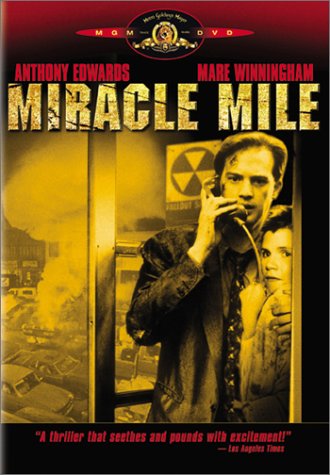
Instead, what truly makes Miracle Mile stand out as a film of its time, is the fact that almost the entire plot revolves around the character of Harry (played by Anthony Edwards) answering a Los Angeles pay phone at four in the morning.

Why is Harry answering a pay phone at 4 in the morning?  It’s because, earlier, he met Julie (Mare Winningham) at the La Brea Tar Pits and they fell instantly in love.  After spending most of the afternoon together, they made a date to meet at the local diner where Julie worked as a waitress.  Julie’s shift ended at midnight.  Harry went home to get a quick nap before picking her up.  Unfortunately, a power failure — one that was largely caused by Harry carelessly tossing away a cigarette — resulted in Harry’s alarm not going off.  At midnight, while Julie was standing outside the diner, Harry was asleep.

Harry doesn’t wake up until well-past 3 a.m.  After hastily getting dressed, Harry drives down to the diner.  When he arrives, he bumps into a tree and three rats fall off the branches and land on his car, which is a bit of an ominous omen.  (After watching the movie, I did a Google search and discovered that it’s actually not uncommon for rats to hang out in palm trees after dark.  I had no idea.  I’m glad I don’t live near any palm trees.)

By the time Harry arrives, Julie’s already gone.  From the payphone outside the diner, Harry calls Julie and leaves an apologetic message on her answering machine.  (Julie sleeps through it.)  Within minutes of Harry hanging up, the pay phone rings again.  Harry answers it, expecting to speak to Julie.  Instead, he finds himself talking to a panicked soldier who was trying to call his father but who dialed the wrong area code.  The soldier says that a war is about to break out and that everyone is going to die.  Suddenly, Harry hears what sounds like a gunshot.  Another voice gets on the phone and tells Harry to go back to sleep and forget about the call.

Of course, the reason why this story couldn’t take place in 2020 is pretty obvious to see.  No one uses pay phones anymore.  If the movie were made today. Harry would have just Julie on his own phone and then waited for her to call him back.  The soldier would never have misdialed his father’s area code.  Harry never would have gotten the message that the world was about to end and most of the subsequent events in Miracle Mile never would have happened.  Harry would have just sat in the diner and had a cup of coffee and waited for Julie to call until the inevitable happened.  In 2020, that would have been the movie.

So, let’s be happy that this film was made in 1988. during the time when pay phones were everywhere, because Miracle Mile is an excellent film.  Miracle Mile starts out as a romantic comedy, with Anthony Edwards and Mare Winningham making for an incredibly adorable couple.  Then, after Harry answers that pay phone, the movie grows increasingly grim as Harry desperately tries to make his way to Julie and arrange for the two of them to board a plane that a mysterious woman (Denise Crosby) has charted for Antarctica.  The problem, of course, is that in order to reach Julie, Harry is going to need the help of the type of people who are typically up and wandering around at 4 in the morning in Los Angeles.  Several people die as Harry tries to make it to Julie and, smartly, the film doesn’t just shrug off their deaths.  For the majority of the film, Harry isn’t even sure if there’s actually going to be an attack and it’s possible that he’s not only panicking over nothing but that he’s causing others to panic as well.  People are dying because of that phone call and Harry doesn’t even know whether it was real or not.  Even when full scale rioting breaks out, Harry doesn’t know if it’s because the world’s ending or because of a bad joke that he took seriously.  Transitioning from romantic comedy to dark comedy, Miracle Mile eventually becomes a nightmare as it becomes obvious that, even if Harry does reach Julie, escaping the city is not going to be easy.  The sun is rising and the truth is about that phone call is about to revealed….

Miracle Mile is a film that will get your heart racing.  On the one hand, Anthony Edwards and Mare Winningham have such a wonderful chemistry and they’re both just so damn likable that you want them to find each other and stay together.  Even if it means running the risk of being incinerated in a nuclear explosion, you want Harry and Julie to be with each other.  At the same time, you watch the movie with the knowledge that, even if they do manage to reunite, it might not matter because the world’s going to end.  Remarkably, almost everyone who Harry talks to about the phone call believes him when he says that a war is about break out.  Almost all of them have a plan to escape and, as a viewer, you get so wrapped up in the film that it’s only later that you realize that none of their plans made any sense.  Hiding out in Antarctica?  How exactly is that going to work?  Antarctica’s not exactly a place to which you impulsively move.  If there is truly no way to escape the inevitable, perhaps we should just be happy that Julie and Harry found love, even if it was right before the apocalypse.

When It Comes To Halloween, Should You Trust The IMDb?


Dr. Sam Loomis

Like a lot of people, I enjoy browsing the trivia sections of the IMDb.  While it’s true that a lot of the items are stuff like, “This movie features two people who appeared on a television series set in the Star Trek Universe!,” you still occasionally came across an interesting fact or two.

Of course, sometimes, you just come across something that makes so little sense that you can only assume that it was posted as a joke.  For instance, I was reading the IMDb’s trivia for the original 1978 Halloween and I came across this:

Peter O’Toole, Mel Brooks, Steven Hill, Walter Matthau, Jerry Van Dyke, Lawrence Tierney, Kirk Douglas, John Belushi, Lloyd Bridges, Abe Vigoda, Kris Kristofferson, Sterling Hayden, David Carradine, Dennis Hopper, Charles Napier, Yul Brynner and Edward Bunker were considered for the role of Dr. Sam Loomis.

Now, some of these names make sense.  Despite the fact that Sam Loomis became Donald Pleasence’s signature role, it is still possible to imagine other actors taking the role and perhaps bringing a less neurotic interpretation to the character.

Peter O’Toole as Dr. Loomis?  Okay, I can see that.

Kirk Douglas, Sterling Hayden, Charles Napier, Steve Hill, or Lloyd Bridges as Dr. Loomis?  Actually, I can imagine all of them grimacing through the role.

Walter Matthau?  Well, I guess if you wanted Dr. Loomis to be kind of schlubby….

Abe Vigoda?  Uhmmm, okay.

Dennis Hopper?  That would be interesting.

Mel Brooks?  What?  Wait….

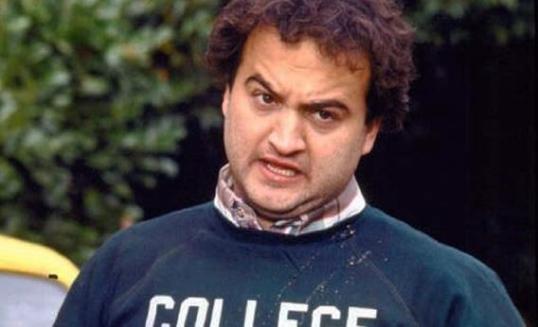
John Belushi?  Okay, stop it!

Dr. Sam Loomis

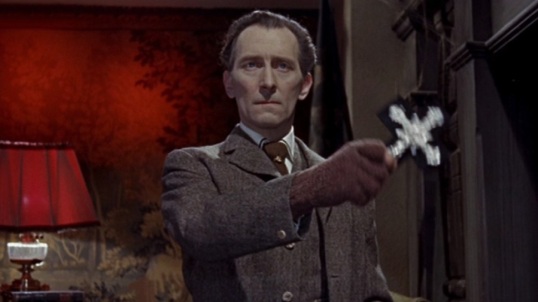
My point is that I doubt any of these people were considered for the role of Dr. Loomis.  Both director John Carpenter and producer Debra Hill have said that they wanted to cast an English horror actor in the role, as a bit of an homage to the Hammer films of the 60s.  Christopher Lee was offered the role but turned it down, saying that he didn’t care for the script or the low salary.  (Lee later said this was one of the biggest mistakes of his career.)  Peter Cushing’s agent turned down the role, again because of the money.  It’s not clear whether Cushing himself ever saw the script.

To be honest, I could easily Peter Cushing in the role and I could see him making a brilliant Dr. Loomis.  But, ultimately, Donald Pleasence was the perfect (if not the first) choice for the role.  Of course, Pleasence nearly turned down the role as well.  Apparently, it was his daughter, Angela, who changed his mind.  She was an admirer of John Carpenter’s previous film, Assault on Precint 13.  Carpenter has said that he was originally intimidated by Donald Pleasence (the man had played Blofeld, after all) but that Pleasence turned out to be a professional and a gentleman.

Laurie Strode

Of course, Halloween is best known for being the first starring role of Jamie Lee Curtis.  Curtis was actually not Carpenter’s first choice for the role of Laurie Strode.  His first choice was an actress named Annie Lockhart, who was the daughter of June Lockhart.  Carpenter changed his mind when he learned that Jamie was the daughter of Janet Leigh.  Like any great showman, Carpenter understood the importance of publicity and he knew nothing would bring his horror movie more publicity then casting the daughter of the woman whose onscreen death in Psycho left moviegoers nervous about taking a shower.

There was also another future big name who came close to appearing in Halloween.  At the time that she was cast as Lynda, P.J. Soles was dating an up-and-coming actor from Texas named Dennis Quaid.  Quaid was offered the role of Lynda’s doomed boyfriend, Bob but he was already committed to another film.

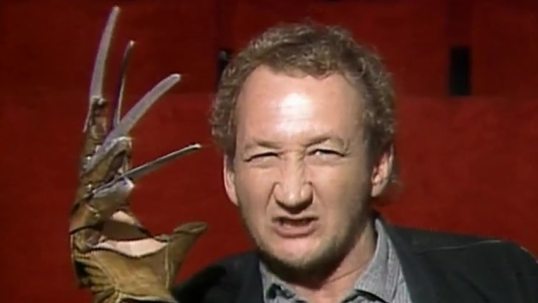
Not considered for a role was Robert Englund, though the future Freddy Krueger still spent some time on set.  He was hired by Carpenter to help spread around the leaves that would make it appear as if his film was taking place in the October, even though it was filmed in May.

Robert Englund, making May look like October

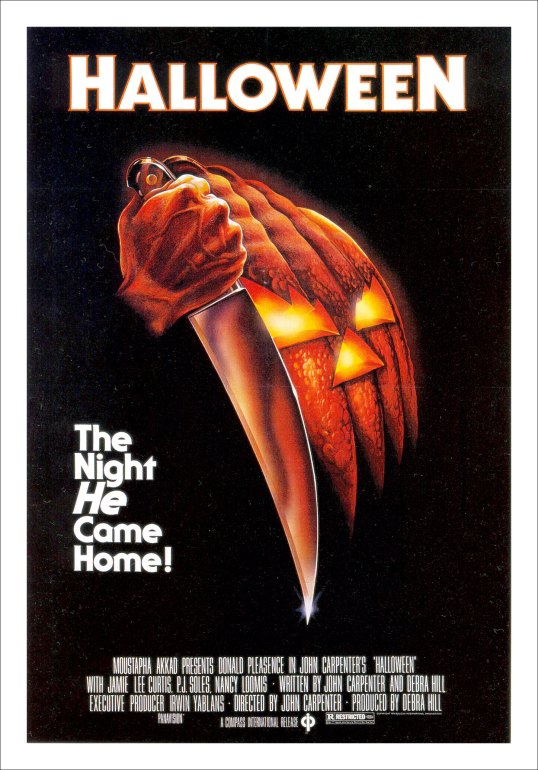
Interestingly enough, Englund nearly wasn’t need for that job because Halloween was not originally envisioned as taking place on Halloween or any other specific holiday.  When producer Irwin Yablans and financier Moustapha Akkad originally approached Carpenter and Hill to make a movie for them about a psycho stalking three babysitters, they didn’t care when the film was set.  It was only after Carpenter and Hill wrote a script called The Babysitter Muders that it occurred to Yablans that setting the film during Halloween would be good from a marketing standpoint.  Plus Halloween made for a better title than The Babysitter Murders.

And, of course, the rest is history.  Carpenter’s film came to define Halloween and it still remains the standard by which every subsequent slasher movie has been judged.  Would that have happened if the film had been known as The Babysitter Murders and had starred John Belushi?

Sadly, we may never know.

Sundance Film Review: Reservoir Dogs (dir by Quentin Tarantino)


The Sundance Film Festival is currently taking place in Utah so, for this week, I’m reviewing films that either premiered, won awards at, or otherwise made a splash at Sundance!  Today, I take a look at 1992’s Reservoir Dogs, which premiered at that year’s Sundance Film Festival.

Technically, I guess I’m obligated to start this review with a spoiler alert.  Though, seriously, is there anyone out there who hasn’t seen Reservoir Dogs?  I guess that there may be.  But surely, even if you haven’t seen it, you know everything that happens in the movie.  You know about the Like A Virgin conversation at the start of the movie.  You know about the ear scene.  You’ve seen countless parodies of that scene where the cast walks down the street in slow motion.  I find it hard to believe that there are people who don’t know everything about this film but still, I guess it’s always a possibility.

Reservoir Dogs is a challenging film to review, though not because it’s overly complicated or difficult to follow.  Instead, the problem is that it’s hard to know what’s left to say about Reservoir Dogs.  Just about every crime film that has come out in my lifetime has owed an obvious debt to Reservoir Dogs.  It’s the film that launched the directorial career of Quentin Tarantino.  It’s also features one of the greatest acting ensembles in the history of American film: Harvey Keitel, Tim Roth, Michael Madsen, Steve Buscemi, Chris Penn, Kirk Baltz, and Lawrence Tierney.  Tierney’s presence was especially important.  By appearing in the film, the veteran tough guy actor passed on the torch of hard-boiled crime to a new generation.

At its most basic, Reservoir Dogs is a heist film.  It employs the type of jumbled timeline that has become a Tarantino trademark.  The film starts with a group of 8 criminals eating breakfast and preparing to rob a jewelry store.  Then it jumps forward to immediately after the crime, with Mr. Orange (Tim Roth) shot in the gut and Mr. White (Harvey Keitel) desperately trying to get them both to the safety of a warehouse.  That’s where they are joined by Mr. Pink (Steve Buscemi).  Mr. Pink is convinced that they were set up.  He rants about being a professional.  He asks if Mr. White had to shoot anyone during his escape.

“A few cops,” Mr. White says.

“No real people?” Mr. Pink replies.

Eventually, Mr. Blonde (Michael Madsen) shows up.  We already know, from the film’s first scene, that Mr. Blonde strongly feels that everyone should tip their waitress.  After he arrives at the warehouse, we discover that he also likes good music and torturing hostages.  Meanwhile, the robbery’s mastermind, Joe Cabot (Lawrence Tierney) and his son, Eddie (Chris Penn), are also on their way to the warehouse.  Neither one is happy about how things are going.

And while all this goes on, Mr. Orange continues to bleed in the background…

Reservoir Dogs is known for being a violent film and, even though the movie is 26 years old, some of the violence can still catch you off-guard and make you flinch.  The scene where Mr. Blonde chops off the cop’s ear is still not easy to watch.  However, the scene that always freaks me out is when Mr. White starts shooting at a police car and the windshield is suddenly smeared with blood.  Mr. White is one of the film’s more sympathetic characters but he doesn’t hesitate to kill.

Of course, I think it could also be argued that Reservoir Dogs is actually as close as Tarantino has come to making a film that condemns violence.  Not counting the flashbacks, the story largely plays out in real time, which means that we basically spend the entire movie watching and listening as Mr. Orange slowly bleeds to death in front of us.

I rewatched Reservoir Dogs for this review and I have to say that I was really surprised to see how well the film holds up.  I was honestly expecting to be a little bit bored with it, just because I’d already seen it multiple times and I knew who the cop would turn out to be.  I already had all of the film’s great lines memorized.  But, as soon as the film started with everyone arguing about Like A Virgin and whether or not to tip their waitress, I was sucked back into Tarantino’s world.  Once again, I found myself laughing at Steve Buscemi’s brilliant delivery of the line: “Why am I Mr. Pink?”  I was enthralled all over again by Tim Roth’s nervous intensity and Harvey Keitel’s weary integrity.  Even Michael Madsen’s psycho routine felt fresh, despite the fact that he’s played numerous cool-as-ice psychos over the course of his career.  Even the way Chris Penn told the story about Lady E still made me laugh.

(To be honest, the line that makes me laugh the most in Reservoir Dogs — and don’t ask me why because I’m not sure of the exact reason — is when the unseen cop who is heard to say, “Yeah, give me the bearclaw,” while following Eddie’s car.)

It’s just a cool movie.  How can you resist this?

What happen at the end of the film?  Well, we all know the basics.  (And here’s where that probably unnecessary spoiler alert comes into play.)  Mr. White kills Joe and Eddie, all to protect Mr. Orange.  Mr. Pink runs from the warehouse.  The seriously wounded Mr. White cradles the dying Orange in his arms.  Orange confesses to being a cop.  Mr. White lets out a wail of both physical and emotional pain.  The police enter the warehouse and order Mr. White to drop his gun.  Mr. White shoots Orange in the head and is then gunned down by the police.

But what happened to Mr. Pink?

That’s a serious question because Mr. Pink is my favorite member of this band of robbers.  (He gets all the best lines, probably because Tarantino was planning on playing the role himself before Steve Buscemi auditioned.)  A lot of people will tell you that they can hear Mr. Pink being arrested outside of the warehouse, shortly before the cops come in and kill Mr. White.  And yes, I realize that, in at least one draft of the script, that’s exactly what happened.

Well, I don’t care.  We don’t actually see Mr. Pink getting arrested.  We don’t hear him getting shot.  As far as I’m concerned, Mr. Pink made it out of there alive and managed to escape with the diamonds.  The police may have yelled at him to stop but, in the end, they were too busy killing Mr. White to keep an eye on him.  Mr. Pink escaped and is currently living on the beach somewhere.  As a result of selling the diamonds, he’s now financially comfortable but he still doesn’t tip his waitress.  That’s just the way Mr. Pink is.

Finally, one little bit of trivia: Reservoir Dogs may have premiered at the 1992 Sundance Film Festival but it didn’t win any awards at the end of it.  Instead, the big winner that year was a comedy called In The Soup.  The star of that film?  Steve Buscemi.

Previous Sundance Film Reviews:

  1. Blood Simple
  2. I Don’t Feel At Home In This World Anymore
  3. Circle of Power
  4. Old Enough
  5. Blue Caprice
  6. The Big Sick
  7. Alpha Dog
  8. Stranger Than Paradise
  9. sex, lies, and videotape

A Movie A Day #67: Animal Factory (2000, directed by Steve Buscemi)


Edward Furlong is Ron Decker, a spoiled 18 year-old from a rich family who is arrested and sent to prison when he’s caught with a small amount of marijuana.  Being younger and smaller than the other prisoners, Ron is soon being targeted by everyone from the prison’s Puerto Rican gang to the sadistic Buck Rowan (Tom Arnold).  Fortunately, for Ron, prison veteran Earl Copen (Williem DaFoe) takes him under his wing and provides him with protection.  Earl is the philosopher-king of the prison.  As he likes to put it, “This is my prison, after all.”  If he can stay out of trouble, Ron has a chance to get out early but, with Buck stalking him, that’s not going to be easy.

Based on a novel by ex-con Edward Bunker, Animal Factory was the second film to be directed by Bunker’s Reservoir Dogs co-stars, Steve Buscemi.  Though it was overlooked at the time, Animal Factory is a minor masterpiece.  Taking a low key approach, Buscemi emphasizes the monotony of prison life just as much as the sudden bursts of violence and shows why someone like Ron Decker can go into prison as an innocent and come out as an animal.  DaFoe and Furlong give two of their best performances as Earl and Ron while a cast of familiar faces — Danny Trejo, Mickey Rourke, Chris Bauer, Mark Boone Junior — make up the prison’s population.  Most surprising of all is Tom Arnold, giving Animal Factory‘s best performance as the prison’s most dangerous predator.