44 Days of Paranoia #16: Wag the Dog (dir by Barry Levinson)


For today’s entry in the 44 Days of Paranoia, we’re taking a look at Barry Levinson’s 1997 political satire, Wag The Dog.

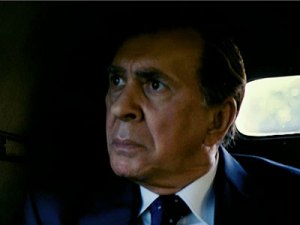
Wag the Dog opens with a White House in crisis.  With two weeks to go until the Presidential election, it’s been discovered that the incumbent President has had a brief dalliance with a girl scout.  Up until the scandal became public, the President was enjoying at 17 point lead in the polls.  Now, that lead is about to evaporate unless something can be done to keep the American public from thinking about the President’s personal life.

Significantly, the President himself never appears on-screen.  We never learn his position on the issues.  We never hear about anything he’s done during his first term.  We don’t even know what political party he belongs to.  (However, his opponent is played by Craig T. Nelson so I’m going to assume that the President is a Democrat.  Because, seriously, it’s hard for me to imagine Nelson being anything other than a Republican…)  The President remains a shadowy and insubstantial figure who, in the end, represents nothing.

Instead of getting to know the President, we instead spend the film with the aides who have to clean up after his mess.  One of those aides, Winifred Ames (Anne Heche), calls in a legendary (and rather sinister) political PR man, Conrad Bean (Robert De Niro).  Conrad announces that the only way to save the campaign is to distract the American public with a quick and totally fake war with Albania.  Why Albania?  According to Conrad, Albania has a sinister name and nobody knows anything about it.

To help create this fake war, Conrad recruits Hollywood film producer, Stanley Motts (a hilariously manic Dustin Hoffman).  Much as Conrad is a legend in politics, Stanley is a legend in Hollywood.  Stanley enthusiastically jumps into the project of creating a fake war of Albania, manufacturing everything from fake war footage to patriotic songs to anything else necessary to rally the American public.  Denis Leary shows up as a mysterious figure known as the Fad King and schemes how to make war with Albania the latest trend.  Willie Nelson sings a song to stir the spirit of every patriotic American.  A very young Kirsten Dunst is recruited to play a terrified orphan in staged Albanian atrocity footage.  A shell-shocked vet (Woody Harrelson) is cast as the Albanian War’s first hero.  Stanley greets every problem with an enthusiastic exclamation of, “This is nothing!”

Along the way, a rather odd friendship develops between the secretive Conrad and the overly verbose Stanley.  However, when Stanley, who often laments that he’s never won an Oscar, starts to complain about the fact that he’s never going to get any recognition for his “greatest production,” Conrad finds himself forced to reconsider their relationship.

Wag the Dog was first released in 1997 and, thanks to David Mamet’s darkly comedic script and Barry Levinson’s brisk direction, the film feels incredibly prophetic.  Indeed, all the film needs is for someone to mention making the war a trending topic and it would be impossible to tell that it was made 16 years ago.  Wag the Dog accomplishes the best thing that any political satire can hope to accomplish: it makes you question everything.  Whenever one watches a news report triumphantly bragging about the latest done strike, it’s hard not to feel that Stanley Motts would approve.

Other entries in the 44 Days Of Paranoia:
  1. Clonus
  2. Executive Action
  3. Winter Kills
  4. Interview With The Assassin
  5. The Trial of Lee Harvey Oswald
  6. JFK
  7. Beyond The Doors
  8. Three Days of the Condor
  9. They Saved Hitler’s Brain
  10. The Intruder
  11. Police, Adjective
  12. Burn After Reading
  13. Quiz Show
  14. Flying Blind
  15. God Told Me To

Lisa’s Thoughts On 10 Best Picture Nominees That She’s Recently Seen: The Alamo, Becket, Elmer Gantry, Gaslight, Gladiator, Kramer Vs. Kramer,Marty, Of Mice and Men, Out of Africa, and Wilson


Since it’s Oscar weekend, I’ve been watching past and present Best Picture nominees like crazy.  Here are my thoughts on ten of them.

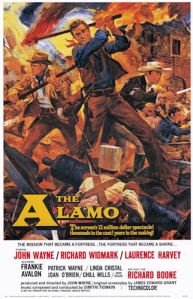
The Alamo (1960, directed by John Wayne, lost to The Apartment) — I’m a Texan which means that I’m legally required to watch both this film and the 2004 remake whenever they show up on television.  Both films are way too long and feature way too many characters speaking speeches as opposed to dialogue but, if I had to choose, I would have to go with the 1960 version of the story.  The original Alamo might be heavy-handed, poorly paced, and awkwardly acted but at least it’s sincere in its convictions.  I always cry when Richard Widmark dies.

Becket (1964, directed by Peter Glenville, lost to My Fair Lady) — This one is a personal favorite of mine.  The film is about the friendship and the eventual rivalry of King Henry II (Peter O’Toole) and Thomas Becket (Richard Burton).  Becket and Henry II start out the film drinking and whoring but eventually, Henry makes Becket Archbishop of Canterbury.  Becket, however, rediscovers his conscience and soon, Henry is famously asking, “Who will rid me of this troublesome priest?”  Becket is an exciting historical drama and Peter O’Toole is at his absolute best as the flamboyantly decadent Henry.

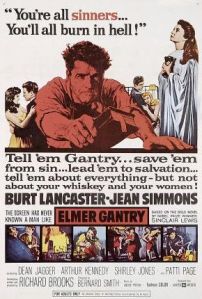
Elmer Gantry (1960, directed by Richard Brooks, lost to The Apartment) — Burt Lancaster plays Elmer Gantry, a traveling salesman and con artist who ends up falling in love with a saintly evangelist (played by Jean Simmons).  Gantry soon starts preaching himself and soon has an army of loyal followers.  However, Gantry’s new career is threatened when an ex-girlfriend-turned-prostitute (Shirley Jones) pops up and starts telling people how Gantry “rammed the fear of God into” her.  With its unapologetically corrupt lead character and its looks at how commerce and religion are often intertwined, Elmer Gantry makes a perfect companion piece to Paul Thomas Anderson’s There Will Be Blood.  Lancaster won an Oscar for his powerful and intense performance in the title role.

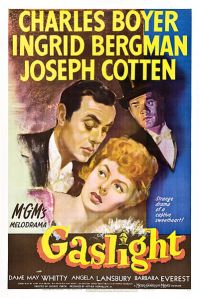
Gaslight (1944, directed by George Cukor, lost to Going My Way) — Evil Charles Boyer marries Ingrid Bergman and then attempts to drive her crazy.  Luckily, Inspector Joseph Cotten is on the case.  Gaslight is, in many ways, an old-fashioned melodrama but it’s still a lot of fun to watch.  Boyer is a suave devil and Joseph Cotten (one of my favorite of the old film actors) is a dashing hero.

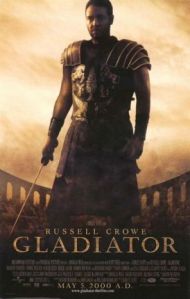
Gladiator (2ooo, directed by Ridley Scott, won best picture) — One thing that I’ve recently discovered is that men love Gladiator.  Seriously, they obsess over this film and hold Russell Crowe’s surly gladiator up as some sort of mystical ideal and if you dare to say a word against it in their presence, be ready for big and long argument.  So, I won’t criticize Gladiator too much other than to say that the film has always struck me as being kinda overlong, that the CGI is occasionally cartoonish, and that, despite his fearsome reputation, Russell Crowe is a lot more interesting as an actor when he plays a thinker as opposed to a fighter.  Joaquin Phoenix, playing the Emperor Commodus, is a lot of fun to watch.

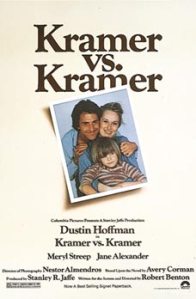
Kramer Vs. Kramer (1979, directed by Robert Benton, won best picture) — Dustin Hoffman plays a workaholic New York advertising executive who, after his wife Meryl Streep leaves him, ends up as a single father.  Kramer Vs. Kramer won best picture in 1979 but I have to admit that I didn’t care much for it.  Then again, I don’t think that I was the intended audience.  Instead, Kramer vs. Kramer appears to have been made to appeal to men frustrated with women wanting to have a life outside of being a domestic servant.  The film is well-acted though Hoffman’s character becomes insufferably smug once he gets comfortable with being a single father.

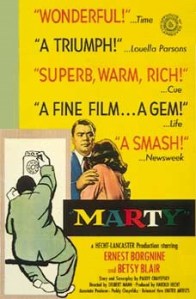
Marty (1955, directd by Delbert Mann, won best picture) — Lonely butcher Marty (Ernest Borgnine) romantically pursues a shy school teacher named Clara (Betsy Blair).  However, Marty’s friends and his family don’t like Clara and Marty soon finds himself having to choose between them.  Marty is a bit of an anomaly when it comes to best picture winners.  It’s not an epic, it doesn’t claim to solve any of the world’s problems, and it’s based on a tv show.  However, it’s also a sincerely sweet and heartfelt  film and also features excellent performances from Borgnine and Blair.

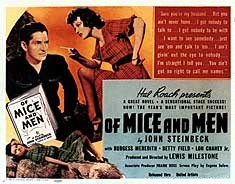
Of Mice and Men (1939, directed by Lewis Milestone, lost to Gone With The Wind) — “Tell me about the rabbits, George.”  Yes, it’s that film.  Smart and little George (Burgess Meredith) and big but simple Lenny (Lon Chaney, Jr.) are migrant farm workers who get a job working at ranch where Lenny ends up accidentally killing the rancher’s daughter-in-law.  Despite the fact that we all now tend to naturally smirk when we hear anyone say “Tell me about the rabbits, George,” Of Mice and Men remains an effective tear-jerker and both Meredith and Chaney give strong performances.

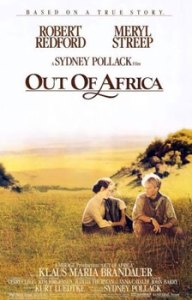
Out of Africa (1985, directed by Sydney Pollack, won best picture) — I recently sat down to watch this film because 1) my aunts love this film and get excited whenever they see that it’s going to be on TV and 2) Out of Africa was named the best film of the year I was born.  So, I sat down and watched it and then three or five hours later, I realized that the film was nearly over.  Anyway, the film is about a Danish baroness (Meryl Streep) who moves to a plantation in Africa and ends up having an affair with a British big game hunter.  The hunter is played by Robert Redford, who refuses to even try to sound British. (USA! USA! USA!)  Anyway, the film is pretty in that generic way that most best picture winners are but the film ultimately suffers because its difficult to care about any of the characters.  Streep acts the Hell out of her Danish accent but she and Redford (who seems to be bored with her) have absolutely no chemistry. I saw one review online that dismissed Out of Africa as a “big budget Lifetime movie” but Lifetime movies are a lot more fun.

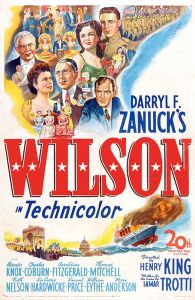
Wilson (1944, directed by Henry King, lost to Going My Way) — Wilson is a two-and-a-half biopic about Woodrow Wilson and his presidential administration.  Wilson is well-played by Alexander Knox, who later showed up in countless exploitation films.  Wilson shows up on cable occasionally and every time I’ve seen it, I’ve had mixed feelings about it.  The critical part of me tends to be dismissive of this film because it’s way too long, extremely stagey, and it glosses over the fact that Wilson was a virulent racist who idolized the Ku Klux Klan.  However, as a secret history nerd, I can’t help but enjoy seeing a film where Vincent Price plays the Secretary of the Treasury.

Two Post Presidents Day Reviews: Frost/Nixon (dir. by Ron Howard) and All The President’s Men (dir. by Alan J. Pakula)


“Now Watergate doesn’t bother me/does your conscience bother you?” — Lynard Skynard, Sweet Home Alabama

As part of my continuing quest to see and review every film ever nominated for best picture, I want to devote my first post Presidents Day post to two films: 2008’s Frost/Nixon and 1976’s All The President’s Men.

During my sophomore year of college, I had a political science professor who, every day of class, would sit on his desk and ramble on and on and on about his past as a political activist.  He protested Viet Nam, he hung out with revolutionaries, he loved Hugo Chavez, and I assume he probably had a Che Guevara poster hanging in his office.  Whenever he wanted to criticize George W. Bush, he would compare him to Richard Nixon and then pause as if he was waiting for the class to all start hissing in unison.  He always seemed to be so bitterly disappointed that we didn’t.  What he, and a whole lot of other people his age, didn’t seem to understand was that Richard Nixon was his boogeyman.  The rest of us could hardly care less.

That was the same problem that faced the 2008 best picture nominee Frost/Nixon

Directed rather flatly by Ron Howard, Frost/Nixon tells the true story about how a light-weight English journalist named David Frost (played by Michael Sheen) managed to score the first televised interview with former President Richard Nixon (Frank Langella).  Both Frost and Nixon see the interviews as a chance to score their own individual redemptions while Frost’s assistants (played by Oliver Platt and Sam Rockwell) see the interview as a chance to put Richard Nixon on trial for Watergate, the Viet Nam War, and every thing else under the sun.  That may not sound like a very exciting movie but it does sound like a sure Oscar contender, doesn’t it?

I’ve always secretly been a big history nerd so I was really looking forward to seeing Frost/Nixon when it was first released in 2008.  When I first saw it, I was vaguely disappointed but I told myself that maybe I just didn’t know enough about Richard Nixon or Watergate to really “get” the film.  So, when the film later showed up on cable, I gave it another chance.  And then I gave it a chance after that because I really wanted to like this film.  Afterall, it was a best picture nominee.  It was critically acclaimed.  The word appeared to be insisting that this was a great film.  And the more I watched it, the more I realized that the world was wrong.  (If nothing else, my reaction to Frost/Nixon made it easier for me to reject the similarly acclaimed Avatar a year later.)  Frost/Nixon is well-acted and slickly produced but it’s not a great film.  In fact, Frost/Nixon is epitome of the type of best picture nominee that inspires people to be cynical about the Academy Awards.

Before I get into why Frost/Nixon didn’t work for me, I want to acknowledge that this was a very well-acted film.  By that, I mean that the cast (Frank Langella, Michael Sheen, Kevin Bacon, Sam Rockwell, and Oliver Platt) all gave very watchable and entertaining performances.  At the same time, none of them brought much depth to their characters.  Much like the film itself, nobody seems to have much going on underneath the surface.  Frank Langella may be playing a historic figure but, ultimately, his Oscar-nominated performance feels like just a typically grouchy Frank Langella performance.  Michael Sheen actually gives a far more interesting performance as David Frost but, at the same time, the character might as well have just been identified as “the English guy.”  In fact, a better title for this film would have been The Grouchy, the English, and the Superfluous.

For all the time that the film devotes to Rockwell and Platt blathering on about how they’re going to be giving Richard Nixon “the trial he never had,” this film is ultimately less about politics and more about show business.  Ron Howard devotes almost as much time to the rather boring details of how the interviews were set up and sold into syndication as he does to the issues that the interview brings up.  Unfortunately, for a movie about show business to succeed, the audience has to believe that the show is one that they would actually enjoy watching,  This, ultimately, is why Frost/Nixon fails.  While the filmmakers continually tell us that the Frost/Nixon interviews were an important moment in American history, they never show us.  Yes, everyone has hideous hair and wide lapels but, otherwise, the film never recreates the period or the atmosphere of the film’s setting and, as a result, its hard not to feel detached from the action happening on-screen.  For all the self-congratulatory claims made at the end of the film, it never convinces us that the Frost/Nixon interviews were really worth all the trouble.  Much like my old poli sci professor, Frost/Nixon never gives us a reason to care. 

For a far more interesting and entertaining look at the Watergate scandal, I would recommend the 1976 best picture nominee All The President’s Men.  Recreating the story of how two Washington Post reporters (played by Robert Redford and Dustin Hoffman) exposed the Watergate scandal that eventually led to Nixon’s resignation, All The President’s Men is the movie that Frost/Nixon wishes it could be.  Despite being made only two years after Watergate, All The President’s Men doesn’t take the audience’s interest for granted.  Instead, director Pakula earns our interest by crafting his story as an exciting thriller.  Pakula directs the film like an old school film noir, filling the screen with menacing shadows and always keeping the camera slightly off-center.   Like Frost/Nixon, All The President’s Men is a well-acted film with a bunch of wonderful 70s character actors — performers like Ned Beatty, Jason Robards, Jack Warden, Martin Balsam, and Robert Walden, and Jane Alexander — all giving effectively low-key and realistic performances.   The end result is a film that manages to be exciting and fascinating to those of us who really don’t have any reason to care about Richard Nixon or Watergate.

Both of these two films were nominated for best picture.  Frost/Nixon quite rightly lost to Slumdog MillionaireAll The President’s Men, on the other hand, lost to Rocky.

6 Trailers For 6 Films That Were Snubbed By The Academy


Seeing as how the Oscar nominations are due to be announced on Tuesday, I thought I would devote this edition to Lisa Marie’s Favorite Grindhouse and Exploitation trailers to films that were snubbed by the Academy.  Remember them while you’re watching Rooney Mara accept best actress.

1) A Life of Ninja (1983)

Despite the colorful trailer, this film was not nominated for best Costume Design, Art Design,  or Cinematography.  Instead, all three of those awards went to Ingmar Bergman’s Fanny and Alexander.

2) The Shark Hunter (1979)

Franco Nero was not nominated for best actor for his performance here.  Instead Dustin Hoffman won for Kramer vs. Kramer.

3) The Terrornauts (1967)

The true terror is that the 1967 Oscar for Special Visual Effects went to Doctor Dolittle and not The Terrornauts.

4) Americathon (1979)

The Academy has never really appreciated hard-hitting political satire which perhaps explains why the previously mentioned Kramer Vs. Kramer won best picture while Americathon was not even nominated.

5) Don’t Torture A Duckling (1972)

The Oscar for Best Foreign language film of 1972 was given to Luis Bunuel’s The Discreet Charm of the Bourgeoisie and not to Lucio Fulci’s classic giallo Don’t Torture A Duckling.

6) The Hills Have Eyes (1977)

And yet somehow, Annie Hall was named best picture.

Is Rod Lurie’s Straw Dogs The Worst Film of 2011?


It’s probably a bit too early to answer that question.  After all, we’ve still got 3 months left to go in the year and Roland Emmerich’s take on Shakespeare (a.k.a. Anonymous) hasn’t been released yet.  So, no, Rod Lurie’s remake of Straw Dogs cannot be called the worst film of 2011 yet.  Instead, it’s just the worst film so far.

Straw Dogs is a remake of the 1971 Sam Peckinpah film.  In the Peckinpah film, David Sumner (played by Dustin Hoffman) is a pacifist who, upon moving to the childhood home of his wife Amy (Susan George), is repeatedly harassed by the locals until he finally takes his very brutal revenge.  It’s a flawed and uneven film that still carries quite a punch.  I wouldn’t say I’ve ever enjoyed watching Peckinpah’s Straw Dogs but it’s undeniably powerful film.  As for the remake, Peckinpah has been replaced with Rod Lurie, Hoffman by James Marsden, and Susan George’s controversial character is now played by Kate Bosworth.  None of these changes are for the better.

Lurie’s version of Straw Dogs almost slavishly follows the plot of the original.  He’s made just a few changes and none of those changes are for the better.  The most obvious change is that, while the first Straw Dogs took place in rural England, Lurie’s version takes place in Mississippi.  It’s pretty easy to guess Lurie’s logic here.  Lurie, after all, previously created the television show Commander-in-Chief in which President Geena Davis heroically struggled to save the nation from fundamentalists with Southern drawls.  Lurie’s vision of Mississippi is some sort of Blue State nightmare where everyone drives a pickup truck, goes to church, cheers at football games, and makes supportive comments regarding the War in Iraq.  In the original Straw Dogs, David Sumner is a truly a stranger in a strange land, an American who doesn’t realize just how out-of-place he is in rural England.  In the remake, David Sumner is just a guy on vacation from the West Coast.  He really has no excuse for being quite as dense as he is when it comes to not pissing off the locals.  By changing the locale, Rod Lurie essentially just makes his film into yet another example of Yankee paranoia.  This wouldn’t be such a problem except that Lurie seems to be taking it all so seriously.  He really seems to feel that he’s making a legitimate contribution to the whole Red State/Blue State divide.  Watching the film, I had to wonder if Rod Lurie truly believed that it’s impossible to get a cell phone signal in Mississippi. 

The other big difference is that in Lurie’s version, David Sumner is no longer a mathematician.  Instead, he’s now a Hollywood screenwriter who is apparently working on an epic screenplay about the Battle of Stalingrad.  (“I figured out a way to get Khrushchev in on the action!” he says at one point.)  To be honest, David’s screenplay sounds kinda boring and it’s hard not to sympathize with the “hillbilly rednecks,” (as David calls them) who ask him why anybody would want to watch his movie.  (The rednecks also ask him if he thinks that God had anything do with the Battle of Stalingrad.  Speaking as a nonbeliever, I have to say that this film was almost hilariously paranoid about any sort of religious belief.)  Part of the power of the first Straw Dogs came from the fact that David was an academic.  He was a man whose life was about theory and that made it all the more shocking to see him explode into action.  It also explained his non-existent social skills, because he was, after all, the product of a very insular, intellectual existence.  However, in the remake, David just becomes a condescending jerk who’s working on a screenplay for a film that most viewers would have little interest in actually sitting through.  (Add to that, it was hard not to feel that this new David was just Rod Lurie’s Mary Sue.)

David is in Mississippi because it’s the childhood home of his wife, Amy.  The character of Amy is problematic in both versions of Straw Dogs but, to be honest, I found her character to be even more illogical and insulting in Lurie’s remake.  In the original Straw Dogs, Amy is portrayed as an idiot who flirts with every man she sees, taunts her husband to the point of violence, and (by that film’s logic) puts herself in a situation that leads to her rape.  The character is, in many ways, an insulting stereotype but at least she’s a consistent insulting stereotype.  The remake’s Amy is presented as being a considerably stronger character.  She doesn’t openly flirt with the local rednecks, she and her husband are a lot more obnoxiously lovey dovey, and (as opposed to in the first film), it’s never suggested that she actually enjoys being raped.  Kudos to Lurie for trying to make her a stronger character.  Yet, at the same time, the remake’s Amy still does a lot of the same illogical things as the original Amy.  The original Amy at least had the excuse of being an idiot.  The remake’s Amy just comes across as being an inconsistent, poorly-concieved character.  Eventually, it becomes obvious that director Lurie wasn’t trying to make Amy into a stronger character as much as he was just trying to be politically correct.  (Another thing that the two Amys have in common is that neither one of them wears a bra.  It made sense in the original film because the original Amy was presented as being something of a wannabe flower child.  In the remake, it just comes across as Lurie’s dirty boy excuse to get a peek at Kate Bosworth’s nipples.  Seriously, who goes jogging without a sports bra?)

Anyway, the remake follows the path of the original.  David and Amy return to Amy’s home village where they meet Amy’s ex-boyfriend Charlie Venner (played by an amazingly hot and sexy Alexander Skarsgard).  David hires Charlie and his redneck buddies to repair the roof of an old barn.  Charlie, who is obviously still attracted to Amy, spends the entire first part of the movie subtly humiliating David and basically being a bully.  Somebody strangles Amy’s cat.  Amy says it was Charlie and his friends.  David replies, “I can’t just accuse them.”  Eventually, David is taken on a deer hunt by Charlie’s friends and while he’s gone, Charlie and his buddy Chris rape Amy. 

(In the original it was a snipe hunt and the sight of Dustin Hoffman searching for a nonexistent creature while his wife is being raped was quite disturbing and perfectly symbolized his character’s impotence.  In the remake, David is once again left alone in the woods but this time, he shoots and kills a deer and, unfortunately, James Marsden isn’t a good enough actor to let us know what that means.)

Amy never tells David that she was raped, nor does she go to the authorities.  (This makes a sick sense in the original.  In the remake, it just seems like an effort by Rod Lurie to degrade a previously strong woman.)  The next night, David ends up sheltering the local sex pervert in his house while Charlie and his drunken friends attempt to break in.  This leads to David revealing that, as opposed to being “a coward,” he’s actually as vicious a killer as everyone else in the film. 

In the original version, this was a disturbing revelation if just because Sam Peckinpah emphasized not so much the killing as the fact that, as the siege progresses, David begins to enjoy the killing more and more.  Once Peckinpah’s David has given into the reality that he too is an animal, you realize that it’ll be impossible for him to return to being the essentially decent man that he was before.  In the original, you start out cheering David’s revenge but soon, you just want it to stop.  Much like the originalTexas Chainsaw Massacre, the film is so thematically nightmarish that you end up thinking you’ve seen a lot more blood than you actually have.  It sticks with you.

However, since Lurie’s remake is a film devoid of nuance or subtlety, the sudden explosion of violence on David’s part is neither surprising nor all that exciting.  And since James Marsden is no Dustin Hoffman (to put it lightly), you don’t see any change in David once the violence begins.  He’s not a man turning into an animal as much as he’s just a 90210 reject with a scowl on his face.  He kills a lot of men but he looks oh so pretty doing it and Amy cheers him on every step of the way.  (In the original, Amy was terrified of her husband’s new side.  I would be too.)  Since Lurie isn’t a good enough director to generate a sincere emotional response to seeing David turn into a killer, he instead lingers over all the blood and gore like a pervert struggling to catch his breath while secretly looking at a snuff website.  In short, the original Straw Dogs condemned violence by pretending to celebrate it.  The remake celebrates it by pretending to condemn. 

Okay, you may be saying, so it’s not a great film.  But is it really the worst of 2011 so far?  After all, Alexander Skarsgard gives a charismatic, bad boy performance and James Woods has a few good scenes as a venomous former football coach.  And director Lurie, while he may be incapable of keeping the action moving at a steady pace, does manage to make Mississippi look pretty.  That’s all true but I still say that Straw Dogs is the worst movie of the year so far.  Why? 

Because it’s not only a remake of a film that didn’t need to be remade but it’s also a remake that was apparently made by people who don’t have a clue about what made the original an important film to begin with.  It’s a film that’s gloriously unaware of its own tawdriness, a sordid mess that can’t even have fun with the possibilities inherent in being a sordid mess.  Arrogantly, director Lurie invited you to compare his film to Sam Peckinpah’s by not just ripping off the film’s story (as countless other enjoyable films have done) but by claiming the title as well.  It’s a film that represents Hollywood at its worst and for me, that’s why it’s earned the title of worst film of 2011 so far.

(One positive note: Perhaps this terrible, insulting remake will encourage someone to track down the original Straw Dogs and see how this story was meant to be told.)

What could have been: The Godfather


I don’t know about you but I love to play the game of “What if.”  You know how it works.  What if so-and-so had directed such-and-such movie?  Would we still love that movie as much?  Would so-and-so be a star today?  Or would the movie have failed because the director was right to reject so-and-so during preproduction?

I guess that’s why I love the picture below.  Taken from one of Francis Ford Coppola’s notebooks, it’s a page where he jotted down a few possibilities to play the roles of Don Vito, Michael, Sonny, and Tom Hagen in The Godfather.  It’s a fascinating collection of names, some of which are very familiar and some of which most definitely are not.  As I look at this list, it’s hard not wonder what if someone like Scott Marlowe had played Michael Corleone?  Would he had then become known as one of the great actors of his generation and would Al Pacino then be fated to just be an unknown name sitting on a famous list?

(This page, just in case you happen to be in the neighborhood , is displayed at the Coppola Winery in California.)

The production of the Godfather — from the casting to the final edit — is something of an obsession of mine.  It’s amazing the amount of names — obscure, famous, and infamous — that were mentioned in connection with this film.  Below is a list of everyone that I’ve seen mentioned as either a potential director or a potential cast member of The Godfather.  Consider this my contribution to the game of What If….?

Director: Aram Avankian, Peter Bogdonavich, Richard Brooks, Costa-Gravas, Sidney J. Furie, Norman Jewison, Elia Kazan, Steve Kestin, Sergio Leone, Arthur Penn, Otto Preminger, Franklin J. Schaffner, Peter Yates, Fred Zinnemann

Don Vito Corleone (played by Marlon Brando): Melvin Belli, Ernest Borgnine, Joseph Callelia, Lee. J. Cobb, Richard Conte, Frank De Kova, Burt Lancaster, John Marley, Laurence Olivier, Carlo Ponti, Anthony Quinn, Edward G. Robinson, George C. Scott, Frank Sinatra, Rod Steiger, Danny Thomas, Raf Vallone,  Orson Welles

Michael Corleone (played by Al Pacino): John Aprea, Warren Beatty, Robert Blake, Charles Bronson*, James Caan, David Carradine, Robert De Niro, Alain Delon, Peter Fonda, Art Genovese, Dustin Hoffman, Christopher Jones, Tommy Lee Jones, Tony Lo Bianco, Michael Margotta, Scott Marlowe, Sal Mineo, Jack Nicholson, Ryan O’Neal, Michael Parks, Robert Redford, Burt Reynolds, Richard Romanus, Gianni Russo, Martin Sheen, Rod Steiger**, Dean Stockwell

Sonny Corleone (played by James Caan): Lou Antonio, Paul Banteo, Robert Blake, John Brascia, Carmine Caridi, Robert De Niro, Peter Falk, Harry Guardino, Ben Gazzara, Don Gordon, Al Letteiri, Tony LoBianco, Scott Marlowe, Tony Musante, Anthony Perkins, Burt Reynolds***, Adam Roarke, Gianni Russo, John Saxon, Johnny Sette, Rudy Solari, Robert Viharo, Anthony Zerbe

Tom Hagen (played by Robert Duvall): James Caan, John Cassavettes, Bruce Dern, Peter Donat, Keir Dullea, Peter Falk, Steve McQueen, Richard Mulligan, Paul Newman, Jack Nicholson, Ben Piazza, Barry Primus, Martin Sheen, Dean Stockwell, Roy Thinnes, Rudy Vallee****, Robert Vaughn, Jerry Van Dyke, Anthony Zerbe

Kay Adams (played by Diane Keaton): Anne Archer, Karen Black, Susan Blakeley, Genevieve Bujold, Jill Clayburgh, Blythe Danner, Mia Farrow, Veronica Hamel, Ali MacGraw, Jennifer O’Neill, Michelle Phillips, Jennifer Salt, Cybill Shepherd, Trish Van Devere

Fredo Corleone (played by John Cazale): Robert Blake, Richard Dreyfuss, Sal Mineo, Austin Pendleton

Connie Corleone (played by Talia Shire): Julie Gregg, Penny Marshall, Maria Tucci, Brenda Vaccaro, Kathleen Widdoes

Johnny Fontane (played by Al Martino): Frankie Avalon, Vic Damone*****, Eddie Fisher, Buddy Greco, Bobby Vinton, Frank Sinatra, Jr.

Carlo Rizzi (played by Gianni Russo): Robert De Niro, Alex Karras, John Ryan******, Sylvester Stallone

Virgil “The Turk” Sollozzo (played by Al Letteiri): Franco Nero

Lucas Brasi (played by Lenny Montana): Timothy Carey, Richard Castellano

Moe Greene (played by Alex Rocco): William Devane

Mama Corleone (played by Morgana King): Anne Bancroft, Alida Valli

Appollonia (played by Simonetta Steffanelli): Olivia Hussey

Paulie Gatto (played by John Martino): Robert De Niro*******, Sylvester Stallone

—-

* Charles Bronson, who was in his mid-40s, was suggested for the role of Michael by the then-chairman of Paramount Pictures, Charlie Bluhdorn.

** By all accounts, Rod Steiger – who was then close to 50 – lobbied very hard to be given the role of Michael Corleone.

*** Some sources claim that Burt Reynolds was cast as Sonny but Brando refused to work with him.  However, for a lot of reasons, I think this is just an cinematic urban legend.

**** Despite being in his 60s at the time, singer Rudy Vallee lobbied for the role of the 35 year-old Tom Hagen.  Supposedly, another singer — Elvis Presley — lobbied for the role as well but that just seems so out there that I couldn’t bring myself to include it with the “official” list.

***** Vic Damone was originally cast as Johnny Fontane but dropped out once shooting began and announced that the project was bad for Italian Americans.  He was replaced by Al Martino.

****** John P. Ryan was originally cast as Carlo Rizzi but was fired and replaced with Gianni Russo.  Ryan went on to play the distraught father in Larry Cohen’s It’s Alive.  Russo went on to co-star in Laserblast.

******* Robert De Niro was originally cast in this role but dropped out to replace Al Pacino in The Gang That Couldn’t Shoot Straight.  Pacino, incidentally, had to drop out of that film because he was given the role of Michael in The Godfather.

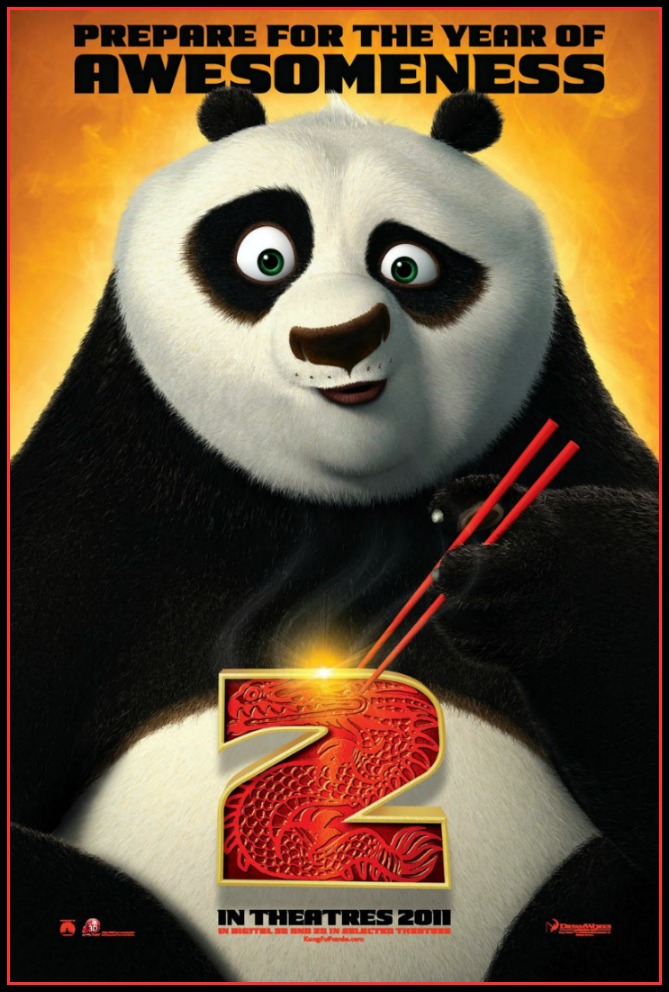
Review: Kung Fu Panda 2 (dir. by Jennifer Yuh Nelson)


In 2008, Dreamworks Animation released what many had thought was one of their animated films. Some even went so far as to consider it on the same level as many of the Pixar animated offerings. This was high praise indeed and the praises from critics was awarded by public acclaim as Kung Fu Panda became an instant classic for Dreamworks Animation. It wasn’t a huge surprise that a sequel was quickly greenlit by the studio and now three years has passed and that sequel has finally come out. Kung Fu Panda 2 does one of those rare feats in film-making where it surpasses it’s original predecessor in all things. This was a sequel that was able to take what made the first one so fun and thrilling and build on it without losing the charm that made it so beloved in the first place.

Kung Fu Panda 2 brings back the Dragon Warrior Po (Jack Black returning in the role of the big fat panda) as he continues to live his dream of having become the Dragon Warrior and fighting evil, bandits and criminals with his fellow kung fu masters, the Furious Five. Instead of the film highlighting Po’s size as a detriment and keeping him a buffoonish character like in the beginning of the first film this sequel actually makes him an equal of his heroes, if not, surpassing them. This is a refreshing change since the writers could’ve easily banked on Po as a character who bungled and stumbled his way through most of the film.

This film was a continuation of Po’s journey as a hero which the first film was just the first step. Despite being a kung fu master in his own right his culture becomes threatened by a villain even more devious than the first film’s Tai Lung. Lord Shen (voiced by Gary Oldman) is the mad peacock heir to Gongmen City who has found an ultimate weapon through fireworks that he plans to defeat kung fu and conquer all of China. Kung fu is everything to Po and he journeys with the Furious Five to confront Lord Shen and stop his plans before it’s too late.

It’s during this journey that Po learns more about his true past and where he truly comes from. The sequences where Po’s adopted goose father tells of Po’s past was some of the best animations Dreamworks has done and I’d say surpasses some of Pixar’s own work. After seeing this film I’m sure many kids and some adults would want themselves their very own baby panda. Who would’ve thought that baby pandas sounded like human babies when they cried. It’s knowing his past that Po must now learn to find his inner peace if he’s to ever go beyond just being a kung fu master.

Kung Fu Panda 2 was actually quite a dark film in places as themes of genocide, destructive march of technology against nature, difficulties of adopted children finding their true origins and many others. That’s not to say that this sequel wasn’t fun to watch. The action took the kung fu fight scenes from the first film to a whole new level, but without turning it into all flash and no substance. It’s during some of the thrilling fight sequences that we see Po truly become part of the Furious Five and even affection from some of it’s members. It would be interesting to see how a third film would explore the growing relationship between Po and certain striped-feline.

The story gets a much needed infusion of creative help from one Guillermo Del Toro who served as creative producer. His inclusion in the film’s development was probably why the film had a much darker and serious tone in addition to the charm it continued from the first film. If there was anyone in Hollywood who knows how to further develop a character through a Campbellian hero’s journey then it’s Del Toro. If Dreamworks Animation is able to keep Del Toro on hand to further treat their other projects then it will be quite a coup for the studio.

The animation in this film is a step above the first film and anything Dreamworks Animation has ever done. With each passing year and release it looks like Dreamworks Animation has been able to come to the same level of animated work Pixar has set with their own projects. While I’m sure there’s no animosity between animators fo the two houses there probably is some sort of friendly rivalry which helps push both studios to improve on their animation work. All this means is that the public wins out in the end as we’re treated to better animated features from both Dreamworks and Pixar. It’s a good thing that Dreamworks Animation has also improved their storytelling with each new film that they’re not being called the weaker films when compared to Pixar’s latest.

In the end, Kung Fu Panda 2 more than lives up to it’s predecessor and actually surpasses it in every way. This sequel’s animation and use of stereoscopic 3D was some of the best in CG animation to date. It had a story that continued to explore and build the characters from the first film that they’ve gone beyond simple, basic animated characters but fully realized and complex individuals. Even the ending scene in the film which definitely sets-up a third film doesn’t seem tacked on but looks like something that would further continue Po’s hero’s journey. Sequels and milking of a franchise usually don’t sit well with serious film fans, but this franchise seems to be doing it correctly and using each new film to further an epic tale. Here’s to hoping we see Po and his Furious Five friends back for more in the coming years.

Kung Fu Panda 2 (Super Bowl TV Spot)


Here’s another tv spot to air during Super Bowl XLV and this time around it’s the one for the upcoming sequel to Dreamworks Animations very popular and successful Kung Fu Panda.

This one using that Queen arena anthem chant from “We Will Rock You”. The 30-second ty spot shows more action with the requisite panda shenanigans from Jack Black’s character.

Kung Fu Panda 2 is one sequel I’m definitely hyped to see as the first film I ended up watching over and over and over and over and over again. The film comes out on May 26, 2011.

Kung Fu Panda 2: The Kaboom of Doom teaser trailer


One of my favorite films of 2008 was an animated film and it wasn’t from Pixar. I’m talking about the Dreamworks Animation release for the summer of the year that was awesome in its very awesomeness. The film I talk of is Kung Fu Panda. It was a film that was fun and more than just a bit inspiring for its message of persevering through obstacles and doubts to achieve one’s dream. That was what I got out if it anyway in addition to what the little ones got which was THE big, fat panda (voiced by the panda-looking one himself Jack Black) doing kung fu in all its awesomeness and bodacity.

It will take another three years before such awesomeness and bodacity returns to the silver screen and in awesome and bodacious 3D. This summer of 2011 will see the return of the Dragon Warrior himself, Po as he must confront a new danger in the form of Gary Oldman voicing some perpetuator of evilness and douchebaggery on the simple talking animals peasants.

Now, time for some kung fu staring contest!

9 Favorite Revenge Films


Having recently seen Michael Caine’s revenge film Harry Brown I got to thinking about other revenge-themed films I’ve watched through the years and I realized that there were quite a bit of them. There’s something just primal and Old Testament about revenge flicks. It doesn’t matter whether they’re high-brow art-house films or the cheapest grindhouse flicks in the end it all boils down to one individual raining down their own version of Divine Wrath on those who wronged them.

Who hasn’t fantasized or thought about going all medieval on someone who just screwed them over. Maybe it was an infraction that was minor that one didn’t need to get overly upset over or something so heinous that only violence at its most basest was the only response. Going through with such thoughts usually stayed there: in one’s thoughts and imaginings. Revenge films seems to be quite popular because they allow even the meekest and most pacifist to secretly live vicariously through the revenge-minded leads in the film.

The list below is not the best revenge films out there but they definitely are my favorites…

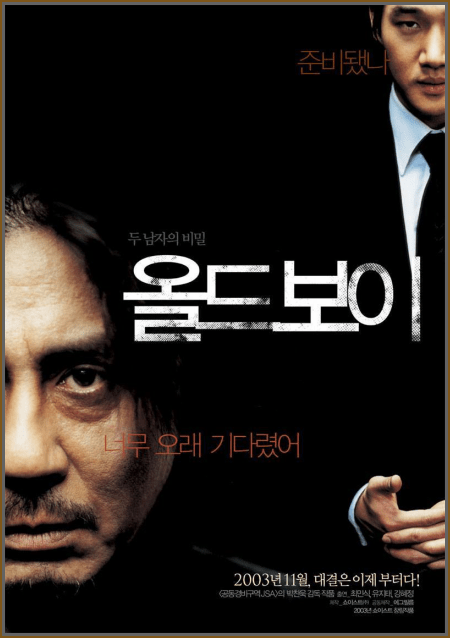
Oldboy – This revenge film by South Korean auteur Park Chan-wook wasn’t just a blast to watch but also happens to be one of the best films of the past decade. It takes a simple plot of a man imprisoned against his will for 15 years with no explanation whatsoever that he literally goes insane and back to sane during his captivity. Revenge being the one thing which keeps him going and revenge he gets to inflict on all those he discovers were responsible. The mind-twisting last act in the film takes the revenge-theme right on it’s head as we find out that the main lead wasn’t the only one on a revenge train of thought.

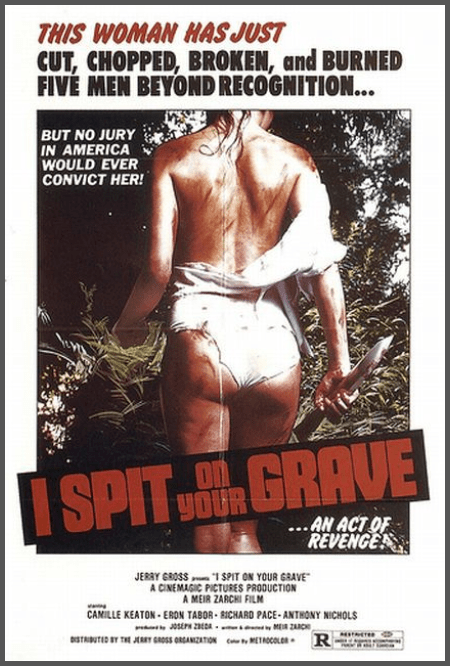
I Spit On Your Grave aka Day of the Woman – This grindhouse classic from Meir Zarchi is the epitome of the rape victim turned revenge valkyrie. The film is not very easy to sit through since there’s nothing subtle about how filmmaker Meir Zarchi filmed every exploitative scene. From the prolonged gang rape sequence to each subsequent revenge act by Camille Keaton’s Jennifer character. Some critics have blasted the film as pandering to the lowest common denominator while others have hailed it as a post-modern feminist film. I like to think that both sides are correct and that the film lies somewhere in the middle. It definitely will put a scare on any group of men who are having thoughts of shenanigans.

Death Wish – When people hear revenge flick they almost always say this iconic film by Charles Bronson from the 70’s. The film was adapted from Brian Garfield’s 1072 novel of the same name and directed by Michael Winner. While critics had mixed reactions to the film with some calling it irresponsible filmmaking, the nation as a whole embraced the film. Here was a film which screamed to the nation that the rising crime-rate in the U.S. during the 1970’s wasn’t going to go unanswered. While some people may have seen the film as a blank check to actually commit vigilantism in the end it just helped a country sick and tired of the crime they see day in and day out. Again here was art becoming a driving force in changing a nation’s collective malaise into something more positive. It didn’t hurt that Bronson was badass as Paul Kersey.

Kill Bill: Volume 1-2 – Who else but the video clerk made good would make what I would consider the greatest genre mash-up film ever made. Quentin Tarantino’s ode to kung fu, spaghetti westerns and revenge flicks became so massive that he had to split the film into two volumes. I am talking about Kill Bill. Not his greatest film ever but I definitely consider it his most geek-friendly and most entertaining. Uma Thurman as The Bride tearing a bloody and witty path of revenge on those who failed to kill her created some of the most iconic fight sequences of the generation this film came out in. Every scene almost seemed to be inspired by other films of a similar theme and genre that film geeks everywhere must’ve exploded in their pants from all the awesomeness they were witnessing. Each volume had two great action sequences that were both fantastical and brutal.

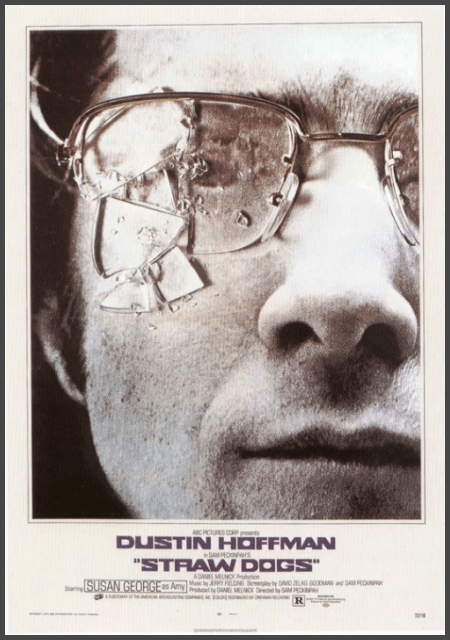
Straw Dogs – One of the most controversial films in Sam Peckinpah’s controversy-filled directing career. Released in 1971 it told the story of how even the meekest person could be pushed into dealing out extreme violent justice on those who have wrong them and those they love. Seen by critics as quite misogynistic due to the nature of the rape scene of Susan George’s Amy character the film was banned for two decades in the UK for it’s unflinching look at violence. Being a huge fan of Sam Peckinpah I had to see it and when I did it automatically became one of my favorite films ever and not just a favorite revenge film. If there was ever a modern retelling of a Biblical-level fable it is this classic from Sam Peckinpah. Every revenge-fueled act by Dustin Hoffman literally oozes Old Testament justice. Just the way I like my revenge. 🙂

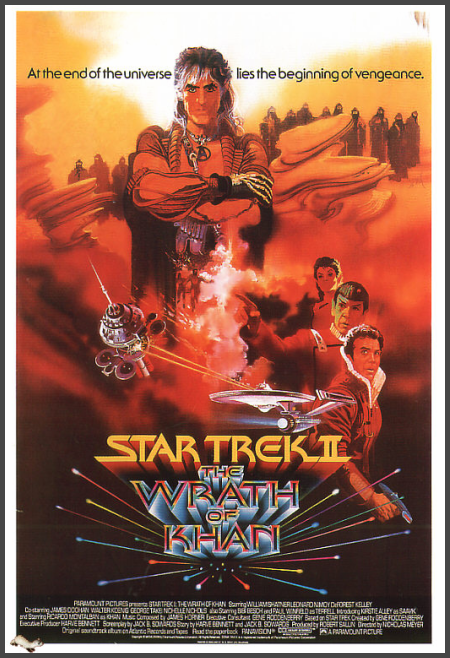
Star Trek II: The Wrath of Khan – Speaking of Biblical this first sequel in the Star Trek film franchise still considered by fans and non-fans alike as the best in the series. Hard to argue with them since it’s also an opinion I share. The sequel takes a popular episode from the original series and follows it up with all the cast of characters older and more seasoned. In the case of Ricardo Montalban’s Khan Noonian Singh quite seasoned and classy as smooth Corinthian leather. It’s a film with Shatner’s Kirk and Montalban’s Khan in an everending cycle of revenge which would culminate in what would be one of film’s most heartbreaking scenes. One could taste the revenge emanating from the two characters as age-won wisdom and genetically-engineered intellect fell by the wayside to feed the vengeance sought by Kirk and Khan. This revenge flick also has one of the most awesome death speeches by a character on film.

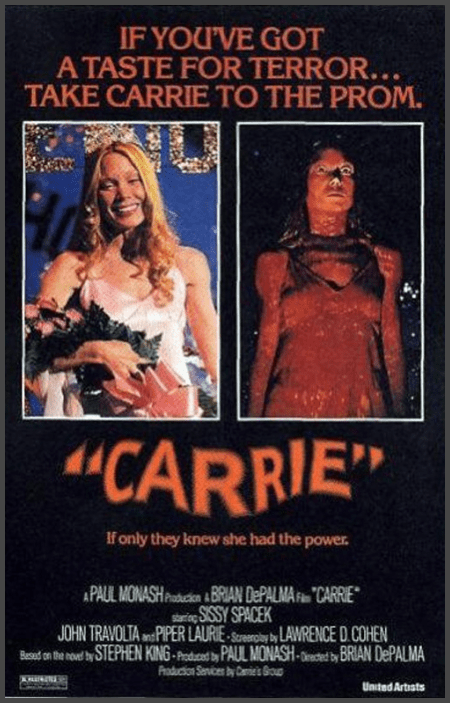
Carrie – Brian De Palma’s film adaptation of one of Stephen King’s better horror novels still seen by many as the best film adapt of a King novel. It combines the existential horror of being a girl and her body maturing in the dog-eat-dog world of high school and the horror said girl can inflict on those tormenting her. It’s high school bullying and revenge with a healthy dose of Stephen King shenanigans mixed in. Sissy Spacek was great as the titular character. One doesn’t have to be a high school girl to feel for Carrie and what she goes through. Her snapping in the last act and inflicting her psychokinetic-brand of revenge on her tormentors must’ve gotten more than a few “Hell yeah!” from some of the teens and adults who went through high school hell. It also has a classic line uttered by Carrie’s mother played by Piper Laurie: “I can see your dirty pillows. Everyone will.”

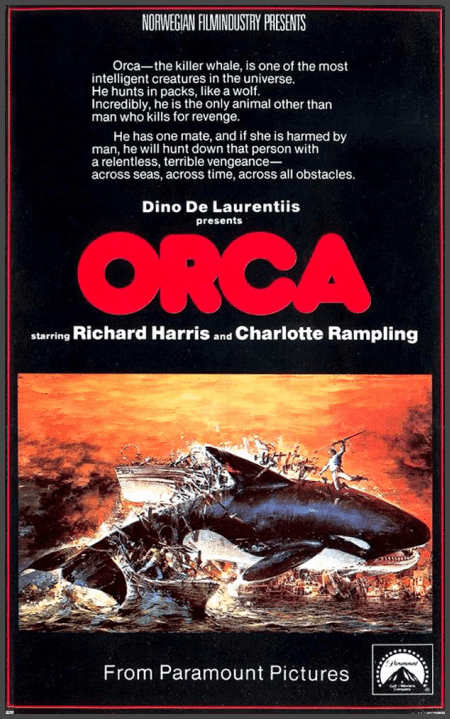
Orca – This film was to be producer Dino De Laurentiis’ attempt to capitalize on the success of Steven Spielberg’s classic man-versus-nature thriller, Jaws. Starring Richard Harris, Charlotte Rampling and Bo Derek the film wasn’t a success when it first came out. While Spielberg’s film was a modern retelling of Moby Dick this killer whale version by director Michael Anderson was Death Wish on water with Paul Kersey as the killer whale. This was one of the first films where I realized none of the people on the screen were worth rooting for to survive. I was all for the killer whale who was on a warpath to avenge his mate and unborn wee killer whale who were killed by Harris and his crew. Shamu this killer whale was not and it always brought a smile to my face whenever the killer whale outsmarted the humans and killed each and everyone in inventive ways. I’m wondering if all the killer whales in all the aquatic parks are just biding their time before they too go all Orca on their handlers and the audience. I’d pay to see that!

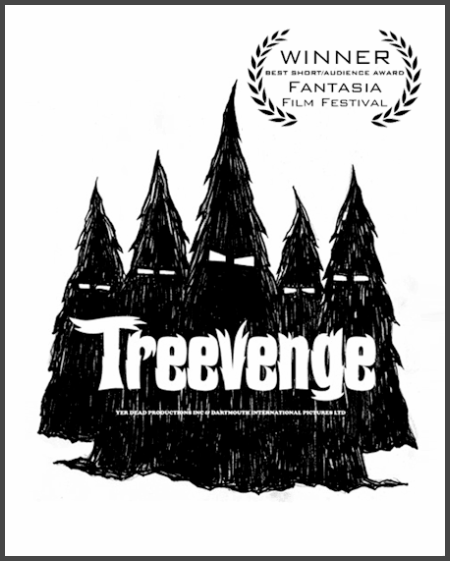
Treevenge – Last but not least the greatest film ever made!