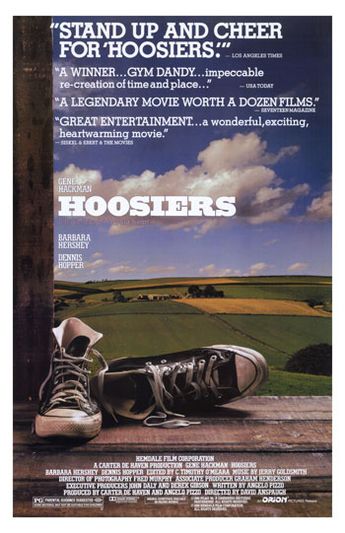
A Movie A Day #68: Hoosiers (1986, directed by David Anspaugh)


I’m back!

Even though it has only been a week since I last did a movie a day, I feel like I’ve been gone forever.  Thank you to everyone who commented or messaged me while I was gone.  It turned out that I just had a bad sinus infection.  It was painful as Hell but, with the help of antibiotics and the greatest care in the world, I’m recovering.

Last week, I asked if anyone had any suggestions for what the 68th movie a day should be.  Case suggested Hoosiers and so it shall be.

In 1951, Norman Dale (Gene Hackman) arrives in the small Indiana town of Hickory.  He is a former college basketball coach who has been hired to coach the high school’s perennially struggling basketball team.  Emphasizing the fundamentals and demanding discipline from his players, Dale struggles at first with both the team and the townspeople.  When he makes an alcoholic former basketball star named Shooter (Dennis Hopper) an assistant coach, he nearly loses his job.  Eventually, though, the Hickory team starts winning and soon, this small town high school is playing for the state championship against highly favored South Bend High School.
For many people, Hoosiers is not just “a basketball movie.”  Instead, it is the basketball movie, the movie by which all other sport films are judged.  Hoosiers is inspired by a true story.  In 1954, small town Milan High School did defeat Muncie for the Indiana State Championship and they did it by two points.  Otherwise, Hoosiers is heavily fictionalized and manages to include almost every sports film cliché that has ever existed.  How good a coach is Norman Dale, really?  Almost every game that Hickory wins is won by only one basket.

Why, then, is Hoosiers a classic?  Much of it is due to director David Anspaugh’s attention to period and detail.  Some of it is due to Gene Hackman, who gives a tough and unsentimental performance.  Whenever Hoosiers starts to cross the line from sentimental to maudlin, Hackman is there to pull it back to reality with a gruff line delivery.  Even his romance with the one-note anti-basketball teacher (Barbara Hershey) works.  Hickory feels like a real place, with a real history and inhabited by real people.

And then there’s Dennis Hopper.  Along with Blue Velvet, Hoosiers was Hopper’s comeback film.  After spending twenty years lost in the Hollywood wilderness, better known for abusing drugs and shooting guns than acting, Hopper had just come out of rehab when he was offered the role of Shooter.  Amazingly, he turned the role down and told the producers to offer it to his friend, Harry Dean Stanton.

According to Peter L. Winkler’s Dennis Hopper: Portrait of an American Rebel, this is what happened next:

Stanton (who, ironically, was also considered for Hopper’s role in Blue Velvet) called Hopper up and asked, “Aren’t you from Kansas?”

“Yeah.”

“Didn’t you have a hoop on your barn?”

“Yeah.”

“I think you may be the guy that David Anspaugh’s looking for.”

Harry Dean Stanton was right.  Dennis Hopper, still very much in recovery, totally inhabited the role of the alcoholic Shooter and gave one of the best performances of his often underrated career.  Both Shooter and the actor playing him surprised everyone by doing a good job and Hopper received his only Oscar nomination for acting for his performance in Hoosiers.  (He had previously been nominated for co-writing Easy Rider.)

You don’t have to like basketball to enjoy the Hell out of Hoosiers.

Roger Corman’s Electric Kool-Aid Tangerine Dream: THE TRIP (AIP 1967)


gary loggins's avatarcracked rear viewer

“You are about to be involved in a most unusual motion picture experience. It deals fictionally with the hallucinogenic drug LSD. Today, the extensive use in black market production of this and other so-called ‘mind bending’ chemicals are of great concern to medical and civil authorities…. This picture represents a shocking commentary on a prevalent trend of our time and one that must be of great concern to us all.” – Disclaimer at the beginning of 1967’s THE TRIP

trip1

“Tune in, turn on, drop out”, exhorted 60’s acid guru Timothy Leary. The hippie generation’s fascination with having a psychedelic experience was a craze ripe for exploitation picking, and leave it to Roger Corman to create the first drug movie, THE TRIP. Released during the peak of the Summer of Love, THE TRIP was a box office success. Most critics of the era had no clue what to make of it, but the youth…

View original post 511 more words

Rebel Rebel: Paul Newman in COOL HAND LUKE (Warner Brothers 1967)


gary loggins's avatarcracked rear viewer

cool1

The Sixties was the decade of the rebellious anti-hero. The times they were a-changin’ and movies reflected the anti-establishment mood with BONNIE & CLYDE, EASY RIDER, and COOL HAND LUKE. Paul Newman starred as white-trash outsider Luke Jackson, but it was his co-star George Kennedy who took home the Oscar for his role as Dragline, the king of the cons who first despises then idolizes Luke.

War vet Luke gets busted for “malicious destruction of municipal property while drunk”, and sent to a prison farm in Florida. The non-conformist Luke butts heads with both the “bosses” (prison guards aka authority) and Dragline, a near illiterate convict who runs the yard. Dragline and Luke decide to settle their differences in a Saturday boxing match. The hulking Dragline beats the shit out of Luke, but the smaller man keeps getting up for more. Dragline finally walks away, and Luke earns both his and…

View original post 551 more words

Film Review: Kid Blue (1973, directed by James Frawley)


KidBlueFor the past week and a half, I have been on a major Warren Oates kick.  The latest Oates film that I watched was Kid Blue, a quirky western comedy that features Warren in a small but key supporting role.

Bickford Warner (Dennis Hopper) is a long-haired and spaced-out train robber who, after one failed robbery too many, decides to go straight and live a conventional life.  He settles in the town of Dime Box, Texas.  He starts out sweeping the floor of a barber shop before getting a better job wringing the necks of chickens.  Eventually, he ends up working at the Great American Ceramic Novelty Company, where he helps to make ashtrays for tourists.

He also meets Molly and Reese Ford (Lee Purcell and Warren Oates), a married couple who both end up taking an interest in Bickford.  Reese, who ignores his beautiful wife, constantly praised Greek culture and insists that Bickford take a bath with him.  Meanwhile, Molly and Bickford end up having an affair.

Bickford also meets the local preacher, Bob (Peter Boyle).  Bob is enthusiastic about peyote and has built a primitive flying machine that he keeps in a field.  The town’s fascist sheriff, Mean John (Ben Johnson), comes across Bob performing a river baptism and angrily admonishes him for using “white man’s water” to baptize an Indian.

Bickford attempts to live a straight life but is constantly hassled by Mean John, who suspects that Bickford might actually be Kid Blue.  When Bickford’s former criminal partner (Janice Rule) shows up in town and Molly announces that she’s pregnant, Bickford has to decide whether or not to return to his old ways.

Kid Blue is one of a handful of counterculture westerns that were released in the early 70s.  The film’s biggest problem is that, at the time he was playing “Kid” Blue, Dennis Hopper was 37 and looked several years older.  It’s hard to buy him as a naïve naif when he looks older than everyone else in the cast.  As for Warren Oates, his role was small but he did great work as usual.  Gay characters were rarely presented sympathetically in the early 70s and counter-culture films were often the worst offenders.  As written, Reese is a one-note (and one-joke) character but Warren played him with a lot of empathy and gave him a wounded dignity that was probably not present in the film’s script.

Kid Blue plays out at its own stoned pace, an uneven mix of quirky comedy and dippy philosophy.  Still, the film is worth seeing for the only-in-the-70s cast and the curiosity factor of seeing Dennis Hopper in full counterculture mode, before he detoxed and became Hollywood’s favorite super villain.

o_kid-blue-dvd-dennis-hopper-warren-oates-5cdc

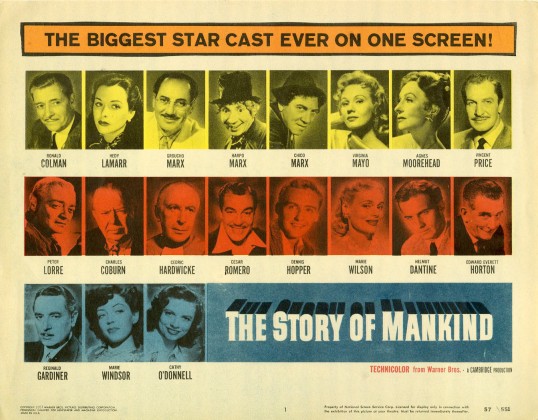
Insomnia File #1: The Story of Mankind (dir by Irwin Allen)


Story of Mankind

What’s an Insomnia File?  You know how some times you just can’t get any sleep and, at about three in the morning, you’ll find yourself watching whatever you can find on cable?  This feature is all about those insomnia-inspired discoveries!

If, last night, you were suffering from insomnia at 3 in the morning, you could have turned on TCM and watched the 1957 faux epic, The Story of Mankind.

I call The Story of Mankind a faux epic because it’s an outwardly big film that turns out to be remarkably small on closer inspection.  First off, it claims to the tell the story of Mankind but it only has a running time of 100 minutes so, as you can imagine, a lot of the story gets left out.  (I was annoyed that neither my favorite social reformer, Victoria C. Woodhull, nor my favorite president, Rutherford B. Hayes, made an appearance.)  It’s a film that follow Vincent Price and Ronald Colman as they stroll through history but it turns out that “history” is largely made up of stock footage taken from other movies.  The film’s cast is full of actors who will be familiar to lovers of classic cinema and yet, few of them really have more than a few minutes of screen time.  In fact, it only takes a little bit of research on the imdb to discover that most of the film’s cast was made up of performers who were on the verge of ending their careers.

The Story of Mankind opens with two angels noticing that mankind has apparently invented the “Super H-Bomb,” ten years ahead of schedule.  It appears that mankind is on the verge of destroying itself and soon, both Heaven and Hell will be full of new arrivals.  One of the angels exclaims that there’s already a housing shortage!

A celestial court, overseen by a stern judge (Cedric Hardwicke) is convened in outer space.  The court must decide whether to intervene and prevent mankind from destroying itself.  Speaking on behalf on humanity is the Spirit of Man.  The Spirit of Man is played by Ronald Colman.  This was Colman’s final film.  In his heyday, he was such a popular star that he was Margaret Mitchell’s first choice to play Rhett Butler in Gone With The Wind.  However, in The Story of Mankind, Colman comes across as being a bit bored with it all and you start to get worried that he might not be the best attorney that mankind could have hired.

Even more worrisome, as  far as the future of mankind is concerned, is that the prosecutor, Mr. Scratch, is being played by Vincent Price.  Making his case with his trademark theatrics and delivering every snaky line with a self-satisfied yet likable smirk on his face, Vincent Price is so much fun to watch that it was impossible not to agree with him.  Destroy mankind, Mr. Scratch?  Sure, why not?  Mankind had a good run, after all…

In order to make their cases, Mr. Scratch and the Spirit of Man take a tour through history.  Mr. Scratch reminds us of villains like the Egyptian pharaoh Khufu (John Carradine) and the Roman Emperor Nero (Peter Lorre, of course).  He shows how Joan of Arc (Hedy Lamarr) was burned at the stake.  The Spirit of Man argues that, despite all of that, man is still capable of doing good things, like inventing the printing press.

And really, the whole point of the film is to see who is playing which historical figure.  The film features a huge cast of classic film actors.  If you watch TCM on a semi-regular basis, you’ll recognize a good deal of the cast.  The fun comes from seeing who tried to give a memorable performance and who just showed up to collect a paycheck.  For instance, a very young Dennis Hopper gives a bizarre method interpretation of Napoleon and it’s one of those things that simply has to be seen.

And then the Marx Brothers show up!

They don’t share any scenes together, unfortunately.  But three of them are present!  (No, Zeppo does not make an appearance but I imagine that’s just because Jim Ameche was already cast in the role of Alexander Graham Bell.)  Chico is a monk who tells Christopher Columbus not to waste his time looking for a quicker way to reach India.  Harpo Marx is Sir Isaac Newton, who plays a harp and discovers gravity when a hundred apples smash down on his head.  And Groucho Marx plays Peter Miniut, tricking a Native American chief into selling Manhattan Island while leering at the chief’s daughter.

And the good thing about the Marx Brothers is that their presence makes a strong argument that humanity deserves another chance.  A world that produced the Marx Brothers can’t be all bad, right?

Anyway, Story of Mankind is one of those films that seems like it would be a good cure for insomnia but then you start watching it and it’s just such a weird movie that you simply have to watch it all the way to the end.  It’s not a good movie but it is flamboyantly bad and, as a result, everyone should see it at least once.


In Praise of Easy Rider’s Captain America


1969 was a watershed year for both America and the movies.  While the war in Viet Nam dragged on and turmoil raged at home, movie audiences watched as two generations of Fondas appeared in movies about the American dream.  In Sergio Leone’s Once Upon A Time In The West, Henry Fonda played Frank, a gunslinger so ruthless that he shoots a child during his first scene.  In They Shoot Horses, Don’t They?, daughter Jane Fonda played a woman struggling to survive the Great Depression.  And, in Easy Rider, Peter Fonda played Captain America.

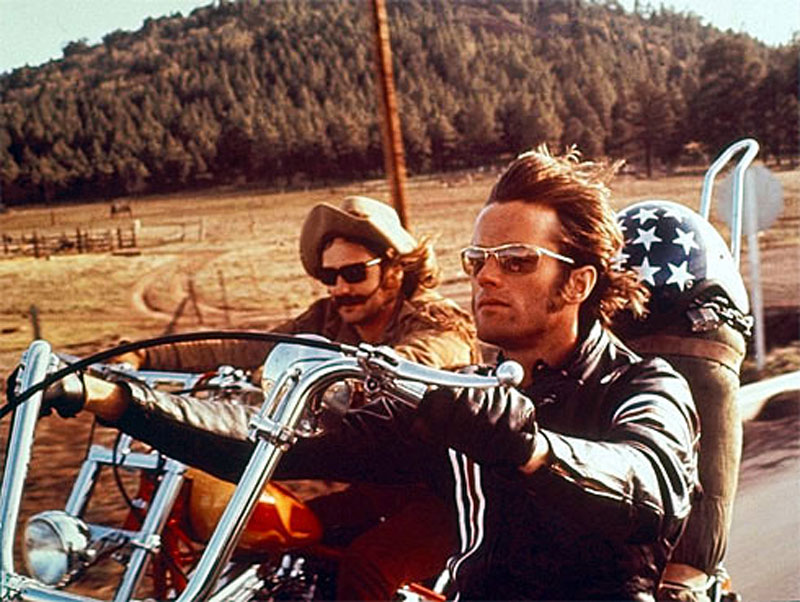
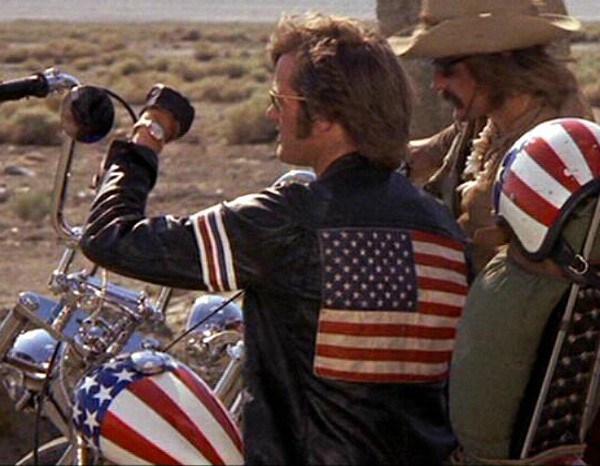
Peter FondaThe Captain America of Easy Rider should not be mistaken for the super soldier played by Chris Evans.  Instead, this Captain America is actually Wyatt Williams, a motorcycle rider who is planning on going to Mardi Gras with his friend Billy (Dennis Hopper, who also directed).  Wyatt is nicknamed Captain America because he wears a leather jacket with an American flag on the back.  It is an appropriate nickname because Wyatt represents everything that is good about America.

When we first meet Captain America, he and Billy are engaged in a business transaction, bringing to mind the old saying that the business of America is business.  They are selling cocaine to none other than Phil Spector.  Taking Spector’s money, Wyatt stuffs it into a plastic tube that he keeps hidden in his motorcycle’s fuel tank.  It is no coincidence that the fuel tank is decorated with the stars and bars.

Peter-Fonda-and-Dennis-Hopper-in-Easy-RiderHaving made their money, Wyatt and Billy ride across the country to celebrate.  At the start of their journey, Wyatt takes off his watch and leaves it on the ground, declaring that time has no meaning to a man who has freedom.  If you replaced their motorcycles with horses, there would be little to distinguish Wyatt and Billy from the American outlaws who might show up in an old Henry Fonda western.

On their way to New Orleans, Wyatt and Billy interact with many different people.  If the always paranoid and nervous Billy represents America’s worst impulses, Wyatt represents the best.  When Wyatt and Billy eat dinner with a rancher and his family, Wyatt alone appreciates what the rancher has accomplished and says, “You’ve got a nice place. It’s not every man that can live off the land, you know. You do your own thing in your own time. You should be proud.”  When they later stop off at a ramshackle hippie commune, Wyatt is the one who says, in the best tradition of American optimism, that “They’ll make it.”

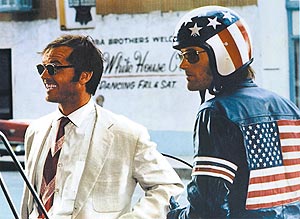
EasyRider2When they stop to pick up a hitchhiker and then later when alcoholic lawyer George Hanson (Jack Nicholson) joins them on their trip, it’s always Wyatt who volunteers to share his bike.  (Billy always rides alone.)  Whenever they stop for the night, it is always the generous Wyatt who offers to share his grass with whomever is traveling with them.  When George smokes for the first time, Wyatt is the one who teaches him.  It is the stoned George who tells Wyatt and Billy that they represent freedom.

It is only after George is beaten to death by a group of rednecks that Wyatt loses his optimistic outlook and his generous spirit.  George’s death opens Wyatt’s eyes in much the same way that the turmoil of the 1960s did for the rest of America.  After George’s murder, Wyatt loses his faith in himself.  When he and Billy reach New Orleans, Mardi Gras is a letdown.  When he takes the acid that was given to him by the hitchhiker, Captain America’s journey becomes a bad trip both figuratively and literally.

0603-peter-fonda-and-easy-riderjpg-b0f5351afb0a53df_mediumWhile Billy insists that they had a great time in New Orleans (in much the same way that some insist that America is just as strong a nation as it has ever been), Wyatt knows the truth.  “We blew it,” Wyatt says, speaking for the entire nation.

Despite his mistakes and despite having blown it, Wyatt, much like America itself, remains good at heart.  When Captain America dies at the end of the film, it is because he is trying to protect his friend Billy.  In the best American tradition, he sacrifices himself to protect another.

This Independence Day, let us all take a few moment to appreciate Wyatt Williams, the man known as Captain America.

Wyatt Williams (aka Captain America) RIP

Wyatt Williams (aka Captain America) RIP


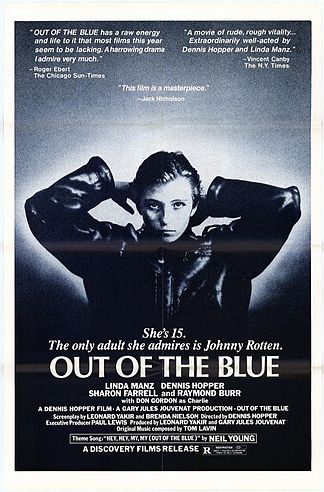
Embracing the Melodrama Part II #64: Out of the Blue (dir by Dennis Hopper)


Out_of_the_Blue_Film“Subvert normality.”

— Cebe (Linda Manz) in Out of the Blue (1980)

The 1980 Canadian film Out of the Blue opens with a terrifying scene.  Don Barnes (Dennis Hopper), drinking a beer and playing with his daughter while driving a truck, crashes into a school bus.  The bus is full of children, many of whom are seen being thrown into the air as the truck literally splits the bus in half.

Don is sent to prison.  His wife, Kathy (Sharon Farrell), becomes a drug addict.  His daughter, Cebe (Linda Manz), grows up to be an angry and alienated teenager.  Cebe spends her time either aimlessly wandering around her economically depressed hometown or else ranting about the phoniness of society to anyone who will listen (and quite a few who won’t).  Much like the killer cops in Magnum Force, all of her heroes are dead.  Occasionally, she sees a pompous therapist (Raymond Burr) whose liberal humanism turns out to be just as empty as the reactionary society that Cebe is striking out against.  Cebe’s heroes are Elvis, Sid Vicious, and her father.

When Don is finally released from prison, he returns home and he announces that he’s straightened out his life.  He promises that he’ll stay sober and he’ll be a good father.  That, of course, is all bullshit.  Soon, Don is struggling to hold down a job and spending his time drinking with his friend Charlie (Don Gordon).  Anyone who has ever had to deal with an alcoholic father will be able to painfully relate to the scenes where Don goes from being kind and loving to demonic in a matter of seconds.

Eventually, it all leads to a violent ending, one that is powerful precisely because it is so inevitable.

Out of the Blue is one of my favorite films, one that I relate to more than I really like to admit.  Directed in a raw and uncompromising manner by Dennis Hopper, Out of the Blue is a look at life on the margins of society.  And while some would argue that not much happens in the film between the explosive opening and the equally explosive ending, nothing needs to happen.  The power of the film comes not from its plot and instead from the perfect performances of Linda Manz, Dennis Hopper, Sharon Farrell, and Don Gordon.  Only Raymond Burr feels out of place but there’s a reason for that.

As much as I love Out of the Blue as a movie, I love the story of its production as well.  Originally, Out of the Blue was to be your typical movie about a rebellious teen who is saved by a patient and compassionate counselor.  Dennis Hopper was originally just supposed to co-star.  However, after the shooting started to run behind schedule, the film’s original director was fired.  Hopper talked the producers into letting him take over as a director.

This was the first film that Hopper was allowed to direct since the 1971 release of the infamous flop, The Last Movie.  Hopper, who was then best known for his drug use and his alcoholism, promised to be on his best behavior.  However, he then proceeded to secretly rewrite the entire film.

When Raymond Burr showed up to shoot his scenes, he was under the impression that he was still the star of the film.  Hopper essentially proceeded to shoot two separate films.  One film followed the original script and starred Raymond Burr.  The other was Hopper’s vision.  When it came time to take all of the footage and edit together the film that would be called Out of Blue, only two of Burr’s scenes made it into final cut and, in both of those scenes, Burr’s character is portrayed as being clueless.

Out of the Blue is not a happy film but it’s a good one.  More people need to see it.

Shattered Politics #84: Swing Vote (dir by Joshua Michael Stern)


Swing_vote_08

Have you ever heard the old saying about how one vote can make all the difference?  I’ve always had to laugh whenever I hear that because I know that, every election, my sister Melissa is going to cancel out my ballot by voting the exact opposite of how I vote.  As a result, even though I’ve participated in almost every election since 2004, my vote has hardly ever really mattered.

(Then again, neither has my sister’s….)

But anyway, the idea of one vote making all of the difference is taken to its logical extreme in the 2008 comedy Swing Vote.  In Swing Vote, a presidential election comes down to who wins the state of New Mexico.  And who wins the state of New Mexico will be determined by just one vote.  You see, the popular vote in New Mexico is tied between the two candidates but it turns out that, due to a voting machine error, one man’s vote has not been counted.  And now, that man has ten days to recast his vote.

(Why does he have ten days?  Mostly because there would not be a movie if they just said, “Please cast your vote again…now!”)

Of course, the problem is that the guy never cast a vote in the first place.  Instead, his vote was cast by his daughter (Madeline Carroll), who basically committed an act of vote fraud and violated federal law.  But it’s cute because she’s super precocious and she just wants her Dad to stop being such a fuck-up.

Oh, did I mention that?

That’s right — the fate of America is in the hands of a complete and total fuck-up.  His name is Bud and he’s played by Kevin Costner.  He’s a rather stupid guy who has never been responsible a day in his life.  He’s also a former felon, which really should have made him ineligible to vote in the first place.  And, on top of that, he’s the type of alcoholic who promises his little girl that he’ll meet her at a scheduled place and time and then proceeds to get drunk inside.

OH MY GOD, WHAT A GREAT GUY!

But, we’re supposed to like Bud because he’s played by Kevin Costner and I really don’t get that logic.  I always find it odd that, every year, we hear about how Kevin Costner is going to be in a few dozen films and how they’re all going to be hits and he’s suddenly going to be a big star again.  I’m never quite sure why people are excited about this prospect.  Whenever I see Costner on-screen (which, admittedly, doesn’t happen that often), I’m always struck by the fact that, regardless of the role, he really does come across as being an asshole.  That really does seem to be his screen presence.  That’s certainly the case in Swing Vote.

And maybe that’s the point of the film.  Be sure to vote so that the fate of America doesn’t end up in the hands of Kevin Costner.

That said, I will say that Swing Vote deserves some credit for casting Kelsey Grammer as the President and Dennis Hopper as his opponent.  Personally, I probably would have voted to reelect Kesley but I think Dennis would have done a good job as well.

(By the way, if ever do find yourself watching Swing Vote, imagine how much funnier the film would have been if it ended with Costner casting his vote and then announcing, “I voted third party!”)


Horror on TV: Twilight Zone 4.4 “He’s Alive”


TheTwilightZoneLogo

Tonight’s episode of the Twilight Zone was originally broadcast on January 24th, 1963 and it’s one of the rare hour-long episodes of the original Twilight Zone. In He’s Alive, a very young Dennis Hopper plays Peter Vollmer, an aspiring Neo-Nazi who isn’t having much luck bringing fascism to America until he meets a mysterious benefactor who teaches him the tricks of the trade.

It’s a pretty good (if heavy-handed) episode, distinguished by both Dennis Hopper’s lead performance and a message that is probably even more relevant today than when the show was first broadcast.

This episode was written by Rod Serling and directed by Stuart Rosenberg.

Back to School #43: River’s Edge (dir by Tim Hunter)


In his film guide, Heavy Metal Movies, Mike McPadden describes the disturbing 1987 teen crime drama River’s Edge as being “666 Candles“.  It’s a perfect description because River’s Edge appears to not only be taking place in a different socio-economic setting than Sixteen Candles and The Breakfast Club but perhaps on a different planet as well.

River’s Edge opens with a close-up of a dead and naked teenage girl lying on the edge of a dirty, polluted river and it gets darker from there.  The dead girl was the girlfriend of the hulking John Tollet (Daniel Roebuck, playing a character who is miles away from his role in Cavegirl).  As John explains to his friends, he strangled her for no particular reason.  His friends, meanwhile, respond with detachment.  Their unofficial leader, the hyperactive Layne (Crispin Glover), insists that since nothing can be done about the dead girl, their number one concern now has to be to keep John from getting caught.  While Layne arranges for John to hide out with a one-legged drug dealer named Feck (Dennis Hopper), two of John’s friends, Matt and Clarissa (played by Keanu Reeves and Ione Skye), consider whether or not they should go to the police.  Oddly enough, John really doesn’t seem to care one way or the other.

Seriously, River’s Edge is one dark film.  If it were made today, River’s Edge would probably be directed by someone like Larry Clark and, in many ways, it feels like a distant cousin to Clark’s Bully.  The teenagers in River’s Edge live in a world with little-to-no adult supervision.  Matt’s mom is more concerned with whether or not Matt has been stealing her weed than with the fact that Matt might be covering up a murder.  The local high school teacher is a former hippie who won’t shut up about how much better his generation was compared to every other generation.  In fact, the only adult with any sort of moral code is Feck and he’s usually too busy dancing with a sex doll to really be of much help.  It’s a world where no one has been raised to value their own lives so why should they care about a dead girl laying out on the banks of the river?

The film features good performances from Keanu Reeves, Ione Skye, and Daniel Roebuck but really, the entire movie is stolen by Crispin Glover and Dennis Hopper.  In the role of Layne, Glover is a manic wonder, speaking quickly and gesturing even when he isn’t making a point.  When Layne first shows up, he seems like he’s just overly loyal to his friend John but, as the film progresses, it becomes more apparent that he’s less concerned about protecting John and more interested in ordering other people to do it.  For Layne, protecting John is ultimately about maintaining power over Matt, Clarissa, and the rest of their friends.

As for Dennis Hopper — well, this is one of those films that you should show to anyone who says that Hopper wasn’t a great actor.  The role of a one-legged drug dealer who lives with a sex doll sound like exactly the type of role that would lead Hopper to going totally over-the-top.  Instead, Hopper gave a surprisingly subtle and intelligent performance and, as a result, he provided this film with the moral center that it very much needs.

Glover and Hopper