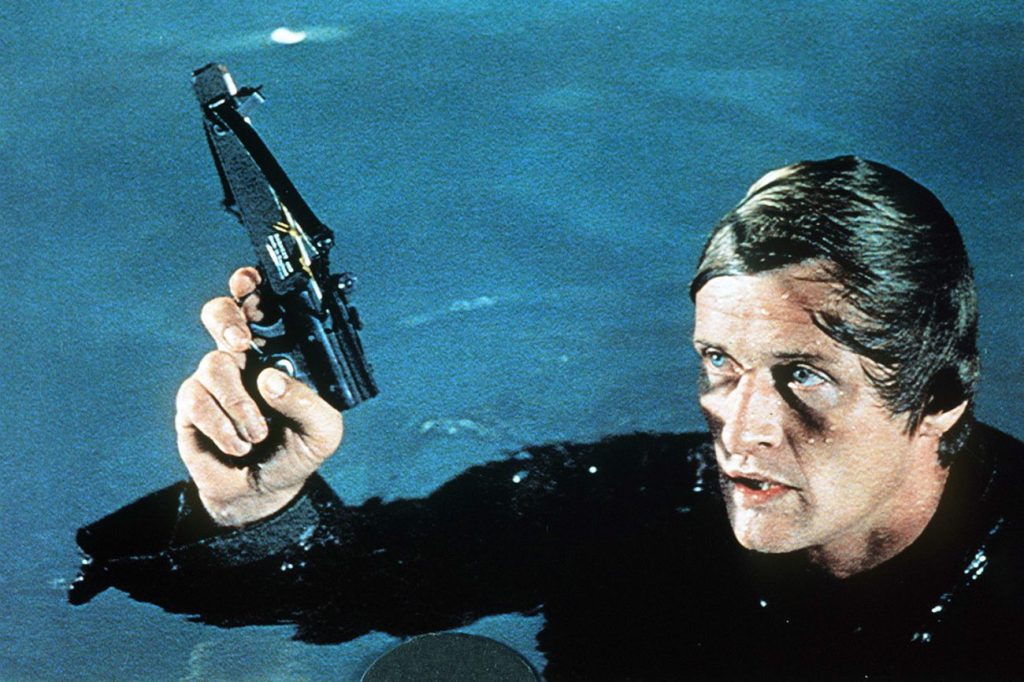
I’ve been having the best time reviewing Rutger Hauer films every Sunday. Today, I revisit THE OSTERMAN WEEKEND from 1983. Hauer made this film the year after BLADE RUNNER, so he was in the prime of his career. It also teams him up with an all-star supporting cast and master director Sam Peckinpah.
THE OSTERMAN WEEKEND opens with CIA Director Maxwell Danforth (Burt Lancaster) watching a recording of agent Laurence Fassett (John Hurt) making love to his wife. When Fassett hits the shower, two KGB assassins come in and kill her. Consumed by grief, Fassett hunts down the assassins and uncovers a Soviet spy network known as Omega. Fassett has identified three American men as top Omega agents… television producer Bernard Osterman (Craig T. Nelson with an awful, glued-on mustache), plastic surgeon Richard Tremayne (Dennis Hopper) and stock trader Joseph Cardone (Chris Sarandon). Rather than arrest the men and risk alarming the KGB, Fassett proposes to director Danforth that they try to turn one of the three men to the side of the West in hopes that this person will provide the information needed to bring down the Omega network.
Enter controversial television journalist John Tanner (Rutger Hauer). Fassett knows that Tanner has been close friends with Osterman, Tremayne, and Cardone since all four attended Berkeley together, and he believes that Tanner can successfully turn one of them. Although initially highly skeptical, the super patriotic Tanner begins to change his mind when Fassett shows him videotaped evidence of his old friends talking with a Russian agent in various capacities. Tanner reluctantly agrees to try turn one of his friends at their annual “Osterman Weekend” reunion which is coming up that week at Tanner’s house. He does have one condition… that Danforth, the CIA director will appear as a guest on his show. Danforth agrees to this condition. So that weekend, Tanner and his wife Ali (Meg Foster) welcome their old friends and their wives into their home, while Fassett has video camera equipment installed and hangs out in a van spying on the festivities. There’s no doubt it will turn out to be an awkward weekend, and you can’t help but wonder if Fassett may have more sinister motives than he’s letting on.
I’ll go ahead and say that I had a great time watching THE OSTERMAN WEEKEND for the first time in thirty-plus years. I’ve often read a criticism that the plot of this film is “incomprehensible.” Based on a book by Robert Ludlum, the story is purposely designed to keep you guessing up until its big reveal, but I didn’t have any trouble following it all. I’d say the biggest issue is that it doesn’t really stand up under close scrutiny. Some of the actions of the various characters don’t always make a lot of sense in light of the movie’s big twist near the end, but that didn’t take away from my personal enjoyment of the film. I just went along with the plot wherever it took me, and that was easy for me to do based on the cast that we have assembled. Any movie that includes Rutger Hauer, Burt Lancaster, John Hurt, Craig T. Nelson, Dennis Hopper, Chris Sarandon, Meg Foster, Helen Shaver, and Candy Yates will get a watch from me. Heck, Tim Thomerson even shows up as a motorcycle cop at one point. It’s a who’s who of excellent actors who always make their films watchable. In my opinion, it’s Hauer, Hurt, Foster and Nelson who do the most with their characters and take home the acting honors for their work here. Burt Lancaster is one of the all-time greats, and he does a good job, but it’s a one note character so there isn’t much he can do. Hopper and Sarandon are also fine, but their characters don’t really stand out. Their screen wives, Shaver and Yates, seem to be here mostly for eye candy because their tops are off for an abnormally large amount of their screen time! Speaking of eyes, the Hauer / Foster team up has to be on the list of the most striking combo pair of eyes in the history of cinema. Foster has the most noticeable eyes of any actress I’ve ever seen.
This is the great Sam Peckinpah’s final film, and I don’t agree with the people who complain that his career ended with a whimper. THE OSTERMAN WEEKEND is not in the same league as THE WILD BUNCH, RIDE THE HIGH COUNTRY, THE STRAW DOGS, or THE GETAWAY, but not many films are, including most of his own. And this movie is certainly visionary in one area, and that is found in its main theme about the damage that can be done with the manipulation of the media, including physical media, like videotape and audiotape. The primary driver of the film from the very beginning to the very end is the danger of false information that looks and sounds true. I can promise you that as I type this, and as you read it, there are people all over this world trying to make lies sound or appear true so they can share them on the news and on social media. I invite you to question everything you read, watch or hear on any outlet where you receive your news. Peckinpah’s final film beats this into our heads, just 40 years earlier.
Sam Peckinpah was known for his stylish and violent action sequences. THE OSTERMAN WEEKEND is more of a paranoid thriller, but it does feature some good action. There’s a chase sequence early in the film where Hauer’s wife and son are kidnapped, and he’s forced to commandeer the truck of honeymooners John Bryson (a Peckinpah regular) and Anne Haney (Greta from LIAR LIAR) to take off in hot pursuit. The scene features Peckinpah’s signature stunts, slow motion, and a myriad of cool tracking shots. There’s another fun scene where Hauer is using a baseball bat to defend himself against his pal Craig T. Nelson, who’s been shown to be a martial arts expert. It’s an exciting scene even if Hauer does get his ass kicked, in slow motion no less. And I always appreciate a movie with some good crossbow action, especially when it’s being wielded by a lady. The poster of the film prominently features a lady with a crossbow and we get to see Meg Foster step into that role in the actual film. She gets one especially gruesome, blood gurgling kill.
Overall, I think THE OSTERMAN WEEKEND is a good film. It is not nearly as bad as the critics of the time labeled it, and it’s not as good as Peckinpah’s best work, but you can certainly do a lot worse. It has a great cast, a timely message, a lot more sex and nudity than I remembered, and some cool action sequences. It’s definitely worth a watch!
Ray Mercer (Peter Weller) has just gotten out of prison and already, he and his wife Rebecca (Tia Carrere) are heading to Nevada for a quicky divorce. However, a stopover in Las Vegas leads to Ray having a run of luck in a casino owned by Charles Atlas (Dennis Hopper). Ray and Rebecca start to reconsider their divorce but their reconciliation is temporarily put on hold when the casino is robbed by a bunch of thieves led by Martin Kove. Because of Ray’s criminal history, the police (led by David Alan Grier) consider Ray to be the number one suspect. Ray and Rebecca try to escape from the casino and clear Ray’s name, leading to a night on nonstop action and an explosive climax at the Hoover dam.
One thing that you can say about Top of the World is that it certainly isn’t boring. The action starts earlier and lasts nonstop until the end of the movie. No sooner has Ray escaped from one scrape than he finds himself in another. Despite the low-budget, the action scenes are often spectacularly staged and exciting to watch. Another thing that you can say about Top of the World is that, for a B-movie, it certainly has a packed cast. Along with Weller, Carrere, Hopper, Grier, and Kove, the movie also finds room for Peter Coyote, Joe Pantoliano, Ed Lauter, Gavan O’Herlihy, Eddie Mekka, Cary-Hiroyuki Tagawa, and even Larry Manetti of Magnum P.I. fame. This movie paid off a lot of mortgages and probably funded more than a few vacations.
One thing you can’t say about Top of the World is that it makes any sense. It doesn’t. There are so many holes in the plot that you could fly a helicopter through them and that’s exactly what this film does. But with the nonstop action and the entertaining cast, most people won’t mind. I certainly didn’t!
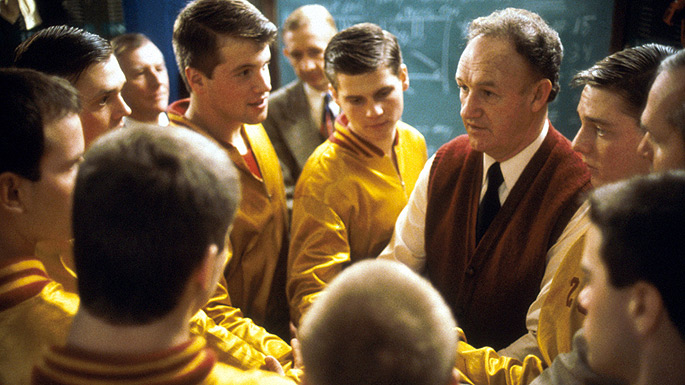
Gene Hackman is a tremendous, multiple Oscar winning actor who has been in some of the best movies ever made. Of all that great work, the movie that means the most to me is HOOSIERS (1986). If you don’t believe me, just go ahead and follow me on X. I’m easy to find. My handle is @Hoosiers1986. I’ve shared before that my dad was a high school basketball coach at small schools here in Arkansas that weren’t much different from the one in Hickory, IN depicted in the film. Growing up in the Crain household, basketball was my life and my dad and HOOSIERS have always been such inspirations to me.
On his 95th birthday, I wanted to share this video I found of Hackman discussing his role as Coach Norman Dale in HOOSIERS, which includes clips from behind the scenes and of the film itself. I had never seen this material before so I found it especially interesting. He tells a really special story about a lady he met while on location. It was quite touching. Happy Birthday, Mr. Hackman! Enjoy!
It was around 1986 or 1987, and I was around 13 years old. I had never heard of David Lynch, but I was at this video store at the Park Plaza mall in Little Rock when I came across a VHS tape of BLUE VELVET on sale for $1.99. The description looked very interesting, and it had Dennis Hopper in it. I recognized Hopper because he was in one of my favorite movies at the time, HOOSIERS. My dad was a high school basketball coach, so basketball was my life up until I graduated high school. Somehow, I was able to talk my mom into buying it for me. BLUE VELVET was probably the strangest film I had seen up to that point in my life, and there was no doubt that I didn’t understand what was going on in some parts of the film, but I was still mesmerized by it. I became an immediate fan of Lynch.
For the next decade or so, I was on the lookout for anything new from David Lynch, whether it be the TWIN PEAKS T.V. series, or even more importantly to me, WILD AT HEART, with Nicolas Cage, Laura Dern and Willem Dafoe. I’d watch the man’s work all by myself in my home in Toad Suck, Arkansas. It felt like I was in a gang of 1, as I’m not sure there was another person in my community who had any clue who David Lynch was, or who appreciated his work. But that was okay. I enjoyed his films and that’s all that matters.
I haven’t kept up with David Lynch that much over the last few years, but I’ve always recognized what a unique talent he was. Rest in peace, sir, and congratulations on a life well lived!
HOOSIERS is based on the true story of a small high school winning the Indiana state basketball championship in 1954. Gene Hackman plays Coach Norman Dale, the once successful college coach who gets a second chance when he’s hired to coach high school basketball in the tiny town of Hickory, Indiana. It takes some time for Coach Dale to whip the talented, but undisciplined young men into a team, and it also takes a little time for local legend Jimmy Chitwood to decide that he will play basketball again. Chitwood had stopped playing prior to the arrival of Coach Dale, but after watching the way the coach goes about his business, he decides he’ll give it another go. After a rough start, the team starts playing good basketball and starts piling up wins as they make their way towards a potential state championship.
HOOSIERS was released when I was 13 years old, and it has been one of my favorite movies for almost 40 years. Why, you might ask? I’ll start by giving you a little Bradley Crain family history. First, basketball was my life growing up. My dad was a teacher and high school basketball coach. From the earliest days I can remember, my dad was teaching me how to play basketball. He taught me the proper techniques for shooting, and through lots of practice I became very good at it. I’m one of those people who could be referred to as a “gym rat.” The only things I wanted to do growing up were play basketball and go fishing. I have a brother who is one year and 5 days older than me, and he loved basketball too. The competition between the two of us made it difficult at times at home, but it also pushed us to get better. Second, I grew up in a small rural community in Arkansas known as Toad Suck, and I went to school in the small town of Bigelow, Arkansas. Bigelow was classified as a “Class B” school for sports purposes. This was the smallest classification that you could be in, and my class consisted of approximately 40 students. Finally, when HOOSIERS came out I was in junior high and my dream was to win a high school state basketball championship. Our teams were good, and I was still young and naïve enough to believe anything was possible. We even won the district championship my 9th grade year, which was the year after HOOSIERS was released. Alas, the chips didn’t fall our way, and even though we won a lot of basketball games over the next few years, there were no state championships. Now back to the movie!
One of my favorite things about HOOSIERS is the cast of young men hired to play the members of the team. So often in movies, the actors that are supposed to be good at basketball are clearly not. That’s not the case in HOOSIERS. These guys can act and are talented basketball players as well. And what can I say about the cast that includes a marvelous Gene Hackman as the coach, and Dennis Hopper as the friendly, but alcoholic dad of one of the players who “knows everything there is to know about the greatest game ever invented.” Hopper is phenomenal, and his work was recognized with an Oscar nomination. Finally, as the team is making its way towards the championship, each player is given a moment to shine and do their part to help the team. I liked that. It all makes for an exciting and heartwarming true story that pretty much anyone can enjoy. I still love the movie now just thinking about it!
4 (or more) Shots From 4 (or more) Films is just what it says it is, 4 (or more) shots from 4 (or more) of our favorite films. As opposed to the reviews and recaps that we usually post, 4 (or more) Shots From 4 (or more) Films lets the visuals do the talking.
88 years ago, Dennis Hopper was born in Dodge City, Kansas.
It seems rather appropriate that one of America’s greatest cinematic outlaws was born in a town that will be forever associated with the old west. Dennis Hopper was a rebel, back when there were actual consequences for being one. He started out acting in the 50s, appearing in films like Rebel Without A Cause and Giant and developing a reputation for being a disciple of James Dean. He also developed a reputation for eccentricity and for being difficult on set and he probably would have gotten completely kicked out of Hollywood if not for a somewhat improbable friendship with John Wayne. (Wayne thought Hopper was a communist but he liked him anyways. Interestingly enough, Hopper later became a Republican.) Somehow, Hopper managed to survive both a raging drug addiction and an obsession with guns and, after a mid-80s trip to rehab, he eventually became an almost universally beloved and busy character actor.
Hopper, however, always wanted to direct. He made his directorial debut with 1969’s Easy Rider, a film that became a huge success despite being an infamously chaotic shoot. The success of Easy Rider led to the Hollywood studios briefly trying to produce counter-culture films of their own. Hopper was given several million dollars and sent to Peru to make one of them, the somewhat dangerously titled The Last Movie. Unfortunately, The Last Movie, was such a bomb that it not only temporarily derailed Hopper’s career but it also turned Hollywood off of financing counter culture films. Hopper spent a decade in the Hollywood wilderness, giving acclaimed performances in independent films like Tracks and The American Friend, even while continuing to increase his reputation for drug-fueled instability. Hopper would eventually return to directing with his masterpiece, 1980’s Out of the Blue. (Out of the Blue was so controversial that, when it played at Cannes, Canada refused to acknowledge that it was a Canadian production. It played as a film without a country. Out of the Blue, however, is a film that has stood the test of time.) Unfortunately, even after a newly cleaned-up Hopper was re-embraced by the mainstream, his directorial career never really took off. He directed 7 films, of which only Easy Rider and Colors were financially successful. Contemporary critics often didn’t seem to know what to make of Dennis Hopper as a director. In recent years, however, Hopper’s directorial efforts have been reevaluated. Even The Last Movie has won over some new fans.
Today, on his birthday, we honor Dennis Hopper’s directorial career with….
4 Shots From 4 Dennis Hopper Films
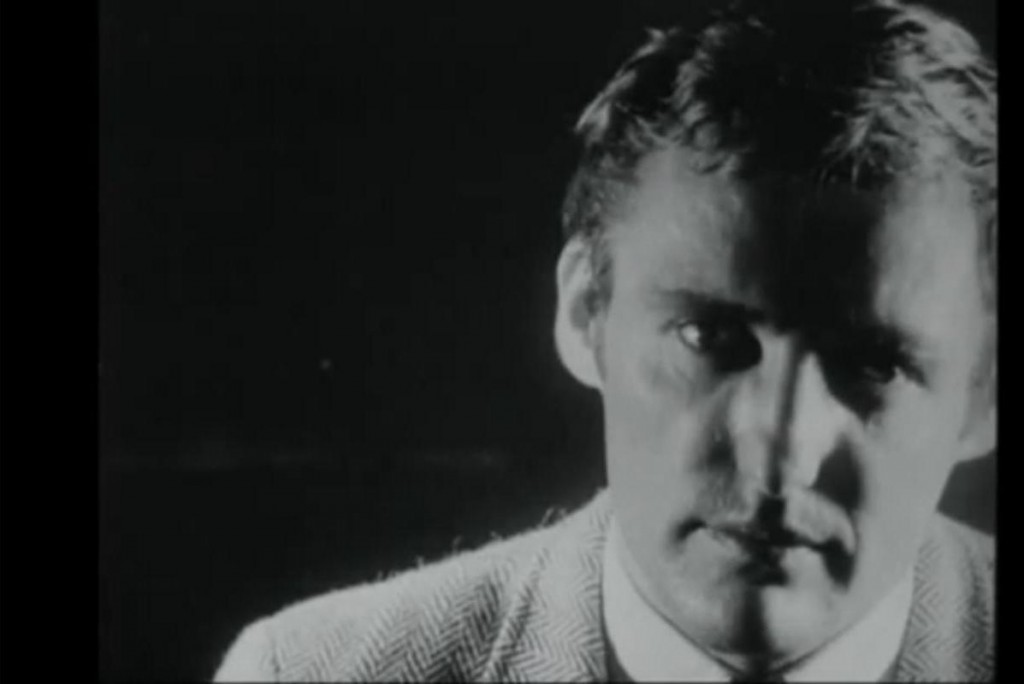
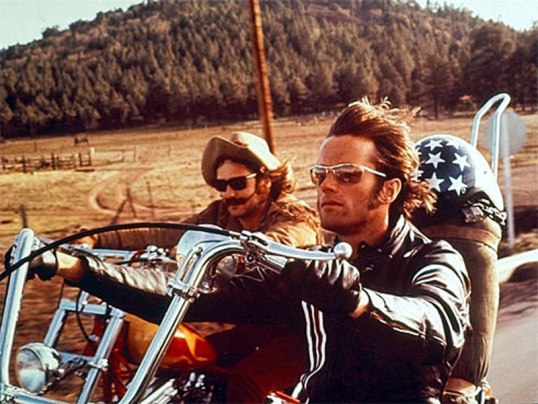
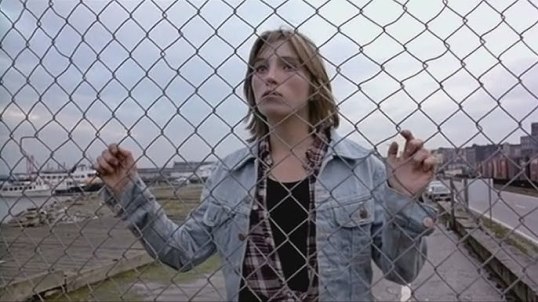
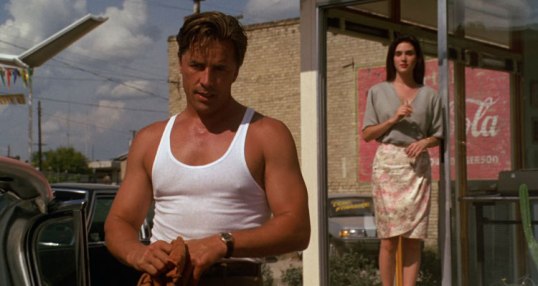
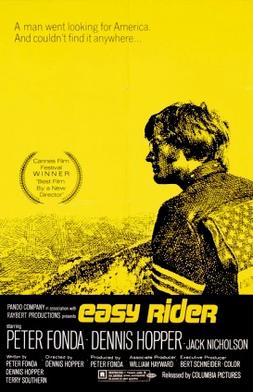
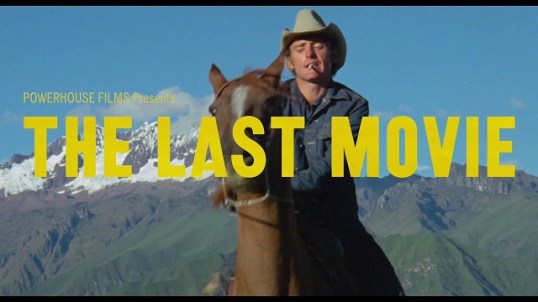
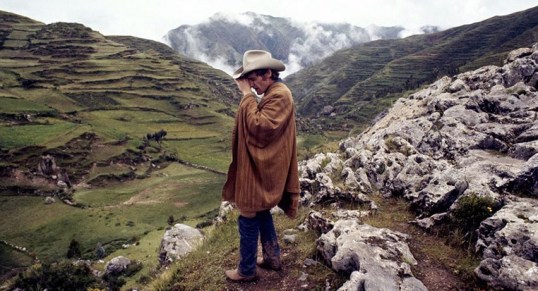
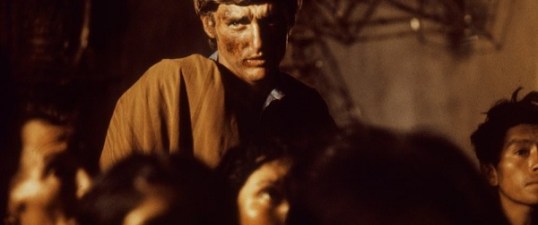
Easy Rider (1969, dir by Dennis Hopper, DP: Laszlo Kovacs)The Last Movie (1971, dir by Dennis Hopper, DP: Laszlo Kovacs)Out of the Blue (1980, dir by Dennis Hopper, DP: Marc Champion)The Hot Spot (1990, dir by Dennis Hopper, DP: Ueli Steiger)
If you can’t get down to New Orleans today (because maybe you have a sprained ankle like me), fear not! Mardi Gras has been immortalized in a number of films. In fact, some have theorized that the whole reason 1969’s Easy Rider was filmed was because Dennis Hopper wanted to go to New Orleans.
The Mardi Gras sequence occurs towards the end of Easy Rider. After a long and eventful journey, Wyatt (Peter Fonda) and Billy (Dennis Hopper) reach New Orleans and experience Mardi Gras with two women that they met at a brothel (Karen Black and Toni Basil). However, the Mardi Gras scenes were actually amongst the first to be shot and Hopper actually filmed several hours of documentary footage of New Orleans’s most famous party. If you watch the footage, you can see bystanders looking directly at the camera. They were not extras hired for the film. They were people on the street who became a part of one of the most important indie films in the history of American cinema. These scenes were shot guerilla style, without permits or, by most reports, any advanced planning.
Hopper also filmed Fonda having an actual bad acid trip. For obvious reasons, Fonda was not happy about being filmed in that condition but he did say, in later interviews, that Hopper made the right decision to include the footage in the film.
For the record, I relate to Toni Basil in this film. She’s having fun and dancing no matter what.
Sometimes, you see a film that is just so weird and incoherent that you can’t help but love it.
Of course, it also helps if the film has a once-in-a-lifetime cast of actors who you would never expect to see acting opposite each other.
For me, that’s certainly the case with 1990’s Backtrack. Directed by Dennis Hopper, Backtrack is a film about an artist (Jodie Foster, channeling Jenny Holzer) who witnesses a mob murder committed by Joe Pesci, Dean Stockwell, Tony Sirico, and John Turturro. An FBI agent played by Fred Ward suggests that the artist should go into the witness protection program but she doesn’t want to give up her life as a New York sophisticate who creates challenging LED displays and who can eat Sno Balls whenever she gets the craving for one. (Yes, this is a plot point.) Turturro and Sirico break into the artist’s apartment and kill her boyfriend, who is played by a wide-eyed Charlie Sheen. The artist puts on a blonde wig and goes on the run, eventually getting a job in advertising.
Realizing that his men can’t get the job done, mob boss Vincent Price decides to hire a legendary hitman played by Dennis Hopper (who also directed this film) to track down the artist. However, the hitman becomes fascinating with the artist’s work, finds pictures of her posing in black lingerie, and immediately falls in love with her. Not only does he wants to save her life but he wants her to wear the same lingerie exclusively for him. (Yes, this is a pretty big plot point.) At first, the artist refuses and views the hitman as being some sort of pathetic perv. But then she discovers that he’s covered her bed with Sno Balls….
Meanwhile, a young Catherine Keener shows up as the girlfriend of a trucker who briefly considers giving the artist a ride to Canada.
And then Bob Dylan shows up, handling a chainsaw.
And there’s Helena Kallianiotes, the outspoken hitch-hiker from Five Easy Pieces, yelling at Joe Pesci!
And there’s Dennis Hopper’s The Last Movie co-star, Julie Adams! And there’s Toni Basil! And there’s director Alex Cox!
Dennis Hopper not only starred in Backtrack but he also directed and it’s obvious that he placed a call into just about everyone he knew. In fact, one could argue that the only thing more shocking than Vincent Price showing up as a mob boss is that Peter Fonda, Karen Black, Elliott Gould, Robert Walker Jr., and Kris Kristofferson are nowhere to be found in the film. Hopper’s first cut of Backtrack was reportedly 3 hours long but the studio cut it down to 90 minutes, renamed it Catchfire, and Hopper insisted on being credited as Alan Smithee. Later, Hopper released a two-hour version with the Backtrack title and his directorial credit restored.
Regardless of which version you see, Backtrack is an odd film. It’s hardly the first film to be made about a hit man falling for his target. What distinguishes this film is just how bizarre a performance Dennis Hopper gives in the role of the hitman. It’s as if Hopper gave into every method instinct that he had and the end result was a mix of Blue Velvet‘s Frank Booth and the crazed photojournalist from ApocalypseNow. Jodie Foster’s cool intelligence makes her the ideal choice for a conceptual artist but it also makes it hard to believe that she would fall for a jittery hitman and, in her romantic scenes with Hopper, Foster often seems to be struggling to resist the temptation to roll her eyes. Somehow, their total lack of romantic chemistry becomes rather fascinating to work. They are two talented performers but each appears to be acting in a different movie. What’s interesting is that I think a movie just about Hopper’s spacey hitman would be interesting (and, if you’ve ever seen The American Friend, it’s hard not to feel that such a movie already exists) but I think a movie about just about Foster’s artist and her life in New York would be just as fascinating. Taken as individuals, the artist and the hitman are both compelling characters. Taken as a couple, they don’t belong anywhere near each other.
But let’s be honest. This is a film that most people will watch for the parade of character actors delivering quirky dialogue. Even if one takes Hopper and Foster out of this mix, this is an amazingly talented cast. One need only consider that John Turturro did Do The Right Thing before appearing in this film while Joe Pesci and Tony Sirico did Goodfellas immediately afterwards. This film features a once-in-a-lifetime cast, made up of actors who were apparently told to do whatever they felt like doing. Turturro plays up the comedy. Sirico plays his role with cool menace. Stockwell barely speaks above a whisper. Fred Ward plays the one sane man in a world of lunatics. Vincent Price delivers his line as if he’s appearing in one of Roger Corman’s Poe films and somehow, it makes sense that, in the world of Backfire, an Italian gangster would have a snarky, mid-Atlantic accent.
It’s an odd little film, an example of 80s filmmaking with a 70s sensibility. While it’s not touched with the lunatic genius that distinguished Hopper’s The Last Movie, Backtrack is still something that should be experienced at least once.
As some of our regular readers undoubtedly know, I am involved in a few weekly live tweets on Twitter and Mastodon. I host #FridayNightFlix every Friday, I co-host #ScarySocial on Saturday, and I am one of the five hosts of #MondayActionMovie! Every week, we get together. We watch a movie. We tweet our way through it.
Tonight, at 10 pm et, #FridayNightFlix has got 1990’s Backtrack, an enigmatic thriller starring Jodie Foster, Dean Stockwell, Joe Pesci, John Turturro, Vincent Price, Fred Ward, Charlie Sheen, Tony Sirico, Bob Dylan, and Dennis Hopper (who also directed).
If you want to join us this Friday, just hop onto twitter, start the movie at 10 pm et, and use the #FridayNightFlix hashtag! It’s a friendly group and welcoming of newcomers so don’t be shy.
Backtrack is available on Prime and Tubi! See you there!
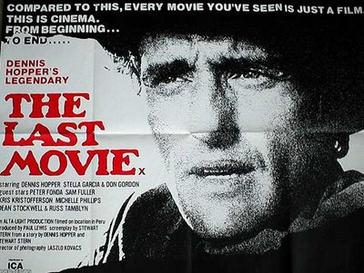
The story behind the making of 1971’s The Last Movie is legendary. It’s also a bit of a cautionary tale.
In 1969, Hollywood was stunned by the box office success of an independent, low-budget counter-culture film called Easy Rider. Easy Rider not only made a star out of Jack Nicholson but it was also the film that finally convinced the studios that the way to be relevant was not to continue to crank out big budget musical extravaganzas like Doctor Doolittle and Hello, Dolly! Instead, it was decided that the smart thing to do would be to hire young (or, at the very least, youngish) directors and basically just let them shoot whatever they wanted. The resulting films might not make much sense to the executives but, presumably, the kids would dig them and as long as the kids were paying money to see them, everyone would continue to get rich. Because Dennis Hopper had directed Easy Rider, he suddenly found himself very much in demand as a director.
Of course, almost everyone in Hollywood knew Dennis Hopper. Long before he became an icon of the counter-culture, Dennis Hopper had been a part of the studio system. John Wayne even referred to Hopper as being his “favorite communist.” Everyone knew that Dennis could be a bit arrogant. Everyone knew that Dennis was very much into drugs and that, as a result, he had a reputation for being a bit unstable. Everyone knew that Dennis Hopper deliberately cultivated an image of being a bit of a wild man and a revolutionary artist. But Dennis Hopper had just directed Easy Rider and Universal was willing to give Hopper some money to go down to Peru and direct his follow-up.
The Last Movie was a film that Hopper had been planning on making for a while. The film’s original script told the story of an aging and broken-down stuntman named Kansas who retires to Mexico and searches for a gold mine with a friend of his. Hopper first tried to get the film going in 1965, with Montgomery Clift in the lead role. After Clift died, Hopper tried to interest John Wayne in the starring role but, though Wayne enjoyed having Hopper in his films so that he could threaten to shoot him whenever Abbie Hoffman said something shocking, he had no interest in being directed by him. When Universal finally agreed to put up the money for the film, Hopper offered the lead role to Jack Nicholson. Nicholson turned it down and told Hopper that it was obvious that Dennis wanted to play the role himself. Dennis decided that he agreed with Nicholson and he cast himself as Kansas. Dennis also made the fateful decision to not only change the story’s setting to Peru but to also film on location.
Dennis and a group of friends flew down to Peru, which, at that time, was the cocaine capitol of the world. Drug use was rampant on the set, with Dennis reportedly being one of the main offenders. The cast and crew filmed during the day and partied at night and no one was particularly sure what the film was supposed to be about. Amazingly, Hopper finished filming on schedule and within budget but, much as he did with Easy Rider, he also overfilmed and ended up with 40 hours of footage. Not wanting to be bothered by the studios, Hopper edited the footage in his compound in Taos, New Mexico. Working slowly and continuing to consume a large amount of drugs and alcohol, Hopper still managed to put together a film that had a straightforward storyline. When Hopper showed his initial cut to filmmaker Alejandro Jodorowsky, the director of El Topo accused Hopper of being too conventional in his approach, which led to Hopper chopping up the film and reassembling it. Finally, after spending over a year working with the footage, Hopper turned in his final edit.
Universal had no idea what to make of the film that Hopper delivered to them. Still, they released it with the hope that the same crowd that loved Easy Rider would embrace The Last Movie. While the film did win an award at the Venice Film Festival, critics hated it and, even worse, audiences stayed away. The film’s reception was so overwhelmingly negative that Hopper found himself largely exiled from Hollywood, with only a few directors (like Francis Ford Coppola) willing to take the chance of working with him. It wasn’t until the 80s, when he finally got clean and sober, that Dennis Hopper was able to reestablish himself as a character actor and, ultimately, a beloved cultural institution.
But what about The Last Movie? Was is it really as bad as the critics claimed? Or was it, as some more recent reviewers have suggested, an unacknowledged masterpiece that was ahead of its time? I recently watched The Last Movie to find out for myself.
Despite its reputation, The Last Movie gets off to a pretty strong start. Samuel Fuller (playing himself) is directing a hilariously over-the-top and violent western in the mountains of Peru. Kansas (Dennis Hopper) is working as a stuntman. He’s fallen in love with a local sex worker named Maria (Stella Garcia). Kansas is meant to be an aging Hollywood veteran, someone who has broken a lot of bones and who carries a lot of aches as a result of his line of work. (One can see why Hopper initially imagined an actor like John Wayne in the role.) He knows that this is going to be his last job and, as we see over the first 25 minutes of the film, he feels alienated from the rest of the cast and crew. Admittedly, Hopper does appear to be a bit too young for the role. The ideal Kansas would have been someone like Ben Johnson, L.Q. Jones, or perhaps Warren Oates. But, still, Hopper does a good job of capturing Kansas’s mixed feelings about the western that’s being filmed around him.
A lot of familiar faces pop up in the film’s fictional western. Dean Stockwell plays an outlaw. Jim Mitchum, Russ Tamblyn and Kris Kristofferson plays his associates. Peter Fonda is the youthful sheriff. Michelle Phillips is the daughter of the town’s banker and apparently, she’s also the girlfriend of one of the outlaws. We watch as the actors pretend to shoot guns and kill each other while the cameras are rolling, just to get up off the ground once “Cut” is yelled. When a local Indian who has been cast as an extra grows upset at the violence, an assistant director explains to him that no one really dies while the cameras are rolling. When shooting wraps, the film company goes home but Kansas stays behind with Maria. One day, the local priest (Tomas Milian) warns Kansas that the local indigenous people have moved into the abandoned film set and are trying to shoot their own movie. Kansas discovers that they have built wooden cameras and wooden boom mics and that their chief is giving orders in the style of Sam Fuller. They’re also firing the guns that the Americans left behind.
The first part of the film works quite well. Hopper’s camera captures the beautiful and isolated Peruvian landscape. The violent western is a pitch perfect and affectionate parody of a generic studio film. Though Hopper is a bit too young for the role, he still does a good job of capturing Kansas’s alienation from his fellow Americans. Even more importantly, the first part of the film seems to have an identifiable theme. The American film crew invaded an isolated part of Peru and changed the culture of the natives without even realizing it. Now, they’ve left but the natives are still dealing with the after effects of the American “invasion.” It’s easy to see, within that part of the story, a critique of both American culture and American foreign policy.
The second part of the film is where things start to fall apart. Kansas meets an old friend named Neville (Don Gordon). Neville has discovered a gold mine in the Peruvian mountains. With Kansas as his partner, he tries to get a businessman named Harry Anderson (Roy Engel) to invest in it. Kansas and Neville try to impress Harry and his wife (Julie Adams, best-known for being stalked by The Creature From The Black Lagoon). Kansas and Neville take the Andersons to a brothel and, in the process, Kansas offends Maria. Kansas then paws Mrs. Anderson’s fur coat and mentions that human beings are covered in hair. For all of their efforts, Harry will not invest, no matter how desperately Neville begs him to reconsider.
The second part of the film drags, with many of the scenes being obviously improvised between Hopper, Gordon, Garcia, Engel, and Adams. Unfortunately, the improved conversations aren’t particularly interesting and they tend to go on forever. Usually a reliable character actor, Don Gordon ferociously chews the scenery as Neville and it doesn’t take long before one grows tired of listening to him yell. (Gordon was far more impressive in Hopper’s Out of the Blue.) With the use of improvisation and overlapping dialogue, the second half of the film tries to feel naturalistic but instead, it’s a migraine-inducing method exercise gone wrong. It’s also during the second part of the film that a “scene missing” title card flashes on the screen, an indication that the discipline that Hopper showed as a director during the beginning of the film is about to be abandoned.
Finally, the third part of the film — well, who knows? The final 25 minutes of the film is collection of random scenes, some of which may be connected and some of which may not. The natives have decided that the only way to properly end their “film” is to kill Kansas. Kansas is shot several times and rides away on his horse. Suddenly, Kansas is back at his home and Maria is taunting him for getting shot. Then, Kansas is riding his horse again. Then suddenly, Dennis Hopper and Tomas Milian are laughing at the camera. A script supervisor tries to get Dennis to look at the shooting schedule while Dennis drinks. This happens:
Milian points out that the blood on Hopper’s shirt is dry. Hopper looks at his shoulder, where Kansas was previously shot, and says that someone needs to add his scar before he can shoot the scene. Ah! So, now we’re acknowledging that it’s all just a movie. Thanks, Dennis! Suddenly, Dennis is Kansas again and he’s collapsing over and over again in the dust. He appears to be dead but no, now he’s Dennis again and he’s standing up and smiling at the camera. And now, he’s singing Hooray for Hollywood. And now, suddenly, Kansas and Neville are talking about The Treasure of the Sierra Madre and then….
Well, let’s just say that it goes on and on before finally ending with a scrawled title card.
It’s a disjointed mess and it’s all the more frustrating because the first 30 minutes of the film is actually pretty good. But then, Dennis apparently remembered that he was supposed to be the voice of the counter-culture and he gave into his most pretentious impulses. Of course, just because a film is a mess, that doesn’t mean that it can’t be entertaining. And again, the first part of the film is entertaining and third part of the film is weird enough that it’ll hold most people’s attention for at least a few minutes. But the middle section of the film is so slow and pointless that it pretty much brings down the entire film.
In the end, what is The Last Movie about? In The American Dreamer(a documentary that was filmed while Hopper was editing The Last Movie in New Mexico), Hopper spends a lot of time talking about revolution and taking over Hollywood but The Last Movie is hardly a revolutionary film. The film is at its most alive when it is focused on the shooting of its fictional western. For all the satirical pokes that The Last Movie takes at the studio system, it’s obvious that Hopper had a lot of affection for Old Hollywood and for directors like Sam Fuller. Kansas may say “Far out,” but he’s hardly a hippie. Even the film’s jumbled finale seems to be saying, “It’s all Hollywood magic!” In the end, the film’s call for a new style of cinema is defeated by its love for the old style of cinema.
Instead, I think The Last Movie works best when viewed as a portrait of paranoia. Hopper himself admitted that he was naturally paranoid and the heavy amount of drugs that he was doing in the 70s didn’t help. One reason why Hopper filmed in Peru and edited in New Mexico was so the studios couldn’t keep track of him and, while directing, he worried about being arrested by the Peruvian secret police. As an actor, Hopper plays Kansas as being someone who views the world with caution and untrusting eyes. He doesn’t trust the other members of the film crew. He loves Maria but he’s still convinced that she’s going to betray him. Even the natives ultimately try to destroy him and the script supervisor tries to get him to stick to the shooting schedule. The film works best as a disjoined portrait of one man’s paranoid and fatalistic world view.
The Last Movie pretty much ended the studio’s attempts to harness the counter-culture by giving money to self-described revolutionaries. The new wave of directors — like Spielberg and Lucas — may have shared Hopper’s then-politics but they weren’t looking to burn down the system. (Hopper himself later became a Republican.) The Last Movie may not have been the literal last movie but it was, for a while at least, the last of its kind.






 Through the Shattered Lens