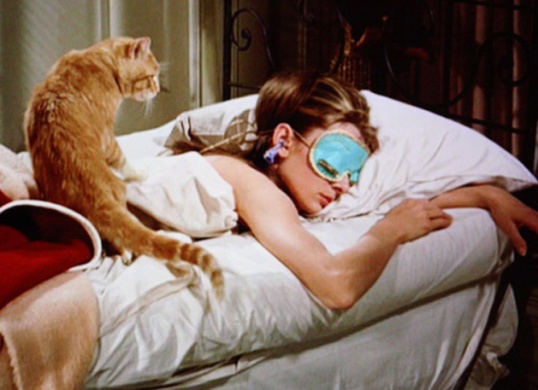
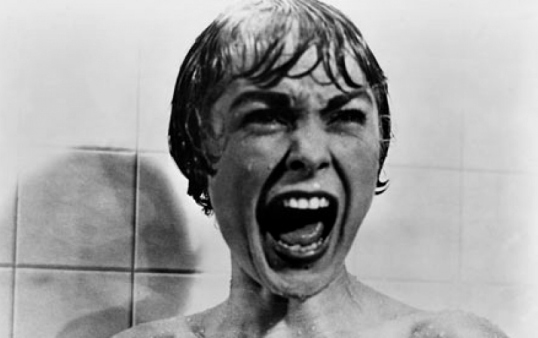
This October, I’m going to be doing something a little bit different with my contribution to 4 Shots From 4 Films. I’m going to be taking a little chronological tour of the history of horror cinema, moving from decade to decade.
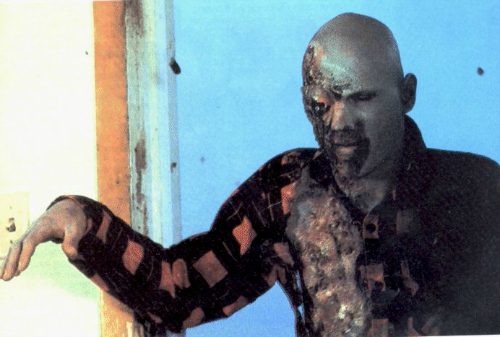
A lot of what you need to know about Demons, an Italian horror film from 1985, can be summed up by the fact that one of the leading characters is named Tony the Pimp. Demons is a very self-aware film, one that is not only over-the-top and ludicrous but which is cheerfully aware that it’s over-the-top and ludicrous. Considering that Demons is an apocalyptic film that ends with nearly the entire cast dead, Demons is a surprisingly good-natured horror film.
The film opens in Berlin. There’s a mysterious man hanging out at a subway station. He’s wearing a silver half-mask and, from what we can see of his face, he appears to be heavily scarred. Interestingly enough, the man is played by Michele Soavi. (Though Soavi is now best remembered as the director of Dellamorte Dellamore, he was an actor and assistant to Dario Argento when Demons was produced.) The man doesn’t speak. Instead, he hands out flyers to random people, inviting them to attend the premiere of a new horror film.
The man obviously does a very good because a truly diverse group of characters show up for the premiere. There’s a wealthy blind man who comes with his assistant. (The assistant is played by Dario Argento’s oldest daughter, Fiore.) There’s an older couple who keep shushing everyone in the audience. There’s Cheryl (Natasha Hovey), who ends up sitting next to the handsome George (Urbano Barberini, who would later co-star in Dario Argento’s Opera). And, of course, there’s Tony the Pimp (Bobby Rhoades) who shows up wearing a white suit and with two prostitutes.
The film-within-the-film is a horror film that plays out like an homage to every Italian horror film released in the 1980s. It deals with four teenagers who stumble across the grave of Nostradamus and end up transforming into blood-thirsty demons. One of the teenagers is played by Michele Soavi, though it’s never clear whether the teenager and the man in the mask are supposed to be the same person.
As they watch the movie, something strange starts to happen in the audience. One of the prostitutes scratched her face when she put on a prop mask. When the same mask appears in the movie, the cut on her face starts to throb. Soon, she is transformed into a … DEMON!
JUST LIKE IN THE MOVIE!
Needless to say, the arrival of a real-life demon leads to a panic in the theater but guess what? The doors are locked! There’s no way out! When Tony the Pimp breaks into the projection booth, he discovers that there’s no projectionist and the movie cannot be stopped! On top of that, getting scratched by a demon means that you transform into a demon yourself!
In other words — remember the debate about whether or not horror movies can turn their viewers into murderous monsters? Well, Demons says that they definitely can…
Demons was directed by Lamberto Bava, son of the famous Mario Bava, and it remains one of the most popular Italian horror films of all time. With a script that was co-written by Dario Argento (who also produced), Demons is a fun and exciting horror film that cheerfully dares you to take it too seriously. Watching this energetic film, you can tell that Bava was having a lot of fun with the idea that the world could end as a result of watching just one horror movie.
Demons was a huge box office hit so, naturally, there were hundreds of unofficial sequels. Though Michele Soavi’s The Churchwas a Demons film in every way but name, the only official sequel was Demons 2. We’ll look at that film tomorrow.
I’ve been using this October’s horrorthon as an excuse to rewatch and review the films of Dario Argento! Today we take a look at one of Argento’s best and most underrated films, 1980’s Inferno!
“There are mysterious parts in that book, but the only true mystery is that our very lives are governed by dead people.”
— Kazanian (Sacha Pitoeff) in Inferno
When 20th Century Fox released Dario Argento’s Suspiria in 1977, they weren’t expecting this Italian horror film to be a huge box office success. That it was caught them totally off guard. Though the studio executives may not have understood Italian horror, they did know that Suspiria made them a lot of money and they definitely wanted to make more of it.
As for Dario Argento, he followed up Suspiria by producing George Romero’s Dawnof the Dead. He also supervised the film’s European cut. (In Europe, Dawn of the Dead was known as Zombi, which explains why Lucio Fulci’s fake sequel was called Zombi2.) When Dawn of the Dead, like Suspiria before it, proved to be an unexpected box office hit, it probably seemed as if the Argento name was guaranteed money in the bank.
Hence, when Argento started production on a semi-sequel to Suspiria, 20th Century Fox agreed to co-finance. Though the majority of the film was shot on a sound stage in Rome, Argento was able to come to New York to do some location work, hence making this Argento’s first “American” film. The name of the movie was Inferno.
Sadly, Inferno proved to be a troubled production. Shortly after production began, Argento became seriously ill with hepatitis and reportedly, he had to direct some scenes while lying on his back while other sequences were done by the second unit.
As well, Argento had a strained relationship with 20th Century Fox. Argento wanted James Woods to star in Inferno but, when it turned out that Woods was tied up with David Cronenberg’s Videodrome, the studio insisted that Argento cast an actor named Leigh McCloskey instead. As a performer, James Woods is nervy, unpredictable, and compulsively watchable. Leigh McCloskey was none of those things.
Worst of all, as a result of a sudden management change at 20th Century Fox, Inferno was abandoned by its own distributor. The new studio executives didn’t know what to make of Inferno and, in America, the film only received an extremely limited release. The few reviews that the film received were largely negative. (Like most works of horror, Argento’s films are rarely critically appreciated when first released.) It’s only been over the past decade that Inferno has started to receive the exposure and acclaim that it deserves.
Argento has said that he dislikes Inferno, largely because watching it remind him of a very difficult time in his life. That’s unfortunate, because Inferno is one of his best films.
The Mother of Tears (Ania Pieroni) in Inferno
“Have you ever heard of the Three Sisters?”
“You mean those black singers?”
— Sara (Eleonora Giorgi) and Carlo (Gabriele Lavia) discuss mythology in Inferno
As I stated previously, Inferno is a semi-sequel to Suspiria. Whereas Suspiria dealt with an ancient witch known as the Mother of Sighs, Inferno deals with her younger sister, the Mother of Darkness. The Mother of Sighs lives underneath a German dance academy. The Mother of Darkness lives underneath a New York apartment building. The Mother of Sighs was a witch. The Mother of Darkness is an alchemist.
Beyond that and the fact that Alida Valli is in both films (though apparently playing different characters), there aren’t many references to Suspiria in Inferno. The tone of Inferno is very different from the tone of Suspiria. If Suspiria was perhaps Argento’s most straight-forward films, Inferno is one of his most twisted. It makes sense, of course. Suspiria is about magic but Inferno is about science. Suspiria casts a very Earthy spell while Inferno often feels like a scientific equation that cannot quite be solved.
The film deals with Mark Elliott (Leigh McCloskey), an American music student in Rome. After he gets a disturbing letter from his sister, Rose (Irene Miracle), a poet who lives alone in New York City, Mark heads back to the U.S. to check in on her. (That’s right — Mark and Rose are two more of Argento’s artistic protagonists.) However, when Mark arrives, he discovers that his sister is missing and it’s obvious that strange inhabitants of the building are trying to cover something up.
“May I ask a strange question?”
“How strange?”
— Sara (Eleonora Giorgi) and Mark Elliot (Leigh McCloskey) in Inferno
Even more than with some of Argento’s other films, the plot of Inferno isn’t particularly important. One reason why it’s easy to get annoyed with Mark is because he spends the entire film demanding to know where his sister is, despite the fact that those of us in the audience already know that she’s dead. Argento showed us her being murdered shortly before Mark’s arrival. Argento makes sure that we know but he never bothers to reveal the truth to Mark and one of the more curious aspects of the film is that Mark never discovers that his sister is dead. (By the end of the film, one assumes that he’s finally figured it out but even then, we don’t know for sure.) The fact of the matter is that Mark and his search for his sister are never really that important. Argento doesn’t particularly seem to care about Mark and he never really gives the viewer any reason to care either. (Of course, it doesn’t help that Mark is rather stiffly played by Leigh McCloskey.)
Instead, Argento approaches Inferno as a collection of increasingly surreal set pieces. Much as in Lucio Fuci’s Beyond trilogy, narrative logic is less important than creating a dream-like atmosphere. Often time, it’s left to the viewer to decide how everything fits together.
There are so many odd scenes that it’s hard to pick a favorite or to know where to even begin. Daria Nicolodi shows up as Elise Stallone Van Adler, a neurotic, pill-popping aristocrat who briefly helps Mark look for his sister. Eventually, she’s attacked by thousands of cats before being stabbed to death by one of Argento’s trademark black-gloved killers. After Elise’s death, her greedy butler makes plans to steal her money. Did the butler kill Elise? We’re never quite sure. Does the butler work for The Mother of Darkness or is he just being influenced by her evil aura? Again, we’re never sure. (By that same token, when the butler eventually turns up with eyes literally hanging out of their sockets, we’re never quite sure how he ended up in that condition. And yet, somehow, it makes a strange sort of sense that he would.)
Cats also feature into perhaps the film’s most famous scene. When the crippled and bitter book seller Kazanian (Sacha Pitoeff) attempts to drown a bag of feral cars in a Central Park pond, he is suddenly attacked by a pack of a carnivorous rats. A hot dog vendor hears Kazanian’s cries for help and rushes over. At first, the vendor appears to be a good Samaritan but suddenly, he’s holding a knife and stabbing Kazanian to death. Why did the rats attack in the first place? Is the hot dog vendor (who only appears in that one scene) a servant of the Mother of Darkness or is he just some random crazy person? And, in the end, does it matter? At times, Inferno seems to suggest that the real world is so insane that the Mother of Darkness is almost unnecessary.
Meanwhile, in Rome, Mark sits in class and reads a letter from his sister. When he looks up, he immediately sees that a beautiful young woman is looking straight at him. She’s petting a cat and staring at him with a piercing stare. (She is played Ania Pieroni, who later achieved a certain cult immortality by appearing as the enigmatic housekeeper in Lucio Fulci’s The House By The Cemetery.) The film later suggests that the woman is the third mother, the Mother of Tears, but why would she be in the classroom? Why would she be staring at Mark?
When Mark’s girlfriend, Sara (Eleonora Giorgi), does some research in a library, she finds a copy of a book about The Three Mothers and is promptly attacked by a mysterious figure. When she flees back to her apartment, she meets Carlo (Gabriele Lavia, who was also in Deep Red) who agrees to stay with her until Mark arrives. Is Carlo sincere or is he evil? Argento does eventually answer that question but he certainly keeps you guessing until he does.
Finally, I have to mention the best and most haunting scene in the film. When Rose searches a cellar for a clue that she believes will lead her to the Mother of Darkness, she discovers a hole that leads to a flooded ballroom. When Rose drops her keys into the hole, she plunges into water and swims through the room. (The first time I saw this scene, I immediately said, “Don’t do that! You’re going to ruin your clothes!”) As Rose discovers, not only keys get lost in that flooded ballroom. There’s a dead body as well, one which floats into the scene from out of nowhere and then seems to be intent on following Rose through the entire room. It’s a sequence that is both beautiful and nightmarish. (It certainly does nothing to help me with my fear of drowning.)
In the end, Inferno is a dream of dark and disturbing things. Does the plot always make sense? Not necessarily. But that plot’s not important. The film’s surreal imagery and atmosphere of doom and paranoia casts a hypnotic spell over the viewer. Inferno is perhaps as close to a filmed nightmare as you’ll ever see.
“She writes poetry.”
“A pastime especially suited for women.”
— Mark and the Nurse (Veronica Lazar) in Inferno
Finally, no review of Inferno would be complete without discussing some of the people who worked behind-the-scenes.
Along with acting in the film, Daria Nicolodi also worked on the script. As is so often the case with Daria and Dario’s collaborations, there are conflicting reports of just how involved Nicolodi was with the final script. Daria has said that she would have demanded co-writing credit, if not for the fact that it had previously been such an ordeal to get credited for Suspiria. Others have claimed that, while Nicolodi offered up some ideas, the final script was almost all Argento’s creation.
(Comparing the films that Argento made with Nicolodi to the ones that he made without her leads me to side with Nicolodi.)
Working on the film as a production assistant was William Lustig, the famed exploitation film producer and director who would later become the CEO of Blue Underground. Reportedly, during filming, Lustig attempted to convince Nicolodi to star in a film that he was going to direct. Nicolodi’s co-star would have been legendary character actor Joe Spinell. Disgusted by the film’s script, Nicolodi refused the role and, as a result, Caroline Munro ended up playing the stalked fashion photographer in Lustig’s controversial Maniac.
Future director Michele Soavi worked on several of Argento’s films. I’ve always been under the impression that Soavi was a production assistant on Inferno but, when I rewatched the film, he wasn’t listed in the credits. Inferno is also not among his credits on the imdb. I guess the idea that one of my favorite Italian horror directors worked on one of my favorite Italian horror films was just wishful thinking on my part.
However, you know who is listed in the credits? Lamberto Bava! Bava, who would later direct the Argento-produced Demons, worked as an assistant director on Inferno. That leads us to perhaps the most famous member of Inferno’s crew…
Mario Bava!
Inferno was the final film for the father of Italian horror. As so often happens, there are conflicting reports of just how involved Bava was with the production. It is know that he worked on the special effects and that he directed some second unit work while Argento was bed ridden with hepatitis. Irene Miracle has said that almost all of her scenes were directed by Mario Bava and that she rarely saw Argento on set.
Mario Bava is often erroneously described as being Dario Argento’s mentor. That’s certainly what I tended to assume until I read Tim Lucas’s All The Colors of the Dark, the definitive biography on Mario Bava. Bava was certainly an influence and it’s certainly true that Argento appears to have had a better relationship with him than he did with Lucio Fulci. But the idea that a lot of Italian horror fans have — that Mario Bava was hanging out around the set of The Bird With The Crystal Plumage and offering Argento fatherly advice — does not appear to be at all true. (It’s a nice image, though.) With all that in mind, it’s still feels somewhat appropriate that Bava’s final work was done on one of the best (if most underappreciated) Italian horror films of all time.
“I do not know what price I shall have to pay for breaking what we alchemists call Silentium, the life experiences of our colleagues should warn us not to upset laymen by imposing our knowledge upon them.”
— The Three Mothers by E. Varelli, as quoted in Dario Argento’s Inferno
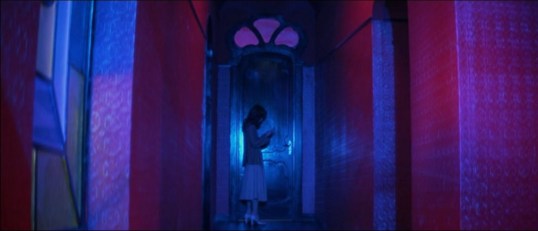
I’m using this October’s horrorthon as an excuse to take rewatch and review all of Dario Argento’s films! Today, we take a look at one of Argento’s best known and most popular films, 1977’s Suspiria!
I’m going to start things out by admitting that this is an intimidating review to write. I once had a discussion with fellow TSL contributor Leonard Wilson about why it’s always so much easier to write about films that we hate than it is to write about films that we love. That’s certainly something that I’m thinking about right now, as I try to think of where to begin with Suspiria.
It’s not just that I like Suspiria. Anyone who has ever visited this site before knows how much I appreciate Italian horror in general and Argento in specific.
No, it’s that I absolutely love this film. I was sixteen the first time that I saw it and I’ve loved it ever since. To me, Suspiria is not just one of the best horror films ever made. It is truly one of the best films period. And I know that I’m not alone in feeling like that. Suspiria is a classic in every sense of the word.
Compared to almost every other film that Argento has made, the plot of Suspiria is remarkably straight forward. Suzy Banyon, an American ballet student, enrolls at the prestigious Tanz Dance Academy in Frieburg, Germany. From the minute she arrives, she gets the feeling that there is something strange happening behind the garish walls of the school and she’s right. While the film may be best known for Argento’s directorial flourishes and Goblin’s classic score, the story itself unfolds with the simplicity of a fairy tale.
The film even opens with a narrator who informs us, “Suzy Banyon decided to perfect her ballet studies in the most famous school of dance in Europe. She chose the celebrated academy of Freiburg. One day, at nine in the morning, she left Kennedy airport, New York, and arrived in Germany at 10:40 p.m. local time.” It’s the film’s equivalent of starting things off with, “Once upon a time…” Having let us know that we’re about to watch a fairy tale and therefore having served his purpose, the narrator isn’t heard for the rest of the film.
Instead, we watch as Suzy first arrives in Germany:
As played by Jessica Harper, Suzy Banyon is yet another neurotic but brave Argento protagonist who has found herself in a strange land. One of the things that I love about Suspiria is that Suzy is such an ordinary and relatable character. She’s not “the chosen one.” She’s not a witch or an aspiring witch or the daughter of a witch or the reincarnation of a witch. She’s not desperately looking for a husband or dealing with a family tragedy or any of that other BS that we have to deal with in today’s cinema.. She doesn’t have any dark secrets or untapped magical powers. She’s not seeking vengeance. She has no trendy agenda. She’s not the protagonist of the latest YA novel. Instead, she’s a dancer. She is someone who is attempting to pursue something that she is good at and that she loves. In short, she is the viewer. Suzy Banyon is us and we are Suzy Banyon. Like us, she’s sometimes scared. Like us, she’s sometimes brave. And, like us, it’s just not in her nature to leave a mystery unsolved.
It’s obvious, from the moment that Suzy arrives, that there’s something strange happening at the school. We, of course, already know that it involves witchcraft. This is largely because we’ve been listening to the film’s score and we’ve heard Goblin’s Claudio Simonetti chanting “WITCH! WITCH!” as Suzy’s taxi drives through the woods and arrives at the school. (The journey through the woods adds to Suspiria‘s fairy tale atmosphere.)
However, for Suzy, her initial concern is that everyone at the school appears to be trying to cheat her out of her money. Madame Blanc (Joan Bennett) has arranged for Suzy to stay in an apartment on which she’ll have to pay rent. When Miss Tanner (Alida Valli, a force of pure nature in this film) finds out that Suzy’s bags have yet to arrive and Suzy doesn’t have any ballet shoes, she tells her to borrow a pair from another student. The student immediately offers to sell them to Suzy and is visibly deflated when Suzy says that she’s just needs to borrow them for a day.
And, of course, there’s Olga (Barbara Magnolfi), a student who thinks that names that start with S are the names of snakes.
(I have to admit that, as a former dance student, that scene brought back a lot of memories.)
But it’s not just money that Suzy has to worry about. There are also maggots that fall from the ceiling, the result of a shipment of spoiled meat. There’s the strange and labored breathing that Suzy occasionally hears behind the walls. There’s the fact that her new roommate, Sarah (Stefania Casini), is convinced that the teachers are hiding a secret. Sarah’s therapist, Dr. Frank Mandel (Udo Kier, playing an oddly respectable role) thinks that Sarah is suffering from delusions but is she?
And, of course, there’s all the mysterious deaths.
For instance, Daniel, a blind piano player, has his throat ripped by his seeing eye dog. Interestingly enough, Daniel is played by Flavio Bucci who, in The Night Train Murders, played a murderer. One of his Night Train victims was played by Irene Miracle, who would later have an important role in Suspiria‘s semi-sequel, Inferno.
Another former student, Pat Hingle (Eva Axen) is brutally stabbed to death and, after her body falls through a skylight, the shattered glass kills her best friend as well. Of course, the killer wears gloves. It wouldn’t be an Argento film otherwise. (Pat’s murder is one of Suspiria‘s best known set pieces, one that is so brutal and violent that it retains its power to shock even after you’ve seen it a few times. For the most part, if someone is going to stop watching or walk out on Suspiria, it’s going to happen during Pat’s murder.)
And through it all, you have Goblin playing on the soundtrack. The film’s score is so important and so relentless that, in its way, it becomes just as important a character as Suzy, Sarah, Madame Blanc, Miss Tanner, or even Udo Kier! The score is relentless and, depending on how loudly you play the film, almost deafening. I saw an interview with Goblin’s Claudio Simonetti where he said that he wanted the score to be “almost annoying” in its relentlessness. The score overpowers you, in much the same way that the witches of Suspiria overpower their victims.
Suspiria was co-written by Daria Nicolodi, Dario Argento’s girlfriend and the mother of Asia Argento. Nicolodi has long claimed that Suspiria is based on something that happened to her grandmother. Argento, meanwhile, has said that nothing in the film was based on fact. Reportedly, Nicolodi wanted to play the role of Suzy and was so offended with Argento instead offered her the role of Sarah that she went off and made Mario Bava’s Shock instead.
(Suspiria is often cited as the start of the long and acrimonious process that would eventually end with Argento and Nicolodi ending their relationship 8 years later.)
Personally, I think that Nicolodi would have been wasted in the role of Sarah but, at the same time, it’s hard to imagine anyone other than Jessica Harper as Suzy Banyon. For that matter, it’s also impossible to imagine anyone other than Dario Argento directing Suspiria. Suspiria is Argento’s masterpiece, taking all of his frequent and familiar motifs (bloody murders, artistic protagonists, the constantly roaming camera, the use of primary colors) and pushing them to their natural extreme. It’s hard to imagine anyone other than Argento telling Suspiria’s story.
Dario Argento on the set of Suspiria
And yet, that is exactly what is about to happen. For years, of course, I’ve heard rumors of a remake and, perhaps naively, I’ve dismissed them. I took some comfort in the fact that even Dario Argento himself came out and forcefully denounced the idea of anyone remaking his masterpiece. Remake Suspiria? I would think to myself, Surely no one is that stupid.
Well, it’s happening and if that doesn’t outrage you, perhaps you should leave right now. Reportedly, the remake is set to be released in 2017. It’ll be directed by Luca Guadagnino and it’ll star Dakota Johnson, Chloe Grace Moretz, and Tilda Swinton. Guadagnino says that his remake will be all about the “power of motherhood.”
Whatever, Luca. Suspiria doesn’t need you and it doesn’t need to be remade.
I’ve been using this year’s horrorthon as an excuse to watch and review all (well, almost all) of Dario Argento’s films! Today, I take a look at one of Argento’s best — 1975’s Deep Red!
After the successful release of Four Flies on Grey Velvetin 1971, Dario Argento announced his retirement from the giallo genre. His next film was 1973’s The Five Days of Milan, a historical comedy-drama with a political subtext. The Five Days of Milan was a huge box office flop in Italy and, to the best of my knowledge, it was never even released in the United States. To date, it is Argento’s most obscure film and one that is almost impossible to see. In fact, it’s so obscure that, in two of my previous posts, I accidentally called the film The Four Days of Milan and apparently, no one noticed.
Forgotten Argento
After the failure of Five Days, Argento returned to the giallo genre. And while he was undoubtedly stunned by the failure of his previous film, Argento ended up directing one of the greatest Italian films of all time. If The Bird With The Crystal Plumage and Four Flies on Grey Velvet were both great giallo films, Deep Red is a great film period. It is Argento at his over the top best.
Now, before I go any further, I should point out that there are many different versions of Deep Red floating around. For instance, it was released in the United States under the title The Hatchet Murders and with 26 minutes of footage cut from the film. For this review, I watched the original 126-minute Italian version. I’ve always preferred the original to the shorter version that was released in America. Oddly enough, Argento has said that he prefers the shorter version.
Deep Red opens with a blast of music that both announces Argento’s return to the giallo genre and also provides some hints to his future as a filmmaker. Whereas his previous films had all featured an excellent but rather serious score by Ennio Morricone, Deep Red was the first Argento film to be scored by Goblin. There’s a gothic, almost operatic playfulness to Goblin’s work on the film. (If the Phantom of the Opera had ended up working in Hollywood and writing film scores, the end result would have sounded a lot like Goblin.) Goblin’s deafening score works as the perfect sonic companion to Argento’s constantly roving camera and vibrantly colorful images. (The blood spilled in Deep Red is the reddest blood imaginable.)
Deep Red‘s protagonist is Marcus Daly (David Hemmings) and, like so many Argento protagonists, he’s both an artist and a man without a definite home. At one point, he explains that he was born in England, grew up in America, and now lives in Italy. He’s a jazz pianist but he supports himself by giving music lessons. In a scene excised from the American cut, Marcus tells his students that, while classical music should be respected and appreciated, it’s also necessary to be willing to embrace art that some critics would dismiss as being “trashy.” Marcus, of course, is talking about jazz but he could just as easily be Dario Argento, defending his decision to return to the giallo genre.
While Marcus plays piano and tries to help his alcoholic friend, Carlo (Gabriele Lavia), a German psychic named Helga Ulmann (Macha Meril) is giving a lecture when she suddenly announces that someone in the audience is a murderer. Later, Helga is brutally murdered by a gloved, hatchet-wielding attacker.
(Helga’s murder scene is always difficult for me to watch, even if Argento doesn’t — as Kim Newman pointed out in a review written for Monthly Film Bulletin — linger over the carnage in the way that certain other horror directors would have. I have to admit that I also always find it interesting that Helga is played by the same actress who, that same year, would play the evil Lady On The Train in Aldo Lado’s The Night Train Murders. Playing one of the Lady’s victims was Irene Miracle, who later co-starred in Argento’s Inferno.)
The only witness to Helga’s murder? Marcus Daly, of course. He’s standing out in the street, having just talked to Carlos, when he looks up and sees Helga being murdered in her apartment. Marcus runs up to the apartment to help, arriving just too late. And yet, Marcus is convinced that he saw something in the apartment that he can’t quite remember. Deep Red is yet another Argento film that deals with not only the power of memory but the difficulties of perception. Marcus knows that he saw something but what?
Well, I’m not going to spoil it for you! In this case, the mystery and its solution makes a bit more sense than the mysteries in Argento’s first three films. Argento isn’t forced to resort to debunked science, like he did in both Cat o’Nine Tails and Four Flies on Grey Velvet. One reason why Deep Red is so compulsively watchable is because, for perhaps the first time, Argento plays fair with the mystery. After you watch the film the first time, go back and rewatch and you’ll discover that all the clues were there. You just had to know where to look.
That said, the way that Argento tells the story is still far more important than the story itself. Argento’s first three films may have been stylish but Deep Red finds Argento fully unleashed. The camera never stops moving, the visuals are never less than stunning with the screen often bathed in red, and Goblin’s propulsive score ties it all together. This is one of those films from which you can’t look away. It captures you from first scene and continues to hold you through the gory conclusion. Deep Red is an undeniably fun thrill ride and, even today, you can easily see why Argento frequently refers to it as being his personal favorite of his many films. In fact, Argento even owns a store in Rome that is called Profondo Rosso.
But you know why I really love Deep Red?
It’s all because of the relationship between David Hemmings and Daria Nicolodi. Daria Nicolodi plays Gianna Brezzi, a reporter who helps Marcus with his investigation. After three films that featured women as either victims or killers, Gianna is the first truly strong and independent woman to show up in an Argento film. I know that some people have criticized the scenes between Hemmings and Nicolodi, feeling that they drag down the pace of the movie. I could not disagree more. Both Hemmings and Nicolodi give wonderful performances and their likable chemistry feels very real.
Gianna and Marcus arm westle. (Gianna wins. Twice.)
To me, that’s what sets Deep Red apart. You care about Marcus and you care about Gianna. Yes, the mystery is intriguing and the murder set pieces are brilliantly choreographed, and Deep Red is definitely Argento at his best. But for me, the heart and soul of the film will always belong to the characters of Marcus and Gianna and the performers who brought them to life.
Deep Red was the start of Dario Argento and Daria Nicolodi’s long and often contentious relationship. (Dario and Daria’s daughter, Asia Argento, was born around the same time that Deep Red was released and has directed two films, Scarlet Divaand Misunderstood, that deal with her often chaotic childhood.) This relationship would play out over the course of six films and, as much as I love those six films, it’s always a little sad to consider that, when watched in order, the provide a portrait of a doomed and dying romance, one that did not particularly end well. (It is possibly not a coincidence that, with the exception of Deep Red and Tenebrae, Daria Nicolodi suffered some type of terrible death in every film she made with Argento.)
But, regardless of what may or may not have been going on behind the scenes, Deep Red remains a triumph for both its director and its stars.
After the good but somewhat generic Cat o’Nine Tails, Dario Argento returned to form with his third film, 1971’s Four Flies on Grey Velvet.
It’s not particularly easy to describe the plot of Four Flies because, much like The Bird With The Crystal Plumage, the storyline is less important than the way that Argento tells it. The film tells the story of Roberto Tobias (Michael Brandon), a drummer with an up-and-coming rock band in Rome. In many ways, Roberto is a typical drummer. He’s the guy who, even though he’s often obscured in the background, keeps things balanced. He has a loving wife, Nina (Mimsy Farmer), a nice house, and worldly, politically woke friends who smoke weed and praise art. Admittedly, one of those friends does tell a rather gruesome story about witnessing a beheading in Saudi Arabia which leads to Roberto having a reoccurring nightmare but otherwise, Roberto would appear to have a great life.
(Incidentally, Roberto’s nightmares are Argento at his best.)
So, why is this stable and easy-going guy suddenly being followed by a mysterious man in a suit? And why, when Roberto confronts the man, does he discover that there’s yet another mysterious figure — this one wearing a mask — following him and taking pictures?
That’s the mystery that opens Four Flies on Grey Velvet but it’s not the only mystery to be found in the film. In fact, this movie finds Argento at both his most macabre and his most playful. At times, he literally seems to be seeing just how far he can push and how complicated he can make things before totally losing his audience. The film may start with Roberto being followed and having nightmares but eventually, it comes to involve everything and everyone from Nina’s enigmatic cousin, Dalia (Francine Racette) to a beatnik named God (played by none other than spaghetti western mainstay, Bud Spencer) to a flamboyant private investigator (Jean-Pierre Marielle). (By today’s standards, the portrayal of the gay detective has a few cringey moments but you have to remember that Four Flies On Grey Velvet was made in 1971. It was nothing less than revolutionary for an Italian film of that era to portray an openly gay contemporary character in any type of positive light.) To top it all off, the solution to the film’s main mystery is discovered through optography, the long-since discredited idea that an eye will “save” the last image seen before death. It’s ludicrous but Argento pulls it off with a cheerfully over-the-top style that perfectly matches the film’s twisted plot. After the toned down Cat o’Nine Tails, Four Flies was Argento’s way of reminding viewers of who he truly was as a filmmaker.
The film’s brilliant opening sets the tone for the entire film. Watch it below and thank me later:
It’s rare that anyone every really discusses the acting in an Argento film. Argento has himself admitted that he doesn’t worry much about actors and many of his films have been released in badly dubbed versions, which often makes it difficult to fairly judge any of the performances. That said, Roberto Tobias is one of my favorite Argento protagonists and it’s all due to Michael Brandon’s performance. Brandon makes Roberto into such a nice guy and does such a good job of capturing his descent into paranoia that it’s impossible not to get caught up in his story. (I would even argue that the long-haired and politically concerned Roberto is almost an autobiographical stand-in for Argento himself.) Though I can’t really explain why without running the risk of spoiling a major part of the movie, Mimsy Farmer is also excellent. Reportedly, Argento originally wanted to cast Mia Farrow and you can imagine a post-Rosemary’s Baby pre-Woody Allen Farrow in the role. But I’m glad that Argento couldn’t get her because Mimsy Farmer gives a close to perfect performance.
Four Flies was the third and final part of Argento’s “animal trailer,” and, at the time, Argento declared that Four Flies would also be his final giallo film. He followed up Four Flies with The Four Days, a historical comedy that was considered to be such a failure that, after its release, Argento returned to the safety of the giallo genre and gave the world one of his greatest triumphs, Deep Red. However, if The Four Days had been a success and Four Flies had been Argento’s final giallo film, it would have been a triumphant note to go out on.
Here’s the very misleading trailer that was used for Four Flies On Grey Velvet‘s American release.
And here’s the even more obscure European trailer!
(I’m using this year’s horrorthon as an excuse to watch and review all of the films of Dario Argento. Yesterday, I reviewed The Bird With The Crystal Plumage. Today, I take a look at The Cat o’Nine Tails.)
In 1971, Dario Argento followed up the massive success of The Bird With The Crystal Plumage with his second film as a director, The Cat o’Nine Tails. While The Cat o’Nine Tails was another huge financial success, it’s never been as a critically acclaimed as Argento’s first film. Argento, himself, regularly cites The Cat o’Nine Tails as being his least favorite of all of the films that he’s directed.
Much like The Bird With The Crystal Plumage, The Cat o’Nine Tails is a giallo that uses it’s rather complicated mystery as an excuse (a MacGuffin, to quote Hitchcock) for several suspenseful set pieces, the majority of which end with someone suffering some sort of terrible fate. In this case, a series of murders are taking place around a mysterious medical complex, the Terzi Institute. The murders are connected to some research being done at the institute. I’m not going to spoil things by revealing what exactly is being researched but I will say that the key to the mystery is vaguely ludicrous, even by the typically flamboyant standards of the giallo genre.
But, then again, so what? The fact that the genre’s mysteries are often overly complex and feature solutions that don’t always make sense is actually one of the appeals of the giallo film. You don’t really watch a giallo for the mystery. You watch it to see how the story will be told. Perhaps more than any other genre, giallo requires a director with a strong vision.
And, if nothing else, Argento has always had a strong directorial vision. Even when you may disagree with the choices that he makes (and I’m sure we all wonder why, in his later films, Argento grew so obsessed with telepathic insects), you can’t deny that they’re always uniquely Argento. Though the film never reaches the delirious heights of The Bird With The Crystal Plumage, The Cat o’Nine Tails still has several strong set pieces. There’s a sequence involving a poisoned glass of milk that I particularly appreciate. And then there’s the long scene at the crypt, in which our two protagonists realize that they don’t really trust each other all that much. And, of course, there’s the ending. For a film that’s often dismissed as being lesser Argento, The Cat o’Nine Tails features one of Argento’s darkest endings.
The Cat o’Nine Tails is unique as being one of the only Argento films to regularly show up on TCM. A lot of that is because The Cat o’Nine Tails is perhaps the least gory of all the films that Argento has made. That doesn’t mean that there isn’t plenty of death and mayhem. There is. Blood is spilled but it never exactly flows. The Cat o’Nine Tails is an Argento film that you could probably safely watch with an elderly relative. That’s not necessarily meant as a complaint. It’s just an observation that, when compared to the panty murder in The Bird With The Crystal Plumage or the skewering in The Mother of Tears, Cat o’Nine Tails is definitely a toned down Argento film.
The other reason why The Cat o’Nine Tails is popular on TCM is because it stars none other than that classic film mainstay, Karl Malden. Continuing the Argento tradition of featuring protagonists who aren’t sure what they’ve witnessed, Malden plays a former newspaper reporter who is now blind. He teams up with another reporter (played by James Franciscus, who may not have been a great actor but who did have perfect hair) to solve the murders. Franciscus has the eyes. Malden has the brains. And Malden’s niece, Lori (Cinzia De Carolis), is largely present to provide the film with its final ironic twist.
Malden does a pretty good job in the role, too. I’ve read some reviews that have complained that Malden overacts but actually, he gives the perfect performance for the material. In fact, Malden’s unapologetically hammy performance contrasts nicely with the work of James Franciscus, which could charitably be called subdued. (Perhaps a better description would be dull…)
Cat o’Nine Tails may not be Argento’s best but I still like it. If for no other reason, watch it for Malden and that wonderfully dark ending.
The name inspires a lot of reactions. Some people will tell you that Dario Argento is one of the greatest directors of all time. Some people regularly cite him as being a prime example of an artist who hit his peak too early and who has spent the latter part of his career imitating his previous successes. Some people will tell you that his films are dangerous. He’s one of those directors whose films always seem to end up getting banned in certain communities. Other cineastes will always praise him as a superior stylist whose influence is still felt to this very day. Argento’s films have inspired thousands of horror filmmakers. His films have also inspired a countless number of viewers to fall in love with horror. Without the influence of Argento the horror genre would be not only less interesting but less profitable as well.
Myself, I’m a huge Argento fan. Yes, I do love Suspiria but then again, everyone love Suspiria. I have also made it a point to track down and watch the forgotten and/or critically reviled Argento films, like Trauma and The Phantom of the Opera. My love of Argento is so strong that I usually even find myself enjoying his less acclaimed work as much as his acknowledged triumphs. He is one of the masters of horror, a true maestro of Italian art. For the longest time, I’ve been meaning to watch and review all 21 of Argento’s cinematic thrillers. (Sadly, his one non-thriller, The Four Days, is notoriously difficult to see.) With this being October, I figured why not now?
Dario Argento made his directorial debut in 1970 with The Bird With The Crystal Plumage. Before directing his first movie, Argento had been a film critic and a screenwriter. (Among other credits, he is listed as being one of the writers of Sergio Leone’s Once Upon A Time In The West. Interestingly enough, his co-writer was another future director, Bernardo Bertolucci.) With his very first film as a director, Argento established himself as a master of both suspense and horror.
I have seen some reviews that have identified The Bird With The Crystal Plumage as being the first giallo film. That’s not at all true. If anything, the credit for directing the first giallo should probably go to Mario Bava (who directed The Girl Who Knew Too Much in 1964) and some students of Italian cinema would even disagree with that. However, The Bird With The Crystal Plumage undoubtedly did a lot to popularize the genre outside of Italy.
The film tells the story of Sam (Tony Musante) and his girlfriend, Julia (Suzy Kendall). Sam is a writer and he’s living in Rome. Argento is not traditionally known as an actor’s director but Musante and Kendall are both remarkably sympathetic in their roles and they seem to have a very real chemistry when they’re both on-screen together. You actually do care about them as a couple and you find yourself hoping that nothing bad happens to them. One thing that I liked was that their tiny apartment looked like it was someplace where a couple actually would live, love, and try to solve a murder. Looking at Sam and Julia in that apartment (which is decorated with a picture of Albert Einstein and a poster reading “Black Power!”), you get the feeling that they have an existence outside of what you’re seeing during the film’s 94 minute running time. They feel real.
Reportedly, Tony Musante and Argento did not have a great working relationship. (Mustante was a character actor who wanted to talk about motivation. Argento was more concerned with the technical aspects of shooting the film.) Mustante may have been miserable but that actually works for his character. When we first meet Sam, he’s frustrated because he’s suffering from writer’s block. He’s so frustrated that he’s on the verge of moving back to the United States. Sam’s frustration feels real and if that’s because Musante happened to be frustrated while shooting the film, so be it. Whatever works.
One night, Sam goes for a walk and witnesses a stabbing in an art gallery. Monica Ranieri (Eva Renzi) survives but it appears that her assailant has managed to escape. The police suspect that Sam might be more than just a witness so they confiscate his passport. Until the attacker is caught, Sam is stuck in Rome.
There’s a serial killer terrorizing Rome and both Sam and the police suspect that Monica nearly became the killer’s latest victim. Some of the film’s most unnerving sequences are shot from the point-of-view of the killer, a technique that both leaves the killer’s identity a secret and also makes the audience complicit in the murders. It’s as if Argento the film critic is daring the audience to consider why they’re watching what Argento the director is doing.
(And the murders in The Bird With The Crystal Plumage are brutal, even by the standards of Italian cinema. The first murder that we actually witness — which is usually referred to as being “the panty murder,” for reasons that I’m not going to freak myself out by describing — is pure and total nightmare fuel.)
Everything that you might expect to find in a giallo is present in The Bird With The Crystal Plumage. It may not have been the first but it’s definitely one of the prototypes for what the genre is usually considered to be. Graphic violence, sexual perversion, point-of-view shots, a constantly roaming camera, a dramatic musical score, a killer who wears black gloves and carries a razor, a witness who has to prove his innocence, and a solution that’s revealed only when Sam reexamines what he thinks he saw; it’s all here.
What distinguishes The Bird With The Crystal Plumage is the style with which Argento tells his story. Dario was 30 years old when he directed The Bird With The Crystal Plumage and there’s an infectious enthusiasm to the way he frames the mayhem. Like many film critics directing their first film, Argento fills his debut with homages to earlier films. You can tell he’s having a lot of fun while discovering just how far he can go without losing his audience.
46 years after it was first released, The Bird With The Crystal Plumage holds up surprisingly well. It’s a nightmarish but compulsively watchable thrill ride and it remains one of Argento’s best.
4 Shots From 4 Films is just what it says it is, 4 shots from 4 of our favorite films. As opposed to the reviews and recaps that we usually post, 4 Shots From 4 Films is all about letting the visuals do the talking.
Happy birthday, Dario Argento!
4 Shots From 4 Films
Deep Red (1975, dir by Dario Argento)
Suspiria (1977, dir by Dario Argento)
Inferno (1980, dir by Dario Argento)
The Stendhal Syndrome (1996, dir by Dario Argento)