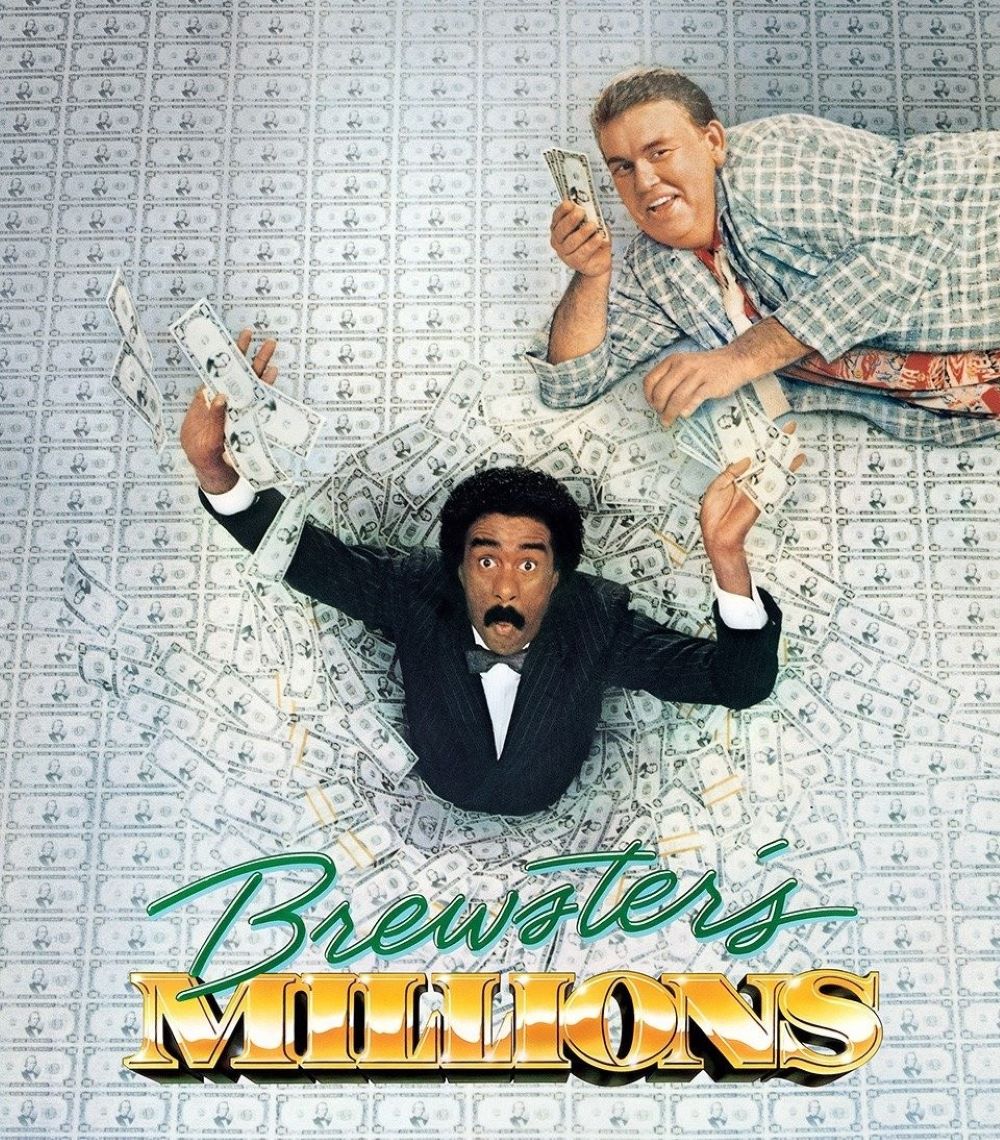
Guilty Pleasure No. 92: Brewster’s Millions (dir. by Walter Hill)


Walter Hill’s Brewster’s Millions (1985) isn’t a perfect movie by any stretch, but it’s the kind of film that sneaks up on you. It may not be sharp enough to qualify as great satire or consistent enough to hit every comedic note, but it has an undeniable charm that pulls you in regardless. It’s loud, uneven, and often ridiculous, yet few comedies from the 1980s are as weirdly entertaining when they’re firing on all cylinders. For many movie fans, it’s that quintessential “guilty pleasure”—a film you know has problems, but that somehow feels impossible to turn off once it starts. And in many ways, that’s exactly where Brewster’s Millions finds its lasting appeal.

The setup alone is too fun to resist. Richard Pryor stars as Montgomery Brewster, a minor league baseball pitcher who unexpectedly inherits the opportunity of a lifetime—to claim a $300 million fortune from a distant relative. The catch? Before he can get it, he has to spend $30 million in 30 days under a bizarre set of conditions that make financial ruin easier said than done. He can’t give the money away, can’t destroy it, can’t buy assets or investments that retain value, and can’t tell anyone why he’s doing it. Fail, and he gets nothing. Succeed, and he becomes one of the richest men alive. It’s the sort of gleefully absurd premise that could only have come from Hollywood in the 1980s, and it’s immediately clear that the film wants audiences to sit back, grab some popcorn, and watch Pryor tear through cash in increasingly funny and desperate ways.

Richard Pryor is, without doubt, the heart and soul of the movie. He imbues Montgomery Brewster with equal parts manic energy and human frustration, giving the character a real emotional arc beneath all the comic spectacle. Pryor’s talent for blending humor with exasperation makes Brewster’s predicament believable, even when it’s insane. Watching him scramble to lose money while the world keeps rewarding him is strangely satisfying. Pryor understood how to play ordinary men caught in extraordinary circumstances, and that quality grounds the film when it could have easily spiraled into total silliness. In scenes where he loses his patience with accountants, schemes wild spending sprees, or watches his good intentions backfire, Pryor’s comic timing keeps the chaos enjoyable.

John Candy adds another layer of charm as Brewster’s best friend and teammate, Spike Nolan. Candy brings warmth, loyalty, and that unmistakable good-heartedness that made him one of the decade’s most beloved comedic actors. The chemistry between Pryor and Candy keeps the film buoyant even through its weaker stretches. Their friendship defines the film’s tone—it’s loose, goofy, and full of bro-ish camaraderie. Without Candy’s infectious energy, the movie’s more hollow comedic beats might have hit the floor with a thud. Together, they create a dynamic that feels real, even inside a premise that’s totally absurd.

As a director, Walter Hill feels like an odd fit for this kind of broad comedy, but that’s part of what makes Brewster’s Millions interesting. Hill, better known for tough, kinetic action films like The Warriors and 48 Hrs., approaches this farce with a surprising amount of structure and visual precision. The film looks slicker and sharper than most comedies of its kind, which gives the excess on-screen an unintentionally epic flair. Hill’s direction keeps the story moving, and though he’s not naturally a comedic filmmaker, his grounded style adds a peculiar edge to all the craziness. It’s chaos with discipline—an aesthetic that somehow works in the movie’s favor.

Still, Brewster’s Millions can’t quite escape its shortcomings. The pacing is uneven, especially in the middle, where the film loses some steam as Brewster cycles through increasingly repetitive spending gimmicks. The story flirts with satire but rarely commits, brushing up against deeper commentary on wealth, politics, and capitalism before retreating to the comfort of broad comedy. The “Vote None of the Above” subplot, where Brewster’s money-wasting political campaign taps into voter cynicism, is one of the smartest parts of the film—but it’s introduced and resolved too quickly to leave a mark. And while the movie is full of lively energy, not every gag lands; a few supporting performances veer into caricature, and some jokes feel very much of their time.

Yet these flaws are partly what make Brewster’s Millions such a delightful guilty pleasure. It’s the cinematic equivalent of junk food—high on calories, low on nutritional value, but deeply enjoyable all the same. Pryor’s constant exasperation, the sheer absurdity of trying to “waste” money legally, and the exaggerated set pieces (like the overblown parties or his failed attempts to lose at gambling) make for irresistible entertainment. Even when the humor dips into predictable territory, the concept keeps pulling you back in. There’s a giddy satisfaction in watching Brewster try—and fail—to lose money, especially because the universe just won’t let him.

The romance subplot with Lonette McKee’s character, Angela Drake, adds just enough heart to balance the absurdity. McKee gives a grounded, intelligent performance that prevents the love story from feeling tacked on, even if it never fully takes center stage. Her presence keeps Brewster tethered to some kind of reality, and the moral through-line—learning that not everything valuable can be bought—lands gently rather than preachily. It’s not profound, but it fits the breezy tone perfectly.

As a comedy of excess, Brewster’s Millions is very much a product of its time. The slick suits, the gaudy parties, the blind faith in wealth, and the Reagan-era optimism about money’s moral neutrality all ooze from every frame. That time-capsule quality is part of its modern appeal. Watching it today, you can’t help but smile at how on-the-nose it feels—a movie from the “greed is good” decade that accidentally ends up mocking the very mindset it sprang from. It’s self-aware only in flashes, but those flashes are enough to make you recognize the movie’s satirical edge hiding beneath its loud surface.

In the end, that’s what makes Brewster’s Millions endure as a lovable guilty pleasure. It has flaws you can’t ignore—uneven pacing, scattershot tone, underdeveloped ideas—but none of them outweigh its charm. Pryor’s comic genius makes even the weakest joke land better than it should. Candy’s warmth keeps the film light. And Hill’s straightforward direction infuses the lunacy with just enough realism to make it believable. The result is a movie that’s too silly to take seriously but too fun to dismiss. You watch it, laugh at its audacity, shake your head at the logic gaps, and yet somehow come away smiling.

Brewster’s Millions may not be a comedy classic, but it’s easy to see why people keep revisiting it. It’s comfort food cinema—lighthearted, clumsy, and endlessly watchable. And like all the best guilty pleasures, it doesn’t need to be perfect to make you happy. Sometimes, seeing Richard Pryor outsmart the meaning of money for two hours is more than enough.

Previous Guilty Pleasures

  1. Half-Baked
  2. Save The Last Dance
  3. Every Rose Has Its Thorns
  4. The Jeremy Kyle Show
  5. Invasion USA
  6. The Golden Child
  7. Final Destination 2
  8. Paparazzi
  9. The Principal
  10. The Substitute
  11. Terror In The Family
  12. Pandorum
  13. Lambada
  14. Fear
  15. Cocktail
  16. Keep Off The Grass
  17. Girls, Girls, Girls
  18. Class
  19. Tart
  20. King Kong vs. Godzilla
  21. Hawk the Slayer
  22. Battle Beyond the Stars
  23. Meridian
  24. Walk of Shame
  25. From Justin To Kelly
  26. Project Greenlight
  27. Sex Decoy: Love Stings
  28. Swimfan
  29. On the Line
  30. Wolfen
  31. Hail Caesar!
  32. It’s So Cold In The D
  33. In the Mix
  34. Healed By Grace
  35. Valley of the Dolls
  36. The Legend of Billie Jean
  37. Death Wish
  38. Shipping Wars
  39. Ghost Whisperer
  40. Parking Wars
  41. The Dead Are After Me
  42. Harper’s Island
  43. The Resurrection of Gavin Stone
  44. Paranormal State
  45. Utopia
  46. Bar Rescue
  47. The Powers of Matthew Star
  48. Spiker
  49. Heavenly Bodies
  50. Maid in Manhattan
  51. Rage and Honor
  52. Saved By The Bell 3. 21 “No Hope With Dope”
  53. Happy Gilmore
  54. Solarbabies
  55. The Dawn of Correction
  56. Once You Understand
  57. The Voyeurs 
  58. Robot Jox
  59. Teen Wolf
  60. The Running Man
  61. Double Dragon
  62. Backtrack
  63. Julie and Jack
  64. Karate Warrior
  65. Invaders From Mars
  66. Cloverfield
  67. Aerobicide 
  68. Blood Harvest
  69. Shocking Dark
  70. Face The Truth
  71. Submerged
  72. The Canyons
  73. Days of Thunder
  74. Van Helsing
  75. The Night Comes for Us
  76. Code of Silence
  77. Captain Ron
  78. Armageddon
  79. Kate’s Secret
  80. Point Break
  81. The Replacements
  82. The Shadow
  83. Meteor
  84. Last Action Hero
  85. Attack of the Killer Tomatoes
  86. The Horror at 37,000 Feet
  87. The ‘Burbs
  88. Lifeforce
  89. Highschool of the Dead
  90. Ice Station Zebra
  91. No One Lives

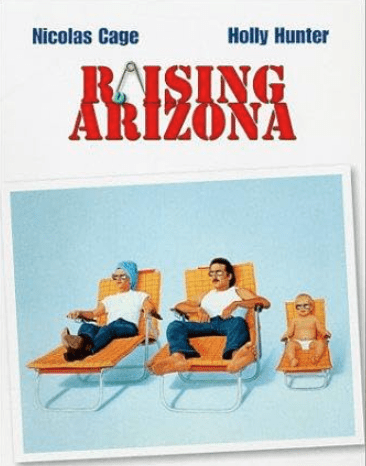
Raising Arizona (Dir Joel & Ethan Coen), Review by Case Wright


Happy Birthday, Nicolas Cage. If you’re an older Millennial or Young Gen X, you saw “Raising Arizona” about 100 times on Showtime and HBO because I believe that it was very inexpensive to license. The film was a hard left turn for the Coen Brothers who had major success with “Blood Simple” – a brutal thriller- that turned all women off to Fat Southern Murderers forever. The Coen thrillers tended to have comedic edge after Raising Arizona, but never just a comedy again- until The Big Lebowski. This film is also responsible for John Goodman. Prior to this film he was in mostly small parts, then after this picture- he became a household name in Roseanne.

Nicolas Cage is a made up name. He is Francis Coppola’s nephew and I can’t fault him for mayonnaising his name because my Italian ancestors did as well. However, I believe that he was trying to hide the Coppola name more than his heritage. Speaking of Italian heritage, try “Groking” “Italian American Jersey Girl” in grok. The lady who appears is beautiful, but doesn’t look like any of my Aunts. I feel that I should advocate for my people- We trend good looking and gave you Pizza Friday! Come on, show some love!

The film’s premise is that H.I. McDonnough (Nicolas Cage) is an ex con who is addicted to robbing the same convenience store again and again and again. This may seem strange, but in another life, I did criminal defense and I had a client who would steal the same jacket from the same store every year. Edwina “Ed” (Holly Hunter) is a cop who processes H.I. again and again. Each time, he flirts with her. His last time as a convict in front of her- her fiancé left her. H.I. realizes that he must go straight to get her love.

After his jail time, he returns as a free man to get his love- “Ed”. It works! They have a great life, but they want a child and yet she can’t conceive. The solution: they will kidnap a baby from the owner of Gallery Furniture! If you were from Texas, you would’ve laughed! They get the kid and are pursued by all sorts of people who want to claim the reward for the kidnapped baby.

This very intricate plot is just the first 30 minutes of the film. It is truly funny. I always felt for these character because good people should have LOTS OF KIDS- as many as possible! They shouldn’t have to pay taxes or anything. This film is special to me for another reason: it is when the Boomers were still young and filled with hope. Now, we are losing them and it hurts. This film is a glimpse of what they were like before the grey and how much they yearned for a good family on their own terms.

“Whisperer”, Short Film Review, By Case Wright


Hi Horror and Case Lovers! So, I could not find a title card image for this short, but clowns scare the $#!% out of me so here we are. Just remember, that’s their real skin, not makeup. The oversized shoes and red nose are just to get you to let your guard down before they kill you! Now, you are able to face the world once again!

The short begins with a college student doing some cleaning at home. He checks the hallways and he sees…. yes a clown! Damn it! WHY?! WHY?!

Clowns, between you and me – why are you even a thing? I know what motivates you to make people mess their pants regardless of the season- you must feed, but why?! Can’t you just be anything else and still feast upon the living?

The Clown confronts the young man and…. he tries to kill him with a crowbar, but the would-be victim fights back with GUNS!!!
Yes, GUNS ARE THE ANSWER! GUNS! They are Clown Repellent! They are Clown-Be-Gone!
The Crowbar vs Clown is pretty effective too.

Now, is this short the result of two bored frat guys? Probably, but I’m ok because clowns are a menace!
Yes, it ends with a gun solving the Clown Menace! This short worked for me!

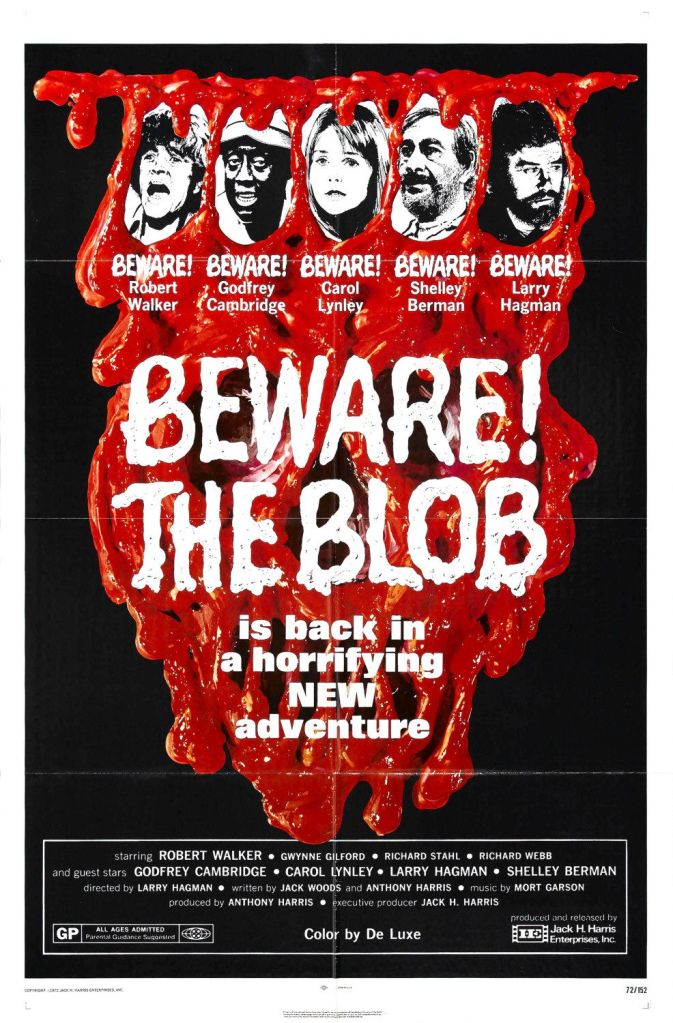
Movie Review: Beware! The Blob (by Larry Hagman)


Everyone has one movie or two that hit them so hard it caused them to develop habits. It could be shaking your shoes to confirm no spiders are in them, counting the seconds after a lightning strike for the thunder, or checking the back seat of your car before you get into it, just in case. Some movies kind of imprint themselves on you in different ways.

Beware! The Blob (or Son of The Blob in some circles) was the most terrifying film I saw as a kid. I watched it in front of my grandmother’s living room tv that had a little alarm clock on the floor beneath it. Unlike Friday the 13th and Halloween, where I could rationalize my fears, Beware! The Blob had me fearing the summer and any open crevice we had. On any visits to our local video store (in the Pre-Blockbuster days), I’d pick out video games to rent and could see the box for the film in the horror section. I’d never walk over there, even in my early teenage years.

Most consider the 1958 original a Classic, and Chuck Russell’s 1988 update often goes toe to toe with John Carpenter’s The Thing on the Best Remakes list. Beware! The Blob will probably never make that list, but it’s not a total loss, given a recent rewatch. The film’s greatest strengths are in the casting and the special effects. From a cinema history/trivia standpoint, the film marks one of the earliest credits for Cinematographer Dean Cundey. Cundey worked as a 2nd Unit Cinematographer for the film, particularly with the animal shots in the opening and later on. That might not sound like much, but Cundey would go on to be picked by Debra Hill to help out on Halloween in 1978. From there, he had The Fog, Halloween II, The Thing, Romancing the Stone, Back to the Future, Big Trouble in Little China, Who Framed Roger Rabbit?, and Jurassic Park, to name a few.

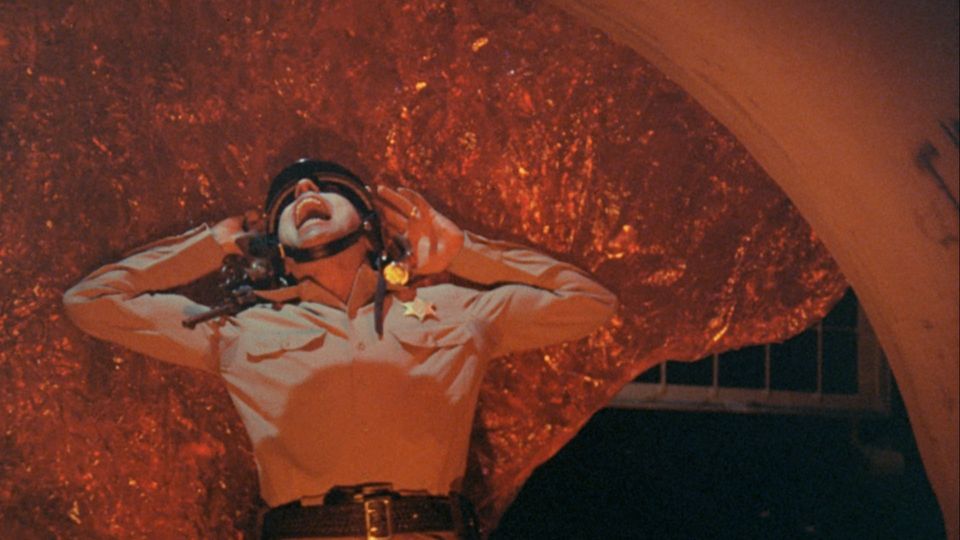
With 14 years since the first film, there were some tech upgrades to how the blob was made. A large plastic balloon was used for some scenes (particularly the bowling alley sequences). Additionally, silicone was added to a drum to allow for the “blob pov” during the bowling alley sequences. In most sequences, a red dyed powder mixed with water was used. To make sure the audience was aware the Blob was close, a high whistle would sound, giving anyone with even the slightest bit of tinnitus some cause to look over their shoulder. Academy Award Winner Tim Baar (The Time Machine) and Conrad Rothmann worked on the effects, along with Cundey.

In his film directing debut, Larry Hagman (TV’s I Dream of Jeannie, Dallas) weaves a tale of horror lurking through a town peppered with parties, hobos, a boy scout team, an angry bowling alley owner, some dune buggy aficionados and a sheriff (Richard Webb, The Phantom Stagecoach) who’s a little confused about some of the events happening in town. To his credit, it’s amazing to see who Hagman assembled here, as he called in some friends to join in on the fun. Comedian Godfrey Cambridge. Cindy Williams, just a few years shy of American Graffiti. Gerrit Graham, about two years before Phantom of the Paradise. Sid Haig (The Devil’s Rejects) is here as well. You can even spot Hagman in the film as one of three hobos squaring off with the Blob. It should be noted that the other two hobos with him are Burgess Meredith (Clash of the Titans) and Del Close (Chuck Russell’s The Blob).

The film flows like it’s namesake, with some chapters having little do to with anything – Dick Van Patten’s boy scouts, while funny, could have had one of their scenes cut for speed. It’s not incredibly terrible, but it’s exactly great, either. Most of the script, written by Anthony Harris, was tossed with ad-libbing done on set. Despite all this, it does looks like the cast enjoyed themselves making the film. It has that going for it, at least.

Sid Haig was caught unaware in Larry Hagman’s Beware! The Blob

Chester, A construction worker from the Arctic (Cambridge) is getting his camping gear stowed away when his wife, Marlene (Marlene Clark, The Beast Must Die) discovers a thermos in their freezer. He explains he performed some work and brought home a piece of what the found in the Arctic. Setting it on a countertop, the couple forget about the thermos, which pops open. The newly released blob absorbs a fly and a kitten before moving on to larger prey. Before we know it, Chester is having problems with his TV – which happens to be playing the original 1958 movie – as it slithers into his favorite recliner. It’s a sequence that’s burned into my mind. I always check a chair before sitting in it. Some check for thumbtacks, I check for alien goo.

When Lisa (Gwynne Gilford, Masters of the Universe & actor Chris Pine’s Mom) discovers Chester with his new friend, she dashes out and heads to her boyfriend, Bobby (Robert Walker, Easy Rider). By the time the couple return to Chester’s place, they find the house empty. Can the couple convince the cops and the town of the danger ahead before it’s too late? Most of Beware! The Blob‘s scenes are set up in a way where people are completely oblivious of it until it’s touched them, causing said individual to slip and fall into the camera. The climax of the film takes place in a bowling alley, which is actually impressive for the techniques used, but even with the casting, you might spend more time laughing than anything else. Perhaps that’s my way of rationalizing the film years later.

At the time of this writing, Beware! The Blob is currently available to watch on the Plex streaming service. We’re also labeling this an Incident – out of respect to the kitten – and returning the timer to Zero.

You’re Killing Me, Smalls!: Let’s Play in THE SANDLOT (20th Century-Fox 1993)


gary loggins's avatarcracked rear viewer


Baseball movies are as American as apple pie, and everyone has their favorites, from classic era films like THE PRIDE OF THE YANKEES and TAKE ME OUT TO THE BALL GAME to latter-day fare like THE NATURAL and FIELD OF DREAMS. There’s so much to choose from, comedies, dramas, and everything in-between. One of my all-time favorites is 1993’s coming of age classic, THE SANDLOT.

Like most baseball movies, THE SANDLOT is about more than just The Great American Pastime. Director David Mickey Evans’ script (co-written with Robert Gunter) takes us back to 1962, as young Scotty Smalls has moved to a brand new neighborhood in a brand new city. His dad died, and his mom (Karen Allen of NATIONAL LAMPOON’S ANIMAL HOUSE fame) has remarried preoccupied Bill (young comedian Denis Leary…. hmmm, I wonder what ever happened to him??), who tries to teach the nerdy kid how to play…

View original post 433 more words

A (Not-So) Brief Note On WELCOME TO MOOSEPORT (20th Century Fox 2004)


gary loggins's avatarcracked rear viewer

Sometimes while scrolling through the channels one come across a pleasant surprise. So it’s Saturday afternoon,a thundershower has cancelled my plan to hit the beach, the Red Sox don’t start for awhile, and I’m clicking the old clicker when I land on WELCOME TO MOOSEPORT. I wasn’t expecting much, just a way to kill time; instead, I found an underrated little gem of a comedy that kept me watching until the very end.

Don’t get me wrong, I’m not saying WELCOME TO MOOSEPORT is an undiscovered classic or anything like that. It’s just a solidly made piece of entertainment about small-town life starring Ray Romano (riding high at the time thanks to his successful sitcom EVERYBODY LOVES RAYMOND) and Oscar winning Gene Hackman. Romano uses his nebbishy TV persona to portray Mooseport, Maine’s local hardware store owner “Handy” Harrison, who gets involved in a mayoral campaign against Hackman’s Monroe “Eagle”…

View original post 438 more words

Make ‘Em Laugh: RIP Tim Conway


gary loggins's avatarcracked rear viewer

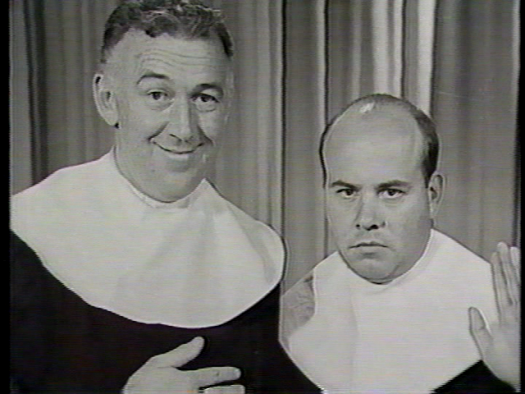
If comedy is a gift, then Tim Conway was America’s Santa Claus, delivering bags full of laughter directly into our homes for over fifty years. The cherubic Conway, who died May 14 at age 85, was mainly known for his television work, but also starred in films, on stage, and in the home video field, making him a true Renaissance Man of Comedy.

Tim and Ernie “Ghoulardi” Anderson

Young Tim got his start in his hometown of Cleveland, not exactly a hotbed of humor (with apologies to Jim Backus, Kaye Ballard, and British transplant Bob Hope ), writing and appearing in skits with local TV personality Ernie Anderson during breaks in a morning movie show. Anderson himself would later gain fame as a horror host (Cleveland’s Ghoulardi) and  a network announcer, ‘The Voice of ABC’ (“Tonight on The Loooo-ve Boat….”).

Comic actress Rose Marie, on a cross-country tour promoting THE…

View original post 887 more words

A Moment of Comedy Bliss with Tim Conway and Harvey Korman


gary loggins's avatarcracked rear viewer

As the world still mourns the loss of Doris Day yesterday, another great has left us  – TV comedy genius Tim Conway, who died today at age 85. Tim rightfully deserves a tribute post of his own, and he’ll get it, but until then, enjoy this classic bit of comedy gold from THE CAROL BURNETT SHOW (and watch Harvey Korman try to keep a straight face!):

Tim Conway (1933-2019)

View original post

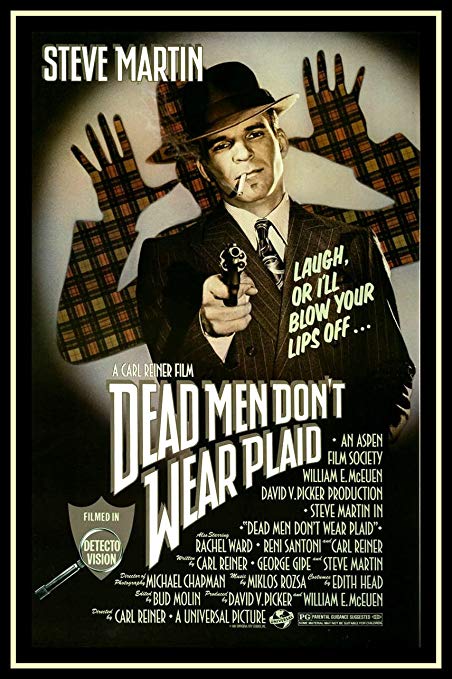
The Dork Knight: Steve Martin in DEAD MEN DON’T WEAR PLAID (Universal 1982)


gary loggins's avatarcracked rear viewer

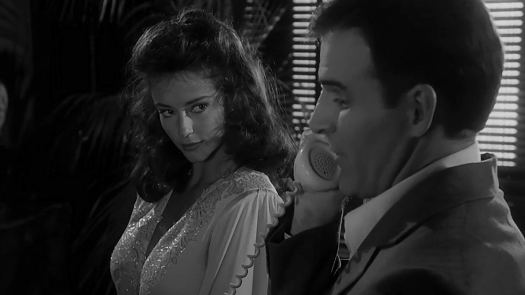
Quick, name a film noir that stars Humphrey Bogart, James Cagney, Joan Crawford, Bette Davis, Ava Gardner, Cary Grant, Veronica Lake, Alan Ladd, Vincent Price, and… Steve Martin? There’s only one: 1982’s DEAD MEN DON’T WEAR PLAID, the second collaboration between that “wild and crazy guy” Martin and comedy legend Carl Reiner. I remember, back in 1982, being dazzled by editor Bud Molin’s seamless job of incorporating classic film footage into the new narrative while simultaneously laughing my ass off. Things haven’t changed – the editing still dazzles, and I’m still laughing!

Martin and Reiner’s first comedy, 1979’s THE JERK, was an absurdist lover’s delight, and this time around the two, along with cowriter George Gipe, concocted this cockeyed detective saga after combing through old black and white crime dramas (we didn’t call ’em film noir back then) and cherry picking scenes to build their screenplay around. Martin plays PI…

View original post 376 more words

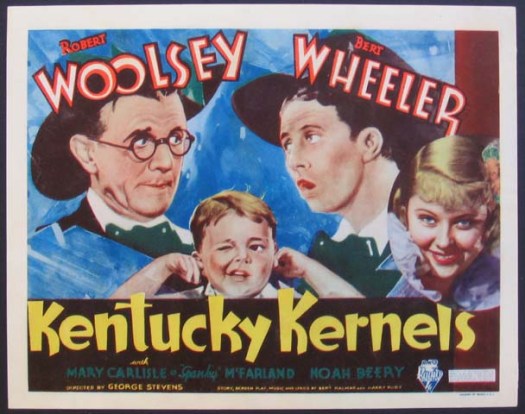
De-Coded: Wheeler & Woosley in KENTUCKY KERNALS (RKO 1934)


gary loggins's avatarcracked rear viewer


The comedy team of Bert Wheeler and Robert Woosley  join forces with Our Gang’s Spanky McFarland in KENTUCKY KERNALS, directed by Hal Roach vet George Stevens. Sounds like the perfect recipe for a barrel of laughs, right? Well, while there are some laughs to be had, the (then) recent enforcement of the Production Code finds W&W much more subdued than in their earlier zany efforts, and playing second fiddle to both Spanky’s admittedly funny antics and the plot at hand, a takeoff on the famed Hatfield-McCoy feud.

Weirdly enough, the film starts off with a lovelorn man attempting suicide by jumping off a bridge. Fortunately for him, he lands in a fishing net owned by down-on-their luck vaudevillians Elmer (Woolsey) and Willie (Wheeler), living in a waterfront shack. The two convince him to adopt a child, and go to the orphanage, where they find cute little Spanky, who has a…

View original post 377 more words