A mad bomber is blowing up large chunks of Seattle and seems to have a vendetta against the city’s bomb squad. John Pierce (Sam Elliott), a burn-out who used to be the best of the best when it came to defusing bombs, comes out of retirement to help with the investigation. The only problem is that all of the evidence seems to be pointing at Pierce. Pierce does his best to prove his innocence while more and more members of the bomb squad get blown up.
The Final Cut has its moments. The lengthy opening scene features Amanda Plummer and John Hannah as two cocky members of the bomb squad who discover that defusing their latest explosive isn’t going to be as simple as they think it is. The final 20 minutes takes the film into Saw territory, with an underground lair and a woman who has been turned into a human explosive. In-between, though, the movie is often slow and Sam Elliott sleepwalks through a role that really demanded the low-budget equivalent of a Lethal Weapon-era Mel Gibson. (Wings Hauser comes to mind.) The actual identity of the bomber will be easy for anyone to guess though the bomber’s final fate is actually executed pretty well.
Director Roger Christian is a long-time associate of George Lucas’s and also worked on Alien as a production designer. That’s probably why the sets, especially that underground lair, look surprisingly good for what was obviously a direct-to-video B-movie. Five years after The Final Cut, Christian would attain an infamous immortality when he was the director unfortunate enough to be credited as directing Battlefield Earth. Compared to Battlefield Earth, The Final Cut is damn good movie.
There was a time in my life, before I could drive, when I would beg my parents to stop at the video store every time we went to the neighboring town of Conway, Arkansas. The town I grew up in was too small to have more than just a gas station, so this movie buff had to take advantage of every trip to town. One night when we were headed home, my parents relented to my repeated requests, so we stopped off at Budget Video. I wanted to choose all the movies, but unfortunately mom and dad would also let my brother and sister choose movies from time to time as well. On this particular night, my brother wanted to rent THE UNTOUCHABLES (1987). I don’t remember what I was wanting, but I do remember that it was not THE UNTOUCHABLES. I probably pouted a little bit, but we ended up taking THE UNTOUCHABLES home with us. We turned it on that night, and I’ll gladly admit that I was 100% wrong. THE UNTOUCHABLES immediately became one of my favorite films. Great job, bro!
It’s 1930 and Prohibition is the law of the land in the United States of America. Treasury agent Eliot Ness (Kevin Costner) has been given the seemingly impossible task of bringing down notorious gangster Al Capone (Robert De Niro), who supplies booze to nearly all of Chicago. Capone doesn’t just supply the booze, he rules Chicago with an iron fist; and if you’re a local business who doesn’t want to buy his product, he just may blow your ass up! Ness’ job is made especially difficult due to the rampant corruption in Chicago, where everyone from the Mayor, to the judges, lawyers, and law enforcement officers are all on Capone’s payroll, making it pretty much impossible to trust anyone. In a complete stroke of luck, Ness encounters the honest Irish American policeman James Malone (Sean Connery) and asks him to join him in bringing down Capone. With Malone, Ness has found that honest and badass cop who’s not afraid to go up against Capone and his goons. Knowing that most of the police force is already compromised, the two men head to the police academy to try to find another honest cop. This turns out to be another great move as they come upon an Italian American trainee named George Stone (Andy Garcia), who’s a prodigy with a gun. Their last, and greatest move in this humble CPA’s opinion, comes when they accept accountant Oscar Wallace (Charles Martin Smith) to their team. Wallace is convinced that the key to bringing down Capone is trying to build a tax evasion case against him. He’s initially laughed at, but it’s soon apparent that this accountant knows his debits and credits, and his expertise may be just what’s needed to end Capone’s reign of terror once and for all.
I’ve always considered THE UNTOUCHABLES to be a near perfect film. One of the main reasons I find the film so perfect is the direction of Brian De Palma. I’ve been a fan of his “style” for so long, with films like DRESSED TO KILL (1980) and BLOW OUT (1981), but I think he just nails the material here. There are so many great scenes, but the “Union Station” sequence has to be one of the most perfectly choreographed sequences of all time. The building of the tension, the slow-motion shootout when the bad guys arrive, and finally the badass resolution all prove what an absolute master De Palma could be with the right material. De Palma claims that he made up the series of shots as he was filming the scenes at the train station, making the final product that much more impressive. And this all plays out against the background of a “lullaby theme” composed by the legendary Ennio Morricone (THE GOOD, THE BAD, AND THE UGLY). This is what “cinema” is all about.
THE UNTOUCHABLES has an amazing cast of actors to bring its “based on real events” story to life. Kevin Costner was just beginning to emerge as a movie star when this movie was made back in 1987. Especially as a younger actor, Costner was good at projecting both a certain innocence, tempered with the willingness to do what it takes to get the job done once his family and friends are put in danger. And what can you say about actors like Sean Connery and Robert De Niro?!! Connery is so charismatic, wise, and tough as the beat cop who shows Eliot Ness how to beat Capone… ”he sends one of yours to the hospital, you send one of his to the morgue!” He’s a beat cop because he’s incorruptible, and Connery projects that stubborn honesty perfectly. I’m so glad that Connery won an Oscar for this performance, as it would be the only time he would ever be nominated for an Academy Award. He’s amazing in this role, even if his accent is Scottish rather than Irish (a notable controversy at the time). Connery may have won the Oscar, but Robert De Niro matches him scene for scene. His ability to make Capone both charismatic and evil in equal measure is an example of what makes De Niro special as an actor. So many actors phone in these types of broad performances, but not De Niro. I also just think it’s cool that De Niro admitted that his performance was heavily influenced by Rod Steiger’s in 1959’s AL CAPONE. I love Steiger and consider this a wonderful tribute. Throw in a young Andy Garcia, the always underrated Charles Martin Smith, and a creepy Billy Drago as Frank Nitti, and you have one of the better casts ever assembled. I especially became a fan of Garcia based on his performance in THE UNTOUCHABLES.
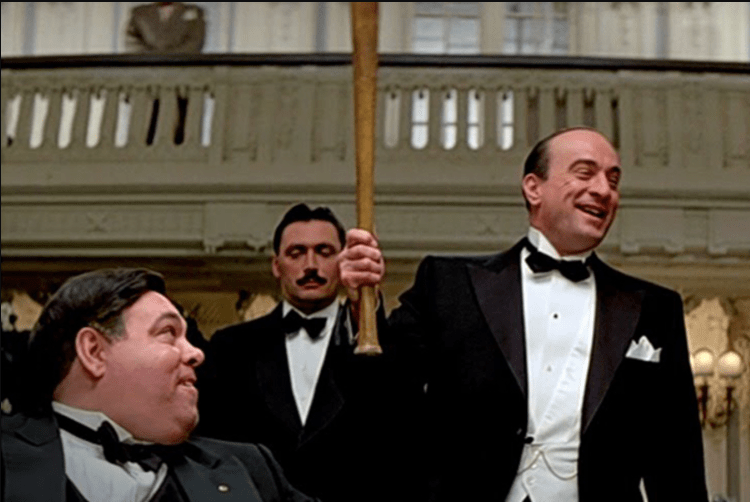
The last person I want to mention is the screenwriter, David Mamet. His screenplay is another perfect element of THE UNTOUCHABLES. The same man who has directed his own films like HOUSE OF GAMES (1987), HOMICIDE (1991), THE SPANISH PRISONER (1997), and SPARTAN (2004) knows how to write a great screenplay. There are so many amazing moments, from the “baseball bat” sequence to the “Stone recruitment” scene, and even Ness’ “he’s in the car” line about Frank Nitti, it’s a muscular screenplay full of big-time moments of audience satisfaction.
At the end of the day, THE UNTOUCHABLES is just a great movie. I still periodically thank my brother for picking it out that fateful day in the late 80’s, and it will always be one of my very favorites. It’s one of those movies that I recommend with zero reservations!
Check out the trailer below, and if you’re smart, you’ll watch one of the great movies of the 1980’s, Brian De Palma’s THE UNTOUCHABLES.
John Carpenter has directed 18 features film, from 1974’s Dark Starto 2010’s The Ward. Some of his films have been huge box office successes. Some of his films, like The Thing, were box office flops that were later retroactive recognized as being classics. Carpenter has made mainstream films and he’s made cult favorites and, as he’s always the first to admit, he’s made a few films that just didn’t work. When it comes to evaluating his own work, Carpenter has always been one of the most honest directors around.
Amazingly, Carpenter has only directed one film that received an Oscar nomination.
That film was 1984’s Starman and the nomination was for Jeff Bridges, who was one of the five contenders for Best Actor. (The Oscar went to F. Murray Abraham for Amadeus.) Bridges played the title character, an alien who is sent to Earth to investigate the population and who takes on the form of the late husband of Jenny Hayden (Karen Allen). The Starman takes Jenny hostage, though its debatable whether or not he really understands what it means when he picks up her husband’s gun and points it at her. He and Jenny drive across the country, heading to Arizona so that he can return to his ship. Pursued by the government (represented by the sympathetic Charles Martin Smith and the far less sympathetic Richard Jaeckel), the Starman learns about emotions, eating, love, and more from Jenny. Jenny goes from being fearful of the Starman to loving him. Carpenter described the film as beingIt Happened One Night with an alien and it’s not a bad description.
After Jenny and the alien visitor make love in a boxcar, the Starman says, “I gave you a baby tonight,” and that would be an incredibly creepy line coming from a human but it’s oddly charming when uttered by an alien who looks like a youngish Jeff Bridges. Bridges definitely deserved his Oscar nomination for his role here. Speaking with an odd accent and moving like a bird who is searching for food, Bridges convincingly plays a being who is quickly learning how to be human. The Starman is constantly asking Jenny why she says, does, and feels certain things and it’s the sort of thing that would be annoying if not for the way that Bridges captures the Starman’s total innocence. He doesn’t mean to be a pest. He’s simply curious about everything.
Bridges deserved his nomination and I would say that Karen Allen deserved a nomination as well. In fact, it could be argued that Allen deserved a nomination even more than Bridges. It’s through Allen’s eyes that we see and eventually come to trust and then to love the Starman. Almost her entire performance is reactive but she makes those reactions compelling. I would say that Bridges and Allen deserved an Oscar for the “Yellow light …. go much faster” scene alone.
Carpenter agreed to make Starman because, believe it or not, The Thing had been such a critical and commercial flop that it had actually damaged his career. (If ever you need proof that its best to revisit even the films that don’t seem to work on first viewing, just consider Carpenter’s history of making films that were initially dismissed but later positively reevaluated. Today, The Thing, They Live, Prince of Darkness, and In The Mouth of Madness are all recognized as being brilliant films. When they were first released, they all got mixed reviews.) Carpenter did Starman because he wanted to show that he could do something other than grisly horror. Starman is one of Carpenter’s most heartfelt and heartwarming films. That said, it also features Carpenter’s trademark independent streak. Starman not only learns how to be human but, as a result of the government’s heavy-handed response to his arrival, one can only assume that he learns to be an anti-authoritarian as well.
Starman is one of Carpenter’s best films and also a wonderful showcase for both Karen Allen and Jeff Bridges.
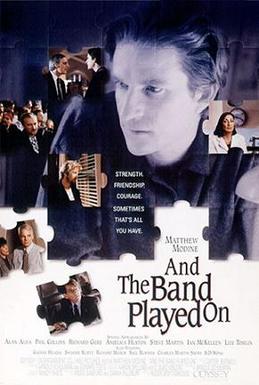
That was one of my main thoughts as I watched 1993’s And The Band Played On.
Directed by Roger Spottiswoode and featuring an all-star cast, And The Band Played On deals with the early days of the AIDS epidemic. It’s a film that features many different characters and storylines but holding it all together is the character of Dr. Don Francis (Matthew Modine), an epidemiologist who is haunted by what he witnessed during the Ebola epidemic in Africa and who fears that the same thing is going to happen in America unless the government gets serious about the mysterious ailment that is initially called “gay cancer” before then being known as “GRID” before finally being named AIDS. Dr. Francis is outspoken and passionate about fighting disease. He’s the type who has no fear of yelling if he feels that people aren’t taking his words seriously enough. In his office, he keeps a track of the number of HIV infections on a whiteboard. “Butchers’ Bill” is written across the top of the board.
Throughout the film, quite a few people are dismissive of Dr. Francis and his warnings. But we, the audience, know that he’s right. We know this because we know about AIDS and but the film also expects us to trust Dr. Francis because it’s specifically stated that he worked for the World Health Organization before joining the Center For Disease Control in Atlanta, Georgia. As far as the film is concerned, that’s enough to establish his credentials. Of course, today, after living through the excesses of the COVID pandemic and the attempts to censor anyone who suggested that it may have begun due to a lab leak as opposed to some random guy eating a bat, many people tend to view both the WHO and the CDC with a lot more distrust than they did when this film was made. As I said, we live in a cynical time and people are now a lot less inclined to “trust” the experts. To a large extent, the experts have only themselves to blame for that. I consider myself to be a fairly pragmatic person but even I now find myself rolling my eyes whenever a new health advisory is issued.
This new sense of automatic distrust is, in many ways, unfortunate. Because, as And The Band Played On demonstrates, the experts occasionally know what they’re talking about. Throughout the film, people refuse to listen to the warnings coming from the experts and, as a result, many lives are lost. The government refuses to take action while the search for a possible cure is hindered by a rivalry between international researchers. Alan Alda gives one of the best performances in the film, playing a biomedical researcher who throws a fit when he discovers that Dr. Francis has been sharing information with French scientists.
It’s a big, sprawling film. While Dr. Francis and his fellow researchers (played by Saul Rubinek, Glenne Headly, Richard Masur, Charles Martin Smith, Lily Tomlin, and Christian Clemenson) try to determine how exactly the disease is spread, gay activists like Bobbi Campbell (Donal Logue) and Bill Kraus (Ian McKellen) struggle to get the government and the media to take AIDS seriously. Famous faces pop up in small rolls, occasionally to the film’s detriment. Richard Gere, Steve Martin, Anjelica Huston, and even Phil Collins all give good performances but their fame also distracts the viewer from the film’s story. There’s a sense of noblesse oblige to the celebrity cameos that detracts from their effectiveness. All of them are out-acted by actor Lawrence Monoson, who may not have been a huge star (his two best-known films are The Last American Virginand Friday the 13 — The Final Chapter) but who is still heart-breakingly effective as a young man who is dying of AIDS.
Based on a 600-page, non-fiction book by Randy Shilts, And The Band Played On is a flawed film but still undeniably effective and a valuable piece of history. Director Roger Spottiswoode does a good job of bringing and holding the many different elements of the narrative together and Carter Burwell’s haunting score is appropriately mournful. The film ends on a somber but touching note. At its best, it’s a moving portrait of the end of one era and the beginning of another.
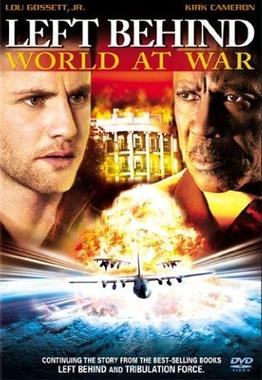
With the 2005 film, Left Behind: World At War, the Left Behind series enter special guest star territory. Kirk Cameron and Brad Johnson, while still present in the film, were largely pushed to the background and Louis Gossett, Jr. and Charles Martin Smith popped up as Nicolae Carpathia’s two main adversaries.
Gossett plays President Gerald Fitzhugh. Smith plays Vice President John Mallory. (Speaking as someone of Irish descent, it fills me with pride to think that America will someday be led by the presidential ticket of Fitzhugh and Mallory.) Despite the fact that Carpathia (again played by Gordon Currie) spent the previous film talking about how, under his leadership, there would be no more borders, it appears that there still are borders. However, Carpathia has a plan to take care of that. Mallory has discovered the plan but, right after he tells Fitzhugh about it, they’re attacked by Carpathia’s goons. The presidential limo is blown up and with it, John Mallory. (Poor Charles Martin Smith.) Fitzhugh manages to escape, thanks to the help of the Tribulation Force.
It turns out that Carpathia’s latest scheme is to steal the few remaining bibles in the world, lace them with anthrax, and then distribute them back to the believers. Gossett gets to go full action hero as he tries to stop Carpathia and good for him. As for the other members of the Tribulation Force, Buck (Kirk Cameron) marries Chloe Steele (Janaya Stephens) and Chloe’s father, Rayford (Brad Johnson), meets his former lover, Hatti Dunham (Chelsea Noble). Hattie is now Carpathia’s lover and is pregnant with his child. Some members of the Tribulation Force die over the course of the film. Buck has a moment of anger at God, which is the best scene in the film because it at least acknowledges that one can believe and still be angry. The majority of the film, however, is Lou Gossett, Jr. wandering around with a “How did I go from winning an Oscar to appearing in this?” look on his face.
Anyway, credit where credit is due. World at War is the most action-packed of the Left Behind films and, while it’s still definitely an evangelical film, it’s considerably less preachy than either the first Left Behind film or Tribulation Force. World at War is pure melodrama, with a lot of plotting and evil cackling and overdone action scenes. If you don’t want to listen to the dialogue, you can focus on just how small the film’s version of the Oval Office is. That’s what happens when you try to a globe-spanning epic on a low budget. Sometimes, you have to settle for a small replica of the Oval Office instead of trying for the real thing.
That’s not to say that World At War is a particularly good film. Brad Johnson gets even less to do than in the second film and Kirk Cameron is still Kirk Cameron. Since he lost his job at the end of Tribulation Force, we’re no longer asked to believe that Kirk Cameron’s playing a respected journalist. Instead, Buck is now just a self-righteous evangelist and, for obvious reasons, it’s easy to believe Kirk Cameron in that role but Kirk Cameron is one of those actors who is far more likable when he’s miscast than when he’s playing himself. Much as with Tribulation Force, World At War can’t seem to decide just how powerful Carpathia actually is. He’s got supernatural powers and is apparently actually immortal and yet, he is often easily deceived by the simplest of ruses and is incapable of killing anyone until their usefulness to the film’s narrative has expired.
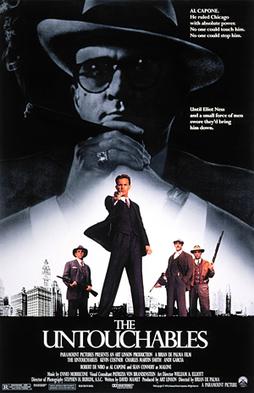
“Let’s do some good!” Eliot Ness shouts as he and a platoon of Chicago cops raid what they believe is a bootlegger’s warehouse.
That line right there tells you everything that you need to know about the 1987 film, The Untouchables. In real life, Eliot Ness was known to be an honest member of law enforcement (which did make him a bit of a rarity in 1920s Chicago) but he was also considered to be something of a self-promoter, someone who tried to leverage his momentary fame into an unsuccessful political career. In the 50s, after Ness had lost most of his money due to a series of bad investments and his own alcoholism, Ness wrote a book about his efforts to take down Al Capone in Chicago. That book was called The Untouchables and though Ness died of a heart attack shortly before it was published, it still proved popular enough to not only rehabilitate Ness’s heroic image but also to inspire both a television series and the movie that I’m currently reviewing.
None of that is to say that Ness didn’t play a role in Al Capone’s downfall. He did, though it’s since been argued that Ness had little to do with actual tax evasion case that led to Capone going to prison. It’s just that, in real life, Eliot Ness was a complicated human being, one who had his flaws. In The Untouchables, Kevin Costner plays him as a beacon of midwestern integrity, a Gary Cooper-type who has found himself in the very corrupt city of Chicago in the very corrupt decade of the 1920s. The film version of Eliot Ness has no flaws, beyond his naive belief that everyone is as determined to “do some good” as he is.
So, The Untouchables may not be historically accurate but it’s still an entertaining film. It’s less concerned with the reality of Eliot Ness’s life and more about the mythology that has risen up around the roaring 20s. Everything about the film is big and operatic. In the role of Al Capone, Robert De Niro sneers through every scene with the self-satisfaction of a tyrant looking over the kingdom that he’s just conquered. While Costner’s Ness tells everyone to do some good, De Niro’s Capone uses a baseball bat to keep his underlings in line. He goes to the opera and cries until he’s told that one of Ness’s men has been killed. Then a big grin spreads out across his face. It’s not exactly a subtle performance but then again, The Untouchables is not exactly a subtle movie. It’s not designed to be a film that makes you think about whether or not prohibition was a good law. Instead, everything is bigger-than-life. It’s a film that takes place in a dream world that appears to have sprung from mix of old movies and American mythology.
In real life, Ness had ten agents working under him. They were all selected because they were considered to be honest lawmen and they were nicknamed The Untouchables after it was announced to the press that Ness had refused a bribe from one of Capone’s men. In the film, Ness only has three men working underneath him and they’re all recognizable types. Sean Connery won an Oscar for playing Jmmy Malone, the crusty old beat cop who teaches Ness about the Chicago Way. A young and incredibly hot Andy Garcia plays George Stone, the youngest of the Untouchables. Best of all is Charles Martin Smith, cast as Oscar Wallace, a mild-mannered accountant who first suggests that Capone must be cheating on his taxes. There’s a great scene in which the Untouchables intercept a liquor shipment on the Canadian border, all while riding horses. Sitting on the back of his galloping horse and trying not to fall off, both Oscar Wallace and the actor playing him appear to be having the time of their lives. For Oscar (and probably for much of the audience), it’s a fantasy come to life, a chance to “do some good.”
The Untouchables was directed by Brian DePalma and his stylish approach to the material is perfect for the film’s story. DePalma fills the film with references to other movies, some from the gangster genre and some not. (In one of the film’s most famous sequence, DePalma reimagines Battleship Potemkin‘s massacre on The Odessa Steps as a shoot-out between Eliot Ness and Capone’s men.) DePalma’s kinetic style reminds us that The Untouchables is less about history and more about how we imagine history. In reality, Capone was succeeded by Frank Nitti and The Chicago Outfit continued to thrive even in Capone’s absence. In the film, Nitti (played by Billy Drago) brags about killing one of the Untouchables and, as a result, is tossed off the roof of a courthouse by Eliot Ness. It’s not historically accurate but it makes for a crowd-pleasing scene.
Big, operatic, and always entertaining, The Untouchables is an offer that you can’t refuse.
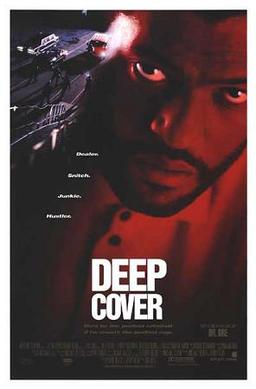
When Russell Stevens was 10 years old, he saw his father get gunned down while holding up a liquor store. Now, 20 years later, Russell (Laurence Fishburne) is a cop who is so straight that he doesn’t even drink. But because of his father’s background, a psychological profile that indicates Russell is unique suited to understand how the criminal mind works, and the fact that he has no loved ones at home, he is recruited to work undercover. His weaselly handler, Carver (Charles Martin Smith), explains that going undercover means that Russell is going to have to become a criminal 24/7. He can’t just do his job for 8 hours a day and then go back to his normal life at night.
With the government’s money, Russell sets himself up as a dealer, buying and selling the drugs that are destroying his community. It does not take long before Russell meets David Jason (Jeff Goldblum), a lawyer and aspiring drug kingpin. At first, David makes Russell as being an undercover cop but, after Russell is arrested by the righteous but clueless Detective Taft (Clarence Williams III), David changes his mind and brings Russell into the operation. The line between being a cop and a criminal starts to blur, especially after David and Russell start to bond over their mutual dislike of their boss, Felix (Gregory Sierra). It doesn’t take long for Russell to get in over his head.
There have been a lot of films made about undercover cops losing themselves in their new criminal identity but few take the story to its logical conclusion like Deep Cover does. Russell may start out as a straight arrow but, by the end of the movie, he’s killed a dealer in cold blood and broken his own personal pledge to never do cocaine himself. He also discovers that David is often a more trustworthy partner than his own colleagues in law enforcement. Fishburne and Goldblum both give excellent, spot-on performances as Russell and David and they’re supported by an able cast of weasels and tough guys. I especially liked Charles Martin Smith’s performance as Carver. (When Russell asks Carver if he’s ever killed a man, Carver laughs and says that he went to Princeton “just to avoid that shit.”) Gregory Sierra is also great in the role of Felix and I loved that, of all people, Sidney Lassick played one of Felix’s henchmen. That’s like seeing John Fiedler play the Godfather.
One of the best crime thrillers of the 90s, Deep Cover is not only a detective film but it’s also a politically-charged look at why America’s war on drugs was doomed to failure. No sooner does Russell get into position to catch the man behind Felix’s operation than he’s told to drop the case because the State Department thinks that the drug lord could be politically helpful to them in South America. As Russell discovers, the War on Drugs is more interested in taking out the soldiers on the streets than the generals in charge. While men like Carver sit in their offices and move people around like pieces on a chess board, people like Russell are left to clean up the mess afterward.
As befits the title, the 1990 film, The Hot Spot, is all about heat.
There’s the figurative heat that comes from a cast of characters who are obsessed with sex, lies, and murder. There’s the literal heat that comes from a fire that the film’s “hero” sets in order to distract everyone long enough so that he can get away with robbing a bank. And, of course, there’s the fact that the film is set in a small Texas town that appears to be the hottest place on Earth. Every scene in the film appears to be drenched by the sun and, if the characters often seem to take their time from getting from one point to another, that’s because everyone knows better than to rush around when it’s over a hundred degrees in the shade. As someone who has spent most of her life in Texas, I can tell you that, if nothing else, The Hot Spot captures the feel of what summer is usually like down here. I’ve often felt that stepping outside during a Texas summer is like stepping into a wall of pure heat. The Hot Spot takes place on the other side of that wall.
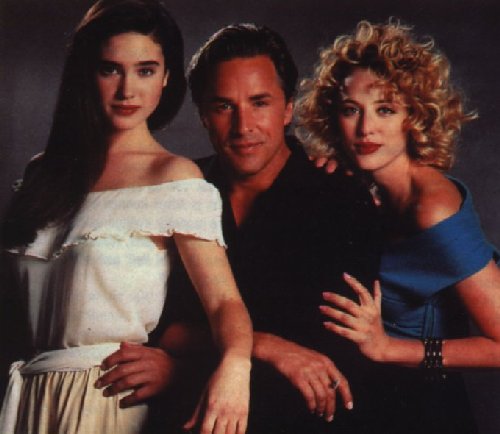
The Hot Spot is a heavily stylized film noir, one in which the the traditional fog and shadows have been replaced by clouds of dust and blinding sunlight. Harry (Don Johnson) is a drifter who has just rolled into a small Texas town. Harry’s not too bright but he’s handsome and cocky and who needs to be smart when you’ve got charm? Harry gets a job selling used cars, though he actually aspires to be a bank robber. Harry finds himself falling in love with Gloria (Jennifer Connelly), a seemingly innocent accountant who is being blackmailed by the brutish Frank Sutton (William Sadler). Meanwhile, Harry is also being pursued by his boss’s wife, Dolly (Virginia Madsen), an over-the-top femme fatale who is just as amoral as Harry but who might be a little bit smarter. Complicating matters is that, while Harry’s trying to rob a bank, he also ends up saving a man’s life. Only Dolly knows that Harry isn’t the hero that the rest of the town thinks he is. She tells him that she’ll keep his secret if he does her just one little favor….
The Hot Spot was directed by Dennis Hopper (yes, that Dennis Hopper) and, from the start, it quickly becomes apparent that he’s not really that interested in the film’s story. Instead, he’s more interested in exploring the increasingly surreal world in which Harry has found himself. The Hot Spot plays out at a languid pace, which allows Hopper to focus on his cast of small-town eccentrics. (My particular favorite was Jack Nance as the alcoholic bank president who also doubles as the town’s volunteer fire marshal.) The film is so hyper stylized that it’s hard not to suspect that every character — with the possible exception of Harry — understands that they’re only characters in a film noir. For instance, is Dolly really the over-the-top femme fatale that she presents herself as being or is she just a frustrated housewife playing a role? Is Gloria really an innocent caught up in a blackmail scheme or is she just smart enough to realize that the rules of noir requires her to appear to be Dolly’s opposite? And is Harry being manipulated or is he allowing himself to be manipulated because, deep down, he understands that’s his destiny as a handsome but dumb drifter in a small town? Do any of the characters really have any control over their choices and their actions or has everyone’s fate been predetermined by virtue of them being characters in a film noir? In the end, The Hot Spot is more than just a traditional noir. It’s also a study of why the genre has endured.
It’s a long and, at times, slow movie, one that plays out at its own peculiar pace. As a result, some people will be bored out of their mind. But if you can tap into the film surreal worldview and adjust to the languid style, The Hot Spot is a frequently entertaining and, at times, rather sardonic slice of Texas noir.
I’ll admit it right now. I’ve never really been a dog person.
That’s the way it’s been my entire life. According to my sisters, I was bitten by a dog when I was two years old. Needless to say, I don’t remember that happening but that still might explain why, when I was growing up, I was scared to death of dogs. Seriously, if I was outside and I heard a dog barking or if I saw a dog running around loose (or even on a leash), I would immediately start shaking. It didn’t help that, for some reason, I always seemed to run into the big dogs that wanted to jump and slobber all over me. (“Don’t be scared,” one dog owner shouted at 10 year-old me, “that’ll just make him more wild,” as if it was somehow my responsibility to keep his dog under control.)
As I grew up, I become less scared of dogs but they still definitely make me nervous. I still cringe when listening to the barking and I still reflexively step back whenever I see a big dog anywhere near me. Now that I know more about dogs, I have to admit that I feel a little bit guilty about not liking them more. Knowing that dogs actually blame themselves for me not liking them is kind of heart-breaking and I have been making more of an effort to be, if nothing else, at least polite to the canines who lives in the neighborhood. That said, I’m a cat person and I’ll always be cat person. Cats don’t care if you like them or not nor do they blame themselves if you’re in a bad mood, which is lot less of an emotional responsibility to deal with.
With all that in mind, I have to say that I still enjoyed A Dog’s Way Home. It’s a family film that was released last January, dealing with an adorable dog named Bella. Bella (whose thoughts are heard courtesy of a Bryce Dallas Howard voice-over) is raised underneath an abandoned building by a cat. (“Mother cat!” Bella shouts as the audiences goes, “Awwwwwww!”) When the building is demolished by an unscrupulous businessman, Bella is adopted by Lucas (Jonah Hauer-King). Lucas works at the VA and Bella is soon a hit with everyone from the patients to Lucas’s mom (Ashley Judd). In fact, the only people who don’t love Bella are the corrupt animal control people. They not only declare Bella to be a pit bull but they also say that it’s illegal for her to live in Denver.
In order to keep the city of Denver from putting Bella down, Lucas and his mom make plans to move to a suburb. However, until they can move, they arrange for Bella to stay at friend’s house, 400 miles away. Bella doesn’t understand what’s happening. She just wants to get back home to Lucas. And, when she hears someone utter the words “go home,” this leads to Bella attempting to do just that. Escaping from her temporary home, Bella spends the next two years making her way to her real home.
Along the way, of course, Bella has adventures. For instance, she discovers that humans really suck sometimes. When a cougar is killed by hunters, Bella adopts and raises the cougar’s child. (Bella calls her “Little Kitten” and then, after a few months pass, “Big Kitten.”) She also discovers that sometimes, humans can be okay, like when she’s temporarily adopted by a couple who love her but who just aren’t Lucas. And, when she’s temporarily the property of a homeless man, Bella learns about the comfort that a pet can bring to someone in need….
There’s nothing surprising about the film but it’s well-done and, like Bella itself, blessed with a genuinely sweet nature. (I started crying about five minutes into the film and I teared up several times afterwards.) Though the corrupt animal control officers seem like they stepped out of a bad Disney film from the 60s, the rest of the cast does a pretty good job of bringing some needed sincerity to even the most sentimental of scenes and it’s impossible not to be touched by Bella’s determination to return to Lucas. It’s a sweet movie, one that can be enjoyed even by someone who isn’t much of a dog person.
Detective Eileen McHenry (Raquel Welch) has just been given her new assignment and she is about to find out that there is never a dull day in the 87th Precinct. How could there be when the precinct’s top detectives are played by Burt Reynolds, Tom Skerritt, and Jack Weston? Or when Boston’s top criminal mastermind is played by Yul Brynner? There is always something happening in the 8th Precinct. Someone is stealing stuff from the precinct house. Someone else is attacking the city’s homeless. Even worse, Brynner is assassinating public officials and will not stop until he is paid a hefty ransom!
Based on the famous 87th Precinct novels that Evan Hunter wrote under the name Ed McBain, Fuzz has more in common with Robert Altman’s MASH than The French Connection. (Skerritt and Bert Remsen, who plays a policeman in Fuzz, were both members of Altman’s stock company.) Much like Altman’s best-regarded films, Fuzz is an ensemble piece, one that mixes comedy with tragedy and which features several different storylines playing out at once. Scenes of homeless men being set on fire are mixed with scenes of Reynolds and Weston going undercover as nuns. (Of course, Burt does not shave his mustache.) Since it was written by Hunter, the film’s script comes close to duplicating the feel of the 87th Precinct novels. Unfortunately, Richard A. Colla was a television director and Fuzz feels more like an extended episode of Police Story or Hill Street Blues than a movie. Unlike Altman’s best films, Fuzz‘s constantly shifting tone and the mix of comedy and drama often feels awkward. Fortunately, Fuzz does feature good performances from Reynolds, Westin, Skerritt, and Brynner, along with a great 70s score from Dave Grusin. Raquel Welch is never believable as cop but she’s Raquel Welch so who cares?
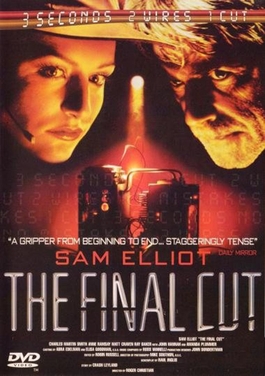 A mad bomber is blowing up large chunks of Seattle and seems to have a vendetta against the city’s bomb squad. John Pierce (Sam Elliott), a burn-out who used to be the best of the best when it came to defusing bombs, comes out of retirement to help with the investigation. The only problem is that all of the evidence seems to be pointing at Pierce. Pierce does his best to prove his innocence while more and more members of the bomb squad get blown up.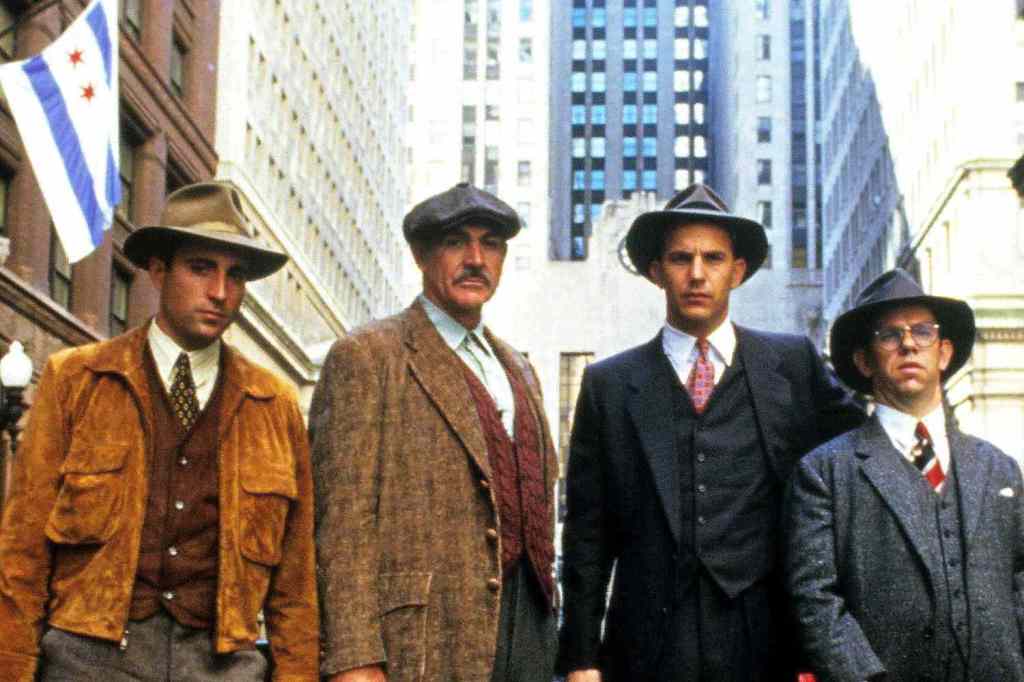

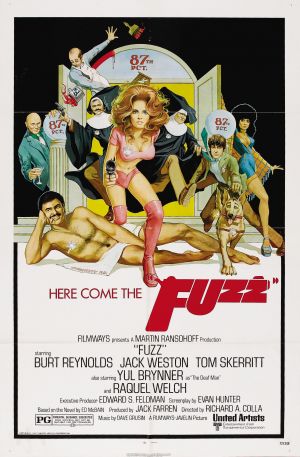 Detective Eileen McHenry (Raquel Welch) has just been given her new assignment and she is about to find out that there is never a dull day in the 87th Precinct. How could there be when the precinct’s top detectives are played by Burt Reynolds, Tom Skerritt, and Jack Weston? Or when Boston’s top criminal mastermind is played by Yul Brynner? There is always something happening in the 8th Precinct. Someone is stealing stuff from the precinct house. Someone else is attacking the city’s homeless. Even worse, Brynner is assassinating public officials and will not stop until he is paid a hefty ransom!
 Through the Shattered Lens