So, I just gave the 1979 film Home Before Midnighta fairly negative review but I simply cannot end the 70s section of Embracing the Melodrama on such a negative note! So, before we move on to the 80s, allow me to suggest another film from 1979 that you could watch while you’re not watching Home Before Midnight!
Time After Time opens in London. The year is 1893. Writer H.G. Wells (Malcolm McDowell) is having a dinner party so that he can show off his latest invention, a time machine. Among his guests is a surgeon named John Stevenson (David Warner). What nobody at the party suspects is that Stevenson also goes by the name Jack the Ripper and that he enjoys killing prostitutes. When a detective from Scotland Yard shows up at Wells’s home, Stevenson jumps into the time machine and escapes into the future. Since Stevenson does not have the “non-return key,” the machine returns back to 1893 but Stevenson has apparently escaped.
Wells uses the machine to pursue Stevenson and soon finds himself in 1979 San Francisco. Wells had expected to find that the future would be a utopia but instead, he discovers the world of 1979 is loud, polluted, violent, angry, and dangerous. (Kinda like the world of 2015…) As Wells pursues Stevenson, he struggles to adjust to the world of the “future,” and he also meets a bank clerk, Amy Robbins (Mary Steenburgen).
Time After Time is probably the sweetest movie ever made about Jack the Ripper and that’s largely because of the romance between both Wells and Amy and the two actors who played them. After watching Time After Time, I was not surprised to learn that McDowell and Steenburgen got married shortly after appearing in this film. They were so incredibly sweet together!
Add to that, considering the he’s best known for playing villains and other menacing types, it’s interesting to see Malcolm McDowell plays such a gentle and nice character. Wells’ befuddlement is charming to watch. There’s a great scene where Amy calls Wells on a landline phone and Wells stares down at the receiver in frightened amazement.
Time After Time is a really good and likable movie. It’s sweet and it proves that even hunting for Jack the Ripper can be a romantic experience if it’s done with the right person. Watch it and enjoy!
How did you spend your Labor Day weekend? Me, I spent it visiting with my family down at my uncle’s place. Sunday afternoon, I was laying out by the pool and listening to my cousins Peter Paul and Paul Peter have a conversation. (And yes, I do call both of them “Paulie.”) They were talking about the Dallas Cowboys and I have to admit that I could not understand a word that they were saying. It was like attending a Latin Mass, in that all I could do was hope that I was nodding at the right moment. I can’t help it. Football goes right over my head. I know that the players are trying to score touchdowns and I know that whenever fall and winter come around, everyone I know is going to be complaining about the Cowboys. But that’s it. (I also know that, what we in America call soccer, the rest of the world calls football. But, to be honest, I really don’t care.) Football talk might as well be a secret language.
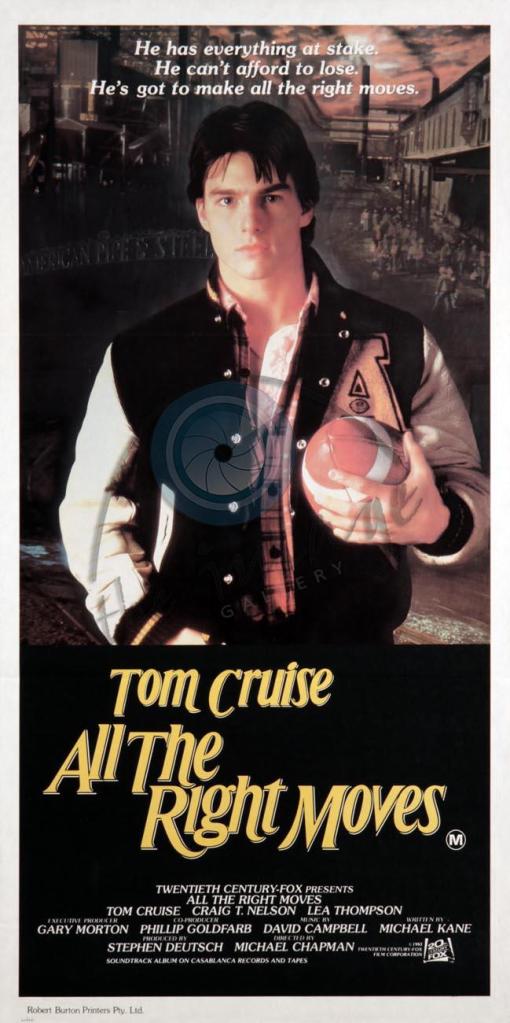
However, I’m clearly in the minority as far as that’s concerned. America loves football and so does Texas. (Yes, I do consider my home state to be its own independent nation. Take that, Vermont.) And the American film industry has a long tradition of making movies — like All The Right Moves — about football.
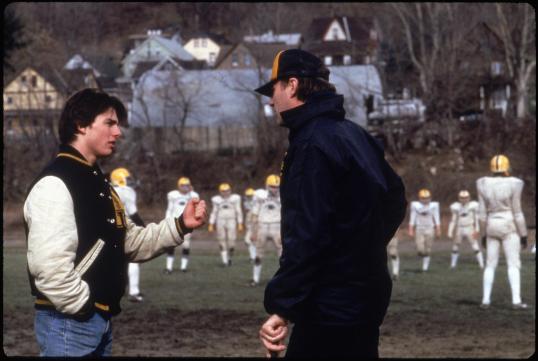
In All The Right Moves, Tom Cruise plays Stefan Djordjevic. Stefan lives in a poor town in Pennsylvania and happens to be one of the stars of the Ampipe High School football team. And that’s a pretty good thing because this town is obsessed with football. The proud Coach Nickerson (Craig T. Nelson) is under constant pressure to win and Nickerson responds by pushing all of his players. However, it finally looks like his approach is going to pay for both him and Stefan. Nickerson is being considered for a college coaching job. Meanwhile, Stefan has a chance to get a scholarship to play football in college. Interestingly, Stefan’s ambition is not to play professional football. Instead, he wants to go to a good college so he can get an engineering degree. Stefan’s main fear is to end up like everyone else in the town, working in a steel mill and not having any way to escape from a life of poverty.
All The Right Moves starts out as a standard sports film but, halfway through, it takes an unexpected turn. Ampipe High plays a game against their main rival, Walnut Heights High School. This is the big game. This is the game that most sports movies end with. This is the game that you watch knowing that Nickerson and Stefan will overcome their differences (Nickerson is stubborn, Stefan is cocky) and that they will manage to narrowly win.
Except, of course, Ampipe doesn’t win. As the result of a last minute mistake, Ampipe loses their lead and they lose the big game. Nickerson yells at the team in the locker room. Stefan yells back and Nickerson kicks him off the team. Suddenly, Stefan finds himself with no future. And Nickerson finds himself and his family being targeted by the angry, football-crazed citizens of the town…
For a football movie, All The Right Moves is actually pretty good. Of course, it’s not really about football. It’s about the desperation of people who have found themselves trapped in a cycle of poverty and how something as seemingly inconsequential as the high school football team can become an entire town’s life. It’s about how two stubborn men — Stefan and Nickerson — allow their own fear of being trapped to keep them from thinking and acting rationally.
The film is also distinguished by good performances from Tom Cruise (who, in the same year, would play a much different high school senior in Risky Business), Craig T. Nelson, and Chris Penn (who plays Stefan’s best friend on the team). However, the film’s best performance comes from Lea Thompson, who is so good in the role of Lisa, Stefan’s girlfriend, that you can’t help but wish that the film had been more about her than him. In probably the film’s best scene, she calls out Stefan for being selfish and points out that, regardless of what happens in Stefan’s future, she’s going to be stuck in the town that he’s so desperate to escape from. The scene where she and Stefan make love is sensitively handled and it also features a split-second or so of Tom Cruise full front nudity.
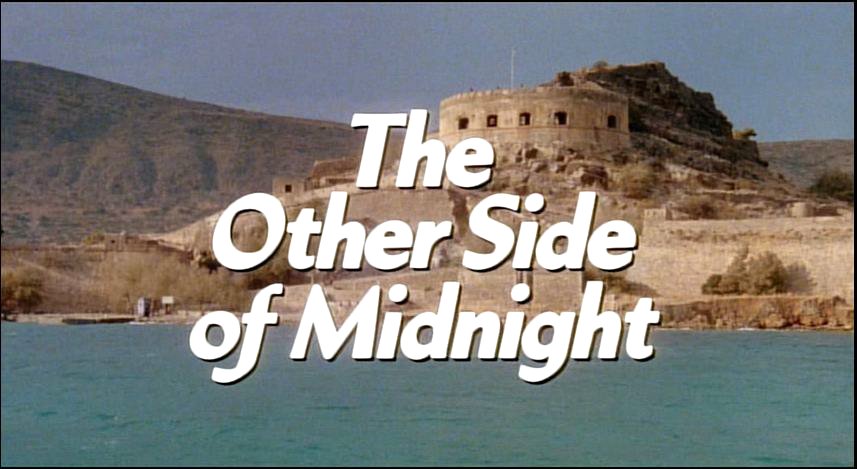
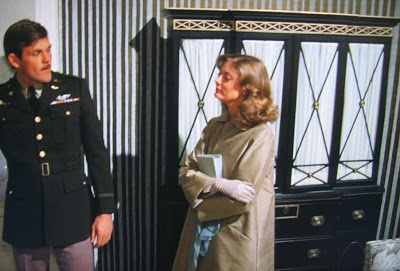
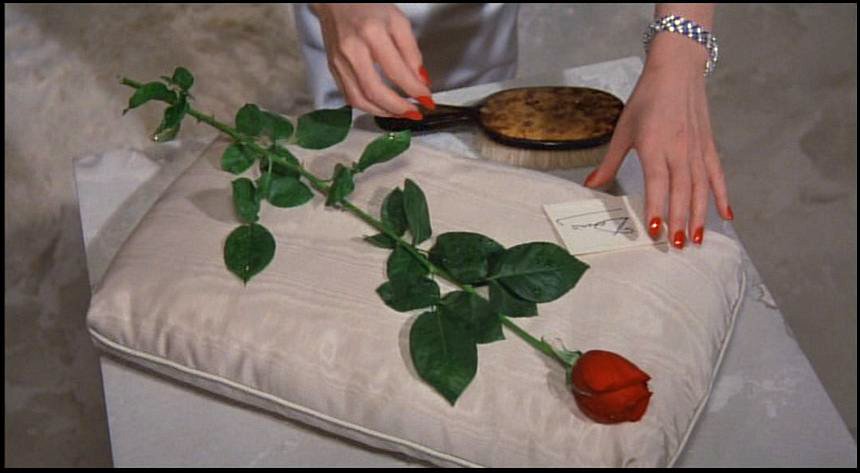
First released in 1977, The Other Side of Midnight is one of those film that literally seems to have everything a viewer could want: sex, love, betrayal, sex, war, melodrama, intrigue, sex, expensive clothes, private island, see-through nightgowns, sex, hurricanes, murder, a surprise twist ending that involves a convent, and sex. Did I mention that this film has sex in it, because it so does.
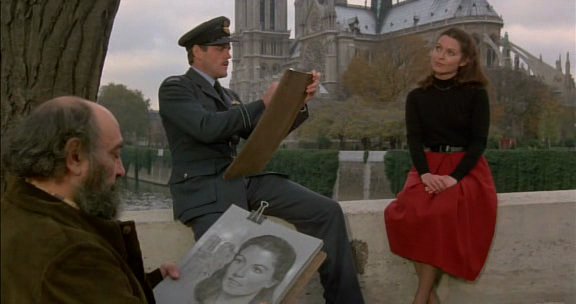
The film opens in Paris during the years leading up to World War II. Beautiful Noelle (Marie-France Pisier) meets Larry Douglas (John Beck), a handsome American who is serving with the Canadian Air Force. Noelle agrees to go out on a date with Larry and they get to have the of the movie’s many falling-in-love montages. Fortunately, they’re in Paris which has a lot of great scenery in front of which they can pose. Unfortunately, Larry is ordered back to the United States. He promises Noelle that he’ll return but he never does. What Larry doesn’t realize is that Noelle’s pregnant — or at least she is until a harrowing scene where she climbs into a bathtub with a wire hanger.
Montage!
This is followed by another montage. Call this the “Out-of-Love-And-Growing-Bitter” montage. Noelle survives the German occupation by seducing and using every powerful man that she meets. Along the way, she becomes one of the most glamorous and famous film stars in all of Europe. Finally, she becomes the mistress of the wealthy and somewhat shady Constantin Demaris (Raf Vallone, doing his best Anthony Quinn impersonation).
Meanwhile, Larry is back in America and, after going through another falling-in-love montage, has ended up married to innocent Catherine Alexander (Susan Sarandon). What Larry doesn’t realize is that Noelle has hired a detective to keep track of him. After the war, Larry gets a job as a commercial airline pilot but Noelle secretly arranges for him to lose that job. Unemployed and desperate, Larry accepts a job to work as the private pilot for Demaris and his mistress.
Montage!
Though it takes him a while to recognize her, Larry eventually does realize that his new boss is his former lover, Noelle. As Larry starts to truly fall in love with Noelle all over again, Noelle starts to pressure him to do something about his new wife. As is the case with several Hollywood melodramas, it all ends in a courtroom. The courtroom scenes may not be exactly exciting but they do feature my favorite image from the entire film: at one point, we see that literally every single character who has appeared in the movie up to this point is sitting in that courtroom, all lined up like a bunch of disparate figures in an Edward Hopper painting.
The Other Side of Midnight is one of those big films where a lot of stuff happens but very little of it really seems to add up to anything. It has a nearly 3 hour running time but it’s story could have just as easily been told in 90 minutes. Instead, director Charles Jarrott pads out the running time with endless falling-in-love and falling-out-of-love montages. This is the type of film that never says anything once that it can say an extra three times.
Montage!
Susan Sarandon and Marie-France Pisier both give good performances. Susan Sarandon is likable, even if her character is unbelievably naive while Marie-France Pisier gives a performance worthy of any good film noir but neither one of them has much chemistry with John Beck. Fortunately, some of the supporting players — like Raf Vallone and Christian Marquand — take full advantage of every chance that they get to chew every piece of scenery that’s available. Clu Gulager, the father of horror director John Gulager, pops up as well, playing perhaps the only good male in the entire film.
In the end, The Other Side of Midnight (and what the Hell does that title mean anyway?) is a rather silly movie about a bunch of shallow characters wearing beautiful clothes and wandering through wonderfully baroque locations. Fortunately, I love elaborately decorated locations and glamorous outfits so I enjoyed The Other Side of Midnight despite myself.
Montage!
One final thing about The Other Side of Midnight: 20th Century Fox was so sure that The Other Side of Midnight would be a huge success that they used it to blackmail theater owners into agreeing to show an obscure science fiction film called Star Wars. Theaters would only be allowed to show The Other Side of Midnight if they also agreed to show Star Wars during the week before Midnight opened.
The end result, of course, is that The Other Side of Midnight was a bomb at the box office and Star Wars is still making money.
Below is a behind-the-scenes documentary on the making of The Other Side of Midnight.
 So, I just gave the 1979 film Home Before Midnight a fairly negative review but I simply cannot end the 70s section of Embracing the Melodrama on such a negative note! So, before we move on to the 80s, allow me to suggest another film from 1979 that you could watch while you’re not watching Home Before Midnight!