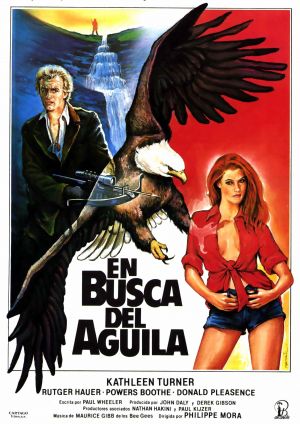
A Movie A Day #200: A Breed Apart (1984, directed by Philippe Mora)


Sometimes, the story behind a movie is more interesting than the movie itself.

Rutger Hauer stars in A Breed Apart, playing an eccentric environmentalist named Jim Malden.  Malden loves nature but he hates people, with the exception of a local storekeeper named Stella (Kathleen Turner) and her young son.  The local fishermen (one of whom is played by Hauer’s Blade Runner co-star, Brion James) may hate him but they are no match for Malden’s guerilla tactics.  Recently, a new breed of bald eagle has been discovered and Malden is determined to protect it.  At the top of a cliff, there is a nest full of eagle eggs and Malden will not let anyone near them.

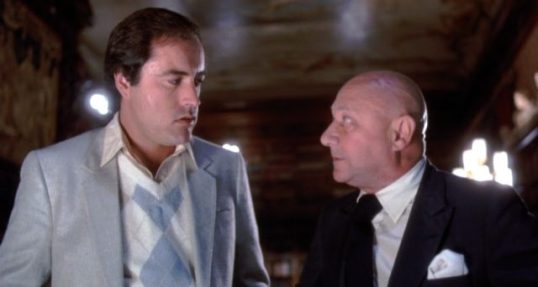
Rich collector J.J. Whittier (Donald Pleasence) is determined to get those eggs for himself.  In order to deal with Malden, Whittier hires famous rock climber, Mike Walker (Powers Boothe).  Disguising himself as a nature photographer, Walker attempts to befriend Malden so that he can get to the eggs.  Even as Malden shows Walker why it is important to protect the environment, Walker falls in love with Stella.

With a cast like this, A Breed Apart should have been far more interesting than it was.  It provides a rare chance to see both Rutger Hauer and Powers Boothe playing heroes but neither seemed to really be into their roles.  Kathleen Turner was sexy but saddled with a terrible accent while Donald Pleasence seemed to be in a different movie.  When I watched A Breed Apart last night, I thought it seemed like a very disjointed movie.  For instance, the movie abruptly jumped from Stella and Walker first meeting to the end of their first date.  There was a random scene of Malden putting on war paint, while remembering the sound of helicopters.  War paint combined with helicopters in an 80s movie usually means that someone is having a Vietnam War flashback but Malden’s military background is never mentioned again.  Even Walker’s conversion to Malden’s cause and rejection of Whittier’s money seemed to happen offscreen.

According to Wikipedia, It turns out that there was a reason for all that.  A Breed Apart was filmed in North Carolina.  After principal filming was completed, four reels of film were sent back to Los Angeles.  However, only three reels ever arrived in California.  One reel disappeared and has never been found.  The footage that actually did make it to Los Angeles was reorganized and edited to try to disguise the fact that a huge part of the movie was missing.

It didn’t work.

(ADDENDUM 9/4/2017: Originally, both myself and a lot of other reviewers, were under the impression that one reel of film went missing and, as a result, the film had to be reedited to make up for the missing footage.  This story is presented as fact on Wikipedia, which is where I and I assume a lot of other people originally got it.  The lesson here is not to use an online encyclopedia that anyone can edit for a primary or even a credible source.  In the comments below, Director Philippe Mora has let me know that there was no lost reel and that, instead, there are several different cuts of the film kicking around, some of which are incomplete and some of which are ok.  Since Mora actually worked on the film, he is a far more credible source than an anonymous Wikipedia article.  I apologize to Mr. Mora for the mistake.)
Lisa Reviews An Oscar Nominee: Bound for Glory (dir by Hal Ashby)


Bound_for_glory_Poster

One of my favorite online film reviewers is Mitch Lovell of the Video Vacuum.  The thing I like about Mitch is that he doesn’t worry about how many Oscars a film has been nominated for or whether or not a film’s politics are currently in fashion.  Unlike a lot of online reviewers, he doesn’t worry about whether or not he’s going against the “accepted” views of the critical establishment.  Instead, he’ll watch a film and tell you exactly how he felt about it.

For example, Mitch Lovell’s review of the otherwise critically acclaimed 1976 best picture nominee Bound for Glory can be summed up in three words: “boring as fuck.”  Every other online review that I’ve found for Bound for Glory offers up polite but rarely inspiring praise for this rather lengthy film about the folk singer Woody Guthrie.  Most of those reviews do acknowledge that the film moves at its own pace but we are told that we will be rewarded for being patient.  If the review was written after 2010, you can be sure that the reviewer will be sure to say that Bound for Glory reminds us of why labor unions are still important and need to be protected from the Tea Party.  (The idea apparently being that, if a film has the right politics, it doesn’t have to actually be all that interesting.)  It’s all rather predictable and that’s why we’re lucky to have reviewers like Mitch Lovell around.  Whether you agree with him or not, it’s good to have a reviewer who will go against the conventional wisdom.

I recently watched Bound for Glory as a part of TCM’s 31 Days of Oscars and, to a large extent, I have to agree with Mitch Lovell’s review.  This is a movie that is not only long but which moves slowly as well.  It’s not that the film has a deliberate pace.  It’s just slow!  (If you want to see a film that makes good use of a deliberate pace, check out Barry Lyndon.)  David Carradine plays Woody Guthrie, a sign painter who, during the Great Depression, abandons his family in Texas and, by hopping trains, makes his way to California.  He works with fruit pickers.  He tries to convince his fellow workers to form a union.  He gets beat up a lot.

And he plays his guitar.

If there’s anything that remains consistent about Bound for Glory, it’s that Woody is always playing his guitar and that every time he starts to play, something terrible either has happened or does happen.  There’s a huge dust storm.  Woody plays his guitar.  A fight breaks out at a union meeting.  Woody plays his guitar.  A bunch of hoboes on a train get beat up.  Woody plays his guitar.  Woody shows up at a textile mill and starts to play his guitar.  He gets beaten up by a bunch of thugs.  Woody impresses Pauline (Gail Strickland) by playing his guitar and soon, he’s cheating on his wife.  Woody partners up with another folk singer, Ozark Blue (Ronny Cox), and they get their own radio show where Woody plays guitar.  Woody promptly gets fired.

It quickly became apparent to me that Woody Guthrie’s guitar was cursed.  Whenever he played it, poor people ended up getting oppressed.

In many ways, Bound for Glory is a prototypical example of what it means to be an acclaimed-at-its-time-but-subsequently-forgotten best picture nominee.  It’s a big epic film that tells a fictionalized account of a real person’s life story.  Woody Guthrie is best known for writing This Land Is Your Land, which is a song that I mostly associate with pretentious super bowl commercials.  As Bound for Glory details, Woody was also a union organizer and political activist but what’s odd is that the film keeps the exact details of what he believed rather vague.  We’re given the general idea of what Woody believed but we’re not given any specifics.  As a result, Woody just comes across like another part-time social protestor as opposed to being a true political thinker (much less a revolutionary).

On a positive note, Bound for Glory is impressive to look at.  The film’s cinematographer was the famous Haskell Wexler (who also directed Medium Cool, a film that was as upfront about its politics as Bound for Glory is vague) and Wexler captures some hauntingly beautiful images of the American wilderness.  The scene where a gigantic wall of dust crashes down onto a small Texas town is especially memorable.

Otherwise, though, Bound for Glory is pretty much a snoozefest.  It was nominated for best picture of 1976 and, when you compare it to fellow nominees like All The President’s Men, Network, Taxi Driver, and even Rocky — Bound for Glory does feel a bit out of place.

Then when you consider some of the other films that came out in ’76 — Carrie,  Face to Face, The Front, God Told Me To, Logan’s Run, The Man Who Fell To Earth, Marathon Man, The Omen, The Outlaw Josey Wales, Lipstick, Robin and Marian, The Sailor Who Fell From Grace With The Sea, and The Town That Dreaded Sundown — the nomination of Bound for Glory feels like even more of a mistake.

Oh well.

Occasionally, the Academy gets it wrong.

Shocking, I know.