Film Review: The Jazz Singer (dir by Richard Fleischer)


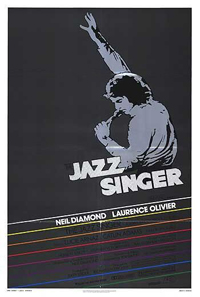
In the 1980 remake of The Jazz Singer, it only takes the film seven minutes to find an excuse to put Neil Diamond in blackface.

Of course, the film was a remake of the 1927 version of The Jazz Singer, which featured several scenes of Al Jolson performing in blackface.  In fact, Al Jolson in blackface was such a key part of the film that it was even the image that was used to advertise the film when it was first released.  Back in the 20s, Jolson said that wearing blackface was a way of honoring the black artists who created jazz.  (As shocking as the image of Al Jolson wearing blackface is to modern sensibilities, Jolson was considered a strong advocate for civil rights and one of the few white singers to regularly appear on stage with black musicians.)  Regardless of Jolson’s motives, less-progressively minded performers used blackface as a way to reinforce racial stereotypes and, to modern audiences, blackface is an abhorrent reminder of how black people were marginalized by a racist culture.  You would think that, if there was any element of the original film that a remake would change, it would be the lead character performing in blackface.

But nope.  Seven minutes into the remake, songwriter Jess Robin (Neil Diamond) puts on a fake afro and dons blackface so that he can perform on stage at a black club with the group that is performing his songs.  The group’s name is the Four Brothers and, unfortunately, one of the Brothers was arrested the day of the performance.  Jess performs with the group and the crowd loves it until they see his white hands.  Ernie Hudson — yes, Ernie Hudson — stands up and yells, “That’s a white boy!”  A riot breaks out.  The police show up.  Jess and the three remaining Brothers are arrested and taken to jail.  Jess is eventually bailed out by his father, Cantor Rabinovitch (Laurence Olivier).  The Cantor is shocked to discover that his son, Yussel Rabinovitch, has been performing under the name Jess Robin.  He’s also stunned to learn that Yussel doesn’t want to be a cantor like his father.  Instead, he wants to write and perform modern music.  The Cantor tells Yussel that his voice is God’s instrument, not his own.  Yussel returns home to his wife, Rivka (Caitlin Adams), and tries to put aside his dreams.

But when a recording artist named Keith Lennox (Paul Nicholas) wants to record one Yussel’s songs, Yussel flies out to Los Angeles.  As Jess Robin, he is shocked to discover that Lennox wants to turn a ballad that he wrote into a hard rock number,  Jess sings the song to show Lennox how it should sound.  The arrogant Lennox is not impressed but his agent, Molly (Lucie Arnaz) is.  Soon, Jess has a chance to become a star but what about the family he left behind in New York?  “I have no son!” the Cantor wails when he learns about Jess’s new life in California.

I’ve often seen the 1980 version of The Jazz Singer referred to as being one of the worst films of all time.  I watched it a few days ago and I wouldn’t go that far.  It’s not really terrible as much as its just kind of bland.  For someone who has had as long and successful a career as Neil Diamond, he gives a surprisingly charisma-free performance in the lead role.  The most memorable thing about Diamond’s performance is that he refuses to maintain eye contact with any of the other performers, which makes Jess seem like kind of a sullen brat.  It also doesn’t help that Diamond appears to be in his 40s in this film, playing a role that was clearly written for a much younger artist.  Still, when it comes to bad acting, no one can beat a very miscast Laurence Olivier, delivering his lines with an overdone Yiddish accent and dramatically tearing at his clothes to indicate that Yussel is dead to him.  Olivier was neither Jewish nor a New Yorker and that becomes very clear the more one watches this film.  It takes a truly great actor to give a performance this bad.  Diamond, at least, could point to the fact that he was a nonactor given a starring role in a major studio production.  Olivier, on the other hand, really had no one to blame but himself.

Still, I have to admit that ending the film with a sparkly Neil Diamond performing America while Laurence Olivier nods in the audience was perhaps the best possible way to bring this film to a close.  It’s a moment of beautiful kitschThe Jazz Singer needed more of that.

Evil Obsession (1996, directed by Richard W. Munchkin)


11 models have been murdered in Los Angeles and Margo (Kimberly Stevens) fears that she could be next.  She’s been receiving threatening notes and feels as if someone is watching her and her boyfriend, Bill (Michael Phenicie).  She hires a private detective (Mark Derwin) to protect her but it might be too late because Homer (Corey Feldman), the man who has been sending her the notes, has already enrolled in the same acting class of Margo.  After Bill turns up dead, Homer is assigned to be Margo’s new scene partner.  Is Homer moving in for the kill or is someone else responsible for the murders?

This mix of erotic thriller and horror was one of those movies that used to show up on a late night Cinemax in the 90s, where it could be watched by teenagers who kept one eye on the screen and one eye looking out for their parents.  Corey Feldman starred in a lot of these films and in this one, he gives a twitchy and occasionally funny performance as the nerdy Homer.  Homer is the most obvious stalker imaginable and it’s hard to believe that Margo, who is so concerned about being stalked that she’s hired a private detective, would not look at Homer and immediately realize that he was the culprit.  Feldman overacts but he at least provides the film with the energy that is missing from the performances of Kimberly Stevens and Mark Derwin.  Even better is the performance of Brion James as the autocratic and pretentious acting teacher.  Watching him, I got the feeling that James probably could have based his performance on any number of Hollywood acting coaches.

KISS Meets The Phantom Of The Park (1978, directed by Gordon Hessler)


In 1978, KISS appeared to have it all.  The band was famous for both their makeup and their anthemic stadium rock.  They had just released not only a new studio album but also four solo albums.  They had starred in their own Marvel comic and gained notoriety for supposedly allowing their blood to mixed in with the comic’s ink.  Teenagers loved KISS and parents and religious leaders feared that the band’s name stood for Knights In Satan’s Service.  KISS had everything except for motion picture stardom.

KISS Meets The Phantom Of The Park was supposed to change that.  The film starred Anthony Zerbe as Abner Devereaux, an engineer and an expert at animatronics who loses his job at Magic Mountain and seeks revenge by using robot versions of KISS to drive the audience of their concert to riot.  Fortunately, the real members of KISS are not just rock stars but also alien beings who descend from the heavens and shoot lightning bolts from their eyes.  (Gene Simmons can breathe fire.)  The real KISS isn’t going to allow their fan to be manipulated by a robot version of the band, which leads to a battle between KISS and the robots that protect Abner’s underground lair.

KISS Meets The Phantom of the Park aired on NBC on October 28th, 1978.  It was later given a theatrical release in Europe, where it was re-edited and retitled Attack of the Phantom.  Since then, it has become a very difficult film to see.  (On Amazon, old VHS copies go for several hundred dollars.)  One reason why the movie is so hard to see is because the members of the KISS hated the movie and felt that they were portrayed as being clowns instead of super heroes.  Even though the members of the band have since mellowed out about the film (with Gene Simmons suggesting it should be viewed on a double bill with Plan 9 From Outer Space), KISS Meets The Phantom Of The Park is still a film that is more talked about than actually watched.

While looking for clips of the movie on YouTube, I came across an upload of the entire film.  The only problem was that all of the dialogue was dubbed into German and that’s not a language that I speak.  Still, figuring that you have to take your opportunities when they’re available, I decided to watch.  I figured that the dialogue might not actually be that important and it wasn’t.  I was able to follow the plot just fine.  (The only weird thing about watching the move in German was listening to the members of the band speak in something other than a New York accent.)  Fortunately, there’s actually more singing than talking in Kiss Meets The Phantom Of The Park and the songs are untouched and in English.  KISS plays Magic Mountain in the film and they actually performed a real concert for filming.  Those are real fans of the band going crazy whenever Gene Simmons sticks out his tongue.

The movie itself is definitely a product of its time and not meant to be taken seriously.  The members of KISS are both aliens that descend from the heavens and rock musicians and they are never seen without their makeup.  Even when they’re hanging out at a hotel pool, they are in full costume and they’re wearing their makeup. When the members of the band enter the Phantom’s underground lab, they have to fight a series of very 70s robots, including some that know karate and two who have lightsabers.  For better or worse, it’s a very silly move that epitomizes an era.  The special effects are cheesy, the members of the band often look straight at the camera, and the rest of the cast does what they can with what they’ve been given.  Anthony Zerbe plays the Phantom with a hint of empathy while Deborah Ryan is the ingenue who searched for her missing boyfriend while Beth plays on the soundtrack.  Keep an eye out for Brion James, playing a security guard.

Overall, the band probably would have been smarter to just release a concert film but then the rest of us wouldn’t have the fun of watching Paul Stanley face off against a robot version of Bruce Lee.  KISS Meets The Phantom of The Park is worth watching at least once, even in German!

October True Crime: Overkill: The Aileen Wuornos Story (dir by Peter Levin)


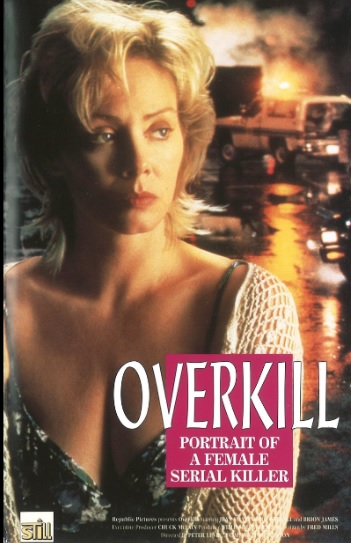
Made for television in 1992, Overkill: The Aileen Wuronos Story opens with Aileen (Jean Smart) and her friend, Tyria Moore (Park Overall), hitchhiking their way through Florida.  Aileen is outspoken and unpredictable, quick to lose her temper with anyone who doesn’t give her a ride or money and also very possessive of Tyria.  Tyria is naïve and a bit spacey, though she is smart enough to have figured out that Aileen is financing their trip through sex work.

Of course, if you’ve seen Monster, you already know the story of Aileen and Tyria and you also know that Aileen is eventually going to end up in a lot of trouble and Tyria is going to be pressured to betray her.  Monster made it clear that Aileen and Tyria were a romantic couple and it even suggests that, for all of her crimes, Aileen sincerely loved Tyria.  Overkill, probably due to being a made-for-television movie from the 90s, treats Aileen and Tyria’s relationship a bit more ambiguously.  While Aileen is portrayed as being very possessive and very protective of Tyria, their relationship is portrayed as being more of a roommate situation than a romantic one.  Indeed, Aileen is often portrayed as being almost stalkerish in her behavior towards Tyria.  Aileen comes across as being much more interested in Tyria than Tyria is in Aileen.

While Aileen and Tyria travel across Florida, men are turning up dead up and down the interstates.  The victims were all shot and they were all middle-class, white professionals.  Most of them are found in circumstances that suggested that they had picked someone up and that person subsequently shot and then robbed them.  When Detective Brian Munster (Brion James) suggests that all of the men could have fallen victim to a female serial killer, his colleagues are skeptical.  Everyone knows that serial killers are always men.  But Munster continues to insist that the murderer must be a woman and soon, he comes to suspect that the killer could be Aileen.  However, all of the evidence that Brian has is circumstantial and it won’t be enough to get a conviction.  He and the member of his investigative team start to watch Aileen, waiting for her to make a mistake that will give them what they need to make an arrest….

After she was convicted of murdering seven men, Aileen Wournos claimed that the police always knew that she was the one committing the murders but that they didn’t arrest her because they wanted to reap the publicity from pursuing America’s first female serial killer.  As evidence, she cited this movie and it must be admitted that this movie does feature a lot of scenes of Munster and his detectives waiting for Aileen to make her next move.  That said, one would think that Overkill would be the last movie that Aileen would want to bring attention to because the film essentially presents Aileen Wournos as being a petulant and trashy psychopath who turned to crime because she was too stupid to do anything else with her life.  If Monster portrayed Aileen as being someone who had been so damaged by society that she could no longer function, Overkill portrays Aileen as being someone who uses her childhood trauma as a convenient excuse for her own antisocial tendencies.

Overkill is a considerably more simplistic portrayal of Aileen’s crimes than Monster.  That said, Jean Smart does a good job in the role and is convincingly angry at the world.  Overkill is more about the effort to catch Aileen than Aileen herself and character actor Brion James, who usually played villains over the course of his career (like Leon in Blade Runner and the killer in The Horror Show), makes for a convincingly no-nonsense cop.  Overkill is a well-made and well-acted film, even if it does ultimately feel a bit shallow in its storytelling.

Film Review: Corvette Summer (dir by Matthew Robbins)


The 1978 film, Corvette Summer, tells the story of Kenny Dantley (Mark Hamill).

Kenny is a student at a high school in Southern California.  He lives in a trailer park and he’s kind of dumb.  He’s the type who rarely shows up to class and, when he does, it’s just to discover that he managed to score a D-minus on his last test.  Kenny doesn’t think school’s important, though.  All Kenny cares about is cars.  He doesn’t date.  He doesn’t have friends.  But he can rebuild a corvette and spend hours talking about why it’s the greatest car in the world.

Yes, Kenny’s an idiot.

Kenny’s auto shop teacher, Mr. McGrath (Eugne Roche), warns Kenny that he’s spending too much obsessing on cars.  Don’t fall in love with a car, Mr. McGrath says.  A car is just a machine and a machine will always let you down.  A machine is something that you build so you can sell it and move on to something else.  To me, Mr. McGrath makes sense but Kenny’s like, “No, that’s totally squaresville.  Real melvin, man.”

(Well, okay, Kenny doesn’t use those exact words but you can tell that he’s thinking them…..)

Anyway, Kenny and the shop class have just rebuilt a red corvette and Kenny’s convinced that it’s the greatest car ever.  However, on the same night that the car makes its debut by cruising down the streets of Kenny’s hometown, it’s stolen!  Maybe Kenny shouldn’t have given the keys to Danny Bonaduce.  Kenny gets so angry that he smashes a cup of coke and attempts to beat up Bonaduce.

Mr. McGrath tells Kenny that these things happen and he suggests that Kenny instead look into enrolling at a community college after high school.  Kenny, however, is too obsessed with finding his car to listen to Mr. McGrath.  He even prints up flyers with a picture of the corvette.  “Have you seen this car?” the flyers ask.  Amazingly, it turns out that someone has.  He tells Kenny that he saw the corvette in Las Vegas.

That’s all it takes for Kenny to head to Nevada.  Of course, since Kenny doesn’t have a car, he has to hitchhiker.  Despite the fact that Kenny looks like a killer hippie and tends to spend a lot of time yelling in a somewhat shrill manner, he’s picked up by Vanessa (Annie Potts).  Vanessa is an “aspiring prostitute” who lives in a van.  “Vanessa” is written on the side of the van, which means that it will be useless if anyone ever needs to use it as a getaway vehicle for a bank robbery.  Way to go, Vanessa.

Once they arrives in Las Vegas, Kenny and Vanessa work a series of different jobs while looking for that corvette.  Along the way, Kenny falls in love, discovers that there’s more to life than just cars, and also suffers a bit of disillusionment when one of his mentors turns out to be not as perfect as Kenny originally believed.

Corvette Summer is best known for being Mark Hamill’s first post-Star Wars role.  He’s in almost every scene of the film and, to be honest, his performance kind of got on my nerves.  Some of that is because, as written, Kenny is almost unbelievably stupid.  But Hamill doesn’t help things by giving a rather shrill performance in the lead role.  Though the film may be a coming-of-age comedy, Hamill is so intense in the role that he comes across as being less like a naive teenager and more like a mentally unbalanced time bomb.  You find yourself hoping that he’ll get the car back before he’s forced to take hostages.  Annie Potts is a bit more likable as Vanessa but her character is dreadfully inconsistent.  One gets the feeling that she’s mostly just there so that Kenny can finally lose his virginity and be a little bit less of a loser by the end of the movie.

I will say that I did really like the performance of Kim Milford, who plays a superslick car thief named Wayne Lowry.  As I watched the film, it took me a few minutes to realize where I recognized Milford from.  He was the star of Laserblast, a film that featured Milford finding a laser gun and using it to blow up a sign advertising Star Wars.  Milford only has a small role in Corvette Summer and we’re not supposed to like him but he’s so handsome and sure-of-himself that it’s hard not to prefer him to the rather histrionic character played by Mark Hamill.

Corvette Summer is such a film of the 70s that watching it is like stepping into a time machine.  That’s not necessarily a bad thing, of course.  Indeed, in 2020, the main appeal of a film like this is a chance to see how people lived in 1978.  (It’s always a bit odd to watch a movie where no one carries a phone or has a twitter account.)  Watching this film in 2020, it’s hard not cringe a little at the sight of not only Kenny hitchhiking but also people stopping to pick him up.  Seriously, are they just trying to get killed?

Striking Distance (1993, directed by Rowdy Herrington)


Thomas Hardy (Bruce Willis) comes from a huge family of Pittsburgh cops.  He used to be a homicide detective but then his father (John Mahoney) was murdered by a serial killer and his cousin (Robert Pastorelli) jumped off a bridge after Hardy turned him in for being crooked.  When Hardy insisted that the serial killer who murdered his father and countless others in Pittsburgh had to be a cop, he was kicked out of homicide and reassigned to the river patrol.

Two years later, Hardy drinks too much and spends his time floating up and down the river.  He’s got a new, younger partner named Emily (Sarah Jessica Parker) but not even Emily can snap him out of his funk.  It’s not until the serial killer starts to strike again — this time specifically targeting people from Hardy’s life — that Hardy starts to care about police work again.

Striking Distance is a good example of a thoroughly mediocre film that bombed at the box office but was given a new lease on life by HBO.  During the 90s, it sometimes seemed as if there wasn’t a day that went by that HBO didn’t air Striking Distance at least once.  I guess it makes sense.  Bruce Willis was a big name and Sarah Jessica Parker did eventually end up starring on one of HBO’s signature hits.  Still, it seems like they could have found a better Bruce Willis film to air.  When critics in the 90s complained that Bruce Willis was an ego-driven star who wasn’t willing to break out of his comfort zone, they weren’t talking about Willis’s appearances in films like Pulp Fiction or 12 Monkeys or even Die Hard.  They were talking about movies like Striking Distance, where Willis smirks his way through the film and spends more time making the camera gets his good side than actually developing a character.

The most interesting thing about Striking Distance is that it manages to be too simple and too complicated at the same time.  There’s no mystery to the identity of the serial killer or why Hardy is being targeted.  There’s also no depth to Hardy and Emily’s relationship.  As soon as they meet, everyone knows where their relationship is going to head.  At the same time, the movie is full of red herrings and unnecessary characters.  Hardy comes from a family of policemen and it seems like we meet every single one of them.  Tom Atkins, Dennis Farina, and Tom Sizemore all show up as different relatives.  They don’t add much to the movie but they’re there.  Andre Braugher, Timothy Busfield, and Brion James also all show up in minor roles, to no great effect beyond providing the film with an “It’s that guy!” moment.

To the film’s credit, it has a few good chase scenes, though the novelty of everyone being in a boat wears off pretty quickly.  Striking Distance is a mess but everyone who had HBO in the 90s sat through it at least once.


Film Review: Cherry 2000 (dir by Steve De Jarnatt)


Okay, so this one is kind of weird.

Remember how, a few nights ago, I watched and reviewed something called Prison Planet?  No?  Well, I don’t blame you.  I wish I could forget about it too.  Anyway, the movie that aired right before Prison Planet was yet another futuristic tale that was largely set in a desert wasteland.  This movie was originally released in 1988 and the title was Cherry 2000.

Cherry 2000 takes place in 2017, or perhaps I should say that it takes place in 2017 as imagined by someone in 1988.  In this film’s version of 2017, both the economy and the environment are a mess, America is divided into warring urban and rural zones, and all human emotion and creativity is being stifled by government bureaucracy.  In short, Cherry 2000‘s version of 2017 is a lot like the real world’s version of 2017…

In the future, everyone’s still obsessed with getting laid but all of the bureaucratic red tape has made things difficult.  Having sex now means first getting a lawyer to draw up a contract.  In order to avoid all of the legal complications, men are now marrying specially designed sex robots.  Again, this probably seemed way out there in 1988 but, in the current world, it just looks like my twitter timeline.

(Do they have sex robots for women in the world of Cherry 2000?  As far as I could tell, all of the sex robots in the film were designed for men’s pleasure, which doesn’t seem quite fair.)

Anyway, Sam Treadwell (David Andrews) is a business executive who thinks that he is deeply in love with his robot wife, Cherry 2000 (Pamela Gidley).  However, a mix of sex and a broken washing machine causes Cherry to short-circuit.  When Sam tries to get her repaired, he’s told that it’s a lost cause.  Cherry is beyond repair.  Add to that, apparently the Cherry 2000 model is no longer being manufactured.  If Sam wants a new Cherry, he’s going to have to go into Zone 7 and get one out of an abandoned factory.

So, of course, that’s what Sam does.  The only problem is that Sam is a business guy and Zone 7 is the most dangerous place in the world.  Why is it so dangerous?  Because it’s ruled by a warlord named …. Lester.  (No offense meant to anyone named Lester but that’s not exactly the most intimidating name in the world.)  Lester is played by B-movie mainstay Tim Thomerson, who appears to be having fun whenever he appears on-screen.

To help guide him through Zone 7, Sam hires E (Melanie Griffith).  E is the film’s saving grace, largely because she kicks everyone’s ass.  The great thing about E is that, from the minute she first appears, she makes no secret of the fact that she finds Sam and his sex robot to be just as pathetic and ridiculous as we do.  Griffith plays the role with just the right mix of humor and annoyance.  If I ever have to guide anyone through a desert wasteland to a sex robot factory, I hope that I can do it with half as much style and panache as E.

Anyway, Cherry 2000 is a weird little mix of the western and science fiction genres.  For a film about sex robots, it actually has a rather goofy and almost innocent feel to it.  It’s a film that raises a lot of issues but which is also smart enough not to spend too much time on any of them.  Director Steve De Jarnatt also directed one of my favorite 80s movies, the charming apocalyptic love story Miracle Mile.  Cherry 2000 may be a mess but it’s definitely a watchable mess.

A Movie A Day #269: The Horror Show (1989, directed by James Isaac and David Blyth)


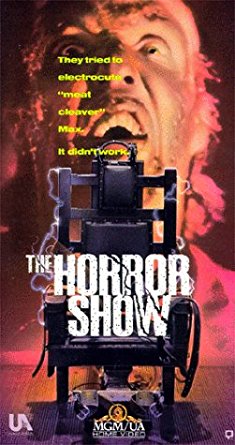
For the crime of having murdered over a 100 people, “Meat Cleaver Max” Jenke (Brion James) is sentenced to death and sent to the electric chair.  Even though everyone thinks that Max was electrocuted, his electricity-fueled spirit is still alive and pissed off.  If this sounds familiar, that is because it is the exact same premise that was used in Destroyer.  The only difference is that Max is not haunting a prison and killing a film crew.  Instead, he is living in a basement and seeking revenge on Lucas McCarthy (Lance Henriksen), the cop who arrested him.
Lucas is already tightly wound.  There is a scene where Lucas is watching as his family laughs uproariously at a late night comic who is telling a not very funny joke about then-Vice President Dan Quayle.  When Lucas thinks that he sees Max on TV, he pulls out his gun and shoots the screen.  His wife, son, and daughter will probably never laugh at another joke about any vice president.  Soon, Lucas is seeing and hearing Max everywhere.  Max says that he is going to tear Lucas’s world apart and he means it.

That The Horror Show is going to be a mess is obvious from the opening credits, where the screenplay is credited to Alan Smithee.  The credited director is visual effects specialist James Isaac but most of the film was reportedly directed by David Blythe.  Isaac stepped in when Blythe was fired by producer Sean S. Cunningham.  Full of false scares and scenes where people go down into the basement for no reason other than to become Max’s latest victim, The Horror Show is usually boring, except for when it is violent, gory, and mean-spirited.  There are moments of strange attempts at humor that do not seem to belong.  In the middle of all the carnage, there is a subplot about McCarthy’s son (Aron Eisenberg) ordering case after case of Nestle Quick.  Did Nestle pay for the product placement?  Were they happy to be associated with a movie where Lance Henriksen has a nightmare that his daughter (played by DeeDee “sister of Michelle” Pfieffer) is pregnant with Max Jenke’s baby?

The Horror Show provided both Lance Henriksen and Brion James with rare starring roles and they did their best what they had to work with.  Also keep an eye out for veteran tough guy Lawrence Tierney as the warden who supervises Max’s execution.

A Movie A Day #224: Armed and Dangerous (1986, directed by Mark L. Lester)


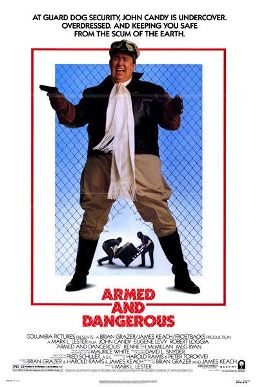
John Candy and Eugene Levy make a great team in the underrated comedy, Armed and Dangerous.

John Candy plays Frank Dooley, a member of the LAPD.  One of the first scenes of the movie is Frank climbing up a tree to save a little boy’s kitten and then getting stuck in the tree himself.  When Frank discovers two corrupt detectives stealing televisions, Frank is framed for the theft and kicked off the force.

Eugene Levy plays Norman Kane, a lawyer whose latest client is a Charles Manson-style cult leader who has a swastika carved into his head.  After being repeatedly threatened with murder, Norman asks for a sidebar and requests that the judge sentence his client to life in prison.  The judge agrees on the condition that Norman, whom he describes as being “the worst attorney to ever appear before me,” find a new line of work.

Frank and Norman end up taking a one day training course to act as security guards and are assigned to work together by their tough by sympathetic supervisor (Meg Ryan!).  Assigned to guard a pharmaceutical warehouse, Frank and Norman stumble across a robbery.  The robbery leads them to corruption inside their own union and, before you can say 80s cop movie, Frank and Norman are ignoring the orders of their supervisors and investigating a crime that nobody wants solved.

Armed and Dangerous was one of the many comedy/cop hybrid films of the 1980s.  Like Beverly Hills Cop, it features Jonathan Banks as a bad guy.  Like the recruits in Police Academy, all of Frank and Norman’s fellow security guards are societal misfits who are distinguished by one or two eccentricities.  There is nothing ground-breaking about Armed and Dangerous but Mark Lester did a good job directing the movie and the team of Candy and Levy (who has previously worked together on SCTV) made me laugh more than a few times.

Armed and Dangerous was originally written to be a vehicle for John Belushi and Dan Aykroyd.  It’s easy to imagine Belushi and Aykroyd in the lead roles but I think the movie actually works better with Candy and Levy, whose comedic style was similar to but far less aggressive than that of Belushi and Aykroyd.  One of the reasons that Armed and Dangerous works is because John Candy and Eugene Levy seem like the two last people to ever find themselves in a shootout or a car chase.  With Belushi and Aykroyd, it would have been expected.  After all, everyone’s seen The Blues Brothers.


A Movie A Day #200: A Breed Apart (1984, directed by Philippe Mora)


Sometimes, the story behind a movie is more interesting than the movie itself.

Rutger Hauer stars in A Breed Apart, playing an eccentric environmentalist named Jim Malden.  Malden loves nature but he hates people, with the exception of a local storekeeper named Stella (Kathleen Turner) and her young son.  The local fishermen (one of whom is played by Hauer’s Blade Runner co-star, Brion James) may hate him but they are no match for Malden’s guerilla tactics.  Recently, a new breed of bald eagle has been discovered and Malden is determined to protect it.  At the top of a cliff, there is a nest full of eagle eggs and Malden will not let anyone near them.

Rich collector J.J. Whittier (Donald Pleasence) is determined to get those eggs for himself.  In order to deal with Malden, Whittier hires famous rock climber, Mike Walker (Powers Boothe).  Disguising himself as a nature photographer, Walker attempts to befriend Malden so that he can get to the eggs.  Even as Malden shows Walker why it is important to protect the environment, Walker falls in love with Stella.

With a cast like this, A Breed Apart should have been far more interesting than it was.  It provides a rare chance to see both Rutger Hauer and Powers Boothe playing heroes but neither seemed to really be into their roles.  Kathleen Turner was sexy but saddled with a terrible accent while Donald Pleasence seemed to be in a different movie.  When I watched A Breed Apart last night, I thought it seemed like a very disjointed movie.  For instance, the movie abruptly jumped from Stella and Walker first meeting to the end of their first date.  There was a random scene of Malden putting on war paint, while remembering the sound of helicopters.  War paint combined with helicopters in an 80s movie usually means that someone is having a Vietnam War flashback but Malden’s military background is never mentioned again.  Even Walker’s conversion to Malden’s cause and rejection of Whittier’s money seemed to happen offscreen.

According to Wikipedia, It turns out that there was a reason for all that.  A Breed Apart was filmed in North Carolina.  After principal filming was completed, four reels of film were sent back to Los Angeles.  However, only three reels ever arrived in California.  One reel disappeared and has never been found.  The footage that actually did make it to Los Angeles was reorganized and edited to try to disguise the fact that a huge part of the movie was missing.

It didn’t work.

(ADDENDUM 9/4/2017: Originally, both myself and a lot of other reviewers, were under the impression that one reel of film went missing and, as a result, the film had to be reedited to make up for the missing footage.  This story is presented as fact on Wikipedia, which is where I and I assume a lot of other people originally got it.  The lesson here is not to use an online encyclopedia that anyone can edit for a primary or even a credible source.  In the comments below, Director Philippe Mora has let me know that there was no lost reel and that, instead, there are several different cuts of the film kicking around, some of which are incomplete and some of which are ok.  Since Mora actually worked on the film, he is a far more credible source than an anonymous Wikipedia article.  I apologize to Mr. Mora for the mistake.)