Vincent Price was born, at the start of the 20th Century, in St. Louis, Missouri. When he first began his film career in the 1930s, he was promoted as a leading man and he was even tested for the role of Ashley Wilkes in Gone With TheWind. (Imagine that!) However, Price would find his greatest fame as a horror icon.
Among the fans of Price’s horror films was a young animator named Tim Burton. In 1982, Price and Burton would work together for the first time, with Price providing the narration for a short, stop motion film that Burton had written and directed. Called Vincent, the film was about a seven year-old boy named Vincent who wanted to be — can you guess? — Vincent Price! The six-minute film follows Vincent as he gets involved in all sorts of macabre activities. Of course, as Vincent’s mom points out, Vincent isn’t actually a monster or mad scientist. He’s just a creative child with an overactive imagination. (To say the short feels autobiographical on Burton’s part would be an understatement.) The animation is outstanding and full of wit but it really is Vincent Price’s wonderful narration that makes this short film a classic.
Both Price and Burton would later call making this film one of the most creatively rewarding collaborations of their respective careers.
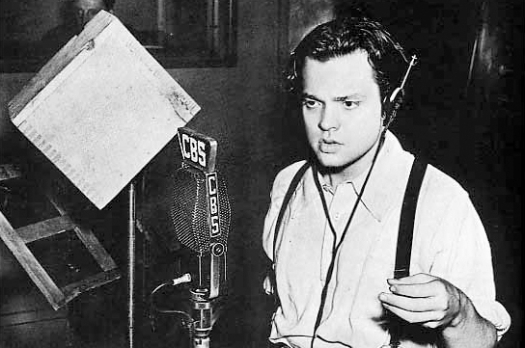
On October 30th, 1938, Orson Welles and the Mercury Theater On The Air broadcast an adaptation of H.G. Wells’s War of the Worlds and, legend has it, they scared the ever-loving heck out of America.
Actually, there’s some debate as to just how panicked America got when they heard the Mercury Theater On The Air’s adaptation of War of the Worlds. There was definitely some panic but there are differing reports on just how wide spread it was. For our purposes, let’s assume that the entire country was terrified at the same time and that everyone was loading up a shotgun and planning to go out and look for aliens. One thing is for sure. With his adaptation of War of the Worlds, Orson Welles managed to invent the whole found footage genre that would later come to dominate horror cinema in the late 90s and the aughts. Every found footage horror film owes a debt to what Orson Welles accomplished with War of the Worlds. We won’t hold that against Orson. Instead, it’s just another example of how far ahead of his time Orson Welles was.
H.G. Wells, the original author of War of the Worlds, and Orson Welles only met once, while they were both in San Antonio, Texas in 1940. (Orson Welles and H.G. Wells hanging out in San Antonio? To be honest, that sounds like it would make a good movie.) They were interviewed for a local radio station. H.G. Wells expressed some skepticism about the reports of Americans panicking while Welles compared the radio broadcast to someone dressing up like a ghost and shouting “Boo!” during Halloween. Both Wells and Welles then encouraged Americans to worry less about Martians and more about the growing threat of Hitler and the war in Europe.
I’ve shared this before but this just seems like the time to share it again. Here, for Halloween Eve, is the 1938 Mercury Theater On The Air production of The War of the Worlds!
1957’s Final Curtain is a short, 22-minute film in which a mysterious man (Duke Moore) wanders around a creepy and seemingly abandoned theater. While Dudley Manlove (who played Eros the Alien in Plan Nine From Outer Space) provides narration, the man sees many strange things in the theater. What is real and what is merely a hallucination? Watch to find out!
Final Curtain was envisioned, by director Edward D. Wood, as being the pilot for a horror anthology series. Though none of the networks were interested in buying Wood’s proposed series, Wood considered Final Curtain to be his finest film and it certainly is a bit more atmospheric than the typical Wood film. The role of the mysterious man was written for Bela Lugosi but, after Lugosi passed away, Duke Moore was cast in the role instead.
May 1st is a day of many holidays, including Law Day.
President Dwight D. Eisenhower first proclaimed May 1st to be Law Day in 1958 and apparently, it’s been celebrated every year since. On Law Day, Americans are meant to reflect on the role of law in the foundation of the nation and also consider its importance to the social order.
To observe this year’s Law Day, I’m happy to present our readers with my favorite episode of Dragnet 1968.
Dragnet began as a radio program in 1949 before making it’s way over to television in 1951. Each episode starred (and the majority were directed by) Jack Webb, who played a no-nonsense cop named Joe Friday. Friday narrated every episode, dropping trivia about the history of Los Angeles while also showing viewers how the cops went about catching criminals. Despite what is commonly believed, Joe Friday never said, “Just the facts, ma’m,” but he did investigate each case with the cool determination of a professional who kept his emotions under control. The majority of Dragnet’s episodes were based on actual cases that were worked by the LAPD, hence the opening declaration of, “The story you are about to see is true.”
On television, Dragnet originally ran from 1951 to 1959, during which time Dragnet also became the first television series to be adapted into a feature film. Jack Webb decided to relaunch Dragnet in 1966 and he produced a made-for-television movie that followed Friday and his latest partner, the far more talkative Bill Gannon (Harry Morgan), as they worked multiple cases over the course of one long weekend. That made-for-television movie led to a series that ran from 1967 to 1970.
The second television series is the best-remembered version of Dragnet, beloved for its scenes of Friday and Gannon debating the issues with a motely collection of hippies, campus radicals, and pipe-smoking academics. Jack Webb viewed Friday as being the voice of the common American, who supported the troops, supported the president, and who wanted to spend the weekend grilling in peace. Friday was the middle-aged suburbanite who wanted to the kids to stay off the grass, whether it was on his front lawn or being sold on a college campus. These episodes were often campy. It’s hard not to smile while listening to Friday and Gannon deadpan their way through conversations with flakey long-haired hippies. It was often obvious that the writers of Dragnet had never actually had any experiences with the hippies, beyond what they saw on the evening news. And yet, as silly as things often were, the show is an interesting time capsule of the time in which it was made. If nothing else, it’s a chance to see the 60s through the eyes of the other side.
My favorite episode was the show’s third season premiere. It originally aired on September 19th, 1968 and it features Joe and Gannon appearing on a talk show. The subject of the show: “The Fuzz Who Needs Them?” Joe and Gannon argue on behalf of the fuzz. Appearing on the other side of the panel are a pipe-smoking academic (Stacy Harris) and the publisher (Howard Hesseman, credited as Don Sturdy) of an underground newspaper. Questions are asked from the audience. John Dietz (played by Lou Wagner, who also plays Harlan Arliss on CHiPs) wants to know why drug are illegal. Mondo Mabamba (Dick Anthony Williams) wears blue glasses and demands to know why the cops are always sitting in squad cars. Overseeing the show is the evil Chuck Bligh (Anthony Eisley). Friday struggles to hold back his disgust as the newspaper publisher throws a “Make Love Not War” pin at him.
This an interesting episode, if just because both sides are allowed to make their case and, in a rarity for Dragnet, neither Friday nor Gannon change anyone’s mind. On the one hand, the academic and the publisher are both portrayed as being fairly obnoxious. On the other hand, Howard Hesseman delivers his lines with such sharpness that his character cannot be as easily dismissed as the usual Dragnet hippie. Chuck Bligh’s talk show predicts the political panel shows of today and it’s interesting to see how we’re still debating many of the same issues that were raised in this episode.
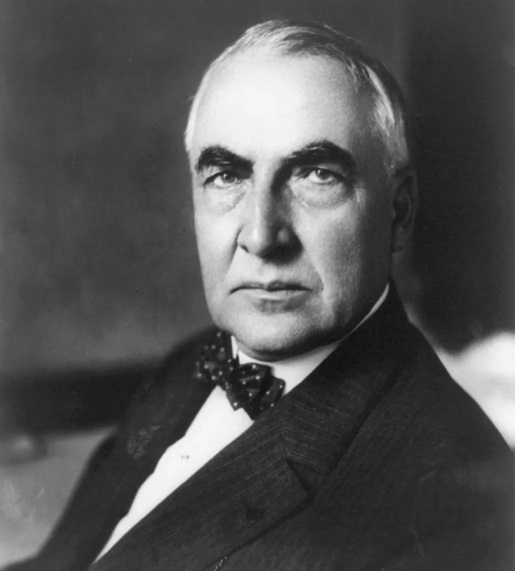
Since today is Presidents Day, I wanted to take a moment to acknowledge and honor my favorite president, Warren G. Harding of Ohio. The former newspaper editor-turned-Senator was elected in 1920, by one of the largest landslides in American history. (Interestingly enough, his opponent was another newspaper man from Ohio, James Cox.) Harding was elected on a platform that promised a “return to normalcy” after the authoritarian excesses of Woodrow Wilson. He was the first president to be elected in a national election in which all states allowed women to vote and he overwhelmingly won their vote. A politician who remembered his friends and who had little trouble entertaining his constituents in his office, Warren Harding epitomized everything that was fun about the early 1920s.
And we have actual newsreel footage of Warren Harding’s inauguration! For today’s blast of the past, here is newsreel footage of my favorite President renewing America’s greatness. This footage is over 100 years old and, in all seriousness, it shows why film is so important. The video below is not just a short movie of someone taking the oath of office in Washington, D.C. Instead, it’s a portal into the past. At a time when history itself is often altered to fit whatever the current narrative may be, it’s good that we can still see things for ourselves.
Filmed in 1957 for a television program called Westinghouse Studio One, The Night America Trembled is a dramatization of the night in 1938 when Orson Welles’s adaptation of H.G. Wells’s The War of the Worlds reportedly caused a panic amongst listeners.
For legal reasons, Orson Welles is not portrayed nor is his name mentioned. Instead, the focus is mostly on the people listening to the broadcast and getting the wrong idea. That may sound like a comedy but The Night America Trembled takes itself fairly seriously, complete with Edward R. Murrow narrating and taking drags off of a cigarette.
Clocking in at a brisk 60 minutes, The Night America Trembled is an interesting recreation of that October 30th. Among the people panicking are a large collection of future stars and character actors. Ed Asner, James Coburn, John Astin, Warren Oates, and Warren Beatty all make early appearances.
It’s an interesting historical document and you can watch it below!
On October 30th, 1938, Orson Welles and the Mercury Theater On The Air broadcast an adaptation of H.G. Wells’s War of the Worlds and, legend has it, they scared the ever-loving heck out of America.
Actually, there’s some debate as to just how panicked America got when they heard the Mercury Theater On The Air’s adaptation of War of the Worlds. There was definitely some panic but there are differing reports on just how wide spread it was. For our purposes, let’s assume that the entire country was terrified at the same time and that everyone was loading up a shotgun and planning to go out and look for aliens. One thing is for sure. With his adaptation of War of the Worlds, Orson Welles managed to invent the whole found footage genre that would later come to dominate horror cinema in the late 90s and the aughts. Every found footage horror film owes a debt to what Orson Welles accomplished with War of the Worlds. We won’t hold that against Orson. Instead, it’s just another example of how far ahead of his time Orson Welles was.
H.G. Wells, the original author of War of the Worlds, and Orson Welles only met once, while they were both in San Antonio, Texas in 1940. (Orson Welles and H.G. Wells hanging out in San Antonio? To be honest, that sounds like it would make a good movie.) They were interviewed for a local radio station. H.G. Wells expressed some skepticism about the reports of Americans panicking while Welles compared the radio broadcast to someone dressing up like a ghost and shouting “Boo!” during Halloween. Both Wells and Welles then encouraged Americans to worry less about Martians and more about the growing threat of Hitler and the war in Europe.
I’ve shared this before but this just seems like the time to share it again. Here, for Halloween, is the 1938 Mercury Theater On The Air production of The War of the Worlds!
First broadcast in 1981, The Wave stars Bruce Davison as Ben Ross, a high school social studies teacher who conducts a social experiment.
Frustrated by the fact that he can’t answer his students questions of how the German people could have allowed the Holocaust to occur, Ben decides to teach his students a lesson. He starts by introducing a bunch of seemingly arbitrary rules to his classroom, concerning the proper way for students to sit at their desks and to address the teacher. Ben is somewhat surprised to see how quickly his students adapt to the new rules, even taking pleasure in showing how quickly and efficiently they can follow orders. The next day, Ben tells his students that they are now members of The Wave, a national youth organization with membership cards and a secret salute.
And that is when all Hell breaks loose. Ben only meant to show his students what it’s like to be a member of a mass movement but the students take The Wave far more seriously than Ben was expecting. Soon, other students are joining The Wave. When the popular football players announce that they are a part of The Wave, others are quick to flock to the organization. The formerly likable David turns into a fanatic about bringing people into the organization. Robert, a formerly unpopular student, revels in his new job of reporting anyone who deviates from the rules of The Wave. When a student reporter writes an article that is critical of the organization, she and the school paper are targeted. Has Ben’s social experiment spiraled out of control?
42 years after it was originally produced, The Wave remains a powerful and sobering look at how people can be manipulated into doing things as a mob that they would never do as an individual. If anything, the film feels more relevant today than it probably did in 1981. The character of Robert, in particular, is a familiar one. He’s someone with no self-esteem who latches onto a movement and finds his identity by taking down others and accusing them of failing to follow the rules. One can find people like Robert all over social media, searching through old posts for any example of wrongthink that they can broadcast all through their social world. It’s tempting to smirk at how quickly the members of The Wave sacrificed their freedom and their ability to think for themselves but it’s no different from what we see happening in the real world every day. (Indeed, if the film had been made just two or three years ago, The Wave would probably be the people policing whether or not the rest of us were observing quarantine and wearing our facemasks correctly.) People like to feel that they belong to something, even if that means sacrificing their humanity in the process.
Featuring a good performance from Bruce Davison as the well-meaning teacher who is both fascinated and terrified by the experiment that he’s set in motion, The Wave can be viewed below:
In 1986’s The Drug Knot, Dermot Mulroney plays a high school student.
At the time this show aired, Dermot Mulroney was 25 years-old and he looked like he was 30 but, looks aside, he actually gives a pretty convincing performance as Doug Dawson. Doug is a smart and musically-gifted high school senior. He’s talented enough to make beautiful music with a saxophone and rebellious enough to skip class so that he can play the sax in the school locker room. His girlfriend, Kim (Meryl Streep look-alike Kim Myers), is totally in love with Doug but she also worries that he’s getting too heavily into dugs. He’s gone from smoking weed to snorting cocaine. He hides his drugs in his bedroom. His mother (Mary Ellen Trainor) has no idea that Doug is a drug addict while Doug’s little brother (David Faustino) wants to be just like him.
Can you see where this is heading?
In order to combat the school’s growing drug problem, the school has invited a speaker named David Toma to give a speech at a school assembly. Toma is a former cop who struggled with addiction himself. He inspired not one but two television shows, one called Toma and the other called Baretta. He goes from school to school and he gives speeches about all of the teenagers that he knows who have died as a result of doing drugs. As we see throughout the episode, Toma is a confrontational speaker, one who is not afraid to yell at his audience. Doug shows up for the assembly but his bad attitude leads to Toma kicking him out.
Personally, I’ve always had mixed feelings about the idea of trying to change people’s behavior by yelling at them. I know that it’s a popular technique and there’s been a lot of television shows (Intervention and Beyond Scared Straight come to mind) that are all about getting in people’s faces and screaming at them. My feeling, though, has always been that this approach is more about making other people feel good than actually changing behavior. Everyone wants to see the people who have caused them stress get yelled at. On talk shows, audiences would applaud whenever a disrespectful teen got sent to boot camp but it’s rare that you ever heard about whether or not the approach actually worked. I mean, I assume the approach works for some people but I know that if someone yells at me not to do something, my usual reaction is to go ahead do it just because I resent authority. David Toma’s approach would not have worked with me.
(One interesting thing about The Drug Knot is that David Toma is a real person and he plays himself. Apparently, he’s still out there and still at it, even though he’s in his 90s now. I should note that, on YouTube, there’s a lot of comments from people who say that getting yelled at by David Toma saved their lives so maybe the yelling approach does work for more people than I assumed.)
Anyway, as always when it comes to these made-for-TV anti-drug programs, the drugs lead to tragedy and The Drug Knot ends on a particular dark note. For once, there is no redemption.
Here is The Drug Knot, complete with an anti-drug message from Michael Jordan:
In 1980’s Stoned, Scott Baio plays Jack Melon, a teenager with a problem.
Jack is shy, awkward, and can’t escape the shadow of his older brother, Mike (Vincent Bufano). Mike is champion swimmer. Jack is someone who can barely walk down a hallway without walking into a wall. But then Teddy (Jack Finch) gets Teddy hooked on marijuana, the so-called weed with roots in Hell! Soon, Jack is acting weird, making strange jokes, and getting all of the attention in the world. Unfortunately, Jack is also alienating those closest to him and his newfound habit leads to a near-tragedy.
Stoned was aired as an ABC Afterschool Special and, while it’s not quite Reefer Madness, it does adhere to the general anti-drug formula. In record time, Jack goes from being shy and dorky to being goofy and potentially dangerous. We get all the expected scenes of Jack devouring ice cream, Jack wandering around in a daze, Jack realizing that the girl he likes what’s nothing to do with the new Jack, Jack’s well-meaning teacher (played by the show’s writer and director, John Herzfeld) confronting his students about their drug use, and Jack accidentally hitting his brother with an oar. Jack thinks that marijuana is opening his brain because, while stoned, he suddenly realizes that a tree looks like “Old Man Eber.” Stoned goes on to show Jack ruining his life but I have to admit that I spent most of the running time wondering who Old Man Eber was. (Seriously, Old Man Eber sounds like some sort of Lovecraftian ghoul, waiting in the shadows to drag one to an Arkham cemetery.) Of course, someone nearly dies as a result of Jack’s marijuana use. What’s interesting is Jack is able to save the person’s life, even though he’s stoned. Would non-stoned Jack have been able to do it?
From the fashion choices to the cast to the message that marijuana is the most dangerous thing on the planet, Stoned is one of those TV specials that epitomizes its time. This was a film that was made at a time when it was inconceivable that there would some day be commercials for edible gummies and it shows. Watching Stoned is like stepping into a time machine.
Today, of course, Scott Baio is better known for his politics than his acting. Whenever I see a headline that reads, “This veteran Hollywood star is calling out his industry for not understanding America,” I know the story is inevitably going to be about Scott Baio complaining about his taxes. That said, Scott Baio is convincing when he’s playing Jack as being awkward and insecure but he definitely goes a bit overboard once Jack starts smoking. While that probably dilutes the effectiveness of the film’s message (because, let’s be honest, real stoners are going to watch this and easily recognize the fact that Jack is trying way too hard to convince everyone that he’s stoned), it does give this film a certain entertainment value.
Here is Stoned, complete with the commercials that aired when the show was original broadcast on November 12th, 1980: