Horror Film Review: The Black Sleep (dir by Reginald Le Borg)


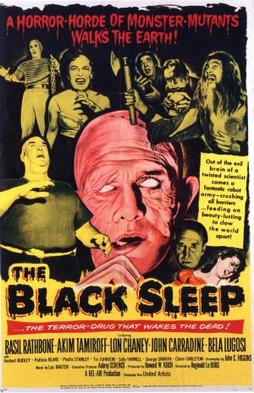
1956’s The Black Sleep opens in a London prison cell.  The year is 1872 and Dr. Gordon Ramsay (Herbert Radley) awaits execution.  He’s accused of murdering a chef who twice sent rubbery scallops to the pass …. wait, a minute, sorry.  Wrong Gordon Ramsay!  This Gordon Ramsay is accused of murdering a man named Curry and he’s considerably more whiny than the modern-day Gordon Ramsay.

Ramsay is visited by Sir Joel Cadman (Basil Rathbone) and Cadman’s associate, Odo the Gypsy (Akim Tamiroff).  Cadman explains that he has developed a potion called “The Black Sleep.”  Drinking it will put the drinker in a state of suspended animation that can pass for death.  And, indeed, it will turn into death unless Cadman administers the antidote.  Cadman offers to give the potion to Ramsay, in return for Ramsay helping Cadman out with his own experiments.  Ramsay agrees.

Ramsay is found “dead” in his cell.  His body is claimed by Cadman and Odo.  (Odo mentions that, in a past life, he was a grave robber and that he died as a result of the guillotine.)  Ramsay is revived and goes to work with Cadman.  As soon as Ramsay enters Cadman’s mansion, he finds himself surrounded by several familiar faces.  For instance, Lon Chaney, Jr. plays the twisted Mungo, who stumbles through the hallways of the mansion and can only be controlled by Daphnae (Phyllis Stanley).  Bela Lugosi plays Casimir, the mute butler.  Bohemud (John Carradine) is a bearded man who rants and raves and calls for Biblical vengeance.  And finally, in the basement, there’s Mr. Curry (Tor Johnson), the man who Ramsay was convicted of murdering!  It turns out that Cadman isn’t quite as benevolent as he presented himself as being.

The Black Sleep may feature an incoherent story but it has a great cast and it is entertaining to see Carradine, Chaney, Tor Johnson, Akim Tamiroff, Bela Lugosi, and Basil Rathbone all living under the same roof and trying to outdo each other as far as the scenery chewing is concerned.  Admittedly, some members of the cast look healthier than others.  Rathbone is as imperiously dashing as always and John Carradine appears to be having a lot of fun with his role.  Akim Tamiroff gets all of the best lines as Odo and he delivers them with just the right amount of wit.  Unfortunately, neither Chaney and Lugosi were in good shape when they appeared in this film.  Lugosi was ill when he did the film.  Chaney, meanwhile, had seen his one-promising career sabotaged by his own alcoholism and, by the time the 50s rolled around, his once handsome features were now ravaged by his drinking.  It transformed him from being a somewhat dull leading man to a craggly character actor.  (Producer/director Stanley Kramer considered Chaney to be one of the best character actors in Hollywood and cast him in both High Noon and The Defiant Ones.)  In The Black Sheep, Chaney’s face is twisted and almost ravaged.  It works for the film but it’s still sad to see.  As for Tor Johnson …. hey, he’s Tor Johnson.  He growls and he tosses things around and he does so convincingly.

(In an interview shortly before his death, Tor said he was offered the role of Oddjob in Goldfinger.  It’s sad to think the world was robbed of the Sean Connery/Tor Johnson team-up it needed.)

This was Bela Lugosi’s final film performance before his death in 1956.  (The footage that appears in Plan 9 From Outer Space was filmed before The Black Sleep.)  It’s a shame that Lugosi wasn’t given more to do in his final film.  Lugosi, with that famous voice, ending his career playing a mute just doesn’t seem right.

Horror on the Lens: The Ghost In The Invisible Bikini (dir by Don Weis)


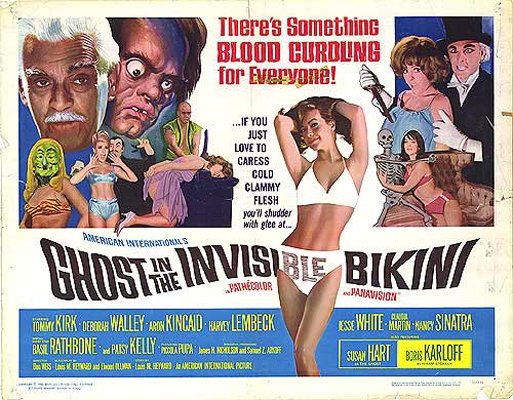
In 1965’s The Ghost In The Invisible Bikini, the recently deceased Hiram Stokely (Boris Karloff) is informed that he has just 24 hours to perform a good deed and get into Heaven.  He also has 24 hours to keep Basil Rathbone from stealing his estate.  Hiram teams up with the ghost of his his dead girlfriend (Susan Hart) and together, they help Hiram’s real heir throw a pool party!

I know, I know.  That makes no sense.  Go with it, it’s the 60s and it’s a party.  The film is silly even by the standards of the typical beach party film but it features Boris Karloff and Basil Rathbone somehow managing to maintain their dignity and Nancy Sinatra singing a song.  (Dean Martin’s daughter, Claudia, also makes an appearance.)  Even more importantly, this is a film that epitomizes an era.  Released in 1965, this was the last AIP beach party movie and it’s a product of the innocent, fun-loving early 60s that would soon be replaced by the violent turmoil of the late 60s.  Hiram was probably happy that he got out when he could.

Here is The Ghost In The Invisible Bikini:

Horror Film Review: Tales of Terror (dir by Roger Corman)


Eh, anthology films.

I have to admit that I’ve never been a huge fan of anthology films.  Anthology films are almost always a bit uneven.  Some filmmakers are better suited to making short films than others and, as anyone who has ever sat through one can tell you, sitting through a boring short film is actually worse than having to watch a boring long film.  Too often, anthology films are just a collection of boring short films.  If you get lucky, there might be a good segment hidden amongst all of the bad segments.  But even so, that often means sitting through 30 minutes of bad filmmaking for 15 minutes of something that’s moderately entertaining.

1962’s Tales of Terror is an anthology horror film.  Directed by Roger Corman, the film is a part of his Poe cycle and features adaptations of three Poe short stories, Morella, The Black Cat, and The Facts In The Case of M. Valedemar.  While it definitely suffers from the flaws that afflict many anthology films, Tales of Terror is saved a bit by the presence of Vincent Price.  Price not only appears  in all three of the films but he also provides the narration that links each film.  As I mentioned when I reviewed The Premature Burial, one cannot underestimate the importance of Vincent Price and his unique style of acting when it comes to discussing Corman’s Poe adaptations.  With his dramatic flourishes and his theatrical style of speaking, Price was the perfect star for these films.  As an actor, he perfectly complimented Corman’s flamboyant and colorful direction.  It also helps that Price himself seems to be truly enjoying himself in all of these films.  His eccentricity brings the film’s to life.

As for the separate stories that make up Tales of Terror, things get off to a rather macabre start with Morella.  Leonora (Maggie Pierce) returns home to visit her father (Vincent Price), who is now a drunken wreck who continues to blame Leonora for the death of her mother, Morella (Leona Gage).  Morella died while giving birth to Leonora.  Leonora is shocked to discover that her father is keeping her mother’s decomposing body in the mansion.  Leonora, who is suffering from a terminal illness, tries to take care of her father.  However, Morella’s spirit remains in the house, leading this story to a rather depressing and unsettling ending.  This story was effectively done, playing out like a particularly morbid companion to The Fall Of The House of Usher.

The Black Cat is presented as a comedy, starring Peter Lorre as a man who becomes convinced that his wife is cheating on him with a snobby wine taster who is, of course, played by Vincent Price.  This overlong segment did not work for me and I have to admit that a lot of that is because I love cats, black cats in particular.  Beyond that, the humor is a bit too broad.  Corman could do comedy, as he showed with Little Shop of Horrors, but he seems to be trying a bit too hard here.

Finally, the third segment is The Facts In The Case of M. Valdemar, in which Vincent Price plays the title character.  The dying Valdemar employs a hypnotist (Basi Rathbone) to put him in a trance to help relieve his suffering.  However, the hypnotist hopes to marry Valdemar’s wife (Debra Paget) and, after putting Valdemar into a trance, he leaves the dying man there.  Valdemar, whose body starts to decay, cannot die.  But, once he becomes angry enough, he can still rise from his bed to seek revenge even as his body putrefies.  This segment was the best of the three, featuring Price’s best work in the film and also a wonderfully villainous turn from Basil Rathbone.  The makeup effects that were used to capture Valdemar’s decay remain effectively frightening today.

Tales of Terror is two good stories and one mediocre one, which is better than the usual anthology film.  Still, not surprisingly, the main reason watch is for the wonderful Vincent Price.

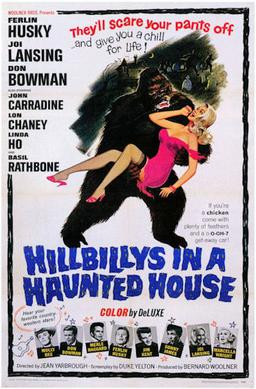
Horrific Insomnia File #63: Hillbillys in a Haunted House (dir by Jean Yarbrough)


What’s an Insomnia File? You know how some times you just can’t get any sleep and, at about three in the morning, you’ll find yourself watching whatever you can find on cable or streaming? This feature is all about those insomnia-inspired discoveries!

If you were having trouble getting to sleep last night, you could have jumped on Tubi and watched a film from 1967 called Hillbillys In A Haunted House and it would have put you right to sleep.

Hillbillys In A Haunted House has some big names in the cast but, unfortunately, none of them get to do much.  Instead, the main characters are country singer Woody Wetherby (Ferlin Husky), his partner Boots Malone (a very pointy Joi Lansing), and their road manager, Jeepers (Don Bowman).  When we first see them, they’re driving to Nashville and even worse, they’re singing about the fact that they’re driving to Nashville.  They’re scheduled to perform in “the Jamboree.”  However, after they’re delayed by a bunch of cops having a shoot out with two spies, Boots announces that Jeepers is a nervous wreck and that they really need to stop and rest for the night.

Unfortunately, they’re in the town of Sleepy Junction and there’s not much to Sleepy Junction because everyone in town recently moved to Acme City.  As a result, there are no hotels or motels in Sleepy Junction.  But there is a big, deserted mansion that is rumored to be haunted.  With a storm approaching and Jeepers’s nerves even more on edge then before, they head to the mansion.  At the mansion Woody sings a song and then some neighbors stop by and they all sing another song.  Are you getting the feeling that there’s a lot of singing in this movie?  You’re right, there is.  It’s all studio-perfect singing too.  Woody lip-syncs like a pro.

Anyway, the mansion is also being used by four spies, played by Basil Rathbone, John Carradine, a hulking Lon Chaney, Jr., and Linda Ho.  The four of them live in the surprisingly clean basement of the mansion.  Living with them is a gorilla.  The spies planning on stealing a formula for rocket fuel from Acme City but first they need to do something about the hillbillys that are currently in the haunted house.  Carradine and Rathbone try to scare them out with some remote control ghost action.  Jeepers may be a coward and Woody may be a redneck and Boots may have atrocious taste in clothes but all three of them are Americans and they’re not going to stand for any spy nonsense!

If you think it sounds like this was stupid, you’re right.  Carradine and Rathbone both struggle to maintain a straight face.  Poor Lon Chaney Jr. often appears to be out of breath.  There’s way too much singing.  Seriously, couldn’t the hillbillies have just driven another few miles to Acme City and found a hotel?

The film will put you to sleep, though.  It has its uses.

Previous Insomnia Files:

  1. Story of Mankind
  2. Stag
  3. Love Is A Gun
  4. Nina Takes A Lover
  5. Black Ice
  6. Frogs For Snakes
  7. Fair Game
  8. From The Hip
  9. Born Killers
  10. Eye For An Eye
  11. Summer Catch
  12. Beyond the Law
  13. Spring Broke
  14. Promise
  15. George Wallace
  16. Kill The Messenger
  17. The Suburbans
  18. Only The Strong
  19. Great Expectations
  20. Casual Sex?
  21. Truth
  22. Insomina
  23. Death Do Us Part
  24. A Star is Born
  25. The Winning Season
  26. Rabbit Run
  27. Remember My Name
  28. The Arrangement
  29. Day of the Animals
  30. Still of The Night
  31. Arsenal
  32. Smooth Talk
  33. The Comedian
  34. The Minus Man
  35. Donnie Brasco
  36. Punchline
  37. Evita
  38. Six: The Mark Unleashed
  39. Disclosure
  40. The Spanish Prisoner
  41. Elektra
  42. Revenge
  43. Legend
  44. Cat Run
  45. The Pyramid
  46. Enter the Ninja
  47. Downhill
  48. Malice
  49. Mystery Date
  50. Zola
  51. Ira & Abby
  52. The Next Karate Kid
  53. A Nightmare on Drug Street
  54. Jud
  55. FTA
  56. Exterminators of the Year 3000
  57. Boris Karloff: The Man Behind The Monster
  58. The Haunting of Helen Walker
  59. True Spirit
  60. Project Kill
  61. Replica
  62. Rollergator

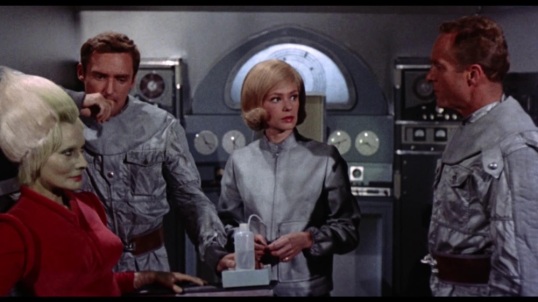
TSL’s Horror Grindhouse: Queen of Blood (dir by Curtis Harrington)


Queen of Blood (1966, dir by Curtis Harrington, DP: Vilis Lapenieks)

Here’s a question: what happens when Roger Corman buys the rights to two Russian science fiction films, decides to jettison basically everything but the special effects footage, and then hires experimental filmmaker Curtis Harrington to shoot an entirely new film around that footage?

You end up with the 1966 film, Queen of Blood!

Not that that’s a bad thing, mind you. Queen of Blood is actually pretty good and director Harrington manages to smoothly integrate the Russian footage with the new footage. Basically, it works out so that you’ll see a Russian shot of the spaceship taking off or landing and then you’ll see a shot of John Saxon, Dennis Hopper, or Basil Rathbone sitting on a set and pretending like they’re in space.

The film opens with Dr. Faraday (Basil Rathbone) discovering that aliens have been transmitting a message to Earth. They’re sending an ambassador to meet with the Earthlings but the aliens’ spaceship ends up crash landing on Mars! Faraday arranges for an Earth spaceship, the Oceano, to go to Mars and rescue the ambassador.

Aboard the Oceano is a cast made up of a few familiar faces. John Saxon plays Allan, who is the de facto leader of the expedition and also engaged to marry Dr. Faraday’s assistant, Laura (Judi Meredith). A young-looking Dennis Hopper is Paul Grant, an astronaut. Don’t get too excited about Hopper being in the cast. Queen of Blood was made when Hopper was still trying to pursue mainstream film stardom so he gives a rather bland performance here. There’s a few scenes where you can tells that Hopper is on the verge of smirking at some of his dialogue but, for the most part, he plays the role extremely straight. Rounding out the crew is Anders (Robert Boon) and Tony (Don Eitner), neither one of whom would go on to star in Easy Rider, Blue Velvet, or Nightmare on Elm Street.

It’s a difficult journey. The Oceano keeps running into Russian-filmed turbulence on the way to Mars. When they do land, they discover that the ambassador (Florence Marly) is waiting for them to rescue her. She doesn’t talk much nor does she have any interest in eating Earth food. She does seem to like every member of the crew except for Laura. Of course, the ambassador’s defining trait is that she likes to drink blood….

All things considered, Queen of Blood works pretty well. While none of the performances are particularly memorable (though Basil Rathbone does bring some old school class to what is essentially a cameo role), Curtis Harrington does a great job creating and maintaining a properly ominous atmosphere. It takes a while for the crew to finally find the Queen of Blood but, when they do, Harrington gets every bit of creepiness that he can out of the character. The film even ends on an appropriately dark note, suggesting that the human race may be just too stupid to survive.

Queen of Blood is an entertaining B-movie. Watch it the next time you’re in the mood for some intergalactic blood-sucking fun!

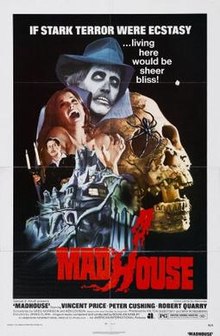
The TSL’s Horror Grindhouse: Madhouse (dir by Jim Clark)


In this 1974 film, Vincent Price plays Paul Toombes, a talented actor who, despite his formal training and his distinguished background, is best-known for giving hammy performances in low-budget horror films.

Hmmm …. do you think Vincent Price possibly could have related to this character?  I mean, one thing that people often forget is that Vincent Price did not start his career in horror movies.  Price started his career as a romantic lead and then he eventually moved into character parts.  He was tested and apparently quite seriously considered for the role of Ashely Wilkes in Gone With The Wind.  Price was also considered for the role of Mr. Potter in It’s A Wonderful Life and rumor has it that he would have gotten the role of Addison DeWitt if George Sanders had turned down All About Eve.  Before he became an icon of horror, Price had roles in big-budget Oscar nominees like The Song of Bernadette and Wilson.  He even appeared in the classic film noir, Laura.

It wasn’t until the 50s that Price started to regularly appear in horror films and soon, that was what he was best known for.  Price’s naturally theatrical style made him a perfect fit for the genre and it won him a legion of adoring fans.  The same can be said of Paul Toombes.

Paul Toombes is best-known for playing the role of Dr. Death.  He appeared in five Dr. Death films, the majority of which were written by his friend, Herbert Flay (Peter Cushing).  Unfortunately, the murder of his fiancée put a temporary end to Toombes’s acting career.  Even though Toombes was acquitted of the crime, everyone seems to assume that he did it.  Apparently, having a nickname like Dr. Death doesn’t do much to convince people of your benevolence.

However, Toombes finally has a chance to rebuild his career!  The BBC wants to produce a Dr. Death TV series and they want Toombes to once again play his most famous role.  The only problem?  People involved with the production are getting murdered, one-by-one.  Is Dr. Death responsible or is he being set up?

Madhouse is kind of an early slasher film, though, with its gloved killer and its whodunit plot, it has more in common with an Italian giallo than an installment of Friday the 13th.  The deaths are bloody but not too bloody.  In fact, for a film that’s full of murder and betrayal, Madhouse is surprisingly good natured.  The main appeal of the film, of course, is to see Vincent Price and Peter Cushing acting opposite of each other.  Though they were both known for appearing in horror films, Price and Cushing were two very different actors and each brought his own individual approach to Madhouse.  Price is his usual flamboyant self while Cushing is considerably more reserved and the contrast of their styles actually creates an interesting dynamic between Toombes and Flay.

Madhouse is also full of footage from previous films that Vincent Price had made for AIP.  (Of course, these movies are presented as being Dr. Death films.)  Basil Rathbone and Boris Karloff both appear in archival footage, acting opposite Price.  It’s nice to see them, even if neither one of them was actually alive when Madhouse was filmed.  Paul Toombes actually gets a scene where he praises Bail Rathbone’s performance and one gets the feeling that the sentiments were being expresses as much by Price as by the character he was playing.

Madhouse is okay.  The plot’s not particularly challenging and the tone tends to go all over the place, as if the film can’t decide whether it wants to be a horror movie or a Hollywood satire.  However, the film works whenever Vincent Price is on-screen, which is often.  Price is just fun to watch, especially when he’s teamed up with an old pro like Peter Cushing.  For fans of Price and Cushing, Madhouse is an entertaining chance to watch two icons of horror go at it.


Spring Breakdown: The Ghost In the Invisible Bikini (dir by Don Weis)


The 1966 film, The Ghost In The Invisible Bikini, asks the question, “What can you do if you want to have a beach party but you don’t have a beach?”

The answer: “Find a pool!”

Seriously, a pool is just as good as a beach and fortunately, Chuck (Tommy Kirk) has a pool where his friends can hang out and listen as Vicki (Nancy Sinatra) sings a song.  It’s in a big old mansion and hey, it might be haunted.  It used to belong to Hiram Stokeley (Boris Karloff) and he’s dead now so he certainly won’t mind, right?

Well, what if he’s not dead!?

Oh wait, actually, he is dead.  But he’s still hanging around.  It turns out that he needs to do at least one good deed in order to get into Heaven.  (Isn’t starring in Frankenstein enough?  I mean, c’mon…..)  It also turns that Hiram only has 24 hours to do that good deed or it’s off to Hell for him.  Maybe he could figure out a way to help Chuck and his family win his fortune!  Hiram enlists the help of his long-dead girlfriend, Cecily (Susan Hart).  Cecily, we are told, is wearing an invisible bikini but we just have to take the film’s word on that because it’s invisible and, seeing as how Cecily’s a ghost, it’s always possible that only reason she’s transparent is because she’s a spirit.  I mean, seriously, who knows how ghosts work?

Anyway, it’s not going to be easy for Hiram and Cecily to ensure that Chuck inherits that fortune, largely because Chuck and all of his friends are idiots.  The other problem is that Reginald Ripper (Basil Rathbone), Hiram’s lawyer, is determined to win that money for himself and, if you have any doubt that he’s a bad dude, just check out his name.  GOOD PEOPLE ARE NOT NAMED REGINALD RIPPER!  Fortunately, even though Reginald graduated from law school and is played by Basil freaking Rathbone, he’s still an idiot and he comes up with the stupidest plan possible to get Chuck and friends out of the house.

He’s going to make them think that it’s haunted!

(But it is haunted….)

Reginald’s plan is to have his evil associates, J. Sinister Hulk (Jesse White), Chicken Feather (Benny Rubin), and Princess Yolanda (Bobbi Shaw), pretend to be monsters and ghosts in order to scare all of the teens out of the house.  He also enlists his daughter, Sinistra (Quinn O’Hara), to help but Sinistra isn’t really bad.  She’s just extremely near-sighted and someone thought it would be a good idea to name her Sinistra.

And then the bikers show up!  This is one of AIP’s beach party films so, of course, there are bikers.  Eric von Zipper (Harvey Lembeck) shows up and pretends to be Marlon Brando in The Wild One.  Of course, at the time this film was made, the real Marlon Brando was filming Arthur Penn’s The Chase so I’m going to guess that Harvey Lembeck probably had more fun pretending to be Brando than Brando was having being himself….

Anyway, this is a stupid movie even by the standards of the AIP beach party films.  It’s also notably disjointed.  That probably has something to do with the fact that Karloff and Susan Hart weren’t actually added to the film until after the movie had already been shot.  Apparently, AIP felt that the first cut of the movie was missing something so they said, “Let’s toss in a little Karloff!”  Of course, Boris Karloff was such an old charmer that it doesn’t matter that he doesn’t ever really interact with anyone other than Susan Hart over the course of the film.  You’re just happy to see him.

So yeah, technically, this is not a good film but, at the same time, you kind of know what you’re getting into when you watch a movie called The Ghost In The Invisible Bikini.  The jokes fall flat.  The songs are forgettable.  But the whole thing is such a product of its time that it’s always watchable from an anthropological perspective.  Add to that, you get Boris Karloff and Basil Rathbone, doing what they had to do to pay the bills and somehow surviving with their dignity intact.  Good for them.

Lisa Reviews An Oscar Nominee: Romeo and Juliet (dir by George Cukor)


http://www.youtube.com/watch?v=IoAgB_sbDOE

You know the story that’s told in this 1936 film already, don’t you?

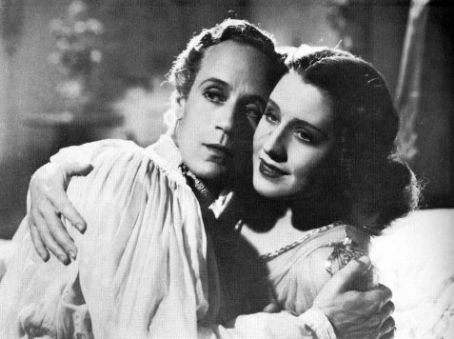
In the city of Verona, Romeo Montague (Leslie Howard) has fallen in love with Juliet Capulet (Norma Shearer).  Normally, this would be cause for celebration because, as we all know, love is a wonderful thing.  However, the House of Capulet and the House of Montague have long been rivals.  When we first meet them all, they’re in the process of having a brawl in the middle of the street.  There’s no way that Lord Capulet (C. Aubrey Smith) will ever accept the idea of Juliet marrying a Montague, especially when he’s already decided that she is to marry Paris (Ralph Forbes).  Things get even more complicated with Juliet’s cousin, Tybalt (Basil Rathbone), kills Romeo’s best friend, Mercutio (John Barrymore).  Romeo then kills Tybalt and things only grow more tragic from there.

It’s hard to keep track of the number of films that have been made out of William Shakespeare’s tale of star-crossed lovers and tragedy.  The plot is so universally known that “Romeo and Juliet” has become shorthand for any story of lovers who come from different social sects.  Personally, I’ve always felt that Romeo and Juliet was less about love and more about how the rivalry between the Montagues and the Capulets forces the young lovers into making hasty decisions.  If not for Lord Capulet throwing a fit over his daughter’s new boyfriend, she and Romeo probably would have split up after a month or two.  Seriously, I’ve lost track of how many losers I went out with in high school just because my family told me that I shouldn’t.

Producer Irving Thalberg spent five years trying to get MGM’s Louis B. Mayer to agree to greenlight a film version of Romeo and Juliet.  Mayer thought that most audiences felt that Shakespeare was above them and that they wouldn’t spend money to see an adaptation of one of his plays.  Thalberg, on the other hand, thought that the story would be a perfect opportunity to highlight the talents of his wife, Norma Shearer.  It was only after Warner Bros. produced a financially successful version of A Midsummer Night’s Dream that Mayer gave Romeo and Juliet the go ahead.

Of course, by the time the film went into production, Norma Shearer was 34 years old and a little bit too mature to be playing one of the most famous teenagers in literary history.  Perhaps seeking to make Shearer seem younger, Thalberg cast 43 year-old Leslie Howard as Romeo, 44 year-old Basil Rathbone as Tybalt, and 54 year-old John Barrymore as Mercutio,  (In Barrymore’s defense, to me, Mercutio always has come across as being Verona’s equivalent of the guy who goes to college for ten years and then keeps hanging out on the campus even after dropping out.)

In short, this is the middle-aged Romeo and Juliet and, despite all of the good actors in the cast, it’s impossible not to notice.  There were few Golden Age actors who fell in love with the authenticity of Leslie Howard and Basil Rathbone is a wonderfully arrogant and sinister Tybalt.  Norma Shearer occasionally struggles with some of the Shakespearean dialogue but, for the most part, she does a good job of making Juliet’s emotions feel credible.  As for Barrymore — well, he’s John Barrymore.  He’s flamboyant, theatrical, and a lot of fun to watch if not always totally convincing as anything other than a veteran stage actor hamming it up.  The film is gorgeous to look at and George Cukor embraces the melodrama without going overboard.  But, everyone in the movie is just too old and it does prove to be a bit distracting.  A heart-broken teenager screaming out, “I am fortune’s fool!” is emotionally powerful.  A 43 year-old man doing the same thing is just not as effective.

Despite being a box office failure (it turned out that Mayer was right about Depression-era audiences considering Shakespeare to be too “arty”), Romeo and Juliet was nominated for Best Picture of the year, the second Shakespearean adaptation to be so honored.  However, the award that year went to another big production, The Great Ziegfeld.