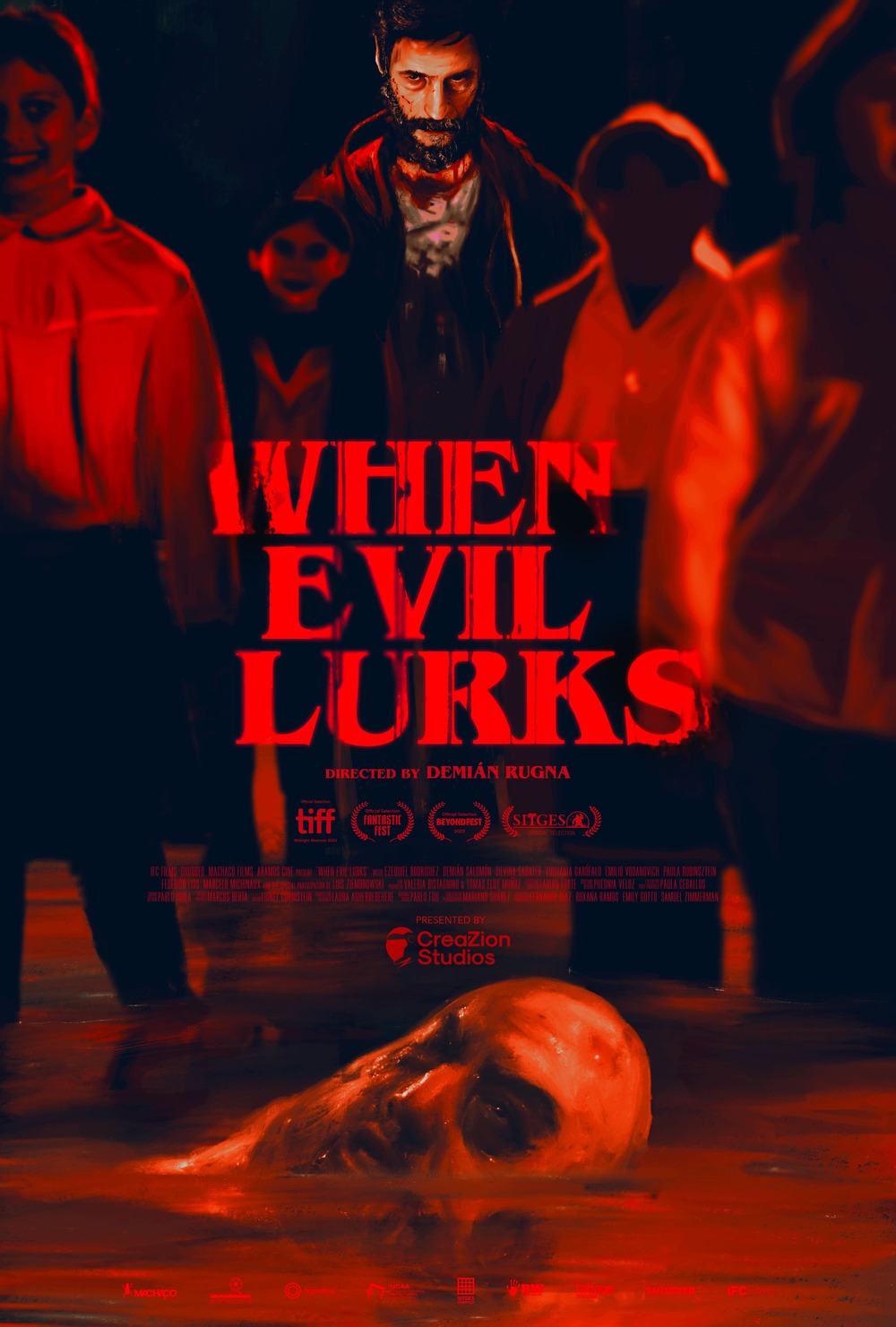
“Evil likes children, and children like evil.” — Mirtha
Most possession movies give you something to hold on to: a priest with a plan, a family worth saving, or the reassuring possibility that evil can be sent back where it came from. Demián Rugna’s When Evil Lurks takes those comforts away and leaves a bunch of frightened people making a terrible situation worse. This 2023 Argentine horror film is less interested in a battle between good and evil than in what happens when ordinary human weakness gives evil room to spread. It’s a vicious, messy, deeply uncomfortable movie, and its most disturbing quality isn’t the gore. It’s how quickly a supposedly sensible decision becomes an irreversible mistake.
The trouble begins in rural Argentina, where brothers Pedro and Jimmy discover a severely deteriorated man whose body is harboring a demonic presence. He’s known as a “rotten,” and dealing with him requires more care than the people nearby are willing to exercise. Alongside a local landowner, the brothers attempt to move him away from their property, treating a supernatural emergency like an unpleasant chore. Naturally, this doesn’t solve anything. Their attempt to put distance between themselves and the danger helps spread it instead. That opening establishes the movie’s central pattern: somebody recognizes a problem, chooses the quickest solution, and creates something much worse. The horror grows out of people trying to regain control without fully understanding what they’re handling.
What makes this setup interesting is that possession isn’t an unbelievable discovery in the world of the film. People already have a vocabulary for it. There are rules, warnings, and specialists called cleaners who are supposed to handle these situations. The trouble is that knowing a danger exists doesn’t mean anyone responds responsibly. Rugna builds his supernatural world through anxious conversations and half-understood instructions rather than a long explanation. We pick things up while the characters are already struggling to keep pace. It makes the setting feel lived-in, as though this nightmare has happened elsewhere and the lessons simply haven’t stuck. There’s something particularly unnerving about watching people face a known threat with so little practical preparedness.
The countryside adds another layer of discomfort. There’s plenty of open space, but very little actual freedom. Roads connect one vulnerable household to another, and leaving a dangerous place doesn’t necessarily mean escaping the danger. Rugna and cinematographer Mariano Suárez make farms, modest homes, and stretches of daylight feel exposed rather than peaceful. You don’t spend the whole movie peering into dark corners, waiting for something to emerge. Sometimes the threat is clearly visible, and the suspense comes from watching someone approach it anyway. That directness gives the horror an unpleasant physical presence. It isn’t safely tucked away in shadows or confined to some obviously sinister building. The ordinary surroundings also make the violence feel intrusive, as though something has broken into a world that wasn’t visually prepared for it.
The physical effects make that presence hard to ignore. The rotten man’s swollen, decaying body is an early announcement that Rugna isn’t interested in keeping this material tasteful. Flesh looks vulnerable, contaminated, and capable of becoming something horribly unfamiliar. Yet the gore isn’t effective simply because it’s graphic. It destroys the comfortable distance between recognizing a horror setup and feeling genuinely worried about what comes next. Children and animals aren’t protected by the usual genre boundaries, which makes otherwise ordinary scenes nerve-racking. Viewers sensitive to violence involving either should approach cautiously. The movie doesn’t merely suggest that terrible things could happen; it follows through. More importantly, those moments alter the atmosphere afterward. Once a familiar source of comfort becomes dangerous, it’s difficult to trust another one.
Rugna is especially good at deciding when to make us wait and when to pull the floor out. Some sequences stretch a warning sign until you want to shout at the screen. Others turn violent before you’ve fully registered the possibility. That combination keeps the film from settling into an easily predictable rhythm. A quiet conversation can feel more dangerous than a frantic escape, because you’re never sure which moment Rugna is preparing to rupture. The effect is exhausting, sometimes deliberately so. Like the characters, you’re left trying to assess the next immediate threat without having recovered from the last one. The film’s strongest stretches create a nasty tension between wanting the characters to hurry and knowing that rushing is exactly what keeps getting them into trouble.
Ezequiel Rodríguez gives Pedro enough emotional weight to keep this from becoming an empty collection of atrocities. Pedro wants to protect his family, but that desire doesn’t automatically make him thoughtful, reliable, or brave in useful ways. His fear often comes out as impatience, and his need to act can override his ability to listen. Rodríguez makes that combination painfully believable. You can understand the emotion driving a decision while still wanting to stop him from making it. His performance is especially effective when confidence starts looking like a desperate pose rather than a genuine belief that things will work out. Pedro needs to see himself as someone who can help, even when his actions suggest otherwise.
Demián Salomon provides an effective contrast as Jimmy, and their exchanges carry the strained familiarity of brothers who don’t need a crisis to have disagreements. Their relationship gives the movie a human texture that its grotesque imagery alone couldn’t provide. They don’t suddenly become a perfectly coordinated team because the stakes are high. They argue, react differently, and struggle to turn shared concern into a useful plan. That messiness matters because the movie keeps questioning whether emotional attachment actually makes people better at protecting one another. Love creates urgency, but urgency can become recklessness. The brothers’ attempts to help are frightening partly because they aren’t detached from the people who might suffer.
Still, the movie’s reliance on bad decisions is also its biggest weakness. There are moments when a character’s mistake feels tragically human, and others when it feels like the screenplay needs someone to ignore an obvious warning. Pedro in particular can test your patience. The supernatural rules create a related problem: they’re specific enough to invite scrutiny but incomplete enough to leave certain developments feeling arbitrary. Not understanding everything can deepen the horror, but it can also weaken the sense that choices have clear consequences. When almost any action might trigger disaster, suspense occasionally slips into the expectation that everyone is doomed regardless. The later stretches also feel less tightly focused than the opening, as the story divides its attention and keeps introducing fresh complications.
What keeps those frustrations from taking over is the film’s consistent interest in responsibility. People try to move the danger, deny its implications, or overpower something they don’t understand. The impulse is rarely outright villainous. More often, it’s recognizable self-protection mixed with pride and impatience. That makes the spreading evil feel like more than a supernatural gimmick. It becomes a way of exposing how easily private shortcuts turn into collective disasters. Rugna doesn’t stop the action to underline that idea, and he doesn’t need to. We keep watching people confuse doing something quickly with doing something useful, then leave others to absorb the consequences. The film is bleak because good intentions offer so little protection against that pattern.
By the end, what lingers isn’t a neat explanation of the demon or a satisfying display of courage. It’s the awful distance between wanting to protect someone and being capable of it. When Evil Lurks isn’t perfectly controlled: its rules can frustrate, its characters can exasperate, and its cruelty will be too much for some viewers. But Rugna gives those rough edges a powerful emotional center. He makes horror out of failed judgment as much as bodily destruction, leaving no comfortable separation between the monster and the mistakes that help it along. The film gets under your skin because the evil is extraordinary, but the behavior allowing it to flourish feels painfully ordinary.

