Retro Television Review: Sylvan In Paradise 1.1 “Pilot”


Welcome to Retro Television Reviews, a feature where we review some of our favorite and least favorite shows of the past!  This Thursday, I will be reviewing Sylvan in Paradise, which aired its only episode on NBC in 1986.  The show can be found on YouTube!
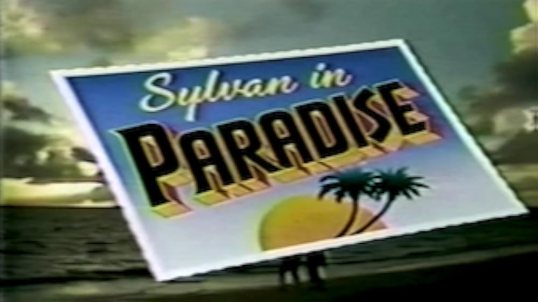
Episode 1.1 “Pilot”

(Dir by Terry Hughes, originally aired on August 2nd, 1986)

“Welcome, welcome, welcome,” says Sylvan Sprayberry (Jim Nabors) to the guest checking into the Hawaiian hotel that employs him. Sylvan is tall, goofy, and talkative, and it’s never really made clear how he somehow became the head bellboy at a hotel in Hawaii. At one point, even Sylvan says he can’t believe he’s gone from “pickin’ cotton in Alabama” to working in paradise.

The uptight owner of the hotel, Clinton Waddle (Brent Spiner), fears that Sylvan will embarrass him when the Vice Consul of New Zealand (Michael Ensign) checks in. Sylvan is more concerned with making sure his niece, Lucy Apple (Courteney Cox), has a wonderful wedding when she marries another bellboy, Sparky McCann (Glenn Withrow).

When a guest who claims to be named Roy Rogers (Pat McCormick) gives Sylvan a statue to deliver to “a man in a green jacket,” Sylvan hands the statue off to Sparky so Sparky can get the tip. Unfortunately, both Roy Rogers and the man in the green jacket turn out to be drug smugglers, and the statue is full of cocaine. Sparky’s going to jail! “Golly!” Sylvan says.

Sylvan sure does feel bad about ruining Lucy’s wedding and getting Sparky sent to jail. Plus, the Vice Consul is now insisting on checking out of the hotel. When Sylvan insists on helping the Vice Consul with his luggage, one of the suitcases opens and reveals that the Vice Consul of New Zealand is himself a drug smuggler. Ha! Take that, New Zealand!

Somehow this leads to Sparky getting out of jail. No one has any hard feelings against Sylvan because he’s such a nice guy. Personally, I would have hard feelings, because just about everything that happens in this episode could have been avoided if Sylvan weren’t so stupid. Jim Nabors gives the same performance here that he gave as Gomer Pyle in the 1960s. The only problem is that Gomer was supposed to be young, whereas Sylvan is in his late 50s and looks older. He really has no excuse for not knowing any better. Would you hire someone who screws everything up to be your head bellhop?

The pilot did not become a series. Today, the only thing really interesting about it is that it featured a pre-Star Trek Brent Spiner and a pre-Friends Courteney Cox. Cox is stuck playing a one-dimensional role, but at least Spiner gets to express some annoyance with Sylvan. He was probably speaking for the entire audience.

Lisa Reviews a Palme d’Or Winner: Scarecrow (dir by Jerry Schatzberg)


With the 2021 Cannes Film Festival underway in France, I thought this would be a good opportunity to spend the next few days looking at some of the films that have won the Palme d’Or in the past.  As of this writing, 100 films have won either the Palme d’Or or an earlier version of the award like the Grand Prix du Festival International du Film.  Some of those films — like Parasite, The Tree of Life, The Piano, Pulp Fiction — went on to huge box office success and Oscar renown.  Others, like 1973’s Scarecrow, did not.

Scarecrow is an example of a type of film that was very popular in the 70s.  It’s a road film, one in which two or more people take a journey across the country and discover something about themselves and, depending upon how ambitious the film was, perhaps something about America as well.  Scarecrow centers on two drifters, who just happen to meet on a dusty road while they’re trying to hitch a ride.  Max (Gene Hackman, fresh off of winning an Oscar for The French Connection) is an ex-convict with a bad temper and a huge chip on his shoulder.  Lion (a young Al Pacino, fresh off of The Godfather) is an ex-sailor who views the world with optimism and who appears to be sweet-natured but simple-minded.  To be honest, it’s a little bit hard to believe that the perpetually resentful Max and the always hopeful Lion would ever become friends but they do.  They travel around the country, talking about their dreams of opening a car wash together.  They meet up with ex-girlfriends and ex-wives.  Eventually, they even end up in a prison farm together, where Lion, temporarily estranged from Max, is taken advantage of by a sadistic prisoner named Riley (Richard Lynch).

Scarecrow is an episodic film, one that moves at its own deliberate pace.  (If that sounds like a polite way of saying that the film is slow-moving …. well, it is.)  Director Jerry Schatzberg was a photographer-turned-director and, as a result, there’s several striking shots of Max and Lion standing against the countryside, waiting for someone to pick them up and give them a ride.  Whenever Max and Lion end up in a bar, the scene is always lit perfectly.  At the same time, Schatzberg also attempts to give the film a spontaneous, naturalistic feel by letting scenes run longer than one would normally expect.  There’s several scenes of Hackman and Pacino just talking while walking down a country road or a city street.  On the one hand, you have to appreciate Schatzberg’s attempt to convince us that Max and Lion are just two guys with big dreams, as opposed to two Oscar-nominated actors pretending to be societal drop-outs.  On the other hand, Schatzberg’s approach also leads to an interminably long scene of Gene Hackman eating a piece of chicken and if you think that Gene Hackman was the type of actor who wasn’t going to act the Hell out of gnawing on and gesturing with a chicken bone, you obviously haven’t seen many Gene Hackman films.

The main appeal of the film, for most people, will probably be to see Gene Hackman and Al Pacino, two of the top actors of the 70s, acting opposite of each other.  Reportedly, both Hackman and Pacino went full method for the film and spent their prep time on the streets of San Francisco, begging for spare change.  The end result is a mixed bag.  There are a few scenes — like when they first meet or when they’re in prison — in which Hackman and Pacino are believable in their roles and you buy them as two lost souls who were lucky enough to find each other.  There are other scenes where they both seem to be competing to see who can chew up the most scenery.   Sometimes, Pacino and Hackman are compelling acting opposite each other.  Other times, it feels like we’re just watching an Actors’ Studio improv class that someone happened to film.  Too often, Hackman and Pacino seem to be so occupied with showing off their technique that the film’s reality seems to get lost under all of the method showiness.  In the end, neither one of the film’s stars makes as much of an impression as Richard Lynch, who is genuinely frightening in his small but key role.

Scarecrow is an uneven film, one that is occasionally effective but also a bit too studied for its own good.  It wears it influences — Of Mice and Men, Midnight Cowboy, Five Easy Pieces — on its sleeve but it also fails to exceed or match any of those previous works.  That said, the film does have its fans.  (Schatzberg has been working on a sequel for a while.)  Certainly, the 1973 Cannes Jury (headed by none other than Ingrid Bergman) liked it enough to give it the Palme.

Scarecrow 2