Here Are The Nominations For The 22nd Annual Critics’ Choice Awards!


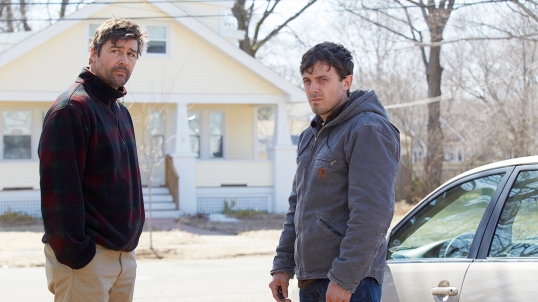
manchester-by-the-sea-sundance-2016

The Broadcast Film Critics Association have announced their nominees for the 22nd Annual Critics’ Choice Awards and here they are!  Once again, in a pattern that will probably see repeated several times of this next month, the nominations were dominated by Moonlight, La La Land, and Manchester By The Sea.

FILM NOMINATIONS FOR THE 22ND ANNUAL CRITICS’ CHOICE AWARDS

BEST PICTURE

BEST ACTOR

BEST ACTRESS

  • Amy Adams – Arrival
  • Annette Bening – 20th Century Women
  • Isabelle Huppert – Elle
  • Ruth Negga – Loving
  • Natalie Portman – Jackie
  • Emma Stone – La La Land

BEST SUPPORTING ACTOR

BEST SUPPORTING ACTRESS

  • Viola Davis – Fences
  • Greta Gerwig – 20th Century Women
  • Naomie Harris – Moonlight
  • Nicole Kidman – Lion
  • Janelle Monáe  – Hidden Figures
  • Michelle Williams – Manchester by the Sea

BEST YOUNG ACTOR/ACTRESS

  • Lucas Hedges – Manchester by the Sea
  • Alex R. Hibbert – Moonlight
  • Lewis MacDougall – A Monster Calls
  • Madina Nalwanga – Queen of Katwe
  • Sunny Pawar – Lion
  • Hailee Steinfeld – The Edge of Seventeen

BEST ACTING ENSEMBLE

BEST DIRECTOR

BEST ORIGINAL SCREENPLAY

  • Damien Chazelle – La La Land
  • Barry Jenkins – Moonlight
  • Yorgos Lanthimos/Efthimis Filippou – The Lobster
  • Kenneth Lonergan – Manchester by the Sea
  • Jeff Nichols – Loving
  • Taylor Sheridan – Hell or High Water

BEST ADAPTED SCREENPLAY

  • Luke Davies – Lion
  • Tom Ford – Nocturnal Animals
  • Eric Heisserer – Arrival
  • Todd Komarnicki – Sully
  • Allison Schroeder/Theodore Melfi – Hidden Figures
  • August Wilson – Fences

BEST CINEMATOGRAPHY

  • Stéphane Fontaine – Jackie
  • James Laxton – Moonlight
  • Seamus McGarvey – Nocturnal Animals
  • Linus Sandgren – La La Land
  • Bradford Young – Arrival

BEST PRODUCTION DESIGN

  • Arrival – Patrice Vermette, Paul Hotte/André Valade
  • Fantastic Beasts and Where to Find Them – Stuart Craig/James Hambidge, Anna Pinnock
  • Jackie – Jean Rabasse, Véronique Melery
  • La La Land – David Wasco, Sandy Reynolds-Wasco
  • Live by Night – Jess Gonchor, Nancy Haigh

BEST EDITING

BEST COSTUME DESIGN

  • Colleen Atwood – Fantastic Beasts and Where to Find Them
  • Consolata Boyle – Florence Foster Jenkins
  • Madeline Fontaine – Jackie
  • Joanna Johnston – Allied
  • Eimer Ni Mhaoldomhnaigh – Love & Friendship
  • Mary Zophres – La La Land

BEST HAIR & MAKEUP

BEST VISUAL EFFECTS

BEST ANIMATED FEATURE

BEST ACTION MOVIE

BEST ACTOR IN AN ACTION MOVIE

BEST ACTRESS IN AN ACTION MOVIE

BEST COMEDY

BEST ACTOR IN A COMEDY

  • Ryan Gosling – The Nice Guys
  • Hugh Grant – Florence Foster Jenkins
  • Dwayne Johnson – Central Intelligence
  • Viggo Mortensen – Captain Fantastic
  • Ryan Reynolds – Deadpool

BEST ACTRESS IN A COMEDY

  • Kate Beckinsale – Love & Friendship
  • Sally Field – Hello, My Name Is Doris
  • Kate McKinnon – Ghostbusters
  • Hailee Steinfeld – The Edge of Seventeen
  • Meryl Streep – Florence Foster Jenkins

BEST SCI-FI/HORROR MOVIE

BEST FOREIGN LANGUAGE FILM

  • Elle
  • The Handmaiden
  • Julieta
  • Neruda
  • The Salesman
  • Toni Erdmann

BEST SONG

  • Audition (The Fools Who Dream) – La La Land
  • Can’t Stop the Feeling – Trolls
  • City of Stars – La La Land
  • Drive It Like You Stole It – Sing Street
  • How Far I’ll Go – Moana
  • The Rules Don’t Apply – Rules Don’t Apply

BEST SCORE

  • Nicholas Britell – Moonlight
  • Jóhann Jóhannsson – Arrival
  • Justin Hurwitz – La La Land
  • Micachu – Jackie
  • Dustin O’Halloran, Hauschka – Lion

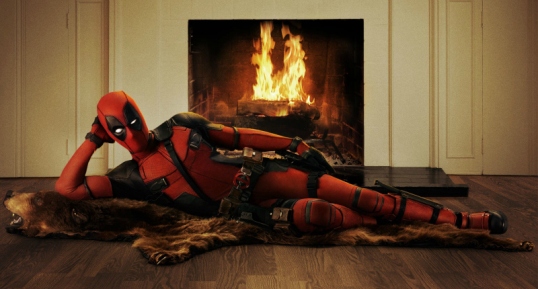
Deadpool

Here Are The Satellite Nominations!


la-la-land

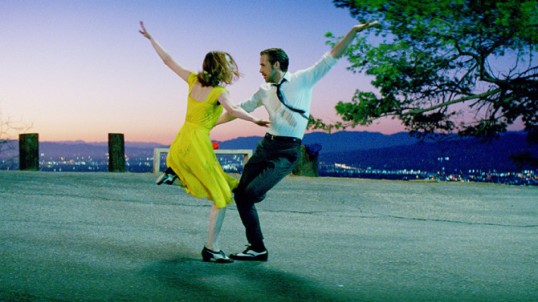
The International Press Academy — a.k.a. the Oscar precursor that nobody cares about — announced their nominees for the best of 2016 earlier today and it was a very good day for a film that I cannot wait to see, La La Land!

Here are the Satellite nominations!

Special Achievement Award Recipients

Mary Pickford Award- Edward James Olmos
Tesla Award- John Toll
Auteur Award- Tom Ford
Humanitarian Award- Patrick Stewart
Best First Feature- Russudan Glurjidze “House of Others”
Best Ensemble: Motion Picture- “Hidden Figures”
Best Ensemble: Television- “Outlander”

Actress in a Motion Picture

Annette Bening, “20th Century Woman”
Emma Stone, “La La Land”
Natalie Portman, “Jackie”
Ruth Negga, “Loving”
Taraji P. Henson, “Hidden Figures”
Meryl Streep, “Florence Foster Jenkins”
Isabelle Huppert, “Elle”
Amy Adams, “Nocturnal Animals”

Actor in a Motion Picture

Casey Affleck, “Manchester by the Sea”
Ryan Gosling, “La La Land”
Joseph Gordon-Levitt, “Snowden”
Viggo Mortensen, “Captain Fantastic”
Joel Edgerton, “Loving”
Andrew Garfield, “Hacksaw Ridge”
Tom Hanks, “Sully
Denzel Washington, “Fences”

Actress in a Supporting Role

Helen Mirren, “Eye in the Sky”
Michelle Williams, “Manchester by the Sea”
Nicole Kidman, “Lion”
Octavia Spencer, “Hidden Figures”
Naomi Harris, “Moonlight”
Viola Davis, “Fences”
 Actor in a Supporting Role

Jeff Bridges, “Hell or High Water”
Mahershala Ali, “Moonlight”
Dev Patel, “Lion”
Lucas Hedges, “Manchester by the Sea”
Eddie Murphy, “Mr. Church”
Hugh Grant, “Florence Foster Jenkins”

Motion Picture

“La La Land”
“Moonlight”
“Manchester by the Sea”
“Lion”
“Jackie”
“Hacksaw Ridge”
“Loving”
“Hell or High Water”
“Nocturnal Animals”
“Captain Fantastic”
“Hidden Figures”
“Fences”

 Motion Picture, International Film

“The Happiest Day in the Life of Olli Maki”- Finland
“Toni Erdmann”- Germany
“Julieta”- Spain
“A Man Called Ove”- Sweden
“The Salesman”- Iran
“The Ardennes”- Belgium
“Ma’ Rosa”- Philippines
“The Handmaiden”- South Korea
“Elle”- France
“Paradise”- Russia

Motion Picture, Animated or Mixed Media 
Title of Film
“Zootopia”
“Kubo and the Two Strings”
“Moana”
Finding Dory”
“My Life As a Zucchini”
“The Jungle Book”
“The Red Turtle”
“Miss Hokusai”
“Trolls”
“Your Name”

Motion Picture, Documentary

“Gleason”
“Life Animated”
“O.J.: Made in America”
“13th”
“The Ivory Game”
“The Eagle Huntress”
“Tower”
“Fire at Sea”
“Zero Days”
“The Beatles: Eight Days a Week”

Director

Barry Jenkins, “Moonlight”
Kenneth Lonergan, “Manchester by the Sea”
Mel Gibson, “Hacksaw Ridge”
Damien Chazelle, “La La Land”
Tom Ford, “Nocturnal Animals”
Pablo Larrain, “Jackie”
Denzel Washington, “Fences”

Screenplay, Original

Barry Jenkins, “Moonlight”
Damien Chazelle, “La La Land”
Kenneth Lonergan, “Manchester by the Sea”
Taylor Sheridan, “Hell or High Water”
Matt Ross, “Captain Fantastic”
Yorgos Lanthimos/Efthymis Filippou, “The Lobster”

Screenplay, Adapted

Andrew Knight/Robert Schenkkan, “Hacksaw Ridge”
Luke Davis, “Lion”
Kieran Fitzgerald/Oliver Stone, “Snowden”
Justin Marks, “The Jungle Book”
Allison Schroeder, “Hidden Figures”
Todd Komarnicki, “Sully”

Original Score

Rupert Gregson Williams, “Hacksaw Ridge”
Justin Hurwitz, “La La Land”
Lesley Barber, “Manchester by the Sea”
John Williams, “The BFG”
John Debney, “The Jungle Book”
Hans Zimmer, “Hidden Figures”

Original Song

“Audition”- ‘La La Land’
“City of Stars”- ‘La La Land’
“Dancing with Your Shadow”- ‘Po’
“Can’t Stop the Feeling”- ‘Trolls’
“I’m Still Here”- ‘Miss Sharon Jones’
“Running”- ‘Hidden Figures’

Cinematography

John Toll, “Billy Lynn’s Long Halftime Walk”
Linus Sandgren, “La La Land
James Laxton, “Moonlight”
Simon Duggan, “Hacksaw Ridge”
Jani-Petteri Passi, “The Happiest Day in the Life of Olli Maki”
Bill Pope, “The Jungle Book”

Visual Effects

“The Jungle Book”
“Billy Lynn’s Long Halftime Walk”
“Doctor Strange”
“The BFG”
“Sully”
“Deadpool”

Film Editing

Tom Cross, “La La Land
Joi McMillon/Nat Sanders, “Moonlight”
Tim Squyres, “Billy Lynn’s Long Halftime Walk”
Alexandre de Francheschi, “Lion”
John Gilbert, “Hacksaw Ridge”
Steven Rosenblum, “The Birth of a Nation”

Sound (Editing and Mixing)

La La Land
“Billy Lynn’s Long Halftime Walk”
“Hacksaw Ridge”
“The Jungle Book”
“Allied”
“13 Hours: The Secret Soldiers of Benghazi”

Art Direction and Production Design

David Wasco, “La La Land
Barry Robinson, “Hacksaw Ridge”
Jean Rabasse, “Jackie”
Christophe Glass, “The Jungle Book”
Gary Freeman, “Allied”
Dan Hennah, “Alice Through the Looking Glass”

Costume Design

Colleen Atwood, “Alice Through the Looking Glass”
Eimer Ní Mhaoldomhnaigh, “Love & Friendship”
Courtney Hoffman, “Captain Fantastic”
Madeline Fontaine, “Jackie”
Mary Zophres, “La La Land
Alexandra Byrne, “Doctor Strange”

Film Review: Hacksaw Ridge (dir by Mel Gibson)


hacksaw_ridge_poster

To be honest, Hacksaw Ridge is probably not the type of film that I would usually watch.  I’m not a huge fan of war movies and the trailer really didn’t inspire much enthusiasm within me.  However, ever since the film was released last Friday, it’s been the subject of some Oscar buzz and … well, you know me and the Oscars.  There’s no easier way to get me to take a chance on a movie than to tell me that it might be nominated for an Oscar.  I’m a completist, after all.  If they’re going to nominate 8 to 10 movies for best picture, you better believe I’m going to make sure that I’ve seen all of them.

So, after voting yesterday, I saw Hacksaw Ridge and all I can say is, “Wow!”  Hacksaw Ridge left me with tears in my eyes and feeling totally exhausted.  This is one of those films that kind of sneaks up on you.  I spent the first half of the film thinking to myself, “Okay, this is good and all but I still don’t see what the big deal is.”  And then suddenly, that second half started and soon, I was totally struggling to catch my breath.

I’ll just say this right now: Hacksaw Ridge is one of the most powerful anti-war films that I’ve ever seen.  It’s also an incredibly violent film, one that will leave non-veterans amazed at the number of ways that soldiers can be shot, stabbed, blown up, and set on fire.  But, despite all the visceral action that plays out across the screen, Hacksaw Ridge never glorifies combat.  It never glamorizes the destructive power of war.  We may be happy when we see a certain soldier somehow manage to survive but we never find ourselves cheering.  Instead, often times, we worry what awaits that soldier after the war.  The combat in Hacksaw Ridge is so brutal and so terrifying that you find yourself wondering not only how anyone could survive but also how anyone could ever go on with “normal” life after seeing the horrors of war.

Hacksaw Ridge tells the true story of Desmond Doss, a conscientious objector who served, as a combat medic, in the U.S. Army during World War II.  As a Seventh Day Adventist, Doss both refused to carry a rife and refused to train on the Sabbath.  Despite all the efforts of both his sergeant and his captain to convince Doss to leave the service, Doss stayed in the Army, served in combat despite refusing to carry a rifle, and became the first C.O. to be awarded the Medal of Honor.  In the film, Doss is played by Andrew Garfield, who is one of those extremely talented actors who has been miscast in several films.  Fortunately, he’s perfect for Hacksaw Ridge.  Though his rural accent occasionally slips, Garfield is convincing as both a relatively naive farmboy and a man of such strong convictions that he’s willing to risk being court martialed to uphold them.  If Hacksaw Ridge is about Doss proving himself to his fellow soldiers, it’s also a film about Andrew Garfield, who is still perhaps best known for being awkwardly cast as Spiderman, proving himself as a unique and interesting actor.

Garfield pretty much dominates the film but a few of the supporting performers do manage to make an impression.  Vince Vaughn is surprisingly effective as the tough and no-nonsense sergeant and Teresa Palmer is sympathetic as Doss’s wife.  Hugo Weaving plays Doss’s alcoholic father, a man who is still haunted by what he saw during the first world war and he does a great job.

I know that some people are going to be hesitant about Hacksaw Ridge because it was directed by Mel Gibson but you know what?   You may not expect Mel Gibson to direct one of the most searing anti-war films of the past decade but that’s exactly what he managed to do.  It’s an important film, one that reminds us that war is neither fun nor an adventure.  It’s a film that shows what our combat veterans had to deal with (and when we countless men lost their legs as the result of a Japanese rocket, it’s hard not to make the connection to the countless vets who have lost limbs in the Middle East) and, in its way, chastises a society that would abandon them after the war is over.  If Doss, working on his own, was willing to put his life at risk to save 75 wounded soldiers, how can we, as a society, justify not taking care of our wounded veterans?   Hacksaw Ridge is a film that works both as a tribute to our veterans and a reminder that the costs of war are all too real.

It’s a good and important film.  I recommend the Hell out of it.

Here’s the Trailer for Hacksaw Ridge!


PCASThe upcoming film, Hacksaw Ridge, tells the story of Desmond Doss.  Doss was an army medic who, during World War II, refused to carry a weapon because of his religious beliefs.  Considering that we currently live in warlike times and even so-called liberals are currently making excuses for all sorts of war mongering, Hacksaw Ridge seems like it could have the potential to be an important film.  It’s due to be release at the height of awards season.

Add to that, it stars Andrew Garfield, who is one of those actors who seems to be destined for an Oscar nomination at some point in his life.  (He might get one this year for his role in Martin Scorsese’s Silence.)  Vince Vaughn, a good actor who could really use a good role at this point in his career, is also in this film.

However, the film is also directed by Mel Gibson and that’s the big question mark, isn’t it?  He’s not a bad director and this seems like his type of subject matter but he’s still Mel Gibson.  Will the same film industry that embraced convicted child molester Victor Salva continue to view Mel Gibson as being a pariah?

We’ll get a chance to see if Hacksaw Ridge lives up to its Oscar contender potential on November 24th!

Here’s the trailer!

Embracing the Melodrama Part II #117: Never Let Me Go (dir by Mark Romanek)


NeverletmegoposterquadI can still remember, back in the year 2010, when I first saw Never Let Me Go at the Dallas Angelika.  Going into the film, I didn’t really know what was waiting for me.  I hadn’t read the novel that it was based on.  All I knew was that it had a cool trailer and it starred two of my favorite actresses, Carey Mulligan and Keira Knightley.  Before I watched Never Let Me Go, I didn’t even know who Andrew Garfield was but that changed quickly.  Never Let Me Go took me by surprise.  I figured it would be a sad movie, based on the melancholy trailer and title.  But I had no idea how sad or effective it would be.  By the end of the movie, I was in tears.

And, even though I was already writing for this site at the time, I somehow never wrote up a review of Never Let Me Go.  Oh, I certainly meant to.  I went out of my way to recommend the movie on twitter.  I included it on my list of films that deserved Oscar consideration.  But I never actually got around to writing that full review.  The emotions were just too overwhelming.

Well, I’m going to use this opportunity to recommend that, if you haven’t already, you make an effort to see Never Let Me Go.  It’s a beautifully done film, one that confirms that director Mark Romanek is a major talent who really should have more than just three feature films to his credit.  (True, he does have a lot of music videos…)  As well, the film was written by Alex Garland, which should interest those of you who fell in love with Ex Machina earlier this year.

As for the film itself, it takes place in a world where, we’re told, a medical breakthrough was discovered in 1952 that allows people to live to be over 100 years old.  The details of that medical breakthrough are slowly revealed to us over the course of the film.  Unfortunately, it’s impossible to really talk about this film without revealing those details so consider this to be your SPOILER WARNING.

Basically — much as in Clonus — life has been extended through the use of cloning.  Cloned children are raised outside of the view of “normal” society.  They go to special schools.  And when they turn 18, they are harvested for their organs.  Clones are told that their ultimate goal is to “complete,” which is a polite way to say that most of them die before they ever reach 30.  A few lucky ones are allowed to be “carers.”  They take care of and comfort dying clones and, as a result, they get to put off their first organ donation for a few years.

Unlike Clonus, where the cloning was clandestine and done only to benefit the very rich, the clones are not a secret in Never Let Me Go.  Everyone knows why they exist and everyone knows what is going to ultimately happen to them.  Whenever the clones are allowed to leave their schools and explore the real world, they are greeted with a mix of hostility, fear, and guilt.  Because they are due to be sacrificed, society chooses to believe that the clones are somehow less than human.

As for the clones, the majority of them accept their fate.  You watch Never Let Me Go and you keep waiting for some sort of revolution and it never comes.  Some of the clones are angry.  Many of them desperately believe that there’s some way that they can avoid having to give up their organs.  A good deal of the film is spent listening to people you’ve come to love talk about getting a “deferral” that the audience knows does not exist.  For the most part, though, the clones passively accept their fate because that’s what they’ve been raised to do.

The film itself follows three clones from their childhood to their completion.  Kathy (Carey Mulligan) is a carer.  Ruth (Keira Knightley) starts out as a snob but softens as her fate becomes more and more inevitable.  And, lastly, there’s Tommy (Andrew Garfield).  Tommy starts out as an awkward young boy and he grows up to be an awkward young man.  Of all of them, Tommy is the most convinced that, as a result of the artwork he innocently drew as a boy, he will somehow be given a deferment.  Garfield is so heartbreaking in this role.  When he finally snaps and screams in frustration, you scream with him.

Never Let Me Go is not an easy film to watch but it’s one that I highly recommend.  It’ll make you think and it’ll make you cry.  And after you watch the movie, read Kazuo Ishiguro’s wonderful novel.  It’s even more heart-breaking than the movie.

Trash Film Guru Vs. The Summer Blockbusters : “The Amazing Spider-Man 2”


the_amazing_spider_man_2__2014____alternate_poster_by_camw1n-d7c1h7t

Seriously, folks, this whole contrarian role I seem to have either stumbled or , if you want to be grandiose about things,  been thrust into? Its actually getting pretty old.  Sure, I can’t do much about how my brain works, but once in awhile, maybe just for a day or so to see what it would be like, I’d love to at least like the same stuff everybody else does, and dislike all the same stuff that the rest of you do, too, just to relieve the tedium of seeing things in a fundamentally different way than everyone else. Mind you, I’n only talking about changing things up as far as my taste in films and other ostensibly “entertaining” media go here, these other perfectly mainstream ideas like “corporations are our friends and we shouldn’t tax them too high,” and “problems like racism, sexism, and other forms of discrimination are all in this past” — you can keep those, I’m happy to still keep tilting at windmills and telling Mr. and Ms. Middle America that they’re hopelessly deluded if they really believe the Hallmark Card pseudo-reality being sold to them while their pockets are being picked clean by the same rich assholes who then have the nerve to tell them that the real “moochers” are poor folks, or people of color, or single mothers, or any other group still that’s still easy to scapegoat and demonize.

At this point you’re probably wondering what any of this has to do with reviewing the just-released (“just,” in this case, meaning last week) The Amazing Spider-Man 2, and I can’t say I blame you, so here’s what I’m getting at : received “wisdom” has it that this is just some bog-standard, average-at-best super-hero flick. And the same received “wisdom” has it that the reason this is no great shakes (and you can bet the exact same argument will be trotted out in a couple of weeks in regards to the new X-Men movie) is because it’s not a Marvel Studios product but is, in fact, a Sony/Columbia release under license from Marvel. And I’m sorry, but I smell a serious rat with that fallacious line of “reasoning.”

Let me tell you why : Marvel, and their bosses at Disney,  desperately want the Spider-Man property back “in house” (same goes for X-Men) and have a vested interest in promoting the myth that only they can do it “right.” To that end, I’ll bet my bottom dollar that they’re the ultimate source of this goofy idea that somehow Sony’s Spider-Man lacks the “magic” that they’d bring to the property (and that’s really what Spidey is at this point — a “property” — as opposed to an actual character) and I’d even go so far as to speculate that they’ve contacted their bought-and-paid for media mouthpieces and had off-the-record conversations with them designed to subtly kick up an orchestrated “whisper campaign” against this film.

Shit, as science has proven, always runs downhill, and soon the folks who make their living telling other people what to think have affected the opinions of the legions of unpaid armchair critics (like myself) who in turn affect the opinions of fans and more casual movie-goers, and before you know it, the meme that The Amazing Spider-Man 2 just ain’t all that great has taken firm hold in the public consciousness. Sure, it all looks spontaneous enough, and most of the people playing along with the scheme have no idea that they’re doing, essentially, pro bono work for one monolithic studio conglomerate in their covert “war” against another monolithic studio conglomerate, but there you have it.

Spider-Man-Jamie-Foxx

What’s especially despicable about this, though, is how rancid and idiotic “homer”-ism in the “fan” community is so easily manipulated to shady ends, yet seldom if ever turned in a genuinely positive direction. The same “fans” who are actively and openly rooting for Marvel to “get back their baby,” for instance, don’t seem to care too much about the situation of Spidey’s actual creator, Steve Ditko, who is 86 years old and has never seen a dime from any of the flicks his legendary creation appears in — hell, when Sam Raimi’s first Spider-Man movie came out, Ditko was living under, to put it politely, reduced circumstances in a rented apartment above a New York City thrift store. If even a tiny fraction of the amount of energy fans put into campaigning for Marvel Studios were put into campaigning for the dozens, if not hundreds, of creators that Marvel has screwed over, who knows? Maybe the cause of creators’ rights would finally be getting somewhere. Let me be as blunt as possible here : if you care more about Marvel getting back the cinematic rights to Spider-Man, the X-Men, and the Fantastic Four than you do about folks like Steve Ditko, Gary Friedrich, Bill Mantlo, or the heirs of Jack Kirby, then you’re either a complete asshole, being played for a sucker, or both. These actual people deserve your support — not the corporate suits who continue to profit off the fruits of others’ imaginations.

To that end, I don’t have any real personal stake in whether or not The Amazing Spider-Man 2 is “not as good as it could/would be with Marvel Studios in charge,” because I could care less about the bottom-line corporate balance sheets of either DisMar or Sony/Columbia. They’re all faceless, greedy bastards in my book. But after watching the film, the rat I smelled grew even more pungent, so I decided to put my little “homer” theory to the test via the modern “miracle” of social networking.

Don’t worry, I didn’t waste too much time on this off-the-cuff experiment, only about 30 minutes or so, but the results were telling. I went onto twitter, looked for the first dozen comments of the “this would be so much better if Marvel did it” variety (they weren’t had to find), and asked the folks making such statements why they thought that. Of the 12 folks I asked, seven never responded, three said variations of the exact same thing (“because it’s theirs and they’d know how to do it right”) and two said they flat-out didn’t know why, “it just would be.”

Not done making a nuisance of myself, I then asked all 12 people again “What’s so ‘wrong’ with this movie in the first place in comparison with Marvel Studios product?” and received only two answers, one of which was “it just is,” and the other being “you can tell just by watching that they don’t get it.”

Excuse me, but — what’s not to get? It’s not like I’m going to try to convince you here that The Amazing Spider-Man 2 is necessarily all that great, but for what it is, frankly, it’s just fine, and in fact it’s a damn sight better than the last two Marvel Studios releases, the thoroughly uninspired Captain America : The Winter Soldier and the downright risible Thor : The Dark World, both of which were essentially big-budget TV movies-of-the-week (and overseen by television directors, no less). I’d even go so far as to say it’s quite a bit more enjoyable than Marvel’s most-ballyhooed cinematic endeavors, the incredibly over-rated The Avengers and the obviously-constructed-by-the-numbers Iron Man films.

It’s far from a terrific super-hero movie, mind you, like Christopher Nolan’s  Batman Begins or Richard Donner’s original Superman, but it definitely fits comfortably into the “above average, at any rate” group populated by flicks like The Dark Knight (which is nowhere near as good as  many seem to think, but is still fairly solid) and Raimi’s Spider-Man 2. So I guess my main argument isn’t even necessarily that this is all that much  better than at least the top-tier Marvel Studios flicks, like the first Thor and Captain America : The First Avenger, but that it’s in no way appreciably worse. Given that, then, and taking into consideration how positively homogenized and formulaic Marvel’s “in-house” product has become in the absence of genuinely talented directors like Kenneth Branagh and Joe Johnston, there’s absolutely no reason to believe they’d “do a better job of things” if the web-slinger’s rights suddenly fell back into their lap.

green-goblin-spider-man-the-amazing-spider-man-2

Frankly, some of the criticism being leveled at this flick is just plain absurd on its face, and amazingly hypocritical. I’ve seen folks who gushed over The Avengers claim, with a straight face, that the problem with The Amazing Spider-Man 2 is that it “relies too heavily on CGI battle scenes.” And Whedon’s movie didn’t? I’ve seen many self-styled “opinion makers”  who gushed over the the “human”  characterization in Nolan’s Bat-films say that this movie “has too much Peter Parker, not enough Spider-Man.” I’ve seen people who applauded the revisionist origin story given Superman in Zack Snyder’s Man Of Steel grouse about how director Marc Webb and his committee of screenwriters are “playing too fast and loose” with Spidey’s backstory here. And,  while I’ll grant you that Jamie Foxx’s Max Dillon/Electro character is flat-out absurd in both its human and super-human iterations, and that getting shocked by a big cable and falling into a vat of electric eels is a pretty lame way for a villain to get his powers, it’s worth noting that many of the people poking fun at this have no problem with the idea of a chemically-enhanced “super soldier” being frozen in a block of ice and waking up, without having aged a day, in the Captain America movies, or of the Norse Gods being a real race of inter-dimensional super-beings in the Thor films, and are even willing to swallow the single-most laughable notion in all comic-book flicks, that of a spoiled billionaire rich kid who inherits his daddy’s company and still actually works for a living, as Tony Stark does in the Iron Man series.

There are plenty of folks out there telling you what Webb and company get wrong in The Amazing Spider-Man 2 — from the aforementioned Electro stuff to Andrew Garfield’s take on Peter Parker being “unlikable” (news flash — he’s been a self-pitying, self-aborbed, flat-out selfish little prick in the comics from day one) to Sally Field’s Aunt May being “too young” (whatever ,  she does a really nice job)  to Paul Giamatti’s wasted and pointless cameo as the villainous Rhino at the end —let me take just a few minutes to tell you what this movie gets right.

exclusive-the-amazing-spider-man-2-pictures-153555-a-1389698871-470-75

Dane DeHann is positively creepy as Harry Osborn/The Green Goblin and his origin/descent into villainy is portrayed in a way that actually makes sense. Likewise, even though his screen time is limited, Chris Cooper knocks it out of the park as his vicious, megalomaniacal father, Norman. There’s real chemistry between Garfield’s Parker and Emma Stone’s Gwen Stacy, and the film does a nice job of updating/translating the legendary penultimate Spidey/Gwen story for the silver screen. The CGI effects work is solid and a represents a big step up from the lackluster graphics of Webb’s first Spider-film. The characters are allowed to age at least semi-normally, as evidenced by the fact that Peter, Gwen, and their classmates are  shown graduating high school at the start of the film (and a good thing too, since both actors are, what? Pushing 30?). Webb directs the action sequences that he’s being maligned for with far more aplomb than his more-praised counterparts like Jon Favreau or Joss Whedon, who just show one building after another being smashed to rubble in between those fucking interminable shots of Robert Downey Jr.’s face inside of his Iron Man helmet. And at least this movie gives us warts-and-all human beings at its core with plausible psychological motivations for doing what they do rather than mythological gods, science-whiz playboys, sexy Russian super-spies with no accents, or one-dimensional do-gooders fresh out of suspended animation.

It’s not enough to make The Amazing Spider-Man 2 a truly great super-hero movie, and a forced and tacked-on ending epilogue-ish ending doesn’t help (even if there’s plenty of reason for fans to “ooh”and “aah” when we get a sneak peek at the character designs for the members of the sure-to-pop-up-in-the-next-flick Sinister Six, and hey, isn’t that the Black Cat we get to meet — briefly and in her civilian identity — earlier on, too? Where’s the fan-gasming for that?), but it makes it a heck of a lot more involving than much-more-highly-praised (even if it’s dull and repetitious) fare that just so happens to carry the Marvel Studios logo above its title. And you know what? That’s all it would take for fans to love this one, and is the single, solitary reason why many of them don’t. You might call that loyalty, but I call it bullshit.
 

Movie Review: The Amazing Spider-Man 2 (dir. by Marc Webb)


hr_The_Amazing_Spider-Man_2_59

 One would think The Amazing Spider-Man 2 would be a hit right out of the ballpark. You have a follow up to the highly successful film & one of Marvel’s flagship characters and tons of back story the movie can work with. It’s filmed right in New York – I saw part of the setup at Times Square myself. Perhaps I caught the film at a bad time, or my mindset wasn’t proper, but I had a tough time feeling anything for the film. Perhaps because this is a sequel to a film that rebooted another movie that was only a decade old. Maybe the time has come for Disney/Marvel to knock on Sony’s door and tell them they want their baby back. My only regret is that I didn’t get this review out soon enough to save people from spending money on this. I should have done more.

With Great Power really does come Great Responsibility.

The film picks up some time after the end of the first film and does manage to handle a few story related elements well. Writers Alex Kurtzman and Roberto Orci (Transformers, Star Trek), along with two other writers created a script that connected to the first film. The audience is given some closure when it comes to Peter Parker’s parents and the secrets they were guarding. For long time comic fans, they’ll get a Spider-Man that cracks tons of jokes while taking down the bad guys.

Okay, let’s focus on the good before the bad.

It’s Andrew Garfield and Emma Stone’s chemistry that keep the moments between Peter Parker and Gwen Stacy real. You can tell there’s a good connection between them in any scene they share. You might as well be watching a reality series based on their relationship, really. Additionally, Garfield continues to give Spider-Man all the razor sharp wit he deserves, feeling very much like the comics. Credit also goes out to Sally Field as Aunt May. For a character that is usually in the background, her scenes were the memorable ones – the ones that I’d start a conversation with “Hey, you remember that part when…” Even Dane DeHaan’s Harry Osborne was pretty good for the most part, I suppose.

I can’t complain about the way it was shot or the effects that were used. Spider-Man’s swinging is pretty on point, and the in air acrobatics are as cool as they’ve ever were. Some scenes tend to move a little slow – particularly the Gwen / Peter ones – but it helps to establish where they’re going. It’s more or less a necessary evil.

And that’s about it. I don’t really have much else to say on the good elements to this movie. It’s a shame really, because making movies aren’t easy with restrained budgets and producers breathing down your neck to get the product in the theatre.

Now the Bad:

Let’s start with Electro. While I thought the Electro powers were great and all, I had a problem with the reason behind his existence. It’s almost a page taken out of Batman Forever – literally, that was the first movie that came to mind on watching Oscorp technician Max Dillion’s (Jamie Foxx) Spider-Man fandom blossom into jealousy and then hatred. Foxx does what he can with it, and I’ll admit that once he has that Electro-suit on, it’s kind of cool. The argument could be made that because the character meets his hero and is then shunned by him, this causes him to become a villain – as evidenced by the schizophrenia-like voices that accompany Electro’s theme (“He lied to me, They hate me, they’re using me, He’s dead to me.”) during his fights. My reasoning here is that if the character was a fan of Spider-Man, having witnessed him stop all these crimes, wouldn’t it make sense for Spider-Man to try to stop you if you’re inadvertently disturbing the peace? It’s not even like Dillon had a beef with any of the Oscorp workers who may have mistreated him here. I had a serious disconnect with Electro as a character with justifiable motives for his actions. Granted, this is coming from someone who isn’t as familiar with Electro as many who’ve read the comics. It’s altogether possible that he is working within the comic’s defined role, and if that’s the case, many may find it refreshing. It just seemed a little off to me.

DeHaan has similar issues. As Harry Osborn, he’s great. As the Goblin (you’ve been looking at the posters, it’s not exactly a spoiler), I found myself feeling like the only reason he was there was to push a story arc. Imagine someone watching a fight and then suddenly running in and saying “Aha, now you face me!” It was just about the same setup here. The collective theme of the movie seems to be..”You know what? Let’s hate Spider-Man, because we can. We’ll figure out a detailed, legitimate reason later.”

On Paul Giamatti, I would dare to call his appearance a cameo, but it feels tacked on. I thought it would we better to never mention him at all marketing wise and then surprise audiences with where he goes. That’s all I really have to say about him in this.

One other thing was a standout – the music. The music, though a great change from Horner’s Rocketeer sounding score, almost overpowers the film. I was a little shocked to find out that Hans Zimmer worked on it (Along with friends Johnny Marr and Pharrell Williams), but some of the tracks felt phoned in. If you asked me who did the music before showing me the credits, I would have sworn it was maybe Henry Jackman, or maybe Tyler Bates. That isn’t to say that either of them are bad composers, by the way.

Let me put it this way: You could have switched this score out with the one from Despicable Me and I don’t think anyone would have known the difference. I almost put my hands in my face on hearing “The Itsy Bitsy Spider” in the middle of a track. Zimmer might as well have just went with his “Point of No Return” score here.

Overall, The Amazing Spider-Man 2 was so-so for me. I don’t see myself trying to ever see it again, but depending on what you’re looking for, you may get a different experience from it. I’m hoping that Sony just shelves the Webhead for a while.

Super Bowl Trailer: The Amazing Spider-Man 2 “Enemies Unite”


1024px-Amazing-spider-man-2-poster

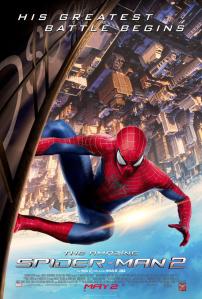
The Amazing Spider-Man 2 continues the reboot Sony began with the Spider-Man franchise minus Sam Raimi and Tobey Maguire. While The Amazing Spider-Man did quite well in the box-office when it came out in 2012 the general consensus with fans and critics alike was that it was just another origins tale that rehashed events from the Peter Parker story that was already well-known to comic book and non-comic book fans alike.

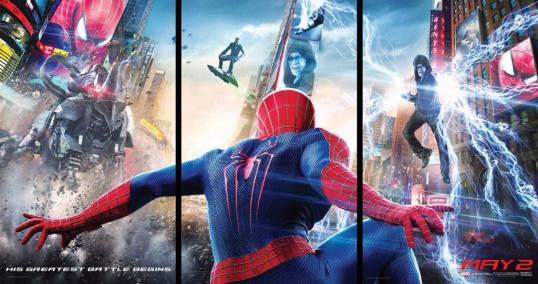
This sequel will now bring in villains and some plot points that fans have been waiting for since the franchise first began in the early 2000’s. We have Jamie Foxx and Paul Giamatti as the villains Electro and Rhino finally appearing on film with hints that other iconic Spider-Man villains such as the Vulture and the Hobgoblin probably having a cameo. This sudden flood of villains looks to be Sony’s attempt to set-up a Sinister Six film that would be the studio’s way to counter the success of Marvel’s and Disney’s success with The Avengers.

Time will tell if this gamble will end up paying off for Sony and many comic books wish it won’t since there’s a chance it would return Spider-Man to Marvel Studios thus making him available to appear in future films as an Avenger.

Sony went to unprecedented lengths to make sure people knew about the new trailer arriving on Super Bowl Sunday. We had a teaser teasing the trailer for the Super Bowl. Then we had the brief teaser shown during the Super Bowl. Below is the full 3-minute plus trailer that was shown on-line soon after.

The Amazing Spider-Man 2 is set for a May 2, 2014 release date.

Trash Film Guru Vs. The Summer Blockbusters : “The Amazing Spider-Man”


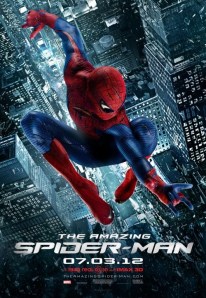
I know, I know — it’s really not even fair, is it? To review director Marc Webb’s probably-happening-to-quickly relaunch of Marvel’s Spider-Man franchise in the wake of Christopher Nolan’s The Dark Knight Rises seems like setting this flick up for defeat. Truth be told, though, I actually saw this flick on opening night, and held off on reviewing it here on Through The Shattered Lens because, well — everybody else was already having a crack at it on here. I swear. I think this is the fourth or fifth review of this film to go up here. So I held off. And honestly, the fact that I wasn’t rushing home to sit down and review it right away should tell you something right there, shouldn’t it?

Not that The Amazing Spider-Man isn’t a perfectly decent little superhero flick, it is. But that’s all  it is. I can’t find much fault here, really — Webb’s directive from Columbia seems to have been to, in effect, Nolan-ize the Spider-Man story with this reboot, and on the surface, he seems to have done that. The tone is darker and more somber. James Garfield’s take on Peter Parker is altogether more haunted and troubling than was Tobey Maguire’s. He’s less likable, too — a development I actually welcome. Emma Stone does a nice job as high-school love interest Gwen Stacy. Martin Sheen’s Uncle Ben in an altogether more realistic and involving take on the character than we got in Sam Raimi’s first flick. Sally Field is great as Aunt May. Dennis Leary does a fine job as Gwen’s dad, police Captain George Stacy, who has a hard-on to arrest Spider-Man. Campbell Scott, in flashback scenes as Peter Parker’s dad, cuts both a kindly and haunting figure, and the decision of the filmmakers/studio to concentrate on the mystery surrounding the elder Parkers is a good one that gives the series a little bit more depth.About the only two serious knocks against the film are the normally-reliable Rhys Ifans’ take on the villainous Curt Connors/Lizard, his performance in both roles being of a distinctly lacking/mail-in-in nature, and the CGI effects in general, which are of middling quality, particularly in terms of their realization of Connors’ Lizard persona (or maybe that should be reptile-ona). They’re not bad, but they’re not up to the level we expect in our summer blockbusters at this point, and I would say they’re pretty of a piece, quality-wise, with, say, the second Hulk flick.

Anyway, by and large, the word we’re looking for here, across the board, is competent. Not inspired, by any means, and not groundbreaking — just competent.  I’ll be honest and admit I liked this flick better than Joss Whedon’s Avengers, since it at least provided some level of human melodrama to back up the action, but it seems that the lesson studios have taken from Nolan raising the bar on the entire superhero genre is not that we want more complex, challenging, higher-quality, more technically-brilliant, more multi-faceted fare, but that we just want these flicks to be “darker” and “more realistic.” They “get” what the success of the  Batman films means on a surface level, but they really don’t “get it” at all.

For those of you who are old enough to remember the “evolution” of the comics medium in the mid-to-late ’80s with books like Frank Miller’s The Dark Knight Returns  and Alan Moore and Dave Gibbons’ Watchmen, assuming you were paying attention to comics back then, this will all seem terribly familiar — after the success of those two books, the “Big Two” publishers said they got the message and that people were ready for “superheroes to grow up.” And what did we get? Not more intelligent, thought-provoking, boundary-pushing, stories and characters that challenged the conventions of the genre itself the way those works did, but a steady stream of “darker,” more “mature,” somber, soul-less versions of the same kind of crap the industry was already cranking out — a state of “creative” affairs that continues unabated to this day. Nolan’s raised the bar on superhero storytelling on the silver screen the same way that Miller, Moore, and Gibbons did on the printed page, and Hollywood seems to have taken the same “lessons” from it that Marvel and DC did a quarter-century ago.

in other words, welcome to a new age of superhero sameness. On the one extreme we’ll have pure, unfiltered, two-dimensional, check-your-brain-at-the-door, CGI-heavy slugfests, a la The Avengers. Comics could always do these and do ’em well, and now so can the movies. On the other hand, we’ll have ostensibly more “mature,” “realistic,” “darker” stuff like this. But don’t expect another series with the innate intelligence and willingness to push the envelope in new directions that we’ve gotten with the Dark Knight films anytime too soon. Meet the new boss — same as the old boss.

Mind you, all of this was pretty much written and ready to go before I saw The Dark Knight Rises — and now that I have, my initial view still stands. Reaction to one flick shouldn’t change one’s opinions on another, after all. So yeah, this is perfectly adequate, acceptable superhero fare — but in the wake of DKR , do “adequate” and “acceptable” still cut it? Should they ever have? And are we willing to settle for movies like The Amazing Spider-Man that think that all DKR and its ilk prove are that audiences want the same old stuff, albeit with “darker,” more humorless trappings — or are we going to reward work that does what Nolan’s done with his Batman series in terms of pushing the genre itself in directions we’d never before expected? Let’s vote with our dollars, and vote wisely.

Review: The Amazing Spider-Man (dir. by Marc Webb)


It was in the summer of 2002 that the superhero film genre finally entered it’s Golden Age (or Silver Age for some). X-Men had come out two years before to positive acclaim and, most importantly, in the box-office. It wasn’t until Sam Raimi released the first in what would be his trilogy in the Spider-Man film franchise that superhero comic book films became the power in Hollywood it remains to this day. The first film from Raimi easily captured the pulp and campy sensibilities of the source material and for an origin story film it was done quite well in that it introduced the titular character and what made him tick. In 2004, Raimi and company released what many consider the best comic book film with Spider-Man 2. The film brought a level of Greek tragedy to the fun of the first film and it definitely brought one of the best realized comic book villains on film with Alfred Molina as Dr. Octopus. Then the franchise hit a major bump in 2007 with Raimi third entry in the franchise with the bloated Spider-Man 3.

Sony Pictures, who owned the film rights to the Spider-Man franchise, were so quick to churn out a fourth film, but in doing so lost the filmmaker and cast that made the trilogy happen. In the studios’ thinking they needed to get a fourth film up and running in order to keep the rights to the film from reverting back to Marvel and Disney. So, out goes Sam Raimi, Tobey Maguire and Kirsten Dunst and in comes Marc Webb, Andrew Garfield and Emma Stone. Instead of getting Spider-Man 4 we get The Amazing Spider-Man which doesn’t continue what Raimi had established with the first three films, but reboots the franchise all the way to the beginning.

Marc Webb takes the screenplay worked on by a trio of screenwriters (James Vanderbilt, Alvin Sargent, Steve Kloves) and reboots the origin story of Peter Parker’s transformation into Spider-Man. We find Peter Parker back in high school as a student and still getting bullied by Flash Thompson while remaining awkward around girls (especially one Gwen Stacy played by Emma Stone). yet, before we even get to this part of the film we get an introductory coda where we find a preadolescent Peter Parker playing hide and seek with his scientist father. These early scenes show hints that the enhanced spider thatwill bite and give eter his abilities may have had his father’s research and work written all over it.

This intro influences much of the storyline and leaves a huge impact on the character of Peter Parker which the previous three films never explored. The rest of the film has Peter investigating the circumstances of his parent’s disappearance and his adjustment to having been given the superhuman abilities by the spider that his father may or may not have been responsible in breeding.

First off, the film does a good job in re-establishing Peter Parker as a high school student. The original film spent some time in this part of Peter Parker’s life but never truly explored it. We see Peter not just the class genius, but also one who also shows an affinity for photography (something that the original trilogy never really explained other than he needed the job and money). There’s also some added layers to the character as this version of Peter Parker is more than willing to stand up to the bullies picking on the weaker students other than himself. It’s a huge departure from the meek and geeky Peter Parker of the past. We still get a geeky and smart Peter, but one who is also a sort of a well-intentioned slacker. We also get a proper introduction for Gwen Stacy (something the third film criminally mishandled)

The film introduces once again many of the characters the first film in the series had already done. From Uncle Ben (played by Martin Sheen this time around) and Aunt May (Sally Field) right up to the robber who runs into Uncle Ben and changes Peter Parker’s outlook on his role as a hero forever. Again these were character that had already been explored by the first three films and they’re scenes that had an air of familiarity to them though Sheen performance as Uncle Ben added more layers to the character who becomes Peter Parker’s moral center.

Another thing that the film did a good job with was the design of the film. It has been ten years since the first film and the technology in CGI-effects has leapfrogged exponentially since. The look of the OsCorp Tower was a beautiful piece of architectural design. The building loomed over New York City like something dark with a hint of malice. There were changes to the suit Peter wears that really harkens back to the McFarlane years of the Spider-Man comics. Even the return of the web-shooters was a nice surprise that I had some reservations when first hearing about it.

A third good thing about the film was the extended montage when Peter Parker realizes he has gained new abilities and begins to test them out. It’s familiar territory from the first film, but Marc Webb and Andrew Garfield adds a new level of youthful exuberance to the proceedings. Even the use of parkour by Peter Parker to show his growing abilities didn’t come off as silly. Garfield’s performance as Peter Parker in this montage was pretty great. One could believe at how much fun he was having at discovering each new level of abilities. Even some of the growing pains he goes through after getting bit were some of the more hilarious moments in the film that ultimately lacked much of it in the end.

Which brings us to what made this entertaining film end up becoming a failure in the end.

I admit that the film entertained me in the end, but there were things aboutThe Amazing Spider-Manwhich nagged at me throughout and afterwards. While the film was entertaining the story self and most of the characters were inconsistently written. Once one looked past the action and some of the witty dialogue in the beginning the film’s many plot-holes and head-scratching moments become too glaring to ignore.

The character of Peter Parker does get some new layers of characterization in the beginning, but as the film played out the more the Peter Parker of this film began to stray away from not just what Raimi had created and guided through the first three films but also most of the character’s decade’s long growth in the comics. Yes, we see Peter Parker as the science-genius and even moreso than the one portrayed by Tobey Maguire, but we also don’t get the awkward teen who grows into his abilities, but most importantly, one who learns through tragedy that he has a responsibility to the people around him to protect them even if it means sacrificing his wants and dreams to do so. We don’t just see Peter Parker saving people, but also one who seemed to relish beating up and abusing those who used to do the same to him and/or others. Spider-Man in this film acts more like a bully than a reluctant hero by film’s end. Even the events that should’ve taught him the lessons of self-sacrifice and heeding the needs of the many fail to make much of an impact on the teen superhero. All one has to look at as the perfect example of this darker and more selfish turn to the character was Peter’s whisper to Gwen about promises not being kept being the best ones.

Other characters get inconsistencies in how they’re written. The other big one being Dr. Curt Connors who begins the film as a scientist so intent of not just curing his disability but also helping the world. It’s a character similar in tone to Alfred Molina as Dr. Octopus, yet where that villain remained a tragic one throughout the film and we could see the path which led him to become a villain with Dr. Connors in this fourth film there’s such a huge turnabout in the character’s motivations that whatever sympathy we may have had for Connors was squandered.

Not every character fails to impress. Martin Sheen and Denis Leary as Uncle Ben and Capt. Stacy respectively were fully realized characters who become Peter Parker’s moral centers and voice of reason. In fact, both Sheen and Leary helped anchor the scenes they appeared in and thus made their characters’ fate have the sort of emotional impact that a growing hero needs to move from being reluctant to accepting of his lot in life. It’s a shame that the writers failed to capitalize on the performances of these two character actors to help make Peter Parker more a hero and less a teenager more in love with what he can do instead of realizing that he has more to offer those who are weakest.

This is not to say that the performances by the cast was bad. From Garfield and Stone right up to Ifans, Sheen, Leary and Field, the cast did a great job with an uneven and inconsistent script that was too full of themes and ideas but no focus on any one of them. It’s a wasted opportunity to build on what the previous cast of the three films had created. Even the third film which many would agree as being a huge, bloated mess actually had a singular focus. It was a story that tried to explore Peter Parker’s darker side andhow his life as a superhero negatively impacts everyone around him he cares for. With this Marc Webb production we get a Peter Parker who at times was compassionate when it came to others being bullied and then we get one who relished on doing the same to those he now sees deserving of payback. Even Parker’s hunt for his uncle’s killer which the film spent a considerable time following just got dropped without any sort of resolution. One of the most significant events in Peter’s life gets dumped to the wayside to concentrate on finally pitting Spider-Man against the film’s Lizard.

Did The Amazing Spider-Man need to have gotten made? The answer to that would be a yes.

Did Marc Webb, the three writers in Vanderbilt, Sargent and Kloves and the new cast get the reboot correctly? I would say no.

This was a film that spent too much time reintroducing characters both comic book and film fans already knew intimately. The storyline itself shared many similarities to the second film in the series yet none of the cohesiveness which made that first sequel such an instant classic the moment it premiered in 2004. The Amazing Spider-Man spent so much time trying to come off as a grittier and edgier version of the character (I call this the Christopher Nolan-effect) that what should’ve been coming off as a fun-loving, albeit self-sacrificing hero, came off as a dick once he finally got the full costume on. The people in charge of this reboot sacrificed what was fun about the film franchise for realism that the character and his universe were never steeped in to begin with.

Gritty, edgy and realism may work for Nolan’s take on the Batman film franchise, but for Spidey it fails and just turns what could’ve been a fresh new take on the franchise into another entertaining, but ultimately forgettable entry in the series. Maybe it’s time Sony just realize that it’s just pushing this franchise downhill and let the rights revert back to Marvel who seem to have found a balance between pulpy camp and serious realism.