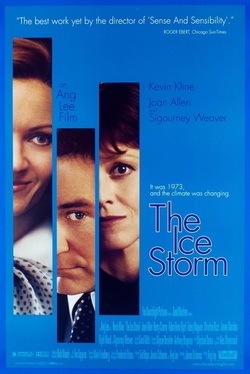
Back to School Part II #34: The Ice Storm (dir by Ang Lee)


the-ice-storm

The 1997 film The Ice Storm is kind of a schizophrenic film, which makes sense since it’s set in 1973 and, just from what I’ve seen in the movies, it appears that the early 70s were kind of a schizophrenic time.

It’s a film that deals with two sets of people who all live in an upper class Connecticut community.  One part of the film deals with parents who are freaking out about suddenly being adults.  The other part of the film deals with the children, most of whom seem destined to make the same mistakes as their parents.  It’s a film that is occasionally bracingly realistic and relatable, one that reminds us that being directionless in the 70s isn’t necessarily that different from being directionless in 2016.  At other times, the film feels a bit too studied for its own good.  This is one of those films that features a Tobey Maguire voice-over and, as good an actor as Maguire has always been, he’s always at his worse when reciting a pseudo-profound voice over.  And then there are other times when the film feels a bit too cartoonish for its own good.  Elijah Wood’s a stoner.  Sigourney Weaver walks around with a bullwhip.  David Krumholtz shows up as a character named Francis Davenport.

Fortunately, the film is directed by Ang Lee and Ang Lee is probably one of the few filmmakers who can overcome tonal inconsistency.  Lee is so good with actors and is such a good storyteller that even his lesser films are usually worth watching.  The Ice Storm would just be another silly sin-in-the-suburbs film if it had been made by any director other than Ang Lee.

The main adult in the film is Ben Hood (Kevin Kline).  Ben is married to Elena (Joan Allen) but he’s having an affair with his neighbor, Janey (Sigourney Weaver).  Elena may be upset when she finds out about the affair but she’s still willing to accompany her husband to a key party.  A key party was a 70s ritual in which husbands would throw their car keys into a big punch bowl and then the wives would randomly pick a key and have sex with the owner.  Basically, anytime a TV show or a movie takes place in the suburbs during the 70s, there has to be at least one key party.

And The Ice Storm‘s key party is kind of fun to watch.  Kevin Kline and Joan Allen both give really good performances and Ben is such a loser that it’s fun to watch him freak out when Janey gets a key other than this own.  Elena, meanwhile, ends up going off with Janey’s husband (Jamey Sheridan, pretty much looking the same in this 1997 film as he did in Spotlight and Sully) and they share a really good scene together, one that reveals that none of the film’s adults are really as mature or liberated as they claim to be.

While the adults attempt to play, their children attempt to find some sort of meaning to their empty existence.  Ben and Elena’s daughter, Wendy (Christina Ricci), wears a Richard Nixon mask and enjoys sexually teasing her classmates, especially Janey’s youngest son, Sandy (Adam Hann-Byrd).  Ben and Elena’s oldest son, Paul (Tobey Maguire) is in New York, hoping to lose his virginity to Libbits (Katie Holmes) despite the fact that Libbets is far more interested in his boarding school roommate, Francis Davenport (David Krumholtz).  Paul also compares his family to the Fantastic Four so, assuming Paul survived both the 70s and 80s, he’s probably still living in Connecticut and telling everyone who disappointed he was with last year’s film.

And, of course, there’s Mickey (Elijah Wood).  Mickey is Janey’s oldest son and he’s permanently spaced out.  When the ice storm of the title occurs, Mickey is the one who decides to wander around outside and appreciate the beauty of nature’s remorseless wrath.

Needless to say, the ice storm is also a really obvious metaphor for the way all of these very unhappy (but very prosperous) characters tend to view and treat each other.  Despite all the attempts to pretend otherwise, everyone has a frozen soul.  Nobody’s capable of maintaining any sort of real emotional connection.  Of course, someone dies and everyone’s forced to take a look at the sad reality of their lives and the film ends with a sudden and spontaneous display of actual human emotion.  It’s one of those ideas that probably works better as a literary conceit than a cinematic one.

That said, The Ice Storm is flawed but very watchable.  I enjoyed it, even if it did occasionally seem to be trying way too hard.  It’s well-acted and, if nothing else, I enjoyed getting to see all of the amazingly tacky clothes and the interiors of all those big houses.  These people love their wide lapels and their shag carpeting.  The Ice Storm is not Ang Lee’s best but it’s still good enough.

Playing Catch-Up With 6 Mini-Reviews: Amy, Gloria, Pitch Perfect 2, Sisters, Spy, Trainwreck


Amy_Movie_Poster

Amy (dir by Asif Kapadia)

Amy opens with brilliant and, in its way, heartbreaking footage of a 14 year-old Amy Winehouse and a friend singing Happy Birthday at a party.  Even though she’s singing deliberately off-key and going over-the-top (as we all tend to do when we sing Happy Birthday), you can tell that Amy was a star from the beginning.  She’s obviously enjoying performing and being the center of attention and, try as you might, it’s impossible not to contrast the joy of her Happy Birthday with the sadness of her later life.

A star whose music touched millions (including me), Amy Winehouse was ultimately betrayed by a world that both wanted to take advantage of her talent and to revel in her subsequent notoriety.  It’s often said the Amy was self-destructive but, if anything, the world conspired to destroy her.  By focusing on footage of Amy both in public and private and eschewing the usual “talking head” format of most documentaries, Amy pays tribute to both Amy Winehouse and reminds us of what a great talent we all lost in 2011.

Gloria_(2014_Film_Poster)

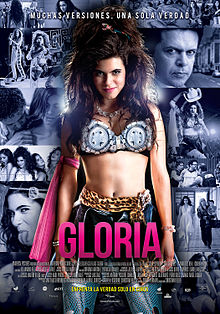
Gloria (dir by Christian Keller)

The Mexican film Gloria is a musical biopic of Gloria Trevi (played by Sofia Espinosa), a singer whose subversive songs and sexual image made her a superstar in Latin America and challenged the conventional morality of Catholic-dominated establishment.  Her manager and lover was the controversial Sergio Andrade (Marco Perez).  The movie follows Gloria from her first audition for the manipulative Sergio to her arrest (along with Sergio) on charges of corrupting minors.  It’s an interesting and still controversial story and Gloria tells it well, with Espinosa and Perez both giving excellent performances.

Pitch_Perfect_2_poster

Pitch Perfect 2 (dir by Elizabeth Banks)

The Bellas are back!  As I think I’ve mentioned a few times on this site, I really loved the first Pitch Perfect.  In fact, I loved it so much that I was a bit concerned about the sequel.  After all, sequels are never as good as the original and I was dreading the idea of the legacy of the first film being tarnished.

But the sequel actually works pretty well.  It’s a bit more cartoonish than the first film.  After three years at reigning ICCA champions, the Bellas are expelled from competition after Fat Amy (Rebel Wilson) accidentally flashes the President.  The only way for the Bellas to get the suspension lifted is to win the World Championship of A Capella.  The plot, to be honest, really isn’t that important.  You’re watching the film for the music and the interplay of the Bellas and, on those two counts, the film totally delivers.

It should be noted that Elizabeth Banks had a great 2015.  Not only did she give a great performance in Love & Mercy but she also made a respectable feature directing debut with Pitch Perfect 2.

Sisters_movie_poster

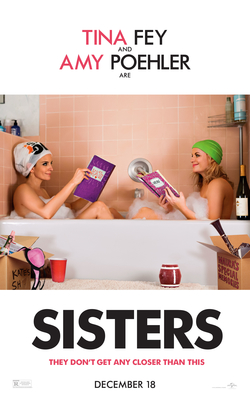
Sisters (dir by Jason Moore)

It’s interesting how opinions can change.  For the longest time, I really liked Tina Fey and I thought that Amy Poehler was kind of overrated.  But, over the past two years, I’ve changed my opinion.  Now, I like Amy Poehler and Tina Fey kind of gets on my nerves.  The best way that I can explain it is to say that Tina Fey just seems like the type who would judge me for wearing a short skirt and that would get old quickly, seeing as how I happen to like showing off my legs.

Anyway, in Sisters, Tina and Amy play sisters!  (Shocking, I know.)  Amy is the responsible one who has just gotten a divorce and who wants to make everyone’s life better.  Tina is the irresponsible one who refuses to accept that she’s no longer a teenager.  When their parents announce that they’re selling the house where they grew up, Amy and Tina decide to throw one last party.  Complications ensue.

I actually had two very different reactions to Sisters.  On the one hand, as a self-declared film critic, it was easy for me to spot the obvious flaw with Sisters.  Tina and Amy should have switched roles because Tina Fey is simply not believable as someone who lives to have fun.  Sometimes, it’s smart to cast against type but it really doesn’t work here.

However, as the youngest of four sisters, there was a lot of Sisters that I related to.  I saw Sisters with my sister, the Dazzling Erin, and even if the film did not work overall, there were still a lot of little scenes that made us smile and go, “That’s just like us.”  In fact, I think they should remake Sisters and they should let me and Erin star in it.

Spy2015_TeaserPoster

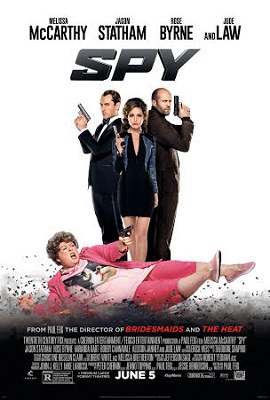
Spy (dir by Paul Feig)

There were a lot of very good spy films released in 2015 and SPECTRE was not one of them.  In fact, the more I think about it, the more disappointed I am with the latest Bond film.  It’s not so much that SPECTRE was terrible as there just wasn’t anything particular memorable about it.  When we watch a film about secret agents saving the world, we expect at least a few memorable lines and performances.

Now, if you want to see a memorable spy movie, I suggest seeing Spy.  Not only is Spy one of the funniest movies of the year, it’s also a pretty good espionage film.  Director Paul Feig manages to strike the perfect balance between humor and action.  One of the joys of seeing CIA employee Susan Cooper (Melissa McCarthy) finally get to enter the field and do spy stuff is the fact that there are real stakes involved.  Susan is not only saving the world but, in the film’s best scenes, she’s having a lot of fun doing it and, for that matter, McCarthy is obviously having a lot of fun playing Susan and those of us in the audience are having a lot of fun watching as well.

Spy also features Jason Statham as a more traditional action hero.  Statham is hilarious as he sends up his own macho image.  Seriously, who would have guessed that he could such a funny actor?  Here’s hoping that he, McCarthy, and Feig will all return for the inevitable sequel.

Trainwreck_poster

Trainwreck (dir by Judd Apatow)

There’s a lot of great things that can be said about Trainwreck.  Not only was it the funniest film of 2015 but it also announced to the world that Amy Schumer’s a star.  It was a romantic comedy for the 21st Century, one that defied all of the conventional BS about what has to happen in a romcom.  This a film for all of us because, let’s just be honest here, we’ve all been a trainwreck at some point in our life.

But for me, the heart of the film was truly to be found in the relationship between Amy and her younger sister, Kim (Brie Larson).  Whether fighting over what to do with their irresponsible father (Colin Quinn) or insulting each other’s life choices, their relationship is the strongest part of the film.  If Brie Larson wasn’t already guaranteed an Oscar nomination for Room, I’d demand that she get one for Trainwreck.  For that matter, Amy Schumer deserves one as well.

Seriously, it’s about time the trainwrecks of the world had a film that we could truly call our own.

Film Review: Minions (dir by Pierre Coffin and Kyle Balda)


Minions_posterThe Minions, everyone’s favorite group of little yellow weirdos from the first two Despicable Me films, now have a movie of their very own!  Earlier tonight, Jeff and I braved a theater that was full of hyperactive little children and we watched Minions.

I have to admit that I was really looking forward to seeing Minions.  After all, I loved both of the Despicable Me movies and, much like Through the Shattered Lens co-founder Arleigh Sandoc, I thought the minions were pretty adorable.  Along with the fact that they were just so weird that you couldn’t help but love them, the minions were distinguished by the wonderfully cheerful approach that they took towards their work.  Even when one of them was accidentally launched into space during the original Despicable Me, he continued to smile.  He was just happy to be a part of the project.  Seriously, who wouldn’t want a bunch of minions to do her bidding?

Now, it was established during the first Despicable Me movie that the minions were specifically created by the super villain Gru.  However, Minions reimagines their origins.  Now, we discover that the minions have existed since the beginning of time and, apparently immune from aging, they have always sought to serve a villainous master.  During the film’s opening, we watch as they serve a Tyrannosaurus Rex, Dracula, and Napoleon.  Unfortunately, the minions’ combination of enthusiasm and stupidity proves fatal to most of their employers.

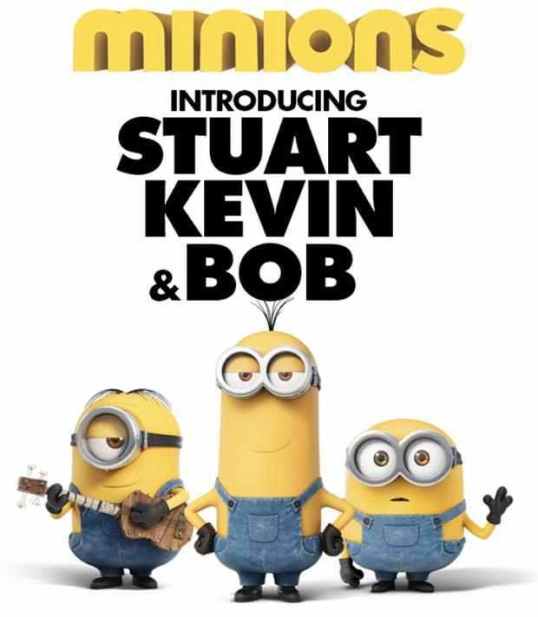
Eventually, the minions find themselves exiled to Antarctica.  After several centuries, the minions find themselves suffering from depression and ennui.  Finally, three brave minions (all voiced by director Pierre Coffin) volunteer to go out into the world and find a new master to serve.  Kevin is the responsible leader.  Bob is the cute, enthusiastic one who always carries a teddy bear with him.  (Bob also has heterochromia, just like me!)  And finally, Stuart is the one who likes to play his guitar.

Kevin, Bob, and Stuart get in a rowboat and eventually, they reach New York City.  However, it turns out that the year is 1968 and there is a serious shortage of evil super villains to serve!  Not only is Gru just a child but Bill Clinton hasn’t even launched his political career yet!  Eventually, though, our three minions learn about Villain-Con, being held in Orlando, Florida.  Hitching a ride with a family of aspiring bank robbers (Micheal Keaton is the voice of the father), the minions reach Orlando and eventually, they end up working for Scarlet Overkill (Sandra Bullock) and her husband, Herb (Jon Hamm).

Scarlet explains that, ever since she was a little girl, she has wanted to be the Queen of England.  But she doesn’t have the crown!  She orders Kevin, Stuart, and Bob to get that crown and reads them a bedtime story about three minions who failed to get a crown and were subsequently killed by an angry wolf.  AGCK!

This leads to our three minions going to London and, since it’s 1968, that also leads to a lot of good (if predictable) songs on the soundtrack.  As a result of several odd incidents, Bob is briefly the King of England.  And things only get stranger from there…

The children in the audience loved it but, at the same time, I could never bring myself to like Minions as much as I wanted to.  Minions just doesn’t have as much heart as Despicable Me.  There’s no moment in Minions that’s anywhere close to being as joyful as the “It’s so fluffy” scene from Despicable Me.  The minions are fun supporting characters but they don’t quite work as well as protagonists for a 91 minutes film.  Sandra Bullock tries really hard as Scarlet Overkill but she just doesn’t have the right voice for the character.  Part of Sandra Bullock’s appeal, after all, is that she not only looks but sounds like she’s totally down-to-earth and that’s one thing that Scarlet definitely is not.  Jon Hamm, however, is hilarious as the vacuous Herb.

Minions is a cute movie that doesn’t really make much of an impression.  Kids will love it, though.  And, even though I would never actually eat there, I’m still going to go by McDonald’s and order a Happy Meal so I can get the little minion that’s inside.

(Especially if it’s one of those cursing minions…)

Cursing Minions

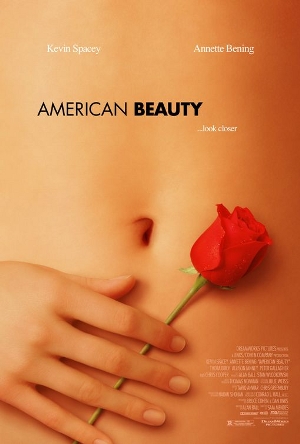
Embracing the Melodrama Part II #98: American Beauty (dir by Sam Mendes)


American_Beauty_posterWhat crap!

I know, I know.  “American Beauty is an incisive satire that looks at the stifling conformity of American suburbia with Kevin Spacey giving the definitive portrait of the male midlife crisis and blah blah blah blah blah blah.”  Listen, American Beauty is a terrible film.  I don’t care if it won a lot of Oscars, including the 1999 award for best picture.  American Beauty is a shallow film that, at its worst, is deeply misogynistic.

American Beauty tells the story of two people.  They’re married.  They live in the suburbs.  They have a teenage daughter who is a cheerleader.  They pretend to have the perfect life but actually, everyone’s extremely unhappy.

WOW!  OH MY GOD!  PEOPLE ARE SECRETLY UNHAPPY IN THE SUBURBS!?  MY MIND IS BLOWN!  WOW, NO ONE’S EVER HAD THAT THOUGHT BEFORE!  OH.  MY.  GOD!

Anyway, the husband is named Lester (Kevin Spacey).  Lester’s a loser.  He narrates the film and he’s played by Kevin Spacey so you’re supposed to think that he’s really this great guy who deserves better but honestly, Lester’s a whiny little jerk.  He’s upset because, now that he’s an adult, he misses being a teenager.  Life hasn’t turned out the way that he wanted it to.  Boo hoo.  As I said, Lester is kind of whiny but the film treats him like he’s an enlightened truth seeker.  In order to keep the audience from realizing that Lester is a loser, the film surrounds him with one-dimensional stereotypes.

And really, Lester is the ultimate male fantasy.  Everything that he says and thinks is wise.  His every thought and feeling matters.  To its discredit, the world has failed to recognize that Lester’s vapid thoughts are worthwhile.  Lester quits his job and finds employment working in fast food.  Lester fantasizes about fucking his daughter’s best friend (Mena Suvari).  Lester starts to smoke weed with his teenage neighbor (Wes Bentley).  In real life, Lester would just be another pathetic guy having a midlife crisis but, in the world of American Beauty, he’s a seeker of truth,

Anyway, eventually, Lester gets shot in the back of the head and dies but that doesn’t keep him from still narrating the film.  You just can’t shut him up.

Meanwhile, Lester’s wife is Carolyn (Annette Bening) and wow, is she evil!  Get this — she actually tries to keep the house clean, is obsessive about her job, and wants her family to eat dinner together.  Oh my God, so evil!  She ends up having an affair with Buddy Kane (Peter Gallagher) and, when they have sex, we’re supposed to laugh at them because they’re so cartoonishly loud.  And when Lester catches them, the audience is expected to applaud and say, “Way to go, Lester!”  The film ridicules Carolyn’s affair but it idealizes Lester’s sexual fantasies.  Lester’s determination to be independent and do what he wants is presented as being heroic.  Carolyn’s determination to have a life that does not revolve around her pathetic husband is presented as being villainous.

And why is that?

Basically, it comes down to the fact that Lester has a penis whereas Carolyn has a vagina.

American Beauty is probably one of the most misogynistic films that I have ever seen, one in which men are exclusively victims of all those unreasonable and untrustworthy women.  Whiny loser Lester is presented as being a hero.  Ricky, the next door neighbor played by Wes Bentley, spends his time going on and on about the beauty of an empty bag and we’re supposed to see some sort of higher truth in his pretentious blathering.  Meanwhile, Carolyn is portrayed as being a shrew.  Lester’s teenager daughter (Thora Birch) is a spoiled brat.  Lester’s sexual obsession, the cheerleader played by Mena Suvari, is presented as being a suburban seductress but, in the film’s eyes, she’s partially redeemed when she suddenly admits to being a virgin.

(The film seems to think that the revelation that teenagers lie about sex is truly shocking.  This is one of those films that makes you wonder if the filmmakers have ever hung out with anyone outside of their own small circle of friends.)

One huge subplot deals with Ricky’s father, a military guy played by Chris Cooper, mistakenly believing that Lester is gay.  And, honestly, American Beauty would have been a better film if Lester had been a gay man and if, instead of buying a new car and getting a crappy job, Lester had dealt with his identity crisis by coming out of the closet.  Certainly, a lot of Lester’s anger would have made a lot more sense if he was a man struggling to come to terms with his sexuality as opposed to being a man who just doesn’t like his job and is upset that his wife no longer has the body of a 17 year-old.

(We are, of course, supposed to be shocked when Cooper suddenly reveals that he himself is gay.  But, honestly, the film’s plans for Cooper are obvious from the minute he first appears on-screen and dramatically squints his eyes in disgust at the sight of two men jogging together.  Cooper is a good actor but he’s terrible in American Beauty.)

It would have taken guts to make Lester gay and, at heart, American Beauty is a very cowardly film.  It attacks easy targets and it resolutely refuses to play fair.  So desperate is it to make Lester into a conventional hero that it refuses to let anyone around him be human.  As a result, a talented cast is stuck playing a collection of one-note stereotypes.  No wonder a lot of people love this film — it makes you feel smart without requiring that you actually think.

American Beauty was written by Alan Ball and directed by Sam Mendes.  Both Ball and Mendes have subsequently done far better work, which is good because American Beauty is a terrible movie.  The script is a pretentious mess and Mendes never seems to be quite sure what exactly he’s trying to say from scene-to-scene.

American Beauty did win best picture but who cares?

It’s a crappy film.


Shattered Politics #63: Primary Colors (dir by Mike Nichols)


Primaryposter

Jack Stanton (John Travolta) is the charismatic governor of an unnamed Southern state.  After spending his entire life in politics, Jack is finally ready to run for President.  Even more ready is his equally ambitious wife, Susan (Emma Thompson).  Jack proves himself to be a strong candidate, a good speaker who understands the voters and who has the ability to project empathy for almost anyone’s situation. He’s managed to recruit a talented and dedicated campaign staff, including the flamboyant Richard Jemmons (Billy Bob Thornton), Daisy Green (Maura Tierney), and journalist Henry Burton (Adrian Lester).  Henry is the son of a civil rights leader and, as soon as they meet, Jack talks about the first time that he ever heard Henry’s father speak.  Within minutes of first meeting him, Henry believes in Jack.

The problem, however, is that there are constant hints that Jack may not be worthy of his admiration.  There’s the fact that he’s a compulsive womanizer who is given to displays of temper and immaturity.  When one of Jack’s old friends reveals that Jack may have impregnated his daughter, Jack and Susan respond with a pragmatic ruthlessness that takes Henry by surprise.

When one of Jack’s mistresses threatens to go public, Henry is partnered up with Libby (Kathy Bates) and sent to dig up dirt on her and her sponsors.  When the former governor of Florida, Freddie Picker (Larry Hagman), emerges as a threat to derail Jack’s quest for the nomination, Henry and Libby are again assigned to research Picker’s background.  Libby is perhaps the film’s most interesting character.  Recovering from a mental breakdown, Libby has no trouble threatening to shoot one political opponent but she’s still vulnerable and idealistic enough that it truly hurts her when Jack and Susan repeatedly fail to live up to her ideals.  As an out lesbian, Libby is perhaps the only character who has no trouble revealing her true self and, because of her honesty, she is the one who suffers the most.

First released in 1998 and based on a novel by Joe Klein, Primary Colors is an entertaining and ultimately rather bittersweet dramedy about the American way of politics.  John Travolta and Emma Thompson may be playing Jack and Susan Stanton but it’s obvious from the start that they’re meant to be Bill and Hillary Clinton.  And while it takes a few minutes to get used to Travolta’s attempt to sound Southern, this is ultimately one of his best performances.  As played by Travolta, Jack Stanton is charming, compassionate, self-centered, and ultimately, incredibly frustrating.  One reason why Primary Colors works is because we, as an audience, come to believe in Jack just as much as Henry does and then we come to be just as disillusioned as Libby.  Emma Thompson’s performance is a little less obviously based on Hillary.  Unlike Travolta, she doesn’t attempt to imitate Hillary’s voice or mannerisms.  But she perfectly captures the steely determination.

Primary Colors captures both the thrill of believing and the inevitability of disillusionment.  It’s definitely a film that I will rewatch in the days leading up to 2016.

6 Late Film Reviews: 300: Rise of Empire, About Last Night, Adult World, Jersey Boys, Ride Along, and Trust Me


Well, the year is coming to a close and I’ve got close to 50 films that I still need to review before I get around to making out my “Best of 2014” list.  (That’s not even counting the films that I still have left to see.  December is going to be a busy month.)  With that in mind, here are late reviews of 6 films that I saw earlier this year and had yet to get around to reviewing.

300_Rise_of_an_Empire

1) 300: Rise of an Empire (dir by Noam Munro)

Last night, I watched 300: Rise of an Empire for the second time and I still couldn’t figure out what exactly is going on for most of the film.  I know that there’s a lot of fighting and a lot of bare-chested men yelling and, whenever anyone swings a sword, they suddenly start moving in slow motion and dark blood spurts across the screen like Jackson Pollock decorating a previously blank canvas.  The style of 300 has been co-opted by so many other films that 300: Rise of an Empire feels more like an imitation than a continuation.

At the same time, I’m resisting the temptation to be too critical of 300: Rise of the Empire for two reasons.  First off, this movie wasn’t really made to appeal to me.  Instead, this is a total guy film and, much as I have every right to love Winter’s Tale, guys have every right to love their 300 movies.  Secondly, 300: Rise of an Empire features Eva Green as a warrior and she totally kicks ass.

About_Last_Night_One_Sheet

2) About Last Night (dir by Steve Pink)

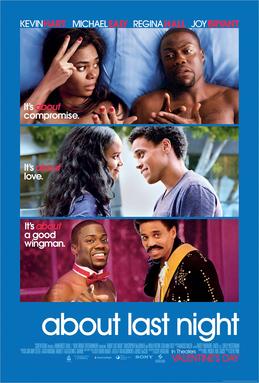
Obviously, I made a big mistake this Valentine’s Day by insisting that my boyfriend take me to see Endless Love.  (I still stand by my desire to see Winter’s Tale.)  I say this because I recently watched this year’s other big Valentine’s Day release, About Last Night, and I discovered that it’s a funny and, in its way, rather sweet romantic comedy.

About Last Night tells the story of two couples, Danny (Michael Ealy) and Debbie (Joy Bryant) and Bernie (Kevin Hart) and Joan (Regina Hall).  All four of the actors have a very real chemistry, with Hart and Hall bringing the laughs and Ealy and Bryant bringing the tears.  The film itself is ultimately predictable but very likable.

Adult_World

3) Adult World (dir by Scott Coffey)

In Adult World, Emma Roberts plays Amy Anderson, an aspiring author and recent college graduate.  Despite her own overwhelming faith in her own abilities, Amy struggles to find a job outside of college.  She is finally reduced to working at Adult World, a small adult bookstore.  Working at the store, she befriends the far more down-to-earth Alex (Evan Peters) and eventually discovers that one of her customers is also her idol, poet Rat Billings (John Cusack).  Amy proceeds to force her way into Rat’s life, volunteering to work as his assistant and declaring herself to be his protegé.  However, it turns out that Rat is far less altruistic than Amy originally thought (and with a name like Rat, are you surprised?).

Adult World is a flawed film but I still really enjoyed it.  The story has a few problems and the film never really takes full narrative advantage of Adult World as a setting but the entire film is so well-acted that you’re willing to forgive its flaws.  Cusack gives a surprisingly playful performance while Evan Peters is adorable in a Jesse Eisenberg-type of way.  Emma Roberts shows a lot of courage, playing a character who is both infuriating and relatable.

Jersey_Boys_Poster

4) Jersey Boys (dir by Clint Eastwood)

Clint Eastwood’s upcoming American Sniper has been getting so much attention as a potential Oscar contender that it’s easy to forget that, at the beginning of the year, everyone was expecting Jersey Boys to be Eastwood’s Oscar contender.  In fact, it’s easy to forget about Jersey Boys all together.  It’s just one of those films that, despite its best efforts, fails to make much of an impression.

Jersey Boys is based on one of the Broadway musicals that tourists always brag about seeing.  It tells the true story of how four kids from the “neighborhood” became the Four Seasons and recorded songs that have since gone on to appear on thousands of film soundtracks.  The period detail is a lot of fun, Christopher Walken, who has a small role as a local gangster, is always entertaining to watch, and the music sounds great but Eastwood’s direction is so old-fashioned and dramatically inert that you don’t really take much away from it.

Hopefully, American Sniper will be the work of the Eastwood who made Mystic River and not the Eastwood who did Jersey Boys.

Ride_Along_poster

5) Ride Along (dir by Tim Story)

School security guard Ben Barber (Kevin Hart) wants to marry Angela (Tiki Sumpter) but Angela’s tough cop brother James (Ice Cube) doesn’t approve.  In order to prove himself worth, Ben goes on a ride along with James and the results are just as generic as you might expect.  Probably the only really funny part of the film was the way that Hart delivered the line, “You’re white!  You don’t fight!” but we all saw that in the commercial so who cares?

On the plus side, Ice Cube has a lot of screen presence and is well-cast as James.  As for Kevin Hart — well, he should probably be thankful that About Last Night came out a month after Ride Along.

Trust Me

6) Trust Me (dir by Clark Gregg)

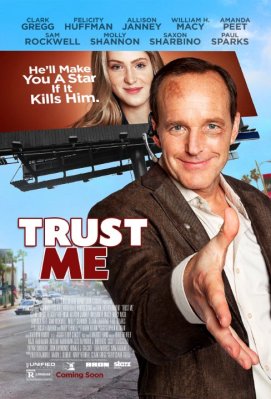
In Trust Me, Clark Gregg both directs and stars.  He plays Howard, a fast-talking but ultimately kind-hearted talent agent who mostly represents children.  After losing some of his most popular clients to rival agent Aldo (a hilariously sleazy Sam Rockwell), Howard meets Lydia (Saxon Sharbino), a 13 year-old actress.  Soon, Howard is representing Lydia and trying to land her a starring role in a major production.  Howard also finds the time to tentatively date his next door neighbor (Amanda Peet).  However, there’s more to Howard than meets the eye.  He is haunted by the death of one of his previous clients and his guilt leads him to become especially protective of Lydia.  When Howard concludes that Lydia is being sexually abused by her crude father (Paul Sparks), he attempts to protect her from both him and the Hollywood system that’s threatening to corrupt her.  It all leads to an oddly tragic conclusion…

I say “oddly tragic” because Trust Me is, in many ways, an odd film.  As a director, Gregg gets good performances from his cast but he never manages to find a consistent tone.  The film starts as a Hollywood satire and then it becomes a romantic comedy and then it turns into a legal drama before then becoming an all-0ut attack on the way the entertainment industry treats child actors and then finally, it settles on being a tragedy.  As a result, Trust Me is undeniably a bit of a mess.

And yet, it’s a compelling mess and the film itself is so heart-felt that you can’t help but forgive its flaws.  If nothing else, it proves that Clark Gregg is capable of more than just being Marvel’s Agent Coulson.

Trailer: Minions (Official)


wpid-minions

BANANA!

The Minions are back and all is right with the world. What better way to decompress from a month full of horror and everything horror than to get back to our helpful, little yellow henchmen.

Minions stars Stuart, Kevin and little Bob. They go on a journey in search of the ultimate master villain to pledge their race’s allegiance to. We’ll find out in July 10, 2015 if their search is one of success.

Back to School #68: Juno (dir by Jason Reitman)


Junoposter2007

(SPOILERS BELOW)

Even though he’s a likable actor and has appeared in several films that I enjoyed, I am always a little bit uneasy whenever I see Jason Bateman on screen.  To me, he will always be Mark, the seemingly perfect husband from the 2007 best picture nominee Juno.  Mark and his wife Vanessa (Jennifer Garner) are unable to conceive so they agree to adopt the unborn child of pregnant teenager Juno (Ellen Page).

At first, Mark seems like the nicest guy on the planet.  Unlike his wife, Mark appears to be laid back and friendly.  Whereas Vanessa tries to maintain a polite distance between herself and Juno, Mark quickly befriends her.  It’s a familiar dynamic.  Vanessa is the one who keeps the household running.  Mark is the one who keeps the household fun.  Vanessa is the adult and Mark is the guy who is young at heart.  It’s not surprising that Juno finds herself feeling closer to Mark than to his wife.

Much like Juno, those of us in the audience are initially fooled into preferring Mark to his wife.  For me, the first indication that Mark was not quite the great guy he seemed to be came when he attempted to convince Juno that Herschell Gordon Lewis was a better director than Dario Argento.  But even that could be forgiven because, as Mark made his arguments, he revealed that he had a pretty good library of DVDs from Something Weird Video.

(Seriously, at that moment, I really hoped that the movie would just spend five minutes letting us see every title in Mark’s movie collection.)

But then there was that moment.  After telling Juno that he was planning on leaving his wife, he looked at her and asked, “How do you think of me?”  And I have to give Jason Bateman a lot of credit.  He delivered that line with just the right amount of needy selfishness.  It’s rare that you see an actor — especially one who has essentially built a career out of being likable — so fully commit to playing a reprehensible character.  When Mark reveals his true nature, it’s shocking because we were so ready to like Mark.  With that one line, we’re forced to re-examine the entire film and we realize that, much like Juno, we allowed ourselves to be fooled by Mark.

Juno is a film about growing up.  Vanessa is a grown up.  Mark refuses to grow up.  And, by the end of the film, Juno has grown up enough to know that she’s not ready to be a mother but Vanessa is.  Juno has grown up enough that she can allow herself to get close to the baby’s father, sweet-natured track star Paulie (played by Michael Cera).

For many people, Juno seems to be a love-it-or-hate-it type of movie.  There rarely seems to be a middle ground.  It seems that for every person who appreciates Ellen Page’s sardonic line readings, there’s another one who finds her character to be abrasive.  For every one who enjoys Diablo Cody’s script, there seems to be another one who finds it to be overwritten.  The same holds true for Jason Reitman’s direction.  Viewers either respond to his quirky vision or else they dismiss him as being far too showy for the film’s own good.

As for me, I’m firmly and unapologetically pro-Juno.  I think Juno is one of the best films of the past ten years and I think that, eventually, both the character of Juno and Ellen Page’s performance will be viewed as being iconic.  When future historians are watching movies for clues as to what it was like to be alive during the first decade of the 21st Century, Juno is one of the films that they will watch.

And when they do, hopefully, they will understand that Jason Bateman was just an actor giving a good performance as a bad person.

Back to School #56: 10 Things I Hate About You (dir by Gil Junger)


10_things_i_hate_about_you_final_poster

A few nights ago, my sister Erin and I watched the 1999 high school-set romantic comedy 10 Things I Hate About You for like the hundredth time.  Seriously, we love this movie so much and, in fact, just about everyone that we know seems to love it as well.  10 Things I Hate About You is one of those films that brings people together.  If you like this movie, I’ll probably like you.

(Want to see true displays of spontaneous sisterhood?  Go to Girlie Night at the Alamo Drafthouse when they’re showing 10 Things I Hate About You.  You will walk out of the movie with a hundred new best friends.)

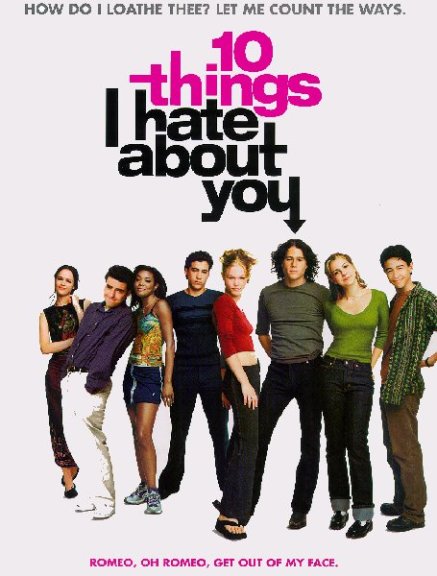
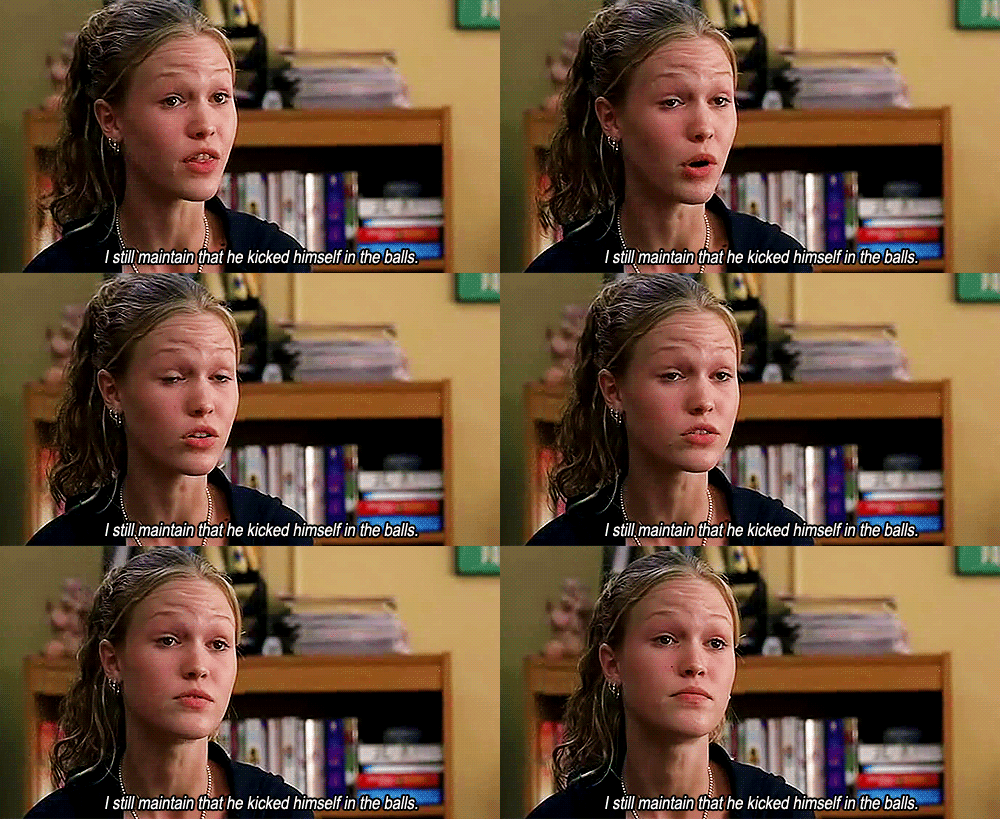
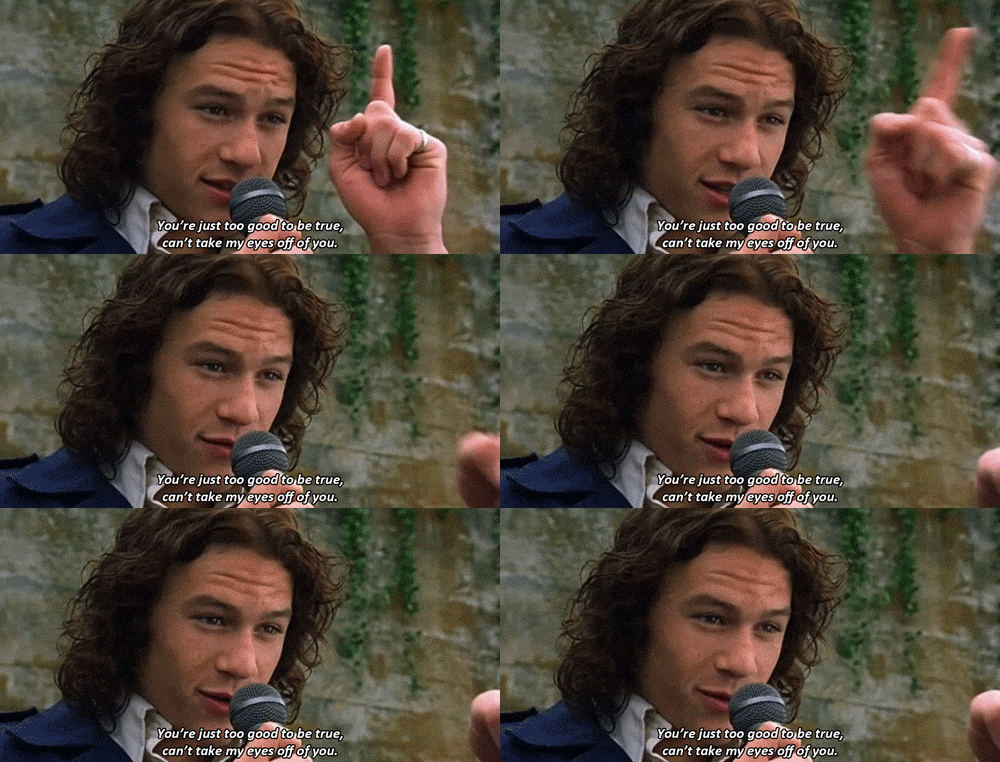
Why do people love 10 Things I Hate About You?  There’s a lot of reasons.  I love Heath Ledger singing Can’t Take My Eyes Out Of You.  I love watching Joseph Gordon Levitt at his most adorable.  I love that it’s a film about two sisters, largely because I have three older sisters and there is so much about the scenes between Kat (Julia Stiles) and Bianca (Larisa Oleynik) to which I could relate.  I love the film’s quirky sense of humor and its unapologetically big heart.  I love the way the film’s script expertly balances cynicism with sentimentality and humor with warmth.  I love the fact that movie takes in place in beautiful houses and features beautiful people wearing beautiful clothes.  What Erin and I especially love about this film is that, as played by Julia Stiles, Kat is just a kickass chick.

flawless-queen-kat-stratford-16681703

Of course, there’s a reason for that.  Much as how the superficially similar Clueless was adapted from Jane Austen’s Emma, 10 Things I Hate About You is adapted from Shakespeare’s play The Taming of the Shrew.  Oddly enough, Shakespeare’s plays seem to translate well into stories about high school.  Maybe it’s because his characters are so often motivated by jealousy, romance, and — it must be said about some — by pure stupidity.  10 Things I Hate About You is definitely one of the best of the teen Shakespeare films.

Taking place at an upper class high school, 10 Things I Hate About You opens with Cameron James (Joseph Gordon-Levitt) arriving for his first day at Padau High School and quickly befriending the only slightly less adorable Michael Eckman (David Krumholtz).  Cameron wants to ask out the beautiful and innocent Bianca (Larisa Oleynik) but Bianca’s overprotective father (played by Larry Miller) has decreed that Bianca can only date if her older sister Kat (Julie Stiles) is also dating.  The problem is that all of the boys at school are scared of the outspoken Kat.

So, Cameron convinces the hilariously vapid male model Joey Donner (Andrew Keegan) to pay the school rebel, Patrick Verona (Heath Ledger, so handsome and charismatic and sexy), to ask Kat out on a date.  Joey, you see, wants to date Bianca as well but Cameron is sure that he can win Bianca away from Joey…

Yes, it’s all a little bit complicated but then again, Shakespeare often is.  For that matter, so is high school.

10 Things

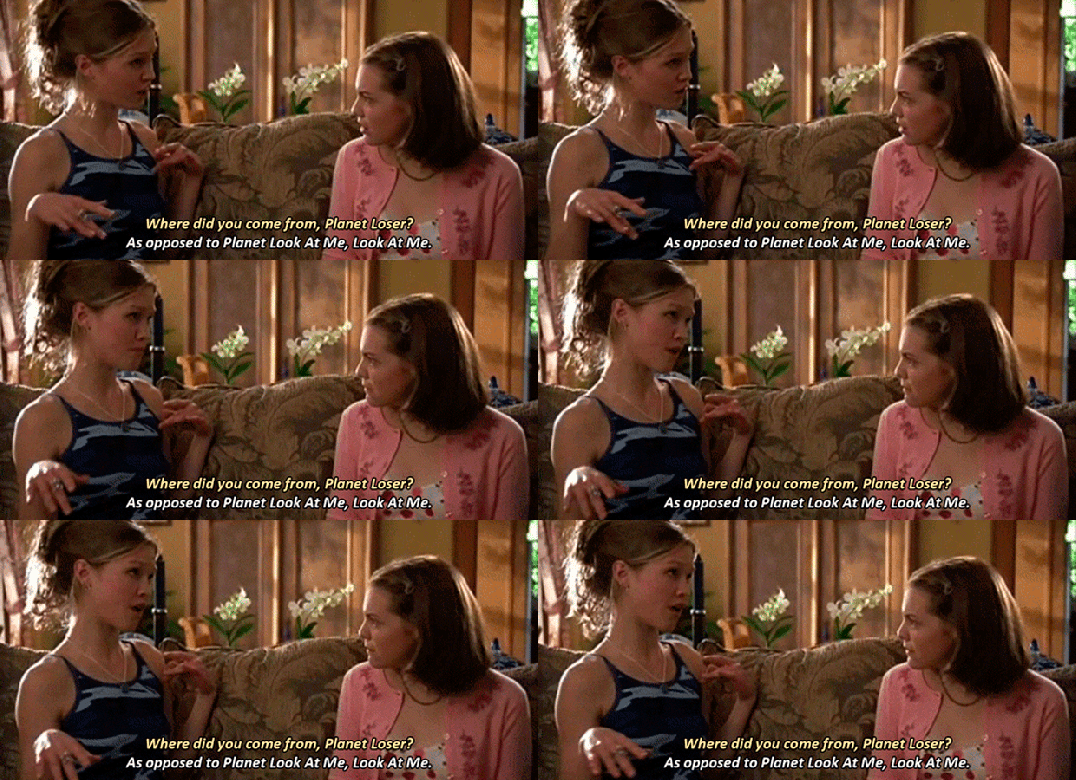
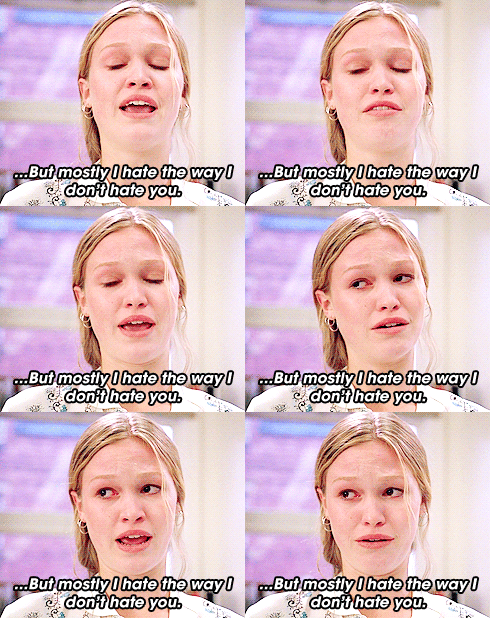
What matters is that all of this leads to a collection of classic scenes and classic dialogue.  What’s my favorite scene from 10 Things I Hate About You?  There’s so many that it’s difficult to narrow it down to just one.  There’s the huge party where Joey continually strikes a pose and a drunk Kat ends up dancing on a table.  There’s the wonderful scene where Patrick serenades Kat.  Or how about when Kat reads the poem that gives the film its title.  But for me, my favorite scene is that one where, after spending nearly the entire film as rivals, Kat and Bianca finally talk to each other as sisters.  Bianca demands to know why Kat won’t go to the prom.  Kat tells Bianaca about her own previous history with Joey.  It’s a low-key and heartfelt scene, wonderfully played by both Larisa Oleynik and Julia Stiles, and I love it just because I’ve had similar conversations with all of my sisters.

planet-loser

I suppose this is where I should make some clever comment about having “10 things I love about 10 Things I Hate About You” but actually, there’s more like a 100 things I love about 10 Things I Hate About You.

This movie makes me happy every time I see it.

And, really, what else can you ask a film to do?

tumblr_ms08c08EbP1sezoa7o1_250


What Lisa Marie Watched Last Night: The Help (dir. by Tate Taylor)


I actually watched several things last night, including the season premieres of The Bachelor and Intervention.  However, neither one of those is an Oscar contender.  The Help is, so I decided I better take the time to watch the film via OnDemand.

Why Was I Watching It?

I wasn’t planning on seeing this movie when it first originally opened in theaters because, just based on the trailer, it looked like it would be your typical, terribly self-congratulatory mainstream films.  I’ve seen far too many films that promote the same old stereotypes in the name of progress and tolerance, as if good intentions can make up for bad filmmaking.  But, so many of my girlfriends came to me raving about how much they loved this film and then my Aunt Kate just about disinherited me when I told her I hadn’t seen the movie (or read the book that it’s based on) and eventually I realized that I had to see the film.  Add to that, chances are that this film is going to be an Oscar contender.

What Was It About

In segregated Mississippi, aspiring writer Skeeter (Emma Stone) decides to write book about the life of the African-American maids and nannies who work for her best friends.  After some initial difficulty, she wins the trust of two maids (Viola Davis and Octavia Spenser) and gets down to exposing the truth.

What Worked

First off, The Help is a perfect example of a well-made, entertaining mainstream film.  I laughed at the funny parts, I cried at the sad parts, and I thoroughly enjoyed the film, even though it kinda fell apart during the 2nd hour.  There’s a lot of very legitimate issues that you can raise about how the film portrays life in the segregated South but the film itself is entertaining and well-made.

It’s also one the best acted films of 2011 with Viola Davis, Octavia Spenser, and Emma Stone all giving great performances.  Jessica Chastain is funny playing a clueless newlywed and Bryce Dallas Howard does a typically good job playing the type of bitchy Queen Bee that we’ve all know and  have all secretly hoped would end up fat and divorced.  I also thought Allison Janney, who plays Stone’s mother, gave an excellent and underrated performance.

This film was directed with a perfect eye for the details needed to make even the most minor of characters memorable.  If nothing else, I enjoyed watching it just to see what everyone would be wearing from scene to scene.

The film’s first hour is probably as perfectly paced and tonally balanced as any film I’ve seen.  However, things fall apart during the second hour (more on that below).  Luckily, the film’s ending is powerful and partially redeems the film’s uneven tone.

What Didn’t Work

The film is moves along pretty well until the 2nd hour, at which point it smashed into a wall created by the inability of mainstream film to truly honestly deal with racism.  At the start of the second hour, civil rights leader Medgar Evers is assassinated by a member of the Ku Klux Klan and I found myself waiting for some sort of expression of anger (or really, any emotion other than stoic suffering) on the part of “the help.”  Instead, we get a scene where both Viola Davis and Emma Stone are watching Evers’s funeral together and both are impressed to see John F. Kennedy show up.  In the next scene, Davis has put a picture of President Kennedy up on her wall next to a picture of Jesus.  So, in other words, this film reacts to the murder of a black man but deifying a white man.  After showing us a clue of violent reality, it’s as if the film can’t figure out how to balance out the ugly realities of racism with the film’s need to appeal to the widest possible audience.  As a result, the next hour of the film feels rather disjointed and uneven.  Even though the film partially redeems itself with one of the best endings of the year, it’s still hard not to feel as if we’re watching a feel good film about something nobody should feel all that good about.

Like a lot of mainstream films about racism, a good deal of this film centers on the friendship between blacks and a few white people who, magically, don’t appear to have a shred of prejudice within them despite the fact that they were raised in the same racist culture as every other white person in the film.  As a result, the racism seen in the film doesn’t really seem like it’s an ingranied part of culture as much as it just seems like the result of a couple of bullies acting like jerks.  As a result, despite its very good intentions, a film like The Help will often unintentionally minimize just what a struggle the fight for civil rights was and is. 

“Oh my God!  Just like me!” Moments

Needless to say, I totally related to Emma Stone’s character in this film. 

Lessons Learned

It’s difficult to make a feel-good movie about racism.