I wasn’t fortunate enough to be able to attend last year’s Toronto International Film Festival. If I was there I have a feeling that a little Indonesian action film would’ve been the highlight of my time at TIFF 2011. The film is The Raid (it will get the Redemptionadded for it’s American release) and from the look of these two trailers it just speaks the language of awesome.
All I can say is that it should put the Indonesian martial arts style Pencak Silat on Hollywood’s map the way Ong Bak did for Muay Thai a decade ago.
If there’s a recent guilty pleasure of mine the past couple years it has to be 2009’s G.I. Joe: Rise of Cobra. Yes, that film was a mess with iconic characters from the G.I. Joe franchise of toys and comics so miscast that it was difficult to feel any sort of attachment to them in the film. But for some reason the film was still entertaining in that dumb, but fun way certain films just end up becoming.
No one thought a sequel would ever be made after that first film, but it looks to have made enough money to justify one for the studios making it. This latest trailer and Super Bowl tv spot for G.I. Joe: Retaliation has The Rock quoting Jay-Z while showing some new sequences in addition to ones already shown in past trailers. We get to see a more than quick glimpse of Cobra Commander in his new, but recognizable facemask.
I’m definitely going to be watching this the weekend it comes out and with Channing Tatum barely being shown as being in the film then my wish that he may not make it past the early minutes of this sequel may have been answered.
G.I. Joe: Retaliation is still set for a June 29, 2012 release date.
“I don’t know. Two toughest kids on the block I guess. Sooner or later they’re going to fight.”
[guilty pleasure]
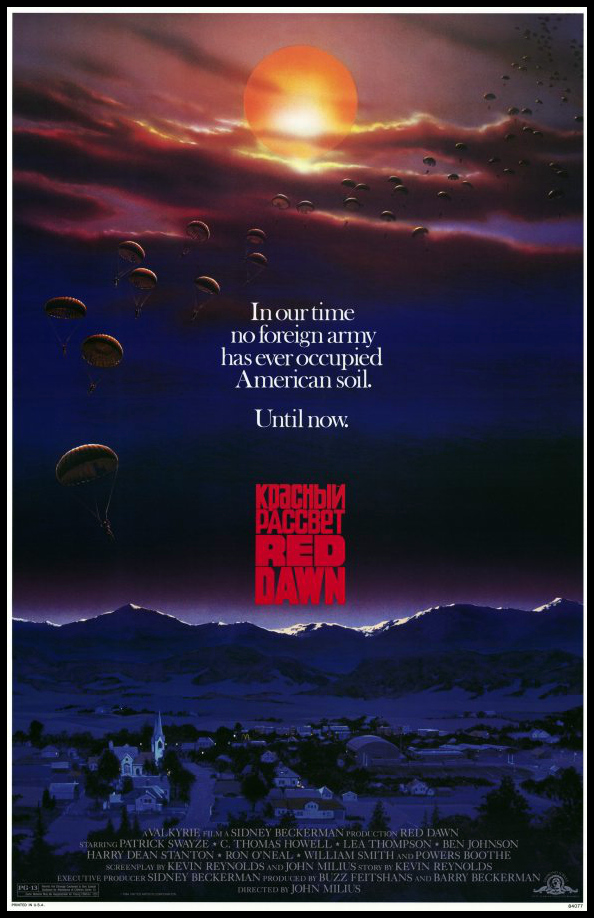
Anyone who grew up during the 1980’s would say that some of the best action films were made and release during this decade. I won’t disagree with them and probably would agree to a certain point. This was the decade when action films evolved from the realism of the 70’s to the excess and ultra-violence of the 80’s. This was the decade which ushered in such action heroes as Schwarzenegger, Stallone and Willis. It was also the decade which released one of the most violent films ever released by a major motion picture studio. It’s a film that has been remembered through the prism of nostalgia. I speak of the 1984 war film by John Milius simply titled Red Dawn.
John Milius is one of those filmmakers who never conformed to the stereotype of liberal Hollywood. He was an unabashed Republican (though he considers himself more of a Zen anarchist) in a liberal studio system who happened to have written some of the most revered films of the 1970’s (Jeremiah Johnson, Apocalypse Now, Dirty Harry). He came up with a follow-up to his hugely successful Conan the Barbarian in the form of a war film set in current times (mid-80’s) America that he called Red Dawn. It was a story which takes an alternate history of the Cold War where Soviet forces and it’s allies launch a successful preemptive invasion of the United States. Before people think that this was the idea born of a conservative, warmongering mind it’s been documented that Milius’ inspiration for this film was a real Pentagon hypothetical exercise of what would happen if the Soviet Union conducted a conventional invasion of the United States and how the government and it’s population would react and resist such an occupying force. The story would finally get it’s final treatment with major input from screenwrtier Kevin Reynolds’ own story which added a certain Lord of the Flies vibe to the group of teenagers who form the bulk of the film’s cast.
The film actually starts off with an impressive sequence of your typical Midwestern high school day with students seated in their classrooms. One moment this Rockwellian image gets a surprise from soldiers parachuting in the field outside the school. Thus we have the beginning of the Soviet invasion with one of the teachers being gunned down for trying to peacefully interact with the airborne troopers. The rest of the film is about a group of highschoolers led by senior Jed Eckert (Patrick Swayze) and his younger brother Matt (Charlie Sheen) as they flee with a handful of their classmates the massacre at their school and soon their whole town as well.
Red Dawn uses the first half of the film to show the confusion and chaos created by the sudden appearance of foreign soldiers on America soil attacking civilians and, soon enough, whatever American military response that manages to react in the area. We’re put in the shoes of Jed and his band of teenagers as they try to survive the roving bands of Soviet and Cuban soldiers patrolling the plains and countryside surrounding their hometown of Calumet, Colorado. We see American civilians packed into re-education camps and rumors of KGB secret police making certain troublemakers disappear and worst. It’s the America Cold War nightmare scenario where the Soviet Evil Empire has taken a foothold on US soil and the government and military nowhere in sight to help it’s population.
The second half of the film solves this scenario by arming the teenagers led by Jed into a sort of teen guerrila force using their school’s mascot as their rallying cry. It’s the shouts of “Wolverines!” which has become part of American pop-culture as we get to see these teenagers conduct hit-and-run strikes on enemy patrols and forward bases while at the same time arming those they free from camps. It’s during this part of the film where the violence gets ramped up to an almost ridiculous level. It’s no wonder that for almost two decades this film would be considered by Guinness World Records as the most violent film ever put on the big-screen. Milius and his filmmaking crew do not skimp on the use of blood squibs as Jed and his ragtag band of teen fighters gun down Soviets, Nicaraguans and Cuban soldiers by the score every minute during a long montage in the middle of the film.
Red Dawn in terms of storytelling is actually quite good in the grand scheme of the narrative being told, but even through the prism of nostalgia and rose-tinted glasses the characters in the film get the short-end of the stick. With the exception of Swayze’s eldest teen Jed as leader of the Wolverines the rest of the band’s teenage characters look like your typical casting call stereotypes who fill in the required roles in any ensemble cast. There’s Darren Dalton as the high school class president jealous of the group’s leader Jed, but unable to act on it. We have C. Thomas Howell as Robert the mousy one when the film begins who becomes a hardened and cold-hearted killer as the film goes on. Everyone fits in neatly to their assigned role and noen of the young actors (at the time) bring much to their characters.
This film continues to be remembered fondly by it’s fans both new and old because of the “what-if” scenario being played out on the screen. I would say that if there ever was a pure American film I would think Red Dawn manages to fit the bill. It’s a film which highlights the so-called individualism and can-do attitude Americans see for themselves. How it’s up to each individual to fight to protect their loved ones and for what is theirs. Some have called this film as a conservative’s wet-dream, but I rather think it’s a film that should appeal more to Libertarians as it focuses on individual liberties and self-preservation when the government and military tasked to protect them have failed.
John Milius has always been a maverick in Hollywood and his unpopular political beliefs have kept him from doing more work in the film industry, but one cannot deny the fact that he made one of the most iconic films of the 1980’s. Whether one agreed with the film’s politics and thought it to be a good film or not was irrelevent. Red Dawn has become part of American pop-culture and will continue to be a major example of the excess of 80’s action filmmaking for good or ill. Plus, even the most liberal people I know find the basic story of fighting to protect the nation from invaders something that feeds their innermost fantasy of playing the good guys fighting the good fight. Red Dawn is a great example of the underdog film that just happens to have teenagers kicking Soviet military ass.
I will admit right here and right now that I really enjoyed G.I. Joe: The Rise of Cobra when it came out in 2009. I know that it was really panned by critics and many film-goers, but I thought it brought the cartoonish action of the original cartoon to life. I wasn’t too thrilled with some of the casting choices, but overall I had fun with the film. I wasn’t really the only one who enjoyed it since it made quite enough in the box-office to warrant a sequel. This sequel looks to bring in only a few people from the first film (Channing Tatum, Ray Park and Lee Byung-hun as Duke, Snake Eyes and Storm Shadow respectively) while bringing in a new cast and, most important of all, a new director and writers.
Jon Chu, fresh off the success of Fast Five, took on this project and from the trailer shown above it looks like he has injected the very same fun action he did for the Fast and the Furious franchise. It’s going to be interesting to see if the action in this sequel follows the same cartoonish (lasers and stuff) kind they had in the first film or will Chu and crew go old-school action and just go with bullets, bombs and rockets. If they go with the latter then I am all for it. Plus, it has “The Rock” as Roadblock. That alone had me as ticket-buyer on Day One of it’s release.
G.I. Joe: Retaliation is set for a June, 29, 2012 release.
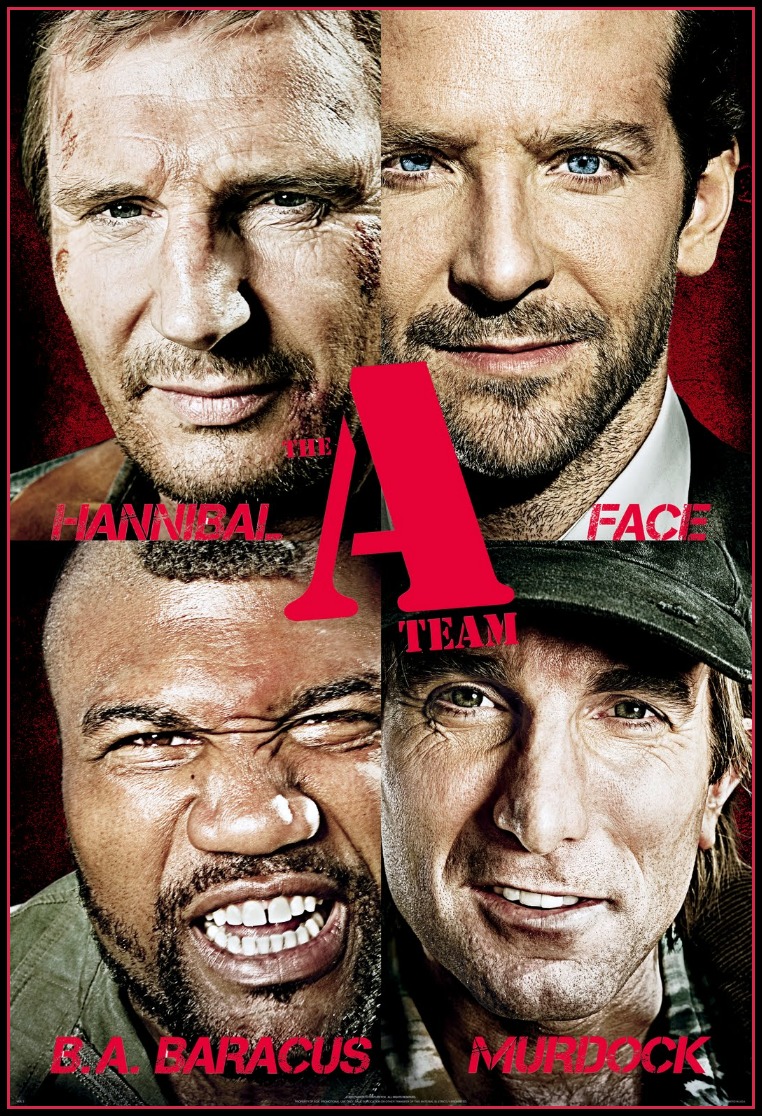
If my memory serves me correctly the year of 2010 ended up becoming the year of the Action Team Flicks. Arriving first was the comic book film adaptation, The Losers, which didn’t do so well. Coming out last was the Stallone testosterone action vehicle, The Expendables, which did much better though it lacked somewhat in the grindhouse it was promising. Smack dab in the middle of these two was the film adaptation of the classic 80’s action tv series of the same name, The A-Team, which in the end I thought was the best of the three Action Team Flicks of 2010.
The A-Team was a film project that once had Mel Gibson attached to it right up to Bruce Willis, but delays upon delays pared back what would’ve been a mega-budgeted action blockbuster into something in the bargain basement (for a summer film). It starred Liam Neeson in the iconic role of Col. John “Hannibal” Smith made famous in the 80’s by George Peppard. Surrounding him would be Bradley Cooper as Templeton “Face” Peck, Sharlto Copley as H.M. “Howlin’ Mad” Murdock and veteran MMA fighter Quinton “Rampage” Jackson as B.A. Baracus. Holding court over this A-Team was filmmaker Joe Carnahan working with a script he, Skip Woods and Brian Bloom (who also had a role as the amoral, sociopathic mercenary Pike).
The film took what was great and fun about the original tv series and gives it a 21st-century upgrade. To say that the film’s plot was secondary to watching the cast having fun on the screen would be an understatement. The story dealt with Smith and his team being accused of a crime they didn’t commit and must now escape from a military prison to find out who set them up and clear their name. It’s straight out of the tv series’ basic premise which managed to last a full on four seasons. Fortunately, Carnahan and his writers only had to make this premise last just a little over two hours. While some may think that two hours would be too long for this film it actually moved quite fast for something that went beyond the two hour mark.
Right from the beginning the cast looked to have been having the time of their lives. Neeson was Hannibal through and through while the other actors making up the rest of the team managed to imbue these well-known characters with their own brand of craziness, absurdity and panache. Just like the other two Action Team flicks of 2010 this film also had it’s share of scene-chewing villains in the form of Patrick Wilson as a duplicitous CIA agent and Brian Bloom as the sociopathic leader of a private military company at odds with Smith and his team. It’s these two groups who end up trying to outguess and outmanuever each other to get that final upper hand. Each encounter between these two groups just got more ridiculous with each passing event.
If one ever wondered if one could fly a tank while it was in freefall then this film answers that question. The climactic showdown at the LA shipyard at night has some of the most over-the-top action of the last couple years that wasn’t a scifi-actioner. Laws of physics doesn’t apply in The A-Team and the film revels in that notion as if telling the audience to either get onboard and enjoy the ride or get off and go on the Toad ride instead.
It’s a shame that The A-Team didn’t do as well in the box-office as some would’ve hoped because the film does set things up for further adventures for Neeson and his crew. What Carnahan ended up making won’t be breaking down the doors to the awards committee, but he did deliver on paying homage to the original tv series while adding his own brand of crazy to a film that had just the right amount of fun, ludicrous action to make it the best of 2010’s Action Team Flicks.
While looking over at something to watch as the night wore on I came across a film that I still consider to this day one of the best action films ever made. People may try and guess that I’m looking at a Michael Bay flick (wrong). Maybe it’s a John McTiernan classic 80’s actioner (wrong again). Or maybe it’s one of those Luc Besson Euro-action flicks which became such the rage amongst the hipster cineaste during the 90’s (wrong thrice). No the film I’m talking about comes from Hong Kong and was the last actin film directed by the master of bullet ballet himself, John Woo, before he left for Hollywood to try his luck.
The film is Hard Boiled and it has so many iconic film scenes that it would be difficult to just choose which one I love. So, I decided to go right at the beginning and picked the “Tea House” gun fight which opens up the film. To call this scene awesome would be an understatement. The scene looks like chaos the moment the first gun goes off, but looking at this scene over and over one cannot help but wonder at the musical-like dance choreography in how the gun fight unfolds from beginning to end.
It’s not a surprise that the musicals of the 50’s and 60’s were some of John Woo’s favorite films and it shows in how he choreographs and films the scene. Chow Yun Fat as the coolest cop ever to walk a beat with the kickass nickname of “Tequila” almost goes through the scene like Fred Astaire or Gene Kelly except this time the lead is not dancing in the rain or with Ginger Rogers, but shooting and weaving his way through a tea house full of Triad gangsters.
Two of the coolest sequences in this scene would be the body grind down the stair bannister and then the final climactic sequence in the end. Also, the way Chow Yun Fat and the main gangster look as they shoot it out reminds one of samurai dueling each other right down to the very stance they sometimes use.
Michael Bay and his supporters could learn and thing or two from Woo and this scene.
It is called the “Marvel Cinematic Universe” and it’s a world-building program that’s been in the making for almost half a decade. It first began when Kevin Feige and the powers-that-be at Marvel Entertainment decided to forgo licensing out the rest of their comic book characters to other studios to play with (Spider-Man, X-Men, Wolverine, Fantastic Four, Daredevil, etc.). Marvel Entertainment was getting rich off of these films without having to help finance any of the films, but the results of these films where hit-or-miss and recently they’ve been really misses (X-Men: Last Stand, X-Men Origins: Wolverine, Fantastic Four: Rise of the Silver Surfer, Ghost Rider to name a few). So, the decision was made for Marvel to open up their own film studio, Marvel Studios, and use money from those licensed films to adapt the remaining characters in the Marvel Universe the Marvel way.
The first film to come out with Marvel Studios as the primary company was 2008’s Iron Man which was followed very closely with a reboot of the Hulk with TheIncredible Hulk later that same summer. Iron Man 2 arrived in 2010 (though it was a mixed bagged depending on who one asks about this sequel) and in 2011 two more Marvel Studio films arrived to continue building this so-called “Marvel Cinematic Universe”. In early May 2011, the first one was Kenneth Branagh’s Thor hitting the big-screen which was widely-acclaimed to be a good and fun entry to this cinematic universe. The final piece and the second Marvel Studio film to arrive in 2011 is the Joe Johnston-helmed film adaptation of one of Marvel Comics’ most iconic characters. The “Marvel Cinematic Universe” finally finds it’s last piece before 2012’s arrival of Marvel Studios’ superhero team film, The Avengers.
Captain America: The First Avenger was being predicted as a film that could fail because of the character itself. Steve Rogers aka Captain America is the All-American G.I. who was straight-laced and never morally ambiguous. This was a character sure of himself and saw the world through a moral prism of black and white. The film that came out of the work by Joe Johnston and his capable film crew was one which surprised most everyone by it’s retro and nostalgic look at action serials of the past but without becoming to beholden to those tropes and losing all the fun in the story. This film played out like a throwback to those very serial action films of the 40’s and 50’s before cynicism and snark took over Hollywood and most of the entertainment industry.
Joe Johnston and his screenwriters, Christopher Markus and Stephen McFeely (and an uncredited Joss Whedon whose strength with dialogue could be seen in this film), were able to make an origin tale which didn’t seem too rushed in laying out just who Captain America was and his early adventures during World War II. It was a great decision to keep most of the film set in World War II since Captain America’s origins would be the hardest to pull off and even harder to convince audiences too used to conflicted and unsure superheroes in their superhero films.
The film begins in current Marvel times as an expedition finds Captain America’s shield in the frozen ice floes of Greenland in what looks to be the wreck of a giant flying wing-type aircraft. Once the shield’s discovery was made the film quickly transitions back in time to 1942 where we get to see first-hand the evil mastermind Johann Schmitt aka the Red Skull (Hugo Weaving) whose obsession and search for ultimate power finally garners him the Tesseract from Odin’s weapon’s vault (the Cosmic Cube last scene in Thor). He would use this cosmic power to power the superweapons being developed by his Nazi-funded splinter group, HYDRA, and it’s lead scientist in Dr. Armin Zola (Toby Jones).
Both Markus and McFeely actually wrote the film to be two storylines running concurrently with Red Skull and HYDRA running in one storyline and the other with Steve Rogers (Chris Evans) as the 90-lbs Brooklyn-native weakling whose attempt to enlist in the Army gets shotdown each and every time he tries. Rogers is just not the type of man the US Army requires no matter how much courage and heart his asthmatic and weak body may hold within. But this very non-physical quality of Rogers is what gets the attention of the US Army’s own research division headed by German scientist and expatriate, Dr. Abraham Erskine, who believes Rogers is the perfect candidate for his super-soldier serum program.
Much of the Roger’s storyline in the early-going brings much comedic dialogue and scenes which made Captain America such a fun film. While Roger’s appearance and situation was never played off for laughs, it was how those around him outside of a few people whose reaction never get past the weakling standing in front of them. Once Rogers does become Captain America the film continued to have fun with the character as he’s drafted by politicians who sees him as the perfect pitchman for the government’s program to sell war bonds. This entire part of the character’s arc even got the full Busby Berkeley musical dance number reminiscent of Steven Spielberg’s musical number to start off Indiana Jones and The Temple of Doom (this won’t be the first time Johnston would pay homage to the Indiana Jones series).
Once Captain America moves past his war bond selling phase the film’s two concurrent running storylines of the Captain and the Red Skull converge to begin the second-half of Captain America. While the comedic dialogue and sequences take a back seat the film still remains very fun as Johnston ramps up the action. He begins with the Rogers disobeying orders and attacking a HYDRA base to rescue not just his boyhood friend Bucky Barnes (Sebastian Stan) from the clutches of HYDRA, but all the prisoners held in the same weapons manufacturing base. The action sequences were filmed in an almost old-school fashion. There’s no tricks of fast editing and quick cuts to make the battles and action chaotic and real, but brought to mind more the action scenes from the Indiana Jones films of the 80’s which Johnston was a part of. All the action sequences in this film were choreographed to be seen and understood, but at the same time with a sense of fun energy that most action films seem to have lost in the last decade.
Captain America was also the first film in the “Marvel Cinematic Universe” which added to the fun by creating a genuine romantic subplot for it’s main lead. The relationship between Steve Rogers and British agent Peggy Carter was written quite beautifully as one between two people who saw each other as equals. This relationship unfolded very organically and not forced onto the two characters and to the audience. There was no manipulation to create a false couple. Steve Rogers gradually grew to not just admire Peggy Carter as a strong-willed, capable, but still feminine woman who saw beyond his initial weakling appearance, but by film’s end as a person who he truly had feelings for. It wouldn’t have worked if the Peggy Carter was just written to be a damsel in distress which she wasn’t and this character’s own journey to admiring Roger’s courage and tenacity in the face of impossible odds to mutual admiration once he became Captain to full-blown love by the end really added the emotional punch to the film. It’s no wonder that the bittersweet ending to the film between these two characters had such an emotional impact. The audience followed these two characters’ in their growing relationship from sweet beginnings to the tragic and bittersweet climactic finish.
It’s that very writing which made Captain America: The First Avenger more than just another superhero film. This was a film that went beyond just superhero action sequences, but a film which brought to mind not just the retro film of such films as Johnston’s own 1991 retro-futurist superhero film, The Rocketeer, but also the fun inherent in the serialized action films of the 40’s and 50’s which Spielberg did paid homage to with Indiana Jones and The Raiders of the Lost Ark. The action, explosions and witty (though without the snark and cynicism) dialogue didn’t dominate the film but became supports for the well-written characters. Characters that were well-played by it’s cast of exceptional actors.
This film, like any other superhero film of the past quarter century, lives and dies by how it’s hero and villain were played. It’s a great thing to have not just Hugo Weaving playing the Red Skull with such relish (with a voice that sounded like a mash-up of Werner herzog and Klaus Kinski), but the surprise was Chris Evans as Captain America himself. Evans had the tougher role since he was the titular character. He was an actor who was more well-known as playing wiseass and jokester roles, but in this film he plays Steve Rogers straight with a sense of unabashed goodness and confidence that he became Captain America without having to be unsure of his abilities, conflicted about his new role as a hero. Evans showed depth and range that was only hinted at in films such as Sunshine.
Another delight in the film would be Hayley Atwell as Peggy Carter. She could’ve been the weak-link in this film and no one would’ve noticed, but she became the moral anchor and strength for the film as she became not just Steve Rogers’ eventual love interest but also his sounding board whenever doubts creeped in. She kept not just him, but the film on course and it helped that she was just as much as kickass as Captain America. Also, to say that Atwell as Peggy Carter was gorgeous to the point of blinding would be an understatement. It’s no wonder Captain America fell for her.
The rest of the supporting cast were up to the challenge no matter the size of the role. Stanley Tucci and Tommy Lee Jones were great as the compassionate mentor and grizzled commanding officer respectively. Jones’ Col. Phillips actually got some of the best one-liners in the film. When Tommy Lee Jones plays such a character as well as he does it’s no wonder he’s the go-to-guy for such roles. He just lives the part and pulls off the lines with such great comedic timing. Dominic Cooper as the young Howard Stark (father of Tony Stark/Iron Man) brought images of the suave and debonair Howard Hughes while Sebastian Stan as Bucky Barnes did a great job in making the character not just a sidekick, but also show hints of why he would become the Winter Soldier later on in the Captain America stories. It’s Stan’s role as Bucky which gives me hope that future Captain America sequels would tap and mine this character’s own journey from sidekick to potential rival as the Winter Soldier.
Captain America: The First Avenger is Marvel Studios’ last puzzle piece in what would transition into 2012’s The Avengers by Joss Whedon and it more than delivers the goods which was a testament to the creative forces led by Joe Johnston, Chris Evans and everyone involved. This was a fun, rollicking good time which brought back the concept that films were ultimately started as a form of mass entertainment. Not every film had to explore the meaning of life and existence. Not every film had to be a journey into the light and dark of existential themes. Films could be a couple hours spent entertaining and allowing it’s audiences to have a fun and good time. Captain America: The First Avenger was able to deliver this type of experience and do so with not a cynical gene in its code. It’s definitely Marvel Studios’ best film to date and one of the best films of the summer.
In 2009, we saw the first film in what Warner Bros. hoped would be the start of a new film franchise in Guy Ritchie’s Sherlock Holmes starring Robert Down, Jr. in the titular role with Jude Law playing his intrepid assistant, Dr. Watson. The film did quite well in the box-office that a sequel was greenlit right away and here we are just five months from the premiere of the follow-up film, Sherlock Holmes: A Game of Shadows.
The first film introduced the character of Sherlock Holmes to the public who really didn’t know much of the iconic character. That film also introduced the one person who would become Holmes equal in intellect and deductive reasoning but without the moral center: Dr. James Moriarty. This arch-foil for Holmes is to be the main antagonist for the sequel and whoever decided to cast Jared Harris in the role of the good Dr. Moriarty should get a raise. Harris has always been one of those character actors who disappears into his roles in every film he has done but never seem to get any glory. Hopefully, once people have seen him in A Game of Shadows, this will change and he joins the likes of Mark Strong, Anthony Hopkins and others who toiled in relative obscurity until finally hitting it big as a charming villain in a major film.
New to the sequel will be Noomi Rapace just fresh off of her stand-out role as Lisbeth Salander in the film adaptation trilogy of Stieg Larsson’s Millenium Trilogy. Also, joining the returning cast is Stephen Fry as Sherlock’s brother Mycroft Holmes. The film, as shown in the trailer, looks to ramp up the action and bring Holmes and Watson on a whirlwind tour of Europe.
Sherlock Holmes: A Game of Shadows is set for a December 16, 2011 release date.
If there was ever a Marvel Comics character who was perfectly suited to star in a grindhouse film it would be Frank Castle aka The Punisher. He’s a character who takes the term anti-hero past its limits and who makes other film vigilantes seem like sissy, choir boys. In December 2008 Lionsgate released a sort of reboot of The Punisher by Jonathan Hensleigh and starring Thomas Jane in the titular role. This time around the role of Frank Castle goes to Ray Stevenson (The Other Guys, Thor, Kill the Irishman) with German-filmmaker Lexi Alexander taking on the director’s reins.
Punisher: War Zone takes much of the characters in the film from story-arcs found in the Marvel Knight’s Punisher MAX series which took the character and his stories into a darker realm of violence. This latest film definitely owes much of it’s darker and more violent tone from that comic book line while at the same time creating a look which brings to mind the garish and over-the-top grindhouse action films of the early 80’s. The film quickly establishes who the Punisher is and what motivates him to take on and kill (heavy emphasis on kill) the criminal underworld of the city. In an opening sequence that probably out-violences every other film released in 2008, the Punisher wipes out a gathering of mobsters in every bloody way as possible. Blood and gore flows and splatters a-plenty in the first 10-15 minutes of this film.
There’s a semblance of a story which involves Castle mistakenly killing an undercover FBI agent which causes him a momentary crisis of conscience, but it really doesn’t last too long as there are more criminals to kill, main and blow up. If there’s one thing the Punisher knows how to do best it’s those three things. Ray Stevenson in the title role doesn’t get to emote much, but does a great job in showing the characters ice-cold ruthlessness paired with a sort of dead-man walking persona which rings true to how the Punisher has been written up of late. His Frank Castle is dead inside and only when he’s the Punisher does he even show any sort of life (even if it’s the barest hint). His foil this time around brings one of the Punisher’s earliest arch-enemies in the disfigured mobster (caused by the Punisher) Jigsaw (played with over-the-top campy relish by Dominic West). Where Castle is deadly serious to the point of morbidity his opposite was all garish with a liberal dose of crazy.
Punisher: War Zone really dispenses with any complexities to it’s plot and just finds reasons and excuses for the Punisher to go on another killing spree against criminals that for some it might not be enough. As a lover of grindhouse and exploitation films what this film offers was enough and really goes a long way in entertaining in such an 80’s fashion. It’s a film that revels in its violent absurdities and campy storytelling. Even the acting by all in the film passes the line of campy and into a sort of Looney Tunes level which makes the extreme violence and gore of the killings more cartoonish than realistic. This was a film that celebrated it’s grindhouse roots from the actors, the filmmakers all the way down to it’s cinematographer and art directors. It’s disposable entertainment and it knows it so doesn’t bother to try and hide that fact and just tries to entertain in every manner possible and then some.
I’ll be honest and admit that I wasn’t overly impressed by J.J. Abrams’ Mission: Impossible3 and when it was announced that a fourth film in the franchise was going into production my initial reaction was an emphatic “meh”. It didn’t help when Pixar veteran Brad Bird was chosen to helm this fourth film. This was a filmmaker who did a great job with Pixar animated films, but still an unknown quantity when it came to live-action projects.
As the months passed and news filtered out from the film’s production the news was positive with many who have seen some rough footage becoming convinced that Brad Bird might know what he’s doing outside the Pixar stable. Mission: Impossible – Ghost Protocol was soon being talked as being one of the most-awaited films of 2011. This newly-released first official trailer goes a long way into adding more positive buzz to a film already hyped up on it.
Also, it has Paula Patton in it, nuff said.
Mission: Impossible – Ghost Protocol is set for a December 16, 2011 release.


 Through the Shattered Lens