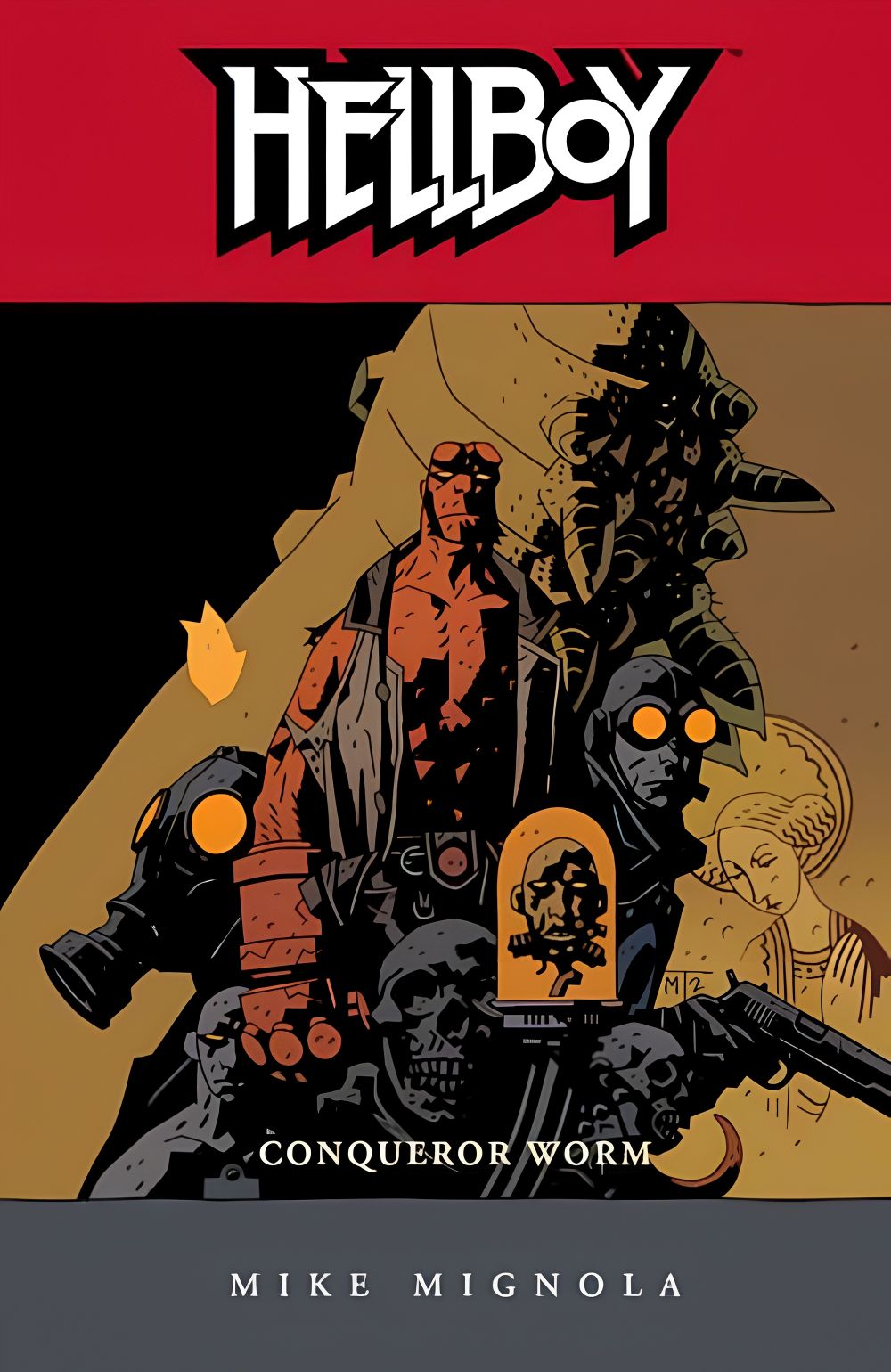
“You know, I’m not human either, remember? When are you guys gonna put a bomb on me?” — Hellboy
Mike Mignola’s Hellboy: Conqueror Worm takes the ingredients of an outrageous pulp adventure and gives them an unexpectedly bitter emotional center. There are Nazi scientists, a sinister castle, a spacecraft returning from the void, and a masked crimefighter whose unfinished business reaches beyond death. Yet the most disturbing thing in the book is not the creature threatening the world. It is the discovery that the people Hellboy works for can treat a friend as disposable equipment. Originally published as a four-issue miniseries in 2001, this is a particularly effective collision of supernatural spectacle and personal disillusionment.
Conqueror Worm continues Hellboy’s main storyline, building on the supernatural confrontations of Hellboy: Seed of Destruction and Hellboy: Wake the Devil while carrying forward Roger’s development in Hellboy: Almost Colossus. It pushes the distinction between monstrous appearances and monstrous choices into more uncomfortable territory. It is relatively easy to recognize cruelty when an occultist practices it in a ruined castle. Recognizing the same moral failure inside an organization supposedly dedicated to protecting humanity is another matter. Mignola makes that recognition the story’s turning point without sacrificing the pleasure of watching Hellboy stumble through another spectacularly unpleasant assignment.
The premise is wonderfully lurid. In 1939, a Nazi space experiment sends a capsule beyond Earth, despite an assault on its Austrian launch site. Decades later, that capsule is coming back, apparently under intelligent control, toward Hunte Castle. The Bureau for Paranormal Research and Defense dispatches Hellboy and Roger to investigate. It is exactly the sort of setup that makes this series so appealing: a piece of wartime madness has survived long enough to become everybody else’s problem. The past does not stay buried here. Sometimes it falls out of the sky.
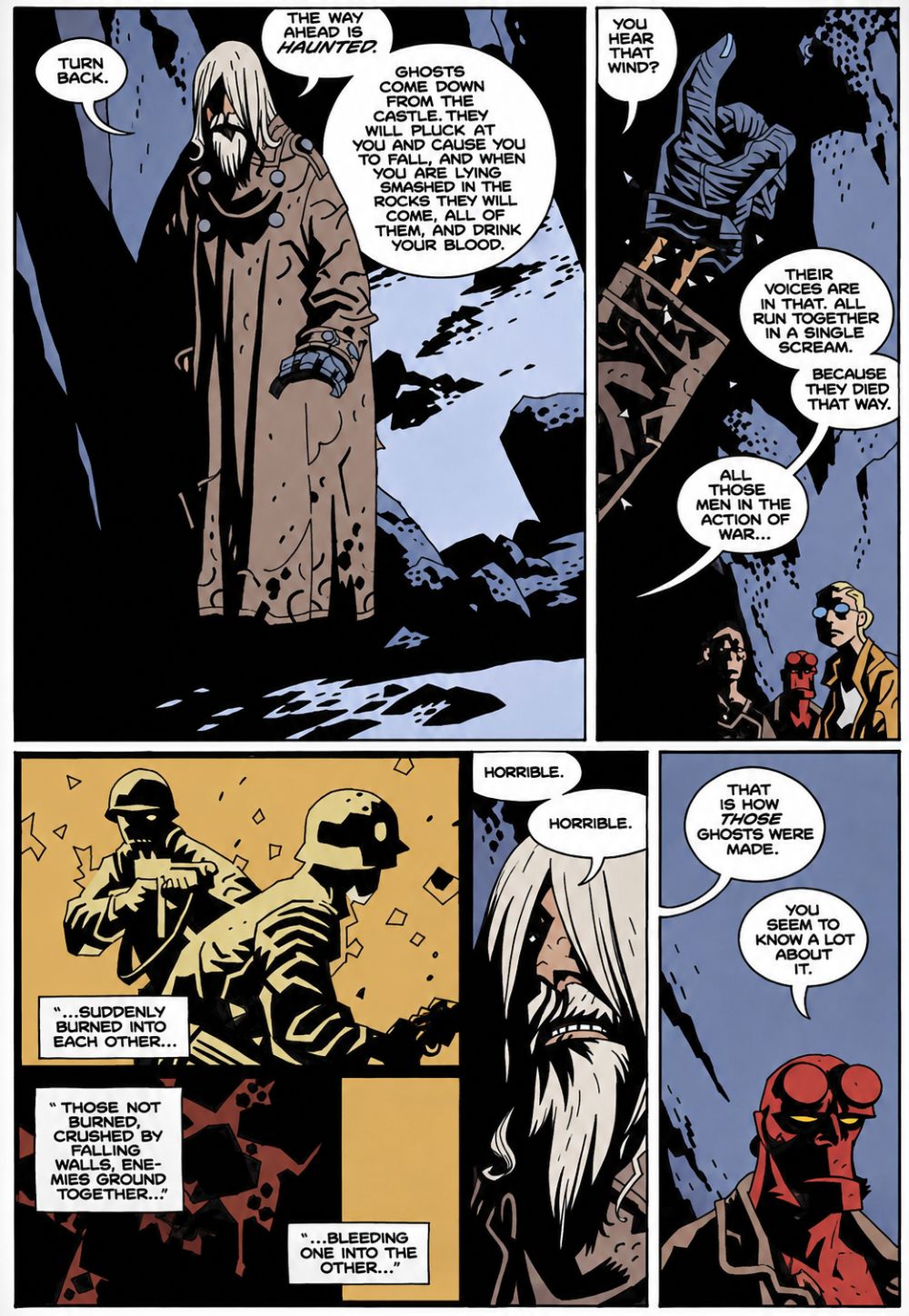
What makes the adventure work is Mignola’s refusal to separate its absurdity from its menace. Herman von Klempt, a surviving Nazi scientist reduced to a head in a container, belongs to a tradition of cheerfully grotesque adventure villains. So do the story’s monstrous henchmen and impossible machinery. None of that prevents the approaching catastrophe from feeling threatening. These ridiculous figures are dangerous because their appetite for control has outlived ordinary human limits. Their bodies have become grotesque extensions of ambitions that were already rotten.
Roger supplies the emotional counterweight. His presence beside Hellboy feels like a tentative step toward belonging, an opportunity to become something other than the unfortunate product of somebody else’s experiment. The Bureau, however, has implanted a bomb inside him and gives Hellboy the means to detonate it if necessary. That detail changes the temperature of the entire mission. Roger may be trusted to enter danger, but he is not trusted with the dignity of being treated as a person. His usefulness has earned him an assignment rather than acceptance.
Hellboy’s disgust matters because it exposes the difference between protecting people and managing assets. He does not need an elaborate philosophical argument to understand what is wrong with the arrangement. Roger is someone he knows, someone capable of fear, loyalty, and sacrifice. The Bureau’s precaution reduces all that complexity to a possible malfunction. Mignola makes the situation especially uncomfortable by allowing its institutional logic to remain recognizable. The bomb is presented as a safeguard, but that reassuring language cannot conceal the violence of the decision.
Lobster Johnson brings a different energy to the book. His goggles, severe silhouette, and uncompromising pursuit of evil could easily make him seem like a nostalgic accessory. Instead, his connection to the castle’s history gives the adventure a mournful undertow. He suggests an earlier age of pulp heroism that has not quite finished dying. His presence also broadens the book’s emotional register: this is not simply a mission into enemy territory, but an encounter with old failures and obligations that death has left unresolved.
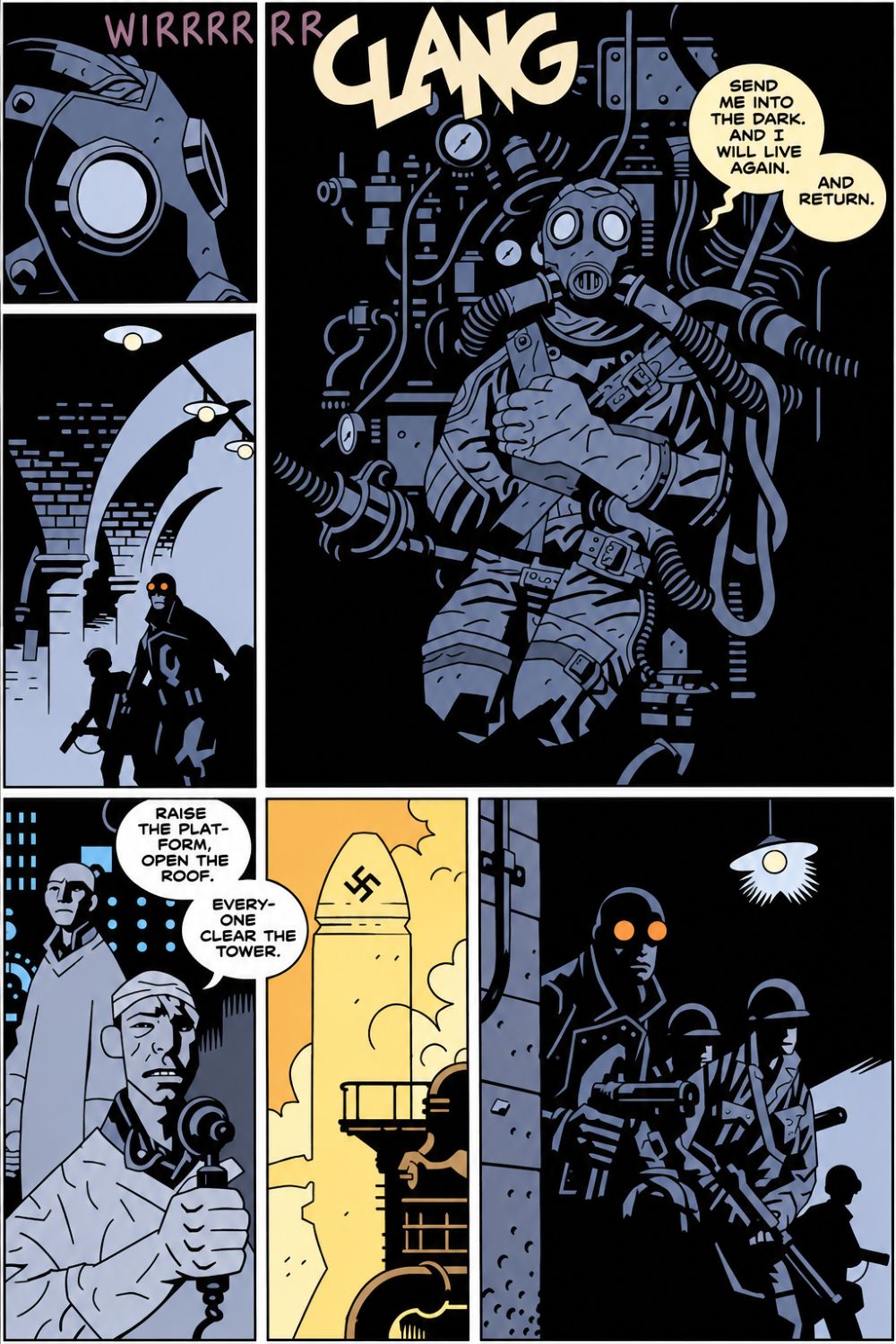
Mignola’s artwork makes those overlapping histories feel physically present. The castle is a collection of oppressive shapes, dark openings, and spaces that seem too large for the figures crossing them. His simplified forms do not diminish the horror; they give it clarity. A silhouette registers before its details do, allowing recognition and unease to arrive together. Dave Stewart’s coloring supports that control, separating figures and supernatural disturbances without dissolving the heavy blacks. Even when the imagery becomes extravagant, the pages retain a strong sense of visual order.
That restraint is valuable because the plot is crowded. Returning villains, occult history, cosmic threats, Roger’s predicament, and Lobster Johnson’s unfinished business compete for attention. Readers unfamiliar with the preceding stories may find some revelations more suggestive than satisfying. A few transitions move so briskly that the book seems eager to reach its next grotesque discovery. Still, the compression gives the adventure momentum, while the conflict over Roger supplies a clear emotional line through its accumulating mythology.
Hellboy: Conqueror Worm is at its best when its enormous supernatural stakes give way to something as simple as one character standing beside another. The Nazi experiments and approaching cosmic horror make for an entertaining nightmare, but Hellboy and Roger give that nightmare a human dimension. Mignola balances the ridiculous, the sinister, and the melancholy without letting any one quality overwhelm the others. The result is a lean, atmospheric adventure that also marks a meaningful change in Hellboy’s journey. He can confront another monster with his fists; deciding where he belongs requires something considerably harder.
Hellboy Saga

