4 Or More Shots From 4 Or More Films is just what it says it is, 4 shots from 4 of our favorite films. As opposed to the reviews and recaps that we usually post, 4 Shots From 4 Films lets the visuals do the talking!
Today, we celebrate the birth of director George Pan Cosmatos! It’s time for….
4 Shots From 4 George Pan Cosmatos Films
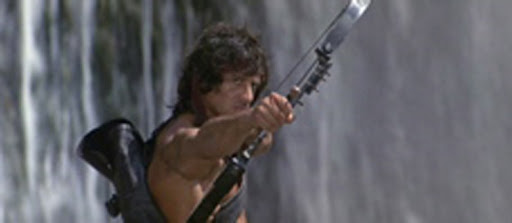
Rambo: First Blood Part II (1985, dir by George Pan Cosmatos, DP: Jack Cardiff)
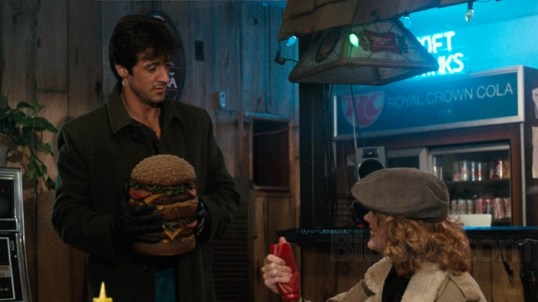
Cobra (1986, dir by George Pan Cosmatos, DP: Ric Waite)
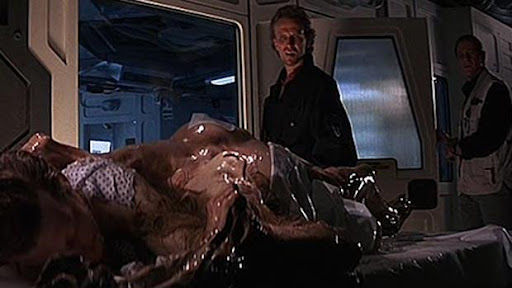
Leviathan (1989, dir by George Pan Cosmatos, DP: Alex Thomson)
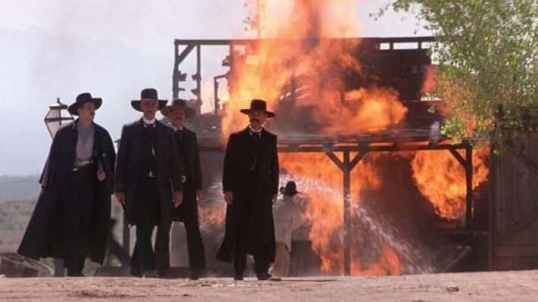
Tombstone (1993, dir by George Pan Cosmatos (and Kurt Russell), DP: William Fraker)
On this date, in 1941, future director George Pan Cosmatos was born in Italy. Cosmatos would go on to direct some of the most financially successfully (if critically lambasted) films of the 80s. He’s also credited as being the director on Tombstone, though it’s generally agreed that Cosmatos largely deferred to Kurt Russell on that film. (Cosmatos was a last minute replacement for the film’s original director.)
Other than Tombstone, Cosmatos is best-known for the films that he did with Sylvester Stallone. And today’s scene that I love comes from the 1986 film, Cobra. In this short but unforgettable scene, we get a chance to learn a little about the Cobra lifestyle. If you have any doubt that Cobra’s a badass, just wait until you see how eats a pizza. He handles his guns just as well as he handle a slice of Pepperoni and a pair of scissors. That Night Slasher better watch out!
First released in 1988, Tucker: The Man and His Dream is a biopic about Preston Tucker.
Tucker was an engineer in Detroit who went from designing vehicles for the Army during World War II to trying to launch his own car company. His ideas for an automobile don’t sound particularly radical today. He wanted every car to have seat belts. He wanted a windshield that popped out as a safety precaution. He want brake pads and he also wanted a car that looked sleek and aerodynamic, as opposed to the old boxy cars that were being pushed out be Detroit. He wanted a car that got good mileage and he wanted one that could be taken just about anywhere. Unfortunately, Tucker’s dreams were cut short when he was indicted for stock fraud, a prosecution that most people agree was a frame-up on behalf of the Big Three auto makers. Tucker was eventually acquitted but his car company went out of business. Of the 50 cars that Tucker did produce, 48 of them were still on the road and being driven forty years later.
The film stars Jeff Bridges as Preston Tucker, Joan Allen as his wife, Christian Slater and Corin Nemec as two of his sons, Lloyd Bridges as the senator who tried to take Tucker down, Martin Landau as Tucker’s business partner, and Dean Stockwell as Howard Hughes, who shows up for a few minutes to encourage Tucker to follow his dreams regardless of how much the government tries to stop him. One gets the feeling that the film was a personal one for director Francis Ford Coppola, a filmmaker who has pretty much spent his entire career fighting with studios while trying to bring his vision to the screen. Tucker fought for seat belts. Coppola fought for a mix of color and black-and-white in Rumble Fish. Tucker stood up for his business partner. Francis Ford Coppola stood up for Al Pacino when no one else could envision him as Michael Corleone. As is the case with many of Coppola’s films, Tucker: The Man And His Dream is a film that Coppola spent years trying to get made. It was the film that Coppola originally intended to be the follow-up to The Godfather, with Marlon Brando projected for the lead role of Tucker. After watching the Tucker, it’s hard not to feel that it worked out for the best that Coppola was not able to make the film in 1973. It’s impossible to imagine anyone other than Jeff Bridges in the role of Preston Tucker.
“Chase that tiger….chase that tiger….chase that tiger….” It’s a song that Tucker sings constantly throughout the film as the camera spins around him and how you react to Tucker: The Man And His Dream will largely depend on how tolerant you are of Coppola’s stylistic flourishes. Coppola directs the film as a combination of Disney fairy tale and film noir. The opening of the film, with Tucker running around in almost a manic state and excitedly telling everyone about his plans, is presented with vibrant colors and frequent smiles and an almost overwhelming air of cheerful optimism. As the film progresses and Tucker finds himself being targeted by both the government and the other auto companies, the film gets darker and the viewer starts to notice more and more shadows in the background. The moments of humor become less and less and there’s a heart-breaking moment where Martin Landau, in one of his best performances, reveals just how far the government will go to take down Tucker’s company. But, in the end, Tucker refuses to surrender and Jeff Bridges’s charming smile continues to fill the viewer with hope. The film becomes about more than just cars. It’s a film that celebrates all of the innovators who are willing to defy the establishment.
There’s a tendency to dismiss the majority of Coppola’s post-Apocalypse Now films. However, Tucker: The Man And His Dream is a later Coppola film that deserves to be remembered.
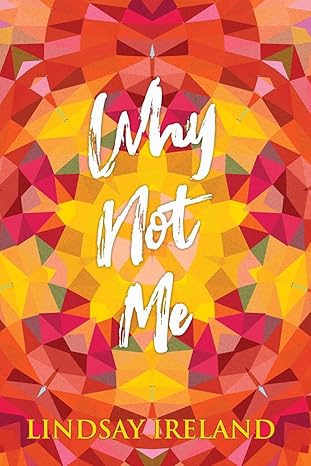
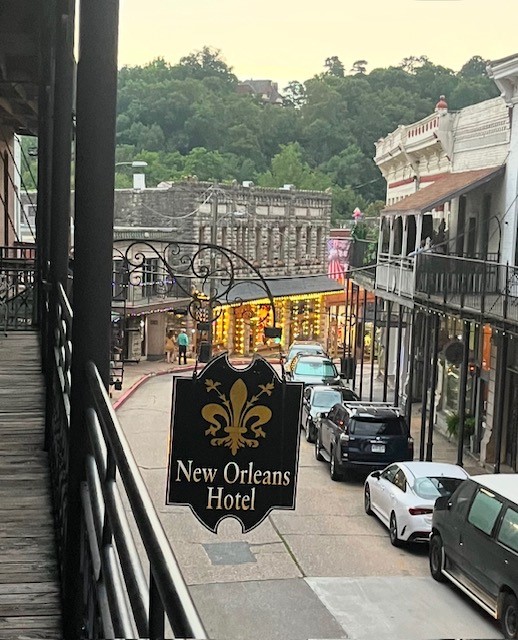
I don’t read that often for recreational purposes. When I do read, it’s usually books about my favorite actors, actresses, directors, or movies in general. But every now and then, a book will pique my interest, and I’ll pick it up. Back in the late spring of 2024, my partner on the “This Week in Charles Bronson” podcast, Eric Todd, made me aware of a book called WHY NOT ME, a memoir from Lindsay Ireland, the niece of Jill Ireland and Charles Bronson. Eric had made contact with Lindsay and the two had some preliminary discussion about her appearing on the podcast. Eric told me that she shared stories of her own life, which included her spending summers as a child on the Vermont ranch of her famous aunt and uncle. As a lifelong Bronson fan, it seemed the book could offer some valuable insight into the life of my movie hero. I figured I could spend some time trudging through Lindsay’s personal life if it allowed me to get those valuable nuggets of information on Bronson and Ireland. I went ahead and bought WHY NOT ME and took it with me when my wife, Sierra, and I were on a relaxing weekend in Eureka Springs, Arkansas. I settled in on the balcony of the New Orleans Hotel, which overlooks a section of the beautiful downtown area and started reading. Here’s a quick summary of the book taken directly from Amazon:
“Lindsay Ireland enjoyed an idyllic childhood. She spent her summers in Vermont with her movie-star relatives where she rode horses, played detective with her cousin, and drank ice-cold lemonade. After the summer months, Lindsay returned to her loving family where her biggest worry was getting good grades in school. Then one day Lindsay noticed blood in her stool. Suddenly instead of carefree afternoons swimming in a lake or dressing her Barbie doll, Lindsay spent months in a sterile hospital room receiving intravenous fluids and, eventually, a life-saving ostomy surgery. At age eleven, Lindsay was diagnosed with her first autoimmune disease, and her life was never the same. In this candid memoir, Lindsay evolves from a girl living with an autoimmune disease into a young woman struggling to love a body that has continuously failed her, and, eventually, into a mother and wife who has fought to make herself visible despite her invisible illnesses.”
As alluded to above, I was interested in WHY NOT ME because I wanted to read Lindsay Ireland’s stories about Charles Bronson & Jill Ireland. And I was certainly in awe as Lindsay spoke of her times with her Uncle Charlie, Aunt Jill and her cousins in Vermont. Reading about my movie hero from her perspective was something I appreciated tremendously. But what really blew me away with this book is how connected I became to Lindsay’s personal life events, struggles and triumphs. Lindsay funneled her memories and writings through a lens of “the power of perspective.” It’s through this perspective that Lindsay speaks of how important her family has been to her over the years as she’s faced the fear of serious health issues in both her childhood and again as an adult. She spoke of the importance of making a good match with a therapist, and how that has helped her over the years. She spoke of how important it has been for her to learn to speak of the difficult things in her life, even if they make her uncomfortable. Lindsay’s strength in writing is her ability to share her own insecurities, the ways that she has been able to overcome them, and then make you believe that you can overcome them to! I was able to relate to so many of the things she shared, and I can see how much my own life could have improved if I had done these things earlier.
The one thing that probably stuck with me the most, however, is when Lindsay spoke of how hard it was when she was dealing with some very difficult issues in her life, yet she felt unseen and unheard, even from those people who loved her, wanted the best for her and had good intentions. This is where I decided I need to make the most improvement in my own life. It seems we can get so caught up in our own feelings and concerns that the needs of others, even those we love, can be neglected. Sadly, I know that there are times that I don’t show the concern, empathy or compassion that I should to other people. After finishing WHY NOT ME, I am determined to make sure that the people I love never feel unseen or unheard, especially my wife. I fail at times, mainly because I can be a smartass, and my wife might even roll her eyes or tease me if she reads this, but I truly never want her to feel unseen or unheard again.
If you want to hear more directly from Lindsay, or maybe even hear me or my buddy Eric bare our own souls, I’ve attached our podcast episode again for your viewing / listening pleasure!
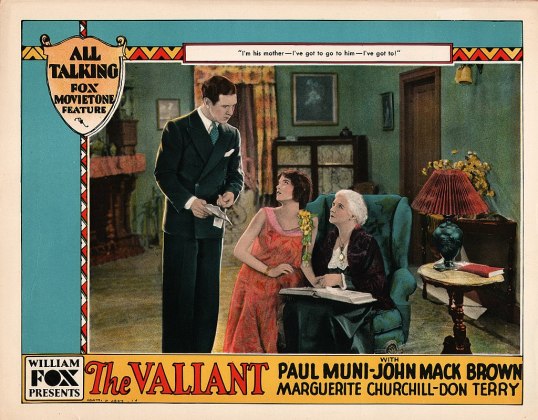
In the days after World War I, a man (Paul Muni) stumbles out of an apartment building and then walks down to the local police station. He informs the officer on duty that he just shot a man. He refuses to explain why he shot the man and, when asked for his name, he identifies himself as James Dyke. The office notices a poster for “Dyke & Co.” on the wall and realizes that the man made up his name. The man is convicted and sentenced to be executed.
The years pass as the man waits for his execution date. He is a model prisoner, working hard in the garden and writing editorials for the newspapers in which he warns young readers about pursuing a life of crime. The money he makes, he puts into Liberty Bonds. He continues to refuse to tell anyone his first name.
In a small town, an old woman (Edith Yorke) sits in her rocking chair and has visions of all the men who went to war and never returned. When the woman sees a picture of James Dyke in a newspaper, she thinks that he looks like her son, Joe, who long ago went missing. The woman’s daughter, Mary (Marguerite Churhill), realizes that her mother is planning to make the trip to the prison to see him before he is executed. Mary decides to go herself. She tells her fiancé (John Mack Brown) that she could never get married if it turned out her brother was a murderer. Meanwhile, the old woman continues to have visions of soldiers marching to war.
At the prison, James Dyke tells Mary that he has no family and he has no past. But he did serve in World War I and during that time, he met her brother and he saw him die heroically in battle. Dyke tells her to write to the army for the details of her brother’s death but to be aware that they might not even know whether or not he actually served because the war was such a confusing time that “they don’t know what happened to half the men out there.” Dyke and Mary continue to talk as the hour of execution draws near….
An adaptation of a one-act play, The Valiant was released in 1929, at a time when America was still coming to terms with the horror of the Great War and Hollywood was still trying to adjust to the arrival of sound. Though many had assumed that sound films would just be a fad, it turned out that audiences really did like to hear the dialogue as opposed to just reading it. The Valiant is the type of melodrama that was popular during the silent era and the film does feature title cards that appear between scenes. “A city street — where laughter and tragedy rub elbows,” one card reads. Another one announces, “Civilization demands its toll.” At the same time, it is a sound picture. The first five minutes of the film are just the Man walking through the city and listening to the sound of cars honking and people talking. Like many of the early sounds films, it’s obvious that the majority of the cast was not quite sure how they should handle delivering their dialogue. Some people talk too loudly. Some talk too softly. Quite a few deliver their dialogue stiffly and without emotion. Others use way too much emotion.
The only actor who seems to be fully confident in his ability to perform with sound is Paul Muni, making his screen debut in the lead role. Muni gives a strong and empathetic performance, one that makes even the most melodramatic of dialogue feel naturalistic. Muni shows an instinctive knowledge of how to deliver his lines with emotion without going over the top, which was a skill that many of the actors who tried to make the transition to sounds films never learned. Paul Muni was the first great actor of the sound era, as well as one of the first screen actors to use what would eventually become known as the Method. Among the actors who were directly inspired by Muni were John Garfield, Montgomery Clift, and Marlon Brando. Much of modern acting owes a huge debt to the work of Paul Muni.
Seen today, the contrast between Paul Muni’s performance and the film’s staginess can make The Valiant seem like a rather surreal film. While Muni captures the screen and confidently delivers his lines, everyone else seems hesitant and unsure of how to reply. The end result is that, to modern audiences, The Valiant can almost seem like a filmed dream. From the shot of Muni walking down the noisy city street to the sudden appearance of a swing band playing in the prison cafeteria, the film can seem almost Lynchian in its oddness.
The Valiant was a box office success and, according to the notes in the Academy archives, Paul Muni was among the actors considered for the second Best Actor Oscar. (That year, there were no official nominations and only the winners were announced.) The Oscar went to Warner Baxter for In Old Arizona but Muni would go on to have an amazing career.
First off, we’ve got the trailer for Head, starring the Monkees! This film was co-written by Jack Nicholson.
2. The Great Rock and Roll Swindle (1980)
In the first film that Julien Temple made about the history of the Sex Pistols, Malcolm McLaren presents himself as being the genius behind the group and tries to keep viewers from noticing that Johnny Rotten refused to have anything to do with the film.
3.Stunt Rock (1978)
I know next to nothing about this film but it was directed by Brian Trenchard-Smith and that’s often a good sign.
4, Sgt. Pepper’s Lonely Hearts Club Band (1978)
Featuring Donald Pleasence singing the longest version of I Want You ever recorded!
5. The Decline of Western Civilization (1981)
From director Penelope Spheeris comes the ultimate documentary about 1980s Los Angeles punk rock.
6. The Decline of Western Civilization Part 2: The Metal Years (1988)
Director Harmony Korine is 52 years old today. In honor of his birthday, today’s music video of the day is for a song and a music video that was inspired by Korine’s work as a filmmaker. So, watch this and then you can start having that dream again.
Welcome to Late Night Retro Television Reviews, a feature where we review some of our favorite and least favorite shows of the past! On Fridays, I will be reviewing Friday the 13th: The Series, a show which ran in syndication from 1987 to 1990. The entire series can be found on YouTube!
This week, we meet Johnny Ventura!
Episode 2.22 “Wedding Bell Blues”
(Dir by Jorge Montesi, originally aired on May 15th, 1989)
With Ryan and Jack out of town, it falls to Micki to retrieve a cursed pool cue stick. Helping her out, despite all of her attempts to convince him to get lost, is Johnny Ventura (Steve Monarque), a friend of Ryan’s who Ryan hired to help search for the cue stick. Even after Johnny finds out that the item has been cursed by Satan and Micki’s entire life currently revolves around supernatural violence, Johnny wants to not only help out but to also stick around, just because he likes Micki. Micki might want to tell him about all of her previous boyfriends who have all died as a result of getting involved in the search for cursed antiques.
I understand that Johnny is going to eventually replace Ryan on the show, starting with the third season. This episode isn’t particularly subtle about setting Johnny up as a Ryan substitute, though Johnny’s crush on Micki is a bit less cringey than Ryan’s. (Ryan is Micki’s cousin, which is something that the show often seems to overlook.) Johnny is established as being a cocky guy who is willing to break the rules. In other words, he’s just like every other guy who has ever been a lead character on a show like this. One of the stranger things about Johnny is that everyone keeps referring to him as being a “kid,” even though he looks like he’s older than just about everyone else on the show.
As for the cursed pool cue, it belongs to Jennifer (Elizabeth Maclellan), a waitress at a seedy bar. She wants to marry Danny (Louis Ferreira), a self-centered pool player who treats her terribly. Jennifer is convinced that Danny is just worried about winning the upcoming pool tournament so she impales people with the cursed pool cue. Each time Jennifer kills someone, the next game that Danny plays is his best ever. Jennifer is slightly sympathetic because she’s convinced that Danny will marry her right after he wins the tournament and she’s too insecure to see what a cad he is. (She’s also pregnant, though Danny doesn’t know it.) When Jennifer’s sister (played, in a very early role, by Lolita Davidovich) says that Danny is never going to marry her, Jennifer refuses to believe it. When Jennifer discovers that her sister is sleeping with Danny, Jennifer has found her next victim.
It’s really not that interesting of a curse but then again, this episode is more concerned with introducing the character of Johnny Ventura than with anything else. Unfortunately, at least in this episode, Johnny really isn’t that compelling of a character. This was a bit of a disappointing episode but who knows? Maybe Johnny Ventura will grow on me.
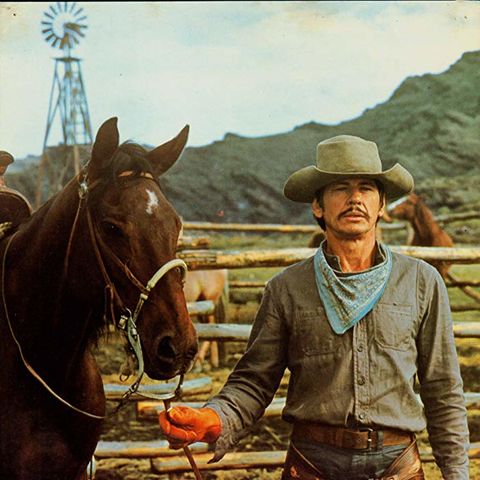
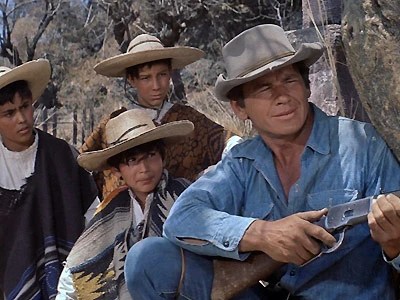
Director John Sturges was born on January 3rd, 1910. He directed some of my favorite movies, and many of them starred my movie hero, Charles Bronson. The picture above is from 1973’s CHINO!
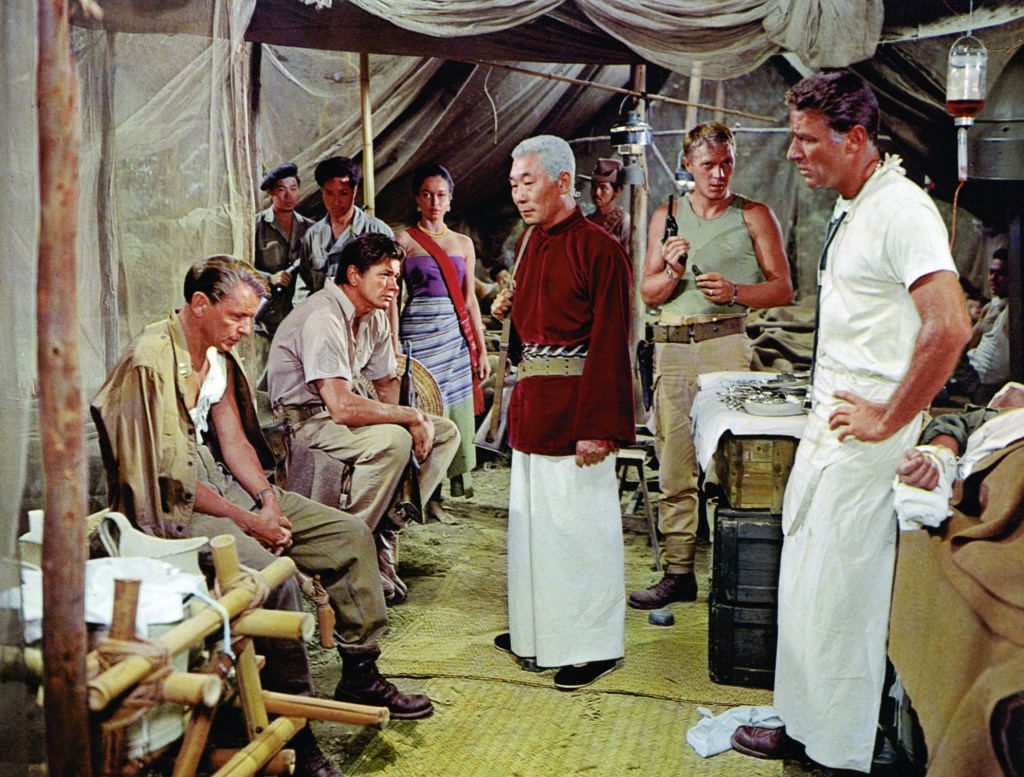
Charles Bronson’s second role in a film was in Sturges’ THE PEOPLE AGAINST O’HARA from 1951, starring Spencer Tracy. The picture below isn’t a very good picture as Bronson was only in one scene. Can you spot Bronson??
In 1959, Sturges would direct Charles Bronson in NEVER SO FEW, which co-starred Frank Sinatra and Steve McQueen.
Just a year later in 1960, Sturges would direct Bronson and an all star cast that included Yul Brynner, Steve McQueen, James Coburn and Robert Vaughn in THE MAGNIFICENT SEVEN, a remade of the Akira Kurosawa classic THE SEVEN SAMURAI. Bronson’s role as Bernardo O’Reilly is one of the best in the entire film.
John Sturges would direct Charles Bronson again in 1963 in the classic film THE GREAT ESCAPE, which also starred Richard Attenborough, Steve McQueen, James Garner, James Coburn and Donald Pleasence. Charles Bronson drew on his experience in the coal mines of Pennsylvania when he played “The Tunnel King” in the classic World War II film. Charles Bronson is one of the characters who actually escapes, which made me very happy!
John Sturges would direct Charles Bronson one more time in the underrated western from 1973, CHINO (pictured at the top). Sturges was a phenomenal director, and Charles Bronson was in some of his very best work! As Charles Bronson’s biggest fan, Sturges will always be one of my favorite directors!!






 Through the Shattered Lens