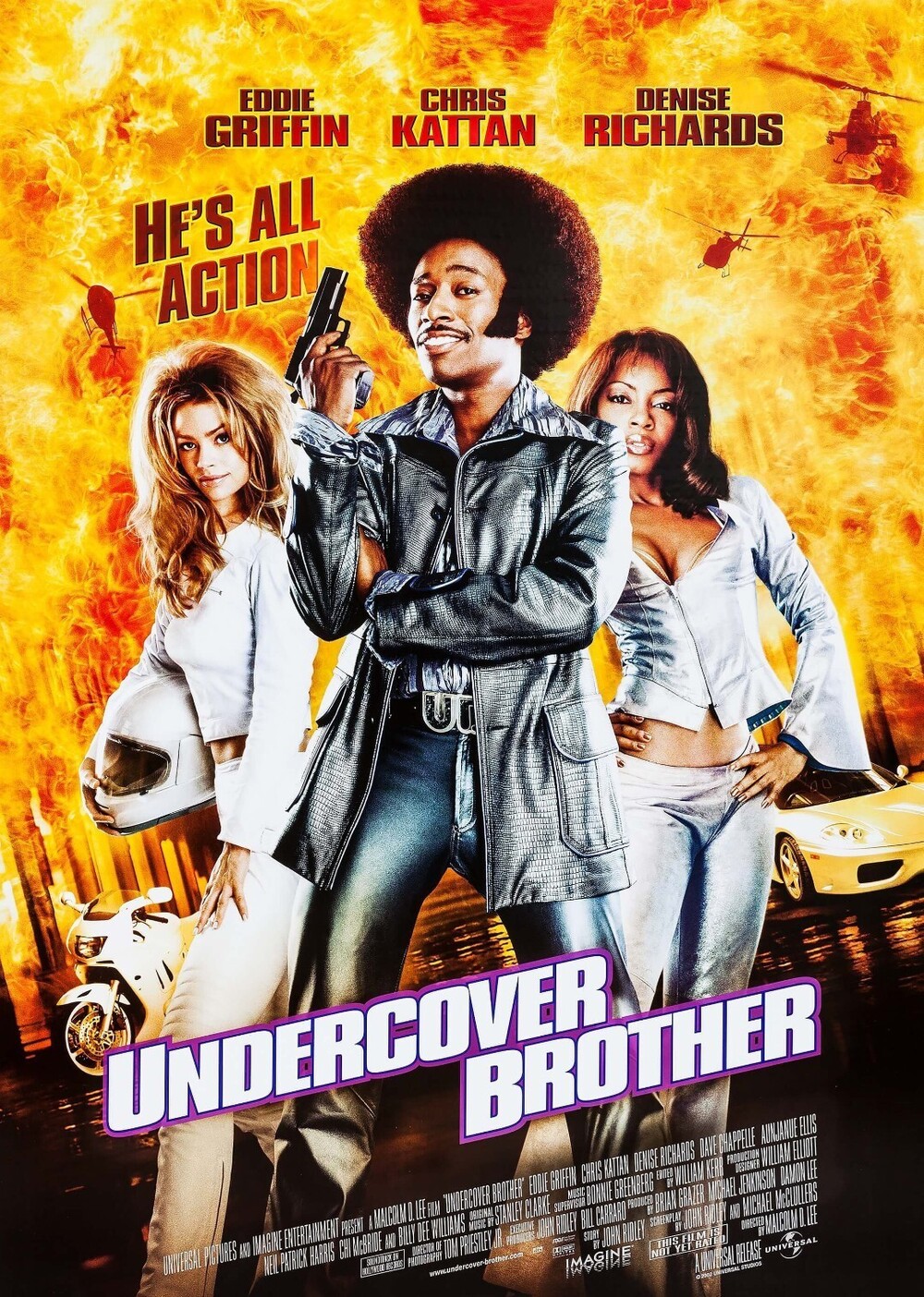
Undercover Brother is exactly the kind of movie that earns the phrase “guilty pleasure.” It is messy, broad, and often ridiculous, but it is also packed with enough energy, attitude, and sharp-enough satire to make its flaws feel like part of the joke rather than dealbreakers. The result is a comedy that may not always land cleanly, but it absolutely understands its own vibe and commits to it hard.
At the center of it all is Eddie Griffin, who gives the title character a big, swaggering, old-school cool that carries the movie through its shaggier patches. He plays Undercover Brother as a throwback spy hero with a giant Afro, loud fashion sense, and nonstop confidence, and that exaggerated persona is a big reason the film works as well as it does. Griffin’s performance is not subtle, but subtlety is not really the point here; he sells the movie’s cartoonish energy without making it feel lazy.
What makes Undercover Brother more than just a random parody is how committed it is to poking at both blaxploitation iconography and mainstream spy-movie clichés. The film was directed by Malcolm D. Lee and written from material based on John Ridley’s earlier animated series, and it leans into that satirical roots-and-gadgets formula with a lot of style. It clearly wants to be playful, but it also wants to say something about race, image, and the way Black identity gets packaged or watered down in pop culture.
That said, the movie is not exactly a model of precision. Some of the jokes are sharp and immediate, while others feel like they are still revving the engine long after the punchline should have arrived. The plot is basically an excuse to move from one set piece to another, and the film knows it, which helps, but it also means the whole thing can feel more like a high-speed sketch comedy than a fully shaped story. If you go in expecting airtight narrative logic, you will probably be annoyed; if you go in wanting a fast, funky send-up, you will have a much better time.
The supporting cast gives the movie a lot of its flavor. Dave Chappelle, Aunjanue Ellis, Billy Dee Williams, Chris Kattan, Denise Richards, and Neil Patrick Harris all add to the film’s chaotic mix, and the casting itself becomes part of the joke. Billy Dee Williams especially feels perfectly placed in a movie that is constantly riffing on cool, style, and old-school charisma, while Denise Richards gets a knowingly exaggerated role that plays into the film’s cartoonish battle between seduction and resistance.
What helps Undercover Brother age a little better than some early-2000s comedies is that it is not just throwing random nonsense at the screen for cheap laughs. There is a genuine satirical target here, and even when the movie gets clumsy, it still feels like it has a point of view. The movie clearly aims to be both goofy and observant, and even when the balance is uneven, it is hard not to appreciate the effort.
The best thing about Undercover Brother is its attitude. It moves like a movie that wants to be loud, stylish, and a little bit too much, and that confidence gives it a strange charm. The humor is often broad, sometimes cartoonish, and occasionally uneven, but the film’s willingness to fully commit to its bit makes it easy to forgive a lot. Even when the satire is more enthusiastic than elegant, the movie keeps its foot on the gas, and that momentum is a big part of its appeal.
Its biggest weakness is also the thing that makes it memorable: the movie can feel overstuffed with ideas, references, and gags, some of which work better than others. A few jokes feel a little dated now, and the film’s style of satire is not always as clean or as clever as it seems to think it is. Still, the movie has enough bite, personality, and goofy confidence that those rough edges become part of its charm instead of sinking it. That is the hallmark of a true guilty pleasure: you can see the flaws clearly, but you keep smiling anyway.
So Undercover Brother is not a perfect comedy, and it is not trying to be one. It is loud, silly, politically aware in a very pop-movie way, and shamelessly committed to its own funk. If you want polish, you will find plenty to criticize; if you want a movie with attitude, quotable energy, and the kind of swagger that makes its imperfections oddly lovable, this one delivers. It is a flawed satire, sure, but it is also a genuinely fun one, and that is why it still plays like a guilty pleasure worth revisiting.
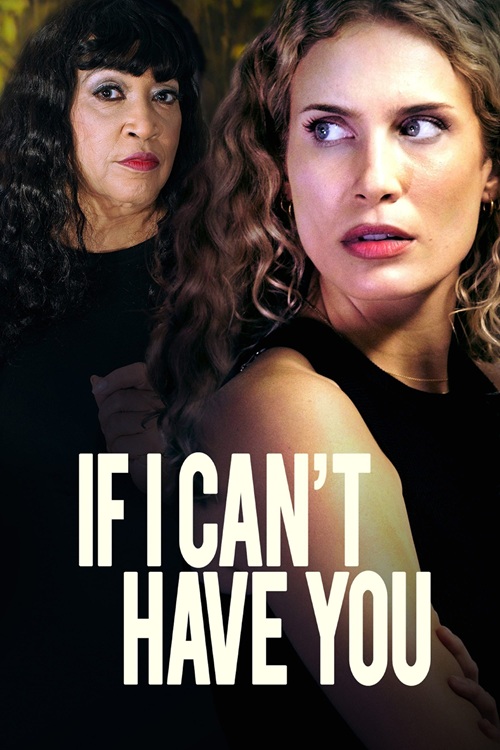
In 2023’s If I Can’t Have You, Michelle (Bailey Kai) is the host of the hottest late night radio show in town but she’s been getting creepy phone calls from someone identifying himself as Curtis. Michelle and her producer (Gina Haraizumi) can’t get get any help from the cops (played by Jackee Harry and Tracy Nelson) so they decide to investigate on their own.
Who is Michelle’s stalker? Could it be the creepy guy (Michael Pare) who lives next door? Could it be their geeky engineer, Keith (Phillip McElroy)? Could it be Stan (Eric Roberts), the owner of the radio station who seems to be really determined to get them to change their time slot? Or could it be just some other random guy with too much time on his hands?
To give credit where credit is due, director David DeCoteau does manage to generate some suspense as to who the stalker actually is. I wouldn’t say I was exactly shocked when the stalker’s identity was revealed but DeCoteau still did a good job of giving us plenty of suspects to consider. That said, this is still a David DeCoteau film and the real pleasure of the film is spotting all of the standard DeCoteauisms. In this case, Joe’s Restaurant — previously seen in The Wrong Mr. Right — makes a return appearance.
In the end, this one isn’t as much fun as DeCoteau’s “Wrong” films. There’s no Vivica A. Fox saying, “Looks like you suspected the Wrong Stalker.” Still, it’s entertaining enough and Eric Roberts appears to have been in a good mood during filming.
Previous Eric Roberts Films That We Have Reviewed:
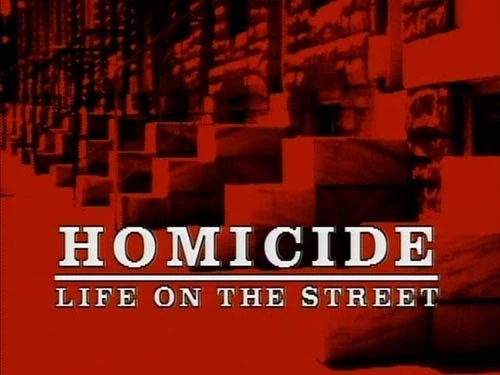
Welcome to Retro Television Reviews, a feature where we review some of our favorite and least favorite shows of the past! On Sundays, I will be reviewing Homicide: Life On The Street, which aired from 1993 to 1999, on NBC! It can be viewed on Peacock.
This week, drug lord Luther Mahoney returns.
Episode 5.4 “Bad Medicine”
(Dir by Kenneth Fink, originally aired on October 25th, 1996)
Someone is selling bad heroin in Baltimore. This episode opens with a montage of dead junkies being discovered. Detective Munch explains to a uniformed cop why he has to stick around until it’s firmly established that the latest dead junkie died of an overdose and not something like a hit to the back of the head. Munch says that everything he knows, he learned from his ex-partner. Hey, Munch, Bolander’s not coming back! You have to accept it.
Things are looking grim for Giardello’s detectives. Megan Russert has run off to Europe. Bolander is retired. Felton is missing. Frank is recovering from his stroke and still needs to pass his firearms exam. And now, Kellerman has been accused of taking bribes while working as an arson investigator. Kellerman is given desk duty, which means that he can’t help Lewis pursue drug kingpin Luther Mahoney (Erik Todd Dellums).
Mahoney returns in this episode, dragged into the box and accused of murdering a rival dealer. Mahoney is his usual smug snake self but Lewis and his temporary partner, Narcotics Detective Terri Stivers (Toni Lewis), are convinced that they’ve finally got him where they want him. First off, there’s a junkie who has been bullied into informing on Luther. Plus, Luther slips up and reveals that he knew some facts about the murder that were not released to the press. Is Luther Mahoney going down!?
Well, don’t get too excited. Ed Danvers informs them that their evidence isn’t enough to get a conviction. Juries don’t trust junkies. Luther could have heard the details of the murder on the street. Everyone knows that Luther is guilty but no one can prove it beyond a reasonable doubt. Luther goes free and the informant ends up dead.
Meanwhile, Frank Pambleton stops taking his medicine so that he can concentrate on passing his firearms exam. He still fails. Even though he was able to hit the target, he took too long reloading his gun. Pembleton starts to take his medicine again.
Finally, Brodie still doesn’t have anywhere to live. He stayed with Munch for one night and then voluntarily left. (The reasons why are left ambiguous but it’s suggested that Brodie came across Munch’s private drug stash and freaked out.) Brodie moves in with Bayliss and quickly makes things awkward by overanalyzing the Mighty Mouse cartoon that Bayliss is watching. Brodie explains that Mighty Mouse is an agent of chaos and Bayliss looks like he’s already realized this living arrangement is not going to work.
This was a properly cynical episode, one where the main theme seemed to be that our heroes are fighting a losing war. Giardello is running low on detectives. Kellerman is put on desk duty because of one weak accusation. Pembleton has to pass a firearms exam, despite rarely having to draw his gun. In the end, men like Luther Mahoney walk free while the addicts caught in-between end up dead in the street.
Bette Davis was born 108 years ago today. Today’s song of the day just feels right.
Her hair is Harlow gold Her lips a sweet surprise Her hands are never cold She’s got Bette Davis eyes
She’ll turn her music on you You won’t have to think twice She’s pure as New York snow She got Bette Davis eyes
And she’ll tease you, she’ll unease you All the better just to please you She’s precocious, and she knows just what it Takes to make a pro blush She got Greta Garbo’s standoff sighs, she’s got Bette Davis eyes
She’ll let you take her home It whets her appetite She’ll lay you on a throne She got Bette Davis eyes
She’ll take a tumble on you Roll you like you were dice Until you come out blue She’s got Bette Davis eyes
She’ll expose you, when she snows you Offer feed with the crumbs she throws you She’s ferocious and she knows just what it Takes to make a pro blush All the boys think she’s a spy, she’s got Bette Davis eyes
She’ll tease you, she’ll unease you All the better just to please you She’s precocious, and she knows just what it Takes to make a pro blush All the boys think she’s a spy, she’s got Bette Davis eyes
She’ll tease you She’ll unease you Just to please you She’s got Bette Davis eyes
She’ll expose you When she snows you ‘Cause she knows you, she’s got Bette Davis Eyes
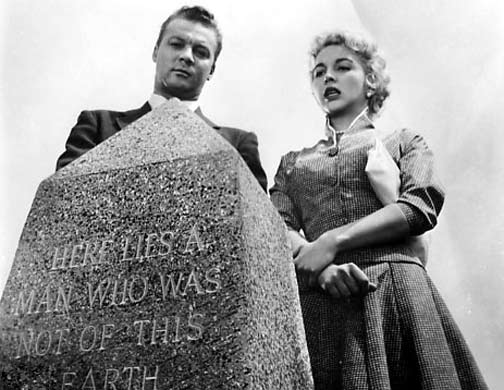
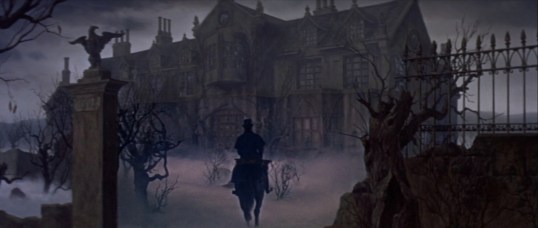
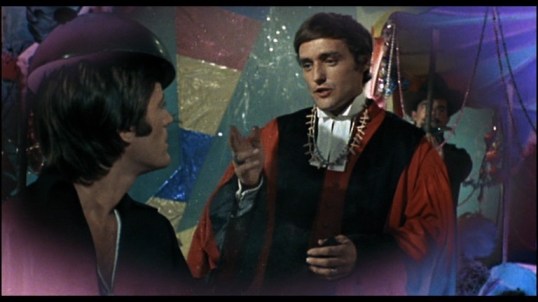
4 (or more) Shots From 4 (or more) Films is just what it says it is, 4 (or more) shots from 4 (or more) of our favorite films. As opposed to the reviews and recaps that we usually post, 4 (or more) Shots From 4 (or more) Films lets the visuals do the talking.
Today would have been the 100th birthday of the legendary filmmaker, Roger Corman! And that means that it’s time for….
4 Shots From 4 Roger Corman Films
Not Of This Earth (1957, dir by Roger Corman, DP; John J. Mescall)
House of Usher (1960, dir by Roger Corman, DP: Floyd Crosby)
The Masque of the Red Death (1964, dir by Roger Corman, DP: Nicolas Roeg)
The Trip (1967, dir by Roger Corman, DP: Archie Dalzell)
This picture, a favorite of mine, is from many years ago. The original photograph was taken behind an abandoned Albertson’s, which has since been torn down and replaced by a Gold’s Gym. The picture is entitled Faith but it’s not just about religious faith. It’s about having faith in anything and how that faith can help us both get through the bad times and appreciate the good times.





 Through the Shattered Lens