Continuing my series on the best of 2011, here are ten of my favorite songs from 2011. Now, I’m not necessarily saying that these were the best songs of 2011. Some of them aren’t. But these are ten songs that, in the future, will define 2011 for me personally. Again, these are my picks and my picks only. So, if you think my taste in music sucks (and, admittedly, quite a few people do), direct your scorn at me and not at anyone else who writes for the Shattered Lens.
By the way, I was recently asked what my criteria for a good song was. Honestly, the main thing I look for in a song is 1) can I dance to it and 2) can I get all into singing it while I’m stuck in traffic or in the shower?
Anyway, at the risk of revealing just how much of a dork I truly am, here are ten of my favorite songs of 2011.
1) What The Water Gave Me (performed by Florence + The Machine)
Musically, 2011 was a good year for me because it’s the year that I first discovered Florence + The Machine.
2) Only In My Double Mind (performed by Centro-Matic)
This is a great song from one of the best bands to come out of North Texas.
3) Man or Muppet (performed by Jason Segal and Walter)
Featuring lyrics from the brilliant Bret McKenzie.This song makes me cry every time.
4) Immigrant Song (performed by Karen O, Trent Reznor, and Atticus Ross)
Say what you will about David Fincher’s rehash of The Girl With The Dragon Tattoo, it had a good soundtrack. This cover of Immigrant Song made the film’s first trailer bearable. Unfortunately, it wasn’t really featured in subsequent trailers, being replaced by Daniel Craig going, “I want YOU to HELP ME catch a KILLER of WOMEN.”
5) Friday (performed by Rebecca Black)
Yeah, yeah, I know. It’s a terrible song and you know what? That’s why I can’t help but love it. Listen, there are thousands of terrible song released every year but there are none quite as a terrible as Friday. The genius of Friday is that it took everything that we associate with terrible music — nonsensical lyrics, insane autotune, a socially irresponsible message, creepy rappers who show up out of nowhere and for no good reason — and then just smashed it all together into the YouTube video that refused to die. Add to that, a few months ago, me and my BFF Evelyn got like totally drunk and then wandered around the streets of Dallas singing this song at the top of our lungs and I swear, every guy who passed by yelled words of encouragement at us.
(And, by the way, if you’re going to hate someone, hate on Fred Phelps. Leave Rebecca Black alone. Life’s too short.)
6) Hold it Against Me (performed by Britney Spears)
Yeah, yeah, I know. Everyone loves to hate on Britney blah blah blah. This song is fun to sing in the shower and you can dance to it. And, quite frankly, that’s all I need.
7) Beard (performed by Burning Hotels)
This is from another North Texas band.
8) Fucking Perfect (performed by Pink)
An anthem. (Yes, I know this song came out in 2010 but it was important to me in 2011 so I’m listing it here now. So there.)
9) Love Is The Drug (performed by Oscar Isaac and Carla Gugino)
From the Sucker Punch soundtrack comes this sneakily subversive cover.
10) No Light, No Light (performed by Florence + The Machine)
Finally, what better way to end this list than with some more of Florence + The Machine.
Finally, I want to close this list with a song that came out long before 2011 but it’s an important song to me and it was sung by someone who we lost far too early this year.
Coming tomorrow: ten of the best things I saw on television in 2011.
It’s not really a coincidence that the two genres of music I’ve listened to most over the years are black metal and post-rock. Something about tremolo guitar very consistently inspires me, and these are the two styles that most frequently and effectively utilize it. But post-rock is one of the most diverse styles of music on the market, and if it employs techniques found in black metal to capture its most intense moments, its other reaches are inexhaustible. It’s characterized more by the effect it produces in the listener than by the means it employs towards this end, and tremolo guitar just happens to be the best–certainly not the only–technique suited for it. The effect it produces is, you might say, a general sense of awe.
When we speak of post-black metal we’re suggesting a branching out from something that is much more locked in place. Technically black metal means tremolo guitar and blast beats, plain and simple. Thematically it goes a bit beyond post-rock, exploring and reveling in a very wide array of human emotions which, to conform to a cultural misconception, might be generally described as negative. Sometimes a post-black metal tag suggests bands that break out from tremolo and blast beats but stick to the same “negative” themes, as in say, Agalloch. Sometimes a post-black metal tag suggests something more like “progressive black metal” which finds creative new ways to employ blast beats and tremolo picking, like Ihsahn or Krallice.
Obviously musical classifications are dubious, sometimes illogical, and only really practical as a shorthand for “you might like this band if you like x”. But with a great deal of discretion they may also be employed to track the general evolution of music–the emergence of new methods and themes, the passive and active influences of any of these upon another, etc–and to predict where it is headed next.
Violet
Deafheaven are a brand new band out of San Francisco. They haven’t been releasing demo tapes unnoticed for a decade like a lot of “new” bands; they only just formed in 2010, and Roads to Judah is their debut album. It was the logical next album for me to review, in a sense. I love Krallice, I was told if you like Krallice check out Liturgy, Liturgy’s popularity lead me to reconsider Wolves in the Throne Room, and a broader consideration for “popular” black metal meant the next band to listen to was Deafheaven. (I would imagine I’ll be completing this path by checking out Ash Borer some time next week.)
Now, stylistically none of these four bands have very much in common. Furthermore, I am standing by my opinion that Wolves in the Throne Room are overrated, mediocre, and generic. But Krallice, Liturgy, and Deafheaven all deserve acute attention. Each, in very different ways, is completely redefining black metal. Krallice are doing so by pretty much perfecting everything I’ve ever loved about the style. Liturgy are doing so by embracing a subtle theme within it. Deafheaven, the band I am exploring now, are something of a grand amalgamation of pre-existing genres of music which have often shaken hands but never before so fully embraced each other. As regards my opening observations, they could just as easily be described as “blackened post-rock” as “post-black metal.”
I think the significance of this has been obscured by people calling them shoegaze black metal. Yes, one of their guitarists, Nick Bassett, was in a shoegaze band prior to Deafheaven (Whirr), but you can’t honestly tell me you hear it in this music. Post-rock is greatly in debt to shoegaze in a lot of ways, but it’s not the same thing, and you can’t tell me this sounds more like The Jesus and Mary Chain than Mono. Not that shoegaze black metal isn’t itself a creative new genre, the fact that Alcest already did it (though Neige denies any direct influence) and a lot of bands copies him drastically downplays its significance. But calling Deafheaven shoegaze is like calling it classic rock, because, you know, somewhere down the line The Who influenced metal. No, this is an amalgamation of post-rock and black metal. That is why it’s on the cutting edge. That is why there’s no obvious term with which to describe it.
I’m not sure exactly what all to take from it. Violet doesn’t inspire me in the way that a lot of black metal does, but that’s not to say it falls short. I almost want to say I’d have to see them live to fully appreciate them. I mean, very few post-rock bands deliver on their studio albums. With the exceptions of Explosions in the Sky and Godspeed! You Black Emperor I almost always have to see a post-rock band in concert to appreciate them, and even then no matter how much they blow me away I don’t necessarily enjoy their albums. I get the same vibe from the four opening minutes of Violet that I get from bands like Mono and This Will Destroy You–a pleasant bore through my stereo and a total mindfuck live. You have to feel this sort of music encompassing you and see the musicians creating it to fully take it in.
Language Games
The second track, Language Games, is much more accessible and immediately appealing. What’s more, it progresses into something which feels an awful lot like screamo to me, most notably in the emotionally tortured screams laid over a simple undistorted melody at 3:50 and the drum roll that follows. I wouldn’t be the first to describe Deafheaven as a screamo black metal crossover, and they are, after all, on Converge frontman Jacob Bannon’s record label, Deathwish Inc. Am I then to call this blackened post-screamo? That’s fucking stupid. I think what you can really take from Deafheaven is something a little more inspiring. Like Liturgy, it is a grand realization of hidden trends growing within music in general, and as such it fits no “genre” tags at all until more bands come along that sound like it.
Whatever you want to call Liturgy’s sound, I’ve been pointing out signs of it for a while now, here in an Ulver song, there in an Alcest song, and many other places besides. As regards Deafheaven, black metal and post-rock have always shared a bit in common, and I would argue that screamo is no foreigner either. It’s a word I’ve been hesitantly coughing up to describe more and more black metal recently. Ars Poetica by Drudkh bewildered me with its likeness to Envy, I explicitly noted a post-rock/screamo vibe at the end of The Puritan’s Hand by Primordial, and I pointed out similarities in Altar of Plagues as well, to name a few. Deafheaven took up a growing theme and ran with it.
Unrequited
Deafheaven are definitely at the top of my bands to see live list, and Roads to Judah is an exceptional album, but it’s kind of a downer in so far as none of the tracks deeply move me. I can get into the vibe but I can’t latch on to any particular moment. It’s significance for me is more in what it accomplishes as the most pronounced and maintained example of a combination of stylistic crossovers long in the making.
But let’s end this on a cautionary note. To suggest black metal broke out of its shell in 2011 would be ridiculous. If I turn to Sagas by Equilibrium in 2008, Ballade cuntre lo Anemi francor by Peste Noire in 2009, Luna by Boris in that same year (the Chapter Ahead Being Fake split with Torche), or Blut aus Nord right now, I can find plenty of examples of older bands doing much more progressive (and impressive) things with black metal than what you’re hearing on Roads to Judah. Deafheaven (and Liturgy for that matter) feel pretty immature when competing in the big leagues. The uniqueness of these bands arises from their willingness to shout out something previously only whispered, not from their having perfected anything. (Mind you I am not suggesting they sound remotely similar.)
This act of shouting is only one of many features which have given rise to a lot of derision. With Deafheaven boldy embracing screamo, Liturgy sounding like the Neutral Milk Hotel of black metal, and both bands dressing like trendy assholes, it’s no wonder “hipster” denunciations are flying right and left. “Emo” and “black metal” go together like two gay cowboys at a Texas Republican convention. But really, the more we admit that black metal has always been a little emo the more we detract from the power of subtlety, and there’s some legitimate concern that their appearance is more likely to catch on than their performance. Liturgy and Deafheaven are both great, and some really shitty bands are going to follow in their wake. But it was there all along. This was all bound to happen.
I heard this band before you did. No, really. It was completely by accident, to be honest. I had just found out about Agalloch bassist Jason William Walton sideproject and indisputable worst band in existence Especially Likely Sloth. Youtube didn’t exist yet so I had to actually go to the Vendlus Records website, where they were really pushing preorders of Wolves in the Throne Room’s debut album. It was only like $8 so I threw it in the cart. Two years later I almost saw them live, opening for Jesu on their 2007 US tour. I thought it would be kind of cool, being the one kid in the house who had actually heard of them (I had no idea Southern Lord picked them up), but they made the mistake of scheduling all their Texas stops the exact same areas/days as Finntroll, and the opportunity to see the latter two days in a row won out.
Next thing I know they’re the most popular black metal band in the world. Go figure.
Thuja Magus Imperium
I guess what shocked me most about that was I never thought they were very good. I mean, I had heard Diadem of 12 Stars plenty of times, and to me they were just another black metal band, with no distinguishing features to speak of.
By the time I found out about their success though, they had just released a third album. I hadn’t heard about the second, I didn’t remember the first (because it is very forgettable), and I was not feeling up to the task of attentively engaging three albums which I didn’t have high hopes for. All of the hype was coming from outside of metal circles, and sure, Pitchfork has pushed good metal before (Mastodon for one outstanding example), but nine times out of ten their selections are borderline arbitrary–the first metal experience of ‘experts’ completely foreign to the genre or maybe even just the newest release from a record label helping to pay their bills. No, when metal bands become popular in non-metal crowds, it usually has nothing to do with their music.
Last week though, I heard Liturgy. Hyped by all of the same dubious sources, it was comparisons to Krallice and Hunter Hunt-Hendrix’s outlandish interview that ultimately compelled me, but in light of the fact that Aesthethica is fucking amazing, I thought it high time I gave a few other “Pitchfork metal” bands a try. For obvious reasons both in fame and personal experience, Wolves in the Throne Room were the first casualty.
I had Celestial Lineage on repeat for two solid days trying desperately to derive something, anything special and significant out of it. I couldn’t. At the surface they were the same generic status quo black metal act I heard demo recording samples of back in 2005. But as it always goes, when it came down to actually spelling out what in particular I found boring about them I finally found myself noticing some of the appeal. Not much, mind you, but a little bit.
Let’s look at this opening track. I hear a chick singing to some simple piano and synth, some basic tremolo lurking in the background–a mood setting introduction, like 50% of the genre. Nothing in particular sets it above average. I’m not really feeling it yet, still just hearing a recording studio session. The black metal fades out of the ambiance rather than exploding, and I like that. Once again, it’s nothing unique, but always an effective way of stating your intentions up front. There’s an obvious Agalloch influence, most distinct in the guitar solos, and by the time they end I’m definitely getting a dark, reflective vibe–nature themes, something really earthy. The transition back into a female chant, a synthy night sky with chime-spawned stars, a slow resurrection of guitar painting the celestial horizon in different shades of black, blotting out the stars in an auroral haze… It’s exceptionally visual, and it’s visual in a distinctly American way. You know: earth spirituality; something native to the soil; American folk metal, which possesses virtually no stylistic commonality with its pantheon-laden European namesake.
The second track is a two minute ambient piece, and I find it irritably overdone. It is accented by a vocal chant which just doesn’t fit the picture, and I think if they’d left that out it would have been perfect. At any rate, the third song explodes back into black metal.
Subterranean Initiation
This is what I remember forgetting about their first album: really generic black metal. A mix of second wave and Ukrainian sounds, it is moody and scene-setting only to the extent that all black metal is, and offers absolutely no leads as to what the band had in mind beyond “Ok dudes at this part let’s sound like Emperor or Drudkh or some shit, it’ll be cool.”
A little over 4 minutes in the song comes to a standstill, and the residual distortion and drums kind of scrape along in a not particularly coherent mishmash. Out of it emerges a shamefully obnoxious guitar hammering the same meh chords over and over and over (and over) and I would probably have shot myself at this point, but beneath it all the drummer is actually tearing it the fuck up with subtly accented blast beats that I found simultaneously intense and relaxing. The guitar eventually goes post-rock kind of out of nowhere and ends a mostly boring song on a pretty good note.
Astral Blood
I kind of wanted to end this on Woodland Cathedral, a 5+ minute ambient track that impressed me in ways similar to the latter half of the opening song, but since it’s mainly their black metal that I’ve been bashing, Astral Blood is probably the better choice. Here they do it right, and I never need to question their originality because I’m already too caught up in it to care. The mood sets in instantly, unleashing black metal’s potentially soothing effects–the sort of feel good in the cold contemplative darkness track that I like having on as a background piece. When the ambiance returns it’s gorgeous, and the song doesn’t really go down hill until 5:30 (at which point the guitar repeat is once again merely obnoxious), periodically recovering and digressing through to the end.
So, what’s the final verdict? On the surface, generic. In depth, too diverse for its own good. The first track, Thuja Magus Imperium, is really brilliant, but it is perhaps the only track I can say such things about. There is a fine line between meditative repetition and a broken record, and Wolves in the Throne Room seem pretty oblivious to it. What’s more, their fastest metal moments lack emotion and intensity, and their slowest lack subtlety. Their ambient tracks are nice, but they have a habit of overdoing them, especially vocally (including the female vocals at times), where once again a little subtlety could have saved the day. I was pretty impressed by the drummer the few times I tuned in to him, and perhaps another listen as attentive as the few I put in writing this would position me to praise him more thoroughly, but I am out of time and patience.
It’s because Celestial Lineage does possess a few moments of brilliance, however, that a thorough critique is even possible. The album as a whole is not at all generic in the sense of say, the new Demonaz album, and, while I might enjoy listening to that one slightly more, it’s got a lot less to appreciate. Celestial Lineage is only generic in its methods for creating complexity; it’s not generic at its core. But it is also nothing special, as I’d originally perceived.
Wolves in the Throne Room have reportedly claimed that their music is meant to be meditative rather than aggressive, and that they play black metal on their own terms. They’re fooling themselves with the latter claim, and while I’ll grant that it’s meditative, those non-metal fans who think it is exceptionally so simply have not experienced much of the genre.
Two months ago I thought I could actually finish reviewing every album I wanted to before it came time for the year-end lists. Then I got hooked on Diotima by Krallice again, bought Skyrim, and had finals. (Yes, I will be a student until I’m pushing 40 at this rate.) So much for writing the rest of the reviews I’d intended to. But there remains one band that’s just too loud to pass up, and I am not necessarily referring to their music.
Returner
In certain ways, Aesthethica is the triumphal conclusion to a seed I first noticed begin to sprout on Ulver’s Nattens madrigal, recorded back in 1996. Hymn VI: Of Wolf and Passion accomplished something completely unprecedented in the history of black metal up to that time. The song began with a frightfully fleeting glimpse at something beautiful; it wasn’t an “introduction” to the song, prefixed for the purpose of defilement. No, it was an ecstatic jubilation shouting out from the depths, proclaiming a profound sublimity hidden beneath this shroud of loathsome chaos. Almost a decade later, in 2005, Neige found himself transfixed upon a fleeting vision of a word of pure light and recorded Le Secret. This is, roughly, a description he himself has used in attempting to articulate his muse. Feeling that the original recording failed to capture this, he recently released a new version of the EP. It, like Souvenirs d’un autre monde and more so Écailles de Lune, has a tendency to overemphasize the aural light, with angelic vocals and an uplifting shoegaze fuzz drowning out the cold death of traditional black metal. He has turned to what you might regard as stereotypical representations of purity in order to recreate his vision.
But this sense of something whole and eternal falls on deaf ears. To me it is merely pretty, never spiritual, because it fails to capture what made the original Le Secret so profound. There, the black metal never made amends. It was an ever present, undeniable force, fulfilling its original purpose and not merely conforming to a new creative whim. The beauty rested within it, perpetually fleeting, not beyond it and eternal. Neige was never aware of his own masterpiece. Perhaps that sort of innocence is what made it possible in the first place. I applaud him for seeing through his own vision to completion and not settling for mine, but the future of Alcest is of no further relevance to the musical progression I have been anticipating these past few years.
For that I turn to Liturgy. On Aesthethica we hear one of the first conscious recognitions of that seed I detected in Ulver, which has been slowly blossoming in the darkness ever since.
Harmonia
In case the video to Returner did not suffice, Liturgy’s frontman, Hunter Hunt-Hendrix, made a complete fool of himself in an interview last year while attempting to explain the philosophy behind his music. I will make no apologies here; he deserves every ounce of ridicule he’s received from it. At one point he suggested that fans read his ‘manifesto’, which is free to download, and I did. It is crammed to the hilt with pomp and self-righteousness, amidst which the following constitutes, I believe, his main idea: He describes metal as a pursuit of maximum intensity. The closer music evolves towards that end, the more apparent it becomes that “totality is indistinguishable from nothingness” (Hideous Gnosis: Black Metal Theory Symposium I, 57). Black metal long embraced nihilism as the ultimate end, but nihilism is a hollow reward. The true apex of humanity lies in the penultimate, one step from the void, reveling in the finite.
What I find interesting here is not what he’s saying (well, I do find it interesting, but I’ll keep those thoughts to myself), but rather the fact that paradigms are beginning to emerge which attempt to define the sensation I expressed in terms of my experiences with Ulver and Alcest. I call Aesthethica a triumphal conclusion because it is the first thoroughly self-conscious result of a musical trend I’ve been following for quite some time now–triumphal because, well, it’s pretty damn good. It marks the end of an evolutionary process, from which a new cycle will begin. Transcendental black metal is going to happen whether we like it or not, and in the process we will witness a very peculiar clash of values. I mean, just look at these guys:
High Gold
Aesthethica isn’t always this good. Some tracks bore me to tears. It’s in their intense moments that Liturgy really shine, and while these comprise the bulk of the album, the band seems to have little else to offer. Generation is a rhythmic plod which dreams of being post-metal but feels more like my cd is skipping. Glass Earth is a vocal chant that inspires only laughter; it sounds like something off a really bad indie rock album, and this amidst a genre as intimately connected to folk as metal. The intentional 60 seconds of silence at the end of Sun of Light is annoying, though forgivable in the wake of the album’s best track; but the three minute doodle filler track that follows seems to serve no purpose whatsoever.
Its finest moments though, such as High Gold, are amazing. I can’t say that the album is great, because it’s so inconsistent, but I will acknowledge that it contains some of the best songs written this year, and moreover, it is unique in what it attempts to accomplish. Perhaps a lot more could be said on its behalf had Hunter Hunt-Hendrix declined all interviews and published no ‘manifesto’, but I’m kind of glad he did what he did. It confirmed a message which I’ve been preaching for years now; not, that is, his precise philosophy, but at least a feeling. There has been something entirely positive and uplifting lurking out there in the black metal scene for a very long time. Liturgy are the first band I know of to not merely incorporate it but embrace it as the fundamental focus of their entire sound. Other bands have occasioned to evoke it in passing more effectively (Krallice for instance), or have consistently approximated it without ever fully cashing in (post-Le Secret Alcest and associated acts), but Liturgy provide me with something solid to point at and say unequivocally that is what I was talking about.
I woke up this morning thinking “I want to listen to some new black metal.” I pulled up my usual sources and subsequently spent about 20 minutes scrolling through “shoegaze black” and “post-black” and “progressive black” “transcendental esoteric aesthetic neo-black” and, well, I was getting annoyed. Then I remembered I’d overlooked a new Marduk EP back in May, and now I am happy.
Warschau 2: Headhunter Halfmoon
Because Marduk never disappoint. They certainly aren’t among my favorite black metal bands, but they come with a sort of guarantee. When you see “Marduk”, you hear violent, completely unforgiving Swedish-style black metal, pretty much without exception. Even their mellow moments are by average standards brutal. That has at least been the case since I started listening to them (Panzer Division Marduk, 1999), and it certainly holds on Iron Dawn.
Typical Swedish-style black metal has always been a little bland to me, and I think that’s the only reason I don’t sing their praises more. Within that limited genre, of the bands I’ve heard they’re second only to Endstille.
Modern warfare has been a common theme in their music for a long time now, and they don’t necessarily bring anything new to that perspective on Iron Dawn, but I do think this EP, especially this song, makes exceptionally good use of sound effects. The sirens and exploding bombs seem to meld with the relentless blast beats perfectly to maintain the song’s intensity.
Prochorovka: Blood and Sunflowers
The album progressively mellows out, though “mellow” is a very relative term here. For the sake of not posting the EP in its entirety, I’ll go ahead and skip the middle track. (Though I must say, until I read the track title, “Wacht Am Rhein: Drumbeats of Death”, I thought he was screaming “droppings of death”, as in a broken English attempt at describing aerial bombardment, and had in mind a vision of especially volatile poop.)
Prochorovka is a slow plod that maintains the brutality in spite of dropping the blast beats. Again the warfare sound effects serve as percussion and paint a nasty vision of sub-human slaughter. Good times.
I don’t have much to say about Iron Dawn, or any other Marduk album for that matter. They’ve just kept doing their thing over the years, and if you like one album there’s a good chance you’ll like them all. In a time when straight up brutal black metal with no pretentious trappings is getting harder and harder to come by, it served my momentary mood well.
Krallice began as a joint project between Colin Marston of Behold… The Arctopus and Mick Barr of Orthrelm some time in 2006 or 2007. My very limited experience with both of these bands has left the unpleasant taste in my mouth of haphazard noise for its own sake–barely coherent avant-garde math rock which never has and never will excite me. Inexplicably, with their powers combined the two have produced some of the most beautifully constructed songs I have ever heard. Their self-titled debut in 2008, especially the opening track Wretched Wisdom, completely blew my mind in a way that no other band has accomplished since, taking the still formative genre of post-black metal and practically perfecting it in one shot.
Their second album, Dimensional Bleedthrough, never quite moved me the way their self-titled did, and while I listened to it aplenty when first released, it was soon forgotten. I was nevertheless quite excited to try out Diotima, released this past April, and within the first, well, really five seconds or so, I knew something had changed. By the end of its 70 minutes I had experienced one of the finest masterpieces of metal ever written.
(untitled intro)/Inhume
There’s a lot to be said even of the two minute introduction leading in to Inhume. Never mind that ten minute tracks is their norm, the introduction (they didn’t even bother naming it) is an incredible song in its own right. Diotima begins with a nuclear bomb, the chain reaction of which never ends. The desperate melody is more emotionally driven than anything on Dimensional Bleedthrough, calling to mind their first release, but the intensification of the drumming established on Dimensional Bleedthrough persists. It’s a perfect merging of all of their first two album’s finest qualities–beautiful song-writing on the one hand and intensity on the other–and I enter Inhume a deer in the headlights.
There is barely room to breathe before the next song slams a frantic vision of shapes and patterns into your brain that disturb and terrorize. It overwhelms you with ordered chaos. It’s never inaccessible, never obscure, but rather all too comprehensible. Often I speak of the importance of listening to an album in two states of mind, first passively, appreciating its aesthetics, and then attempting to analyze what’s really going on. On Diotima these experiences are one and the same. The drumming locks your eyelids in place, wide open, and the guitars assault your rationality.
Inhume is followed by The Clearing, and the album begins to calm down. The song initially picks up where Inhume leaves off, but before long the sensory overload fades into something more dark and moody. Mick Barr offers up his tortured, otherworldly black metal vocals for the first time on the album, and Nicholas McMaster’s bass lines and rhythmic death metal vocals become a little more pronounced. The song goes on to repeat a pattern of ascending chords which periodically break, here into a moving melody, there into a brutally bassy grind. Rather than ultimately coalescing into something grand, it ends in the midst of gloom, Barr and McMaster trading off screeches and growls in something dark, sinister, and perhaps a bit unfulfilling.
The mood of the ending is a bit unpleasant, but in so far as it leaves the listener discouraged, it’s perfectly placed to be followed by the album’s most uplifting track, Diotima.
Diotima
This album is more or less brilliant from start to finish, but two songs stand miles above the rest. The fourth track, Diotima, is one of them. It begins in the depths of The Clearing’s conclusion, with some bizarre creation in the form of tremolo guitar bubbling and boiling forth from the pit. The guitar battles against slow, brooding drums and vocals to find its way out of this miasma, and finally, around 5:30, it breaks free. The amorphous creation briefly stands alone, a vision of volatile beauty in perpetual motion, but before long the bass and drums begin to slowly creep up from beneath, ready to collide and set off a chain reaction which, well, might be the most incredible minute of music I have ever experienced.
The song is barely half over when this movement comes to an end, and the rest is experienced in a state of shock and enlightened awe. Something of a return to Inhume’s overwhelming combination of constantly fluctuating guitars and consistently warp speed drumming characterizes what immediately follows, and then a sort of death metal breakdown paves the way for the tracks final explosion, which never actually ends, instead fading off into the distance.
The fifth song, Litany of Regrets, is the only really questionable inclusion on the album. It consists of fourteen minutes of oscillating guitars and a single sustained drumline, breaking only infrequently and never for more than a few seconds. I could try to dig for some deeper complexity to it, but frankly if 20-some listens haven’t converted me nothing ever will. It’s the only track I ever skip, and I feel no inclination to speak at length about it. In reviewing the album just as in listening to it, I just find myself impatiently anticipating Diotima’s other exceptional masterpiece, Telluric Rings.
Telluric Rings
Unfortunately, the studio cut of this track seems to have been recently removed from youtube. I’m not sure what’s up with that, but out of respect for the band (especially since all other tracks were left up) I will hold off uploading my own copy of it until I find out why it’s gone missing. None of the live recordings are quite sufficient to pick up all of the subtitles I intend to describe, but it’s nice to display some of their visual intensity, and you really ought to buy this album anyway.
This song sweeps you off your feet in the first second–a beautiful, captivating flow of sound perfectly paced to mesmerize. The perfect bend in the midst of tremolo picking around the 25 second mark just blows my fucking mind. Diotima might sport my favorite moment on the album, but Telluric Rings is by far my favorite song over all. At no point, not for a single second, does it ever let go. The lyrics to the opening movement might make no sense to me, but they are somehow beautiful, and more discernible than most of the album. “The eye seeks a desert. / The anchorite sits, pensive, / thought encumbered. / Pillars of cracked rock and the catarrhs of coarse winds”.
The first transition begins about 2 and a half minutes in, allowing a few seconds of obvious escalation in which to wave goodbye. There is a bit of sadness in its coming. You sense correctly that the bliss of the first movement will never return. But the moment the actual transition ends and the second movement begins your attention involuntarily shifts focus. The violence and brutality of what follows is overwhelming. Here again the song is paced to perfection, indescribably captivating in its new form. McMaster’s vocals reach their finest on the album with the rhythmic belting out of “where lie old dreams of caverned maws and light in gulfing void.“
The next transition happens far more abruptly. Around 6:40 the guitars explode in pure desperation, perhaps the most emotional moment on the album save the title track, underscored and amplified by a creative baseline.
At 9 minutes, everything stops. The band all hang their heads, and nothing on the stage moves save Colin Marston’s fingers. A twisted melody drowns itself in distortion. There is nothing beautiful here–nothing like the solo guitar segment of Diotima. This is just pure morbid foreboding. You know it will break, it does break, and well, enjoy.
Dust and Light
Diotima’s final track, Dust and Light, is also its most difficult. It leaves nothing of the bad taste of Litany of Regrets, but neither is its quality immediately apparent. The beginning is a very fitting comedown from Telluric Rings. Mick Barr’s vocals and the blast beats which soon arise are distant now, dissolving in a pure and beautiful haze. The sense of ascension does not last forever, however. The song undergoes three transition beginning around 4:45, first into something more direct, then into something more typically violent and aggressive, and finally into another sort of haze starkly different from the first. No longer is the music dissolving into something greater. Now it is just combusting, breaking apart into a cloud of its own sundered particles. And thus it ends. Perhaps the final lyrical line best explains this song: “Acknowledge divinity’s mortality.“
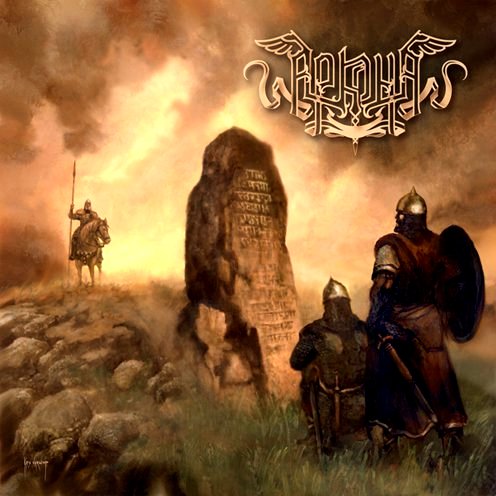
I would like to believe that Аркона, or Arkona for you non-purists, is a band requiring little introduction. They did not create the Slavic brand of folk metal, nor are they necessarily the best of their kind, but I would argue that they are the most accessible. Eschewing the common pagan metal dependence on raw production, Arkona deliver directly, presenting a full sound pervaded with folk and ferocious intensity.
At least, that is how I think of them. My ability to relate to the band is a bit narrow. I have somehow only ever listened to Возрождение (Vozrozhdeniye) and От Сердца к Небу (Ot Serdtsa K Nebu), but I’ve listened to both countless times. I am in no position to describe what precisely has changed here since Гой, Роде, Гой! (Goi, Rode, Goi!), but 2007 isn’t that far removed.
Азъ/Аркаим (Az’/Arkaim)
Following their best introduction track to date, Slovo kicks off in standard Arkona form, exploding briefly and then opening up to Masha’s breathtaking vocals. The instrumentation employed differs little from the past–bagpipe and woodwinds driving over epic synths and intense pagan aggression, with slow, tense interludes setting each stage. In the details though, much has changed.
The first difference that caught my eye was the introduction of a violin to accentuate the tension. This application (not its use in general), as it turns out, is more a feature of the opening track than the album as a whole, but the mood it aims for is a recurring theme: expect softer, subtler means to distinguish Slovo’s dynamics shifts.
The other thing I immediately noticed was a diminishing in the intensity of Masha’s metal vocals, and this, unfortunately, is consistent throughout the album. Oh, she can still belt them out better than just about any female metal vocalist out there, but that Slavic shrillness behind the gutturals seems to be gone, degrading into something a bit deeper and a bit more typical to metal in general.
Никогда (Nikogda)
When I returned to a few Ot Serdtsa K Nebu tracks to confirm this latter observation, a lot of other disappointments surfaced. Masha’s mellowing out from a violent she-wolf to a standard death metal growler is only the tip of the iceberg, though her clean singing might be as good as ever. The entire album is really a step down in ferocity. Primitive folk transitions have been replaced by a more consistent reliance on synth and whispered interludes to create a sound that is perhaps fuller but not nearly as inspiring. The track at hand is a bit of a counterexample, but consider it among the heaviest Slovo has to offer, not par for the course.
Don’t get me wrong though. I consider Ot Serdtsa K Nebu one of the best albums of all time, and that’s a pretty high standard to maintain. On Slovo, Arkona continue to produce absolutely solid pagan/folk metal, they’re just complacently maintaining the genres rather than redefining them. The specifically Slavic sounds of pagan metal are here sharing the stage with a more universal approach to the genre.
The album still brings a lot of uniqueness to the table. The guitar on Nikogda manages to maintain a constant tension that never bores in spite of (or even perhaps specifically because of) its simplicity, and it pairs up with the vocals perfectly. The song Леший (Leshiy) delightfully converts a border-line cheesy, carnival accordion into convincing metal. And though no hammer dulcimer is mentioned in the album’s credits, a sound I can describe as nothing else (perhaps very convincing keyboards?) peppers many tracks like falling snow, giving them a decidedly wintery vibe. (I can’t resist pointing out, to the complete apathy of anyone potentially reading this, a peculiar reminiscence I perceive in this last feature to Midwinter Land, the Sindar Ruins theme of Suikoden III, by Michiru Yamane, Keiko Fukami, and Masahiko Kimura.)
Слово (Slovo)
As for my gripes about intensity, the title track does manage to rise to the level I’d come to expect from Ot Serdtsa K Nebu, and might bring to light the stylistic change I had in mind. What springs to life here around 3:30, THAT is what I was looking for on this album. If brief, it demonstrates the intensity hedging on insanity that Slavic folk can offer to metal. That the sort of impact I got from Ot Serdtsa K Nebu in its entirety can only be compared to a passing phrase in Slovo speaks against the album, but in all fairness, that’s a pretty high measuring stick. Slovo is a really enjoyable album throughout, and it’s taken no effort on my part to keep it on perpetual repeat these last few nights. It’s more mellow than what I’d come to expect, in its folk features even more so than in the metal, and the overuse of whispered/spoken introductions and filler tracks is a mild annoyance, but it’s still a cut above much of the competition. If you’re new to the band and these sample tracks left you unimpressed though, do acquire a copy of Ot Serdtsa K Nebu before you write them off altogether.
Hands That Pluck is highly erratic black metal cum indie post rock, dubious yet seldom disappointing, as presented by your inconspicuous next door neighbor. Or something like that. The pictures of Andrew Curtis-Brignell scattered across the internet range from creepy skinhead to a guy fully immersed in modern trends, thick frame glasses and all. What he pretty much never looks like is a black metal artist. His music follows a similar trend, full of uncharacteristic oddities, sometimes for the better and sometimes for the worse
Profane Inheritors
The only sustained features you’re going to find on the opening track are a tendency towards constant moody transitions and rather awkward, out-of-place vocals that do not necessarily work. The further details are unique to the track at hand. Given that the album is about 124 minutes long, it would be beyond my means or particular desire to take a close look at each one. At any rate, if you think you have swallowed all Hands That Pluck has to offer in one attentive listen you’re probably not giving it enough credit. Much of it teeters on a narrow pinnacle, ready to fall into an endless brilliant void on one side or a festering trash heap on the other at any moment. There are tracks I have marked off as exceptional on one listen and found entirely meritless on the next, and vice versa. Most, on any given listen, will stand their ground and leave you uncertain.
The opening track, Profane Inheritors, reflects that. The deep, shouted vocals dominate the raw black metal over which they are layered, and before long the music winds down to give them undivided center stage. A dissonant solo here, another vocal solo there, and then suddenly you realize the song has gotten really intense. Encased in the music’s peculiarity, the crushing sort of post-metal ending emerges while you’re still trying to figure out what’s going on, and perhaps just as you give in and start to really enjoy it the song transitions again, into a minimalist ambient outro.
A well-crafted song, or a jumble of random movements masking nonsense in some faux-esoteric mishmash? The truth is I think most of the album is a combination of both, and if you accept that the artist isn’t trying to bullshit you but doesn’t always quite pull off his emotional intentions faultlessly, you might be well on your way to appreciating Hands That Pluck.
The Sea of Grief Has No Shores
Because it’s by no means perfect, but neither is the artist arrogantly throwing out random notes and believing himself to have created a masterpiece. It’s something you should listen to with an ear for what the artist is trying to create, not what he necessarily always does, and sometimes (or if you’re better off than I, every time) the message gets through to create a highly moving song, peculiarly emotional for its style.
Or at least peculiarly emotional for black metal. Stylistically in general terms, the album is an equal mix of black metal, post-rock/metal, and ambient sounds, and never so much an amalgamation of the three as a timeshare. That is, I find it misleading to describe Hands That Pluck as post-black metal. It is post-rock and black metal. Sometimes entire songs divide them, sometimes he jumps back and forth between the two right and left, but both are too dominant in their pure forms to call it post-black.
The post-rock is the more coherent side of his sound, and the more consistently appealing. It furthermore sheds light on a sense of awareness which lends credence to his more spasmodic moments. The Sea of Grief Has No Shores is the sort of song that reminds you, if the other tracks leave you in doubt, that he really has some vision in mind. What you might have liked in Profane Inheritors did not transpire merely by chance.
Ninety-Three
You can listen to Hands That Pluck a dozen times and take an entirely different experience out of it every time, but let whatever strikes you at a given moment be the prize. Don’t dig too deep, or you might end up chasing the wind. There’s more to it than you will be able to take in in one sitting, but not necessarily as much as your initial bewilderment might lead you to believe, nor as little as a skeptic might first assume. The vocals are his biggest stumbling block, and I’m inclined to say they’re downright bad, but they’re not a game ender, and behind them I think he pulls off a good song more often than not.
This will be Andrew Curtis-Brignell’s final full release under the Caïna monicker, though a split with White Medal is still to come. It is his fourth album, the first coming in 2006. It should be interesting to see where his musical inclinations take him from here. It is definitely his less black metal, more post-rock/metal moments, such as the majority of Ninety-Three, that appeal to me most, but if it’s the post-whatever that draws me into Hands That Pluck (and makes the ending of this current track so awesome), it’s the black metal that makes the album stand out as something original. All of the immediate “high” points of Hands That Pluck I can compare to a dozen different bands. The album as a whole stands alone, an entirely unique work. It can phase from immediately accessible and borderline catchy to completely obscure at a whim, and while its finest moments in either form are certainly enjoyable, none of them stand out quite enough to consistently move me. It’s only when taken as a whole, I think, that you’ll be able to get sense of his bigger picture.
I don’t know, I feel no compulsion to listen to this in its entirety a dozen times over, and I think that’s what it would take to really appreciate it. At the same time, the fact that I feel no such compulsion speaks against it; I am not convinced that the payoff would be sufficient. The more work you put into appreciating something, the higher your expectations rise, and I get the feeling Hands That Pluck is ultimately a bit on the average. I definitely recommend listening to the entire thing a few times, because with the right disposition you might find it amazing. Me, I’ll be moving on.
I am not overly familiar with Arckanum. I associate the one-man act more with Johan “Shamaatae” Lahger’s peculiarity than with his music. From releasing a music video frequently featured among metal’s cheesiest to releasing an album absurdly titled ÞÞÞÞÞÞÞÞÞÞÞ, his minor exploits will perhaps always incline me to regard Arckanum with an eye towards the ridiculous. ÞÞÞÞÞÞÞÞÞÞÞ did, however, receive some pretty gushing reviews (I never got around to listening to it enough to judge one way or the other), and when I saw that he’d released a new one I thought it due time to give him a shot.
Helvitt
Arckanum has a somewhat odd history musically as well. After releasing three full-length albums between 1995 and 1998, he took a decade long hiatus, not reappearing until 2008 and releasing a full length album every year since. (Sviga Læ, which was never brought to my attention, came out between ÞÞÞÞÞÞÞÞÞÞÞ and Helvítismyrkr.)
In the meantime, Shamaatae has been an active writer on the subjects of “Chaos-Gnosticism” and “Anti-Cosmic Satanism”. A scholar in his field I’m sure. Whatever all that means, it apparently falls into a similar boat as the rituals practiced by fellow Swedes Dissection and Watain. Jon Nödtveidt took his own life in proclaimed accord with such teachings, and though I can never resist a tasteless joke that he had listened to the final studio cut of Reinkaos for the first time moments before his death, suffice to say these guys take themselves seriously.
One might expect that sort of intensity and personal conviction to be reflected in the music.
Nifldreki
Throughout Helvítismyrkr though, I’m not really hearing it. The album is in no sense bad, but it rarely surpasses the generic. Neither the song writing nor the atmosphere in which it is presented conjure for me much beyond a decent musician’s create outlet. He fails to take me beyond himself.
The album does have some catchy feature riffs however, Nifldreki being a prime example, and, the slow grind In Svarta aside, Shamaatae maintains a breakneck pace throughout the majority of each track, giving Helvítismyrkr a particular coherence and consequent appeal. Again, there is absolutely nothing bad about this work, I just had higher hopes.
Svartr ok Þursligr
Helvítismyrkr’s high point almost beyond debate is Svartr ok Þursligr. The breaks in the opening riff come in hard rock fasion that really drive the song, if in a peculiarly fun sort of way. Given the background, I was expecting the best tracks to be more on the esoteric side, but Shamaatae seems to be in his prime on Helvítismyrkr when he’s rocking out.
What propels the song from being merely more fun than the rest to being something really outstanding follows the transition about 3 minutes in. He incorporates a woeful, weeping violin that, aside from completely catching me off my guard, pairs up with the tremolo guitar with astounding success. It’s something I’ve never heard before in black metal, and the effect is a sort of tragedy in the positive sense–maybe not the vibe he intended to deliver, but one that certainly appeals. I can’t imagine it being sustained throughout an album without sounding over the top, so I wouldn’t encourage him to push for more of it in the future, but as a single instance it works exceptionally well.
I am not sufficiently well-versed in Arckanum’s catalog to personally recommend better efforts, but if the sparks of talent you’ve heard in these sample tracks entice you, ÞÞÞÞÞÞÞÞÞÞÞ seems to be popularly regarded as his best work. As for Helvítismyrkr, it is a decent effort but nothing to brag about.
Thantifaxath are a new black metal band out of Toronto. They released their debut ep this year in cassette format on Dark Descent Records, and I think you will like it.
10,000 Years of Failure / Violently Expanding Nothing
The amount of diversity they’ve managed to cram into a five and a half minute long song (excluding the introduction here merged) is pretty amazing. The track, and most of the ep really, isn’t so much moody as thematic. It’s got a sort of sci-fi horror vibe throughout, apparent right from the bass riff introduction, and the ample mingling of melody in between epic black metal explosions almost gives the song a plot line. Even the choice of album cover, Nicéphore Niépce’s La cour du domaine du Gras (supposedly the first photograph ever taken), resembles something of an extra-terrestrial sighting. If the track title is any indication, this was likely their intent, and they pull it off well. Outer space and black metal are an uncommon mix, and one usually attempted through an emphasis on slow-moving, vast atmospherics. Violently Expanding Nothing (the youtube label “Violently Expanding Emptiness” is wrong; I’m taking the track title from the actual packaging) is, in contrast, gritty and abrasive, and all the more effective because of it.
Freedom is Depression
Thantifaxath definitely lay down their best card first, but the album’s other two tracks (both under five minutes long) carry much of the same appeal. Freedom is Depression, peculiar title aside, continues to give me that sort of b-side horror flick vibe, especially with its low production atmospheric guitars. The main riff following the introduction calls to mind recent Enslaved, and that might be the only clear comparison I can make of this album to anything else in particular. It’s among the most unique black metal I’ve heard in a while, and it makes excellent use of relatively low production value to create an eery, unearthly vibe.
Keep an eye out for these guys. They’re brand new, and I suspect their best is yet to come.