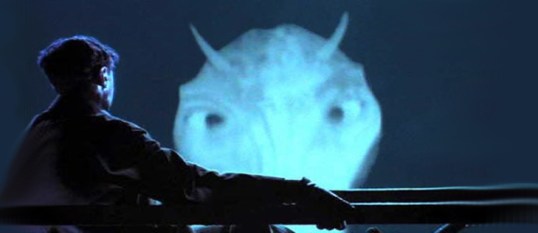
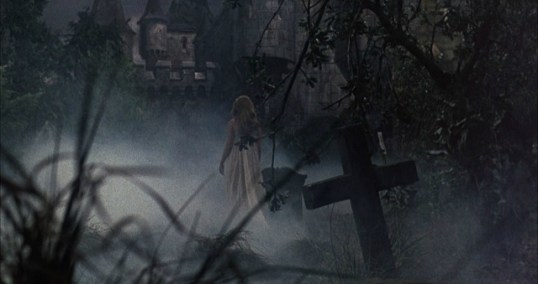
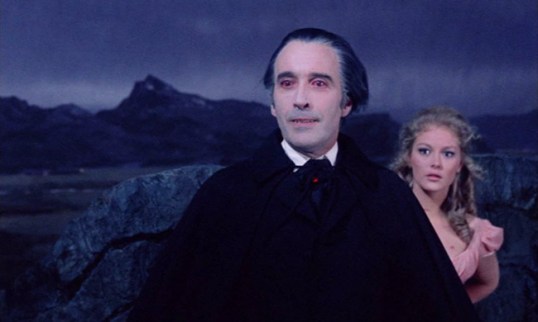
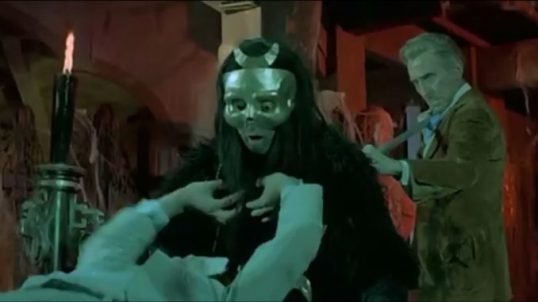
4 Shots From 4 Films is just what it says it is, 4 shots from 4 of our favorite films. As opposed to the reviews and recaps that we usually post, 4 Shots From 4 Films is all about letting the visuals do the talking.
This October, I am going to be using our 4 Shots From 4 Films feature to pay tribute to some of my favorite horror directors, in alphabetical order! That’s right, we’re going from Argento to Zombie in one month!
Today’s director is Roy Ward Baker, one of the masters of Hammer and Amicus horror!
4 Shots From 4 Roy Ward Baker Films
Quatermass and the Pitt (1967, dir by Roy Ward Baker, DP: Arthur Grant)
The Vampire Lovers (1970, dir by Roy Ward Baker, DP: Moray Grant)
Scars of Dracula (1970, dir by Roy Ward Baker, DP: Moray Grant)
The Legend of the 7 Golden Vampires (1974, dir by Roy Ward Baker, DP; John Wilcox and Roy Ford)
Mystery Tales was one of the many pulp magazines from West Fiction Publishing Company. From 1938 to 1940, over the course of 9 issues, Mystery Tales brought readers stories of cults, criminals, demons, femme fatales, and damsels in distress. Though I’m sure the stories were fine, the magazine is today mostly remembered and sought after by collectors for its extremely lurid covers. Below are 7 of the covers of Mystery Tales!
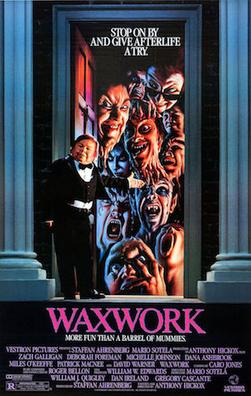
First released in 1988, Waxwork asks the audience with a very important question.
Let’s say that you and your best friend were walking to school one day when you suddenly noticed a gigantic mansion that you had never seen before, sitting in the middle of your neighborhood. And what if a tall, somewhat sinister Englishman (played by David Warner, none the less) suddenly appeared out of nowhere and told you that the mansion was actually a waxwork. And what if that Englishman than invited you to come to the waxwork at midnight and specifically asked you to come in a group of 6. Would you do it?
Now, I know that your first instinct is to say, “Of course, I wouldn’t!” That’s the type of answer that we’ve been conditioned to give because no one wants to admit that they can be as dumb as a character in a horror movie. But really, I would go. Especially if, like the characters in Waxwork, I was a teenager. (Actually, most of the characters in Waxwork are described as being college students but they all act like high school students and their college appears to be a high school so draw your own conclusions.) When you’re a certain age, you feel like you’re immortal and an invitation to hang out in a creepy building with a bunch of strangers at midnight feels totally reasonable.
Anyway, four rich kids — Mark (Zach Galligan), China (Michelle Johnson), Sarah (Deborah Foreman), and Tony (Dana Ashbrook, a year before he was cast as Laura Palmer’s boyfriend in Twin Peaks) — visit the waxwork at midnight. What they discover is that the building is full of macabre exhibits that recreate various moments from horror history. There’s werewolves, vampires, and Jack the Ripper. There’s also the Marquis de Sade, a figure that the seemingly innocent Sarah becomes fascinated with. And, as two of the visitors discover, stepping past the red rope and entering an exhibit transports them into an alternate world where they become the victim of the star of each display.
Not surprisingly, the film is at its best when imagining the world inside each exhibit. Each exhibit has its own backstory and its own set of guest stars. John Rhys-Davies shows up as a werewolf. Miles O’Keeffe is a properly urbane Count Dracula. J. Kenneth Campbell plays the Marquis de Sade, who the film imagines as a swashbuckling sadist. That said, I think the most effectively frightening exhibit was one that featured no special guest stars but a very determined and very strong mummy.
What’s going on at the waxwork!? As explained by Sir Wilfred (Patrick Macnee, bringing some welcome wit and style to the film), it’s all a part of a scheme to bring the most evil beings ever back into existence so that they can conquer the world. It’s important that none of the waxworks be allowed to enter the real world and soon, Sir Wilfred and his ragtag army are laying siege to the waxwork and bringing things to an apocalyptic conclusion. The final battle is a bit haphazardly edited and it’s impossible to really keep track of who is fighting on which side. (Indeed, I’m still not sure where Sir Wilfred even found his army.) But it does feature plenty of in-jokes for horror fans, including a cameo appearance by the carnivorous plant from Little Shop of Horrors.
Waxwork is entertaining film. It doesn’t take itself particularly seriously and, indeed, Mark, China, Sarah, Tony, and all of their friends feel as if they could just as easily have been found in the pages of a Bret Easton Ellis novel about pretty but vapid alcoholics. Mark is the type who gets his maid to write his term papers. Tony just wants to drink (but, because he’s played by the adorable Dana Ashbrook, he’s still the most likable character in the film). China says, “I do what I want, when I want,” when confronted about cheating on her boyfriend. Sarah is the “innocent” one but just seeing the words “Marquis de Sade” causes her to swoon. Dropping these four idiots into a situation where the fate of the world is at stake feels like a wonderfully sardonic cosmic joke.
In the end, the true pleasure of Waxwork is watching old pros like David Warner, Patrick Macnee, and the exhibit guest stars hamming it up. Macnee, in particular, seems to enjoy leading the final charge against the forces of evil and, indeed, it’s hard not to wish that he had even more screen time than he did. David Warner, meanwhile, rolls his eyes at just how difficult it can be to bring the 18 most evil figure in history back to life. It’s hard work but I guess someone has to do it!
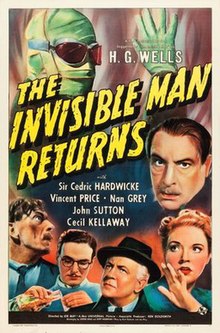
1940’s The Invisible Man Returns opens with Sir Geoffrey Radcliffe (Vincent Price) sitting on Death Row. Convicted of the murder of his brother, Radcliffe is due to soon be executed. Radcliffe claims that he was framed and his girlfriend, Helen Manson (Nan Grey), has spent the past week of her life begging for someone to order a stay on the execution. However, with the home secretary out of the country, there is no hope of a reprieve.
Dr. Frank Griffin (John Sutton), brother of the original Invisible Man, visits Radcliffe in prison and gives him the same serum that his brother previously developed. Now invisible, Radcliffe is able to escape from the prison. Radcliffe is determined to prove his innocence but Dr. Griffin is more concerned with developing a way to reverse the serum’s effects before Radcliffe is driven insane, just as the original Invisible Man was. Radcliffe becomes convinced that his brother was murdered by their cousin, Ricard Cobb (Sir Cedric Hardwicke) but is Radcliffe correct or is the serum just making him paranoid? With Inspector Sampson (Cecil Kellaway) searching for Radcliffe and fully aware of what effects the serum are going to have on his mind, can Radcliffe clear his name before he loses his sanity?
The Invisible Man Returns went into production after the success of Son of Frankenstein proved that there was a market for sequels to previously successful horror films. (Yes, there was a time when sequels were not an automatic thing.) This was also one of the first horror films in which Vincent Price made an appearance. (Today, we’re so used to the image of Vincent Price as a somewhat campy horror icon that it’s easy to forget that he originally started his career as a romantic leading man and was even seriously considered for the role of Ashley Wilkes in Gone With The Wind.) As he spends the majority of the film wearing the same tight bandages that hid Claude Rain in the first film, Price’s actual face is only visible for slightly less than a minute and, without his famous mustache, it’s actually rather difficult to recognize him. That said, there’s no mistaking Price’s voice, heard as the invisible Radcliffe bitterly complains about everything from a barking dog to other people’s doubts about Cobb being the murderer. While this film does find Price in a slightly more subtle mood than many of us horror fans are used to, it still features plenty of hints of what the future would hold.
I enjoyed The Invisible Man Returns, which featured some witty invisibility sequences (watch invisible Vincent Price toss off those clothes!) and also managed to take the story’s violence about as far as it could without violating the production code. While it’s always a pleasure to watch any film featuring Vincent Price, I also liked the performance of Cecil Kellaway, who played the inspector as being the epitome of the the upstanding but dryly humorous British policeman. One gets the feeling that absolutely nothing could ever take the Inspector by surprise …. not even an Invisible Man!
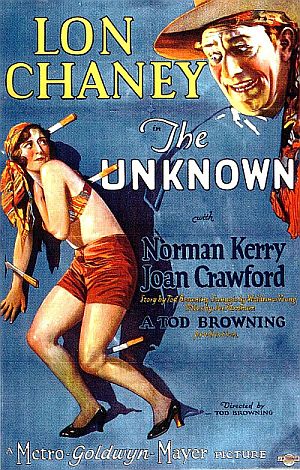
First released in 1927, The Unknown tells the story of circus performer Alonzo the Armless (Lon Chaney, Sr.). As you might guess from his name, everyone thinks that Alonzo is armless. Of course, he’s not. He’s just a contortionist who pretends to have no arms. People thinking that he has no arms gives him the perfect alibi whenever he has to strangle someone.
However, Alonzo has fallen in love with Nanon (Joan Crawford), his beautiful circus assistant. Unfortunately, Malabar the Mighty (Norman Kerry) is also in love with her and there’s no way that Alonzo could allow her to get too close because then she might discover that he not only has arms but that his hand has an unusual deformity that would identify Alonzo as the man who strangled Nanon’s father.
Alonzo’s solution? Maybe he could just get someone to amputate his arms for real! But will that be enough for him to win Nanon away from Malbar? Or will he pursue an even more macabre plan to get Malabar out of the picture?
The Unknown was, for years, considered to be a lost film. In 1968, a 49-minute print of the film was found in France. That’s the version that I’m sharing here. Reportedly, several early scenes were missing but those scenes were not important to the overall story. Even in truncucated form, The Unknown is a wonderfully surreal and atmospheric film and it’s widely considered to be the best of Tod Browning and Lon Chaney’s collaborations. Since this film was made in the age before CGI, whenever Alonzo hides his arms, Chaney was having to do the same thing. This is one of Chaney’s best performances. Alonzo is both frightening and rather sad in his way. Having won the role over Greta Garbo, Joan Crawford was 18 when she played Nanon.
Happy Horrothon! “I know you’re gonna say, this isn’t horror! This is Thor singing the blues!” I hear your critique and I reject it! The greatest horror stories especially in science fiction have trauma, fear, and hope. Alien, for example, terrible things happen to this crew of…. I guess…. miners, but at the end – there’s hope because Ripley overcomes. I always have a bit of anxiety at the end of the New “Outer Limits” or films like “Life” because it’s a good twist, but everyone is now dead and the heroes failed- that’s too much like life!
In “Rain”, a woman is alone and there appears to be a guy in the friendzone who REALLY wants to be with her and can sing and looks like Thor. For the interest of Horrorthon, we’re going to presume that- I don’t know this lady’s name but I’ll call her Susan- that Susan’s previous guy was eaten by a …got it…. a werewolf! Take that doubters told you I could contrive this into a horror review- BWAHAHAHA!
Side note: Susan, you’re being too picky. I’m sure that youhad a rough time, but this guy even wrote a song for you, looks like Thor, and sounds like Otis Redding reincarnated. Maybe your standards are just WAY too high?
Susan’s boyfriend was werewolf puppy chow and Thor is trying to tell her that it will be okay. He has felt her pain because there is probably at least another werewolf in town that probably ate his girlfriend too. Can you imagine that support group? They must hate Iams and Doggy costumes! The line “Is that rain or are you crying again?” gets to me because when you’re broken-hearted – it’s like the tears can’t stop. “A soul with no face is a lonely embrace” this line is all about not seeing your soulmate again- Fucking Werewolves, we gotta do something about them, but then this song wouldn’t exist; so, I’m torn!
As they try console each other, “now’s there clouds between us all”; so, they likely hooked up, but they also have to worry about the full moon coming- probably. I like that at the end of the song – he says – “You ain’t gonna be ain’t gonna be alone” and notice, he doesn’t say- With me – Wonderful me. He’s left her better off and maybe he will be alone and live out his days as a werewolf hunter?
Push It was the lead single off of Garbage’s second studio album, Version 2.0. The video was directed by an Italian photographer named Andrea Giacobbe, who was selected after the band saw and was impressed by his video for Death in Vegas’s Dirt. Though Shirley Manson said that the songs lyrics were intentionally meant to be surreal and that the song was about, “the schizophrenia that exists when you try to reconcile your desires and demons with the need to fit in,” even the band was surprised by the bizarre storyboards that Giacobbe prepared for the video.
What’s happening in the video is definitely open to interpretation, as the action goes from three nuns assassinating Shirley Manson’s rotoscoped “partner” to Manson living in the suburbs with a man who has a light bulb for a head. Demonic children and aliens also make an appearance. In the end, the video feels like a throwback to the early days of MTV, when it was more important to be weird and challenging than to craft your image for the adolescent Total Request Live crowd. It certainly feels as if it’s taking place in a separate universe than the one where MTV is now the exclusive property of Rob Dyrdeck.
For tonight’s episode of The Hitchhiker, our narrator (played by Page Fletcher) takes a look at Jeremy (John Shea) and Julie (Alexandra Paul).
Jeremy and Julie are a couple who are taking a road trip and whose relationship is strained due to Jeremy’s obsession with organization and control. However, when Jeremy and Julie meet two people that Jeremy can’t control — a biker (Dean Hallo) and his pregnant girlfriend (Nancy Isaak) — Jeremy finds himself taking a trip through time and learning a lesson about letting go.
This episode features good performances from John Shea, Alexandra Paul, Dean Hallo, and Nancy Isaak and it also features the Hitchhiker offering up some memorably judgmental commentary. The Hitchhiker is apparently not a fan of control freaks. I’m not really a fan of control freaks either but there’s nothing wrong with having a to-do list to help guide you through your day.
This episode originally aired on February 24th, 1987.
First released in 1982, Madman takes place on the last night of camp.
Max (Carl Fredericks), the jovial and beloved owner of the camp takes his senior counselors and his campers on one last outdoor adventure. As they sit around the campfire, he tells them the story of a farmer named Marz who, years before, went crazy and hacked up his family with an axe. The local townspeople attempted to hang Marz but somehow, he escaped from the noose and disappeared into the wilderness, along with the bodies of all of his victims. The locals say that Madman Marz is still out there in the wilderness, waiting for someone to shout his name so that he can return to life and kill again. Max tells his campers that it’s very important that they only whisper the name of Madmam Marz.
“MADMAN MARZ!” Richie (Jimmy Steele), one of the campers, shouts.
Everyone tells Richie not to shout his name so Richie shouts it again.
Max announces that it’s time to return to camp. He specifically tells none of the campers to deviate from the path back to the camp. He tells everyone to follow their counselor. He makes the directions very specific and clear.
So, of course, Richie decides to wander off by himself. As he wanders through the wilderness, he comes across Madman Marz’s old cabin and he breaks a window….
Now, if you’ve ever seen a slasher film before, you are probably expecting Richie to be the first victim of rejuvenated Madman Marz. Well, you would be incorrect. In fact, Richie turns out to be a bit of a Karma Houdini because, while Madman Marz does return with his axe, he never actually goes after Richie. Instead, Madman Marz just stalks the various counselors who go into the woods in search of Richie. Don’t get me wrong. Richie is definitely a bit traumatized by what he sees inside of Madman Marz’s cabin. But it’s still hard not to feel that Richie got off pretty easy when compared to everyone else.
But that’s really what makes Madman a superior slasher film. It defies our expectations when it comes to who dies and who doesn’t. Though it was obviously inspired by the camp-centric horror of Friday the13th, Madman isn’t afraid to break the rules of the genre. It’s one of the rare slashers where it feels like anyone could fall victim to the killer depending on how their luck goes that night. As opposed to slashers where it sometimes seems that the victims are being punished for having sex or doing drugs or going against the rules of society, the victims in Madman tend to just be in the wrong place at the wrong time. Marz doesn’t really have a complicated motivation. He’s a madman and he’s so ruthless and relentless that he becomes a genuinely frightening monster.
Madman Marz is not only genuinely frightening but so is the film featuring him. Madman was a low-budget, non-union production, with the majority of the cast and crew credited under pseudonyms. (Dawn of the Dead‘s Gaylen Ross, who appears as one of the counselors, is credited as Alexis Dubin.) But that low budget does prevent Madman from being an atmospheric and suspenseful slasher film, one that will not only inspire nightmares but also probably cure most people of any desire to go camping.