Music Video Of The Day: Women by Def Leppard (1987, directed by Doug Freel and Jean Pellerin)


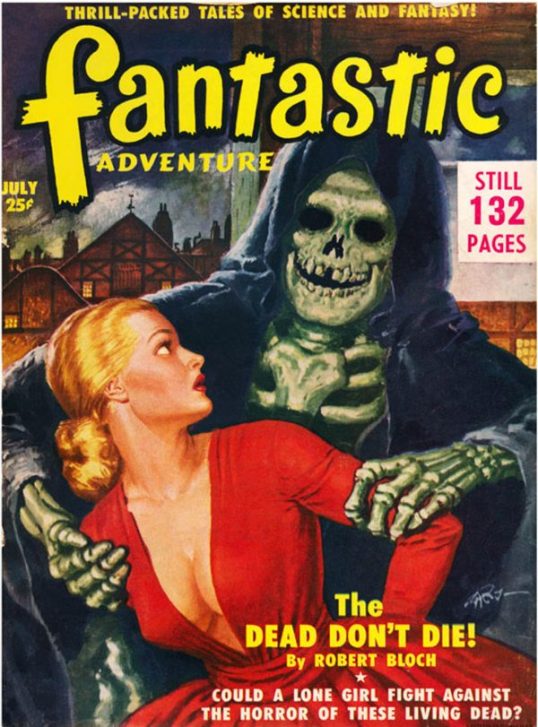
This music video represents the fantasy of almost every 80s kid, skateboard wherever you want, read a comic book about your favorite hero having an amazing adventure, and doing it all while your favorite band performs behind you.

Depending on what part of the world you were living in, Women was either the first or the second single to be released off of Dep Leppard’s best-selling album, HysteriaHysteria was a great album that was helped immeasurably by MTV.  Fans of the band already knew that Def Leppard rocked but MTV gave everyone the chance to watch them as they did so.

This was the first Dep Leppard video to be filmed after Rick Allen lost his left arm.  A good deal of the video’s popularity comes from Rick showing that he was still one of the best drummers in the business.

Enjoy!

Horror on TV: Baywatch Nights 2.11 “Frozen Out Of Time” (dir by Rick Jacobson)


Tonight, with Halloween only a few days away, The Shattered Lens is proud to present a bonus episode of televised horror!  In this beloved episode of Baywatch Nights, two 900 year-old Vikings are causing chaos in Los Angeles!  Who can stop them?

David Hasselhoff, of course!

This episode originally aired on February 9th, 1997!

Horror on TV: The Hitchhiker 6.16 “Made in Paris” (dir by Rene Mazor)


On tonight’s episode of The Hitchhiker, a factory owner finds himself cursed after an undocumented worker dies in his factory.  This is a Hitchhiker morality play.  If you’re a businessperson who doesn’t take of your employees, the Hitchhiker is going to show up outside your factory and tell everyone what a terrible person you are.

The episode originally aired on January 25th, 1991.

October Hacks: Popcorn (dir by Mark Herrier and Alan Ormsby)


The 1991 film, Popcorn, tells the story of what happens when an experimental film goes wrong.

In the late 60s, a freaked-out hippie named Lanyard Gates directed a short film called PossessorPossessor featured footage of him apparently preparing to sacrifice a woman on an altar.  Gates declined to film a third act conclusion to the film.  Instead, he murdered his family on stage and in front of a terrified audience.  The resulting panic caused a fire to break out, killing almost everyone at the Dreamland Theater.  As a result, Possessor has become a legendary film, one that is believed lost.  Of course, it’s not lost, as a group of film students and their professor find out over the course of Popcorn.

Years later, one of those film students, an aspiring screenwriter named Maggie (Jill Schoelen), has been having disturbing nightmares about being caught in a fire and being pursued by a madman.  When she sees Possessor, she realizes that much of the imagery in her dreams comes from the film.  When Maggie attempts to talk to her mother about all of this, Suzanne (Dee Wallace) denies knowing anything about Possessor or Lanyard Gates but it’s not hard to tell that she’s lying.

Still, Maggie does have other things to worry about.  Her school’s film department has been hit by budget cuts and neither she nor her classmates will be able to make their student films unless they raise some money.  One of the students, Toby (Tom Villard), suggests holding a fundraiser at the Dreamland Theater, where they could show old movies and even recreate some of the old gimmicks that were used to promote those movies.  Professor Davis (Tony Roberts) thinks that is a great idea!  Why, he could even control the giant, remote-controlled bug that was used to promote Mosquito!

Filmed in Jamaica (and featuring a somewhat random performance by a reggae band), Popcorn was originally offered to director Bob Clark.  However, Clark didn’t want to return to the horror genre so, instead, it was Clark’s frequent collaborator, Alan Ormsby, who was hired to direct the film.  Reportedly, Ormsby was replaced a few weeks into filming by Mark Herrier, with the assumption being that the producers felt that Ormsby was spending too much time on filming the three fake movies that are screened during the fund raiser.  Those films are Mosquito, The Attack of the Electrified Man, and a dubbed Japanese film called The Stench.  In the film’s credits, Ormsby is credited with directing the three fake film while Mark Herrier is credited with directing the “modern” scenes.

Perhaps not surprisingly, the three fake film are actually the best thing about Popcorn.  If Alan Ormsby was taking a lot of time to shoot the fake films, it obviously paid off because all three of them perfectly capture the feel of the era when they were supposedly shot and all of them are filled with the type of details that only a true fan of old horror movies would think to include.  Mosquito is a giant bug film that feels as if it could have come straight from 1957.  The Amazing Electrified Man feels like one of the films that poor Lon Chaney Jr. would have found himself starring in after leaving Universal.  And The Stench is the perfect import — slow-moving, a bit pompous, and terribly dubbed.

As for the rest of Popcorn, it’s a well-made slasher film.  Mark Herrier did a good job directing the “modern” scenes, with a scene in which the killer’s face seems to literally melt after he kisses one of his victims being a definite creepy highlight.  The kills are reasonably creative and, in one case involving electrocution, rather disturbing.  Jill Schoelen is a likable heroine, Derek Rydall is cute as her hapless boyfriend, and Tom Villard’s uninhibited performance gives the film a much-needed jolt of energy.  Though the old films may be the highlight of Popcorn, the “modern” scenes hold up as well.

The TSL Horror Grindhouse: Children Shouldn’t Play With Dead Things (dir by Bob Clark)


The title of this 1972 film is definitely a case of truth in advertising.

Children definitely should not play with dead things!  I don’t care how mature they are or how lenient of a parent you’re trying to be.  When you see your child playing with a dead thing, it is on you to step forward and say, “Child, leave that dead thing alone unless you want to forever burn in Hell.”  I know that type of language might be traumatic for some children but you’ll be glad you did it.  You know who played with dead things when he was a child?  Jeffrey Dahmer!  And look how that turned out.  He got a miniseries made about him and became an internet meme.

Now, it should be pointed out that they’re aren’t any children to be found in Children Shouldn’t Play With Dead Things.  The children of the title are actually a group of wannabe actors who are led by a pretentious douchebag named Alan (played by the film’s writer, Alan Ormsby).  With his mustache and his long hair and his hip clothes and his vocabulary of psychobabble and buzzwords, Alan considers himself to be quite the chic 70s gentleman.  He refers the other actors as being his “children,” and they let him get away with it.  Personally, I would be kind of insulted but whatever.

One night, Alan and his theatrical troupe ride a boat off to an island that is sitting off the coast of Miami.  The island is reputed to be haunted and Alan tells the actors several rather gruesome stories about things that have supposedly happened to the inhabitants of the island.  According to Alan, the island is used as a cemetery for criminals who were so vile that no one wanted to collect their bodies.

Why are the actors on the island?  Along with leading his theatrical troupe, Alan considers himself to be a bit of a warlock.  He wants to perform a ceremony at midnight and he expects his actors to help him out.  If they don’t help, they’ll lose their jobs.  If they do help, they’ll probably lose their lives.  Alan and his actors dig up the body of a man named Orville (played by the wonderfully named Seth Sklarey).  The ceremony that Alan performs at midnight fails to bring Orville back to life but it does cause the dead who were left in their graves to rise from the Earth as zombies.  The zombies are not happy that their island has been invaded and they’re especially not happy about Alan digging up Orville.

Children Shouldn’t Play With Dead Things is a mix of comedy and horror, with Alan’s pretentious foolishness dominating the first half of the film while the second features the zombies laying siege to a cottage.  It starts out slow but, once the zombies come to life, the film achieves a surreal grandeur.  For an obviously low-budget film, the zombie makeup is surprisingly effective and the zombies themselves are so relentless and determined in their pursuit of the living that they help Children Shouldn’t Play With Dead Things survive the inevitable comparisons to Night of the Living Dead.  The film’s final scene, which plays out in near silence, has an undeniable horrific power to it.

Children Shouldn’t Play With Dead Things was the third film to be directed by Bob Clark.  He also directed films like Deathdream, Black Christmas, Murder By Decree, and the infamous (and very financially successful) Porky’s.  Of course, his most beloved film is the one that we’ll all be watching in a little less than two months, A Christmas Story.

Maniac Cop III: Badge of Silence (1992, directed by William Lustig)


Despite finally getting his burial with honors at the end of Maniac Cop 2, Matt Cordell (Robert Z’Dar) returns for one last outing.  Raised from the dead by a voodoo houngan (Julius Harris), Cordell invades a hospital to seek vengeance for a comatose policewoman named Katie Sullivan (Gretchen Baker).  In a coma due to the wounds she received while thwarting a convenience store robbery, Katie is being framed by unscrupulous reporters and attorneys who claim that Katie was a bad cop who killed a clerk in cold blood.  Cordell sees Katie as being a fellow victim of anti-cop bias and he is not going to let anyone treat her with disrespect, which is something that two doctors (Robert Forster and Doug Savant) are unfortunate enough to discover.  Sean McKinney (Robert Davi) and Dr. Susan Lowery (Caitlin Dulany) try to figure out how to bring peace to the souls of both Cordell and Katie.

As opposed to the first two films, Maniac Cop III had a troubled production.  Lustig and screenwriter Larry Cohen wanted to set the film in a Harlem hospital and bring in an African-American detective to investigate Cordell’s activities.  The film’s Japanese producers insisted that Robert Davi return as the lead, even though the script’s lead character had little in common with the way Sean McKinney was portrayed in Maniac Cop 2.  Larry Cohen then refused to do any rewrites on the script unless he was paid more.  William Lustig filmed what he could and ended up with a 51-minute movie.  Extra scenes were directed by one of the film’s producers and the film was also padded out with outtakes from Maniac Cop 2.

The film is disjointed and there’s too much time devoted to Jackie Earle Haley playing a character who has much in common Leo Rossi’s serial killer from the second film.  (Haley’s performance is fine but the character feels superfluous).  But the movie’s hospital setting leads to some interesting kill scenes and Z’Dar and Davi both give good performances as two different types of maniac cops.  The supporting cast is full of good character actors like Haley, Forster, Savant, Julius Harris, Bobby Di Cicco, and Paul Gleason.  Despite the film’s flaws, Maniac Cop III is a solid ending for the trilogy.

Retro Television Reviews: Return To Cabin By The Lake (dir by Po-Chih Leong)


Welcome to Retro Television Reviews, a feature where we review some of our favorite and least favorite shows of the past!  On Sundays, I will be reviewing the made-for-television movies that used to be a primetime mainstay.  Today’s film is 2001’s Return To Cabin By The Lake!  It  can be viewed on YouTube.

Stanley Caldwell (Judd Nelson) is back!

At the end of Cabin By The Lake, screenwriter Stanley had managed to escape from the police by faking his own drowning.  Return to Cabin By The Lake finds Stanley using a variety of disguises and fake identities in his effort to once again become a part of the film industry.  He is particularly interested in the fact that his previous murder spree is being turned into a movie.  He’s considerably less happy about the fact that everyone involved in the movie continually disparages his work as a screenwriter.  He’s even less happy when he hears them speculating that there was a sexual-motive behind Stanley’s murders or that Stanley was acting out against his mother.  For someone who spent the previous movie drowning innocent women and then visiting their bodies in the lake, Stanley sure does seem to be shocked to discover that most people don’t have a high opinion of him.  You’re a murderer, Stanley.  People don’t like murderers.

Anyway, as a master of disguise, Stanley is able to work his way into the production of the film.  Even though everyone on the set is spending 24 hours a day obsessing on and recreating the crimes of Stanley, no one is suspicious of the guy who looks just like Stanley and who keeps saying stuff like, “Stanley would never do that!”  Stanley becomes obsessed with script writer Andrea (Dahlia Salem).  He also comes to resent the film’s shallow director, Mike Helton (Brian Krause, giving the film’s best performance).  Stanley decides that he would be a better director of the film so he buries Mike alive and then takes over direction.

Return To Cabin By The Lake is a bit more deliberately humorous than the first film.  If Cabin By The Lake was full of pleasant townspeople and earnest police officers, Return To Cabin By The Lake is populated with caricatures of various Hollywood phonies.  Everyone involved in Return To Cabin By The Lake‘s film-within-a-film is blithely unconcerned with the feelings of the the victim’s loved ones nor do they really care about telling the story accurately.  Helton’s only concern is that the script have enough sex.  That Stanley not only takes over as director but turns out to be a pretty good at it would appear to be Return To Cabin By The Lake’s ultimate statement on the film industry.

Judd Nelson is a bit more energetic in the sequel than he was in the first film.  That said, Return To Cabin The By The Lake makes the mistake of asking us to buy the idea of Stanley being a master of disguise.  Judd Nelson is always going to look and sound like Judd Nelson, regardless of whether he’s wearing a wig or not.

Though it’s a bit constrained by being a made-for-TV movie, Return To Cabin By The Lake is a marked improvement on the first film, one that has more humor and a better performance from its lead.  The film ends with an opening for another sequel but it was apparently never to be.

Horror Scenes That I Love: Sissy Spacek in Carrie


Sissy Spacek hasn’t appeared in many horror movies but the one in which she did appear is such a classic and Spacek’s performance was so strong that she qualifies as a horror icon regardless.  In 1976, Sissy Space played poor and victimized Carrie White, the shy high school student who ended up burning down the prom.  Her performance became one of the few horror performances to be Oscar-nominated and Carrie launched a series of Stephen King adaptations.

In one of the best scene from the film, Carrie is forced to deal with both an insensitive principal and a brat on a bicycle.

Horror Novel Review: The Rich Girl by R.L. Stine


The 1997 novel, The Rich Girl, tells the story of two teenage friends.

Emma is poor and worried about how her family is going to be able pay for her mother’s medical needs.  Sydney is rich and worried that Emma is going to stop being her friend just because she doesn’t like Sydney’s boyfriend, Jason.  As you can probably guess, one of these friends has much larger and far more serious concerns than the other but this book is called The Rich Girl and therefore, Sydney is our main character.  Sorry, Emma.  Only rich people get to star in Fear Street books.

Anyway, Sydney and Emma work at the local movie theater.  One night, they come across a duffel bag that someone has been left behind.  It’s full of money!  In fact, there’s more than enough money to help out Emma’s mother.  Sydney wants to turn the money in but Emma points out that her family needs the money and, even more importantly, Emma needs the money.  Emma wants to go to college and she wants to finally buy some pretty clothes and she wants her mother to be alive to see her do both.  Sydney and Emma decide not to turn in the money but to instead bury it out in Fear Woods.  They’ll leave it out there for two weeks and then, it’ll all belong to them!  Yay!

Sydney and Emma promise each other that they won’t tell anyone about the money but then Sydney tells Jason.  Jason demands a some of the money for himself, though if he could just shut up and be patient, Sydney would eventually have half of the money and everything about their toxic relationship suggests that she would give him however much he wanted.  Anyway, all of this all leads to violence and Jason’s apparent death.  Sydney and Emma hide Jason’s body but Emma can’t shake the feeling that someone is watching and following her.  Could Jason be back from the dead!?  Does Zombie Jason want revenge!?  Or could it be something else?

This book had a big twist at the end but it was pretty familiar twist and I saw it coming from miles away.  I appreciated the kind of dark ending but neither Sydney nor Emma were particularly compelling characters.  This one kind of felt like Stine an autopilot.

October True Crime: Jack The Ripper (dir by Monty Berman and Robert S. Baker)


The year is 1888 and London is a city in fear.

A mysterious, cloak-wearing serial killer know as Jack The Ripper is stalking the fog-strewn streets and killing prostitutes after asking them if they know the whereabouts of Mary Clark.  The newspapers are full of stories about the murders and editorials condemning the failure of Scotland Yard to capture the killer.  The citizens of London’s Whitechapel district are resorting to vigilante justice and any stranger is liable to be accused of being the Ripper.

When an American policeman named Sam Lowry (Lee Patterson) shows up in Whitechapel, he is accosted by a group of suspicious citizens.  Fortunately, before one of them can stab Sam, he’s saved by his old friend, Scotland Yard’s Inspector O’Neill (Eddie Byrne).  Sam explains that he’s come to London to not only help his old friend O’Neill catch the killer but to also study how the city of London has responded to the horror of the Ripper’s crimes.  O’Neill introduces Sam to both the world weary coroner, Sir David Rogers (Ewen Solon), and to Anne Ford (Betty MacDowell), the liberal-minded ward of Dr. Tranter (John Le Musurier).  As Anne shows Sam around London and speculates about why the Ripper has managed to avoid being caught by the police, O’Neill tries to discover the Ripper’s identity before he can strike again.

As you may have guessed from the plot description, this 1959 film doesn’t exactly stick to the historical fact when it comes to the murders of Jack the Ripper.  For instance, the names and the number of victims have been changed and, needless to say, the NYPD didn’t loan any of its detectives to Scotland Yard.  Then again, there’s very few films about Jack the Ripper that actually stick to the facts of the case.  (Murder By Decree came perhaps the closest, though it still insisted on pushing the ludicrous Royal Ripper theory.)  When one watches a Jack the Ripper film, it’s with the understanding that the story is probably going to be fictionalized.  Considering that there’s probably no chance of the Ripper’s identity ever being conclusively established, it’s to be expected.

As for the film itself, it actually has quite a few effective moments.  The heavy fog and the black-and-white cinematography creates the properly ominous atmosphere and the murders themselves are surprisingly brutal for a film from 1959, leaving no doubt that this film’s Ripper is a cruel sadist regardless of what other motives he may have.  The film itself ends with a properly macabre twist.  Patterson, Byrne, and MacDowell aren’t particularly interesting in the lead roles (and Patterson’s pompadour looks a bit ludicrous on a Victorian-era policeman) but the suspects, victims, and witnesses are all well-played by a cast of very British character actors.

There are apparently several versions of Jack the Ripper out there.  Though the film was a British production, it was filmed with an eye towards the international market and, as a result, there were several different edits depending on what the film could get away with in each country.  Apparently, one version actually switched from black-and-white to color whenever blood was spilled and certain European countries got a version that featured a few fleeting moments of nudity.  The version edited for American audiences, not surprisingly, doesn’t feature any of that but it’s still a watchable and entertaining Jack the Ripper film.

One final note: my personal opinion is that Jack the Ripper was some guy that no one has ever heard of.  He was probably not a doctor.  I doubt he was a Freemason.  He certainly was not a part of a Royal conspiracy or any of that other nonsense.  He may have been a butcher but it’s just as possible that he could have been a hatmaker or a carriage driver or a petty criminal who paid for his drinks through mugging.  He was probably never suspected at the time and I imagine he died without ever telling anyone what he had done.  People find comfort in conspiracies and elaborate cover-ups but often, the simplest solution is the correct one.

(That said, every time that Jeff and I go to London, we do the Jack the Ripper walking tour.  It’s always interesting to hear the weird theories that people come up with.)