In North Dakota, college student Lila Jenkins (Taylor Spreitler) and her friends are trying to greenify a house that was recently purchased by their sorority. It’s the same house where, 25 years ago, Lila’s late mother fought off a Leprechaun. Lila is the daughter of Jennifer Aniston’s character from the first film, and the fact that her mother is dead probably tells us how much interest Aniston has in returning to the franchise that made her a star. That’s some friend for you.
Mark Holton does return from the first film, recreating the character of Ozzie Jones. Ozzie gets sprayed by water from the well while dropping Lila off at the house. Later, the Leprechaun (now played by Linden Porco) bursts out of his abdomen. Ozzie may be dead, but his ghost still appears, which is good because Lila and her friends are going to need all the help they can get.
To date, this is the last Leprechaun film, and ironically, it’s also the only Leprechaun film to actually show any interest in maintaining continuity with the first one. It’s actually not terrible. The Leprechaun is talking and rhyming again, and some of the kills are memorably bloody. This is the only film I know of that features death by solar panel. It’s still missing Warwick Davis, though, and Davis really was what made the first few Leprechaun films memorable. Linden Porco’s not bad, but he doesn’t have the same joyous energy that Davis brought to the role. As for the human actors, none of them can really match up to Jennifer Aniston, Shevonne Durkin, or Ice-T.
Supposedly, Warwick Davis has said that he would now be willing to come back and play the Leprechaun in another film, assuming the money and the script were right. I hope he does. As bad as most of the Leprechaun films were, the character still deserves a proper sendoff.
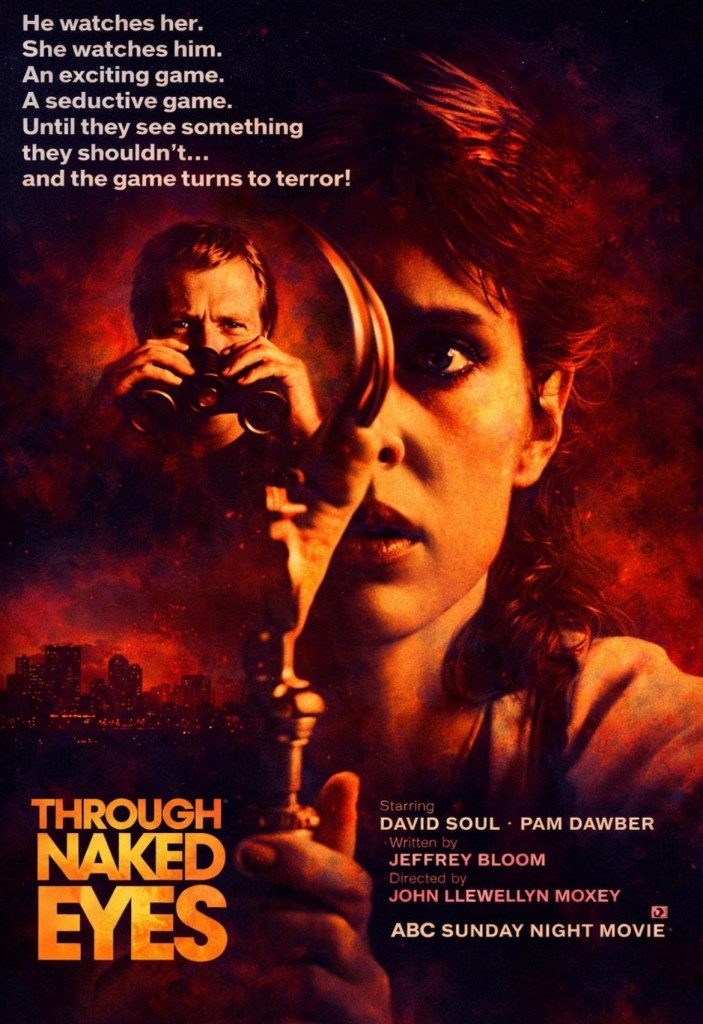
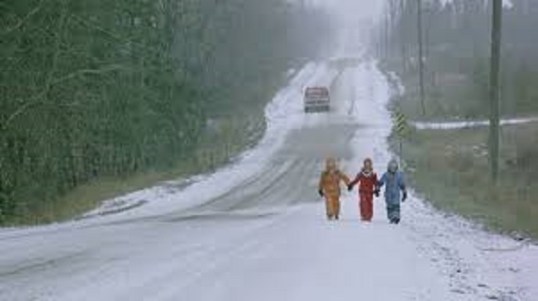
One of the coolest things about being a contributor for The Shattered Lens is the month of October and our Horror-thon. I’m constantly on the lookout for less well-known thrillers that I can watch and write about. I recently came across the 1983 made-for-TV thriller THROUGH NAKED EYES. The premise gives off some definite REAR WINDOW vibes, a favorite of mine, and I’ve always enjoyed the actor David Soul. Having never seen the film, or even heard about it before, I thought I’d give it a shot.
Soul plays William Parrish, a talented flutist who spends most of his time practicing his craft, while still carving out a few moments to pull out his binoculars and check out some of the people who live in the apartment building across the street. One night, he discovers that an attractive woman, Anne Walsh (Pam Dawber), is also watching him through her very nice telescope. Through a variety of circumstances, the two voyeurs meet and begin a relationship. By the way, did I mention that there have been a series of knife murders in the neighborhood, even in William’s own apartment building? And that the detective in charge of the investigation has our musician in his sights as the number one suspect? Of course the fun is watching the suspects and clues pile up as the story plays out!
THROUGH NAKED EYES is one of those movies that snuck up on me. It took a little bit of time for me to get into it as I watched our main character play his flute, practice his flute and sweat profusely. Set in Chicago, they are really trying to make the point that it’s HOT. Everyone is so sweaty. They’ll be having symphony practice and William’s shirt will be so wet that it looks like he just ran a marathon. It was over 100 degrees in Arkansas for 22 days this past summer, and I’ve never been that sweaty inside a building. I guess the AC was spotty in the Windy City back in the early 80s. We also spend time in Anne’s life as we follow her job as guide at the planetarium, as well as her dealings with her sleazy literary agent who’s helping her get some articles published in National Geographic. Seriously dude, that mustache is just creepy. Once we get past all this setup and the two meet, have dinner, and make love, the thriller elements start getting a lot more interesting as the stakes get a lot higher! I won’t say anymore, but I got wrapped up into the story and really enjoyed the last hour.
David Soul gives a strong performance in the film, one that I appreciated more and more as I got to know his character. To be honest, at first he seems pretty darn creepy, but he turns out to have a lot more depth than you might initially think. Pam Dawber, best known to me for MORK & MINDY, is cute, kind, and even sexier than I remembered in her role as the voyeur who had her own little obsession going on. I will admit that it sounded a lot more innocent, and less creepy, when her character explained herself. It convinced me for sure!
The supporting cast in this film is tremendous, and certainly adds to my enjoyment of the film. Fionnula Flanagan has an excellent scene where her shrink character provides a more balanced perspective on our number one suspect. Gerald Castillo is good as the obsessed cop with blinders on for everything except getting his man, who he believes is William. I recognized Castillo from his performances as cops in several Bronson films of the 80s. My favorite scene in the entire film completely surprised me and it involved a scene between William and his estranged dad, played by William Schallert. I love a good, emotional father / son scene. You can even play a game of “spot the future stars” as John Mahoney, Dennis Farina, and Ted Levine play various Chicago police officers throughout the film. It was fun every time one of them would pop up.
If it’s not obvious, I had a good time with THROUGH NAKED EYES. The film does a good job of taking its time and letting us get to know these characters in a way that helps us see them differently as the story plays out. In other words, the film’s drama is effective. It also stretches out the suspense appropriately so that we stay invested in the thriller elements as well. As a viewer, I actually cared about what would happen at the end. Nothing says you enjoy a movie like caring about the outcome, and this one was a very nice discovery for me.
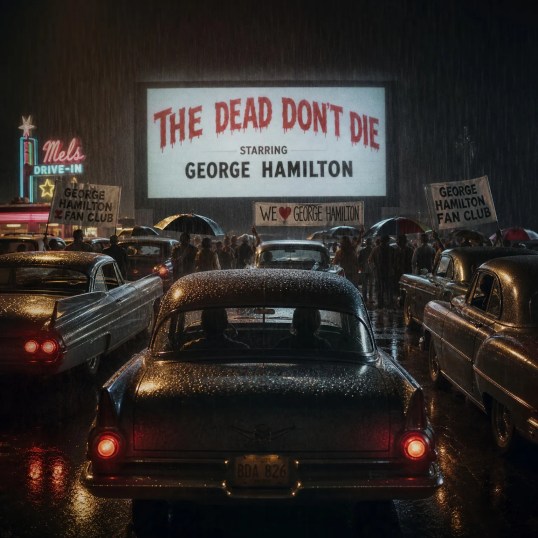
Today, we offer up a bonus horror on the lens, a 1975 made-for-television movie called The Dead Don’t Die!
The Dead Don’t Die takes place in Chicago during the 1930s. George Hamilton is a sailor who comes home just in time to witness his brother being executed for a crime that he swears he didn’t commit. Hamilton is convinced that his brother was innocent so he decides to launch an investigation of his own. This eventually leads to Hamilton not only being attacked by dead people but also discovering a plot involving a mysterious voodoo priest!
Featuring atmospheric direction for Curtis Harrington and a witty script by Robert Bloch, The Dead Don’t Die is an enjoyable horror mystery. Along with George Hamilton, the cast includes such luminaries of “old” Hollywood as Ray Milland, Ralph Meeker, Reggie Nalder, and Joan Blondell. (Admittedly, George Hamilton is not the most convincing sailor to ever appear in a movie but even his miscasting seems to work in a strange way.)
“Today it is science fiction, tomorrow it will be science fact….”
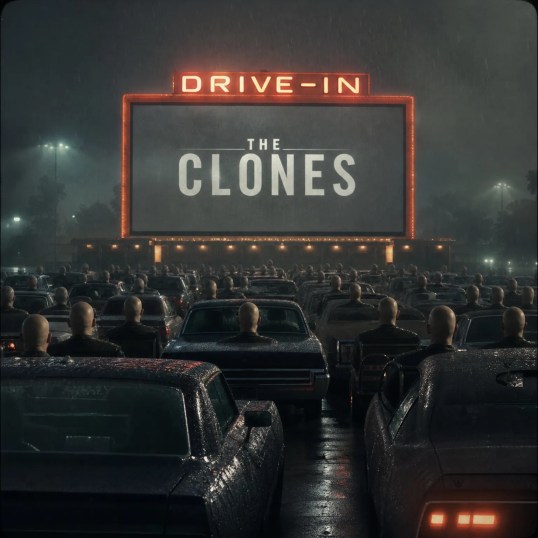
So declared the trailer from 1973’s The Clones.
One of the first films to be made about cloning, this movie tells the story of Dr. Gerald Appleby (Michael Greene), who discovers that there’s another version of him living his life. Dr. Appleby and his clone both find themselves being pursued by two government agents (Gregory Sierra and Otis Brown) and a mad scientist (Stanley Adams).
TheClones requires some patience. It moves at its own deliberate pace and there’s quite a few scenes of Dr. Appleby running through the desert. That said, the film builds up to wonderfully twisted conclusion and the final roller coaster shoot-out makes everything more than worth it.
Ever since I first saw this ennui-drenched film in 2012, I’ve been recommending it to people. I’m happy to share it with you today!
As some of our regular readers undoubtedly know, I am involved in a few weekly live tweets on Twitter and Mastodon. I host #FridayNightFlix every Friday, I co-host #ScarySocial on Saturday, and I am one of the five hosts of #MondayActionMovie! Every week, we get together. We watch a movie. We tweet our way through it.
Tonight, at 10 pm et, #ScarySocial presents Piranha II — The Spawning!
If you want to join us this Saturday, just hop onto twitter, start the movie at 10 pm et, and use the #ScarySocial hashtag! It’s a friendly group and welcoming of newcomers so don’t be shy.
For today’s horror song of the day, we have Demon, a track from the soundtrack for the 1985 film, Demons. This song was composed and performed by Claudio Simonetti, who is best known as the keyboardist of Goblin.
The music video, incidentally, was directed by Michele Soavi, who also appeared in Demons as the mysterious masked man handing out free movie tickets.
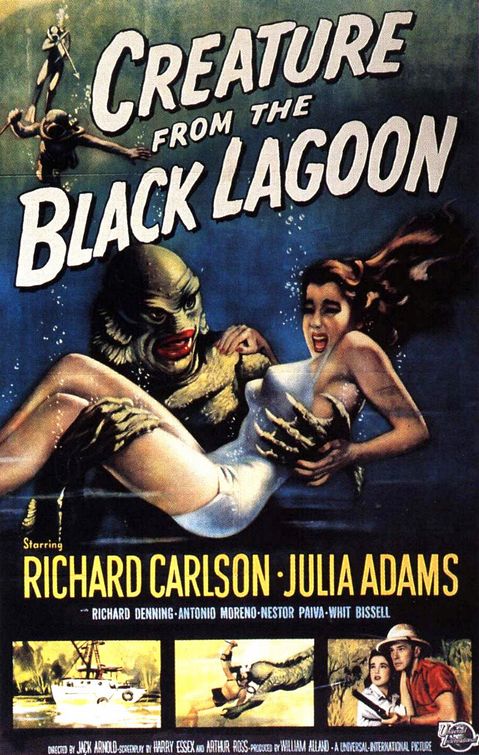
Today’s horror scene that I love comes from one of my favorite films, 1953’s Creature From The Black Lagoon. In this scene, Julie Adams goes for a swim. Little does she realize that, under the water, the Creature is following her every move. Wonderfully directed by Jack Arnold, this creepy yet oddly lovely scene is one of the best of the 50s.
(Today also would have been the 100th birthday of Julie Adams, one of the best — and in my mind, most underrated — actresses of Hollywood’s Golden Age.)
4 Shots From 4 Films is just what it says it is, 4 shots from 4 of our favorite films. As opposed to the reviews and recaps that we usually post, 4 Shots From 4 Films lets the visuals do the talking!
4 Shots From 4 Films
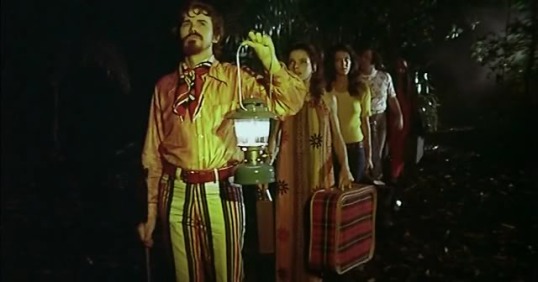
Children Shouldn’t Play With Dead Things (1972, dir by Bob Clark, DP: Jack McGowan)
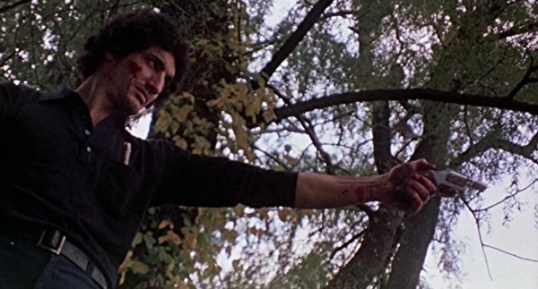
The Last House On The Left (1972, dir by Wes Craven, DP: Victor Hurwitz)
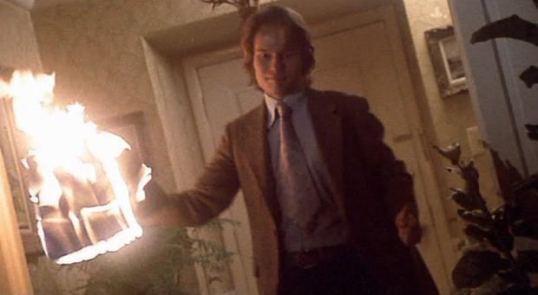
The Killing Kind (1973, dir by Curtis Harrington, DP: Mario Tosi)
The Brood (1979, dir by David Cronenberg, DP: Mark Irwin)
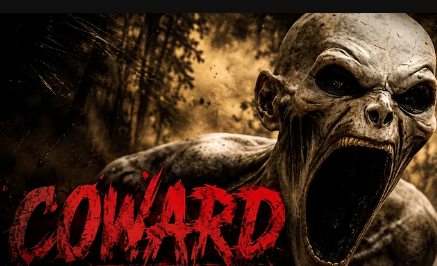
Coward has A LOT going on, but it’s fun! The protagonist is reading the woods next to Baby Yoda (yes, really), Baby Yoda flees, and our protagonist dies.
Hear me out, this story has a beginning, middle, and end. Also, it made me laugh. Kerron Andrews has skills to make a quick compelling story – FOR CHEAP! Industry people – Take Note- If I were looking for a man to make my low budget horror film, I’d DM him right away.
I couldn’t find Kerron Andrews on X, but I left him a kind comment on his YT.
2014’s Only One Way tells the story of Paul (Josiah David Warren), who is 20 years old and who lives with his parents in Texas. Paul was home-schooled and now he’s a college student. He goes to church every Sunday and he and his parents have regular Bible study.
Paul is a bit easily led. We discover this when he starts dating Melanie (Erika Alaspa), who is still in high school and who insists that Paul tell her that she’s beautiful whenever he picks her up from her dance class. Melanie’s father has a devilish beard and a condescending attitude and, when he hears that Paul still lives at home, he says that’s fine except that Paul won’t be a real man until he moves out. Later Paul gets a text from Melanie telling him that her parents loved meeting him but that they all agree that he needs to become “A REAL MAN” and find a new place to live.
Paul gets his own apartment and soon, he’s struggling in both school and life. Melanie and her wild friends are always coming over to party. They introduce Paul to smoking weed. Paul goes from hacking up a lung to making an apple pipe in record time. Uh-oh! His parents stop by the apartment to drop off some groceries and they catch Paul with an apple.
No longer welcome at his parents’s house, Paul tries to make it in the world on his own. He gets a job delivering fried chicken but he’s not good at it. You may wonder how any twenty year-old could manage to screw up something as simple a delivering fried chicken. Well, Paul drops a bucket of KFC on somebody’s lawn and his response it just to brush the grass off the chicken. Then he drops the bucket for a second time when trying to hand it off to the people who ordered it.
“That’ll be fifteen,” Paul says.
No, Paul, that’ll be free!
To be honest, what Paul is going through is not that unusual. I think everyone struggles a bit making the transition from being a teenager to being an adult. The job of a parent is to help the kid prepare for that transition but still, it’s not easy going from living a life with no consequences to living a life where everything has a consequence. Everyone probably parties too much when they first leave home. It’s just human nature.
The thing that sets Paul apart is that he really does just seem to be a complete idiot. Even before he starts dating Melanie, he’s talking about how he’s struggling in college. The film puts most of the blame on Melanie but Melanie isn’t the one who told Paul to put the chicken back in that bucket. Melanie may smoke weed but Paul is the one who decides to smoke with her. Believe me, most people will not be offended if you don’t smoke their weed. That just means more for them.
Anyway, this film was shot on video with a largely amateur class and it shows. This is one of those films where you really have to strain to make out the dialogue because the sound recording is so bad. On the plus side, Paul does own a really cute dog and, by the end of the film he’s found a girlfriend who isn’t trying to destroy his soul. Good for him!
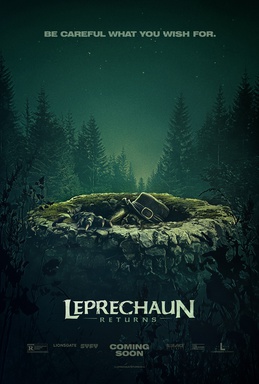 In North Dakota, college student Lila Jenkins (Taylor Spreitler) and her friends are trying to greenify a house that was recently purchased by their sorority. It’s the same house where, 25 years ago, Lila’s late mother fought off a Leprechaun. Lila is the daughter of Jennifer Aniston’s character from the first film, and the fact that her mother is dead probably tells us how much interest Aniston has in returning to the franchise that made her a star. That’s some friend for you.