
David Gordon Green’s Halloween trilogy is coming to an end and, as a fan of the classic Halloween franchise, all I can say is that it’s about time.
Here’s the trailer for Halloween Ends.
David Gordon Green’s Halloween trilogy is coming to an end and, as a fan of the classic Halloween franchise, all I can say is that it’s about time.
Here’s the trailer for Halloween Ends.
Below, you’ll find the trailer for Curse of the Kraken. Humanity has been dumping trash in the ocean for so long that the Kraken has decided to toss it all back onto dry land. It’s also decided to use its tentacles to create some cartoonish gore.
Yes, this is apparently a real movie. And who knows? With the right attitude, it could be fun. I’ll watch just about anything.

I have one last trailer to share tonight and it deals with a far more important subject than either The Munsters or After Ever Happy.
She Said is about the New York Times’s investigation that brought down Harvey Weinstein and which launched the #MeToo movement. It’s an important story for a number of obvious reasons. Myself, I’ll be curious to see if the film is honest about how many well-known people, in both Hollywood and Washington, looked the other way when it came to Weinstein and who only turned on him once it was obvious that his time as a Hollywood and political power broker was over. Today, of course, everyone is quick to mention that they always hated Harvey Weinstein but that didn’t stop those same people from thanking him in their Oscar speeches or accepting his money when they wanted to run for office. A true account of Harvey Weinstein’s crimes will mean calling out a lot of people who, even after all this time, are not normally called out. I hope this movie has the guts to do that.
Here’s the trailer.
We’re still doing this, huh?
After Ever Happy is the latest installment in the After films. Hardin and Tessa continue to try to make their love work. One would think that the fact that they’re both totally shallow and uninteresting would make things simple but the course of true love is never smooth. (I imagine that’s why Batman’s never had a lover who survived more than two movies.) What type of title is After Ever Happy? Like what the Hell does that even mean? I could understand After Happily Everafter, even though that would still be a clunky title. But After Ever Happy? Also, could someone please tell the actor playing Hardin that it is possible to occasionally have a non-sullen facial expression. Hardin is rich, spoiled, and in love and yet he’s still such a whiny little bitch. And now he’s writing about it? Seriously …. GAG!
What?
Oh yeah, you better believe I’ll be seeing this movie.
Here’s the trailer for After Ever Happy!
And here’s a picture of Batman and Robin, because why not?

Yesterday, the trailer for Rob Zombie’s film reboot of The Munsters was released. Judging from the reaction online, you would think that it was some sort of crime against …. well, I guess humanity wouldn’t be quite the right way to put it. Still, I’ve seen people who are far older and I would think far more mature than me saying that this trailer shows that Rob Zombie has no respect for “the legacy of The Munsters.” Weren’t The Munsters just a dumbed down version of The Addams Family?
Anyway, I just watched the trailer and it really doesn’t look that bad to me. Of course, it doesn’t really look that good either. It looks like it’ll be one of those in-between sort of films that people talk about for a week and then forget about. One thing I do appreciate, though, is that it looks colorful. I get the feeling that Rob Zombie enjoyed doing whatever it was that he ended up doing with this film and, really, Zombie deserves to enjoy himself on occasion.
Anyway, here’s the trailer!
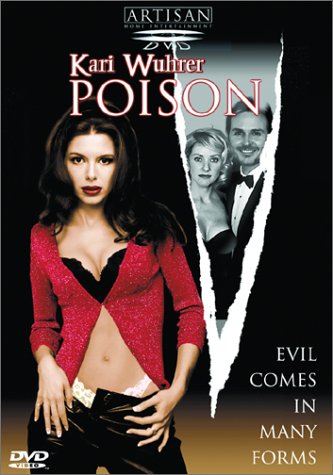 After her husband commits suicide, Ann Stewart (Kari Wuhrer) seeks revenge on the CEO who fired him and Nicole Garrett (Barbara Crampton), the woman who get the promotion that he was counting on. Ann has good reason for being upset, seeing as how she slept with the CEO specifically so he wouldn’t fire her husband. When she finds out that the her husband was never even being seriously considered for the promotion and all of that extramarital sex was for nothing, Ann snaps. Somehow, Ann not only knows how to blow up the CEO and his family but also how to get away with. However, her plot against Nicole is more complicated. After murdering Nicole’s housekeeper, Ann takes her place. Soon, Ann is trying to seduce both Nicole’s husband (Jeff Trachta) and her son (Seth Jones) while encouraging Nicole’s teenage daughter (Melissa Stone) to be even more slutty than before. Ann discovers that Nicole can be a demanding boss and that she and her husband are on the verge of splitting up. Ann also learns that Nicole is diabetic and has to be careful what she eats. That’s good information to have, now that Ann is the one preparing all of her meals! Ann sets her plan in motion. To quote the song of old, that girl is poison.
Poison is typical of the films that used to show up on Cinemax late at night. It’s also a Jim Wynorski film and you always know what you’re getting into with Wynorski. Poison has all of the gratuitous shower scenes and naked midnight swims that you would expect from a film like this. It also has the same basic plot as Scorned, with Kari Wuhrer taking on the Shannon Tweed role of the vengeance-obsessed widow. It’s hard to say who did the role better. Tweed was more calculated in the way she destroyed the family while Wuhrer is more obviously unhinged and impulsive in her actions. Perhaps because Jim Wynorski directed Poison while Andrew Stevens was responsible for Scorned, Poison is a little more self-aware that Scorned and has more of a sense of humor about itself than Scorned did. Ann is eventually as angry about Nicole being a demanding employer as she was about her husband committing suicide. Fans of these movies will want to see Poison for the chance to watch Barbara Crampton and Kari Wuhrer face off against each other. Both of them bring their best.
It’s Wynorski. You know what you’re getting.
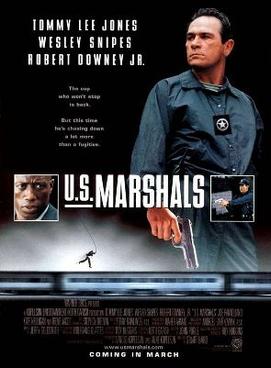
Mark Roberts (Wesley Snipes), formerly of the Diplomatic Security Service and wanted for murder, escapes when his prison transport aircraft crashes into an Illinois swamp. U.S. Marshal Sam Gerard (Tommy Lee Jones) was on the same flight and quickly assembles his team so that they can track down and capture the fugitive. That’s what Sam Gerard does. He’s the best fugitive hunter around. Complicating matters is that an inexperienced DSS agent named John Royce (Robert Downey, Jr.) has been assigned to the team. Royce says that the men that Mark killed were friends of his and this hunt is personal for him. However, Sam suspects that Mark might not be as guilty as he seems. Considering that the last high-profile fugitive that Sam chased was also innocent, I have to wonder why Sam has any faith in the system at all.
Based on the classic televisions how, The Fugitive was one of the biggest film hits of 1993 and it also became one of the few action films to receive an Oscar nomination for Best Picture of the Year. Even though the film starred Harrison Ford as a doctor wrongly convicted of murdering his wife, it was Tommy Lee Jones who got all the best lines and all the critical attention. Tommy Lee Jones was also the one who received an Oscar for his work on the film. The Fugitive was such a hit that it was pretty much guaranteed that there would be a sequel. Since there were only so many times that Richard Kimble could reasonably be wrongly convicted of murder, it also made sense that future films were focus on Sam Gerard and his team.
U.S. Marshals was the first Fugitive sequel and, as a result of terrible reviews and a lackluster box office performance, it was also the only sequel. I saw U.S. Marshals when it was first released in 1998. I enjoyed it but I was also a teenage boy. Back then, I liked everything as long as it featured a car chase, a gunfight, and a leggy female lead. Last night, I rewatched the film for the first time since it was originally released and I still enjoyed it but I could also understand why U.S. Marshals didn’t lead to a Sam Gerard franchise.
The plane crash was as cool as I remembered. So was the scene where Wesley Snipes escaped from Sam by jumping onto a train. (That scene was featured in all of the commercials.) The scenes of Tommy Lee Jones getting frustrated with incompetent local law enforcement were still entertaining, as were the scenes of him interacting with his team. I even liked the much-criticized cemetery stakeout. There was much about the film to like but the main problem was that Sam Gerard works better as a supporting player than as a leading character.
Harrison Ford really doesn’t get enough credit for the success of The Fugitive. One the main reasons why that film works is because Ford is so likable and sympathetic as Richard Kimble. It’s entertaining to check in on Sam and his team but it’s Ford who makes us care about the story. In U.S. Marshals, Wesley Snipes’s character is never as clearly defined as Kimble. We learn very little about him, other than he tries not to actually hurt anyone while escaping. There’s no emotional stakes to whether Mark is innocent or guilty and no real suspense as Sam goes through the motions of hunting him. Sam may still have a way with words but, in U.S. Marshals, he’s just doing his job. Things do get personal when Sam and his team are betrayed by one of their allies and a member of the team is killed but even then, it doesn’t make sense that the bad guy, who had been pretty careful up until that point, would mess up his plans by impulsively killing someone who hadn’t really witnessed anything that incriminating.
I think U.S. Marshals missed its calling. Sam and his team were entertaining enough that, if they had starred in a weekly television show called U.S. Marshals, it probably would have run for ten seasons. As a movie, though, it can’t escape the long shadow of The Fugitive.
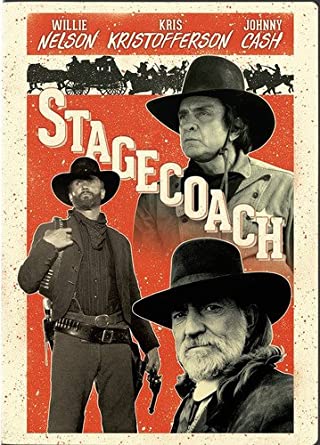 The year is 1880 and Geronimo and his Apaches are on a warpath against the people who have taken their land. Despite the warnings of the local Calvary officers, one stagecoach tries to make the long journey from Arizona to New Mexico. The seven passengers may start out as strangers but they’re going to have to work together to survive the journey. The most famous passenger is dentist-turned-gunslinger Doc Holliday (Willie Nelson). The most infamous is the Ringo Kid (Kris Kristofferson), an outlaw who has recently escaped from prison and who is looking for revenge against the men who framed him for a crime that he didn’t commit. Henry Gatewood (Anthony Fraciosa) is a banker who has embezzled money and is looking to make a quick escape. Foppish Trevor Peacock (Anthony Newley) sells liquor. Dallas (Elizabeth Ashley) is a former prostitute looking to start a new life. Mrs. Mallory (Mary Crosby) is nine months pregnant and traveling to reunite with her husband, an officer in the Calvary. Finally, Hatfield (Waylon Jennings) is a chivalrous gambler. Riding atop the stagecoach is Buck (John Schneider), who gets paid 8 dollars a month to risk his life taking people through Apache country, and Curly (Johnny Cash), the tough-but-fair town marshal who plans to arrest the Ringo Kid as soon as they reach civilization.
Made for television, Stagecoch is an adequate remake of the John Ford classic. The story remains basically the same, with the main difference being that the majority of the characters are now played by country-western singers who are a few years too old for their roles. Doc Holliday, who died of “consumption” when he was in his 30s, is played by Willie Nelson, who doesn’t look a day under 70. The Ringo Kid is played by Kris Kristofferson, who, despite having literally played Billy the Kid a decade earlier, still doesn’t look like he’s ever been called a “kid” at any point in his life. Compared to their original counterparts, the remake’s characters have been slightly tweaked so that they fit with the outlaw country images of the singers playing them. Doc Holliday sympathizes with Geronimo and says that his use of whiskey is “medicinal.” Kristofferson’s Ringo Kid is more openly contemptuous of authority than John Wayne’s. Waylon Jennings is less of a cynic in the role of Hatfield than John Carradine was and Johnny Cash sits atop the stagecoach like a man on a holy mission.
The cast is the main reason to watch this version of Stagecoach. The film can’t match the original but Nelson, Kristofferson, Jennings, and Cash obviously enjoyed playing opposite each other and, even if Nelson and Kristofferson are miscast, all of them bring some needed country-western authenticity to their roles. As for the non-singers, Mary Crosby, Elizabeth Ashley, and John Schneider all make the best impressions while both Franciosa and Newley seem too 20th Century for their western roles. Director Ted Post does a good job with the action scenes and keeps the story moving, even if the remake’s status as a TV production keeps him from capturing visual grandeur of Ford’s original. Stagecoach is a respectful remake of a classic, one that can be appreciated when western fans on its own merits.
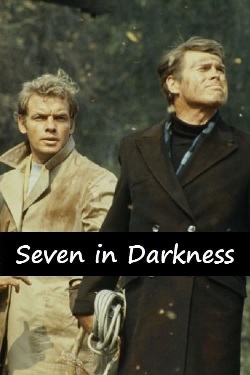 A group of blind people, led by teacher Alex Swain (Barry Nelson), are flying to a convention for the blind in Seattle. When their flight is knocked off-course by an unexpected storm, the plane crashes into a remote forest. The plane’s crew and the one sighted passenger are all killed in the crash, leaving the eight blind passengers to fend for themselves. The plane is perched on the edge of a mountain, there are wolves all around, and no one can see the surrounding terrain. And one of the passengers is pregnant and could give birth at any minute! To Alex’s resentment, the group turns to Mark (Sean Garrison) to help them survive in the wilderness. Mark was blinded while serving in Viet Nam and he’s still haunted by what happened during the war. At first, he resists being thrust into a leadership role but finally, it becomes clear that he has no choice. Under Mark’s leadership and despite Alex’s protestations, the eight survivors try to find their way back to civilization.
Filmed for television and based on a novel by Leonard Bishop, Seven in Darkness is a tense and well-acted movie. It’s not easy to watch the survivors feeling around in the darkness, trying to find their way to safety. That we can see what they don’t makes things all the more suspenseful. Even more importantly, the film does a good job of presenting the survivors of being individuals. Even though they all share a disability, they still have their own personality quirks, strengths, and flaws. Surprisingly the stand-out amongst the cast is none other than Milton Berle, cast in a dramatic role and giving a nuanced performance as the angriest of the survivors. Watching Seven in Darkness, you come to care about all of the survivors and you get very wrapped up in whether or not they’re going to be able to make it to safety.
Seven in Darkness was the first film to be shown as a part of ABC Movie of the Week. It can be found on YouTube.
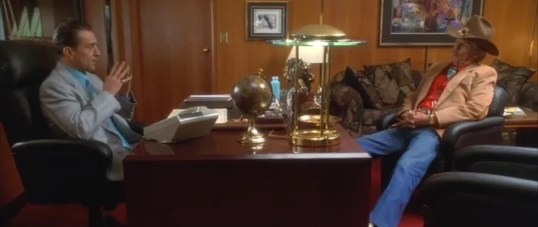
Yesterday, the great western character actor, L.Q. Jones, passed away. He was 94 years old.
Though he was probably best known for the films that he did with Sam Peckinpah and for directing the darkly humorous sci-fi film, A Boy And His Dog, Jones also appeared in Martin Scorsese’s 1995 film, Casino. Playing the role of county commissioner Pat Webb, Jones went toe-to-toe with Robert De Niro and more than held his own. Reportedly, Scorsese asked Jones to rewrite much of his dialogue, in order to give it a western authenticity,
From Casino, here is a scene that I love:
Though Ace would disagree with me, he really should have just taken Webb up on his suggestion to give his brother-in-law a “position further down the trough.” That pride was not only Ace’s undoing but also the end of Bugsy Seigel’s vision of Las Vegas.
Interestingly enough, this scene always makes me think of the scene where Sen. Pat Geary (also of Nevada) tried to bully Michael Corleone in The Godfather Part II. In that film, the Corleones were able to put the senator in his place. In Casino, however, it turns out that Pat Webb is right and Ace and the gangsters in Kansas City never really do figure out how things work in Vegas.

