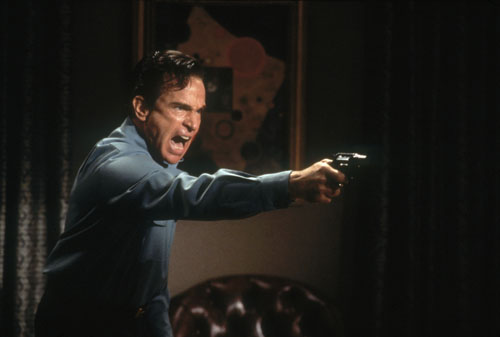
Embracing the Melodrama #40: Bugsy (dir by Barry Levinson)


Bugsy5lrg

Let’s continue to embrace the melodrama with the 1991 best picture nominee Bugsy.

Gangster Benjamin Siegel (Warren Beatty) may be known as Bugsy but nobody dares call him that to his face.  Siegel may be best known for his quick temper and his willingness to murder anyone who gets in his way, but Ben insists that he’s not as crazy as everyone considers him to be.  Instead, Ben knows that he’s a very special person, a visionary businessman whose business just happens to be organized crime.  Along with his childhood friends Lucky Luciano (Bill Graham) and Meyer Lansky (Ben Kingsley), Siegel is one of the founders of the modern American crime syndicate.  Unlike his more practical-minded partners, Siegel revels in being a public figure.  Bugsy examines how Siegel became a celebrity gangster and how that celebrity eventually led to his downfall.

As the film opens, Luciano and Lansky send Siegel out to Los Angeles, specifically to look after their west coast business operations.  Before Siegel leaves, he is specifically told to keep a low profile.  So, of course, as soon as Siegel arrives in Los Angeles, he starts hanging out with actor George Raft (Joe Mantegna) and having a very public affair with actress Virginia Hill (Annette Bening).  Siegel quickly falls in love with the glamour and glitz of Hollywood and starts to think of himself as being a movie star.  When he’s not working with violent gangster Mickey Cohen (Harvey Keitel) to control the Los Angeles underworld, Siegel is attending film premieres and even shooting a Hollywood screen test.  Back in New York, Luciano and Lansky can only watch as their childhood friend goes out of his way to defy their instructions and become the most famous gangster in America.

Eventually, Siegel goes on a gambling trip to Nevada and comes up with an idea that is destined to change America forever.  With funding from Lansky and Luciano, Siegel begins construction on the Flamingo Hotel and Casino in Las Vegas, Nevada.  However, Siegel’s plans are so extravagant and, in many ways, impractical that the budget soon soars out of control.  Not helping matters is the fact that Virginia is embezzling money from the casino’s budget.  Even after Siegel finds out, he can’t bring himself to be angry at her.  He understand that he and Virginia are essentially cut from the same cloth.

However, back in New York, Luciano grows more and more frustrated with Siegel’s wasteful ways and Lansky comes to realize that he can only protect his friend for so long…

Bugsy is a big, extravagant movie that tries to be a few too many things at once.  Over the course of two and a half hours, it attempts to be a love story, a biopic, a classic gangster film, an allegory for the American dream, a history lesson, a period piece, and finally, a metaphor for the act of filmmaking itself.  (When Siegel complains that Luciano and Lansky don’t understand why the Flamingo has to be huge, it’s hard not to feel that he’s meant to be a stand in for every director who has ever had his budget cut by a meddling studio executive.)  When a film tries to be so many different things all at once, you can’t be surprised when the end result is a little uneven.  Bugsy starts out slowly but gradually picks up speed and the final part of the movie is everything that one could hope for from an epic gangster film.

The film works best as a character study of a man who, in the best American tradition, attempts to reinvent himself by moving out west.  Back in New York, Ben is known as a cold-blooded and dangerous killer.  However, once he arrives in Los Angeles, Ben attempts to recreate himself as a celebrity and then as a visionary.  For him, the Flamingo is about more than money.  The Flamingo is about being remembered for something other than his nickname.  The Flamingo is his way to escape from his past.  However, as Bugsy makes clear, the past can be ignored but it never goes away.
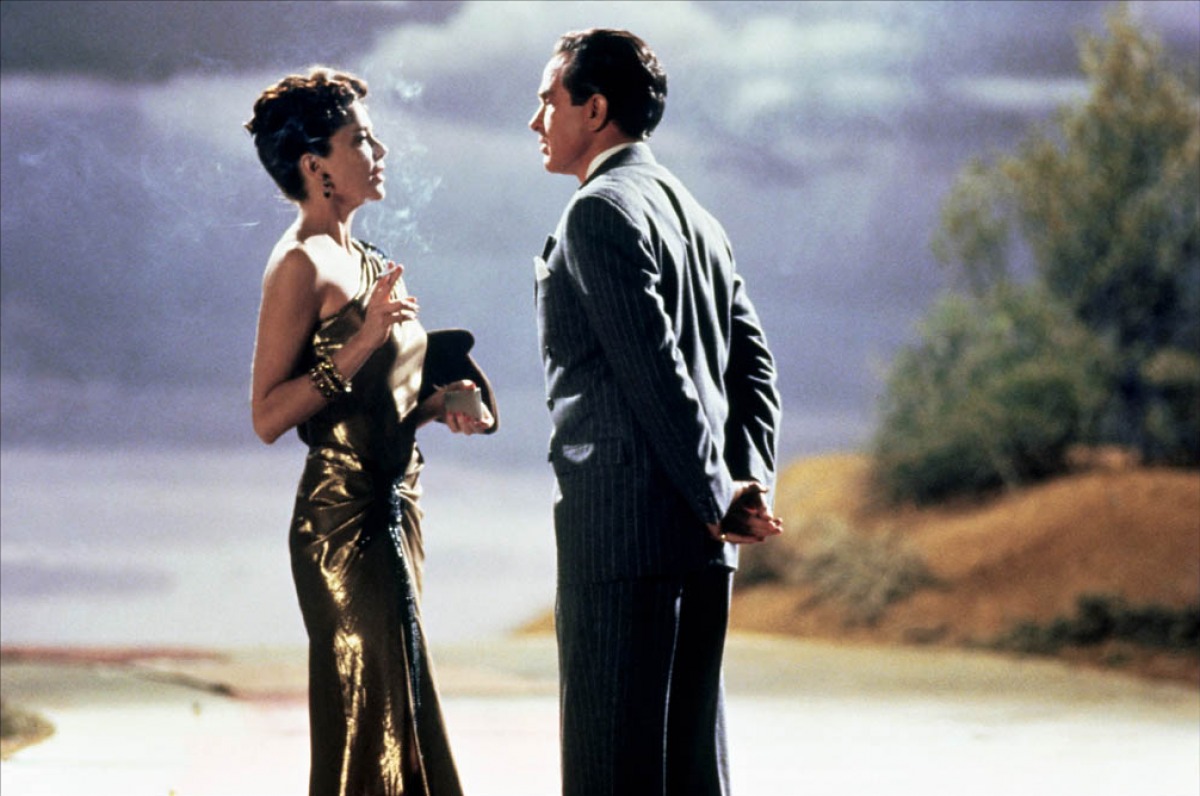
bugsy-1991-09-g

Embracing the Melodrama #39: True Colors (dir by Herbert Ross)


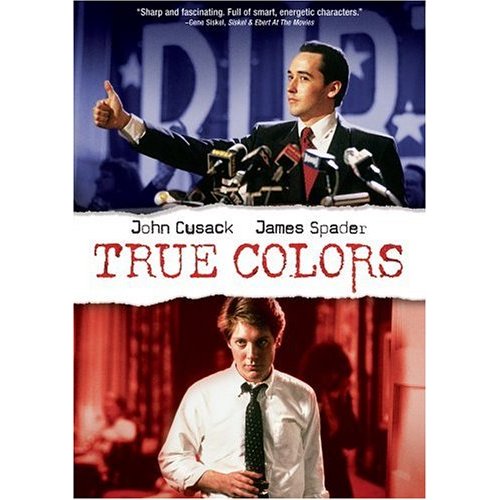
True Colors

For the past 9 days, I’ve been posting chronological reviews of 54 of the most (and least) memorable melodramas ever filmed.  I started with a film from 1916 and yesterday, I completed the 80s.  Today, we start in on the 90s with the 1991 political drama True Colors.

True Colors tells the story of two ambitious law students.  Tim Gerritty (James Spader) is a wealthy idealist who wants to work at the Justice Department so he can uncover and prosecute political corruption.  His roommate and eventual best friend is Peter Burton (John Cusack).  Although Peter initially lies about his background, it’s eventually revealed that he comes from a poor family and the result of growing up in poverty has left Peter with an obsessive desire for revenge on everyone who has ever looked down on him.  And how is Peter planning on getting that revenge?  By marrying the daughter of Sen. James Stiles (Richard Widmark) and eventually running for a seat in the U.S. House.  Despite the fact that Tim happens to be in love with Sen. Stiles’s daughter as well, he still supports his friend Peter and even agrees to be his best man.  However, as Peter gets closer and closer to achieving his goals, Tim starts to reconsider their friendship….

There’s a scene about halfway through True Colors, in which Peter Burton attempts to blackmail Sen. Stiles into supporting his political career.  Stiles agrees but then angrily adds, “God help you when the people find out.  They always do, you know.”  I was naturally waiting for Peter to come up with a properly sarcastic response but instead, Peter simply looks down at the ground, properly chastened.  It’s a jarringly false note and, unfortunately, everything that comes after this scene feels equally false.  The film, which starts out as such a strong portrait of what happens with friendship comes into conflict with ambition, ends up turning into a painfully predictable political diatribe, the type of thing that makes the portrait of politics in The Adjustment Bureau seem subtle and nuanced by comparison.  When Tim decided to betray Peter, it should be a moment full of moral ambiguity.  Instead, we’re expected to ignore their long friendship and just be happy that Tim is willing to do the right thing and protect the integrity of the American political process.

And, who knows?  Maybe that’s the way people viewed politics back in the early 90s.  But for audiences today, it all feels really naive and simplistic.

But, if you can manage to look past the film’s weak’s script, you can enjoy the acting.  John Cusack is wonderfully intense as Peter, making the character compelling even when the screenplay lets him down.  Watching him in True Colors is like watching the performance that he should have given in The Butler.  James Spader is sympathetic as Tim and, like Cusack, his performance almost allows him to overcome a script that doesn’t seem to realize that Tim is essentially a self-righteous jerk.  And finally, there’s Mandy Patikin who has a lot of fun playing the local crime boss who sponsors Peter’s career and who, in one memorable (if out-of-place ) scene beats up a shark that’s jumped up on the desk of his yacht.

Much like High Stakes, True Colors is one of those obscure films that occasionally pops up on cable, usually late at night and usually serving as filler between showings of better-known films.  Keep an eye out for it, if just for the chance to enjoy the performances.

Trash Film Guru Vs. The Summer Blockbusters : “Transformers : Age Of Extinction”


transformers-age-of-extinction-poster

You can accuse Michael Bay of many things — overblown spectacle, formulaic hackery, using CGI as a massive crutch, general lack of anything resembling original vision — but false advertising ins’t among them : when you go see a Bay-directed flick, particularly a Bay-directed Transfomers flick, you know exactly  what you’re in for.

Oh, sure, his latest — Transformers : Age Of Extinction — alters the basic cosmetic trappings somewhat, most notably by banishing Shia LaBeouf to whatever hell for dead careers Megan Fox was earlier castigated to in favor of proven “action hero” star Mark Wahlberg, and yeah, Stanley Tucci is about the only major holdover (as far as human beings go) from previous entries in this series (look for more newcomers in the form of Kelsey Grammer and Nicola Peltz as Wahlberg’s daughter), but this is no reboot, by any stretch.

For one thing, the story continues directly on from the previous efforts, with the Transformers having been “driven underground,” so to speak, thanks to a government witch-hunt until no less than Optimus Prime himself is discovered and “resurrected” by Wahlberg’s Cade Yeager (there’s a focus-group-tested name if I’ve ever heard one) character, who —

Oh, fuck it. Does this even matter? Does even the most hard-core fan of this franchise — and that’s precisely what it is, a franchise — care what the plots of these films are about? If so, you have to feel a sort of pity for them, because Bay and screenwriter Ehren Kruger (who was supposed to be the “next big thing” once upon a time for a few minutes there) clearly don’t. Every single “slow” or “quiet” scene is obviously just set-up to carry us into the next big CGI set piece, so we won’t waste our time here with a terribly detailed breakdown of the story. Sound fair?

Transformers-4-Age-of-Extinction-Mark-Wahlberg-Jack-Reynor-and-Nicola-Pelt

All in all, Transformers : Age Of Extinction is all about getting the job done, slapping the finished product up on the screen, and opening up those cash register drawers. In that respect — and that one only — you’ve gotta say “mission accomplished” here. This movie is making money hand over fist and evidently the public’s appetite for more and more robo-carnage is proving to be flat-out insatiable. We apparently love this shit.

The question I have is — who’s “we”? Like the ever-ephemeral “they” of “well, they say you should — ” and “they say it’s not good for you to —” fame, the target audience for these films eludes me. I don’t like ’em. Nobody I know likes ’em. Nobody whose reviews I read online likes ’em. Nobody anywhere seems to like ’em.

And yet there it is — an 87% CinemaScore rating and another sequel already germinating somewhere in the pipeline. How, exactly, does this happen?

transformers-age-of-extinction-trailer

The short answer is — I don’t know. There’s obviously an appreciative audience for these things out there somewhere, but I can’t figure out where it is, beyond perhaps in junior high schoolyards. That’s not enough to explain the phenomenon, though. I know it’s purely anecdotal, but when I went to see this film, the theater had maybe 30 or 40 people in it, and the crowd remained silent throughout. No clapping and cheering. No gasping in awe. No chuckles at the limp one-liners. And yet it wasn’t a rapturous, devotional silence these folks were in the midst of — it was just a kind of “blah” sense of resignation. We were here. This was happening. Everything, apparently, was as it should be. Until the end credits rolled, and we all left to do whatever it is we were  supposed to do next.

And maybe that’s the genius and/or malevolence of what Bay and company have come up with here in a nutshell : Tranfromers movies, for all their empty-hearted and empty-headed spectacle, aren’t huge pop culture events anymore. But a lot of us — myself included — keep going to them because they’re supposed to be. And we’re supposed to be there for them. It’s almost like a kind of Orwellian mass conditioning going on : we’re told this is a big deal and, lemmings that we are, we don’t want to miss out on that. Final score : Michael Bay and Paramount Pictures 1, hope for humanity 0.

transformers_aoe_domtlr1_texted_stereo_h264_hd-1

Pessimistic? Sure. But is there any reason not to be? A family of four left the theater at exactly the same time I did and their car was parked right next to mine. We followed the same route for a few blocks (I wasn’t purposely tailing them, I promise!) — until they pulled into a McDonald’s. And that pretty much says it all right there.

Embracing the Melodrama #38: High Stakes (dir by Amos Kollek)


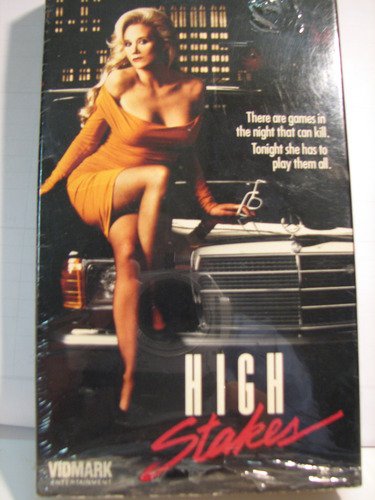
High Stakes

Yesterday, I said that Dance or Die was the most obscure film that I would be reviewing for this series of melodramatic film reviews.  Well, I may have spoken too soon.  Originally, I was not planning on reviewing the 1989 film High Stakes for this series.  Until a few nights ago, I had never even heard of it.  However, I watched it late last night and I realized immediately that I had to include it in this series.

High Stakes is one of those odd, older films that occasionally pops up as filler on Encore, playing in between showings of movies that people have actually heard of.  When I first came across this film listed in the guide, it was mentioned that High Stakes was Sarah Michelle Gellar’s film debut.  However, before all of my fellow Buffy fans get all excited, they should be aware that Sarah was only 12 years old when she appeared in High Stakes and she spends most of her screen time going, “Mommy!”  If not for her name in the credits, you would never suspect that the little girl playing Sally Kirkland’s daughter would later grow up to play one of the most iconic characters in film history.

Sarah plays the daughter of Bambi (Sally Kirkland), an aging New York-based prostitute and stripper who works for the demonic pimp Slim (Richard Lynch).  Bambi hates her life but she does what she has to do to support her daughter.  One night, Bambi finds a man passed out in the garbage across the street from her apartment.  That man is John Stratton (Richard LuPone), a crooked stock broker who has recently grown disillusioned with his greed-fueled life.  John is laying in the garbage because he’s just been mugged.  Despite her natural instincts, Bambi takes sympathy on John and allows him to come up to her apartment.  John and Bambi start to talk about their respective lives, just to have the conversation interrupted by one of Slim’s henchmen showing up at the apartment and demanding money.  John and the henchmen get into a physical altercation and soon, he and Bambi find themselves on the run with $4,000 of Slim’s money.

As directed by Amos Kollek, High Stakes is essentially two different stories.  One of which is rather conventional thriller, in which John and Bambi have to escape from Slim.  The thriller elements are rather predictable, distinguished only by Richard Lynch’s notably unhinged performance.  The other part of the film is the opposites-attract love story between John and Bambi and these scenes work a lot better.  LuPone and Kirkland have a lot of a chemistry and some of the best moments in the film are the ones where the characters simply talk about their different lives.  Kirkland, in particular, does a good job and she manages to bring some unexpected shadings to a stock role.  She’s especially good in her scenes with Sarah Michelle Gellar, radiating a very natural maternal instinct.  By the end of the film, you truly like Bambi and root for her.  Despite all of my natural expectations, High Stakes turned out to be a rather sweet and touching film.

High Stakes may be an obscure film but it’s definitely one to keep an eye out for the next time it shows up on Encore.

Sarah Michelle Gellar and Sally Kirkland in High Stakes

Sarah Michelle Gellar and Sally Kirkland in High Stakes

That concludes the 80s.  Tomorrow, we’ll start in on the 90s.

Embracing the Melodrama #37: Dangerous Liaisons (dir by Stephen Frears)


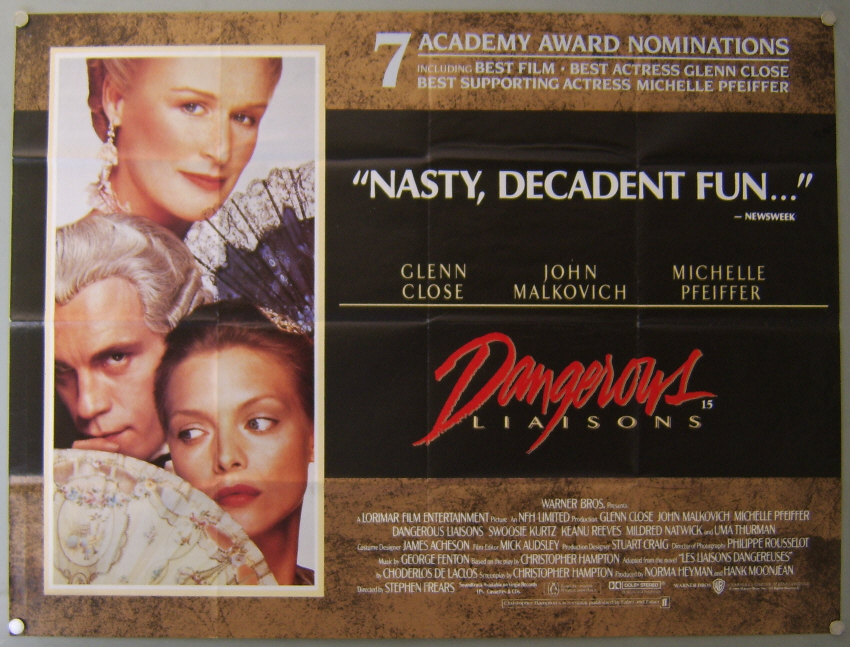
When watching a film like the 1988 best picture nominee Dangerous Liaisons, it helps to know something about history.  The film takes place in 18th century France and, even though it’s never specifically stated in the film, I watched it very much aware that the story was taking place just a few years before the French Revolution.  Even the aristocratic libertines who survive until the end of the film are probably destined to end up losing their lives at the guillotine.  Even though you don’t see anyone losing their head during Dangerous Liaisons (nor do you hear anyone say, “Let them eat cake.”), the film offers up such an atmosphere of decadence and manipulation that it leaves the viewer with little doubt as to why the people occasionally feel the need to rise up and destroy their social betters.

Dangerous Liaisons tells the story of the Vicomte de Valmont (John Malkovich) and the Marquise de Mertuil (Glenn Close), two amoral members of the aristocracy who deal with their boredom by playing games with the emotions of others.  Valmont is a notorious womanizer while Mertuil is obsessed with “dominating” the male sex and “avenging my own.”  At the start of the film, Mertuil has discovered that a former lover is planning on marrying the innocent Cecile (18 year-old Uma Thurman, stealing every scene that she appears in), who has basically spent her entire life in a convent.  Mertuil asks Valmont to seduce and take Cecile’s virginity before the wedding.  At first, Valmont says that Cecile is to easy of a challenge and declines.  Instead, Valmont has decided that he wants to seduce Madame de Tourvel (Michelle Phieffer), a married woman who is renowned for both her strong religious feelings and her virtuous character.  Mertuil agrees that she will sleep with Valmont if he can provide her with written proof that he’s managed to seduce Tourvel.

Tourvel is staying with Valmont’s aunt (Mildred Natwick), which gives Valmont — with the help of his servant, Azolan (Peter Capaldi) — several chances to try to trick Tourvel into believing that he’s a better man than everyone assumes him to be.  (With Azolan’s help, Valmont finds a poor family and donates money to them.  Of course, he makes sure that word of this gets back to Tourvel.)  However, Valmont then discovers that Cecile’s mother (Swoosie Kurtz) has been writing letters to Tourvel, warning her about Valmont’s lack of character.  To get revenge, Valmont agrees to seduce Cecile.

Dangerous Liaisons, which is based on a play that was based on a novel, is sumptuous costume drama.  If you’re like me and you love seeing how the rich and famous lived in past centuries, you’ll find a lot to enjoy in Dangerous Liaisons.  With the elaborate costumes and the ornate sets, the film is a real visual feast.

The film is also a feast for those of us who enjoy good acting as well.  With the exception of a very young Keanu Reeves (who is oddly miscast as the poor music teacher who falls in love with Cecile), the entire film is perfectly cast, right down to the most minor of characters.  (I particularly enjoyed listening to Peter Capaldi, even if his Scottish accent occasionally did seem rather out-of-place in a film about the pre-Revolution France.)  For me, the biggest shock was John Malkovich.  Don’t get me wrong — I’ve always felt that Malkovich was a good character actor but he’s never been someone that I would think of as being sexy.  However, he gives close to a perfect performance as Valmont and, oddly enough, the fact that he’s not really conventionally handsome only serves to make Valmont all the more seductive.  Purring out his cynical dialogue and openly leering at every single woman in Paris, Malkovich turns Valmont into a familiar but all too appealing devil.

Dangerous Liaisons was later remade as Cruel Intentions, which is a film that I’ll be taking a look at very soon.

liaisons

Embracing the Melodrama #36: Fatal Attraction (dir by Adrian Lyne)


fatal-attraction

(This review has spoilers because I felt like it and I’ll do whatever the Hell I want.)

Today, we continue embracing the melodrama by taking a look at the 1987 best picture nominee, Fatal Attraction.

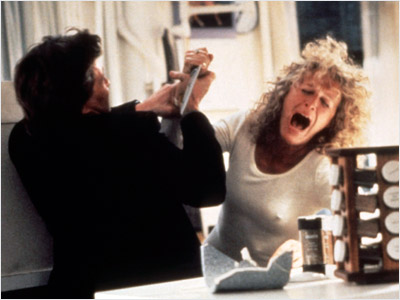
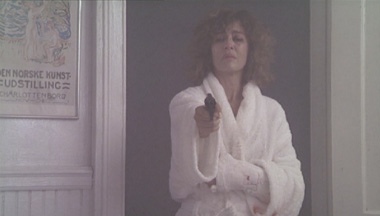
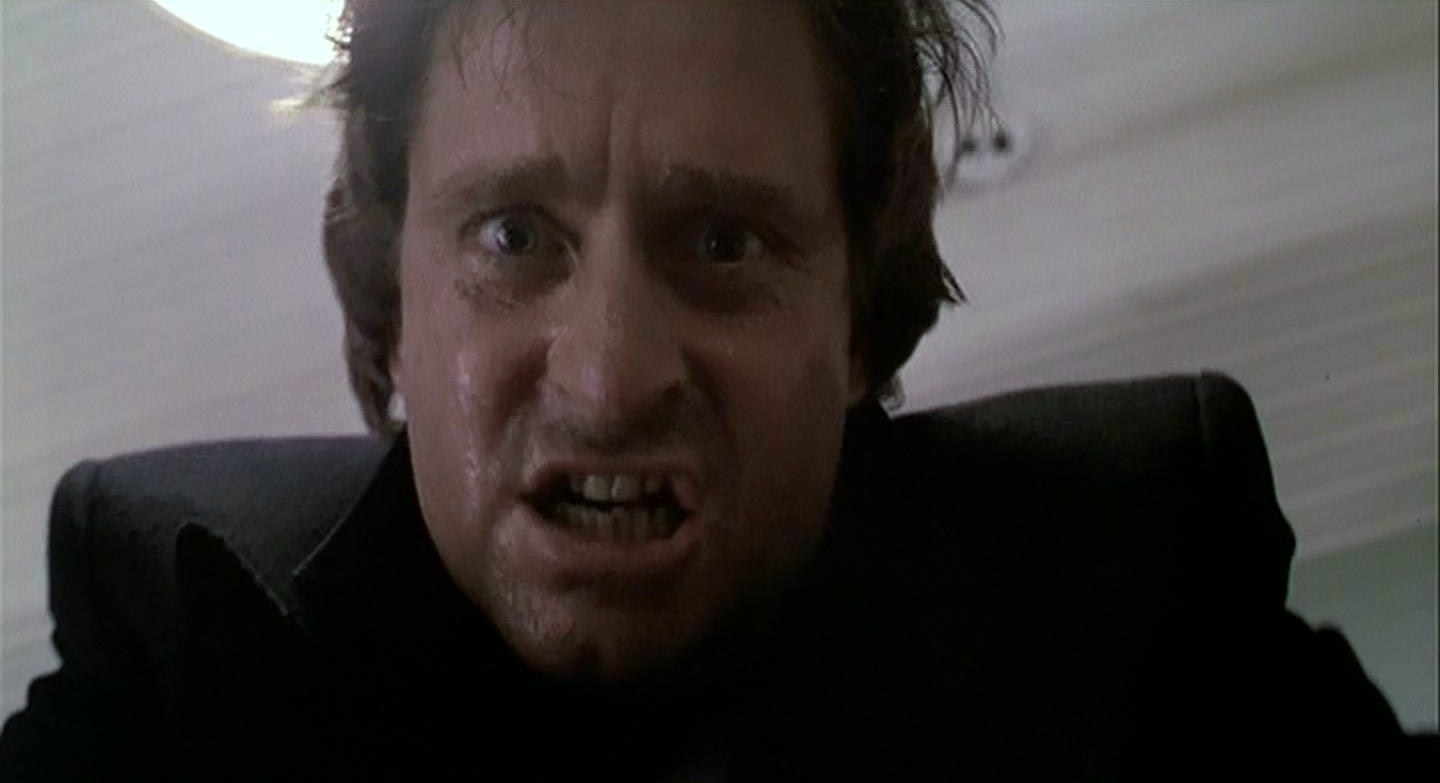
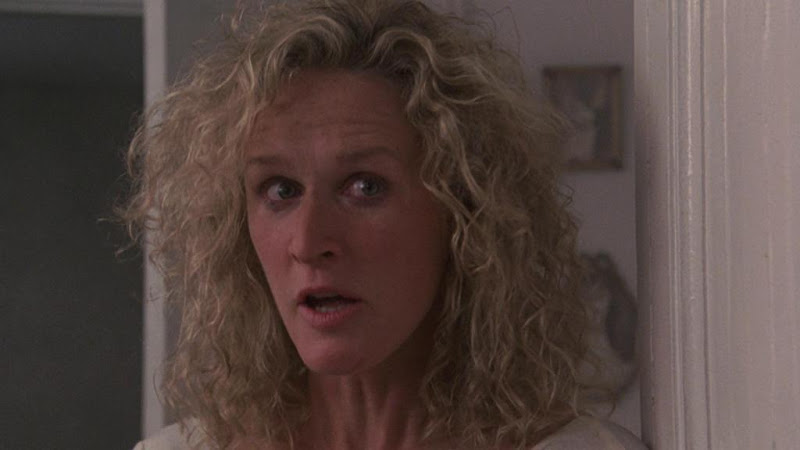
Fatal Attraction opens on a scene of domestic bliss, with lawyer Dan Gallagher (Michael Douglas) and his wife Beth (Anne Archer) in their luxurious Manhattan apartment, getting ready to go out for the night and waiting for the babysitter to arrive.  Dan would appear to have it all: a successful career, a fat best friend, and a beautiful wife.  However, when Beth and their daughter go out of town for the weekend, Dan ends up having an affair with Alex (Glenn Close).  Dan assumes that it was just a weekend thing but Alex is soon stalking Dan.  Trying to escape her, Dan moves his family out to the suburbs but Alex follows them.  Soon, pet rabbits are being killed, Alex is breaking into the house with a knife, and it’s up to Beth to step up and reclaim her man.

I have to admit that I have mixed feelings about Fatal Attraction.  On the one hand, it’s an undeniably well-made film.  It’s well-acted and director Adrian Lyne pushes all of the right emotional buttons and keeps the action moving quickly.  That the film is predictable doesn’t make it any the less effective.  As a lover of horror movies, I appreciated the skill with which Lyne crafted the film’s scare scenes.  Watching the movie, it was easy to see why Fatal Attraction was a huge box office success and why it continues to influence our culture to this very day.

fa05

And yet, at the same time, Fatal Attraction really annoys me.

The film is so well-made and so manipulative that it’s easy to miss the fact that Dan Gallagher is not only never punished for betraying his wife but he’s actually not held responsible for his actions in any way.  Instead, the only person who is truly punished for their transgression is Alex.  The film, after all, makes clear that Alex is the one pursuing Dan.  In fact, it could be argued that when it comes to Dan and Alex, the traditional gender roles have been reversed.  Alex (who, as opposed to the idealized Beth, has a name that is both masculine and feminine) is the aggressive one while Dan is the passive one who gives into temptation and, afterwards, feels guilty.  After admitting his transgression, Dan is allowed to reclaim his manhood and continue on with his perfect life.  However, Alex has no place in conventional society and therefore, she must be destroyed.

And so much the better if she’s destroyed by Beth, a woman who has no problem with accepting a traditionally domestic role.

Far too often, in the past, I know that my girl friends and I always assumed that men were simply incapable of resisting temptation.  Therefore, if your boyfriend cheated on you, it really was not his fault.  He was just being a guy.  Instead, it was the other woman’s fault because she was the one who tempted him.  (And, though we acknowledged this a lot less, it was also his girlfriend’s fault for allowing him to get into a position where he could be tempted in the first place.)  But it was never truly guy’s fault and, as long as you made him suffer for a bit, it was always expected that you would forgive him and take him back.

ff562f_50a74289f9f696cf59a7125eec69b111

That’s the same mentality that runs through Fatal Attraction (not to mention countless daytime talk shows where girlfriends and wives always beat up mistresses while their boyfriend or husband stands over to the side and watches, untouched).  Yes, Dan did cheat on his perfect wife and yes, he feels terrible about it.  But the real threat comes from the woman who pursued him despite knowing that he was married and then, afterwards, had the nerve to demand not to be ignored.  (If anything, the film seems to be suggesting that everything would have been okay if Dan had just fucked someone who works in his office, as opposed to someone who he can’t control through money or the threat of societal shaming.)  When, at the end of the film, Beth shoots Alex, it’s a crowd-pleasing moment but it’s also Beth’s way of reclaiming her man.  Since Dan — being male — can’t be expected to exercise any sort of self-control, it’s the responsibility of Beth to step up and destroy the temptation.

For not respecting the vows of marriage, Alex is a monster who must be destroyed.  Dan, on the other hand, is merely inconvenienced and ultimately, he ends up with a far stronger marriage as a result of having strayed.

In Fatal Attraction, the only thing more dangerous than sex with Alex is examining subtext.

Fatal Attraction-22

Embracing the Melodrama #35: Dance or Die (dir by Richard Munchkin)


Dance or Die

Every month, the Alamo Drafthouse has something that they call the Video Vortex.  This is where, for one night only, they show a movie that are only available on VHS.  For the most part, these movies are usually very obscure, often quite strange, and, not surprisingly, really, really bad.  However, on the plus side, it only costs a dollar to get into Video Vortex and it gives people like me a chance to see films with titles like Dance or Die.

In all probability, of the 50 films that I’m reviewing in this series, Dance or Die is probably the one that nobody else has ever heard of.  That’s understandable because Dance or Die is a pretty bad film and, when it was released way back in 1987, it apparently went straight to video.  If not for the fact that the Alamo Drafthouse is just a few blocks away from me, I would probably never have heard of — much less seen — Dance or Die.

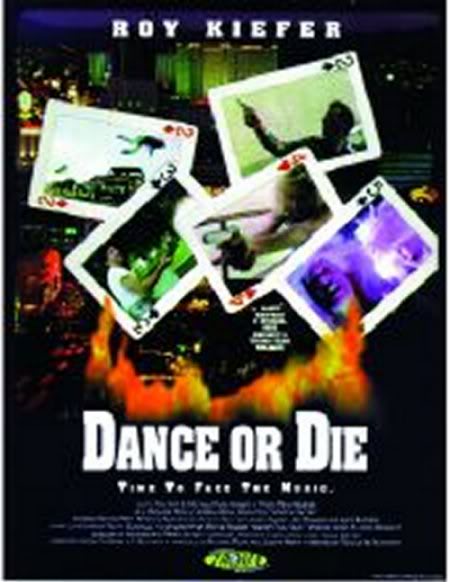
Dance or Die tells the story of Jason Chandler (Roy Kieffer), a choreographer who is also a recovering drug addict.  Jason spends his time either choreographing a show or teaching a dance class.  That’s not me being a vague reviewer.  That’s me pointing out the fact that the film itself seems to be unsure just what exactly it is that Jason spends all of his time doing, beyond the fact that it somehow involves dancing.  At the end of the movie, there’s a hilariously bad dance performance that Jason apparently choreographed.  (I say bad but I have to admit that it’s believably bad and I’ve been involved in worse.)  Are the dancers Jason’s students or are they supposed to be professionals?  Who knows?

We’re also left uncertain as to just when exactly Jason was a drug addict or what he was addicted to or anything else like that.  All we know is that he goes to meetings that have a definite AA feel to them and he has heart-to-heart talks with his drug counselor.  He often says that he’s feeling tempted to return to his old way but what were those ways?

And another thing — if Jason’s a recovering drug addict, is it really a good idea for him to be roommates with a guy who spends all of his spare time selling cocaine out of their apartment?  If I was Jason’s counselor, I’d probably tell him to find a new roommate.  However, in all fairness, the roommate (whose name I never caught — in fact, I’m not sure if it’s ever stated) does tell Jason not to touch any of the cocaine.

And here’s another question for you — why do Jason and his roommate keep an aquarium in their back yard?  It’s just sitting out there with a bunch of confused fish wondering why they’re not being kept in the living room.  When Jason’s roommate holds an outdoor barbecue, a bunch of gangster pop up out of nowhere and gun everyone down and, sad to say, the aquarium is destroyed.

Fortunately, during the massacre, Jason was out doing whatever the Hell it is that he does all day.  (For the most part, it looks like he spends most of his time driving his car.  The film takes place in Las Vegas and you better believe that whenever Jason goes out for a drive, he makes sure to go by a few locations that scream, “Hey, we filmed in Vegas!”)  Jason is naturally upset to discover a bunch of dead people in his house and he’s even more upset when a homicide detective suggests that maybe Jason knows more than he’s telling.  But Jason doesn’t do anything crazy like move out of the house.  Even after he starts to get threatening phone calls, Jason stays in the house.

It turns out that Jason’s roommate hid a file somewhere in the house.  Jason spends most of the movie searching for that file and he even gets desperate enough to bring in a psychic at one point.  However, the file really doesn’t matter.  What does matter is whether or not Jason will be able to resist the temptation to start using drugs again.  Will Jason resist his demons?  Will he find love with one of the two women who are inexplicably attracted to him?  And will the presence of gun-toting gangsters ruin the big dance performance?

Oh, the drama!

Yes, Dance or Die is a pretty inept film but it’s one of those films that, quite unintentionally, has a compellingly surreal feel to it.  It may not work as a thriller or an attempt to explore addiction but it does definitely work as a piece of performance art.  Add to that, there’s dancing!  To be honest, I could have used a lot more dancing but the final performance of Jason’s dance troupe (or students or whatever they’re supposed to be) simply has to be seen to be believed.

Now, I know what you’re wondering.  “Gee, Lisa, how can I see this movie?”

Well, fear not.

The movie is below!

Embracing the Melodrama #34: The Lonely Lady (dir by Peter Sasdy)


The_lonely_lady

“I guess I’m not the only who has had to fuck her way to the top!” — Jerilee Randall (Pia Zadora), accepting an award at The Awards Ceremony in The Lonely Lady (1983)

When I first started doing research on which movies were worthy of being considered for inclusion in this series about embracing the melodrama, I had no idea that it would eventually lead to me watching the worst film ever made.

However, that is exactly what happened.  1983’s The Lonely Lady is without a doubt the worst film that I have ever seen.  Normally, this is where I would say that the film is entertaining specifically because it is so bad but no, this movie just terrible.  Is it so bad that its good?  No, it’s just bad.  Is it one of those films that you simply have to see to believe?  Well, that depends on how much faith you have in God.  Does the film at least have a curiosity value?  Well, maybe.  As bad as you think this movie may be, it’s even worse.

Seriously, to say this film is a piece of crap is to do a disservice to crap.

The Lonely Lady tells the story of Jerilee Randall (Pia Zadora, who also played the girl martian in the classic Santa Claus Conquers the Martian), an aspiring writer who learns about the dark side of Hollywood.  The movie opens with Jerilee graduating from Valley High School and receiving a special prize for being the school’s most promising English major.  Now, from the very beginning, we run into several issues.  Number one, Pia looks way too old to be in high school and the fact that they decided to put her hair in pig tails doesn’t change the fact.  Number two, Pia Zadora is even less convincing as a writer than she was as a girl martian.

At the graduation party, Joe (played by Ray Liotta, of all people) violates Jerilee with a garden hose, in an amazingly ugly scene that pretty much sets the tone for the rest of the film.  No longer an innocent optimist, Jerilee moves out to Hollywood where she ends up married to award-winning screenwriter Walter Thornton (Lloyd Bochner).  When she secretly helps Walter rewrite his latest script (she replaces a long monologue with two lines of dialogue: “Why!?  Why!?”), Walter grows jealous and starts to taunt her by holding up a garden hose.  Jerilee and Walter divorce and Jerilee ends up sleeping with everyone else in Hollywood in an attempt to get a screenplay of her own produced.  Eventually, this leads to Jerilee having a nervous breakdown in which the keys of her typewriter are replaced with the accusatory faces of everyone in her life…

Bleh!  You know what?  Describing this plot is probably making The Lonely Lady sound a lot more interesting than it actually is.  Imagine if Beyond The Valley Of The Dolls was meant to be taken seriously and you have a pretty good idea what The Lonely Lady is like.

Furthermore, I’ve seen a lot of films that claim to be about writers.  Occasionally, we get lucky and the writer is played be an actor who you could actually imagine writing something worth reading.  (Perhaps the best recent example would be Paul Dano, who was completely believable as a critically acclaimed writer in Ruby Sparks.)  However, most of the time, we end up with actors who you can hardly imagine having the either the discipline or the intellectual ability to write anything worth reading.  And then, in the case of The Lonely Lady, we get Pia Zadora who is not only unbelievable as a writer but also as a human being as well.  Watching her performance, you’re shocked that she can remember to breathe from minute to minute, much less actually write anything longer than her first name.

I know it’s a pretty big claim to say that one movie is the worst ever made.  So, feel free to watch The Lonely Lady and then let me know if you agree.

(Be warned — this movie is NSFW and generally sucks.)

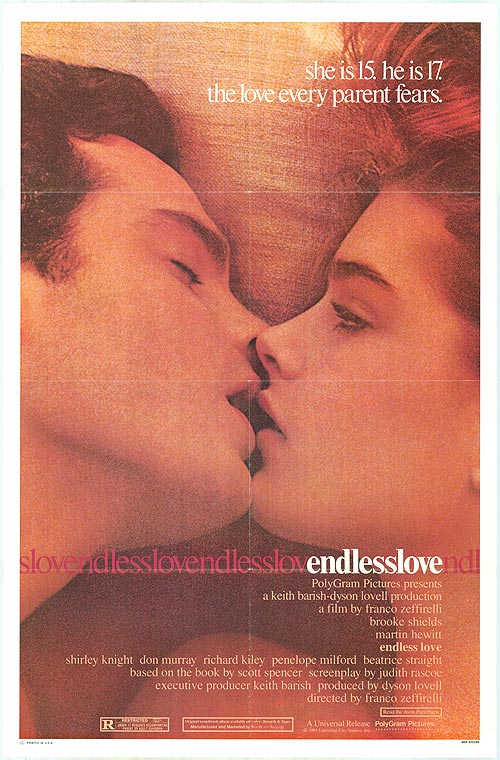
Embracing the Melodrama #33: Endless Love (dir by Franco Zefferilli)


endless love

Do anyone remember a movie that came out in February that was called Endless Love? If you do, you’ve got a better memory than I do because, even though I saw it, I really can’t really remember much about it beyond the fact that I was disappointed by it. I know I had high hopes because the trailer was damn sexy but the film itself just turned out to be rather bland and forgettable.

Well, the 2014 version of Endless Love may have been forgettable but the same can not be said of the original 1981 version.

Endless Love tells the sweet story of two teenagers who want to have sex.  Well, actually, it’s debatable how sweet the story is  because the boy is a creepy stalker-type and the girl appears to be suffering from Stockholm Syndrome but director Franco Zefferilli directs the film as if he’s bringing to life the greatest romance of all time.  The entire film is full of lush images and the swelling musical score suggests that we should hope that these two end up together, even as the boy is burning down the girl’s house.

(Believe me, I love elaborate expressions of love and romantic feelings as much as the next girl but I draw the line at burning down my house.)

David (Martin Hewitt) and Jade (Brooke Shields) both live in the suburbs of Chicago.  Jade’s parents are aging hippies.  Her father (Don Murray) may smoke weed with the neighborhood teenagers and play the trumpet at wild parties but he’s still very protective of his daughter.  Her mother (Shirley Knight) is far more permissive and open-minded.  Jade’s brother, Keith (played by a really young and dangerous-looking James Spader), is friends with David and invites him to a party at his house.  David meets Jade and soon, the two of them are obsessed with each other.

However, not everyone is happy about their newfound love.  Jade’s father doesn’t trust David.  Keith soon starts saying stuff like, “Just because you’re fucking my sister, that doesn’t make you a part of the family.”  (And, as rude as that may be, it’s really hot when said by a young and dangerous-looking James Spader.)  Meanwhile, David’s mom (Beatrice Straight) doesn’t want David hanging out with a family that she describes as being “a relic of the 60s.”

Eventually, Jade is spending so much time thinking about David that her grades start to suffer and she finds that she can no longer sleep.  She starts stealing her father’s sleeping pills.  When she’s caught in the act, David is forbidden from seeing her until the end of the school year.  “It’s only 30 days,” Jade’s mom promises him.

Well, that’s 30 days too long for David!

Taking the advice of a young arsonist (played, in his film debut and with a notably squeaky voice, by Tom Cruise), David decides to set Jade’s house on fire.  His original plan is to save Jade and her family and be hailed as a hero.  Instead, the fire ends up raging out of control and the house is destroyed.

Arrested for arson, David spends some time in a mental asylum and is legally forbidden from ever seeing Jade or her family again.  Eventually, David gets out of the asylum and that’s when the movie gets really weird…

Endless Love is a really creepy movie that makes the mistake of equating stalking with true romance.  There’s no other way to put it.  Yet, at the same time, Franco Zefferilli’s images are so vividly romantic and Martin Hewitt and Brooke Shields are both so physically attractive (never mind that neither one of them apparently knew how to act back in 1981) that you can’t help but sometimes get swept up in the film’s silliness.  Add to that, the film has a great soundtrack and you also get a chance to see Tom Cruise act like a total jackass.

Check it out below!

Embracing the Melodrama #32: Ordinary People (dir by Robert Redford)


ordinary_people_oc87rd_1

For the past seven days, I’ve been reviewing — in chronological order — fifty of the most memorable melodramas ever filmed.  We started with a silent film from 1916 and now, we have reached the 80s.  What better way to kick off the decade than by taking a look at the 1980 Best Picture winner, Ordinary People?

Directed by Robert Redford, Ordinary People tells the story of the upper middle class Jarrett family.  On the surface, the Jarretts appear to be the perfect family.  Calvin Jarrett (Donald Sutherland) has a successful career.  Beth (Mary Tyler Moore) keeps a perfect home and appears to be the ideal suburban matriarch.  However, one summer, their oldest son drowns in a sailing accident and their youngest son, sensitive Conrad (Timothy Hutton), attempts to commit suicide.  After spending four months in a psychiatric hospital, Conrad come back home and the family struggles to put their lives back together.  Even though he starts to see a therapist (Judd Hirsch) and starts dating his classmate Jeannine (Elizabeth McGovern), Conrad still struggles with his feelings of guilt over having survived.  Beth’s struggle to maintain a facade of normalcy leads to several fights between her and Conrad with Calvin trapped in the middle.

Among my fellow film bloggers, there’s always going to be a very vocal group that is going to hate Ordinary People because it won the Oscar for best picture over challenging black-and-white films directed by Martin Scorsese (Raging Bull) and David Lynch (The Elephant Man).  They always tend to complain that Ordinary People is a conventional film that tells a conventional story and that it was directed by a very conventional director.  More than once, I’ve seen an online film critic refer to Ordinary People as being a “big budget Lifetime movie.”

Well, you know what?

I love Lifetime.  Lifetime is the best network on television and to me, a big budget Lifetime movie would be the best Lifetime movie of all.  And, at the risk of alienating all of my film-loving friends, if I had to choose between watching Raging Bull and Ordinary People, I’m going to pick Ordinary People every time.  Raging Bull is visually stunning and features great performances but it’s also two hours spent watching an incredibly unlikable human being beating the crap out of anyone who is foolish enough to love him.  Ordinary People may essentially look like a TV show but it’s also about characters that you can understand and that, as the film progresses, you grow to truly care about.

Yes, I do wish that the character of Beth had been given more of a chance to talk about her feelings and it’s hard not to feel that Ordinary People places too much blame on the mother.  But, even so, the film still ends with vague — if unlikely — hope that Beth will eventually be able to move past her anger and reconnect with her family.  The film may be hard on Beth but it never gives up on her.  That’s what distinguishes Ordinary People for me.  In many ways, it’s a very sad film.  It’s a film that was specifically designed to make you cry and I certainly shed a few tears while I watched it.  But, even with its somewhat ambiguous ending, Ordinary People is also a very optimistic movie.  It’s a movie that says that, as much pain as we may have in our life,we can recover and life can go on and it’s okay to be sad and its also okay to be happy.

And that’s an important lesson to learn.

(That said, if I had been alive and an Academy voter in 1981, I would have voted for The Elephant Man.)

And, for all you Oscar lovers out there, here are clips of Timothy Hutton and Robert Redford winning Oscars for their work on Ordinary People.