Embracing the Melodrama #31: When Time Ran Out (dir by James Goldstone)


If I had been alive in the 70s, I would have been terrified if I had ever found myself in the same general location of Paul Newman, William Holden, Ernest Borgnine, Red Buttons, Jacqueline Bisset, or Burgess Meredith.  Just based on the movies that they spent that decade appearing in, it would appear that disaster followed them everywhere.

Just consider:

Both Paul Newman and William Holden were trapped in The Towering Inferno. 

Ernest Borgnine and Red Buttons both ended up taking an unexpected Poseidon Adventure together.

Jacqueline Bisset was a flight attendant in the first Airport and nearly got killed by a mad bomber.

And finally, Burgess Meredith was a passenger on The Hindenburg.

Seriously, that’s a dangerously disaster-prone bunch of thespians!

So imagine how terrifying it must have been on the set of the 1980 film When Time Ran Out when all 6 of those actors — along with a lot of other disaster film veterans — were first gathered in one place.  People were probably running for their lives, both on-screen and off.
Lava3

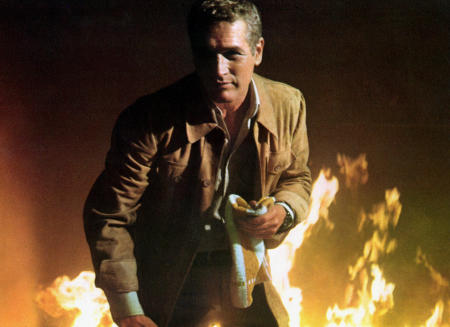
When Time Ran Out takes place on an island in the South Pacific.  Shelby Gilmore (William Holden, playing yet another ruthless but essentially good-hearted businessman) owns a luxury resort that happens to be sitting dangerously close to an active volcano.  Oil rigger Hank Anderson (Paul Newman) is convinced that the volcano is about to erupt but Shelby’s son-in-law, Bob Spangler (James Franciscus), refuses to listen and claims that even if the volcano does blow, the resort will be safe.

(As a sidenote, why were William Holden’s son-in-laws always too blame in disaster movies?  First, you had Richard Chamberlain in The Towering Inferno and now, it’s James Franciscus in When Time Ran Out…)

Suspended over a volcano

Suspended over a volcano

You can just look at the film’s title (When Time Ran Out!) and guess that Bob is probably wrong.  However, Bob has other things on his mind.  First off, he’s cheating on his neurotic wife (Veronica Hamel) with a native islander (Barbara Carrera) who happens to be married to the hotel’s general manager, Brian (Edward Albert).  Brian also happens to be Bob’s half-brother and is therefore owed at least half of Bob’s fortune but nobody but Bob realizes that.

And, of course, there are other colorful guests at the hotel who will soon find themselves either fleeing from or drowning in molten lava.  There’s a white-collar criminal (Red Buttons) who is being pursued by a detective from New York (Ernest Borgnine, of course).  There’s also two retired tightrope walkers (Burgess Meredith and Valentina Cortese) and you better believe that there’s going to be a scene where one of them is going to have to walk across a plank that happens to be suspended over a river a lava…

Told ya!

Told ya!

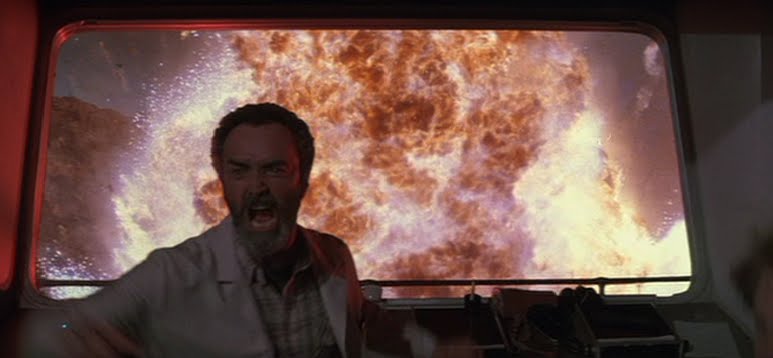
Eventually, that volcano does erupt and…well, let’s just say that When Time Ran Out is no Towering Inferno as far as the special effects are concerned.  The scene where one random fireball flies out of the volcano and heads for the resort is particularly amusing for all the wrong reasons.  Not only does the volcano apparently have perfect aim but it’s also painfully obvious that the fireball is streaking across a matte painting.  This is the type of film where, when people plunge into a river lava, they do so with heavy lines visible around their flailing bodies.  That, along with the cast’s obvious lack of interest in the material, adds up to make When Time Ran Out a film that is memorable for being so ultimately forgettable.

The Horror!

The Horror!

(It’s odd to consider that this film was directed by the same James Goldstone who directed such memorable films as Rollercoaster and Brother John.)

When Time Ran Out is something of a historical oddity because it was the last of the old 70s all-star disaster films.  (This may have been released in 1980 but it’s a 70s film through and through.)  The movie was such a monumental failure at the box office that it pretty much ended an era of disaster films.

For that reason, it also feels like an appropriate film with which to close out the 70s.  Tomorrow, we’ll continue to embrace the melodrama with the 1980s.

when time


Embracing the Melodrama #30: The Greek Tycoon (dir by J. Lee Thompson)


Theo and Liz: A Love Story

Theo and Liz: A Love Story

“The characters in this film are fictitious and any resemblance to persons living or dead is purely coincidental”. — Completely And Totally False Disclaimer From The Greek Tycoon (1978)

In order to appreciate a film like 1978’s The Greek Tycoon, it helps to be a history nerd like me.

If you are, then you probably know that, 5 years after her husband was assassinated in Dallas, former first lady Jacqueline Kennedy remarried.  Her new husband was Aristotle Onassis, a Greek shipping magnate who was 23 years older than her and who had an unsavory reputation.  Onassis was one of the world’s richest men and was known for both his extravagant life style and for being a ruthless operator.  Depending on which books you read, Onassis is portrayed as either being either one of the world’s greatest villains (and, in fact, there’s a whole school of conspiracy theorists who believed that Onassis was somehow involved in John Kennedy’s assassination) or just a casually amoral rich man who treated his new wife like his latest trophy.  Either way, he was not the sort of person who Americans expected to become the second husband of a widowed first lady.

Of course, the Greek Tycoon is not about Aristotle and Jackie Onassis.  It’s about another Greek shipping magnate with a ruthless reputation who shocks the world by marrying the widow of a martyred President.  And, if you stick with the film all the way through the end credits, you’ll even see a disclaimer to prove it!

Anthony Quinn plays Theo Tomasis.  When we first meet him, he’s content to spend his time making crooked business deals and attending parties on a seemingly endless collection of white yachts.  He is grooming his son (Edward Albert) to take over the family business.  He loves both his wife Simi (Camilla Sparv) and his mistress (Marilu Tolo).  In fact, the only problem he has in his life is his business rival, Spyros (Raf Vallone, who played another Greek tycoon in The Other Side of Midnight).  Spyros happens to be Theo’s brother.  But other than that, Theo is content to spend all of his time dancing and breaking plates because, as the film reminds us every chance that it gets, he’s Greek.

However, things change for Theo when he meets Liz Cassidy (Jacqueline Bisset), the wife of young and charismatic Senator James Cassidy (James Franciscus).  Within minutes of meeting her, Theo is hitting on her but Liz loves her husband.  However, Sen. Cassidy soon becomes President Cassidy and this, of course, leads to Cassidy being assassinated while he and Liz are strolling down the beach.

Liz is soon married to the freshly divorced Theo and proving herself to be far more strong-willed than anyone realized.  Despite the anger and efforts of both Theo’s son and the dead President’s brother (Robin Clarke), Liz and Theo’s love endures and soon, they are such a glamorous and famous couple that its surprising that nobody ever suggests making a movie about them.

The Greek Tycoon is a big mess of a movie but it’s enjoyable if you know what inspired it.  (Of course, if you’re not into history and you don’t know anything about Aristotle and Jackie then you’ll probably find The Greek Tycoon to be one of the most boring movies ever made.)  To be honest, the story is never important in a film like this.  Instead, you watch for the clothes and the sets and they’re all properly glamorous in a 1970s sort of way.  Finally, you can watch this movie for Anthony Qunn’s unapologetically over-the-top performance as Theo.  I don’t know if you could necessarily say that Quinn gave a good performance here but, watching the film, it certainly does look like he was having fun.

The_Greek_Tycoon_36374_Medium

Embracing the Melodrama #29: The Other Side of Midnight (dir by Charles Jarrott)


The Other Side of Midnight 1977

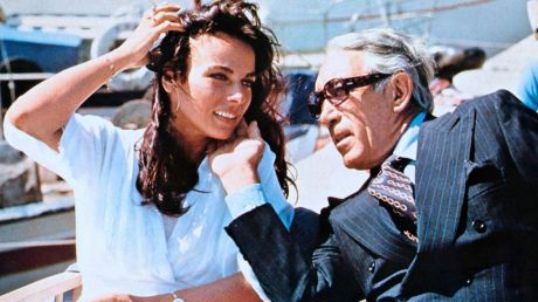
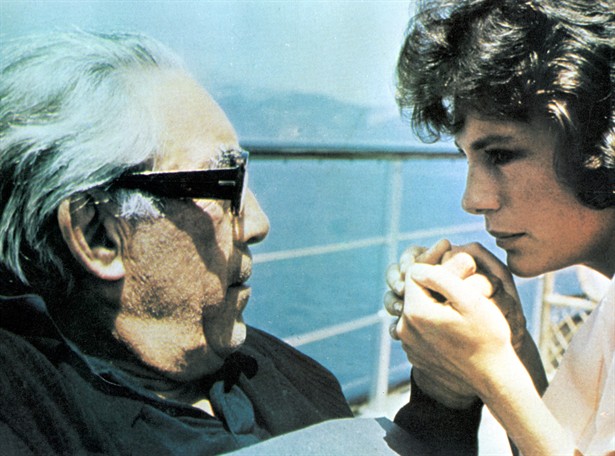
First released in 1977, The Other Side of Midnight is one of those film that literally seems to have everything a viewer could want: sex, love, betrayal, sex, war, melodrama, intrigue, sex, expensive clothes, private island, see-through nightgowns, sex, hurricanes, murder, a surprise twist ending that involves a convent, and sex.  Did I mention that this film has sex in it, because it so does.

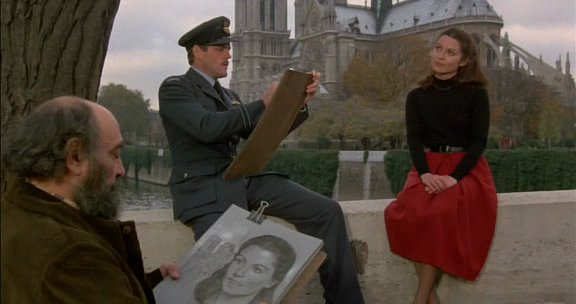
The film opens in Paris during the years leading up to World War II.  Beautiful Noelle (Marie-France Pisier) meets Larry Douglas (John Beck), a handsome American who is serving with the Canadian Air Force.  Noelle agrees to go out on a date with Larry and they get to have the of the movie’s many falling-in-love montages.  Fortunately, they’re in Paris which has a lot of great scenery in front of which they can pose.  Unfortunately, Larry is ordered back to the United States.  He promises Noelle that he’ll return but he never does.  What Larry doesn’t realize is that Noelle’s pregnant — or at least she is until a harrowing scene where she climbs into a bathtub with a wire hanger.

Montage!

Montage!

This is followed by another montage.  Call this the “Out-of-Love-And-Growing-Bitter” montage.  Noelle survives the German occupation by seducing and using every powerful man that she meets.  Along the way, she becomes one of the most glamorous and famous film stars in all of Europe.  Finally, she becomes the mistress of the wealthy and somewhat shady Constantin Demaris (Raf Vallone, doing his best Anthony Quinn impersonation).

Meanwhile, Larry is back in America and, after going through another falling-in-love montage, has ended up married to innocent Catherine Alexander (Susan Sarandon).  What Larry doesn’t realize is that Noelle has hired a detective to keep track of him.  After the war, Larry gets a job as a commercial airline pilot but Noelle secretly arranges for him to lose that job.  Unemployed and desperate, Larry accepts a job to work as the private pilot for Demaris and his mistress.

Montage!

Montage!

Though it takes him a while to recognize her, Larry eventually does realize that his new boss is his former lover, Noelle.  As Larry starts to truly fall in love with Noelle all over again, Noelle starts to pressure him to do something about his new wife.  As is the case with several Hollywood melodramas, it all ends in a courtroom.  The courtroom scenes may not be exactly exciting but they do feature my favorite image from the entire film: at one point, we see that literally every single character who has appeared in the movie up to this point is sitting in that courtroom, all lined up like a bunch of disparate figures in an Edward Hopper painting.

The Other Side of Midnight is one of those big films where a lot of stuff happens but very little of it really seems to add up to anything.  It has a nearly 3 hour running time but it’s story could have just as easily been told in 90 minutes.  Instead, director Charles Jarrott pads out the running time with endless falling-in-love and falling-out-of-love montages.  This is the type of film that never says anything once that it can say an extra three times.

Montage!

Montage!

Susan Sarandon and Marie-France Pisier both give good performances.  Susan Sarandon is likable, even if her character is unbelievably naive while Marie-France Pisier gives a performance worthy of any good film noir but neither one of them has much chemistry with John Beck.  Fortunately, some of the supporting players — like Raf Vallone and Christian Marquand — take full advantage of every chance that they get to chew every piece of scenery that’s available.  Clu Gulager, the father of horror director John Gulager, pops up as well, playing perhaps the only good male in the entire film.

In the end, The Other Side of Midnight (and what the Hell does that title mean anyway?) is a rather silly movie about a bunch of shallow characters wearing beautiful clothes and wandering through wonderfully baroque locations.  Fortunately, I love elaborately decorated locations and glamorous outfits so I enjoyed The Other Side of Midnight despite myself.

Montage!

Montage!

One final thing about The Other Side of Midnight: 20th Century Fox was so sure that The Other Side of Midnight would be a huge success that they used it to blackmail theater owners into agreeing to show an obscure science fiction film called Star Wars.  Theaters would only be allowed to show The Other Side of Midnight if they also agreed to show Star Wars during the week before Midnight opened.

The end result, of course, is that The Other Side of Midnight was a bomb at the box office and Star Wars is still making money.

Below is a behind-the-scenes documentary on the making of The Other Side of Midnight.

Embracing the Melodrama #28: The Towering Inferno (dir by John Guillermin)


The_Towering_Inferno_1974-500x300

I have a weakness for the old, all-star disaster movies of the 1970s.  It could be because those movies remind me of how fragile life really is and encourage me to make the most of every minute.  Or maybe it’s because I have my phobias and, by watching those movies, I can confront my fears without having to deal with a real-life tornado, hurricane, tidal wave, avalanche, or fire.

Or maybe I just have a weakness of glitz, glamour, and melodrama — especially when it involves a huge cast of stars and character actors.  Yes that’s probably the reason right there.

Case in point: the 1974 best picture nominee, The Towering Inferno. 

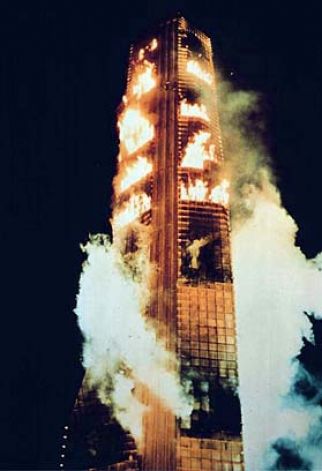
As is the case with most of the classic disaster films, The Towering Inferno is a long and big movie but it has a very simple plot.  The world’s tallest building — known as the Glass Tower — has been built in San Francisco.  On the night of the grand opening, a fire breaks out, trapping all the rich and famous guests on the 135th floor.  Now, it’s up to the fire department to put out the fire while the trapped guests simply try to survive long enough to be rescued.  Some will live, some will die but one thing is certain — every member of the all-star cast will get at least 15 minutes of screen time and at least one chance to scream in the face of the film’s still effective special effects.

628x471

As for the people trapped by the towering inferno, we don’t really get to know them or their motivations.  (Add to that, once the fire breaks out, everyone pretty much only has one motivation and that’s to not die.)  As a result, we don’t so much react to them as characters as we do to personas of the actors who are playing them.

Steve-McQueen-in-The-Towe-001

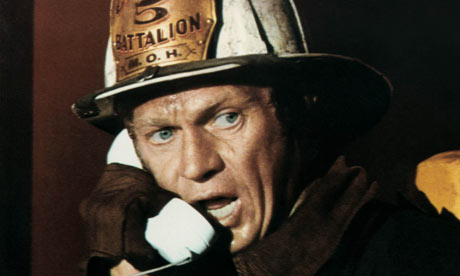
For instance, we know that Fire Chief O’Halloran is a fearless badass and a natural leader because he’s played by Steve McQueen.  McQueen brings a certain blue collar arrogance to this role and it’s a lot of fun to watch as he gets progressively more and more annoyed with the rich people that he’s been tasked with rescuing.

We know that architect Doug Roberts is a good guy because he’s played by Paul Newman.  Reportedly, Newman and McQueen were very competitive and, in this movie, we literally get to see them go-head-to-head.  And, as charismatic as Newman is, McQueen pretty much wins the movie.  That’s because there’s never a moment that O’Halloran isn’t in charge.  Doug, meanwhile, spends most of the movie begging everyone else in the tower to exercise the common sense necessary to not die.  (Unfortunately, despite the fact that he looks and sounds just like Paul Newman, nobody in the tower feels like listening to Doug.  If Towering Inferno proves anything, it’s that most people are too stupid to survive a disaster.)

paul-newman-inferno1

The tower’s owner, James Duncan, is played by William Holden so we know that Duncan may be a ruthless businessman but that ultimately he’s one of the good guys.  Holden gets one of the best scenes in the film when, after being told that people in the building are catching on fire, he replies, “I think you’re overreacting.”

Roger Simmons is Duncan’s son-in-law and we know that he’s ultimately to blame for the fire because he’s played by Richard Chamberlain.  Roger might as well have a sign on his back that reads “Doomed.”  The same can be said of publicity executive Dan (Robert Wagner) and his girlfriend, Lorrie (Susan Flannery).

The_Towering_Inferno_1974_Faye_Dunaway_Mike_Lookinland

Faye Dunway is Susan.  She is Doug’s fiancée and she really doesn’t do much but she does get to wear a really pretty dress.  The same can be said of Susan Blakely, who plays Roger’s dissatisfied wife, and Jennifer Jones, who plays a recluse.  And good for them because if you’re going to be stuck in an inferno without much to do, you can at least take some comfort in looking good.

Then there’s Fred Astaire, who does not dance in this film.  Instead, he plays a kind-hearted con artist who ends up falling in love with Jennifer Jones.  Fred Astaire received his only Oscar nomination for his brief but likable performance in The Towering Inferno.

And finally, there’s the building’s head of security, Jernigan.  We know that he’s a murderer because he’s played by O.J. Simpson and … oh wait.  Jernigan is actually probably the second nicest guy in the whole film.  The only person nicer than Jernigan is Carlos, the bartender played by Gregory Sierra.

OJ

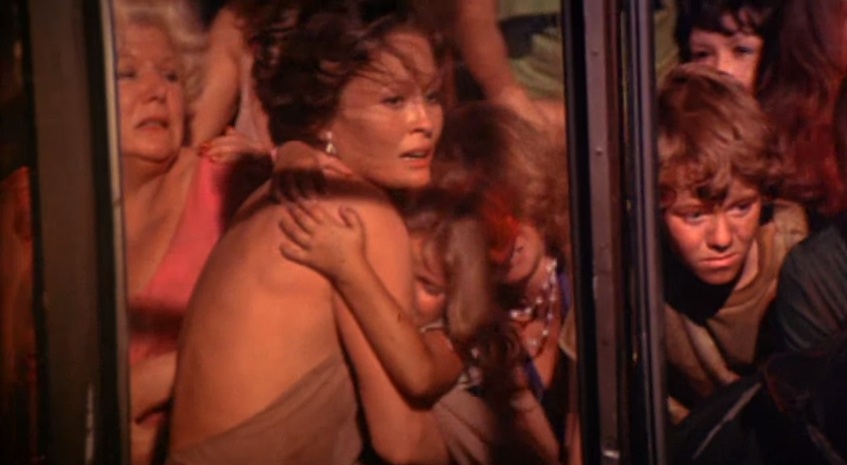
The real star of the film, of course, is the fire.  In the 40 years since The Towering Inferno was produced, there’s been a lot of advances in CGI and I imagine that if the film was made today, we’d be watching the fire in 3D and it would be so realistic that we’d probably feel the heat in the theater.  That said, the fire effects in The Towering Inferno are still pretty effective.  Now, I have to admit that I have a phobia (and frequent nightmares) about being trapped in a fire so, obviously, this is a film that’s specifically designed to work itself into my subconscious.  But that said, the scenes with various extras thrashing about in the flames are still difficult to watch.  There’s a scene where Robert Wagner and Susan Flannery find themselves trapped in a blazing reception area and it is pure nightmare fuel.

The Towering Inferno 9

The Towering Inferno is an undeniably effective disaster film.  At the same time, when one looks at the 1974 Oscar nominees, it’s odd to see The Towering Inferno nominated for best picture along with The Godfather Part II, Chinatown, and The Conversation.  Unlike those three, The Towering Inferno is hardly a great film.

But it is definitely an entertaining one.

toweringinferno2

Embracing the Melodrama #27: Go Ask Alice (dir by John Korty)


Go Ask Alice

Earlier today, I took a look at The People Next Door, a film about a family torn apart by the discovery that their teenage daughter is taking drugs.  For all of that film’s melodrama and over-the-top moments, it still worked.  It may have felt like it was taking place on a plane of heightened reality but it still felt real nonetheless.  Among the many films in the drugs-in-the-suburbs genre, that general feeling of reality made The People Next Door unique.  Far more typical of the genre is the 1973 made-for-TV movie, Go Ask Alice.

Go Ask Alice is based on a YA book that’s been in print for 43 years now.  (I can still remember spending an afternoon reading it in a Barnes and Noble when I was 14 years old.)  The book claims to be the diary of a  teenage girl who ended up getting addicted to drugs and sex.  She runs away from home for a bit and, even when she does manage to stop using drugs, her friends still insist on secretly slipping her acid.  She goes crazy and ends up spending some time in a mental asylum.  Eventually, she’s released and moves to a new town with her family.  She ends the diary saying that she’s looking forward to the future and then, in the afterward, we’re told that she died three weeks later of an overdose and this diary has been published so that we can all learn from her story.

Now, oddly enough, when Go Ask Alice was originally published, it was apparently sold as being an authentic diary of an anonymous teenage girl who had been a patient of the book’s “editor”, Dr. Beatrice Sparks.  However, if you actually read the book, it’s pretty obvious that, while Dr. Sparks may have indeed used some of her patients’ real-life experiences, Go Ask Alice is in no way authentic.  Instead, it’s a classic example of the type of cautionary tale in which a character makes one mistake (in this case, the girl drinks a soda that’s been spiked with LSD) and, immediately afterwards, everything bad thing that possibly could happen does happen.  The purpose of the book is to shock and titillate, to make us wonder how this girl can go from being the sweet optimist who bought a diary because she feels that she finally has something to say to being so jaded that she casually says stuff like, “Another day, another blowjob.”  And, of course, the answer is that she didn’t because the whole thing is totally made up.

But that still didn’t stop anyone from making a movie out of the book and informing us, at the start of the movie, that the story we are about to watch is true and only the names and certain details have been changed to protect everyone’s privacy.  Our diarist (who is now definitely named Alice) is played by a young actress named Jamie Smith-Jackson, who is sympathetic and pretty.  Alice’s mother (Ruth Roman) is too repressed and uptight to provide any guidance to her rapidly maturing daughter.  Meanwhile, Alice’s father is played by William Shatner, so we know he’s not going to be able to do any good either.

Much as in the original book, Alice goes to one party, drinks on LSD-spiked soda, and her life is never the same.  Soon, she’s spending all of her time doing drugs and, as she informs us, having a “monthly pregnancy scare.”  She’s no longer hanging out with her smart, nerdy friends.  Instead, she spends all of her time with a bunch of petty criminals who recruit Alice to help deliver drugs to the students at the junior high.  (“I push at the elementary school!” one junior high kid snarls).  Eventually, Alice runs away from home and lives on the streets.  Fortunately, she runs into a liberal Catholic priest (played by Andy Griffith and yes, you read that right) and starts trying to get her life straight…

Go Ask Alice is no The People Next Door but it’s no Reefer Madness either.  What it gets wrong about teenage drug use, it gets right about just how confusing and alienating it can be to be 15 years old.  At the same time, I’d be lying if I said that this film did not have some camp appeal.  How can it not when it features not only Andy Griffith talking tough but also William Shatner with a bushy mustache?

And guess what?

You can watch it below!

Embracing the Melodrama #26: Beyond the Valley of the Dolls (dir by Russ Meyer)


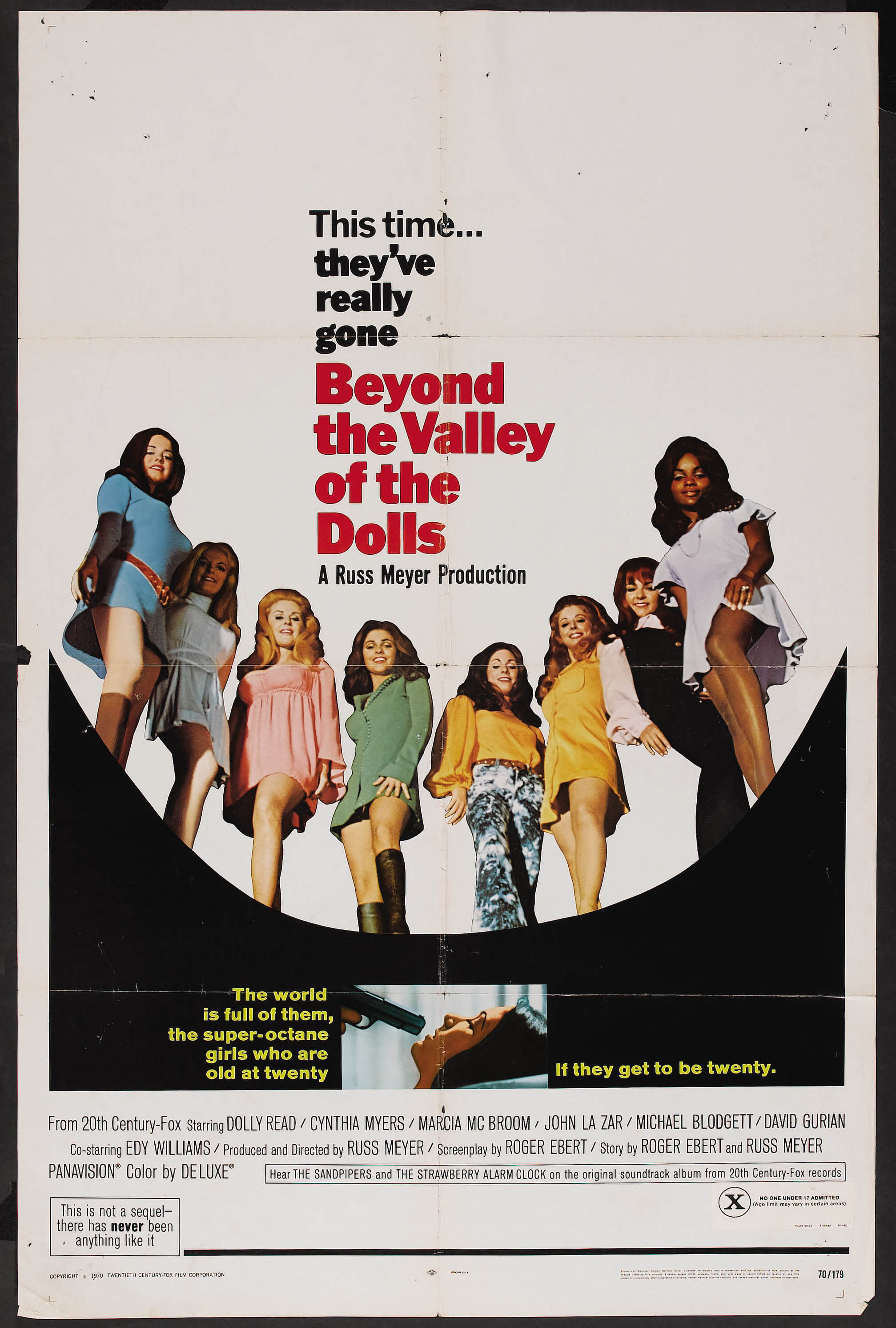
beyondposter

THE FILM YOU ARE ABOUT TO SEE IS NOT A SEQUEL TO “VALLEY OF THE DOLLS.” IT IS WHOLLY ORIGINAL AND BEARS NO RELATIONSHIP TO REAL PERSONS, LIVING OR DEAD. IT DOES, LIKE “VALLEY OF THE DOLLS” DEAL WITH THE OFT-TIMES NIGHTMARE WORLD OF SHOW BUSINESS BUT IN A DIFFERENT TIME AND CONTEXT. — Disclaimer at the beginning of Beyond The Valley of the Dolls (1970)

If I hadn’t reviewed it already, I would definitely have included 1967’s Valley of the Dolls in this series on film melodrama.  However, seeing as I have already reviewed it (and you can read that excellent review here!), I figured why not take this opportunity to review a film that was legally required to acknowledge that it was not a sequel to Valley of the Dolls.

I’m speaking of 1970’s Beyond the Valley of The Dolls, a satirical take on every Hollywood melodrama that had been made up until that point.  It was directed by notorious exploitation veteran Russ Meyer and written by film critic Roger Ebert.  The combination of Meyer’s unapologetic tawdriness and Ebert’s film school in jokes comes together to create a truly memorable film experience.

Okay, so what happens in Beyond the Valley of the Dolls?  Let’s see if I can keep all this straight because, in its clearly satirical way, BVD is a bit like the Game of Thrones of satiric Hollywood melodrama.  There are so many characters with so many subplots that it helps to have a flowchart to try to keep track of it all.

beyond-the-valley-of-the-dolls-05-1

Kelly (Dolly McNamara), Casey (Cynthia Myers), and Pet (Marcia McBroom) start a band and, after playing the high school graduation dance, they decide to head out to Los Angeles to become famous.  Accompanying them is their manager, Harris Allsworth (David Gurian), who is in love with Kelly and spends the entire film looking miserable.  As opposed to the three main characters in Valley of the Dolls, Kelly, Casey, and Pet do not arrive in Hollywood as wide-eyed innocents.  Instead, they’re already talking endlessly about their love of weed, pills, and sex but they do so in dialogue that is so deliberately over-the-top, so intentionally artificial, and so cheerfully delivered by the three girls that it’s impossible not to root for them.  More than that, though, these are three strong, independent women and, regardless of whether they’re appearing a film directed by a man best known for being obsessed with boobs, that’s still three more than you’ll find in most American films from both the 70s and today.

Fortunately, the girls already have a contact in Los Angeles.  Kelly’s rich aunt Susan (Phyllis Davis) knows all sorts of people and wants to share some of her fortune with Kelly.  Unfortunately, Susan’s lawyer is the evil Porter Hall (Duncan McLeod), who hates free spirits.  Porter tries to keep Kelly from getting the money but Kelly is willing to seduce Porter in order to get that money, even after she discovers that the uptight Porter wears his black socks to bed.  Obviously, Porter is a bad guy but who can help Aunt Susan realize this?  How about the wonderfully named man’s man, Baxter Wolfe (Charles Napier)?

ZMan

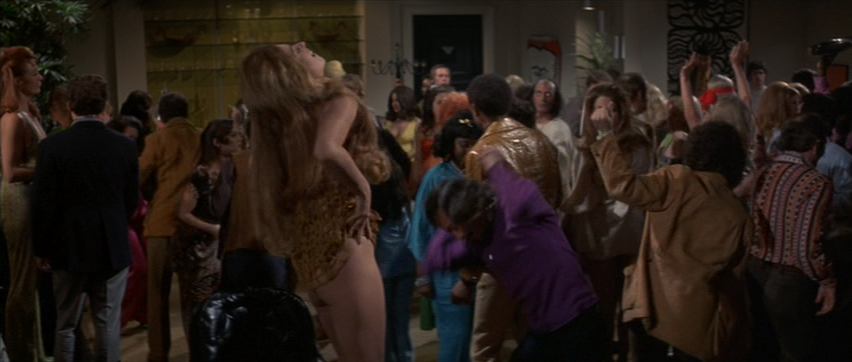
Through Aunt Susan’s influence, the girl’s end up at a party thrown by the legendary music promoter Z-Man (John Lazar).  Z-Man is one of those flamboyant 70s characters who simply has to be seen to be believed.  Z-Man speaks in some of the most florid dialogue ever heard and there are more than a few secrets hidden behind all of that eccentricity.  But, at the moment, what’s important is that Z-Man takes control of the girl’s group — now known as the Carrie Nations (which is actually a pretty good name for a band) — and makes them famous overnight.

Soon, Kelly is spending more and more time with notorious Hollywood gigolo Lance Rocke (Michael Blodgett, who gives a hilariously narcissistic performance) and ignoring poor Harris.  This drives Harris into the waiting arms of porn star Ashley St. Ives (Eddy Williams) who, with her unapologetic and non-neurotic approach to sex, is probably the most stable character in the entire film.

Beyond

Casey, feeling uncomfortable with the Hollywood jet set, is soon popping pills like they’re candy.  She finally starts to find some comfort and happiness with Roxanne (Erica Gavin).

And finally, Pet falls in love with Emerson Thorne (Harrison Page), a serious-minded law student.  However, as much as Pet and Emerson seem to be meant for each other (and they even get a slow-motion montage where they run through a green field), Pet is still tempted to stray by a punch drunk boxer (James Inglehart).

And finally, there’s Otto (Henry Rowland).  Otto is Z-Man’s butler.  Apparently, he’s also a Nazi war criminal.

And, not surprisingly, all of this lust and all of these secrets lead to a suicide attempt, renewed love, and finally a disturbingly violent massacre that leaves the surviving members of the cast feeling wiser and sadder but not necessarily older.  Fortunately, just in case we the viewers might be wondering how all of this could have happened, a somber-voiced narrator suddenly explains what every character did wrong and how those mistakes led to their fate.  Thanks, narrator guy!

So, obviously, Beyond the Valley of the Dolls is not meant to be taken seriously.  The film is a satire of all of the self-serious and hypocritically moralistic Hollywood melodramas that came before it .  Fortunately, the largely likable cast plays all of this absurd material with the straightest of faces and the end result is a film that is sordid and oddly likable.  This is one of those films that, if it offends you, you may be taking life too seriously.

beyond the valley of the dolls party

Embracing the Melodrama #25: The People Next Door (dir by David Greene)


people_next_door

For the past week, I’ve been reviewing — in chronological order — fifty of the most, for reasons good and bad, memorable  film melodramas of all time.  I started with a film from 1916 called Where Are My Children? and now, as we reach the halfway mark, we also reach the 70s.  There were several reasons why I wanted to start the 70s with the 1970 drugs-in-the-suburbs melodrama, The People Next Door.  First off, not many people seem to have heard of it and I always enjoy discovering and sharing previously obscure films.  But, even more importantly, The People Next Door stars Eli Wallach, the great character actor who recently passed away at the age of 98.  Needless to say, Wallach is great in The People Next Door but then again, when wasn’t Wallach great?

At first glance, the Masons appears to be your typical suburban family.  Patriarch Arthur (Eli Wallach) may be a bit strict but he works hard to provide his family with a good life.  Wife Gerrie (Julie Harris) may seem to be a bit nervous at times but she still works hard to maintain a perfect home.  Son Artie (Stephen McHattie) may have long hippie hair and he does devote a lot of time to his band but otherwise, he seems to be a good kid.  And then there’s 16 year-old Maxie (Deborah Winters), who is blonde and pretty and overall the ideal American girl.  Even better the Masons live next door to the friendly Hoffmans, perfect David Hoffman (Hal Holbrook), his perfect wife Tina (Cloris Leachman), and their perfect teenage son, Sandy (Don Scardino).

But guess what?

Nobody’s perfect!

Arthur is actually a smug and overbearing bully whose constant bragging hides his own dissatisfaction with how his life has turned out.  He is jealous of his son’s future and his over protectiveness of his daughter takes on a distinctly disturbing tone as the film progresses.  Arthur is also having an affair with his secretary (Rue McClanahan).

Gerrie knows about Arthur’s affair but chooses to look the other way.  She goes through her day in a haze of smoke provided by the cigarettes that she is constantly smoking.  Like Arthur, she cannot understand her children.  Unlike Arthur, she does realize that she doesn’t have all the answers.

Artie may be a good kid but he feels totally and thoroughly alienated from the rest of the family and, because of his long hair, he is the constant subject of Arthur’s abuse.

And then there’s Maxie, who everyone believes to be perfect and wholesome until one night when she’s discovered tripping on LSD.  Arthur immediately assumes that Artie must have given his sister the drugs and kicks Artie out of the house.  However, what Arthur doesn’t realize, is that Maxie is actually getting the drugs from clean-cut Sandy.  Sandy doesn’t use himself but he has no problem with dealing.

To Arthur and Gerrie’s shock, Maxie tells them that she’s been using drugs for a while and she’s sexually active as well!  When Arthur subsequently discovers Maxie snorting cocaine and living with a naked biker, it’s naturally time for everyone to get into family therapy.  Unfortunately, the therapy doesn’t really help that much and soon, Maxie is again dropping acid and dancing naked on the front lawn…

As you can probably guess from the description above, The People Next Door is one of those families-in-crisis melodramas where everything that possibly can be wrong with a family is wrong with this family.  It’s always easy to dismiss well-intentioned films like this and The People Next Door has its share over-the-top moments.  But, at the same time, the film actually works better than most of the Suburban Hell melodramas of the early 70s.

That’s largely due to the performances, with Eli Wallach in particular giving an explosive performance as an all too plausible monster and Hal Holbrook and Cloris Leachman very believably bringing to life another family which turns out to be not quite as ideal as they first appear to be.  And then there’s Deborah Winters, who starts out as being so mannered that you think she’s going to give a bad performance but then, as the film progresses, you realize that Maxie is the one giving the performance because that’s the only way she can survive her “perfect” family.

I first came across The People Next Door on YouTube and, considering how much I love exposing people to obscure films, I was really looking forward to sharing it with you on this site.  But guess what?  In the three weeks between me watching this film and me staring this post, The People Next Door was taken down from the site.  I guess somebody is really dedicating to protecting the copyright on a film that hardly anybody in the world has actually heard of.

So, unfortunately, I can only share the trailer.

Watch it below!

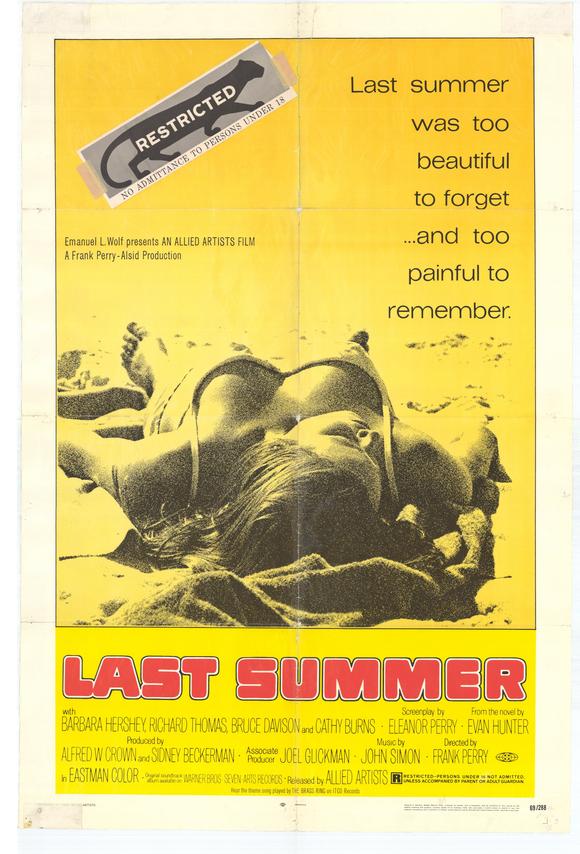
Embracing the Melodrama #24: Last Summer (dir by Frank Perry)


last-summer-movie-poster-1969-1020204164

Let’s close out today’s series of melodrama reviews by taking a look at an unfairly obscure film from 1969, Last Summer.  Directed by Frank Perry (who also directed at least part of The Swimmer before getting into an argument with Burt Lancaster), Last Summer is a film about four teenagers who make the mistake of hanging out with each other during one fateful summer.

Peter (Richard Thomas) and his best friend Dan (Bruce Davison) meet Sandy (Barbara Hershey) on the beach.  Sandy recruits them into helping her take care of a seagull with a broken wing and soon, the three of them are inseparable.  The sexually inexperienced Peter and Dan are both attracted to Sandy while Sandy shown proves herself to have a casually destructive streak.  The two boys are so infatuated with Sandy that they even forgive her after she gets bored with the seagull and kills it.

Eventually, Rhoda (Catherine Burns, who was Oscar-nominated for her performance) starts to hang out with the three of them.  Overweight and shy, Rhoda is, at first, an awkward addition to the group but soon, she and Peter start to grow close.  Sandy, who was previously more interested in Dan until she realized that Peter was losing interest in her, reacts by looking for more and more ways to humiliate the insecure Rhoda.  Eventually, they set Rhoda up on a blind date with a shy Puerto Rican man, a cruel prank which quickly goes wrong.

When Rhoda eventually stands up to her three new “friends,” it leads to a disturbing finale that it is all the more effective specifically because it is so inevitable.

I have to admit that I have a weakness for out-of-control youth films, largely because — while I never went as crazy as Sandy or made as many mistakes as Rhoda — I still had my moments back when I was in high school.  In ways both good and bad, I could relate to the two female leads of Last Summer.  There have been times in my life when I’ve felt like the intellectual and naive Rhoda and then there’s been other times when I’ve felt like the beautiful and self-assured Sandy.  For the most part, I’m usually prouder of myself when I feel like Rhoda but I have a lot more fun when I feel like Sandy.  While the two boys largely remain ciphers, Last Summer is worth seeing for the outstanding performances of Barbara Hershey and Catherine Burns.  Combined with Frank Perry’s atmospheric direction (you can literally see the layers of ennui and humidity clinging to some of the scenes), the end result is an effectively creepy coming-of-age film.

For some unknown reason, Last Summer appears to one of those rare Oscar-nominated films that has never been released on DVD or Blu-ray.  However, it does occasionally show up on TCM and I would suggest keeping an eye out for it.

Last Summer 1969 Thomas Hershey Davidson

(Incidentally, California Scheming — was was released earlier this year — is pretty much an unacknowledged remake of Last Summer, right down to the bit with the seagull.  California Scheming is actually not a bad film.  It’s certainly deserves better than some of the online reviews that it’s received.)


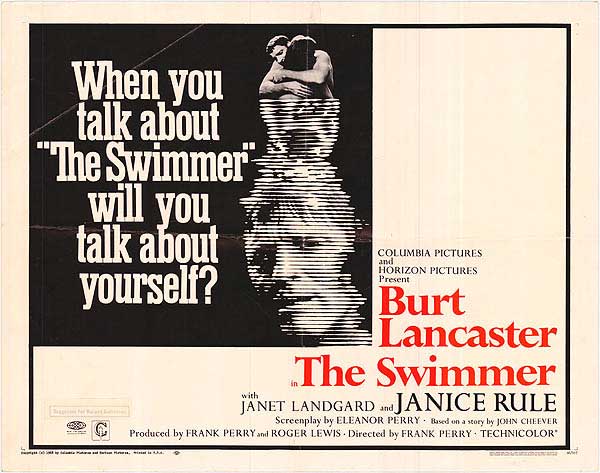
Embracing the Melodrama #23: The Swimmer (dir by Frank Perry)


The Swimmer

The 1968 film The Swimmer opens with Ned Merrill (Burt Lancaster) emerging from the woods that surround an affluent Connecticut suburb.  He’s a tanned, middle-aged man and, because he spends the entire film wearing only a bathing suit, we can tell that he’s still in good shape for a man in his 50s.  When Ned speaks, it’s with the nonstop optimism of a man who has found and claimed his part of the American Dream.  In short, Ned appears to be ideal American male, living in the ideal American community.

However, it gradually starts to become apparent that all is not well with Ned.  When he mysteriously shows up at a pool party being held by a group of his friends, they all seem to be shocked to see him, commenting that it’s been a while since Ned has been around.  Ned, however, acts as if there’s nothing wrong and instead talks about how beautiful the day is and says that he’s heading back to his home.  He’s figured out that all of his neighbor’s swimming pools form a “river” to his house and Ned’s plan is to swim home.

And that’s exactly what Ned proceeds to do, going from neighbor to neighbor and swimming through their pools.  As he does so, he meets and talk to his neighbors and it becomes more and more obvious that there are secrets hidden behind his constant smile and friendly manner.  As Ned gets closer and closer to his actual home, the neighbors are far less happy to see him.

At one house, he runs into Julie (Janet Landgard) who used to babysit for his daughter.  Julie agrees to swim with Ned and eventually confesses that she once had a crush on him.  When Ned reacts by promising to always protect  and love her, Julie gets scared and runs away.

At another house, Ned comes across another pool party.  A woman named Joan (played by a youngish Joan Rivers) talks to him before a friend of her warns her to stay away from Ned.

When Ned reaches the house of actress Shirley (Janice Rule), it becomes obvious that Shirley was once Ned’s mistress.  They discuss their relationship and it quickly becomes apparent that Ned’s memories are totally different from Shirley’s.

And, through it all, Ned keeps swimming.  Even when he’s offered a ride to his house, Ned replies that he has to swim home.

The Swimmer is a film that I had wanted to see ever since I first saw the trailer on the DVD for I Drink Your Blood.  (That’s an interesting combination, no?  I Drink Your Blood and The Swimmer.)  I finally saw the film when it showed up on TCM one night and, when I first watched it, I have to admit that I was a little disappointed.  Stylistically, the film itself is such a product of the 1960s that, even though suburban ennui and financial instability are still very relevant topics, The Swimmer felt rather dated.  I mean, I love a good zoom shot as much as anyone but, often times during the 60s, they seemed to be used more for the sake of technique than the sake of story telling.

However, the second time I sat through The Swimmer, I appreciated the film a bit more.  I was able to look past the stylistic flourishes of the direction and I could focus more on Burt Lancaster’s excellent lead performance.  Lancaster plays Ned as the epitome of the American ideal and, as a result, his eventual collapse also mirror the collapse of that same ideal.  The Swimmer is based on a short story by John Cheever and, quite honestly, the film’s story is a bit too much of a literary conceit to really work on film.  That said, The Swimmer — much like the character of Ned Merrill — is an interesting failure, which is certainly more than can be said of most failures.


Embracing The Melodrama #22: The Incident (dir by Larry Peerce)


The Incident

The 1967 film The Incident could just as easily have been called Train of Fools.  Much like Ship of Fools, it’s an ensemble piece in which a group of people — all of whom represent different aspect of modern society — find themselves trapped in their chosen mode of transportation and forced to deal with intrusions from the outside world.

That intrusion comes in the form of two sociopaths who have decided to spend the entire ride tormenting their fellow passengers.  The more dominant of the two is Joe (played by Tony Musante, who would later star in Dario Argento’s Bird With The Crystal Plumage), who the film hints might also be a pedophile.  His partner is Artie (Martin Sheen), who is less intelligent than Joe but just as viscous.  (And yes,even though he does a good job in the role,  it is odd to see an intelligent and reportedly very nice actor like Martin Sheen playing a character who is both so evil and so stupid.)

Among the passengers:

Bill (Ed McMahon) and Helen (Diana Van Der Vills) are only on the train because Bill refused to pay the extra money to take a taxi back home. Now, they’re stuck on the train with their young daughter who, in one of the film’s more disturbing scenes, Joe starts to show an interest in.

Teenage Alice (Donna Mills) is on a date with the far more sexually experienced Tony (Victor Arnold).  When Joe and Artie start to harass her, her date proves himself to be pretty much useless.

Douglas McCann (Gary Merrill) is a recovering alcoholic who, before Artie and Joe got on the train, was spending most of his time scornfully watching Kenneth (Robert Otis), a gay man who previously attempted to pick Doug up at the train station and who will eventually fall victim to one of Artie’s crueler jokes.

Muriel Purvis (Jan Sterling) resents her meek husband, Harry (Mike Kellin) and see the entire incident as another excuse to cast doubts upon his manhood.

Sam and Bertha Beckerman (played by Jack Gilford and Thelma Ritter) are an elderly Jewish couple who, over the course of a lifetime, have already had to deal with far too many bullies.  Sam’s attempt to stand up to Joe and Artie results in both he and his wife being trapped on the train.

Arnold (Brock Peters) and Joan (Ruby Dee) are the only black people on the train.  Arnold, at first, enjoys watching the white people fight among each other and even turns down a chance to get off the train because he finds it to be so entertaining.  But finally, Joe turns on him as well.

And then there’s the two soldiers, streetwise Phil (Robert Bannard) and his best friend, Felix (Beau Bridges).  Felix speaks with a soft Southern accent and has a broken arm.

And finally, there’s the bum.  When we first see the bum (Henry Proach) he is asleep.  He doesn’t even wake up when Joe and Artie attempt to set him on fire.

One-by-one, Joe and Artie attack and humiliate every single person on the train.  The other passengers, for the most part, remain passive.  Even when some try to stand up to Joe and Artie, their fellow passengers don’t offer to help.  It’s only when one last passenger finally stands up to the two that the rest of them show any reaction at all and even then, it’s not necessarily the reaction that anyone was hoping for.

The Incident, which shows up on TCM occasionally, is a heavy-handed but effective look at what happens when good people choose to do nothing in the face of evil.  Joe and Artie can be viewed as stand-ins for any number of distasteful groups or ideologies and both Tony Musante and Martin Sheen are believable as dangerous (if occasionally moronic) petty criminals.  For that matter, the entire film is well-acted with the entire cast managing to bring life to characters that, in lesser hands, could have come across as being one-dimensional.  The entire film basically takes place in that one subway car but fortunately, the harsh black-and-white cinematography and the continually roaming camera all come together to keep things visually interesting.

The Incident may not be a great film (it’s occasionally bit too stagey and, after watching the first 30 minutes, you’ll be able to guess how the movie is going to end) but it’s still one to keep an eye out for.

Martin Sheen in The Incident