Embracing the Melodrama Part II #51: Walking Tall Part 2 (dir by Earl Bellamy)


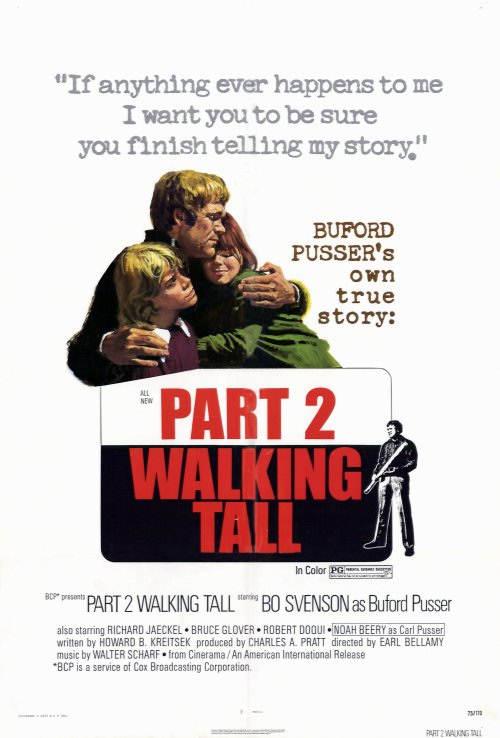
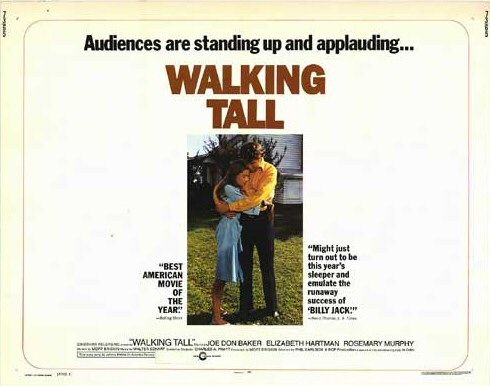
Film_Poster_for_Walking_Tall_Part_2The 1975 southern melodrama Walking Tall Part 2 opens with a voice over telling us that we’re about to see more of the true of story Sheriff Buford Pusser, the Tennessee lawman who carried a big stick, battled the Dixie Mafia, and whose wife was killed in an ambush.  Pusser, we learn, died under suspicious circumstances shortly after the release of the film Walking Tall.

Mere hours before he died, Pusser had signed a contract to play himself in Walking Tall Part 2.  As a result of Pusser’s car “accident,” the film’s producers were forced to cast an actor as the lawman.  Now, it would have made sense to, once again, give the role to Joe Don Baker.  After all, he played the role in Walking Tall and I imagine that to most audiences at that time, he was Buford Pusser.  However, for whatever reason, Baker was not given the role for a second time.  Instead, the role was given to Bo Svenson and, while Svenson does not necessarily do a bad job in the role, he’s still no Joe Don Baker.  The difference between Baker and Svenson is the difference between someone being a redneck and someone just pretending.

The film opens almost immediately where Walking Tall ended.  Terribly wounded in the ambush that took his wife’s life, Buford is in the hospital and his face is covered in bandages.  Townspeople gather outside both his room and his farm and they wonder whether he’ll run for reelection as sheriff.  Someone else mentions that Buford has had massive facial reconstructive surgery.

Finally, the bandages are removed and we discover that Buford has turned into Bo Svenson.  Now, Svenson and Baker do have enough facial similarities that you can force yourself to believe that surgery could lead to Baker having Svenson’s features.  I mean, this isn’t like Mark Ruffalo taking over the role of Bruce Banner from Edward Norton.  At the same time, it’s hard not to wonder how reconstructive surgery could have led to Buford Pusser becoming a blonde or, for that matter, apparently growing by 5 inches between Walking Tall and Walking Tall Part 2.

Anyway, Buford’s out of the hospital and, of course, he’s reelected as sheriff.  One thing that quickly becomes apparent is that everyone in the world totally loves Buford Pusser.  I lost track of how many characters specifically walked up to Buford to tell him that he was a great man and a great sheriff.  Nobody complains about Buford’s habit of ignoring civil liberties while enforcing the law.  Instead, everyone cheers for him.

(And, just in case the viewer is uncomfortable with the sight of the very white Buford taunting the mostly black moonshiners that he spends the film arresting, Buford’s black deputy constantly says stuff like, “Buford, you’re my kind of sheriff!”)

The only people who don’t like Buford are the local crime lords.  They still want Buford dead so they hire a race car driver (Richard Jaeckel) to kill him.  The race car driver’s girlfriend (Angel Tompkins) attempts to hit on Buford but Buford has no interest in her.  Buford’s about enforcing the law and avenging his wife…

Walking Tall Part 2 is a pretty standard film.  Whereas the original Walking Tall had a raw and unpredictable vibe to it, the sequel is predictable and boring.  On the plus side, the film was made on location in rural Tennesee and some of the countryside is nice to look at.

As for Buford Pusser, he died before Part Two was released but the character would return in Walking Tall — The Final Chapter.

Film Review: The Avengers: Age of Ultron (dir by Joss Whedon)


AGU

In some ways, I think I may be both the worst and the best possible person to review the latest installment of the Marvel Cinematic Universe, largely because I’ve seen all the films but I don’t know much about the comics on which they are based. As a result, I can judge each film solely by what is on screen but, at the same time, I know that there are a lot of references that go straight over my head. For instance, when we saw Avengers: Age of Ultron earlier tonight, I had to get my boyfriend to explain to me why certain members of the audience got so excited when Iron Man mentioned an African country called Wakanda. But what’s important is that I would have still enjoyed Age of Ultron even if I had never known why Wakanda was important. The MCU has, so far, managed to maintain a balance between keeping the Marvel fans happy while also remaining accessible to viewers like me. The MCU has created its own separate reality, one that even someone like me can feel comfortable exploring and reviewing.

However, before I get around to giving you my feelings on Age of Ultron, let’s be honest about something.

There are a lot of critics out there who have been waiting for a chance to attack the latest installment of the Marvel Cinematic Universe. Some of them have disliked the MCU since the very first Iron Man film. They have been lone voices in the wilderness, arguing that the entire franchise is overrated and, in some cases, creatively destructive. Much like the Old Testament prophets, they continue to warn of the future while other filmgoers ignore the pillar of fire forming over the nearest theater. And then there are other critics who have praised previous MCU efforts but have never really been comfortable about it. These are the critics who resent having to write positively about a mere genre film. These are the critics who still haven’t gotten over just how good Guardians of the Galaxy truly was. They have been waiting for an MCU misfire so that they can do their penance for suggesting that Robert Downey, Jr. deserved Oscar consideration for Iron Man 3.

avengers-age-of-ultron-trailer-hulkbuster

These critics are going to watch The Avengers: Age of Ultron and they are going to pounce. They are going to point out that Age of Ultron puts too much emphasis on action over nuance and, as impressive as the CGI may be, it’s impossible to deny that Age of Ultron almost robotically follows the classic action movie formula. They’ll point out that none of The Avengers really develop as characters over the course of the film. Depending on how they’ve felt about the MCU up to this point, some of them will point out that Age of Ultron feels a bit like a step backwards. It doesn’t have the political subtext of Iron Man 3 or Captain America: The Winter Soldier. It lacks the satiric edge of Guardians of the Galaxy. And, ultimately, it’s just not as much fun as the first Avengers film.

And they won’t necessarily be wrong. I mean, let’s be honest. I write this as someone who has enjoyed (and, in some cases, loved) the previous MCU films. Avengers: Age of Ultron is not going to be remembered as one of the best of the MCU films. This is a flawed film that never reaches the heights of the original Avengers. All of the criticisms listed above are perfectly valid.

But, with all that in mind, I still enjoyed Avengers: Age of Ultron and I happily recommend it without a bit of hesitation.

film-review-avengers-age-of-ultron

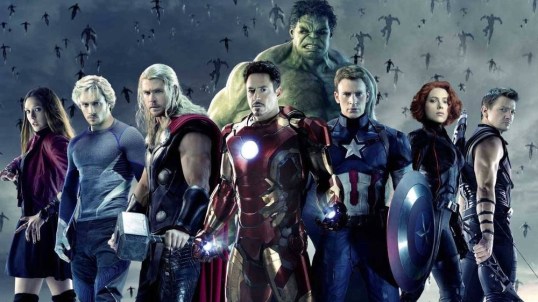
Age of Ultron opens with the Avengers attacking a HYDRA base and we quickly discover that the Avengers are exactly the same as we remembered them. Iron Man (Robert Downey, Jr.) is cocky, self-destructive, and torn by guilt over his past as a weapons manufacturer. Captain America (Chris Evans) is earnest and idealistic. Thor (Chris Hemsworth) is … well, he’s a God. Bruce Banner (Mark Ruffalo) is scared of what he becomes when he transforms into the Hulk. Clint Barton (Jeremy Renner) is still shooting arrows and feeling out-of-place. Natasha (Scarlett Johansson) is still flirty, enigmatic, and apparently in love with Bruce Banner.

ultron

One of the reoccurring themes of the MCU is that whenever Iron Man tries to make the world a better place, he instead ends up nearly destroying it. His latest attempt leads him to create Ultron (voiced quite chillingly by James Spader), a robot who has Tony’s personality and who has decided that the only way to bring about “peace in our time” is to destroy all of humanity. Ultron’s motives are as close as this film gets to any sort of thematic subtext. Ultron stands in for every ideology that would take away a person’s individual freedom in the name of the greater good. Age of Ultron doesn’t explore this subtext as much as I would have liked it to but, at the same time, I appreciated that it was at least there. That’s more than you can say for a film like Man of Steel.

Ultron is not the only new character to show up. Andy Serkis has a small role as a character that will undoubtedly be a villain in a future MCU film. After voicing JARVIS in several films, Paul Bettany finally gets to actually appear onscreen. I can’t talk too much about his character without spoiling the film but Bettany makes good use of his limited screen time.

And then there’s Aaron Taylor-Johnson and Elizabeth Olsen. Previously, they played lovers in Godzilla. In Age of Ultron, they play siblings who just seem like lovers. Taylor-Johnson is Pietro, who can move at super speeds. Elizabeth Olsen is Wanda, whose powers are a bit less defined but mostly seem to consist of being able to do whatever the script needs her to do at the time. (As the film explains it, “He’s fast, she’s strange.”) In the past, I’ve had mixed feeling about Taylor-Johnson. I thought he was brilliant in Nowhere Boy and Anna Karenina but, in other films, I found him to be excessively mannered and a little dull. But, in the role of Pietro, Taylor-Johnson really shines, achieving a good balance of arrogance and vulnerability. As for Elizabeth Olsen, she is perfectly cast as the angry but sensitive Wanda. At the very least, Age of Ultron better serves both of them than they were served by Godzilla.

avengers-ultron-trailer2

(Add to that, Wanda and I share similar tastes in fashion, which will make it easy for me to dress up as her for Halloween.)

Director Joss Whedon does a good job with the film’s many battle scenes, especially the final one. And, as someone who hated the mindless destruction of Man of Steel, I appreciated that, as characters, the Avengers spent as much time trying to protect innocent bystanders as they did battling Ultron and his henchrobots. At the same time, it was hard not to feel that the film’s emphasis on action did sacrifice some of the character moments that have made other MCU films so memorable. Early on in the film, there’s a great scene where the Avengers simply hang out at a party. They dance, they dink, they laugh, and eventually, they all take turns attempting to pick up Thor’s hammer. It’s a fun scene because it brings these heroes back down to Earth and, for a few minutes, we get to relate to them in the way that we would relate to our best friends. Age of Ultron could have used more scenes like that.
lots-of-new-avengers-age-of-ultron-character-details

That said, the cast of Age of Ultron provides enough old fashioned movie star charisma that they overcome the script’s shallow characterization. In many ways, it’s like one of the old Frank Sinatra rat pack movies, where you forgive a lot because you enjoy hanging out with the cast. They’re just fun to watch. Robert Downey, Jr., Chris Evans, Chris Hemsworth, Scarlett Johansson, Jeremy Renner, and Mark Ruffalo; at this point they are so identified with these characters that the actors and their roles might as well be interchangeable.

(And, at this point, if it were revealed the Robert Downey, Jr. owned a suit of armor, would you really be surprised?)

Ultimately, Age of Ultron feels a lot like one of the less acclaimed James Bond films. It’s flawed, it’s imperfect, but fans of the franchise will find a lot to enjoy. Much as you wouldn’t introduce someone to James Bond by showing him Moonraker, you probably wouldn’t want to introduce someone to the MCU by showing him or her Age of Ultron. If, somehow, you’ve managed to exist without ever seeing any other MCU films, then Age of Ultron will leave you confused and wondering what the big deal is. But, if you’re already a fan of the franchise, you’ll find a lot to enjoy here.

And, flaws and all, you’ll walk out of the theater looking forward to the next installment.

the-avengers-2-age-of-ultron-cast-photos

Embracing the Melodrama Part II #50: Hustling (dir by Joseph Sargent)


hustling21I have to admit that I had ulterior motives for reviewing the film Hustle as a part of Embracing the Melodrama.  I was already planning on reviewing another 1975 film about prostitutes, one that I had recently watched on Netflix.  That name of that film was Hustling and, for whatever reason, it amused me to imagine being alive in 1975 and going to see Hustle at a movie theater and then coming home, turning on TV, and finding myself watching a film called Hustling.

So really, if I was going to review one of those films, I had to review the other, right?  It made perfect sense at the time!

Anyway, as for Hustling, it’s a film about prostitutes in New York and the wealthy magazine writer who decides to interview them for an article.  Watching the film, what I immediately noticed was that, even though the film had a properly gritty feel to it, none of the characters ever cursed and, for a film about sex workers, there was no nudity.  Though the characters continually talked about getting beaten up by their pimps, all of the violence occurred off-screen.  Even more importantly, whenever something dramatic happened, the scene would fade to black.  It was almost as if the movie was pausing for an unseen commercial.

Which, of course, it was.  Hustling was made for television and, as I watched it, it was easy for me to imagine that I was actually watching the latest Lifetime original film.  It certainly followed a pattern that should be familiar to anyone who has ever watched a movie on Lifetime.  Wanda (Jill Clayburgh, giving an excellent performance) is a veteran prostitute who, after being arrested for the hundredth time, is told that the charges against her will be dropped if she allows herself to be interviewed by magazine writer, Fran Morrison (Lee Remick).  At first Wanda refuses but, after her pimp refuses to pay her fine and suggests that she should just accept spending a few months in jail, Wanda reconsiders and accepts Fran’s offer.

The rest of the film charts Fran and Wanda’s unlikely friendship.  Wanda tells Fran what it’s like to be prostitute.  Fran encourages Wanda and the other prostitutes to stand up for their legal rights.  Wanda deals with a society that looks down on her.  Fran deals with a boyfriend (Monte Markham) who can’t understand why she’s so concerned about a bunch of prostitutes.  Wanda considers going back to her pimp.  Fran considers exposing all of the “respectable” men who use prostitutes.

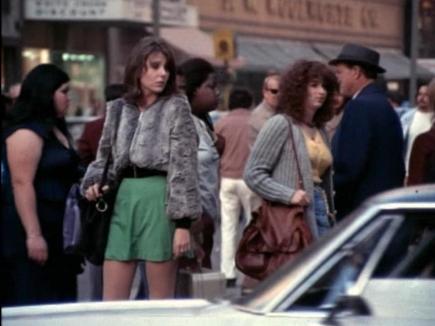
So, Hustling is pretty predictable and, not surprisingly, rather dated but it’s also a fairly effective portrait of life on the margins of society.  Lee Remick is stuck playing a one-note character but Jill Clayburgh is great in the role of Wanda. If nothing else, Hustling was filmed on location in some of the sleaziest parts of 1970s New York City and therefore, the film serves as a bit of a historical document.

For those wishing to check it out, the film’s currently available on Netflix.

Embracing the Melodrama Part II #49: Hustle (dir by Robert Aldrich)


HustleContinuing our journey into the dark Hell of the 1970s, we now take a quick look at the 1975 cop film, Hustle.

Taking place in Los Angeles, Hustle tells the story of several different people who find their lives intertwined in the desperate dance of existence.  (Does that sound overdramatic?  Well, that’s the type of film that this is.)

There’s Leo Sellers (Eddie Albert), a lawyer with bright rosy cheeks and a friendly manner.  You look at Leo and you automatically assume that he must be a nice guy, the type of guy who puts on a fake beard and plays Santa Claus down at the local orphanage.  But actually, Leo is a lawyer for the mob.  He’s gotten rich through crime and his mansion hides all sorts of secrets.  He also has a weakness for violently abusing prostitutes.

Speaking of prostitutes, one of Leo’s favorite is Nicole (Catherine Deneuve), an icy French beauty who survives by holding the world at a distance.  Though Nicole doesn’t like Leo, she has to keep him happy because Leo could easily arrange for her to be deported back to France.

Nicole is also the girlfriend of Phil Gaines (Burt Reynolds), a cynical homicide detective who, like her, tries to keep the world at a distance.  Phil is obsessed with old films and frequently speaks of how much he wishes the real world could be like a movie.  Throughout the film, he talks about eventually moving to Rome.

Phil’s partner is Louis Belgrave (Paul Winfield), who is not quite as cynical as Phil but who is definitely getting there.  Whereas Phil is always talking about how much the world has disappointed him, Louis mostly accepts things without complaint.  He just wants to do his job and go home at the end of the day.

Phil and Louis’s boss is Santoro (Ernest Borgnine, giving a typical Ernest Borgnine performance).  Santoro is not a bad guy but, in order to hold onto his job, he has to keep powerful men like Leo Sellers happy.

Santoro also has to deal with the complaints of people like the Hollingers.  Marty Hollinger (Ben Johnson) is a veteran of the Korean War and handles the world in a gruff and suspicious manner.  Paula (Eileen Brennan) is Marty’s wife and, as a result of his emotional distance, has recently started having an affair.

And then there’s Gloria (Colleen Brennan), Marty and Paula’s daughter.  Gloria ran away from home a while ago and soon found herself working as a stripper, a porn actress, and eventually as a prostitute.  When Gloria is found dead, Phil and Louis get the case.  It’s obvious to them that Gloria committed suicide.  It’s not so obvious to Marty, who is convinced that his daughter was murdered and, disgusted by Phil’s cynical attitude, sets out to investigate the case on his own.

One of the more interesting things about Hustle is that really is no murder mystery.  Despite what Marty believes, Gloria really did commit suicide.  Marty’s insistence that she was murdered has more to do with his guilt over being a bad father than it does with any real evidence.  As Marty investigates his daughter’s life, he is exposed to a sordid world of strip clubs and prostitution.  He discovers that Gloria’s clients included many powerful men and he decides that the last client she saw must have murdered Gloria.

That client is Leo Sellers.  And while Leo may not have murdered Gloria, he is willing to kill Marty to keep his secret life from being exposed.  Phil and Louis are forced to choose between remaining detached or protecting Marty from himself.

And, since this film was made in the 70s, it all ends on a really dark note!

Hustle shows up on Encore occasionally.  It’s a strange film to watch, as it alternates between being a fairly predictable cop film and being a portrait of existential dread.  The movie doesn’t really work; it’s too long, it features some amazingly pretentious dialogue, and Reynolds, Winfield, and Deneuve all seem to be bored with their characters.  Probably the film’s best performance comes from Ben Johnson.  I imagine that has to do with the fact that Johnson is playing the only character who behaves in a fairly consistent way.

And yet, if you’re like me and you’re fascinated with the nonstop fatalism of 70s cinema, Hustle does have some historical value.  It’s one of those films that you watch and you wonder how anyone survived the 1970s!

Embracing the Melodrama Part II #48: The Candy Snatchers (dir by Guerdon Trueblood)


The_Candy_Snatchers_Poster

(SPOILER ALERT)

Do you remember how, just last night, I described The Sister-in-Law as being one of the darkest films ever made?  Well, I stand by that description but, believe it or not, there was another low-budget thriller that was released in 1973 and which is even darker than The Sister-In-Law!  Compared to this film, The Sister-in-Law is a life affirming comedy.

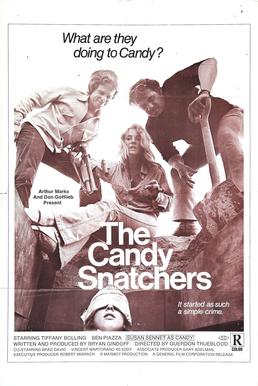
The Candy Snatchers begins with Catholic school student Candy (Susan Sennet) walking home.  As a song called “Money Is The Root Of All Happiness” plays on the soundtrack, we watch Candy as she makes her way across the city.  However, we’re not the only ones watching Candy.  There are also three people in a van and they’re slowly following behind Candy.  They’re also wearing fake noses and glasses.

Despite the elaborate disguises, it’s not difficult to tell the three of them apart.  Jessie (Tiffany Bolling) is their leader, a high-strung woman who always seems to be on the verge of an emotional breakdown.  Alan (Brad David) is her brother and brags that he’s killed twelve people so far and he’s looking forward to adding more to the count.  Their partner is Eddy (Vince Martorano), an overly sensitive criminal who wants to make some money but who doesn’t want to hurt anybody.  Their plan is to kidnap Candy.

(Hence, the Candy Snatchers!)

See, they’re under the impression that Candy’s father, Avery (Ben Piazza) owns a jewelry store and, that by kidnapping Candy, they’ll be able to get him to pay them a ransom.  Pulling up beside her while she attempts to hitchhike home, the three kidnappers grab Candy, pull her into the van, and blindfold her.  They drive up to the mountains and bury Candy in a wooden box, leaving her with a breathing tube to make sure that she doesn’t suffocate.  They then call Avery and give him their demands.

The problem is that the kidnappers haven’t done as thorough a research job as they thought they had.  What they did not realize is that Avery doesn’t own the jewelry store.  Instead, he’s just the manager.  Even worse, it turns out that Avery is not Candy’s father.  Instead, he has just recently married Candy’s mother for her money.  As Avery cheerfully explains, with Candy out of the way, he now stands to inherit $2,000,000 when Candy’s mom dies.

In other words, the kidnappers are now stuck with Candy.

After retrieving her from her underground prison, Alan wants to rape Candy while Jessie wants to kill her.  Eddy, however, feels sorry for Candy.  After telling his two partners that he’s going to kill her, Eddy takes Candy back up to the mountains.  Again, he buries her alive but he promises her that he will return to dig her up as soon as he takes care of his partners.

What Alan, Jessie, and Eddy don’t realize is that all of this is being witnessed by Sean (played by Christophe, the actor’s son), an autistic child who apparently cannot speak.  Candy begs Sean to let someone know where she is but every time that Sean tries to get the attention of his loathsome parents, they either ignore him or they beat him.

By the end of the film, Jessie, Alan, and Candy’s mother are all dead.  When Eddy returns to Candy’s grave, he gets into a gunfight with Avery.  Eddy manages to kill Avery but, before he can dig up Candy, he’s shot in the back.  As he turns around, he sees that he’s been shot by Sean, who has picked up Avery’s gun.  Eddy tumbles down the mountain.  Sean goes back to his house and apparently shoots his abusive mother.  The movie ends with the sound of Candy struggling to breathe underground…

AGCK!

Seriously, I am totally claustrophobic so the end of The Candy Snatchers is pure nightmare fuel for me.  To be honest, the whole film is nightmare fuel.  There’s only two likable characters in the entire film and, as the end credits roll, Sean has just killed his mother and Candy is slowly suffocating underground.

As dark as The Candy Snatchers may be, it’s still strangely watchable and compelling.  It’s not a film that I would recommend to anyone getting over a serious bout of depression but still, it’s a well-acted, well-directed, and consistently surprising film.  In fact, I would say that it’s probably one of the best grindhouse films ever made.

That said, you do have to wonder just how depressing life was in 1973.  Between this film and The Sister-in-Law, I’m surprised humanity survived to see 1974.

What If Aytekin Akkaya Played Captain America?


3devadamThough he may be the most successful, Chris Evans is not the first actor to have played the role of Captain America.  As befits a character that has been around since World War II, Cap has been played by several different actors over the years.  Before Chris Evans and the character became a part of the Marvel Cinematic Universe, the role was played by Matt Salinger.  Before Matt Salinger, there was Reb Brown.  Before Reb Brown, there was Ayetkin Akkaya.  Before Aytekin Akkaya, there was Dick Purcell and…

Wait!  Aytekin who!?

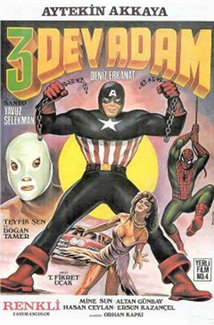
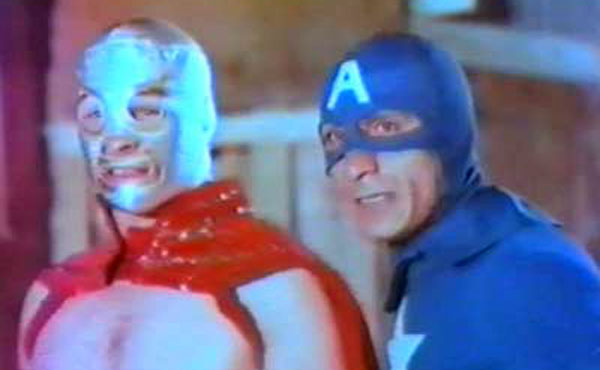
Aytekin Akkaya is the actor who played Captain America in the Turkish film, 3 Dev Adam (also known as Three Mighty Men, Turkish Spider-man, and Turkish Captain America and Santo vs. Spider-Man).   Produced in an alternative universe where there is no such thing as copyright law, 3 Dev Adam is perhaps the strangest Captain America film that you will ever see.

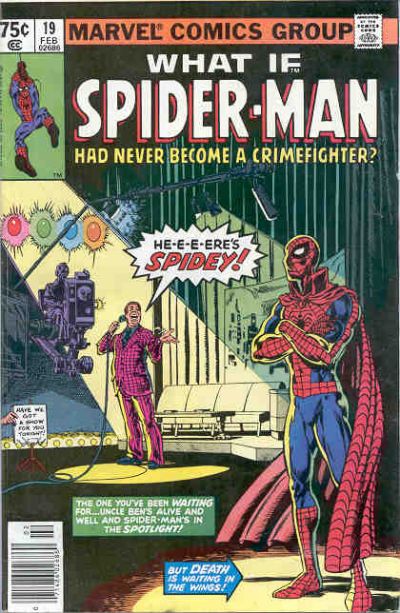
What_If-_Vol_1_193 Dev Adam reminds me of the old Marvel series, What If?  What If showed what would have been the result if certain events in Marvel continuity had happened differently.  A typical issue would have a title like What If Ben Parker Had Not Died or What If Magneto Killed Professor Xavier or What If Rob Liefeld And Jim Lee Had Not Been Hired For Heroes Reborn?  Regardless of the question, the answer was almost always that a hero would have turned into a villain and everyone would be dead by the end of the issue.  3 Dev Adam could have easily been called What If Spider-Man Was A Psychotic Serial Killer?

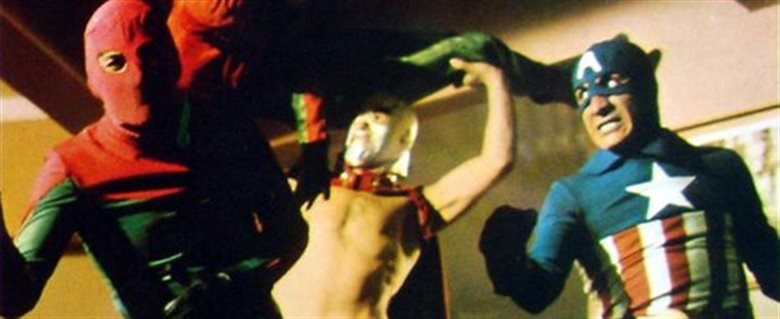
The film opens with a screaming woman being buried up to her neck in sand.  An evil criminal demands information from her and, when he does not get it, he has her killed with a boat propeller.  Who is this psycho?  None other than your friendly neighborhood Spider-Man!  However, this Spider-Man is not Peter Parker or Miles Morales.  He is not even Ben Reilly.  This Spider-Man is a serial killer who steals valuable antiques, sells them to collectors, and then buys them back with counterfeit money.  He does not climb walls or listen to his spidey sense.  Instead of shooting webs, he attacks with a switchblade.  Instead of making jokes and worrying about Aunt May, this Spider-Man laughs and feeds one incompetent subordinate to a hungry gerbil.  This Spider-Man has no Mary Jane Watson or Gwen Stacy in his life.  Instead, he has a girlfriend named Nadia.  When he has sex with her, they are watched by three laughing puppets.

3DEV+2Spider-Man has committed numerous murders in Istanbul.  The police are powerless to stop him so the authorities ask for international help.  The United States sends Captain America and his girlfriend Julia.  Mexico sends famous wrestler Santo.  When the three of them first show up at the Istanbul airport, a snippet of the score from Diamonds Are Forever is heard, reminding us that almost everything in this movie has been stolen.

There are some differences between the Captain that we all know and the Captain played by Aytekin Akkaya.  Akkaya’s Captain America does wear a red, white, and blue costume but he does not carry a shield and his mask does not have wings on either side of his head.  This Captain is trained in karate and has no trouble killing people.  He also enjoys hanging out in strip clubs, which is something that you would never catch the MCU’s Cap doing.  As far as personality is concerned, this Captain America has more in common with Robert Downey, Jr’s Iron Man than with the character played by Chris Evans.

3-dev-adamCaptain America and Santo’s strategy for stopping Spider-Man consists of standing around and waiting for Spider-Man and his goons show up.  They then fight until Spider-Man either escapes or dies.  It turns out that this Spider-Man does have one additional superpower.  Whenever he dies, a new Spider-Man appears nearby and continues fighting.  This leads to a climax where Cap kills Spidey in a number of gruesome ways, just to have a new Spider-Man materialize and laugh at him.  By the end of the film, the screen is littered with dead Spider-Men.

3 Dev Adam is such a strange film that it is almost impossible to review.   If you have ever wanted to see Captain America and Spider-Man fight to the death (over and over again), this is the film for you.  As for Aytekin Akkaya, 3 Dev Adam was the only time that he ever played Captain America.  But anyone who has seen 3 Dev Adam will never forget him.

splash_780

What Lisa Watched Last Night #123: Til Death Do Us Part (dir by Farhad Mann)


Last night, I finally got a chance to watch the latest Lifetime original film, Til Death Do Us Part.

Til Death Do Us PartWhy Was I Watching It?

I missed this one when it premiered on Lifetime last Saturday because I was busy watching Lake Placid vs. Anaconda on SyFy.  Thank God for the DVR!

What Was It About?

It’s yet another Canadian-produced Lifetime movie about a new bride who suspects that her husband might be hiding a deadly secret.  Sandra (Haylie Duff) has just married a doctor named Kevin (Ty Olsson).  At first, Kevin seems like the perfect man but, after they move to a small town, he starts to reveal a controlling and angry side.  Because Sandra has a heart condition, he demands that she constantly take pills.  At the same time, his obsessively devoted sister, Jolene (Magda Apanowicz), has literally moved into the house.

When one of Sandra’s coworkers mysteriously dies, Sandra starts to wonder if maybe her husband was somehow involved.

What Worked?

The film’s first hour worked perfectly, largely because it emphasized Sandra’s confusion and her struggle to adjust to being a part of couple.  Haylie Duff gave a pretty good performance during this part of the movie and was just unstable enough to allow the viewer to think that maybe — just maybe — everything really was just in her head.  Unfortunately, the film sacrificed all hints of ambiguity during the far less satisfying second hour but, for those initial 60 minutes, it was a good and effective thriller.

Ty Olsson and Magda Apanowicz were both well cast as the mysterious husband and his creepy sister.  Magda Apanowicz particularly deserves a lot of credit for totally committing herself to her role.

What Did Not Work?

This is one of those films that was great as long as you didn’t know what was going on.  As long as the viewer was as confused as Sandra, the film worked.  But then, as Kevin’s true nature became more and more obvious, the film itself became less and less interesting.  I almost wish that no effort had been made to provide any motivation for either Kevin or his sister.  If the two of them had remained enigmas, this film could have been an existential masterpiece as opposed to just being another take on Gaslight.

It was hard not to feel that Sandra could have avoided a lot of her troubles by simply doing a google search on Kevin before agreeing to marry him.

“Oh my God!  Just like me!” Moments

If and when I do get married, I hope that my wedding will be as fun and as full of dancing as the wedding that opened this film.  Seriously, I loved the first 15 minutes of this film because it was all about the wedding!

Lessons Learned

Before getting married, be sure to do a google search.

Embracing the Melodrama #47: The Sister-in-Law (dir by Joseph Ruben)


The_Sister-in-Law(SPOILERS BELOW)

After watching enough old movies, I’ve become convinced that the early 1970s must have been the darkest and most cynical time in American history.  It seems like almost every film released from roughly 1970 to 1977 was required to end on a down note.  Even the happy endings were full of ambiguity.  (American Graffiti, a feel-good film according to the reviews that were written at the time of its initial release, ends with one of the characters dying in a car accident and another one MIA in Vietnam.)  I’m not complaining, of course.  I love a sad ending.

Maybe that’s why I so love the 1973 film The Sister-in-Law.  The film starts out as a typical melodrama from Crown International Pictures but it has one of the darkest endings that I’ve ever seen.  In fact, the ending is so dark that it’s pointless to review The Sister-in-Law without telling you how the movie ends.  So, consider this to be your final SPOILER WARNING:

CIP_LogoOkay, ready?

Robert Strong (played by John Savage) is a genuinely likable musician who has spent the last year or so hitchhiking across America.  He decides to visit his wealthy older brother, Edward (Will MacMillan).  It quickly becomes apparent that Robert and Edward are almost insanely competitive with each other.  A friendly day of fun in the pool ends with Edward nearly downing his younger brother.

Robert gets back at Edward by having an affair with Edward’s wife, Joanna (Anne Saxon).  However, Robert eventually breaks things up with Joanna and starts sleeping with Deborah (Meredith Baer), who happens to Edward’s former mistress.

Edward, however, has problems beyond dealing with his wife and his mistress.  It turns out that he’s made all of his money by smuggling drugs into America from Canada.  Now, the Mafia is demanding that Edward bring in a huge shipment of heroin.  Edward, however, convinces his brother to do it for him.

Robert and Deborah drive up to Canada and pick up the heroin.  However, as they do so, they talk about how sick they are of being used by Edward.  So, Robert and Deborah pull over next to a waterfall and, in a surprisingly lyrical scene, they dump all the heroin into the water supply.

And then they make love in the forest.

Well, the mafia wants to know what happened to their heroin.  So, Edward and Joanna get on an airplane and flee the country.  Meanwhile, Robert and Deborah are pulled over by two gangsters.  Robert is pulled out of the car and executed in the middle of the street.  The gangsters drive away.  Deborah collapses to her knees and sobs over Robert’s dead body.

The end.

Seriously, that’s how the movie ends.  The gangsters get away with it.  Hateful Edward and his self-centered wife escape the country.  Deborah is in tears.  And Robert, the one truly likable person in the entire film, lays dead in the street.

Not even David Fincher could make a film this dark.  And, honestly, the darkness at the heart of The Sister-in-Law feels considerably more potent and tragic than anything you could find in any Fincher film.  As played by a very young John Savage (who, just last year, played the President in Bermuda Tentacles), Robert is such a likable guy that you’re glad you got to spend a little bit of time with him before he was brutally murdered in the middle of the street.  Robert’s violent death sticks with you.

(Savage also sung several of the surprisingly catchy songs on the film’s soundtrack.)

Despite or perhaps because of the ultra-dark ending, The Sister-in-Law is one of my favorite Crown International films.  If nothing else, it proves that 1973 was apparently even darker than 2015.

Embracing the Melodrama Part II #46: Walking Tall (dir by Phil Karlson)


Walking_Tall_(1973_film)About 50 minutes into the 1973 film Walking Tall (not to be confused with the 2005 version that starred Dwayne Johnson), there’s a scene in which newly elected sheriff Buford Pusser (Joe Don Baker) gives a speech to his deputies.  As the deputies stand at attention and as Pusser announces that he’s not going to tolerate any of his men taking bribes from the Dixie Mafia, the observant viewer will notice something out-of-place about the scene.

Hovering directly above Baker’s head is a big, black, almost phallic boom mic.  It stays up there throughout the entire scene, a sudden and unexpected reminder that — though the film opens with a message that we’re about to see the true story of “an American hero” and though it was filmed on location in rural Tennessee — Walking Tall is ultimately a movie.

And yet, somehow, that phallic boom mic feels oddly appropriate.  First off, Walking Tall is an almost deliberately messy film.  That boom mic tells us that Walking Tall was not a slick studio production.  Instead, much like Phil Karlson’s previous The Phenix City Story, it was a low-budget and violent film that was filmed on location in the south, miles away from the corrupting influence of mainstream, yankee-dominated Hollywood.  Secondly, the phallic implications of the boom mic erases any doubt that Walking Tall is a film about men doing manly things, like shooting each other and beating people up.  Buford does have a wife (Elizabeth Hartman) who begs him to avoid violence and set a good example of his children.  However, she eventually gets shot in the back of the head, which frees Buford up to kill.

As I said earlier, Walking Tall opens with a message telling us that we’re about to watch a true story.  Buford Pusser is a former football player and professional wrestler who, after retiring, returns to his hometown in Tennessee.  He quickly discovers that his town is controlled by criminals and moonshiners.  When he goes to a local bar called The Lucky Spot, he is unlucky enough to discover that the bar’s patrons cheat at cards.  Buford is nearly beaten to death and dumped on the side of the road.  As Buford begs for help, several motorists slow down to stare at him before then driving on.

Obviously, if anyone’s going to change this town, it’s going to have to be Buford Pusser.

Once he recovers from his beating, Buford makes himself a wooden club and then goes back to the Lucky Spot.  After beating everyone up with his club, Buford takes back the money that he lost while playing cards and $50.00 to cover his medical bills.  When Buford is put on trial for armed robbery, he takes the stand, rips off his shirt, and shows the jury his scars.  Buford is acquitted.

Over his wife’s objections, Buford decides to run for sheriff.  The old sheriff, not appreciating the competition, attempts to assassinate Buford but, instead, ends up dying himself.  Buford is charged with murder.  Buford is acquitted.  Buford is elected sheriff.  Buford sets out to clean up his little section of Tennessee.  Violence follows…

On the one hand, it’s easy to be snarky about a film like Walking Tall.  This is one of those films that operates on a strictly black-and-white world view.  Anyone who supports Buford is good.  Anyone who opposes Buford is totally evil.  Buford is a redneck saint.  It’s a film fueled by testosterone and it’s not at all subtle…

But dangit, I liked Walking Tall.  It’s a bit like a right-wing version of Billy Jack, in that it’s so sincere that you can forgive the film’s technical faults and frequent lapses in logic.  Walking Tall was filmed on location in Tennessee and director Phil Karlson makes good use of the rural locations.  And, most importantly, Joe Don Baker was the perfect actor to play Buford Pusser.  As played by Baker, Pusser is something of renaissance redneck.  He’s a smart family man who knows how to kick ass and how to make his own weapons.  What more could you ask for out of a small town sheriff?

In real life, Buford Pusser died in a mysterious car accident shortly after the release of Walking Tall.  Cinematically, the character of Buford Pusser went on to star in two more films.

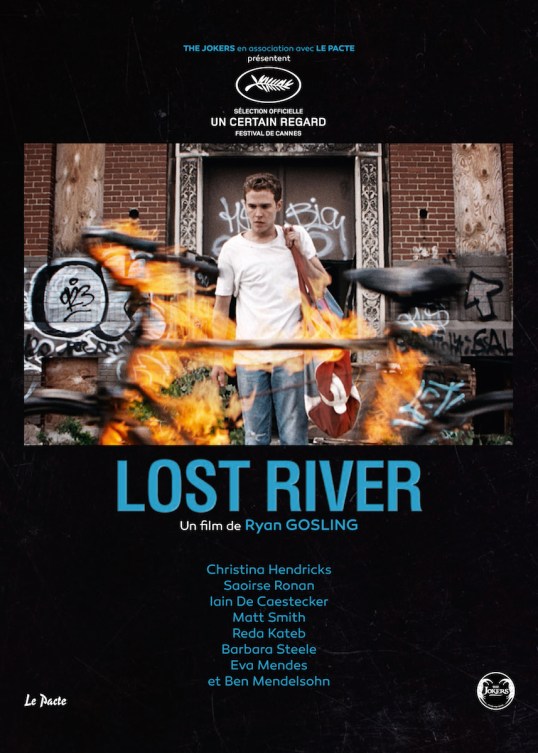
Film Review: Lost River (dir by Ryan Gosling)


Lost River

I had high hopes for Lost River.  Not only is it the directorial debut of one of my favorite actors, Ryan Gosling, but it was also booed at Cannes.  Some of the best and most interesting films ever made have been booed at Cannes.  The reviews that I had read of Lost River indicated that the film was a mess but it was, at the very least, a visually intriguing mess.  I was expecting the film to be pure style over substance but you know what?  I like style.

So, with all that in mind, I finally got a chance to sit down and watch Lost River last night and … bleh.  It’s not a terrible film.  You can watch it and feel that Ryan Gosling does have some promise as a director, if not as a writer.  (Along with directing, he also wrote the film’s screenplay.)  There are some nicely surreal images, though almost all of them appear to have been borrowed from other better films and, as a result, even the strangest of images are rather familiar.  (To be truly impressed by Lost River, it helps to have never seen anything directed by Mario Bava, Dario Argento, David Lynch, or Terrence Malick.)  He gets a memorably unhinged performance from the great Ben Mendelsohn but then again, when hasn’t Mendelsohn given a memorably unhinged performance?

Anyway, Lost River takes place in Detroit, presumably because Detroit features a lot of dilapidated neighborhoods that look interesting on film and allow Gosling to pretend that his film is about America urban decay.  Billy (Christina Hendricks) is on the verge of losing her house but, with the help of sleazy bank manager Dave (Ben Mendelsohn), Billy gets a job working as a performer at a club.  At the club, she and Cat (Eva Mendes) perform elaborate routines which always end with them pretending to die in some excessively brutal and bloody way.  The club’s largely affluent audience loves it.  Dave loves it so much that he’s inspired to sing a song on stage.  Later on in the film, Dave does an elaborate dance because every independent film has to feature an out-of-nowhere elaborate dance.

Meanwhile, Billy’s son, Bones (Iain De Caestecker), is trying to raise money to save the house by stealing copper out of abandoned buildings.  However, this gets him in trouble with Bully (Matt Smith, struggling to speak with an American accent), a psychopath who has declared his section of Detroit to be “Bullytown.”  Bully rides around in a convertible, sitting on a throne that’s been attached to the back seat.  When Bully discovers that Bones has been stealing copper from buildings in Bullytown, Bully declares that Bones must die.

(At some point, you have to wonder if Bully was doomed from the minute that his parents decided to name him Bully.  Maybe if they had named him The Doctor, he could have lived a very different life.)

Living next door to Billy and Bones is Rat (Saorise Ronan, who gives a good performance and deserves better than this role).  Rat is called Rat because she owns a pet rat that’s named Nick.  Got all that?  Rat also lives with her grandmother (Barbara Steele), who never speaks but spends all of her time watching old home movies.  Why would you cast an icon like Barbara Steele and then not allow her to do anything other than sit in a chair and silently stare at a television?

If Lost River was just an exercise in pure style, I probably would have enjoyed it a lot more.  I would much rather a film be too obscure as opposed to being too obvious.  Unfortunately, while Gosling the director is having a lot of fun being as stylish as he can be, Gosling’s the screenwriter proves himself to be heavy-handed and patronizing.  By setting the film in Detroit and having random characters show up to talk about how America is dying and the poor are getting poorer while the rich get richer, Gosling lets us know that Lost River is meant to be more than just an exercise in technique.

The problem is that, as well-intentioned as Gosling may be, you can’t help but get the feeling that he has absolutely no idea what it’s like to be poor or what it’s like to live in a dying American city.  According to the 2010 census, 82.7% of Detroit’s population is African-American.  If you’re making a movie the deals, no matter how strangely, with what it’s like to be poor and desperate in Detroit, why would you decide to exclusively cast affluent-looking Caucasians in all of the main roles?  The few black characters who appear in Lost River are largely there to either comfort or share wisdom with the main white characters before then quickly moving on, never to be seen again after their minute or so of screen time.  It comes across as being condescending in only the way something written by a wealthy white guy can be.

Lost River is a misfire, an attempt by a filmmaker to try to make a statement about something that he really doesn’t seem to know much about.  Judging from the film’s visuals, Gosling has some promise as a director but, in the future, he should probably try to work with a better screenwriter.  If you don’t listen to the dialogue and just consider the film as an exercise in visuals, it’s mildly diverting.  (That said, even the nonstop parade of surreal images gets boring after a while.)  Lost River is not terrible.  It’s just bleh.