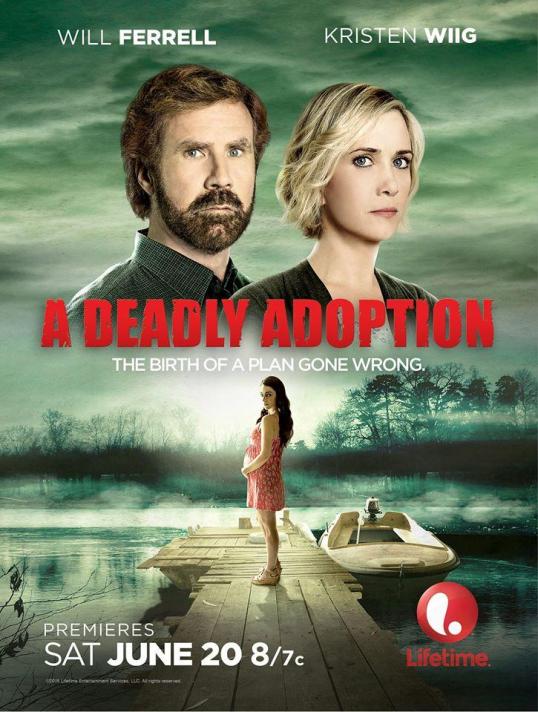
Yes, A Deadly Adoption Was A Comedy…


deadly-adoption

Last night, an article appeared on Mashable in which I was declared to be one of the  “20 people who totally get the ridiculousness of Will Ferrell and Kristen Wiig’s ‘A Deadly Adoption.”  At the time, I was incredibly flattered but also somewhat incredulous.  If I was one of the 20 people who understood that the latest Lifetime film, A Deadly Adoption, was meant to be a drier than dry comedy then that meant that there were presumably people out there who did not get the joke.

And how could that be!? I wondered.

In case you missed it, on April 1st, a story was leaked that Will Ferrell and Kristen Wiig were secretly making a film for Lifetime.  The title of that film was A Deadly Adoption and early reports indicated that it was going to be a serious Lifetime film.  Because the story came out on April Fools Day, a lot of us assumed it was a joke.

However, then Will Ferrell announced that no, it was not a joke.  But now that news of the film had been leaked, he was prepared to close down production and make sure that the film never saw the light of day.  Now, whether Will was being serious in his anger or not is debatable.  (It’s easier to imagine Ron Burgundy having that reaction than Will Ferrell.)  But, regardless, cooler heads prevailed and soon, Lifetime viewers like me were enjoying commercials that featured Jessica Lowndes pointing a gun at a very grim and bearded Will Ferrell.

deadly-adoption-trailer

As the premiere approached, critics and viewers alike wondered if A Deadly Adoption was meant to be a serious film or if it was going to be a comedy.  Those who felt that the film was meant to be serious pointed out that the commercials for the film contained absolutely no hint that it might be a comedy.  Those who thought it was a comedy simply said, “Will Ferrell and Kristen Wiig.”

As for me, I pretty much knew what A Deadly Adoption was going to be from the minute that I discover it was being produced by the same people behind Spoils of Babylon.  And, when I watched the film last night, my suspicions were confirmed.  A Deadly Adoption is a drier-than-dry satire, a film that mashes together every single Lifetime movie trope in order to create the ultimate Lifetime experience.  A Deadly Adoption gets its laughs by refusing to openly acknowledge that it’s gone totally over-the-top.  Will Ferrell and Kristen Wiig both give extremely serious performances, with the humor coming from the fact that they are, with extremely straight faces, delivering dialogue and dealing with situations that are both ludicrous and yet very familiar to anyone who has ever spent a weekend binging on Lifetime.  The end result is that A Deadly Adoption both satirizes and pays tribute to everything that we love about a good Lifetime film.

(Does that make A Deadly Adoption the Sharknado of Lifetime movies?  Technically, yes.  But let’s not say that too loudly because Mia Farrow might hear and decide to live tweet the next showing.)

As for the film itself, it tells the story of Robert (Will Ferrell) and his wife, Sarah (Kristen Wiig).  Robert is a financial author who is also a recovering alcoholic with anger management issues.  (Significantly, everyone always talks about how angry Robert is, despite the fact that we never actually see him lose his temper.)  We know that Robert is a writer because he skypes with his agent and tells her stuff like, “Let’s cut chapter four.”  Sarah, meanwhile, has a typical Lifetime movie career.  She sells organic food at the local farmer’s market.  And, like all Lifetime movie heroines, she has a token and obviously doomed gay best friend named Charlie (Bryan Safi).

Years ago, as the result of an accident on a dock, a pregnant Sarah nearly drowned and lost her baby.  As a result, Robert is incredibly protective of their other daughter, Sully (Aylvvia Alyn Lind). (As part of the A Deadly Adoption drinking game, take a drink every time Will Ferrell says, “She needs her medicine!”)  Robert is also now scared of going out on the water so you better believe that the film’s conclusion is going to involve Robert in a tiny boat.

Anyway, Robert and Sarah want to adopt the unborn child of Bridget (Jessica Lowndes) but what they don’t know is that Bridget has plans of her own.  Upon accepting their offer to live with them until she gives birth, Bridget starts to subtly disrupt the lives of Robert and Sarah.  That right, she’s obsessed!  And, of course, she’s got a redneck boyfriend (Jake Weary) who drives a pickup truck and has a lot of “dangerous” tattoos.  And…

Well, I could actually devote a few thousand words to telling you the plot of A Deadly Adoption.  A lot of stuff happens.  In fact, every single plot point from every single Lifetime film ever made gets used at some point.  Everything about this film — from the acting to the direction to the tasteful decor of Robert and Sarah’s house to the almost obsessive focus on Jessica Lowndes’s cleavage — is designed to make this film look like a typical Lifetime film.

The brilliance of it comes from the fact that Ferrell, Wiig, Lowndes, and Weary all deliver their increasingly ludicrous lines with such intense commitment and low-key seriousness.  (Kristen Wiig, in particular, is great.)  With the exception of one line about lighter fluid and a dance party at the end of the film, there’s nothing in A Deadly Adoption that plays for obvious laughs.  Instead, the film is a two-hour inside joke and, if you get the joke, you’re one of the cool kids.

Unfortunately, there are a lot of uncool kids out there and a lot of them did not get the joke.  If you check out the comments left on the film’s imdb page, you’ll discover that there’s still a lot of people out there who are wondering whether this was meant to be a serious film or not.

*Sigh*

To quote Ron Burgundy, “GREAT ODIN’S RAZOR!”

(Did he say that?  Sounds like something he would say.)

Anyway, to answer those who still do not know — yes, A Deadly Adoption was a comedy.

And it was a brilliant one at that!

This is what I feel like doing when people say they don't know if A Deadly Adoption was supposed to be funny.

This is what I feel like doing whenever people say they don’t know if A Deadly Adoption was supposed to be funny.
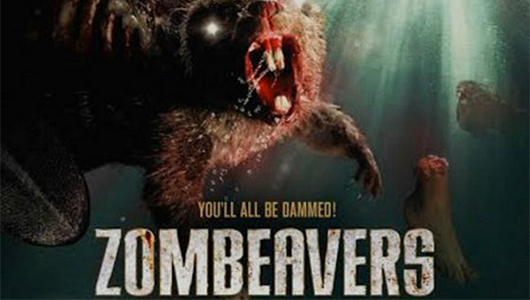
Zombeavers Is The Best Zombie Beaver Film Ever!!!!


ZombeaversOf the many deliberately ludicrous and over-the-top nature-gone-made films to be released in the wake of Sharknado, Zombeavers is one of the most impressive.  Certainly, it’s probably the best film that will ever made about zombie beavers.

The film takes place in one of those isolated areas of rural America where cell phones don’t work, everyone drives a pickup truck, and nobody would dare be seen without a shotgun in his hands.  Of course, if you’ve ever seen a horror movie before than you know that any area this isolated is going to inevitably be ground zero in a mutant beaver attack.

Perhaps not surprisingly, it’s all John Mayer’s fault.  Yes, that’s right, John “Your Body Is A Wonderland” Mayer.  He makes his feature film acting debut here, playing a dumbass trucker who, after his truck collides with a deer, ends up losing a barrel of toxic waste.  That barrel rolls into a nearby lake where it turns the local beaver population into zombeavers!

(Whenever I watch anything on Netflix, I always turn on the closed captioning.  One of the joys of watching Zombeavers came from getting to read sentences like “Zombeavers growl,” at the bottom of the screen.)

Meanwhile, three sorority sisters are spending the weekend at a nearby cabin.  Jenn (Lexi Atkins) is depressed because she caught her boyfriend cheating on her.  Zoe (Cortney Palm) is sarcastic, uses “bitch” as a term of affection, and owns a puppy named Gosling.  (I related to Zoe, despite being a cat person.)  Mary (Rachel Melvin) owns the cabin and is determined to have the perfect girls weekend.  Unfortunately, those plans are ruined by both the surprise arrival of their boyfriends and a sudden zombeaver attack…

Fortunately, there is a potentially crazy but helpful hunter wandering around the woods.  His name is Smyth (“Smyth with a y,” he says upon introducing himself) and he’s played by veteran character actor Rex Linn.  Linn doesn’t get much dialogue but he still manages to make every line memorable as he gives a performance that strikes a perfect balance between drama and parody.  At one point, Linn delivers a monologue about how, in the 1970s, everyone in the county got “beaver fever.”  It’s  ludicrous and the joke is so obvious but Linn bring so much commitment to the monologue and to his performance that he sells it.

And really, the same can be said for Zombeavers as a movie.  It’s ludicrous.  It’s silly.  There’s not a single beaver joke that doesn’t, at some point, get made.  And yet, the film works.  It’s a parody that somehow manages to remain credible.  Yes, the zombeavers are intentionally designed to look fake but you still would not necessarily want to come across one at the foot of your bed in the middle of the night.  Yes, the characters say a lot of silly things but the cast delivers those lines with both a straight face and a lot of conviction.  (In fact, all three of the lead actresses are totally natural and convincing in their roles.)  Everyone involved with the film — from the cast to crew — is so committed to the material that it works even when it shouldn’t.

Zombeavers is currently available on Netflix and should be watched by anyone who loves insane monster movies.  It’s the best movie about zombie beavers ever made.

Pixar Does It Again With Inside Out


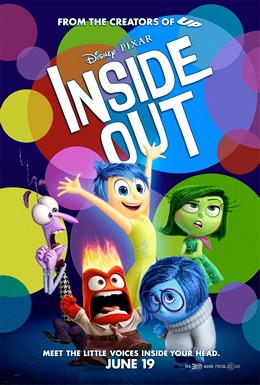
Inside_Out_(2015_film)_posterInside Out is the latest brilliant film from Pixar’s Pete Docter and it will remind you why you fell in love with Pixar in the first place.

There are no talking cars or lovable monsters in Inside Out.  Instead, it’s the story of a very normal 12 year-old girl named Riley (voiced by Kaitlyn Dias).  Or rather, it’s the story of what goes on in her head.  For most of the movie, Riley deals with experiences to which we can all relate: she moves to a new city, she struggles to relate to her well-meaning parents (voiced by Kyle MacLachlan and Diane Lane), and she tries to fit in at a new school.  Inside Out is a film about the small moments of life and how they all add up to create a bigger picture.

What sets Inside Out apart is the way that it tells its deceptively simple story.  Inside Out takes place almost entirely inside of Riley’s brain.  And it turns out that her mind is gigantic wonderland, one that is so big and complex that not even the characters who live there quite understand how it all works.  Bing Bong (Richard Kind), a pink half-elephant, half-cat, half-dolphin creature, spends his time wandering through the halls of memory and mournfully thinking back to when he was Riley’s imaginary friend.  Whenever Riley goes to sleep, the actors and directors at Dream Productions film a different nightly movie.  Meanwhile, Imagination Land is a fun place to visit but not a good place in which to live and past childhood traumass — like a gigantic stalk of broccoli and a terrifying birthday clown — are locked away deep in Riley’s subconscious, where they are guarded by officious policemen.   Zigzagging through this mental landscape is the literal Train of Thought.

And then, above it all, there’s Headquarters.  This is where five different emotions take turns “steering” Riley through life.  Fear (Bill Hader) is always nervous but, at the same time, keeps Riley safe.  Disgust (Mindy Kaling) prevents Riley from eating broccoli and hanging out with the wrong crowd.  Sadness, meanwhile, hasn’t had much to do over the past 12 years and, as a result, she spends most of her time standing in a corner and feeling … well, sad.  Sadness is voiced by Phyllis Smith, best known for playing Meredith on The Office.  Smith proves herself here to be a strong and empathetic voice artist.

Their unquestioned leader is Joy (Amy Poehler).  As befits her name and job, Joy is always positive, always upbeat, and always optimistic.  For 12 years, Joy has been in charge of steering Riley’s life but that all changes when Riley and her family move to San Francisco.  Suddenly, Joy finds it more difficult to keep Riley permanently happy.  Memories that were formerly color-coded yellow for happy start to turn blue.

When both Joy and Sadness are accidentally expelled from the Headquarters, it’s up to the three remaining emotions to try to keep Riley well-balanced until they can return.  However, the journey back up to the Headquarters is a long and dangerous one, full of some of the most imaginative (and metaphorical) imagery in Pixar’s history.  Joy and Sadness will have to work together to make it.

And really, that’s what makes Inside Out so special.  It’s the rare family film that acknowledges that allowing ourselves to feel sad is often as important as being happy.

Inside Out is a brilliant coming-of-age story and one of the best films of the year.  It’s a film that will make you laugh and cry and will remind you of why you fell in love with Pixar in the first place.  Kids will love the humor and adults … well, adults will probably be trying to hold back the tears.

What a great film!

Thank you, Pixar.

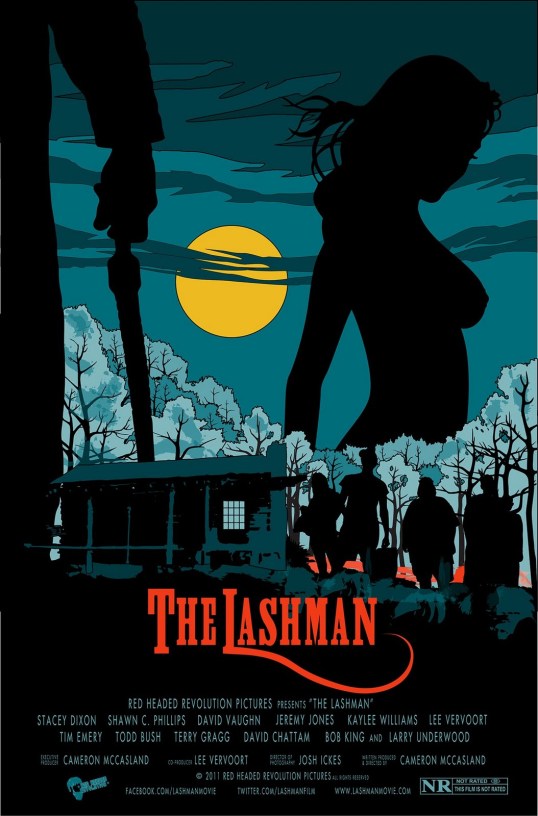
The Daily Grindhouse: The Lashman (dir by Cameron McCasland)


339542_242684609106121_126435694064347_676919_7608822_o

It’s been a while since I’ve down a Daily Grindhouse review here on the Shattered Lens and shame on me for that!  Fortunately, I recently saw a film called The Lashman, a film that may have been released in 2014 but which serves as a tribute to the low-budget, wilderness slasher spectaculars that played at so many grindhouse and drive-in theaters in the 70s and 80s.  After watching the film, I knew that I had seen the perfect film with which to relaunch this feature.

The Lashman was directed by Cameron McCasland and filmed in Kentucky.  As I’ve said many times in the past, I love local horror films.  These are films that are made on location, outside of Hollywood and which often utilize local talent, both behind and in front of the camera.  Along with reminding us that no one location has a monopoly on American filmmaking talent, these locally made horror films also feel a lot more authentic than the slick, “mainstream” films coming out of Hollywood.  This is horror taking place in the real world, as opposed to on a sound stage.  “Authenticity,” that belief that what you’re watching could happen just as easily to you as it could to the people onscreen, is one of the keys of effective horror cinema.  If you can’t relate to the fear of the characters or believe that the film’s threat — no matter how outlandish — might just happen to be waiting for you in the shadows, then the film is not going to work.  Grindhouse horror films, with their rough edges and their cast of often unfamiliar faces, worked precisely because they felt authentic.

I think this especially true for slasher films.  As unfairly critically reviled as they may be, the slasher film is based on a horror that we can all relate to.  We all know that there are disturbed people out there.  We all secretly suspect that we’re more vulnerable, both mentally and physically, than we like to pretend we are.  And, as much as we like to shout back at the screen and complain about how slasher movie victims are always doing something stupid, we all know that we have no idea how we would react if we ever found ourselves in the same situation.  Most of us secretly know that we’d never survive a slasher film.  I know I wouldn’t.  I’d be the girl wandering around outside in her underwear, saying, “This isn’t funny!,” and then spraining my ankle as soon as I tried to run away.

The Lashman is a throwback to those old grindhouse slasher films, a loving homage to films that may have never been critically embraced but which remain undeniably effective.  The film’s story is simple.  Five students spend the weekend at a cabin in the woods.  Lashman, who is rumored to be the malevolent spirit of a man killed over 100 years before, shows up.  People die.

Our five students are all traditional slasher movie victims.  In fact, they share the same basic relationships as the five victims from the original Texas Chainsaw Massacre.  There’s two couples, Stacy (Stacy Dixon) and Billy (David Vaughn) and Daniel (Jeremy Jones) and Jan (Kaylee Williams) and then there’s Stacy’s awkward misfit of a brother, Bobby (Shawn C. Phillips).  (Much like poor wheelchair-bound Franklin from Texas Chainsaw, Bobby spends a lot of time complaining.)

Out of the cast, Shawn Phillips is the one who I immediately recognized because he’s appeared in several low-budget and undeniably fun horror films, with Ghost Shark being a personal favorite.  However, all five of the main cast members do a good job.  I’m jealous of the screaming abilities of Stacy Dixon and Kaylee Williams and David Vaughn made for a good “nice guy” hero.  However, special mention has to be made of Jeremy Jones.  One of the unwritten rules of the slasher genre is that one of your main victims has to be a totally obnoxious jerk and Jeremy Jones deserves a lot of credit for the total commitment that he shows to that role.

The Lashman is a film that will best be appreciated by those who know their horror movies and who can appreciate that McCasland has essentially crafted this film to be a valentine to the entire genre.  Everything about the film — from the beautifully shot opening where two anonymous teens fall victim while the moon beautifully glows down on a lake to the final chase through the woods between the Lashman and his suddenly partially undressed final prey — feels like a tribute to the classic grindhouse horror films of the past.

Finally, as I wrap up this review, allow me to share just a few more thoughts:

This film was produced by Red Headed Revolution Pictures.  As a redhead, I appreciated that.  It was also co-produced by Lee Vervoort, who was one of the directors on Volumes of Blood.

The token crazy old man character (every slasher film has one and nobody ever listens to him when he attempts to warn them) is played by an actor named Larry Underwood, who is a horror host (under the name Dr. Gangrene) and a Rondo-winning horror blogger.  (That said, I should admit that the main reason that I initially smiled when I saw his name in the credits is because I just started reading Stephen King’s The Stand.)

Director Cameron McCasland has a cameo appearance in the film and is credited as playing Handsome Bartender.

The end credits declare, “A good cast is worth repeating!”  If you’ve seen any the great Universal films from the 30s and 40s, you will immediately recognize the phrase.  When I was a kid and I would watch any of the old monster movies, I always loved seeing that “a good cast is worth repeating!”  In a weird way, it always made me feel happy for the cast.


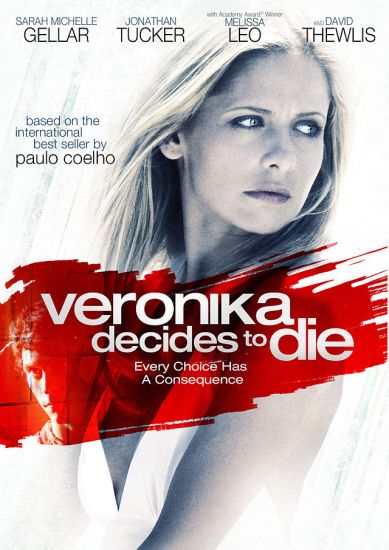
Embracing the Melodrama Part II #126: Veronika Decides To Die (dir by Emily Young)


VeronikaDecidesToDie_USPosterWell, here we are!

It’s been 9 weeks since we originally embarked on this journey that I called Embracing The Melodrama Part II.  At that time, my plan was to do 126 reviews in just three weeks.  It didn’t quite work out that way, did it?  But still, I had fun doing this series of reviews and I hope that you’ve had at least a little fun reading them.  If I’ve inspired you take a chance on any of the films that I’ve reviewed — whether it be Sunrise or An American Hippie In Israel or Cocaine: One Man’s Seduction or Calvary — then this has all been worth it!

So, for my final review in this series, I want to take a quick look at one of the most melodramatic films to be released this year so far, Veronika Decides To Die.

Veronika Decides To Die finally got an American release in 2015, six years after it initially premiered on the festival circuit.  Years before it was available here in the States, Veronika played in Europe.  Not surprisingly, the American release felt much like an afterthought, one final attempt to make a little money off the film before moving on.  It’s spent about a week in theaters and two months later, it is now showing up on cable and Netflix.  And while Veronika didn’t get many reviews, the few that it did get were rather dismissive.

But you know what?

I like Veronika Decides To Die.

Don’t get me wrong.  It’s not a great film.  In many ways, it’s a very silly film.  The entire plot hinges on a character doing something that makes no sense.  Frustrated with her life as an anonymous and lonely office worker, Veronika (Sarah Michelle Gellar) attempts to commit suicide.  She survives the suicide attempt and, upon waking in a mental hospital, she’s told by a mysterious psychologist (David Thewlis) that, as a result of her attempt, she now has a heart condition that will kill her in a matter of weeks.  And what does Veronika decide to do after learning that she’s going to die?  She voluntarily remains in the mental hospital and goes to sessions of group therapy!

And you never really believe that Veronika would do that.  But, if you can bring yourself to accept that one implausibility — well, you’ll soon be confronted by a lot of other implausibilities.  You’ll meet Veronika’s glassy-eyed roommate (Erika Christensen) and a mysterious older patient (Melissa Leo).  You’ll also meet Edward (Jonathan Tuker), who is mute but has such a sexy stare that he really doesn’t need to speak.  And as Veronika gets to know her fellow patients, she starts to come to terms with her own issues of anger and regret and she realize that importance of embracing life and doing what you love.

Of course, that’s a little hard to do when you’re in a mental hospital.  Luckily, there’s a piano that Veronika can play while Edward silently watches her.  If you’re guessing that this eventually leads to Veronika sitting naked at the piano and masturbating in front of Edward, well, you’re right…

Listen, Veronika Decides To Die is one of those films that takes itself way too seriously and it ends with a plot twist that you’ll see coming from a thousand miles away.  I can understand why the film’s release was delayed because the film’s tone is all over the place.

But, dammit, I liked Veronika Decides To Die!

When taken on its own defiantly melodramatic terms, it works.  That’s largely because Sarah Michelle Gellar really commits herself to the role.  You forget that you’re watching Buffy.  Instead, Gellar truly becomes Veronika, this tragically sad and lonely young woman who finds inner peace by masturbating at a piano.  Veronika Decides To Die is a movie that really shouldn’t work but Sarah Michelle Gellar saves it.  When the film starts, she beautifully captures Veronika’s lonely desperation, her feelings of isolation and worthlessness.  (I don’t care who you are, we’ve all felt like Veronika at some point in our life.)   As the film progresses, she portrays both Veronika’s anger and her growing appreciation of life.  She has a nice chemistry with Jonathan Tucker and, in the end, Sarah Michelle Gellar probably gives a better performance than the material really deserves.

Of course, another reason that Veronika Decides To Die works is because it is so silly and melodramatic.  This is one of those films that goes so far over-the-top that it creates an almost heightened sense of reality.  It becomes, almost despite itself, compulsively watchable.

It’s also the perfect film with which to complete Embracing the Melodrama Part II.  I hope y’all have enjoyed reading these 126 reviews because I’ve certainly enjoyed writing them!  To everyone who has read these reviews and clicked on the “like” button and occasionally left a comment or two, thank you so much!  Love you!   However much effort or work it may take, all of you make it worth it.

And now I’m going to go pass out for a little while…

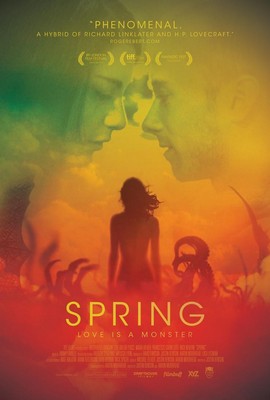
Embracing the Melodrama Part II #125: Spring (dir by Justin Benson and Aaron Moorehead)


Spring_(2014_film)_POSTERWhen was the last time that a film truly took your be surprise?

Well, regardless of what you may think of the film overall, Spring will take you by surprise.  The film takes two different genres — talky romance and body horror — and mashes them together.  It’s the sort of thing that shouldn’t work and, yet, it somehow does.  If Richard Linklater and David Cronenberg spliced their DNA, the result would be Spring.

Spring opens in Los Angeles, with Evan (Lou Taylor Pucci) sitting at the bedside of his cancer-stricken mother and watching her die.  After the funeral, Evan is drinking at a bar when a drunk and obnoxious toadsucker picks a fight with him.  Though Evan, at first, tries to avoid the confrontation, he eventually ends up punching the man.  (Evan spends the majority of the film trying to avoid confrontation.  He’s actually a genuinely likable character and when was the last time you saw that in a film?)  With the man now looking to kill him and the police possibly interested in pressing assault charges, the distraught Evan impulsively decides to take a trip to Italy.

He spends a while wandering around Italy.  He hangs out with obnoxious and continually drunk tourists, the type who will be familiar to anyone who has ever spent the summer after high school graduation in Europe.  And, eventually, he ends up in a beautiful Italian village, where he meets the mysterious Louise (Nadia Hilker).

Louise is a researcher and, at first, it would seem like she and Evan have little in common.  (She’s an intellectual.  Evan, cute as he is, most definitely is not.)  But, over the course of a week, they get to know each other and Evan starts to fall in love with Louise.  These scenes are full of nonstop conversation, covering topics of culture, history, and philosophy.  It’s an obvious homage to Richard Linklater’s films with Ethan Hawke and Julie Delpy and it works perfectly.  Both Pucci and Hilker are likable performers and they have a lot of chemistry.

However, there’s another story unfolding.  At night, a strange creature roams the city, eating stray animals and eventually killing one of the most obnoxious American tourists to ever appear in a film.  How do these two stories connect?

Well, I’m not going to tell you.  You need to see the movie for yourself.

To be honest, when I started this review, I thought I was going to be a lot more critical of Spring.  As often happens with ambitious but low-budget indie films, there are a few scenes where the pacing is off and, once the solution to the film’s big mystery has been revealed, the explanation goes on for a bit too long.  I appreciate the filmmakers attempt to make everything plausible but, sometimes, it’s better to just gloss over the exact details.

But you know what?

As I sit here writing this review, I realize that those criticisms may be valid but, in the big picture, they don’t really matter.  So what if the film has flaws?  All films have flaws!  Spring tells a unique and interesting story and it will take you by surprise.  Plus, it captures the romance of Italy!  So, instead of getting all nitpicky, I’m just going to recommend that you see the film.

Embracing the Melodrama #124: Maps to the Stars (dir by David Cronenberg)


Maps_to_the_Stars_posterI have to admit that, for the most petty of reasons, I was dreading the 2014 release of David Cronenberg’s Maps to the Stars.  

This was despite the fact that I happen to be a big fan of just about everyone in the cast and David Cronenberg as a director.  (I still say that Cosmopolis is one of the best films of the decade and I don’t care who disagrees.)

My initial issue with Maps to the Stars — and again, I admit this is really petty — was that Sasha Stone, over the Awards Daily web site, was so damn fanatical about singing the film’s praises.  I have a theory that Sasha tends to overpraise certain films specifically so she can have an excuse to get angry and go off on a rant when they don’t receive any Oscar nominations.  Ever since Sasha went batshit crazy over The King’s Speech beating The Social Network, Awards Daily has pretty much gone from being a site about the Oscars to being a site about Sasha screaming in the wilderness like a biblical prophet (and not one of the interesting biblical prophets, like Elijah.  We’re talking about Haggai here.)  From what I had read about Maps To The Stars and judging from the response that it got at Cannes (where, despite mixed reviews, it did win an award when Julianne Moore was named best actress), this film seemed like the epitome of another deliberate lost cause.

Fortunately, the release date of Maps To The Stars was moved to 2015 and civilization was spared from having to deal with a thousand “If Cronenberg doesn’t get an Oscar, society is doomed!” rants.  Instead, we had to deal with a thousand “If Hillary Swank doesn’t win for The Homesman, society is doomed!” rants.

“Okay,” you’re saying, “that’s great Lisa.  Thank you for whatever all that was.  But what about the movie itself!?  Is it any good?”

Eh … I guess.

I mean, Maps to The Stars isn’t a bad movie.  It’s not bad at all.  It’s just maddeningly uneven.

One of my favorite up-and-coming stars, Mia Wasikowska, has a great role in it.  She plays a schizophrenic, named Agatha, who comes to Hollywood.  Agatha’s arms and the back of her neck are covered with burn scars and she is always taking pills.  She is also obsessed with a vile teen star named Benjie Weiss (Evan Bird).  There’s more to her obsession than you might originally think.

Benjie, meanwhile, has just gotten out of rehab and he is literally one of the worst characters ever.  The film does try to build up some sympathy for him by revealing just how fucked up his home life is.  His fragile mother (Olivia Williams) always seems to be on the verge of collapse.  His father (John Cusack) is a glib and shallow psychologist.  Benjie serves as a stand-in for every child star who has been destroyed by Hollywood.  Unfortunately, the film devotes so much time to Benjie being a monster that it never really allows us to see why Benjie’s a star in the first place.  Evan Bird gives such a boring, uninteresting, and flat performance that you never really buy the idea of Benjie could be a success.  (Say what you will about Justin Bieber, he does at least have a cute smile.  Evan Bird can’t even claim that.)

Agatha meets a lot of people in Hollywood, including a limo driver (Robert Pattinson) who is an aspiring screenwriter.  She eventually gets a job working for actress Havana Segrand (Julianne Moore).  Havana, herself the daughter of a legendary and self-destructive actress, is a monster but — unlike, Benjie — she’s a sympathetic monster.  She’s a talented actress who grew up in Hollywood and now, because she’s no longer in her 20s, is being discarded by Hollywood.  Havana is as much a victim as a victimizer.

Anyway, the film kinda wanders about.  Along with all the other stuff going on, the characters are regularly visited by ghosts.  Secrets are revealed.  Hearts are broken.  Lives are lost.  And yes, relevant points about Hollywood are made but … well, so what?   There’s nothing in Maps to the Stars that you couldn’t learn from rewatching Sunset Boulevard and Sunset Boulevard is a lot less pretentious.  Plus, William Holden was a much better actor than Evan Bird.

As for Cronenberg’s direction — well, Maps to the Stars is definitely David Cronenberg on autopilot.  It’s filled with identifiable Cronenberg touches.  The emphasis placed on Agatha’s scars, for instance, is trademark Cronenberg.  But still, Cronenberg’s direction often just seems to be going through the motions.  Unlike his work in the far more interesting and challenging Cosmopolis (not to mention Eastern Promises), Cronenberg doesn’t really seem to care that much about the story that he’s telling.

Maps to the Stars is worth watching for the performances of Julianne Moore and Mia Wasikowska.  Otherwise, it’s just another well-made but only occasionally interesting Hollywood melodrama.

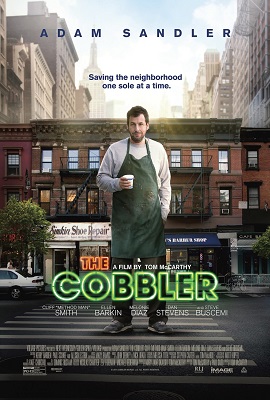
Embracing the Melodrama Part II #123: The Cobbler (dir by Thomas McCarthy)


The_Cobler_poster

Oh, Cobbler, Cobbler — what a frustrating film you are!

There was a time when everyone was excited about seeing The Cobbler.  It was originally scheduled to come out in 2014 and, along with Men, Women, & Children, it was supposed to be part of the dramatic recreation of Adam Sandler.

After all, one of the main reason why critics like me hate to see Adam Sandler devoting his time to stuff like That’s My Boy is because, in the past, Sandler has actually proven himself to be a surprisingly good and likable dramatic actor.  Unfortunately, dramatic Sandler films never seem to make much money and, as a result, Sandler goes back to making films where he, David Spade, and Chris Rock play former high school classmates.  If only one Sandler dramedy could be a success, we tell ourselves, then he’d never feel the need to make another movie like Jack and Jill…

(And yes, I realize that’s probably wishful thinking on our part.  Even if Adam Sandler somehow won an Oscar, I get the feeling he’d follow the win by starting work on Grown Ups 3….)

The Cobbler promised that not only would Sandler be playing a more low-key role than usual but he would also be directed by Thomas McCarthy, who previously directed the excellent The Visitor and Win Win.  Based on his previous films, McCarthy seemed to be the perfect filmmaker to give Adam Sandler some credibility.

And, let’s not forget, that not only would Sandler be working with Thomas McCarthy but Men, Women, & Children was being directed by Jason Reitman!  At one point, it truly appeared that 2014 was going to be the year that we saw the rebirth of Adam Sandler.

And then Men, Women, & Children came out and was a disaster, despite the fact that Sandler got fairly good reviews.  Meanwhile, rumors started to swirl that just maybe The Cobbler wasn’t as good as McCarthy’s previous film.  When The Cobbler‘s release date was pushed back to 2015 … well, we all knew what that meant.

Anyway, The Cobbler was released in a few theaters earlier this year and on VOD.  It’s now available on Netflix.  I watched it last week and it’s really not as bad as I expected it to be.  Of course, that’s not to say that it’s particularly good either.  It’s not terrible but it is disappointing.  Considering the director and the supporting cast (Dustin Hoffman, Steve Buscemi, Dan Stevens, and Melonie Diaz, who was way too good in Fruitvale Station for you not to regret how this film totally wastes her), The Cobbler should at least be interesting.  Instead, it’s just kind of bland.

However, Adam Sandler does give a pretty good performance.  In this film, he plays Max, a shy and emotionally withdrawn cobbler.  He comes from a long line of cobblers and he inherited his store from his father (Dustin Hoffman).  Years before the film begins, Max’s father mysteriously vanished.  Now, Max spends his time going to and from work and taking care of his dementia-stricken mother.  His only friend is Jimmy (Steve Buscemi), the paternal barber who works next door.

In the basement of Max’s shop, there’s an old stitching machine.  About 30 minutes into the film, Max discovers that if be puts on a pair of shoes that have been repaired using the machine, he can physically transform into whoever owns the shoes.  After experimenting with being different people, Max eventually puts on his father’s shoes.  Transforming into his father, he has dinner with his mother.

The next morning, his mother dies.  Max cannot even afford to buy her a good headstone.  However, a local criminal (played by Method Man) has dropped off his shoes to be repaired.  Perhaps, by wearing the criminal’s shoes, Max can come up with the money…

I’m probably making The Cobbler sound a lot more interesting than it actually is.  And seriously, it sounds like it should a really good and thought-provoking movie.  Unfortunately, McCarthy awkwardly tries to combine the broadly comedic elements (i.e., Sandler transforming into a variety of eccentric characters) with the dramatic (which includes not only Max’s anger at his father but a few murders as well).  The film never finds a consistent tone and, as such, it remains an interesting idea in search of a stronger narrative.  Watching the film as it wanders from scene to scene, it’s impossible not to mourn all of the missed opportunities.

But, as I said, Adam Sandler does well.  Hiding his face behind a beard and only occasionally offering up a sad smile, Sandler gives a low-key performance that is full of very genuine melancholy.  In this film, he proves that he can act when he wants to.  You just wish that the rest of The Cobbler lived up to his performance.

Unfortunately, as far as the box office is concerned, The Cobbler is the least financially successful film that Sandler has ever appeared in.  This means that plans for Grown-Ups 3 are probably already underway…

(For those keeping track of the progress of Embracing The Melodrama Part II, we are now 123 reviews down with 3 to go.)

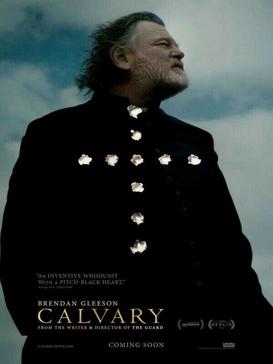
Embracing the Melodrama Part II #122: Calvary (dir by John Michael McDonagh)


Calvary_movieposterCalvary was probably the best movie of 2014 that you did not see in a theater.  I missed seeing it during its brief theatrical run in the States.  If I had seen it when it was originally released, my list of the best films of 2014 would have been far different.  Calvary is an amazing film that takes a serious and intelligent look at issues of faith, morality, guilt, and absolution.  It is one of the best films about Catholicism that I’ve ever seen.

The film, which was written and directed by John Michael McDonagh (who previously gave us The Guard), tells the story of an Irish priest, Father James (Brendan Gleeson).  During confession, an unseen parishoner tells James about the horrific sexual abuse that he suffered as a child.  The parishoner explains that the priest who abused him has since died so the parishoner plans to get his revenge on the Catholic Church by killing James.  He tells James to meet him on the beach next Sunday.  He also informs James that his death will mean more because James is a “good man.”

The rest of the film follows James over the course of what could be the last week of his life and we watch as James struggles to fulfill his priestly duties in a world that seems to be moving further and further away from the Church.  While everyone seems to come to him with their problems and their questions, few people seem to share James’s faith and James is often left to wonder whether he’s doing any good at all.

For instance, when he confronts the local butcher (Chris O’Dowd) for beating his wife, the butcher refuses to admit that he did anything wrong.  When he goes to prison and talks to a serial killer (Freddie Joyce) who wants forgiveness, James replies that he can’t be forgiven because he feels no guilt.  The local millionaire (Dylan Moran) offers to donate money to the church but also confesses that he made his money through illegal means.  A local doctor, a hedonistic, cocaine-snorting atheist played by Aiden Gillen, takes perverse pleasure in taunting James for caring about death.  When James attempts to talk to a local girl, the girl’s father accuses him of being a pedophile.  When the local church catches on fire, nobody in the village seems to care.  And finally, one night, James returns home to discover that someone has murdered his beloved dog.

And yet, there are good moments as well.  James prays with a woman (Marie-Josee Croze) who has just lost her husband.  James gets chance to bond with his emotionally unstable daughter, Fiona (Kelly Reilly).  James successfully counsels a troubled young man (Killian Scott) and befriends an American writer (M. Emmett Walsh).

And, as Sunday approaches, James is forced to decide whether to leave his parish or to go to the beach.

Calvary is a great film, one that consistently takes you by surprise and forces you to think.  In many ways, James serves as a stand-in for the entire Catholic Church.  He’s made mistakes, he’s been battered, and he struggles with doubt.  And yet, at the same time, he is still capable of doing so much good.  Calvary is one of the best Catholic films ever made.

And it also features Brendan Gleeson’s best performance to date.  That is truly saying something because Brendan Gleeson is one of our greatest actors.  Gleeson is onscreen for every minute of Calvary and his emotional and, at times, warmly humorous performance is an amazing thing to behold.  When we first see James, he’s a weary and burned-out man.  Over the course of the week (and the film), he goes from being frightened to angry to sad to eventually achieving a state of grace.

It’s a great performance in a great film.

You may have missed Calvary in 2014.

Don’t miss it again.

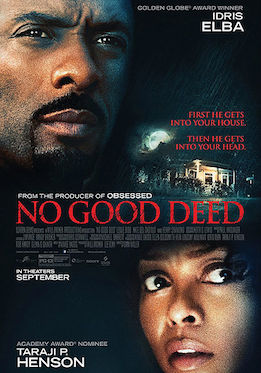
Embracing The Melodrama Part II #121: No Good Deed (dir by Sam Miller)


No_Good_Deed_2014_movie_posterSo, this weekend, my BFF Evelyn and I were watching the critically reviled 2014 film No Good Deed.  As we watched Idris Elba (playing the role of Colin) viciously and violently choke to death a character played by Kate del Castillo, Evelyn said, “He can strangle me any time that he wants.”  My first instinct was to reprimand my friend and remind her that it’s not empowering to allow a man to murder you, regardless of how unbelievably sexy that man may be.  But then, by the time that Idris was murdering Leslie Bibb, I found myself agreeing.  Seriously, Idris Elba can do anything he wants to me….

Idris is pretty much the only reason to see No Good Deed.  No Good Deed is one of those crappy suspense films where every plot point hinges on someone acting like a total idiot.  Colin escapes from prison.  Colin murders his ex-fiancee after he discovers that she’s been cheating on him.  Later, Colin crashes his truck outside of the house of Terri Granger (Taraji P. Henson).  Terri’s husband is out-of-town and when Colin shows up at her doorstop and asks to use the phone to call for a tow truck, Terri invites him inside.  Terri’s friend Meg (Leslie Bibb) shows up.  Mayhem follows.  Of course, there’s a big twist at the end.

This is where I’d usually say something like, “DON’T REVEAL THE SURPRISE ENDING OF NO GOOD DEED!” but, honestly, you’ll figure it out within the first few minutes of the film.  It’s pretty obvious and it’s pretty stupid.  I won’t reveal it but if you see the film, feel free to tell all your friends about the big twist.  Some films were meant to be spoiled.

As I watched No Good Deed and found myself hissing at the terrible dialogue and the total stupidity of all of the characters and wondering if any of the filmmakers had ever actually met any real human beings, I found myself wondering how this film could be so incredibly bad.  I hopped onto the imdb and discovered that the film was written by Aimee Lagos.

If you don’t recognize that name, Lagos also wrote and directed the absolutely terrible movie, 96 Minutes.  And I will say this: No Good Deed is slightly better than 96 Minutes.

That’s the power of Idris Elba.

(Incidentally, it bothers me that nobody in this film is actually named Deed.  If Colin’s full name had been Colin Deed … well, that would have been pretty stupid but it would have at least been kinda fun and entertaining.)

(Also, for those keeping track, that’s 121 reviews down and 5 to go.)