In Praise of Easy Rider’s Captain America


1969 was a watershed year for both America and the movies.  While the war in Viet Nam dragged on and turmoil raged at home, movie audiences watched as two generations of Fondas appeared in movies about the American dream.  In Sergio Leone’s Once Upon A Time In The West, Henry Fonda played Frank, a gunslinger so ruthless that he shoots a child during his first scene.  In They Shoot Horses, Don’t They?, daughter Jane Fonda played a woman struggling to survive the Great Depression.  And, in Easy Rider, Peter Fonda played Captain America.

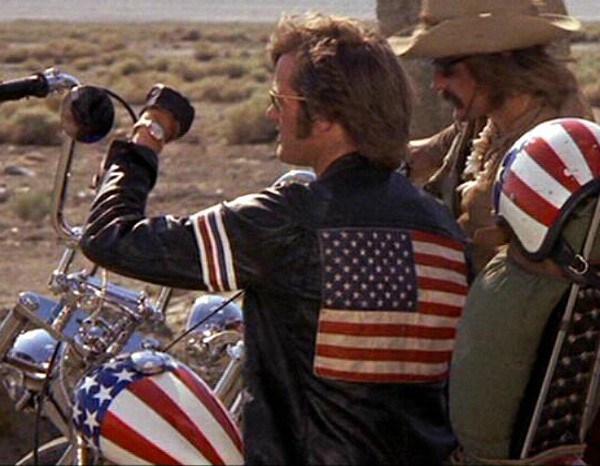
Peter FondaThe Captain America of Easy Rider should not be mistaken for the super soldier played by Chris Evans.  Instead, this Captain America is actually Wyatt Williams, a motorcycle rider who is planning on going to Mardi Gras with his friend Billy (Dennis Hopper, who also directed).  Wyatt is nicknamed Captain America because he wears a leather jacket with an American flag on the back.  It is an appropriate nickname because Wyatt represents everything that is good about America.

When we first meet Captain America, he and Billy are engaged in a business transaction, bringing to mind the old saying that the business of America is business.  They are selling cocaine to none other than Phil Spector.  Taking Spector’s money, Wyatt stuffs it into a plastic tube that he keeps hidden in his motorcycle’s fuel tank.  It is no coincidence that the fuel tank is decorated with the stars and bars.
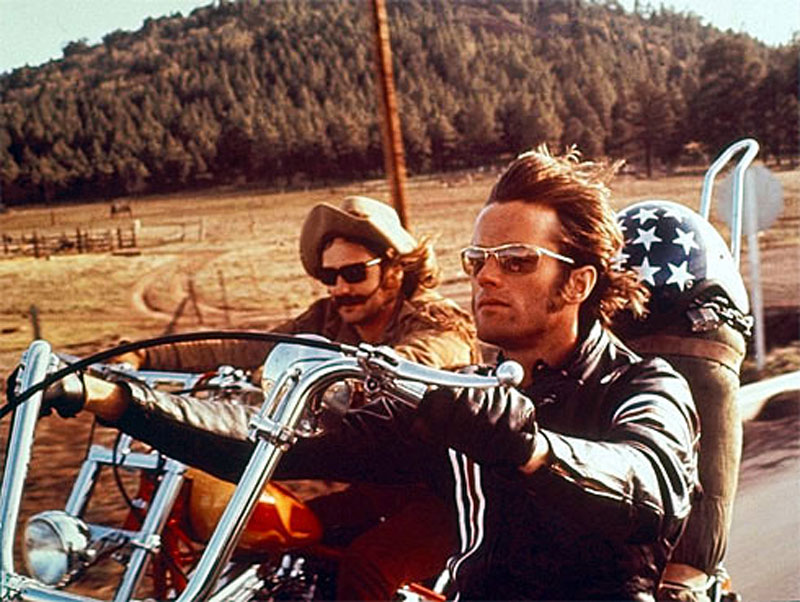
Peter-Fonda-and-Dennis-Hopper-in-Easy-RiderHaving made their money, Wyatt and Billy ride across the country to celebrate.  At the start of their journey, Wyatt takes off his watch and leaves it on the ground, declaring that time has no meaning to a man who has freedom.  If you replaced their motorcycles with horses, there would be little to distinguish Wyatt and Billy from the American outlaws who might show up in an old Henry Fonda western.

On their way to New Orleans, Wyatt and Billy interact with many different people.  If the always paranoid and nervous Billy represents America’s worst impulses, Wyatt represents the best.  When Wyatt and Billy eat dinner with a rancher and his family, Wyatt alone appreciates what the rancher has accomplished and says, “You’ve got a nice place. It’s not every man that can live off the land, you know. You do your own thing in your own time. You should be proud.”  When they later stop off at a ramshackle hippie commune, Wyatt is the one who says, in the best tradition of American optimism, that “They’ll make it.”
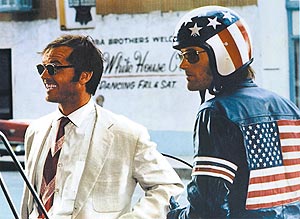
EasyRider2When they stop to pick up a hitchhiker and then later when alcoholic lawyer George Hanson (Jack Nicholson) joins them on their trip, it’s always Wyatt who volunteers to share his bike.  (Billy always rides alone.)  Whenever they stop for the night, it is always the generous Wyatt who offers to share his grass with whomever is traveling with them.  When George smokes for the first time, Wyatt is the one who teaches him.  It is the stoned George who tells Wyatt and Billy that they represent freedom.

It is only after George is beaten to death by a group of rednecks that Wyatt loses his optimistic outlook and his generous spirit.  George’s death opens Wyatt’s eyes in much the same way that the turmoil of the 1960s did for the rest of America.  After George’s murder, Wyatt loses his faith in himself.  When he and Billy reach New Orleans, Mardi Gras is a letdown.  When he takes the acid that was given to him by the hitchhiker, Captain America’s journey becomes a bad trip both figuratively and literally.
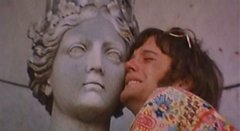
0603-peter-fonda-and-easy-riderjpg-b0f5351afb0a53df_mediumWhile Billy insists that they had a great time in New Orleans (in much the same way that some insist that America is just as strong a nation as it has ever been), Wyatt knows the truth.  “We blew it,” Wyatt says, speaking for the entire nation.

Despite his mistakes and despite having blown it, Wyatt, much like America itself, remains good at heart.  When Captain America dies at the end of the film, it is because he is trying to protect his friend Billy.  In the best American tradition, he sacrifices himself to protect another.

This Independence Day, let us all take a few moment to appreciate Wyatt Williams, the man known as Captain America.
Wyatt Williams (aka Captain America) RIP

Wyatt Williams (aka Captain America) RIP
 

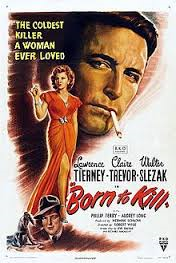
Beyond Redemption: 1947’s BORN TO KILL


gary loggins's avatarcracked rear viewer

born to kill

The darker side of man (and woman) is on full display in 1947’s BORN TO KILL. Sex, violence, greed, blackmail, lust, and murder abound in this mean little film. It’s loaded with crackling hard boiled dialogue (example: “You’re the coldest iceberg of a woman I ever saw, with the rottenest insides”) by screenwriters Eve Green and Richard Macauley. BORN TO KILL shows the RKO film noir style at it’s moodiest peak. It’s hard to believe the director is the same man who helmed the sticky sweet Oscar winning THE SOUND OF MUSIC!

Robert Wise got his start in RKO’s sound editing room, graduating to film editor in 1939. He was nominated for Best Editing for Orson Welles’ classic CITIZEN KANE and was soon promoted to the director’s chair, working with producer Val Lewton on psychological horror gems like CURSE OF THE CAT PEOPLE and THE BODY SNATCHER (with the great terror tandem of Karloff and Lugosi). His resume…

View original post 1,046 more words

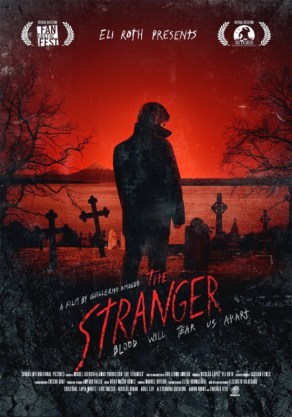
Film Review: The Stranger (dir by Guillermo Amoedo)


the-stranger-posterMeh.

Who cares?

That was my main reaction to watching The Stranger, a film from Chile that, for some reason, is set in Canada.  (There’s absolutely nothing about the film that brings to mind Canada.  The film was obviously shot in South America and almost all of the actors are Chilean.  And, just in case you forget, they’ve all been badly dubbed.)  The Stranger is full of atmosphere and it does attempt to do something new with the vampire genre so I guess we should give it some credit for that…

No, sorry.

Can’t do it.

Listen, I love horror movies.  I think that some of the most interesting films being made today are coming out of the South American film scene.  And, in the past, I’ve even defended Eli Roth, who is credited as being one of the producers on this film.  But I’m sorry — The Stranger is an incredibly boring and unpleasant film.

And yes, I fully realize that the best horror films are meant to be nightmarish and, as a result, somewhat unpleasant to watch.  However, there’s a difference between the stylized violence of a good giallo and the relentless sadism of The Stranger.  There’s no real point or style to the overbearing violence and gore in The Stranger and, as a result, it gets pretty boring after just a few minutes.

Of course, another huge difference between good horror and The Stranger is that The Stranger takes itself way too seriously.  Again to return to the Italian horror comparison, the best giallo films always featured quirky characters, clever dialogue, and plot twists that took us by surprise.  They were exercises in pure style that celebrated cinematic excess.  The Stranger is so somber and grim and serious that it all becomes a bit tedious to deal with.

Also, an innocent black cat is brutally murdered about 30 minutes into a film.  Then, towards the end of the film a dog is similarly attacked and left to die in the desert.  And you really don’t get the feeling that there was any reason for these scenes, beyond the fact that the director needed to keep up with his onscreen death quota..  If you’re going to portray an innocent animal being killed by your hero, at least make sure it’s absolutely necessary to the plot.  Otherwise, it just comes across as pointless sadism.

Anyway, the movie itself is about a stranger (Christobal Tapia Montt), who shows up in what we’re told in a small Canadian town.  He’s looking for his runaway wife, who he discovers has subsequently died.  The man has secrets of his own, of course.  He hates the sunlight.  He apparently cannot be killed by ordinary methods.  His blood can heal others but it also tends to transform them into being blood-thirsty monsters.  Yes, the man is obviously a vampire but the film never comes out and admits that.

There’s all sorts of small town intrigue going on but I’m not going to talk about it because it was tedious enough just trying to watch it.  Ultimately, the whole film is basically just a collection of scenes of people threatening the stranger, the stranger looking somber, and then people threatening each other.  None of the actors are particularly memorable and very few of them speak in their own voices.  One gets the feeling that the Chilean cast could not sound properly Canadian and so a bunch of American actors were hired to overdub everyone’s dialogue.  (I say American because I heard many regional American accents but not a single Canadian one.  All of this again makes you wonder why this film was set in Canada as opposed to some place like maybe Chile.)  The dubbing is atrocious, with the voices rarely matching either the facial expressions or the body language of the original actors.

This movie is a total mess.  Sorry, Eli.  I still think that the Hostel films have a lot more to say about America’s place in the world than most people are willing to admit but ultimately, The Stranger is a disappointment.


Just plain Xilly: Nick Adams in MONSTER ZERO


I was never a big fan of kaiju eiga movies. I watched them as a 60s Monster Kid in good standing, but much preferred the Universal classics, Technicolor Hammer horrors, and AIP/Poe epics. Those badly dubbed, fake looking Toho flicks just weren’t my cup of gruel.

I was however a fan of Nick Adams. The actor had roles in major films of the late 50s (REBEL WITHOUT A CAUSE, PICNIC, NO TIME FOR SERGEANTS) and scored big as Johnny Yuma in TV’s THE REBEL (1959-1961). He was nominated for a Best Supporting Actor Oscar for 1963’s TWILIGHT OF HONOR. Yet a scant two years later, Adams found himself in Japan appearing in low budget nonsense like FRANKENSTEIN CONQUORS THE WORLD and MONSTER ZERO.

MONSTER ZERO begins with astronauts Glenn and Fuji landing on the newly discovered Planet X, just beyond Jupiter. A race known as the Xilians are being attacked by Monster Zero, their name for the fearsome Ghidrah. The Xilian Controller has a plan to import Godzilla and Rodan from Earth to combat  the three-headed beast. In exchange, the Xilians promise to give Earth a miracle drug that will “cure all diseases”!

Glenn and Fuji relay the message to Earth’s Supreme Counsel, who begin searching for the two monsters. Suddenly, three spaceships rise up from the lake which supposedly contains Godzilla. The Controller tells the Earthlings they’ve come in peace to help capture the monsters. They snatch up the creatures in their “nuclear bubbles” (or something) and invite Glenn, Fuji, and their boss to Planet X to observe.

Meanwhile, Fuji’s future brother-in-law, Terry, has invented a sonic disruptor devise. This draws the interest of some Xilian spies hiding on Earth, including Glenn’s girlfriend, Namikawa. The aliens capture Terry and hold him in their secret hideout.

Godzilla and Rodan are set on Ghidrah, and a mighty battle ensues. Well, as mighty as these things get. Ghidrah is sent packing, and the Xilians give our heroes a tape containing the formula for the wonder drug. When the Earthmen return, it’s discovered the tape is actually the voice of The Controller stating Earth must immediately surrender and become a Xilian colony or they’ll wipe us out. Those dirty rats!!

The monsters are brought back to Earth under the control of Xilian magnectic waves (or something) and begin doing their rampaging destruction thing, which consists of crushing a bunch of miniature sets. Glenn and Terry manage to escape the aliens clutches, and the Army uses his sonic distrupter to combat the fiends. The world’s citizens are told to crank up their radios, and the piercing noise causes the Xilians computers to malfunction. The alien spaceships blow up in mid-air! The three behemoths are freed from Xilian control, and Godzilla and Rodan vanquish Ghidrah, bringing peace back to our planet.

MONSTER ZERO is pretty bad as far as these things go. I know there are plenty of kaiju eiga who will vehemently disagree, but to me the movie’s just plain Xilly. Toho Studios had success with this one though, and continued to crank out more rubber suited epics well into the 80s.

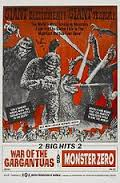
As for Nick Adams, his life and career continued on a downward spiral. An ugly divorce, with rumors of infidelity and domestic violence, ruined is reputation. Adams found work only in TV guest shots and Grade-Z dreck like MISSION MARS and FEVER HEAT. Adams died of a drug overdose in 1968 at the age of 36. MONSTER ZERO wasn’t released in the US until 1970, as a double feature with WAR OF THE GARGANTUAS, featuring another American ex-pat, Russ Tamblyn. A sad ending for a once promising actormonster zero

What Lisa Watched Last Night #125: Perfect High (dir by Vanessa Parise)


Last night, I watched the first post-Deadly Adoption Lifetime movie, Perfect High!

Why Was I Watching It?

Because it was on Lifetime and it was about a dancer, of course!

What Was It About?

Amanda (Bella Thorne) is a suburban teen who loves to dance.  But, after an injury, she gets hooked on prescription pills.  She also becomes best friends with druggie Riley (Daniela Bobadilla), Riley’s boyfriend Nate (Ross Butler), and Carson (Israel Broussard).  Soon, Carson and Amanda are dating and they become perhaps the most boring couple in history.  Of course, since this is Lifetime, the prescription drug abuse quickly leads to heroin, death, and a minute-long rehab scene.

What Worked?

The film did a good job of capturing both the excitement of dancing and the sheer terror of being injured and knowing that, as a result, you can’t do what you love.

What Did Not Work?

The whole movie was just so predictable and so slow.  Don’t get me wrong.  I understand that a Lifetime film about teenagers using drugs isn’t going to exactly be unpredictable.  From the start of the film, I knew that one of the four friends was going to have to die and I easily guessed which one it was going to be.  That’s just the way it works, somebody always has to die in these films.

But the problem is that we are now living in a post-Deadly Adoption age.  After seeing every single Lifetime convention skewered last week, it’s hard to go back to taking any of those conventions seriously.  The whole time I was watching the film, I kept expecting Will Ferrell to suddenly show and start bellowing, “SHE NEEDS HER MEDICINE!”

As well, Perfect High moved way too slowly for its own good.  As characters, Amanda, Riley, Nate, and Carson all fell flat.  Even before they ended up as drug addicts, they seemed like they wouldn’t be that interesting of a group to hang out with.  Before doing drugs, they spent all their time laying on the couch.  After doing drugs … well, that couch became even more comfortable.  For an anti-drug film to really work, you have to mourn what the character could have been if not for their addictions.  But, in Perfect High, everyone seemed to be just as dull regardless of whether they were high or not.

“Oh my God!  Just like me!”  Moments

The movie was about a red-haired dancer who popped too many pills in high school.  Oh my God, just like me!

Lessons Learned

Stay away from that heroin, kids.  Of course, I already knew that.  Even when I was going through my phase where I wanted to experiment with and try everything, I still knew better than to ever use heroin.  (Actually, to be honest, I should say that if I had ever had the opportunity to try heroin, I would have politely declined.  Fortunately, I never even had to deal with being offered heroin, which I guess is the benefit of going to both a high school and a college where everyone was too busy smoking weed to worry about harder drugs.)  Whenever I see a movie like Perfect High, I always wonder how the characters involved have never seen any other movies about heroin abuse.

I mean, don’t they watch Lifetime!?

ph

All Hail Slade Craven! A Look At Turbulence 3: Heavy Metal


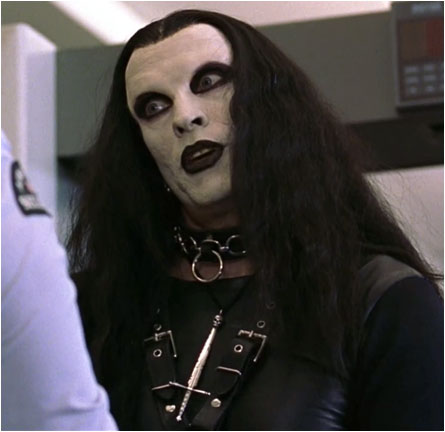
Slade Craven, the hero of Turbulence 3

Slade Craven, the hero of Turbulence 3

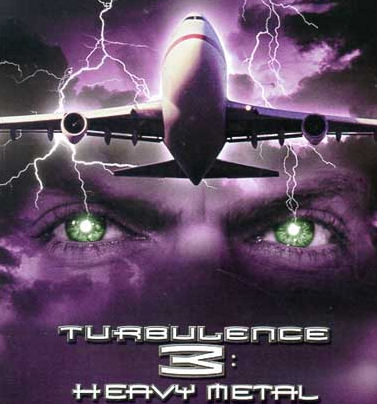
The first Turbulence was a 1997 box office flop that starred Lauren Holly as a flight attendant who must defeat Ray Liotta and land an airplane.  Turbulence 2 was a 1999 direct-to-video release that starred Craig Sheffer as an engineer who must defeat a terrorist and land an airplane.  2001’s Turbulence 3 reuses the special effects footage from the first Turbulence and features Craig Sheffer in a different role but otherwise, it is a completely unrelated to the first two films.  This time, John Mann plays a rock star who must defeat a terrorist and land an airplane.

Slade Craven is a death rocker who, with his white makeup and his long black hair, is an obvious stand-in for Marilyn Manson.  Like Marilyn in his prime, Slade Craven is a controversial artist whose music is critical of religion.  Unlike Marilyn Manson (whose video for Sweet Things Are Made Of This still has the power to shock), the one Slade Craven music video that we see mostly features Slade stumbling around a high school basement and petting a dog.  Marilyn Manson sang about the beautiful people.  Slade Craven’s biggest hit is Love Gun.

Slade Craven has announced his retirement.  His final concert, complete with pyrotechnics and a working electric chair, will be held on an airplane, while the plane is flying from California to Canada.  Only 40 of his most devoted fans will be allowed on the plane but “10 million people” will be watching via the miracle of the Internet.  (Everything about the internet was still exotic in 2001.)

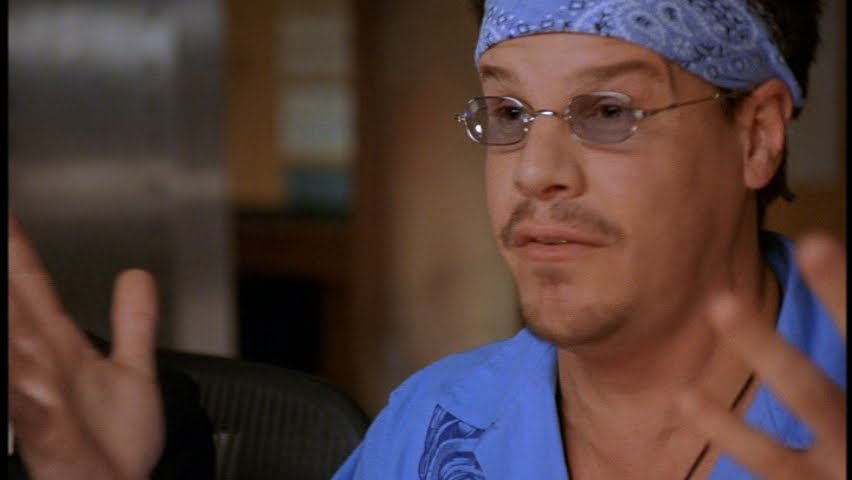
This is what a hacker looked like in 2001.

This is what a hacker looked like in 2001.

On the ground, hacker Nick Watts (Craig Sheffer) is illegally watching the concert when FBI agent Kate Hayden (Gabriella Anwar) shows up to arrest him.  However, before Kate can put on the handcuffs, they notice that something strange is happening on the plane.  Someone has just murdered the band’s manager and has locked Slade in the first class restroom.  A man disguised to look like Slade shoots a co-pilot and announces that he’s going to crash the plane into a cursed cemetery in an area of East Kansas that is so unholy that “even the pope refuses to fly over it.”  The crash will not only be seen by the 10 million people watching on the internet but it will also unleash Satan into the world.

With the help of Nick and Kate, Slade frees himself from his restraints and becomes a hilariously unlikely action hero.  Not only does Slade have to defeat his doppelgänger and the other Satanists on the plane but, after the remaining pilot (Rutger Hauer!) is revealed to be a part of the conspiracy, Slade has to land the plane on his own.  Luckily, Nick has an old NES flight simulator that he can use to help talk Slade down.  “We’re all going to rock and roll!” Slade tells the passengers as he pulls on the throttle.  Meanwhile, on the ground, Kate rewards Nick by handcuffing him and then walking towards the bedroom while unbuttoning her blouse.  Nick hops after her.

Also, on the ground, Joe Mantegna plays an FBI agent.  All of the scenes with Mantegna take place in two locations, suggesting that Mantegna filmed all of his scenes in a day or two.  Turbulence 3 proves that it is impossible to hear Mantegna’s voice without picturing Fat Tony.

Of all the films about heavy metal singers fighting terrorists and landing airplanes, Turbulence 3 might be the best.  All credit belongs to John Mann’s Slade Craven who rocks every day, parties every night, and beats up terrorists all of the time.  Slade Craven proves the nobody saved the world like a shock rocker.  Sadly, there has never been a Turbulence 4.  I would love to see the further adventures of Slade Craven.

turbulence-3-poster

Ted 2 Sucks!


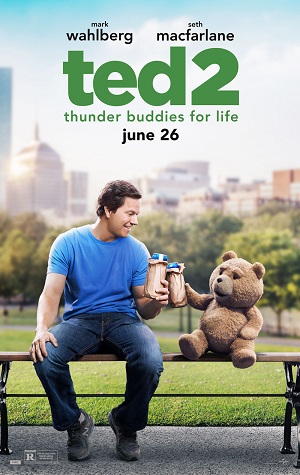
Ted_2_posterWell, I think the title of this review pretty succinctly sums up my reaction to Seth McFarlane’s latest film, Ted 2.  Thanks for reading and have a good…

Oh, really?

Okay, I’ve been told that I have to try to think up at least 300 words to say about Ted 2.  Otherwise, in the eyes of Rotten Tomatoes, we’re not a legitimate film blog.

*sigh*

Okay.

Anyway, Ted 2 is the story of a talking teddy bear (voice by Seth McFarlane) who likes to smoke weed and … well, that’s about it.  He’s just gotten married to Tami-Lynn (Jessica Barth) and they’re having trouble because Tami-Lynn wants a baby but Ted, being a teddy bear, doesn’t have any reproductive organs.  So, he and his friend John (Mark Wahlberg) decide to give Tom Brady a handjob so they can still his sperm.  But, it turns out, none of that was important because the state of Massachusetts claims that Ted is not even a person.  Instead, he’s just “property.”  So, now, John and Ted and their lawyer, Sam (Amanda Seyfried), are fighting the courts to win Ted his civil rights.  And then Giovanni Ribisi wants to kidnap Ted and Morgan Freeman shows up and says a few words.  And the film is narrated by Patrick Stewart because it’s funny to hear Patrick Stewart curse and…

Oh!  And Liam Neeson shows up.  He’s a customer at the store where Ted works as a cashier.  Liam wants to know if Trix are only for kids.  The joke here is that it’s Liam Neeson and he’s asking about cereal.  Ha ha.

Oh!  And there’s two guys who shows up at New York Comic Con so that they can beat up “nerds.”  During every scene set at Comic Con, they’re in the background beating people up and insulting them.  And the two guys are gay!  See, they’re bullies and they’re gay!  And they’re beating up random people at Comic Con, just because they can!  Hilarious, right?

Ted 2 spends a lot of time trying to convince us that Ted’s struggle to be recognized as a person is actually meant to be a metaphor for the American civil rights movement.  But, honestly, I get the feeling that McFarlane relates more to the bullies than he does to any oppressed minority.  As he previously proved with his TV shows and A Million Ways To Die In The West, McFarlane is only interested in going after easy targets.  He’s your typical white male hipster who thinks that, because he voted for Obama, he can get away with telling racist jokes.

And, before anyone misunderstands, I wouldn’t mind McFarlane’s humor if it was at least funny or original.  But instead, it’s the same stupid jokes that he always tells.  Seth McFarlane’s comedic technique is to basically drag things out until viewers laugh from pure exhaustion.  Is it effective?  Well, there are people who continue to praise and defend him and Seth certainly has made a lot of money off of his act.  So, obviously, there are people who respond to this.  But to me, Seth McFarlane’s humor just feels lazy.

Ted 2 lasts 128 minutes.  That’s over two hours devoted to a concept that feels more appropriate for a five-minute skit.  Interesting enough, the first Ted was tolerable because it focused on Mark Wahlberg’s Johnny.  Ted was just a supporting character and he worked as a metaphor for Johnny’s struggle to choose between growing up or being a happy slacker.  (The first Ted was all about Johnny falling in love with Mila Kunis, whose character is rather cruelly dismissed at the start of Ted 2.)  In Ted 2, Ted is the central character and once you get over the fact that he’s a teddy bear who drops multiple F bombs, there’s really not much to the character.  It helps, of course, that we only have to listen to McFarlane.  We don’t have to look at his imminently punchable, oddly lineless face.  But, to be honest, even McFarlane’s voice has become grating.  It’s just so self-satisfied and smug.

I saw Ted 2 with the blogger also known as Jedadiah Leland.  Over the course of 128 hours minutes (it just felt like hours), we each laughed once.  Not surprisingly, both laughs were inspired by Wahlberg’s dumb-but-sweet performance.  Now, I will admit that the rest of the audience laughed a bit more than we did.  But still, there was a definite atmosphere of resignation in the theater.  You could literally hear the people thinking, “Oh, Ted just made a joke about black people.  Better laugh now so everyone knows that I get whatever the Hell this is supposed to be.  After all, those tickets weren’t free…”

What’s the word count now?

758?

Cool.

That’s enough words for me to say, “Ted 2 sucks!”


Revisiting an Old Fiend: THE FACE BEHIND THE MASK


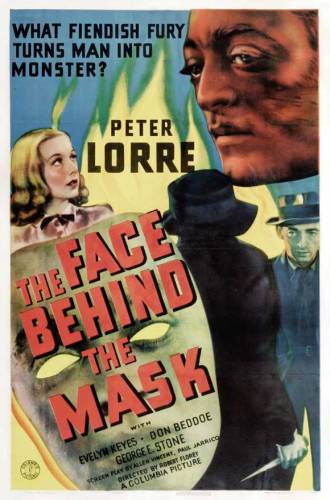
the-face-behind-the-mask-1941-dvd-peter-lorre-evelyn-keyes-1189-p

Recently I switched from cable to DirecTV. As part of my package, I’ve officially joined the DVR generation. This is like being in heaven for an old movie buff like myself. Now I can record films of interest no matter what time they’re on and enjoy them at my leisure. Especially those older black & white gems that air mainly in the wee-wee hours. I can catch up with some classics I’ve only read about over the years but never had the opportunity to view, and those I only have vague memories of watching decades ago on snowy looking UHF channels.

THE FACE BEHIND THE MASK falls into the latter category. This 1941 Columbia film was directed by the criminally underrated Frenchman Robert Florey and stars everybody’s favorite madman Peter Lorre. The movie’s a very early example of 40s film noir, as was another Lorre vehicle, 1940’s  STRANGER ON THE THIRD FLOOR.

Lorre plays Janos Szabo, a newly arrived Hungarian immigrant watchmaker, come to America to find work and live the American dream. He’s befriended by police Lt. O’Hara (Don Beddoe), who buys the naïve newcomer a five dollar lunch and directs him to the Excelsior Palace, a low rent hotel. When another border’s negligence causes the joint to go up in flames, Janos is trapped inside, and suffers a horrible disfigurement.

O’Hara feels responsible for the poor guy’s plight and writes a message on one of his calling cards for Janos to contact him when he’s released from the hospital. Now unable to find work due to his terribly scarred visage, Janos goes to the waterfront, contemplating suicide. He meets up with a petty crook named Dinky, who takes a liking to Janos. Dinky has a safe job lined up but falls ill, and asks Janos to take his place. The Hungarian, good with his hands, takes care of business, When Dinky’s former comrades Benson and Watts show up wanting to know why they weren’t in on the score, the four decide to form a crime gang, with Janos (now nicknamed Johnny) as the ringleader. A crime wave ensues, baffling the police, and putting O’Hara under pressure to end the larcenous spree quickly as possible.

Janos wants the illicit dough so he can have plastic surgery and restore his features. A rubber mask is made from his passport photo for him to wear until the doctor returns. When the doc (an uncredited cameo by Frank Reicher, KING KONG’s Captain Englehorn)  finally does see Janos, he informs him that the facial nerves have suffered too much damage, and it would take fifteen years before any progress could be made!

Disheartened, Janos leaves the doctor’s office, where he (literally) bumps into Helen Williams. Helen is blind, but she can sense the goodness still inside the scarred master criminal. Eventually, Janos comes clean to her about his face, but not his illegal activities. Helen is played by the beautiful Evelyn Keyes, best known as Scarlet O’Hara’s Younger Sister (the name of her autobiography) in GONE WITH THE WIND.

Now in love with Helen, and with plenty of money stashed away, Janos decides to leave his life of crime behind and settle down in the country. This doesn’t sit well with his former cronies, especially Jeff, the gang’s new leader. When the cop’s calling card (remember?) is found in Janos’s old desk, they fear their former boss has turned stool pigeon. The gang beats and tortures Dinky, the only one who knows Janos’s whereabouts. Dinky spills the beans, and Jeff and company pay a visit to Janos and his new bride. While Jeff delivers a warning, the gang plants a bomb in his car, connected to the radio. Dinky gets dumped to the side of the road, badly beaten and shot, but manages to get to a phone and warn Janos. But it’s too late. While Helen’s unpacking the car, she wants to hear some music, turns on the radio, and KA-BOOM! She sadly dies in Janos’s arms.

Dinky’s still alive though, and tells Janos the gang has chartered a plane and are going on the lam. They take to the air and head west, unaware that Janos has ambushed the pilot and is flying the plane. He lands them smack in the middle of the Arizona desert and tells them he’s stranding them all there to die a slow, painful death. Soon after, O’Hara gets a hot tip (pun intended!)and flies west to discover a gruesome tableau. The gang members are all dead, including Janos, who’s been tied to the plane’s wing. O’Hara finds an explanation note in his little friend’s pocket, along with the five bucks for the lunch O’Hara bought him long ago.

Lorre is superb as a man trapped in circumstances beyond his control, showing a wider range of emotion beyond his standard pop-eyed psychopath roles. Keyes is also good as the doomed Helen, proving she could’ve been a much bigger star with better roles. FACE BEHIND THE MASK features plenty of familiar faces from the Mighty Columbia Arts Players brigade (Beddoe, George E Stone, Cy Schindell, John Tyrell, George McKay). The film’s a brisk 75 minutes of entertainment for lovers of 40s cinema in general, and Lorre in particular. The name Janos, by the way, was obviously inspired from the Roman god Janus, always depicted with two faces!

I’m glad I got to rewatch this movie and enjoy it without all that UHF snow.. I’ve got plenty more lined up in the DVR, and look forward to sharing my impressions of them with you, dear reader. So get that popcorn ready and let’s go to the show!

What if Peter Cushing Had Played The Doctor: A Look at Dr. Who And The Daleks


MV5BMjA5MDE3MDI5MV5BMl5BanBnXkFtZTcwNjU3NTgxMQ@@._V1_SY317_CR5,0,214,317_AL_When the long-running British science fiction show Doctor Who premiered over 50 years ago, it was originally envisioned as being a serialized educational program for children.  Each serial would see The Doctor (William Hartnell), his granddaughter Susan (Carole Ann Ford), and teachers Ian (William Russell) and Barbara (Jacqueline Hill) traveling via TARDIS to a different historical period and interacting with real-life figure like Marco Polo and the Emperor Nero.  The first serial, An Unearthly Child, featured the Doctor and his companions going back to prehistoric times and teaching cavemen how to make fire.

However, the show’s second serial forever changed the direction of the series.  Written by Terry Nation, The Daleks introduced viewers to a race of militaristic aliens who, because they had nearly destroyed their planet in a nuclear war, could only exist inside of a tank-like shell.  Devoid of all emotion except for hate, the Daleks were best known for their shrill battle cry of “EXTERMINATE!”  Despite being defeated and apparently destroyed at the end of the serial, The Daleks returned to face the Doctor many times and the show itself shifted its focus away from teaching history lessons and instead became the show that we all know and love today.

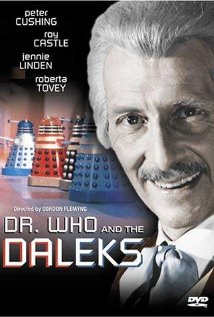
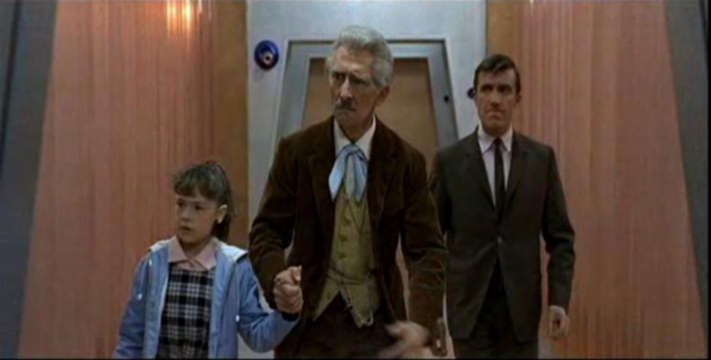
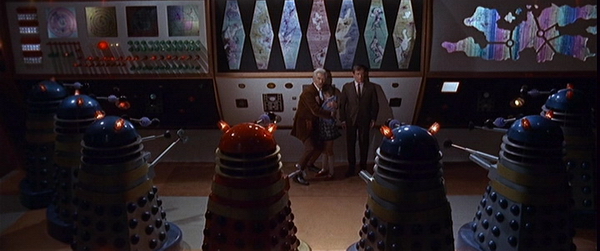
Dr-Who-and-the-Daleks-Poster-by-Tim-DoyleAt its height, the popularity of the Daleks rivaled that of the Doctor and his companions.  In 1965, when Amicus Productions produced the first Doctor Who feature film, it was a no-brainer that it would feature the Daleks.  With a few key changes (mostly to the character of the Doctor and his companions), Dr. Who and the Daleks recreates the plot of Terry Nation’s original serial.  The Doctor (played by Peter Cushing), his granddaughters, Barbara (Jennie Linden) and Susan (Robert Tovey), and Barbara’s boyfriend Ian (Roy Castle) go to the planet Skaro, where they help the peace-loving Thals battle the war-obsessed Daleks.

Beyond selling the rights to the story, the BBC had nothing to do with the film’s production.  Amicus obviously geared the film towards children, perhaps not understanding that, though Doctor Who may have started out as a kid’s show, the program itself had become much more adult as it grew in popularity.  Hoping to make a film that could appeal to a wider (read: American) audience than the original TV show, Amicus changed a few key details.  As a result,  for fans of the original show, Dr. Who and the Daleks is a true oddity.  It provides an alternative vision of what Doctor Who could have been.

One change that did work is that, at a time when Doctor Who was still being broadcast in black-and-white, Dr. Who and the Daleks was in color.  Visually, the film has a pop art feel, full of primary color and featuring locations that feel like low-budget version of the villainous lairs that Ken Adam used to design for the James Bond films.  This was the first time that the Daleks had been seen in Technicolor and the show even appropriated the film’s Dalek color-scheme when color episodes started to air in 1970.

Dr-Who-The-Daleks-2

Other changes do not work quite as well.  The Daleks’ famous “EXTERMINATE” battle cry is never heard.  The show’s beloved theme music has been replaced with an uninspired score from veteran Amicus composer Malcolm Lockyer.  While the TARDIS still looks like a blue police box and is bigger on the inside than the outside, the sleek control console and the familiar grinding noise are both gone.  Instead, the inside of the TARDIS is a cluttered mess of loose wires and flashing lights.  The Doctor now has two granddaughters and, undoubtedly in order to appeal to children, Susan is much younger than she was in the television series.  As well, in the television series, Ian was a science teacher who had no fear of standing up to The Doctor.  The film’s Ian is clumsy and used mostly for broad comic relief.

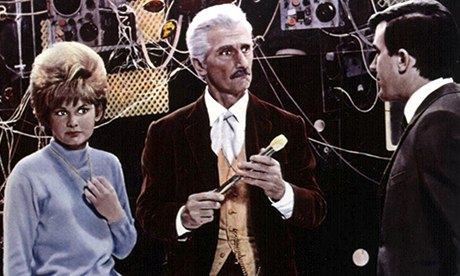
Dr. Who & the Daleks films tillThe biggest change is to the character of the Doctor himself.  For fans of the series, there is no bigger pet peeve than when unfamiliar critics refer to the main character as being “Dr. Who.”  True fans know that the show’s title is a question and not a statement.  No one knows the Doctor’s true name or his exact age.  What they do know is that Doctor is a Time Lord from Gallifrey and that he stole his TARDIS.  Whenever the Doctor’s body suffers too much damage, he regenerates into a new body (and a different actor).

Of course, in 1965, the Time Lords had yet to be officially introduced.  The name “Gallifrey” had never been uttered on the television show.  The Time Meddler, which was the first serial to introduce another member of the Doctor’s race, only aired a month before the release of Dr. Who and the Daleks.  On the TV series, William Hartnell was still playing the First Doctor and it would be another two years before the character would regenerate for the first time.  When Dr. Who and the Daleks was released, all that was known of the Doctor was that he was an alien and no one knew his true name.

Even those two facts are ignored in Dr. Who and the Daleks.  Instead of being the abrasive alien that Hartnell played on the show, the film’s Doctor is portrayed as being a brilliant but absent-minded inventor who is very much a human being.  The film also establishes early that his last name really is Who, with Ian regularly addressing him as “Dr. Who.”  We never learn his first name.  Maybe it was Larry.

Dr-Who-and-the-Daleks-Dr-Who-4Dr. Who was played by Peter Cushing, who Amicus felt would be a bigger box office draw than William Hartnell.  Cushing does a good job playing his version of the character and it’s interesting to compare his kindly performance to both his better known work for Hammer and George Lucas and William Hartnell’s ruthless interpretation of the character.  Cushing regularly goes back to save the life of Castle’s cowardly Ian.  Hartnell would have just let him die.

Though the film bombed in North America (where, at the time, Doctor Who was still unknown) it did will enough in the UK to lead to a sequel, Daleks — Invasion Earth: 2150 A.D.  When the sequel failed at the box office, plans for future movies starring Peter Cushing as the Doctor were abandoned.  That was probably for the best.  If the Amicus films had been a success, they could have changed the direction of Doctor Who just as surely as Terry Nation did when he first introduced the Daleks.  Doctor Who could have reverted to being a show for children instead of becoming the show that it is today.

Still, it is hard not to wish that Peter Cushing could have gotten to play the Doctor in a “real” Doctor Who film.  After all, Christopher Lee would have made a great Master.

Dr Who and the Daleks (13)

Yes, A Deadly Adoption Was A Comedy…


deadly-adoption

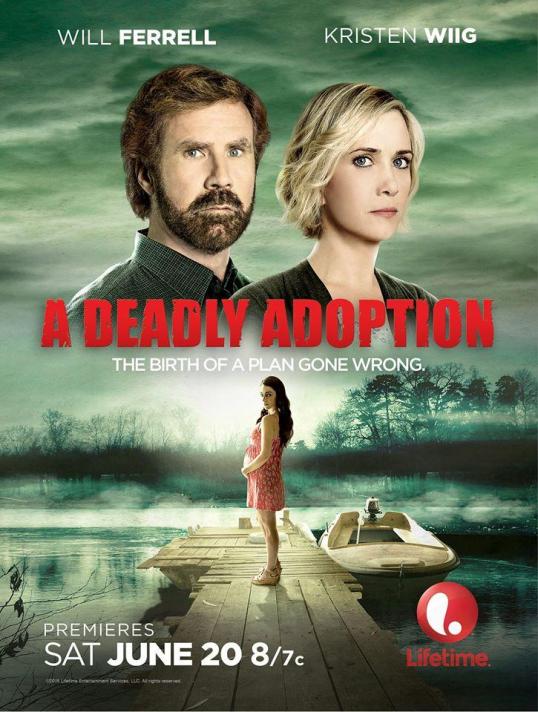
Last night, an article appeared on Mashable in which I was declared to be one of the  “20 people who totally get the ridiculousness of Will Ferrell and Kristen Wiig’s ‘A Deadly Adoption.”  At the time, I was incredibly flattered but also somewhat incredulous.  If I was one of the 20 people who understood that the latest Lifetime film, A Deadly Adoption, was meant to be a drier than dry comedy then that meant that there were presumably people out there who did not get the joke.

And how could that be!? I wondered.

In case you missed it, on April 1st, a story was leaked that Will Ferrell and Kristen Wiig were secretly making a film for Lifetime.  The title of that film was A Deadly Adoption and early reports indicated that it was going to be a serious Lifetime film.  Because the story came out on April Fools Day, a lot of us assumed it was a joke.

However, then Will Ferrell announced that no, it was not a joke.  But now that news of the film had been leaked, he was prepared to close down production and make sure that the film never saw the light of day.  Now, whether Will was being serious in his anger or not is debatable.  (It’s easier to imagine Ron Burgundy having that reaction than Will Ferrell.)  But, regardless, cooler heads prevailed and soon, Lifetime viewers like me were enjoying commercials that featured Jessica Lowndes pointing a gun at a very grim and bearded Will Ferrell.

deadly-adoption-trailer

As the premiere approached, critics and viewers alike wondered if A Deadly Adoption was meant to be a serious film or if it was going to be a comedy.  Those who felt that the film was meant to be serious pointed out that the commercials for the film contained absolutely no hint that it might be a comedy.  Those who thought it was a comedy simply said, “Will Ferrell and Kristen Wiig.”

As for me, I pretty much knew what A Deadly Adoption was going to be from the minute that I discover it was being produced by the same people behind Spoils of Babylon.  And, when I watched the film last night, my suspicions were confirmed.  A Deadly Adoption is a drier-than-dry satire, a film that mashes together every single Lifetime movie trope in order to create the ultimate Lifetime experience.  A Deadly Adoption gets its laughs by refusing to openly acknowledge that it’s gone totally over-the-top.  Will Ferrell and Kristen Wiig both give extremely serious performances, with the humor coming from the fact that they are, with extremely straight faces, delivering dialogue and dealing with situations that are both ludicrous and yet very familiar to anyone who has ever spent a weekend binging on Lifetime.  The end result is that A Deadly Adoption both satirizes and pays tribute to everything that we love about a good Lifetime film.

(Does that make A Deadly Adoption the Sharknado of Lifetime movies?  Technically, yes.  But let’s not say that too loudly because Mia Farrow might hear and decide to live tweet the next showing.)

As for the film itself, it tells the story of Robert (Will Ferrell) and his wife, Sarah (Kristen Wiig).  Robert is a financial author who is also a recovering alcoholic with anger management issues.  (Significantly, everyone always talks about how angry Robert is, despite the fact that we never actually see him lose his temper.)  We know that Robert is a writer because he skypes with his agent and tells her stuff like, “Let’s cut chapter four.”  Sarah, meanwhile, has a typical Lifetime movie career.  She sells organic food at the local farmer’s market.  And, like all Lifetime movie heroines, she has a token and obviously doomed gay best friend named Charlie (Bryan Safi).

Years ago, as the result of an accident on a dock, a pregnant Sarah nearly drowned and lost her baby.  As a result, Robert is incredibly protective of their other daughter, Sully (Aylvvia Alyn Lind). (As part of the A Deadly Adoption drinking game, take a drink every time Will Ferrell says, “She needs her medicine!”)  Robert is also now scared of going out on the water so you better believe that the film’s conclusion is going to involve Robert in a tiny boat.

Anyway, Robert and Sarah want to adopt the unborn child of Bridget (Jessica Lowndes) but what they don’t know is that Bridget has plans of her own.  Upon accepting their offer to live with them until she gives birth, Bridget starts to subtly disrupt the lives of Robert and Sarah.  That right, she’s obsessed!  And, of course, she’s got a redneck boyfriend (Jake Weary) who drives a pickup truck and has a lot of “dangerous” tattoos.  And…

Well, I could actually devote a few thousand words to telling you the plot of A Deadly Adoption.  A lot of stuff happens.  In fact, every single plot point from every single Lifetime film ever made gets used at some point.  Everything about this film — from the acting to the direction to the tasteful decor of Robert and Sarah’s house to the almost obsessive focus on Jessica Lowndes’s cleavage — is designed to make this film look like a typical Lifetime film.

The brilliance of it comes from the fact that Ferrell, Wiig, Lowndes, and Weary all deliver their increasingly ludicrous lines with such intense commitment and low-key seriousness.  (Kristen Wiig, in particular, is great.)  With the exception of one line about lighter fluid and a dance party at the end of the film, there’s nothing in A Deadly Adoption that plays for obvious laughs.  Instead, the film is a two-hour inside joke and, if you get the joke, you’re one of the cool kids.

Unfortunately, there are a lot of uncool kids out there and a lot of them did not get the joke.  If you check out the comments left on the film’s imdb page, you’ll discover that there’s still a lot of people out there who are wondering whether this was meant to be a serious film or not.

*Sigh*

To quote Ron Burgundy, “GREAT ODIN’S RAZOR!”

(Did he say that?  Sounds like something he would say.)

Anyway, to answer those who still do not know — yes, A Deadly Adoption was a comedy.

And it was a brilliant one at that!

This is what I feel like doing when people say they don't know if A Deadly Adoption was supposed to be funny.

This is what I feel like doing whenever people say they don’t know if A Deadly Adoption was supposed to be funny.