Film Review: Super Christian (1980, dir. John Schmidt)


Super Christian played by John Schmidt

Super Christian played by John Schmidt

I’ll admit it, I saw the title and thought this had to be hilariously bad. I mean it’s called Super Christian for crying out loud. But you know what, it wasn’t bad. It’s goofy and it’s low budget, but for a Christian movie, it has it’s heart in the right place. It’s not like God’s Not Dead.

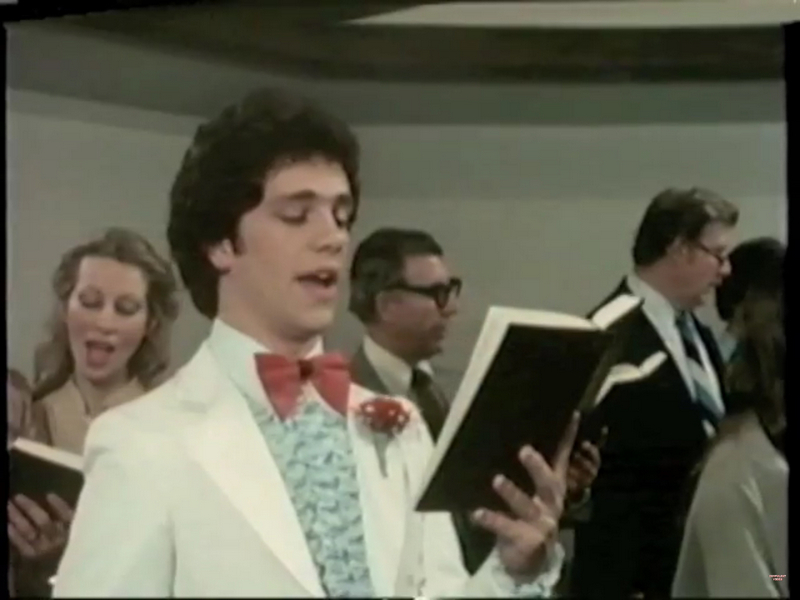
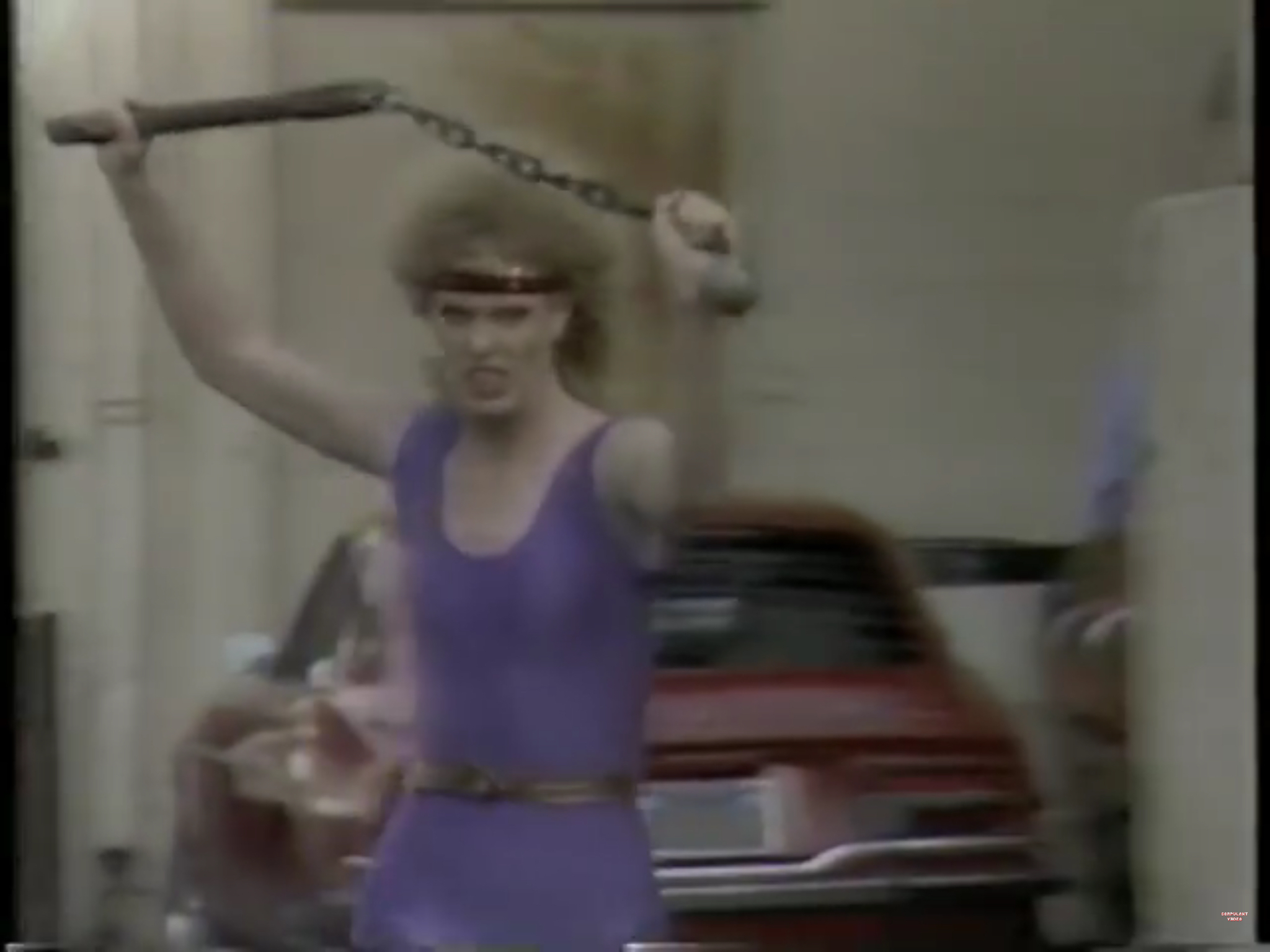
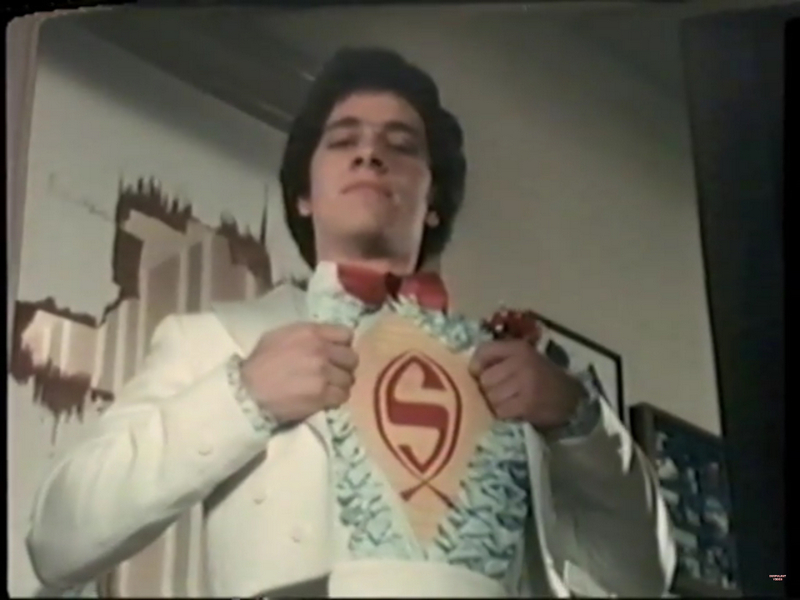
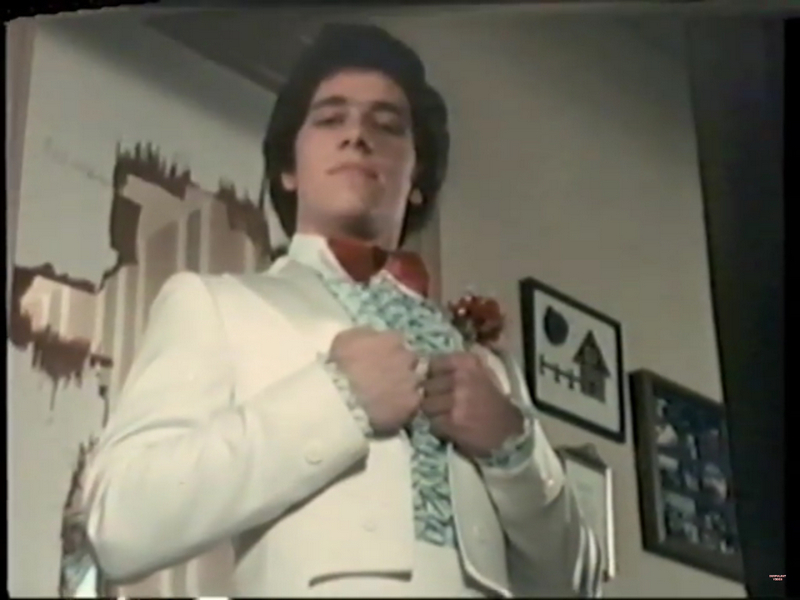
Here’s the gist. It’s about a guy who during the week is a bit of douchebag. Let’s not mince words, he’s a total jerk. However, on Sunday, this happens.

Super Christian

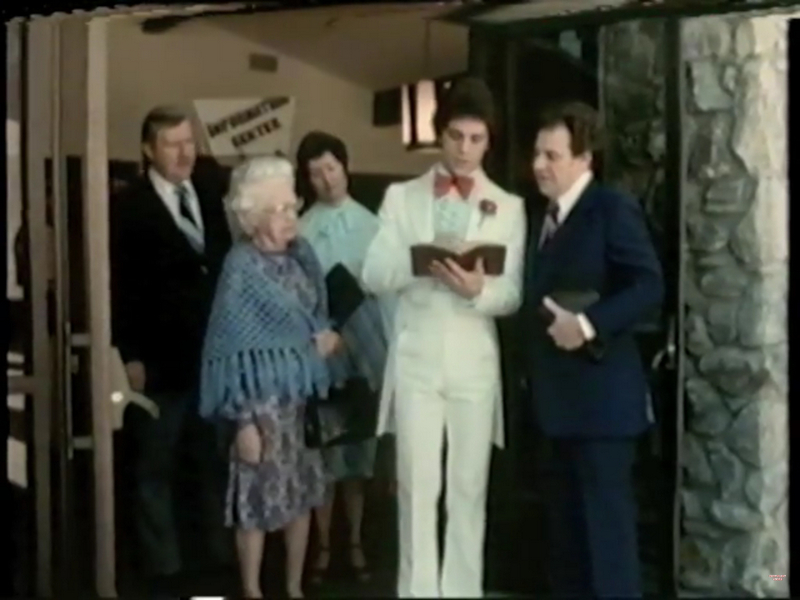
Super Christian

Super Christian

Super Christian

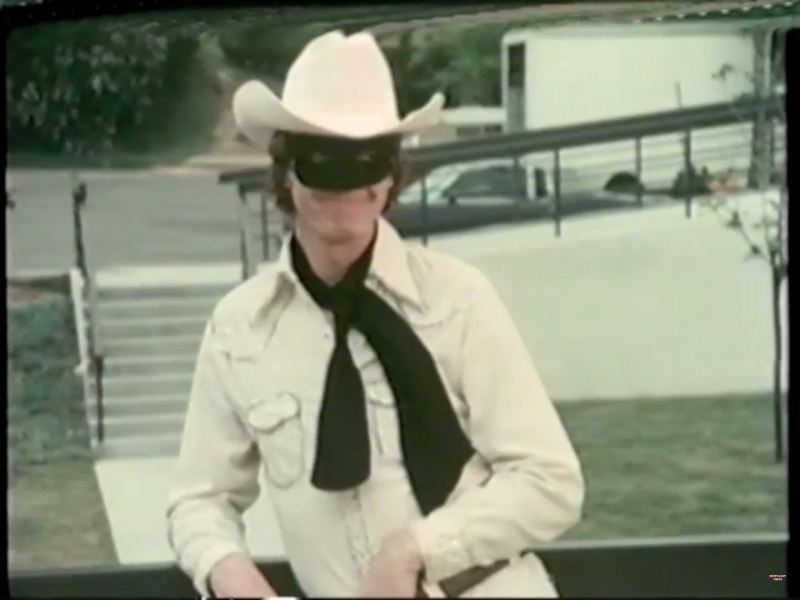
During this spectacle a man takes notice and pays Clark Kant a visit. Yes, that is his name in the movie. He sits him down and explains that he knows what he is doing. He once did it himself. Then, the grand reveal. He was once The Lone Christian!

The Lone Christian

The Lone Christian

He tells him that he used to show up on Sunday to be the ideal Christian, but wasn’t a good guy the rest of the time. Clark gives up the secret identity nonsense and decides to just be a decent person all the time. Of course he still attends church, but the message applies to anyone who only acts like a great person when it’s convenient. It’s only 27 minutes which is perfect for getting the short point across to the audience. I liked it.

Apparently, Schmidt still makes movies. I wonder if he’s stayed above films like God’s Not Dead. Now I just need to find Super Christian 2. Yes, there is a sequel.

Film Review: Battling Amazons (1987) (dir. Steve Antoniou)


Battling Amazons Title Screen

“Where’s Mercury? Mercury, it’s God. Listen, I need you to take a message to Odin and Zeus. And don’t forget Moses. Tell the boys to send their strongest, ablest, most beautiful women to Earth to punch it out. I wanna see some real knockouts. Tell ’em to call it: Battling Amazons. Do it!”

Thus begins one of dumbest and greatest things ever made. You might be asking yourself: Why Moses? Well, Delilah of course! We all know what she did to Victor Mature’s hair so she clearly can handle herself in the ring. So, the call goes out and numerous women are sent to battle.

Thesbian, The Viking Queen

Thesbian, The Viking Queen

Peelar, The Tiger Woman

Peelar, The Tiger Woman

Athena

Athena

Wanda, The Iron Mistress

Wanda, The Iron Mistress

Sandra, The Prophet

Sandra, The Prophet

Lazar, The Woman Of The Future

Lazar, The Woman Of The Future

Delilah

Delilah

Deidre, The Brazilian Bombshell

Deidra, The Brazilian Bombshell

We are then introduced to Georgia and Peter Willis who are two of the three people who guide us through the fights. I would be shocked if their lines were written in advance because it really sounds like they are improvising. Especially Peter. Sometimes it’s like he can’t think of something to say.

At first glance this looks like something exploitative, but it’s not really. You want that, then the movie called Trashy Ladies Wrestling that they advertise at the end of the copy I watched is for you. This is pure parody. The ladies get out there and lay it on as thick as possible. Even Holly the “round girl” comes out and does her best impersonation of those girls who are only there for eye candy.

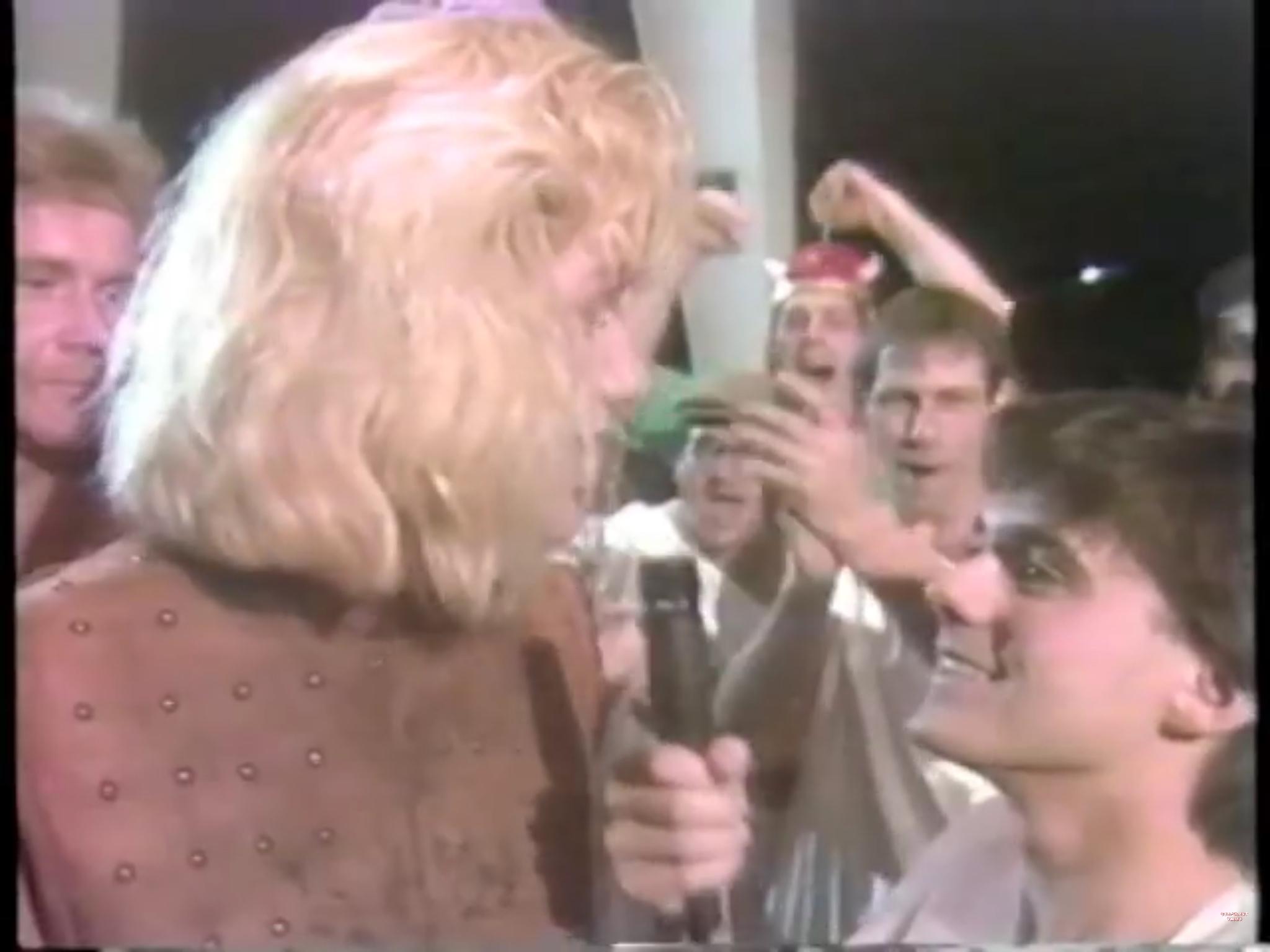
But just as professional wrestling doesn’t all take place in the ring, neither does Amazon boxing. As the ladies arrive, Dan Dugen interviews them. They come up to him and act all tough to a remarkably small audience waiting for them. The best part of these interviews is the size of the guy doing them. The only people this guy is bigger than are Peter Dinklage and the lead singer of The Outfield. It really adds to the impression that these ladies are sent by the Gods. They tower over him.

Interview

The other people who are of note are Issie, the manager of Delilah, and Wanda, The Iron Mistress.

Issie

Issie

Wanda is one of the last of the ladies to show up, but they cut several times to show that she is on her way. My favorite is when they show her running across some grass next to a parking lot. There’s a trash can in her way and she just knocks it out of her way while holding some weapon in her hand. Other times she just runs like a mad woman holding something. These parts always had me laughing.

Wanda is on her way!

Wanda is on her way!

In wrestling backstage drama is all part of the experience and that is brought to Amazon boxing as well. During the battle between Thesbian and Delilah, Issie plays a horn. It distracts Thesbian and causes Delilah to win the fight. Then comes the controversy that takes us into a flashback where we see that Delilah told Issie to sneak into Delilah’s training area to find her weakness. After realizing that the brush in her bag will do him no good, he finds the horn.

Finding The Horn

Finding The Horn

As for the fighting itself. It’s pretty ridiculous, but they actually appear to be fighting. It’s not like the kind of thing where you’d expect every move, punch, or grab to be of a sexual nature. It’s just weak sauce moves. Still, it’s fun to watch.

I just can’t do this thing justice with words or a few screenshots. It must be seen. It’s only an hour long and it’s on YouTube at the time of writing this. Otherwise, it’s available through Amazon on VHS. Check it out!

Film Review: All The Wilderness (dir by Michael Johnson)


All the Wilderness

I recently watched an excellent little film called All The Wilderness.

James Charm (Kodi Smit-McPhee) is a shy and withdrawn teenager who is still struggling to deal with the recent death of his father.  He spends his time wandering around the forest surrounding the house where he lives with his mother (Virginia Madsen).  Occasionally, he makes his way into the nearby city and aimlessly wanders through the desolate streets.  In his spare time, he sketches pictures of dead animals and tells people that he can predict when they are going to die.  When he informs the local bully that he’s going to die in just a few more days, the bully responds by punching James in the face.

Sometimes, James visits a therapist (Danny DeVito) who seems to alternate between concern and indifference.  One day, while sitting in the waiting room, James meets Val (Isabelle Fuhrman), who is dealing with her parents’ divorce and spends her time making and selling eccentric doughnuts.  James likes Val but he’s too scared to open up to her.  Some of that may have to do with the mysterious, hooded figures who occasionally materialize out of thin air and pursue him through the streets.

After sneaking out of one unproductive therapy session, James discovers a mysterious man named Harmon (Evan Ross) playing a piano in a courtyard.  Later, after his hamster mysteriously dies, a distraught James sneaks out of his house, makes his way down to the city, and gets on a bus.  Sitting across from him is none other than Harmon.

Harmon invites James to follow him on a trip into the hidden corners of the city.  Soon, James is discovering that the wilderness is not only limited to the countryside surrounding his mother’s house.  There’s also an urban wilderness and, with Harmon as his guide, James starts to discover it.  And yet, even as James starts to find happiness, those hooded figures continue to follow him…

All The Wilderness reminded me a lot of last year’s underappreciated California Scheming, another atmospheric look at alienation that was full of existential dread.  All The Wilderness is probably not a film for everyone.  Not only is it extremely stylized but it’s also a bit too short.  All The Wilderness is one of the few films that could actually benefit from an additional 30 minutes added to its running time.

And yet, flaws and all, All The Wilderness is a great film and one that everyone should take the time to see.  It is perched so precariously between being insightful and being pretentious that it becomes oddly compelling to watch the film’s valiantly struggle to maintain its balance.  Visually, this is an incredible film just to look at, with the constantly moving camera capturing images of ominous yet undeniably beautiful urban decay.  In small roles, both Danny DeVito and Virginia Madsen are well-cast while Evan Ross is appropriately charismatic as Harmon.  Finally, Kodi Smit-McPhee — all grown up from his heartbreaking performances in The Road and Let Me In — gives a wonderful and versatile performance in the lead role.

All The Wilderness is a film that deserves to be seen.

A Superfast Review of Superfast!


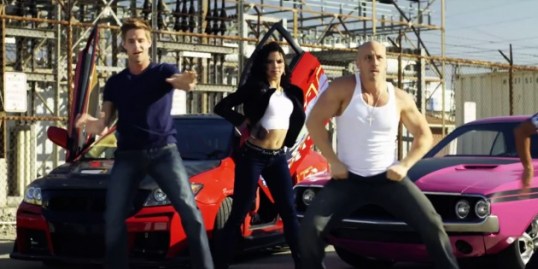
A typical scene from Superfast!

A typical scene from Superfast!

Superfast! tells the story of an incredibly stupid undercover cop named Lucas White (Alex Ashbaugh).  Despite the fact that he’s so white that he regularly freezes mayonnaise so that he can then lick it like a popsicle (or so he tells us), White is assigned to infiltrate a group of multi-ethnic Los Angeles street racers.  Led by the bald and imposing Vin Serento (Dale Pavinski), these street racers spend their time doing vaguely defined illegal stuff.  Lucas soon wins Vin’s trust and finds himself torn between his job and his new friends.

When it looks like Vin and his crew are going to have to flee the country, they plot to rip-off crime lord Juan Carlos de la Sol (Omar Chaparro).  In order to do this, Vin recruits a crew that includes characters with names like Rapper Cameo, Cool Asian Guy, and Model Turned Actress.  Pursuing Vin and his crew is the ultra intense Detective Rock Johnson (Dio Johnson).

If all this sounds familiar, that’s because Superfast! is a spoof of the Fast and the Furious franchise.  As far as spoof movies go, Superfast! is not bad.  The actors do a good job of imitating the hypermasculine style of the Fast and Furious franchise and I actually found myself laughing at a few of the jokes.  Considering that this film was directed by the infamous duo of Jason Friedberg and Aaron Seltzer, a few laughs were still more laughs than I was expecting.  Superfast! deserves some credit for being consistently amusing, even if the overall film was pretty uneven.

Of course, the main problem with Superfast! is that the Fast and the Furious films already do a pretty good job of spoofing themselves.  One of the main reasons why that franchise has not only survived but prospered is because the films themselves are full of a winking self-awareness.  The franchise itself has consistently, and with good humor, acknowledged just how over-the-top things can get.  (Indeed, the franchise is populated by actors — like Dwayne Johnson and Vin Diesel — who have made a career out of poking gentle fun at their images.)  There’s really not a single joke to be found in Superfast! that hasn’t already been made in a previous Fast and the Furious film.

But, with all that in mind, Superfast! is an amusing enough way to waste 90 minutes.  Dale Pavisnki especially deserves some credit for the commitment that he brings to the role of Vin Diesel Serento.

Superfast! was released on the same day as Furious Seven.  Needless to say, Furious Seven did just a little bit better with audiences and critics.  Superfast! can currently be viewed on Netflix.

What Lisa Watched Last Night #126: Trigger Point (dir by Philippe Gagnon)


Yesterday, I watched the Canadian film Trigger Point on the Lifetime Movie Network.

Trigger Point

Why Was I Watching It?

Oh, why not?  It was Sunday, I was still recovering from a very active Independence Day, and it was on the Lifetime Movie Network.  You know me.  I can’t resist Lifetime.

What Was It About?

College student Callie Banner (Jordan Hinson) blames a Big Evil Corporation for her father losing his job and becoming an alcoholic.  So, she gets involved in a campus protest group.  Soon, she is ignoring all of her old, apolitical friends and spending all of her time chanting slogans and raising her fist in solidarity.  She breaks up with her old boyfriend and is soon dating the charismatic Jared Church (Yanni Gellman).

However, something strange is happening.  Former members of the protest group are dying and their wealthy parents are being blown up.  The cops call it murder/suicide but could it just be murder/murder?  That’s what Callie has to find out, while still also finding time to paint signs, hang banners, and come up with catchy slogans.

What Worked?

Trigger Point confirmed all of my long-held suspicions about political activists.  Good work, Trigger Point.

What Did Not Work?

I was about to complain about the fact that Callie came across as being a humorless scold but then again, that aspect of her character worked as far as the film’s plot was concerned.  If Callie wasn’t a humorless scold, she never would have gotten involved with the protesters in the first place.  And while it can be argued that the film suffered because Callie is such an unlikable character, I would suggest that Callie being so unlikable actually worked to the film’s advantage.  If she had been likable, you would have actually been worried about her well-being and the film would not have been as much fun.  But since she wasn’t likable, you never really cared how many terrible things happened to her.

So, though it may not have been due to the intentions of the filmmakers, the entire film works.

“Oh my God!  Just like me!” Moments

I imagine if I was the type to get involved in a political protest, I’d probably act a lot like Callie.  I would totally throw myself into it, I’d flirt with the leaders, I would be judgmental towards anyone who didn’t want to protest, and, in the end, I would discover that everyone around me was a murderer.  That’s one reason why I never got involved with the Occupy movement, no matter how many times I was invited.

Lessons Learned

Don’t get involved in any student protests.  Seriously, they always seem to lead to murder.

Poli-Tricksters: The Marx Brothers in DUCK SOUP (1933)


DuckSoup1When I heard TCM was airing DUCK SOUP tonight, I set the DVR. I got home as soon as I could (after an excellent Tom Rush concert) and began watching before it was finished recording. This is one of my favorite movies of all time, right up there in my personal comedy pantheon with such gems as AIRPLANE! and BLAZING SADDLES. It’s one of the most anarchic comedies ever made, and certainly one of the funniest.  If you think today’s politicians are a bunch of looney tunes, wait til you get a load of these guys.

We begin as Freedonia is on the brink of bankruptcy. Mrs. Teasdale (perennial Marx foil Margaret Dumont) will loan the country twenty million dollars only if her choice of leader is appointed. She wants Rufus T. Firefly (Groucho), a sarcastic, lecherous wise guy (Teasdale: “It’s a gala day for you.” Firefly: “Well, a gal a day is plenty for me, I don’t think I can handle any more”). Firefly’s accompanied by his personal secretary, Bob Roland (Zeppo). Meanwhile, Ambassador Trentino of rival Sylvania plots to woo the old dame for her money. He sends his two top spies, Chicolini and Pinky (Chico and Harpo), disguised as peanut vendors, to dig up dirt on Firefly.

Soon Chicolini is made secretary of war. Firefly and Bob, suspecting Trentino’s up to no good, devise a plan to insult Trentino and start a war. But Rufus is the one insulted when Trentino calls him an “upstart”, and war is declared! The spies are sent to Mrs. Teasdale’s house to steal Freedonia’s war plans, and they both impersonate Firefly to perform the dastardly deed. Chicolini gets caught and is put on trial for treason. The trial’s interrupted by Trentino, who’s come to make amends with Firefly. But the ‘headstrong’ Rufus ends up slapping the ambassador again, and the war is on.

The battle of Freedonia begins, with the brothers dressed in different war uniforms as the battle rages.  The bullets fly, as do the jokes (Bob: “General Smith reports a gas attack. He wants to know what to do.” Firefly: “Tell him to take a teaspoon of bicarbonate of soda and half a glass of water.”) Eventually, Sylvania is defeated when Trentino’s head gets trapped in a door and the madcap brothers pelt him with fruit, causing him to surrender. Freedonia victorious!

It’s hard to describe all the lunacy this film offers. The puns and one-liners fly fast and furious (my favorite line: “Remember we’re fighting for this woman’s honor, which is more than she ever did.”) Sight gags abound, like the running battle between the peanut vending spies and lemonade stand owner Edgar Kennedy. And of course there’s the classic ‘mirror scene’ with Groucho and Harpo, later reprised by the silent Harpo and Lucille Ball in TV’s I LOVE LUCY.

This was the last of five films the Marxes made for Paramount Pictures. DUCK SOUP was so ahead of it’s time, the movie did poor at the box-office, as they were released from their contract. Signing with MGM in 1935, the boys went on to star in hits like A NIGHT AT THE OPERA and A DAY AT THE RACES. But for sheer, unadulterated Marx madness, this is just their greatest comedy, indeed one of the best of all time. If you didn’t watch the broadcast, I hope you DVR’d it. And if you didn’t, go out and find a copy quick. I guarantee you won’t be disappointed. Hail, hail Freedonia!!

The Things You Find On Netflix: Austin to Boston


Austin to BostonAustin to Boston is a documentary about a group of mostly British folk musicians who, in 2012, toured the United States.  The group included a few familiar names (Ben Lovett of Mumford and Sons, for example) and several up-and-comers (Ben Howard, The Staves).  Traveling across America in five VW campers, the bands went from Austin to Boston in two weeks.  Along the way, they stopped and played at everywhere from Nashville to Woodstock.  The documentary, which is narrated in a memorably grizzled fashion by driver Gill Landry, follows them as they discover America, deal with shows that are both good and bad, and, most of all, make music.  Make no mistake, this is a musical documentary.  While the musicians do occasionally talk about their lives, for the most part, we get to know them through their music.

I have to admit that I was a little bit surprised by how much I enjoyed Austin to Boston.  My taste in music tends to run the gamut from EDM to more EDM so, to be perfectly honest, spending 70 minutes watching a bunch of folk acts should have been pure misery for me.  (Someday, I’m going to write an article about the Tyranny of Acoustic Harmonizing.)  But, even if it wasn’t my type of music, I could still appreciate that the musicians traveling from Austin to Boston were damn talented and had beautiful voices.  Could I have done without that gospel song that seemed to go on  forever?  I certainly could have.  But, if that’s your type music, you’ll probably really enjoy hearing it because it’s being performed by some seriously talented people.

And even if it isn’t your type of music, Austin to Boston is such an intensely likable documentary that it really doesn’t matter.  There’s something really sweet and special about watching these British musicians discover and, to a certain extent, fall in love with America.  And, speaking as an American, Austin to Boston made me better appreciate my frustrating home country as well.  Over the course of this short but achingly sincere film, we get to see a lot of American scenery and it reminds us of just how beautiful it all can be.  When you live here, you tend to take it for granted and sometimes, I think it’s good to take another look through non-native eyes.

Did Austin to Boston awaken any sort of dormant love that I may have for folk music?  No, it did not.  To a certain extent, I wish it had because it really is such a heartfelt documentary.  But, in the end, The Staves all have beautiful voices but it’s just not my type of music.  But it did make me better appreciate both my home country and the way that music — regardless of style or genre — can bring us all together.

And you know what?  If this is your type of music, you’ll freaking love this documentary.  You’ll watch Austin to Boston and you’ll say, “What the Hell was that EDM-loving redhead talking about?  THIS IS GREAT!”

Austin to Boston can currently be viewed on Netflix.

An Oddball Bit of Americana: WHERE DO WE GO FROM HERE? (1945)


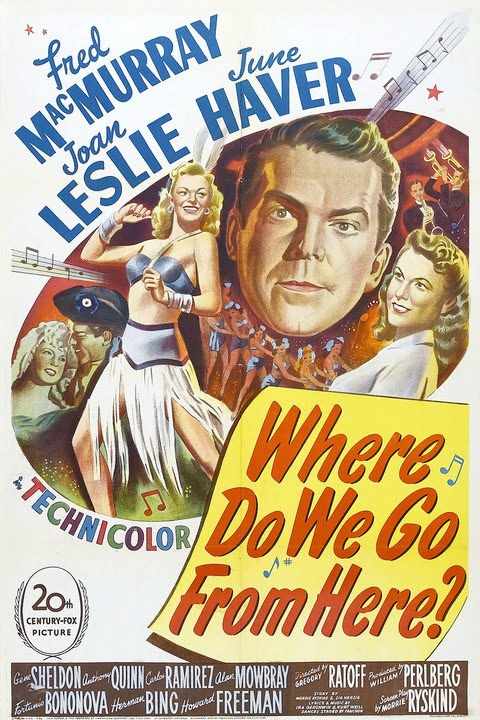
I’d never heard of this musical fantasy until running  across it while scrolling through channels looking for movies to review. The premise caught my attention and I decided to DVR it and take a look. WHERE DO WE GO FROM HERE? is definitely dated, with it’s World War 2 slang and constant references to Brooklyn, but is charming enough to merit at least a look.

The film stars Fred MacMurray as Bill Morgan, down in the dumps because he’s 4F and can’t get in the service. Bill’s got the hots for USO worker Lucilla (June Haver) but she’s only got eyes for men in uniform. Meanwhile, Sally (Joan Leslie) is in love with Bill, only the klutzy, dim witted lug can’t see it. While working at a scrapyard (for the war effort), Bill accidentally frees a genii (Gene Sheldon) in an old lamp. The genii, named Ali of course, grants Bill his wish to get into the Army.

Due to Ali being a bit rusty, Bill is sent to Valley Forge in 1776, where he meets George Washington (Alan Mowbray), who sends Bill to spy on the Hessians. They’re portrayed as Nazi ancestors, complete with exaggerated accents. The Hessian general (Otto Preminger) exposes Bill, and he’s sent before a firing squad. Ali bails him out and places him in the Navy.

Unfortunately, it’s Christopher Columbus’s navy! Bill helps Columbus (Fortunio Bonanova) avert a mutiny, and when they arrive at the New Land, Bill is sent by dinghy to New York, where he encounters hostile Indians, led by Chief Badger (Anthony Quinn). The Chief catches Bill in a tepee with his wife (Haver) and Bill has to fast talk his way out of getting scalped. He ends up buying Manhattan, then wishes his way to the colony of New Amsterdam (where everyone talks like Yoda!). He has become the village blacksmith. Bill meets a girl named Katrina (Leslie), who’s about to marry Herr Kreiger to avoid him foreclosing on the family farm. Bill, being the owner of Manhattan, tries to save her from this fate by selling the land to the West Indies Trading Company for one million gulden. Taxes leave Bill 50 gulden in the hole, however, and he’s sent to debtor’s prison. A drunken Ali is his cellmate (he’s been celebrating) and Bill’s last wish is to return to the 20th Century. They’re whisked back to the future, where it’s discovered the 4F ban has been lifted. Bill can join the Army at last, and is reunited with Sally.

The screenplay by Morrie Ryskind (mostly remembered for his work on Marx Brothers comedies) moves along briskly and has it’s share of laughs. The musical numbers by the unlikely team of Kurt Weill and Ira Gershwin are pleasant, but  easily forgettable. MacMurray has a good voice, which wasn’t featured   often enough in film. Leslie and Haver have plenty of eye appeal, and the cameo roles are fun for movie buffs. WHERE DO WE GO FROM HERE? is no classic, but an enjoyable way to waste 78 minutes before having your cookout or going to see the fireworks.  Happy 4th of July, dear readers!fred

In Praise of Easy Rider’s Captain America


1969 was a watershed year for both America and the movies.  While the war in Viet Nam dragged on and turmoil raged at home, movie audiences watched as two generations of Fondas appeared in movies about the American dream.  In Sergio Leone’s Once Upon A Time In The West, Henry Fonda played Frank, a gunslinger so ruthless that he shoots a child during his first scene.  In They Shoot Horses, Don’t They?, daughter Jane Fonda played a woman struggling to survive the Great Depression.  And, in Easy Rider, Peter Fonda played Captain America.
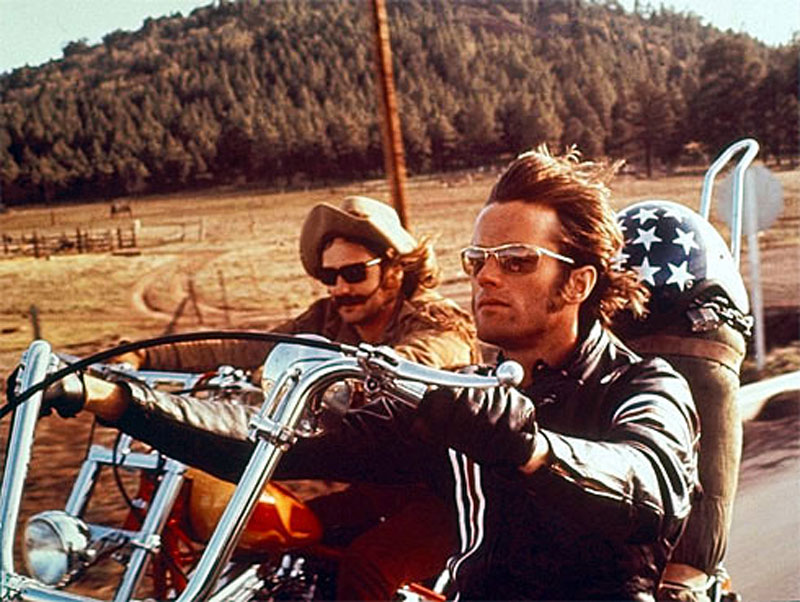
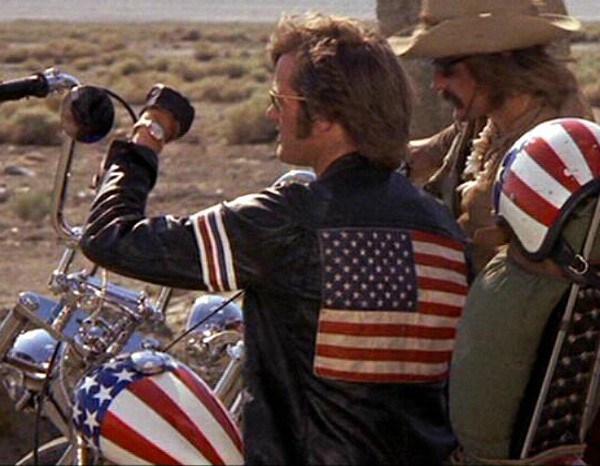
Peter FondaThe Captain America of Easy Rider should not be mistaken for the super soldier played by Chris Evans.  Instead, this Captain America is actually Wyatt Williams, a motorcycle rider who is planning on going to Mardi Gras with his friend Billy (Dennis Hopper, who also directed).  Wyatt is nicknamed Captain America because he wears a leather jacket with an American flag on the back.  It is an appropriate nickname because Wyatt represents everything that is good about America.

When we first meet Captain America, he and Billy are engaged in a business transaction, bringing to mind the old saying that the business of America is business.  They are selling cocaine to none other than Phil Spector.  Taking Spector’s money, Wyatt stuffs it into a plastic tube that he keeps hidden in his motorcycle’s fuel tank.  It is no coincidence that the fuel tank is decorated with the stars and bars.
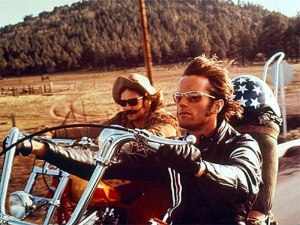
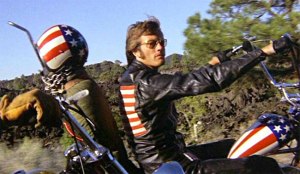
Peter-Fonda-and-Dennis-Hopper-in-Easy-RiderHaving made their money, Wyatt and Billy ride across the country to celebrate.  At the start of their journey, Wyatt takes off his watch and leaves it on the ground, declaring that time has no meaning to a man who has freedom.  If you replaced their motorcycles with horses, there would be little to distinguish Wyatt and Billy from the American outlaws who might show up in an old Henry Fonda western.

On their way to New Orleans, Wyatt and Billy interact with many different people.  If the always paranoid and nervous Billy represents America’s worst impulses, Wyatt represents the best.  When Wyatt and Billy eat dinner with a rancher and his family, Wyatt alone appreciates what the rancher has accomplished and says, “You’ve got a nice place. It’s not every man that can live off the land, you know. You do your own thing in your own time. You should be proud.”  When they later stop off at a ramshackle hippie commune, Wyatt is the one who says, in the best tradition of American optimism, that “They’ll make it.”
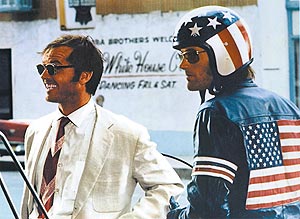
EasyRider2When they stop to pick up a hitchhiker and then later when alcoholic lawyer George Hanson (Jack Nicholson) joins them on their trip, it’s always Wyatt who volunteers to share his bike.  (Billy always rides alone.)  Whenever they stop for the night, it is always the generous Wyatt who offers to share his grass with whomever is traveling with them.  When George smokes for the first time, Wyatt is the one who teaches him.  It is the stoned George who tells Wyatt and Billy that they represent freedom.

It is only after George is beaten to death by a group of rednecks that Wyatt loses his optimistic outlook and his generous spirit.  George’s death opens Wyatt’s eyes in much the same way that the turmoil of the 1960s did for the rest of America.  After George’s murder, Wyatt loses his faith in himself.  When he and Billy reach New Orleans, Mardi Gras is a letdown.  When he takes the acid that was given to him by the hitchhiker, Captain America’s journey becomes a bad trip both figuratively and literally.
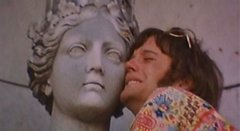
0603-peter-fonda-and-easy-riderjpg-b0f5351afb0a53df_mediumWhile Billy insists that they had a great time in New Orleans (in much the same way that some insist that America is just as strong a nation as it has ever been), Wyatt knows the truth.  “We blew it,” Wyatt says, speaking for the entire nation.

Despite his mistakes and despite having blown it, Wyatt, much like America itself, remains good at heart.  When Captain America dies at the end of the film, it is because he is trying to protect his friend Billy.  In the best American tradition, he sacrifices himself to protect another.

This Independence Day, let us all take a few moment to appreciate Wyatt Williams, the man known as Captain America.

Wyatt Williams (aka Captain America) RIP

Wyatt Williams (aka Captain America) RIP
 

Beyond Redemption: 1947’s BORN TO KILL


gary loggins's avatarcracked rear viewer

born to kill

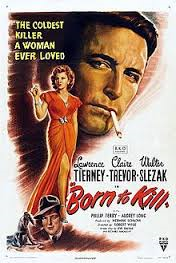
The darker side of man (and woman) is on full display in 1947’s BORN TO KILL. Sex, violence, greed, blackmail, lust, and murder abound in this mean little film. It’s loaded with crackling hard boiled dialogue (example: “You’re the coldest iceberg of a woman I ever saw, with the rottenest insides”) by screenwriters Eve Green and Richard Macauley. BORN TO KILL shows the RKO film noir style at it’s moodiest peak. It’s hard to believe the director is the same man who helmed the sticky sweet Oscar winning THE SOUND OF MUSIC!

Robert Wise got his start in RKO’s sound editing room, graduating to film editor in 1939. He was nominated for Best Editing for Orson Welles’ classic CITIZEN KANE and was soon promoted to the director’s chair, working with producer Val Lewton on psychological horror gems like CURSE OF THE CAT PEOPLE and THE BODY SNATCHER (with the great terror tandem of Karloff and Lugosi). His resume…

View original post 1,046 more words