Cleaning Out The DVR Yet Again #33: Stakeland 2: The Stakelander (dir by Dan Berk and Robert Olsen)


(Lisa recently discovered that she only has about 8 hours of space left on her DVR!  It turns out that she’s been recording movies from July and she just hasn’t gotten around to watching and reviewing them yet.  So, once again, Lisa is cleaning out her DVR!  She is going to try to watch and review 52 movies by the end of Wednesday, December 7th!  Will she make it?  Keep checking the site to find out!)
stakeland23

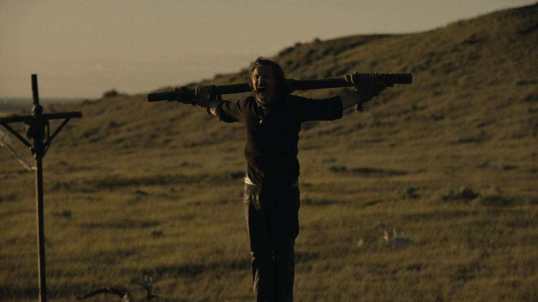
Stake Land 2: The Stakelander premiered on the SyFy network on October 15th.  Normally, I watch and live tweet any and all SyFy premieres but I was actually on vacation when Stake Land 2 premiered.  So, I recorded it!

And now, I’ve watched it.

And…

Well, this is kind of a strange one.  I have to admit that I’m a little bit shocked that this one premiered on SyFy without even getting a limited theatrical release.  (I mean, Hell, even 400 Days played in theaters for a week!)  After all, Stake Land 2 is a direct sequel to Stake Land, which did get a theatrical release back in 2010 along with positive reviews and a strong cult following.

In fact, not only is Stake Land 2 a direct sequel but it also features the return of almost the entire cast and the original screenwriter.  Original director Jim Mickle — who went from Stake Land to Cold In July — does not return but he is on board as an executive producer.  Though the film’s budget was low, it’s still obvious that the production cost a bit more than the typical SyFy mockbuster.  So, I’m a bit curious how Stake Land 2 ended up making its debut on SyFy.

Well, regardless of how it got there, Stake Land 2 premiered as a part of SyFy’s 31 Days Of Halloween.  One of the advantages of Stake Land 2 being a sequel to another fairly well-known film is that it was one of the few SyFy October premieres that did not play out as a rip-off of It Follows.  Instead, it felt like a rip-off of The Walking Dead, except with vampires instead of zombies.

The film picks up where the original Stake Land ended.  Martin (Connor Paolo) and his wife have set up a perfect life in New Eden but it’s all shattered when they’re attacked by a band of vampires that’s led by The Mother (Kristina Hughes).  Seeking revenge, Martin returns to the Badlands of America and searches for his mentor from the previous film, Mister (Nick Damici).  Mister is older and wearier now and he’s haunted by nightmares.  But he and Martin can still kill vampires!

Anyway, the majority of the film is a lengthy road film.  In fact, it’s a bit too lengthy.  This is one of those films that covers for a thin plot by supplying a lot of filler.  There’s a kind of fun scene set in an underground, Mad Max-style fight club and, along the way, Mister and Martin picks up some properly quirky allies.  There’s a few good shots of the desolate landscape and The Mother is genuinely menacing.

But, especially when compared to the first film, Stake Land 2 is ultimately way too predictable and more than a little bland.  Whereas the first Stake Land managed to create its own universe, one that you were actually curious about, Stake Land 2 is just another forgettable sequel.

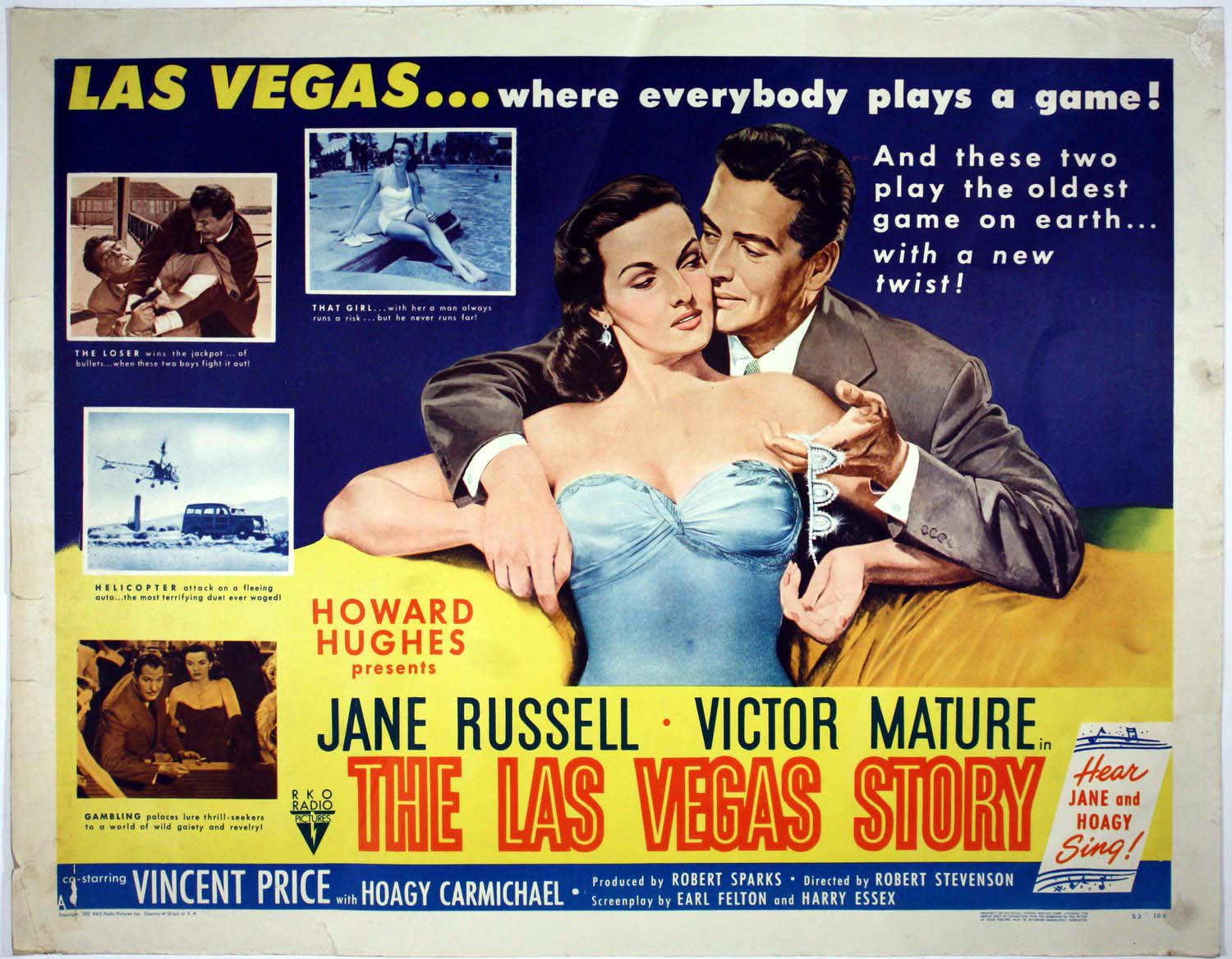
All That Glitters Is Not Gold: Jane Russell in THE LAS VEGAS STORY (RKO 1952)


gary loggins's avatarcracked rear viewer

lvs1

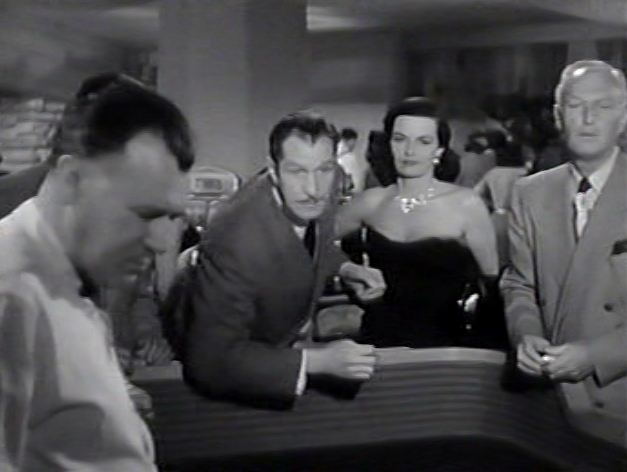
Jane Russell’s  sexy as always, but THE LAS VEGAS STORY falls flatter than the proverbial pancake. This dull little crime drama boasts a good cast and some good moments, but on the whole doesn’t satisfy. One of the problems is Jane’s co-star Victor Mature, who tries but can’t match the cynicism frequent Russell co-star Robert Mitchum would’ve brought to the role of Jane’s jilted ex-lover, now a cop in the City of Sin. The most interesting thing about THE LAS VEGAS STORY is it’s screenplay credits, which we’ll get to later.

lvs2

When ex-lounge singer Linda Rollins (Russell) returns to Vegas with husband Lloyd (a subdued but still sarcastic Vincent Price ), she visits her old stomping ground the Last Chance, where she’s greeted by piano player Happy (Hoagy Carmichael) and former boss Mike Fogarty (Will Wright), who’s been bought out by new owner Clayton (Robert J. Wilke). Police lieutenant Dave Andrews (Mature)…

View original post 501 more words

Cleaning Out The DVR Yet Again #31: Black and White (dir by James Toback)


(Lisa recently discovered that she only has about 8 hours of space left on her DVR!  It turns out that she’s been recording movies from July and she just hasn’t gotten around to watching and reviewing them yet.  So, once again, Lisa is cleaning out her DVR!  She is going to try to watch and review 52 movies by the end of Wednesday, December 7th!  Will she make it?  Keep checking the site to find out!)

black_and_white_black_white-681253575-large

On November 15th, I recorded the 1999 melodrama, Black and White, off of Encore.

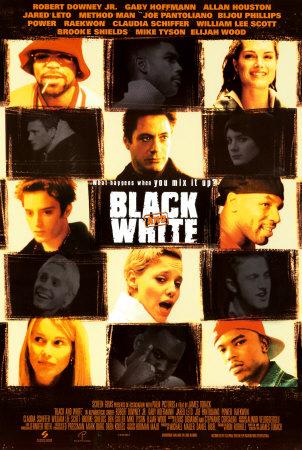
Black and White is a film that I’ve seen several times and I’ve always meant to review it.  It’s an attempt to explore the state of race, rap, crime, and sex in the late 20th century.  It’s also a James Toback film, which means that it contains all of the stuff that appears in every James Toback film: a threesome in the park, improvised dialogue, cameos from famous people playing themselves, an obsession with college basketball games, casual sexism, and a lot of talk about why you should never send “a little boy to do a man’s job.”  By his own admission, the white Toback is obsessed with the black experience but, when you watch a James Toback film, you get the feeling that his entire knowledge of African-American culture comes from watching other movies.

In short, Black and White is probably one of the silliest and most misjudged films that I’ve ever seen.  In fact, it’s so misjudged that it’s compulsively watchable.  Though I’m always hesitant to casually toss around the term “guilty pleasure,” that’s exactly what Black and White is.

Black and White tells several different stories, some of which are connected and some of which are not.  Sam Donager (Brooke Shields) is an independent filmmaker who is attempting to make a documentary about white people who try to act black.  Her husband, Terry (Robert Downey, Jr.), is gay and hits on every man (and boy) that he sees.  Sam and Terry start following around a group of privileged white kids who are obsessed with rap music.  Sam asks them if they want to be black.  They say that they’re going through a phase.

One of the kids is named Wren and he’s played by Elijah Wood.  He doesn’t really do much but every time he shows up in the film, you go, “It’s Elijah Wood!”  And then there’s Marty King (Eddie Kaye Thomas) who is the son of the Manhattan District Attorney (Joe Pantoliano).  Marty’s older brother is Will (William Lee Scott) ,who is some sort of low-level criminal.  And finally, the unofficial leader of the kids is Charlie (Bijou Phillips) and she gets to give a long monologue explaining the various uses of the n-word.

(Their teacher, incidentally, is played by Jared Leto.  If you’ve ever wanted to listen to Jared Leto lecture about the relationship between Othello and Iago, this is the film to see.  That said, the whole Othello and Iago lecture is just kinda randomly tossed in and doesn’t really pay off.)

Charlie is one of the many girlfriends of Rich Bower (Power), who is not only an up-and-coming rap producer but he’s also the head of a criminal organization.  (There’s a lengthy and kinda pointless scene where he and his associates demand money from a club manager played by Scott Caan.)  Rich is also friends with Mike Tyson.  Tyson plays himself and he gets to deliver an entire monologue about how Rich should never send a boy to do a man’s job.

But we’re not done!  Rich’s cousin is Dean Carter (Allan Houston), a college basketball player.  Dean is dating an anthropology graduate student (Claudia Schiffer, giving a hilariously terrible performance) who is obsessed with fertility symbols.  Dean is also being blackmailed by a corrupt cop named Mark Clear.  Guess who plays Mark Clear?

BEN FREAKING STILLER!

Needless to say, Ben Stiller is massively miscast.  He delivers he lines in his trademark comedic fashion, which makes it next to impossible to take him seriously as any sort of threat.  He also has a backstory that is needlessly complex but at least it allows him to say, “I’m Saul of Fucking Tarsus!”

Anyway, almost the entire film was improvised, which is one of those things that probably seemed like a good idea at the time.  A few of the actors do well with the improvisation.  Stiller may be miscast but at least he can come up with stuff to say.  Robert Downey, Jr.’s character may seem out-of-place but again, Downey knows how to keep things interesting.  But the rest of the cast seems to be a bit stranded so we end up with a lot of lengthy scenes of characters struggling to make some sort of sense of Toback’s storyline.

It’s obvious that James Toback felt that this film had something important to say but, instead of any insight, it can only offer up the occasionally strange-as-Hell scene.

Like this scene, for instance, in which Mike Tyson literally attempts to kill Robert Downey, Jr:

Or this weird little scene between Ben Stiller and Joe Pantoliano, which is dominated by Stiller’s odd delivery of his lines:

Or the closing montage, which is actually rather well-put together and makes great use of Michael Fredo’s Free:

Sadly, the video above ends before it gets to the part where we see Claudia Schiffer on a date with Mike Tyson, telling him about fertility symbols.

Anyway, Black and White is one of those films that wants to say something despite not being sure what.  Again, it may ultimately be rather silly but it’s still compulsively watchable.

(For the record, Marla Maples — who also appeared in Maximum Overdrive and was married to future President Donald Trump when this movie was made — has a cameo as a character named Muffy.  We live in a strange fucking world, don’t we?)

Cleaning Out The DVR Yet Again #30: The Adventures of Hercules (dir by Luigi Cozzi)


(Lisa recently discovered that she only has about 8 hours of space left on her DVR!  It turns out that she’s been recording movies from July and she just hasn’t gotten around to watching and reviewing them yet.  So, once again, Lisa is cleaning out her DVR!  She is going to try to watch and review 52 movies by the end of Tuesday, December 6th!  Will she make it?  Keep checking the site to find out!)

her1

On November 10th, I recorded 1985’s The Adventures of Hercules off of the Encore Family channel.

Let’s see if I can explain exactly what this film is about.  Bear with me because this is going to be a strange one.  For that matter, you might also want to bare with me because The Adventures of Hercules is all about displaying the physique of body builder Lou Ferrigno.  Ferrigno plays the legendary Greek demigod Hercules.  Or I should say that he provides Hercules’s body and occasionally a facial expression or two.  Since The Legend of Hercules was an Italian film, the entire cast is obviously and frequently awkwardly dubbed.  That includes Ferrigno.  Though Hercules doesn’t say much, when he does speak, he does so in a voice that really doesn’t go with his body, his personality, or anything that seems to be happening on screen.

Anyway, I guess I should try to explain the plot.  I should mention that The Legend of Hercules is a sequel to another Hercules film.  I haven’t seen the first Hercules film.  Maybe the Legend of Hercules would have made more sense if I had, though I somehow doubt it.

Basically, bad things are happening on Earth.  Why?  Well, it appears that four of the Gods have gotten together and stolen Zeus’s 7 Mighty Thunderbolts.  They’ve hidden the Thunderbolts across the planet, entrusting them with various monsters.  As a result of Zeus no longer having his thunderbolts, the Moon is now on the verge of colliding with Earth and human sacrifices are also being committed to a monster that looks a lot like the ID Monster from Forbidden Planet.  

What does a Mighty Thunderbolt look like?  Here you go.

What does a Mighty Thunderbolt look like? Here you go.

Two sisters, Urania (Milly Carlucci) and Glaucia (Sonia Vivani), appeal to Zeus for help but, of course, Zeus is powerless without his thunderbolts.  However, he can still sends his son Hercules (Lou Ferrigno) to Earth.  Working with the sisters, Hercules goes on a quest for the thunderbolts.  This basically amounts to a series of scenes in which Hercules battles various people in rubber suits.  Whenever Hercules throws a punch, he’s filmed so that appears that he’s punching the camera.  Whenever Hercules’s fist makes contact, there’s a flash of red.  Whenever anyone is knocked off their feet by Hercules, they flip around in slow motion.  This happens every ten minutes or so.

Now, I don’t want to spoil the movie but I simply have to tell you about this.  There is a scene, towards the end of the film, in which Hercules literally grabs hold of the Moon and prevents it from crashing into the Earth.

Anyway, the plot makes no sense and that’s a huge part of this film’s enthusiastic, if frequently inept, charm.  As directed by the famed Italian director, Luigi Cozzi, The Adventures of Hercules has this cobbled together feeling to it that is undeniably likable.  Much as with Cozzi’s best-known film, Starcrash, The Adventures of Hercules is a film that wins you over by pure determination.  Cozzi set out to make a mythological epic and he wasn’t going to let something like a complete lack of budget stop him.

How strange an experience is The Adventures of Hercules?  Check out some of these randomly assembled screen shots:

adventures-of-hercules-1985

hercules2

margiaphroditeimpressed

adventuresofhercules2

hercules-2

adventuresofhercules3

b0056924_577cbcc1c68aa

herc-02

The other fun thing about The Adventures of Hercules is that, since this was a Luigi Cozzi film, the cast is full of Italian exploitation vets, the majority of whom were best known for appearing in far less family-friendly fare.

Here’s just a few of the performers you’ll find in The Adventures of Hercules:

Sonia Vivani, who plays Glaucia, also played the doomed sculptor in Umberto Lenzi’s infamous Nightmare City.

William Berger, who plays the villainous King Minos, appeared in several classic Spaghetti westerns, including Sabata.  Sadly, his promising career was cut short when he was framed for drug possession and spent several years in an Italian prison.  When he was finally freed, he ended up doing movies like The Adventures of Hercules.

Zeus was played by Claudio Cassinelli, an acclaimed actor who appeared in several giallo films.  He also co-starred in 1978’s infamous Mountain of the Cannibal God.

The evil High Priest was played by Venantino Venantini whose credits include everything from The Agony and the Ecstasy to Lucio Fulci’s City of the Living Dead to Umberto Lenzi’s Cannibal Ferox.

Aphrodite is played by Margit Newton, who somewhat infamously starred in what is generally considered to be the worst zombie film of all time, Hell of the Living Dead.

Serena Grandi played Euryale (a.k.a. Medusa).  Grandi is probably most remembered for his grotesque death scene in  Antropophagus.  She was also the star of one of my personal guilty pleasures, Lamberto Bava’s Delirium.

And finally, the mad scientist Dedalos was played by Eva Robbins, who achieved immortality by playing the Girl on the Beach in Dario Argento’s Tenebrae.

The Adventures of Hercules might not be “technically” a good film but it’s definitely (and rather compulsively) watchable.

Cleaning Out The DVR Yet Again #29: A Mother’s Escape (dir by Blair Hayes)


(Lisa recently discovered that she only has about 8 hours of space left on her DVR!  It turns out that she’s been recording movies from July and she just hasn’t gotten around to watching and reviewing them yet.  So, once again, Lisa is cleaning out her DVR!  She is going to try to watch and review 52 movies by the end of Tuesday, December 6th!  Will she make it?  Keep checking the site to find out!)

mother-mural-lmn-620x325

A Mother’s Escape aired on Lifetime Movie Network on July 21st, 2016.

Reportedly based on a true story, A Mother’s Escape tells a story that, on its surface, should be familiar to anyone who has ever watched a Lifetime film.  After an argument with her abusive husband, Murel (Tara Buck) grabs her young son, Kipp (Spencer Mabrey), jumps in a car, and takes off in search of a better life.  When we first meet them, they’re driving through Oklahoma.  They stop at the house of Murel’s mother, Tess (Beth Grant).

From the minute that we first see Murel and Kipp, we feel like they know them.  Both Tara Buck and Spencer Mabrey inhabit these roles so completely that it’s easy to forget that we’re watching actors performing from a script.  Refreshingly, the film makes not attempt to idealize Murel.  She’s frequently immature and occasionally self-centered but the ultimately, she’s defined by her love for her son.  When she briefly talks to her husband on the phone, Murel is briefly tempted to return to him.  Like so many victims of abuse, she fears that she might not deserve better.  Fortunately, Tess is there to bluntly tell her that she does deserve better.

And so does Kipp.

Though her husband is not Kipp’s biological father, he did adopt him when he and Murel married.  After Murel leaves, he accuses her of kidnapping her own son.  Now, Murel must keep Kipp safe while also trying to avoid capture.

As I said, this might sound like a typical Lifetime film.  However, it doesn’t feel like a typical Lifetime film.  It moves at its own slow but steady pace, taking the time to allow us to get to know both Murel and Kipp.  As Kipp, Spencer Mabrey is refreshingly non-cutesy while Tara Buck gives an almost heart-breakingly poignant performance as his imperfect but loving mom.  As an added bonus, this film features some hauntingly beautiful shots of the Oklahoma landscape.

Though it may require some patience, A Mother’s Escape is one of the best Lifetime films that I’ve seen in a while.

Cleaning Out The DVR Yet Again #27 and #28: Who Killed JonBenet? (dir by Jason Lapyre) and JonBenet’s Mother: Victim or Killer (dir by Siobhan Walshe)


(Lisa recently discovered that she only has about 8 hours of space left on her DVR!  It turns out that she’s been recording movies from July and she just hasn’t gotten around to watching and reviewing them yet.  So, once again, Lisa is cleaning out her DVR!  She is going to try to watch and review 52 movies by the end of Tuesday, December 6th!  Will she make it?  Keep checking the site to find out!)

jonbenet

On November 5th, Lifetime aired a film about the murder of six year-old JonBenet Ramsey, Who Killed JonBenet?  They followed this film with a documentary called JonBenet’s Mother: Victim or Killer?  I did not watch the films when they originally aired, largely because, much like Girl In The Box and Cleveland Abduction, the subject matter sounded way too disturbing to me.  Instead, I just recorded them and, for a few weeks, both programs sat unwatched on my DVR.

Until earlier today, that is!

I watched both of them and then I quickly deleted both of them as well.  And now I’m going to write a few words about them.  In fact, I’m going to try to devote as little time as possible to these films.

Normally, I’m the first one to defend Lifetime and their movies.  If you’re a regular reader of this site, you know how much I love Lifetime movies.  I love them for the exact same reason that most people claim to disdain them.  It’s rare that I ever see a Lifetime film that I can’t enjoy or, at the very least, defend.

But, seriously, Who Killed JonBenet? was such a misfire that I barely know where to begin. In many ways, it’s a typical true crime film.  Suspects are identified.  Detectives find themselves caring about the case … TOO MUCH!  It ends on a note of surface ambiguity that’s deceptive because the film all but comes out and accuses Patsy Ramsey of murdering her daughter.

That thing that sets Who Killed JonBenet? apart is that the film is narrated by JonBenet Ramsey, who is apparently speaking to use beyond the grave.  JonBenet tells us that she’ll always be six.  And she tells us that one of the detectives is a nice lady.  And it’s such an icky technique that it pretty much makes the entire film nearly unwatchable.  Every time that we hear that cloying little voiceover, we’re reminded of two things: 1) this film is based on the real life rape and murder of a six year-old and 2) this movie was made specifically to exploit that event.  In the end, you feel guilty for watching the damn movie in the first place.

Seeing as how Who Killed JonBenet? basically accuses Patsy Ramsey of murder, it’s interesting that it was immediately followed up by JonBenet’s Mother: Victim or Killer?  JonBenet’s Mother explores Patsy’s life and pretty much comes to the conclusion that, while Patsy may have been a bit odd, she did not kill her daughter.  If anything, the documentary shows that Patsy was largely the victim of a vicious media.

Like, to name just one example, Who Killed JonBenet?

Anyway, let us never speak of these two movies again.  When I think of a Lifetime movie, I’d much rather think of Confessions of Go Go Girl.

Cleaning Out The DVR Yet Again #26: The Muthers (dir by Cirio H. Santiago)


(Lisa recently discovered that she only has about 8 hours of space left on her DVR!  It turns out that she’s been recording movies from July and she just hasn’t gotten around to watching and reviewing them yet.  So, once again, Lisa is cleaning out her DVR!  She is going to try to watch and review 52 movies by the end of Tuesday, December 6th!  Will she make it?  Keep checking the site to find out!)

the-muthers

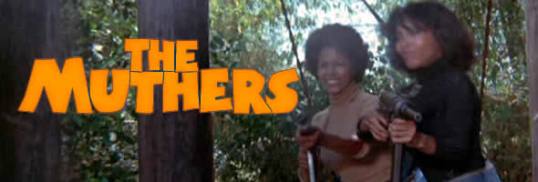
On November 13th, TCM Underground aired the 1976 Filipino women-in-prison film, The Muthers!  And I recorded it!

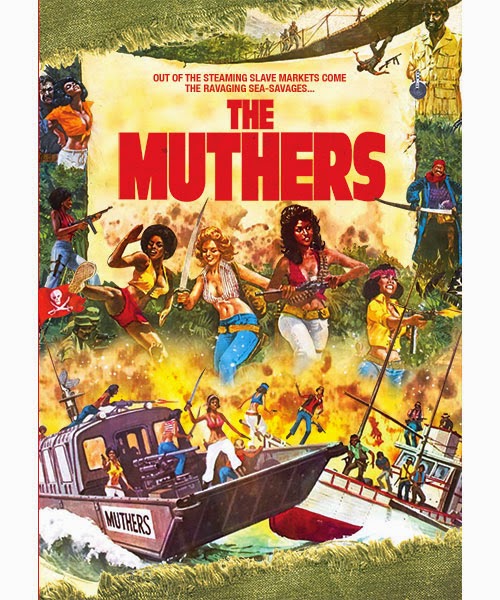
Before I say anything about the film itself, I want to acknowledge how much I love the poster above.  I mean, that poster promises a film full of actions, thrills, and a healthy dose of girl power.  You look at that poster and you think to yourself, “The Muthers must be one the greatest drive-in films ever made!”

You might also think that from reading about the film’s plot.  The Muthers opens with Kelly (Jeannie Bell) and Anggie (Rosanne Keaton) sailing the high seas. It turns out that they’re pirates!  They forcibly board yachts and rob decadent rich people.  They’re good at their job and they have fun, too!  Even better, they’re constantly fighting a rival pirate, a blowhard chauvinist named Turko (John Montomgery)!  Turko only has one eye, that’s how much of a pirate he is!

If the film had just been Kelly and Anggie fighting Turko, The Muthers probably would be a classic.  However, since this is a Filipino women-in-prison film, Kelly soon discovers that her sister has been imprisoned on Get Out If You Can Island.  (Seriously, that’s what they call the island.)  The island is run by the evil Montiero (played by Tony Carreon, a perennial villain in Filipino cinema) and, if they don’t rescue her, Montiero will sell her into prostitution.

Naturally, Kelly and Anggie go undercover and infiltrate the island.  Sadly, the film gets kind of boring after Kelly and Anggie reach the prison.  One reason why Filipino exploitation films are so respected and loved by aficionados of grindhouse cinema is because they frequently went totally and completely over the top.  There was a shamelessness to the best of the Filipino grindhouse films and it makes them fascinating to watch.  The Muthers starts out like a classic, with the pirates and Turko and all that, but once Kelly and Anggie reach the island, the film becomes oddly restrained.  There’s little violence, little sex, only one notable use of slow motion, and the film even lacks the radical political subtext that runs through many women-in-prison films.  One can’t help but wonder what the late Jess Franco would have done with the same material.

So, sadly, The Muthers failed to live up to the promise of that poster.

It happens.

muthers

Cleaning Out The DVR Yet Again #25: Marie Antoinette (dir by Sofia Coppola)


(Lisa recently discovered that she only has about 8 hours of space left on her DVR!  It turns out that she’s been recording movies from July and she just hasn’t gotten around to watching and reviewing them yet.  So, once again, Lisa is cleaning out her DVR!  She is going to try to watch and review 52 movies by the end of Tuesday, December 6th!  Will she make it?  Keep checking the site to find out!)

marie-antoinette_poster

On November 12th, I recorded 2016’s Marie Antoinette off of Starz.

Before I review Marie Antoinette, I think it’s important that you know that I am an unapologetic Sofia Coppola fan.  I love every film that she’s made and I look forward to her upcoming remake of The Beguiled.  At the same time, I can also understand why some people feel differently.  Sofia Coppola’s films are not for everyone.  For one thing, almost all of her films deal with rich people.  The existential angst of the wealthy and/or famous is not a topic that’s going to fascinate everyone.  When you watch a Sofia Coppola film, you never forget that you’re watching a film that’s been directed by someone who largely grew up in the spotlight and who knows what it’s like to have money.  An ennui born out of having everything and yet still feeling empty permeates almost every scene that Sofia Coppola has ever directed.  (If you have to ask what ennui is, you’ve never experienced it.)  Many viewers look at Sofia Coppola’s filmography and they ask themselves, “Why should we care about all these materialistic people?”

However, while Sofia Coppola may not know what’s it’s like to be poor (or even middle class for that matter), she does understand what it’s like to feel lonely.  Her filmography could just as easily be called “the cinema of isolation.”  It doesn’t matter how much money you may have or how famous you may or may not be, loneliness is a universal condition.  A typical Sofia Coppola protagonist is someone who has everything and yet still cannot connect with the rest of the world.  More often that not, they turn to excessive consumption in order to fill the void in their life.  To me, the ultimate Sofia Coppola image is not, regardless of how much I may love them, Bill Murray and Scarlett Johansson in Lost in Translation.  Instead, it’s Stephen Dorff (playing a far less likable version of Bill Murray’s Translation character) standing alone in the desert at the end of Somewhere.

Marie Antoinette, which was Sofia’s follow-up to Lost in Translation, is technically a historical biopic, though it makes little effort to be historical or accurately biographical.  Kirsten Dunst plays Marie Antoinette, the final queen of France before the French Revolution.  It was Marie Antoinette was accused of dismissing starving French peasants by announcing, “Let them eat cake!”  (For the record, it’s probable that Marie Antoinette never said that.  It’s certainly never heard in Coppola’s film.)

Marie Antoinette opens with the title character arriving in France at the age of 14.  She’s an Austrian princess who has been sent to marry the future king of France, Louis XVI (Jason Schwartzman).  From the minute we meet her, Marie Antoinette is portrayed as being a pawn.  Her mother arranges the marriage as a way to seal an alliance with France.  The king of France (played by Rip Torn) expects Marie Antoinette to get produce an heir to the throne as quickly as possible.  Meanwhile, her new husband is an infantile and immature fool who doesn’t even know how to make love.  Marie Antoinette finds herself isolated in a strange country, expected to be all things to all people.

And so, Marie Antoinette does what I always do whenever I’m feeling unsure of myself.  She hangs out with her girlfriends.  She throws expensive parties.  She gambles.  She flirts.  She shops.  She has fun, regardless of whether it’s considered to be proper royal behavior or not.  Occasionally, she is warned that she is losing popularity with the French people but she’s not concerned.  Why should she be?  She doesn’t know anything about the French people.  All she knows about is the life that she was born into.  She didn’t choose to be born in to wealth and power but, since she was, why shouldn’t she have a good time?

The French Revolution doesn’t occur until near the end of Marie Antoinette and when it does happen, it happens quickly.  And yet, the shadow of the revolution hangs over the entire film.  We watch the knowledge that neither Marie Antoinette nor her husband possess: eventually, they are both going to be executed.  And knowing that, it’s hard not to cheer Marie Antionette on.  She may be destined for a tragic end but at least she’s having a little fun before destiny catches up with her.

Kirsten Dunst makes no attempt to come across as being French or Austrian but then again, neither does anyone else in the film.  After all, this is a movie where Rip Torn plays the King of France without once trying to disguise his famous Texas accent.  Coppola isn’t necessarily going for historical accuracy.  Instead, in this film, Marie Antoinette serves as a stand-in for countless modern celebrities.  In the end, Marie Antoinette is portrayed as not being much different from Paris Hilton or Kardashian.  Meanwhile, the people who eventually show up outside the palace, carrying torches and shouting threats, are the same as the viewers who loudly condemn reality television while obsessively watching every episode of it.

Coppola’s stylized direction results in a film that is both thought-provoking and gorgeous to look at and which is also features several deliberate anachronisms.  (In many ways, Marie Antoinette blatantly ridicules the very idea that history can be accurately recreated.)  Perhaps because it was following up the beloved Lost In Translation, Marie Antoinette has never got as much praise as it deserves but I think it’s a film that is totally deserving of a reevaluation.

(Sidenote: Fans of Italian horror should keep an eye out for Asia Argento, who has a small but very important supporting role.)

Cleaning Out The DVR Yet Again #24: Duel (dir by Steven Spielberg)


(Lisa recently discovered that she only has about 8 hours of space left on her DVR!  It turns out that she’s been recording movies from July and she just hasn’t gotten around to watching and reviewing them yet.  So, once again, Lisa is cleaning out her DVR!  She is going to try to watch and review 52 movies by the end of Tuesday, December 6th!  Will she make it?  Keep checking the site to find out!)

duel

On November 5th, I recorded the 1971 film Duel off of MeTV!

Duel tells the story of David Mann (played by Dennis Weaver).  The name is probably not a coincidence.  David is an “everyman,” if your idea of an everyman is a workaholic who is incapable of expressing his emotions.  David is driving through the California desert.  When he calls his wife (apparently, he left home in the morning without ever bothering to wake her), he tells her that he’s on a strict schedule and that he might lose an important sale if he’s delayed in any way.  You get the feeling, however, that David’s trip is less about business and more about a desire to get away from his life.  His conversation with his wife is strained and, when we watch him interact with a gas station attendant, we’re struck by how awkward David is.

Indeed, the only time that David seems to be really comfortable and relaxed is when he’s safely inside of his car.  When we first see him, he’s listening to a radio talk show and occasionally commenting on what he’s hearing.  David Mann has a better rapport with an unseen talk show host than he does with his own family.

Later, in the film, David is flagged down by a school bus that has stalled on the side of the road.  The bus driver asks David to give him a push.  For his part, David reacts with visible panic at the sight of several hyperactive children rushing towards his car. When they hop on his hood, David starts to frantically order them off.  It makes sense really.  The car is what he loves.

Of course, it’s not just bratty children that David has to deal with.  There’s also a gigantic truck traveling up and down the highway.  When David gets stuck behind the truck, he honks his horn.  He yells at the unseen driver.  He passes the truck at one point, just to have the truck promptly pass him so that it can continue to block him.  When the driver finally does motion for David to pass him, David changes lanes just to discover another car coming straight at him.

The truck’s driver, it turns out, wants to kill David.  Why does he want to kill David?  We’re never quite sure.  For that matter, we’re never quite sure what the truck is transporting, beyond the fact that it’s apparently flammable.  But the brilliance of Duel is that it doesn’t matter why the truck’s driver is trying to kill David. All that matters is that he’s determined to do so.

And David — the man who can’t even figure out how to have a conversation with his wife — must now try to figure out how to defeat a seemingly unstoppable predator…

Today, Duel is probably best known for being Steven Spielberg’s first film.  (It was a made-for-television production that got a theatrical release in Europe.)  Watching Duel (and Jaws, for that matter) it’s easy to imagine an alternative universe where, instead of becoming America’s best known creator of mainstream entertainment, Spielberg instead became one of America’s best horror director.  Duel is a suspense-filled thrill ride, one that’s scary because it remains rooted in reality.  Seriously, who hasn’t gotten nervous when they’ve found themselves sharing the road with a gigantic truck?

(If anything, I’d argue that Duel is scarier than Jaws.  I mean, I live in Dallas so it’s not like I have to worry about getting attacked by a shark.  On the other hand, I drive my car nearly every day.)

Dennis Weaver plays the archetype of what would become the typical Steven Spielberg protagonist and he does an excellent job in the role.  Weaver is on screen throughout the entire movie.  We see the entire story unfold through his eyes and Weaver gives a harrowing performance as a man who is slowly but steadily pushed to the verge of a breakdown by an enemy that he cannot even begin to comprehend.

If you haven’t seen Duel, you need to.

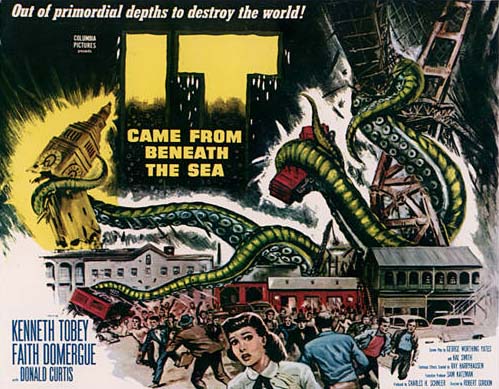
Creature Double Feature 2: IT CAME FROM BENEATH THE SEA and 20 MILLION MILES TO EARTH (Columbia, 1955 & 1957)


gary loggins's avatarcracked rear viewer

creature_double_feature_logo

Let’s return to those thrilling days of yore before CGI and enter the wonder-filled world of Special Effects legend Ray Harryhausen! I’ve covered some of Harryhausen’s fantastic work before (ONE MILLION YEARS BC EARTH VS THE FLYING SAUCERS THE VALLEY OF GWANGI ), and most of you regular readers know of my affection for his stop-motion wizardry. So without further ado, let’s dive right into IT CAME FROM BENEATH THE SEA.

itcame1

An atomic submarine picks up a mysterious large object on its sonar. The sub’s hit hard, and radiation is detected in the surrounding area. The damaged sub is taken to Pearl Harbor for repairs, and a substance found on it is determined to be from a “living creature” by eminent scientist Dr. John Carter (Donald Curtis) and beautiful marine biologist Prof. Leslie Joyce (Faith Domergue ). Sub Commander Pete Matthews (Kenneth Tobey ) and Leslie immediately butt heads…

View original post 866 more words