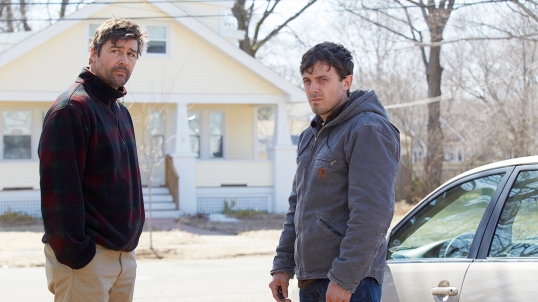
Playing Catch-Up: Manchester By The Sea (dir by Kenneth Lonergan)


manchester-by-the-sea-sundance-2016

Manchester By The Sea is the latest Oscar contender to be set in Massachusetts.  I’m not exactly sure why but it appears that if you want your film to get some sort of Oscar consideration, it’s always good idea to set it some place in New England.

Consider some of the films nominated for Best Picture since the 1992:

1992′ Scent of a Woman featured a New England prep school.

1994’s The Shawshank Redemption took place in Maine.

1997’s Good Will Hunting took place in Boston.

1999’s The Cider House Rules was set in Maine.

2001’s In The Bedroom took place in Maine.

2003’s Mystic River was set in Boston.

The 2006 winner The Departed was also a Boston-set film.

2010’s The Fighter also set in Boston.  For that matter, The Social Network started at Harvard.

2013’s Captain Phillips featured Tom Hanks speaking with Boston accent.

And, finally, last year’s Spotlight was as much a celebration of Boston as anything else.

As of this writing, it appears that Manchester By The Sea will continue the long tradition of New England-set films being nominated for best picture.  Interestingly, of all those films, Manchester By The Sea is probably the most low-key.  Though it’s a film that deals with death, it’s a natural death as opposed to the violent executions that dominated The Departed and Mystic River.  And though there are two bar fights, there’s very little violence to be found in Manchester By The Sea.  As opposed to Spotlight, Manchester By The Sea is not about moral crusaders battling against the corrupt establishment.

Instead, it’s the story of an intelligent but irresponsible man named Lee Chadler (Casey Affleck).  When Lee was a young man living in the town of Manchester-By-The-Sea, he was someone.  He was a high school hockey star.  He made an okay living, he had a lot of friends, and he was very close to his older brother, Joe (Kyle Chandler).  He was married to Randi (Michelle Williams) and he had two daughters.

And then he lost everything.  He lost his daughters, through a stupid accident for which he blamed himself.  Randi divorced him.  His friends abandoned him.  The only thing that prevented him from shooting himself was the intervention of Joe.  Lee eventually ended up in Quincy, Massachusetts, working as a maintenance man and keeping to himself.

And that’s probably what Lee would have done his entire life, if Joe hadn’t died.  Lee returns to Manchester-By-The-Sea and, to his shock, he discovers that he’s been named the guardian of Joe’s sixteen year-old son, Patrick (Lucas Hedges).  Still struggling with his own feelings of guilt, Lee now finds himself thrust into the role of being a father.

Patrick, of course, doesn’t think he needs a guardian and sometimes, it almost seems as if Patrick might be right.  At times, it’s hard not to feel that Patrick is a hundred times more mature than his uncle but occasionally, Patrick’s grown-up mask will slip.  When he learns that his father cannot be buried until the spring and the body will be kept in a freezer, Patrick stays calm until he opens up the freezer at home.  That’s when the reality of it all hits him and it’s an amazingly powerful moment.

Manchester By The Sea is not an easy film to describe.  There’s not much of a plot.  Instead, it’s just a portrait of people living from day-to-day, trying to juggle handling tragedy with handling everyday life.  Conditioned by previous films, audiences watch something like Manchester By The Sea and wait for some gigantic dramatic moment that will magically make sense of the human condition but, by design, that moment never comes.  That’s not what Manchester By The Sea is about.  If there is any great lesson to be found in Manchester By The Sea, it’s that life goes on.

Despite being full of funny lines, it’s a sad film but fortunately, it’s also a well-acted one.  I have to admit that I’m not as crazy about Manchester By The Sea as some of the critics who are currently declaring Manchester to be the best film of 2016 are but I can’t disagree with those who have praised Casey Affleck’s lead performance.  Lucas Hedges also does a good job as Patrick and Michelle Williams gets one revelatory scene in which she happens to randomly run into her ex-husband on the street.

As I said, I liked Manchester By The Sea but I didn’t quite love it.  It’s a well-made and well-acted film and, if it’s not as brilliant as some have claimed, it’s still worthy of respect.

Playing Catch-Up: The Nice Guys (dir by Shane Black)


the-nice-guys

Last night, along with seeing Trainspotting at the Alamo Drafthouse and watching The BFG at home, I also rewatched The Nice Guys.

Now, I saw The Nice Guys when it was first released last May and I absolutely loved it.  However, before I started rewatching it, I was a little worried .  I remembered that The Nice Guys was a stylish and often hilarious action film, one that featured a great comedic turn from Ryan Gosling and a performance from Russell Crowe that showed why he deserves to make a comeback as a leading man.  I also remembered that, for all of its graphic violence and often profane dialogue, The Nice Guys was also an unexpectedly sweet-natured movie.  I loved not only the rapport shared between Gosling and Crowe but also the relationship between Gosling and Angourie Rice, the actress playing his daughter.  In fact, I remembered enjoying The Nice Guys so much that I was worried that it wouldn’t hold up to a second viewing.

It often happens when you love a film the first time that you see it.  On a second viewing, you start to notice all the little flaws that you didn’t notice the first time.  Lines that you remembered as being brilliant are no longer impressive, largely because you know they’re coming.  All too often, the films that blow you away fail to hold up over time.

(Anyone tried to rewatch Inherent Vice lately?)

But you know what?

The Nice Guys is not one of those films.  I watched the film for a second time and I loved it even more than the first time.

The Nice Guys takes place in Los Angeles in 1977.  It’s a time of wide lapels, leisure suits, tacky interior design, porno chic, and concerns that the L.A. air is so full of smog that not even bumble bees are willing to fly around in it.  Ryan Gosling is Holland March, a well-meaning if somewhat sleazy private investigator who has been hired to track down a porn star named Misty Mountains.  Of course, Holland know that Misty is dead.  Everyone knows that she’s dead.  She died in a car crash, one that made all the headlines.  But Misty’s aunt swears that she saw Misty after Misty’s supposed death.

Holland thinks that Misty’s aunt may have mistaken her niece for Amelia Kutner (Margaret Qualley), the daughter of Judith Kutner (Kim Basinger, whose presence is meant to remind audiences of L.A. Confidential), an official at the Justice Department who has been leading a crusade against pornography.  Holland starts to search for Amelia which leads to Amelia paying Jackson Healy (Russell Crowe) to intimidate Holland.

Who is Jackson Healy?  Well, he’s not a licensed private investigator, though he’d certainly like to be.  Instead, he’s a professional enforcer.  If you pay him enough money, he’ll beat people up for you.  Usually, he beats up stalkers and ex-boyfriends.  When he discovers that Holland is a private investigator, Jackson is intrigued.  Jackson would like to be a private investigator.  Of course, that doesn’t stop Jackson from breaking Holland’s arm.  Jackson’s a professional, after all.  As Jackson leaves Holland’s house, he runs into Holly (Angourie Rice), Holland’s twelve year-old daughter.  She gives him a bottle of Yoohoo.

Later, Jackson is confronted by two men.  Keith David plays Older Guy and he’s intimidating because he’s Keith David.  His partner is a giggly sociopath played by Beau Knapp.  For reasons that are too much fun for me to spoil, he is known as Blue Face.  The two men demand to know where Amelia is.  After Jackson manages to chase them off with a shotgun, he teams up with Holland to try to track down Amelia and find out what’s going on…

Got all that?

The mystery — which eventually expands to involve everything from porn to political protest to the Detroit auto industry — is deliberately and overly complex but at the same time, it’s actually rather clever.  And, as I can now say after rewatching the film, it actually holds up quite well.  But, to be honest, the mystery is not as important as the whip smart dialogue, the frequently over the top action, and the chemistry between Gosling, Crowe, and Rice.  As good as the action may be, the film’s best scenes are simply the ones that feature the three leads talking to each other.

(Upon discovering that Jackson both broke her father’s arm and that he beats people up for a living, Holly immediately asks how much it would cost to have one of her friends beat up.)

And you know what?  As played by Gosling and Crowe, they really are the nice guys.  Holland tries to be cynical but, for the most part, he’s just an overprotective father.  Jackson may beat people up for a living but he’s not a sadist.  He’s a lot like the film, violent but with a good heart.

The Nice Guys is full of wonderful set pieces, like when Gosling, Crowe, and Rice infiltrate a sleazy 70s party or the film’s explosive finale.  For me though, I love the little details and the quieter moments.  I love the fact that even one of the worst people in the movie responds postively to having someone innocently hold his hand.

(I also love that Matt Bomer shows up, playing a totally terrifying hitman.  It’s a small role but Bomer does so much with it.)

It’s a shame that The Nice Guys came out as early in the year as it did.  It’s also a shame that it didn’t do better at the box office.  The Oscars could use a little action and a little comedy this year, don’t you think?

A Movie A Day #4: The Glory Boys (1984, directed by Michael Ferguson)


glory-boysProfessor David Sokarev (Rod Steiger) is a nuclear physicist who is scheduled to give a lecture in London.  When he is informed by Mossad that a Palestinian splinter group is planning on assassinating him, Sokarev wants to cancel his trip.  However, the Israeli government insists that he go to London and put his life in danger.  To do otherwise would only serve to embolden the terrorists.  Accompanied by two Mossad bodyguards, Sokarev reluctantly leaves for London.

Three Palestinians are intercepted as they attempt to sneak into England.  Two of them are killed but the youngest, Famy (Gary Brown), survives and makes his way to London.  He meets up with McCoy (Aaron Harris), a world-weary member of the Irish Republican Army.  Though McCoy would rather just spend his time with his innocent girlfriend, Norah (Sallyanne Law),  he has agreed to help the Palestinians but is shocked to discover that Famy is so inexperienced that he doesn’t even know how to drive.

The head of MI5, Mr. Jones (Alfred Burke), is tasked with keeping Prof. Sokarev safe.  He recruits Jimmy (Anthony Perkins), a retired agent.  Jimmy once saved Jones’s life but now he is an alcoholic and is considered to be unpredictable and insubordinate.  Once Jimmy comes out of retirement, Jones worries that Jimmy is so obsessed with violence that he’s willing to use Sokarev as bait to draw out the terrorists.

The Glory Boys was originally a three-part miniseries that was made for Yorkshire Television.  It was later re-edited into a 104 minute movie that was released in the United States.  Even late into the 1990s, it was not unusual to come across the edited version of The Glory Boys on late night television.  Based on a novel by Gerald Seymour, The Glory Boys holds up well and the issues that it raises, about how far the government should go to battle terrorism, remain relevant today.  Rod Steiger brings a lot of dignity to the role of Sokarev and Joanna Lumley has a small role as Jimmy’s girlfriend.  But ultimately, the main reason to see The Glory Boys is because of the strange casting of Psycho‘s Anthony Perkins as a British intelligence agent.  Perkins’s accent is dodgy but his jittery persona works surprisingly well for the role.  Jimmy (Is the name meant to be a swipe at the infallible persona of James Bond?) is ruthless, paranoid, and possibly sociopathic, which makes him perfect for intelligence work but worthless for almost every thing else.

For tomorrow’s movie a day, Anthony Perkins returns in another British spy film, ffolkes.

glory-boys-2

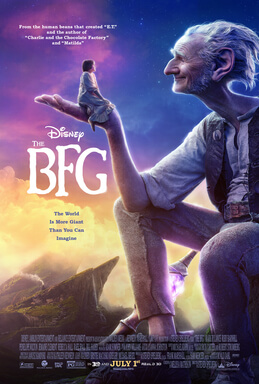
Playing Catch-Up: The BFG (dir by Steven Spielberg)


the_bfg_poster

I heard so many negative things about Steven Spielberg’s latest film, The BFG, that I was really expecting it to be terrible.  When it came out this summer, a lot of critics seemed to take an almost perverse delight in talking about its flaws and some people actually seemed to be thrilled over the fact that it flopped at the box office.

And I have to admit that the commercials that I had seen didn’t really fill me with much desire to actually sit through the movie.  Mark Rylance looked vaguely grotesque as the giant.  Add to that, I spent several months convinced that BFG stood for “Big Fucking Giant.”  Once I was reminded that he was actually a Big Friendly Giant, I was kinda like, “But wouldn’t my way be more fun?”

But anyway, I finally watched The BFG last night and it’s actually not terrible.  Don’t get me wrong.  It’s not great.  In many ways, this movie is Spielberg at his most sentimental.  Imagine if every triumphant musical cue in Lincoln was stretched out for two hours and you might have an idea as to how he approaches The BFG.  At times, I had a hard time following the film’s storyline, largely because the pacing was totally off.  As a director, Spielberg never seems to be quite sure if he’s making a film exclusively for kids or if he’s trying to make a film that adults can appreciate with their children.  It’s a tonal mess.

And yet, for all those weaknesses, The BFG has enough sweet moments that it feels a little bit churlish to be too critical of it.  Spielberg’s heart seems to be in the right place, even if he is struggling to figure out how to express himself.  As I watched the film, I felt bad about being so dismissive of what I had seen of Rylance’s performance in the commercials leading up the actual film.  Rylance gives a heartfelt and warm performance, playing a giant who, because he is so nice, is bullied by even bigger giants.

As I said, I struggled to follow the film’s story.  I knew that BFG had been forced to abduct an orphan named Sophie (Ruby Barnhill) because she saw him and he couldn’t risk her accidentally revealing his existence to the rest of the world.  I also understood that BFG also had protect her from the other giants because the last child he befriended was eaten by those other giants.  But then there was all this stuff about dream time and eventually, Queen Elizabeth II showed up and declared war on the evil giants and I was just so confused.  For once, Spielberg’s skills as a story-teller fail him.  It’s hard to believe that they same director who did the simple and economical Duel also did The BFG.

To be honest, the folks at Pixar, with their trademark mix of sentiment and subversion, would have been the ideal team to take on The BFG.  Spielberg’s instincts are so resolutely mainstream that he doesn’t seem to understand how to best approach some of the story’s more “out there” elements.  But that said, The BFG isn’t terrible.  Mark Rylance does a really good job as the giant and, as you would expect from any Spielberg film, the film is undeniably visually impressive.

The BFG may not be great but it’s not awful.

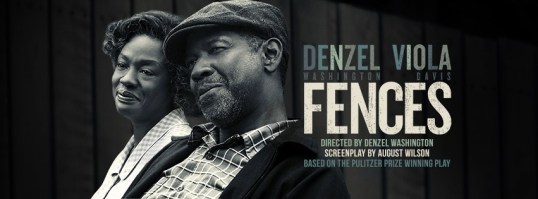
Playing Catch-Up: Fences (dir by Denzel Washington)


Well, 2016 is officially over and soon, it will be time for me to start posting my picks for the best of the year!  I’ve still got a lot of movies that I need to review (and, in some cases, watch) before making out that last so let’s not waste any time!  It’s time to start playing catch up!

fences

In Fences, Denzel Washington plays Troy Maxson.  When the film begins, Troy is 51 years old and lives in Philadelphia in the 1950s.  He’s a proud, charming, and often angry man.  He’s the type of man who can tell a wonderful story and who can make you laugh but, at the same time, you’re always aware that he could explode at any minute.  It’s hard not to like Troy Maxson but, at times, it’s hard not to be a little scared of him.

Troy is a garbage man, apparently destined to spend the rest of his working life hanging onto the back of a garbage truck because his union does not allow black to drive the trucks.  Troy has recently complained about the lack of black drivers and, as he tells his best friend, Bono (Stephen McKinley Henderson), he’s now expecting to be disciplined.  However, to his great surprise, he is instead reassigned to be a driver, making him the first black man to work as a driver for the Philadelphia Sanitation Department.

And that may not seem like much today but, as the film makes clear, that was a huge deal in the 1950s.

Troy, of course, didn’t grow up wanting to be a garbage man.  As he tells his son, Troy left home when he was just a teenager and made his living as a mugger.  During one robbery, he accidentally killed a man and spent the next decade in prison.  It was in prison that he first met and befriended Bono.  It was also in prison that Troy discovered that he was a pretty good baseball player.  Upon his release, he played for the Negro League.  Though everyone agrees that Troy was a good player (and Troy is always quick to claim that he was the best), he never played for the Major Leagues.  The film suggests that, after the league was integrated, Troy tried out but was rejected.  His wife, Rose (Viola Davis), says that Troy was rejected because, at the age of 40, he was too old.  Troy says it was because of the color of his skin.

As I said, it’s hard not to admire Troy.  He’s a man who stands up for himself and he seems to sincerely love his wife.  When his oldest son, a musician named Lyons (Russell Hornsby), comes by to ask for money, it’s hard not to laugh with and appreciate the style with which Troy shows his irritation.  Troy is so charming that, it’s only after Lyons leaves, that you realize that Lyons practically begged his father to come see him play and Troy pretty much blew him off.

And then there’s Troy’s youngest son, Cory (Jovan Adepo).  Cory is in high school.  He’s a football player and he’s recently been scouted by a college.  Troy tells Cory that he’s wasting his time and that no black man will ever be given a fair chance in the NFL.  He tells Cory that he needs to get a real job, like he did.  And as Troy continues to yell at Cory, you start to understand Troy’s jealousy.  Cory has an opportunity that Troy will never have, not due to any difference in talent as much as to the fact that Troy grew up at a time when segregation was the unquestioned law of the land whereas Cory is coming of age the beginning of the civil rights era.

At one point, Cory asks his father, “Why don’t you like me?”

“I don’t have to like you,” Troy replies and the words sting.

Troy is a character about whom you’ll have mixed feelings.  Beyond his anger at his son, he’s also exploiting his mentally impaired brother, Gabe (Mykelti Williamson).  Gabe has a metal plate in his head, the result of his service in World War II.  Gabe receives a monthly disability check and Troy has been using that money to support his family.

Through it all, Rose remains by his side, listening to him when he’s angry and, whenever she can get a word in, acting as his conscience.  But then, Bono asks Troy about his relationship with Alberta, the new girl at work and Troy confesses what the audience suspected.  Not only is Troy cheating on his wife but Alberta is pregnant….

Troy is a great character and Denzel Washington gives perhaps his best film performance in the role.  (Washington already played the role on stage.)  In many ways, Troy is a monster but, at the same time, it’s impossible not to feel for him.  His anger is real.  His selfishness is all too real.  But his pain and his (legitimate) frustrations are very real, as well.  Troy Maxson is a character who, like everyone, struggles to maintain his balance as he walks the line between right and wrong.  He makes several mistakes but he’s never less than fascinating and Washington’s volcanic performance is never less than enthralling.  Matching Washington every step of the way is Viola Davis, giving a powerful performance as the loyal but outspoken Rose.

In fact, the entire film is a master class of great acting.  (If Mykelti Williamson occasionally goes a bit overboard as Gabe, that has more to do with the character than the performer.)  Though the film is dominated by Washington and Davis, I think special mention has to be made of Stephen McKinley Henderson, who brings a lot of understated wisdom to the role of Bono.

Denzel Washington also directed Fences and, unfortunately, he’s not as good a director as he is an actor.  While he goes get brilliant performances from his cast, Fences never really breaks free from its theatrical origins.  It’s very much a filmed play as opposed to a cinematic work of art and, the few scenes that attempt to “open up” the play feel somewhat awkward.  In the end, Fences is best as a record of incredible acting.

A Movie A Day #3: The Firm (1989, directed by Alan Clarke)


the-firm1The Firm, which should not be confused with the John Grisham novel or the Tom Cruise film adaptation, was a 70-minute film about football hooliganism that was made for the BBC’s Screen Two in 1989.  In the United States, it has never really been understood just how big a problem football hooliganism was in the United Kingdom in the 1980s.   That’s because, despite the best efforts of ESPN, most Americans don’t care about soccer.  In America, “soccer riot” sounds like the punchline of a bad joke.  But in Europe, it was a very real problem.  If you want to understand why some people call football hooliganism “the English Disease,” The Firm is the film to see.

Clive “Bex” Bissell (Gary Oldman) has a nice home, a well-paying job as an estate agent, a loving wife (played by Lesley Manville, who actually was married to Oldman at the time), a newborn son, and a large circle of friends.  He’s also the head of the Inner City Crew, a violent group of football hooligans (known as a firm) who follow West Ham United across Britain and pick fights with other firms.  (Bex is actually a second-generation football hooligan and his father is constantly complaining that the new generation isn’t tough or violent enough.)  Bex does it for the buzz.  As another member of the ICC puts it, after listening to a fatuous television commentator going on about how football hooligans are actually searching for some sort of larger meaning in their lives,  “Why doesn’t he just say that we like hitting people?”  With the 1988 European Championships coming up, Bex wants to unite all the regional firms into one national organization, with himself in charge.  To do that, he’ll have to defeat two rival firm leaders, Oboe (Andrew Wilde) and Yeti (Phil Davis).

For a film about people about who are willing to kill over association football, very little soccer is actually seen in The Firm.  The ICC plays a game, which is interrupted by Yeti driving across the field.  Later, Yeti and his lieutenants walk through a stadium, looking for a fight and ignoring the match being played in front of them.  Bex’s childhood bedroom is covered with newspaper clippings about West Ham United but Bex is more interested in the buzz than in football.

The Firm is full of classic scenes, from Bex initiating the newest member of the ICC to the disturbing moment that Bex’s son gets a hold of his knife to the final bar brawl.   For me, my favorite scene is when the three rival firms hold a meeting in a posh hotel room:

Along with featuring one of Gary Oldman’s best performances, The Firm was also the last film to be directed by the great Alan Clarke.  Making good use of the steadicam walking shots that he was famous for and taking an unflinching approach to the story’s violence, Clarke not only directed the definitive film about football hooliganism but also provided a portrait of life in the final years of Margaret Thatcher’s Britain.

For tomorrow’s movie a day, we stay in Britain as Anthony Perkins fights terrorists in The Glory Boys.

the-firm

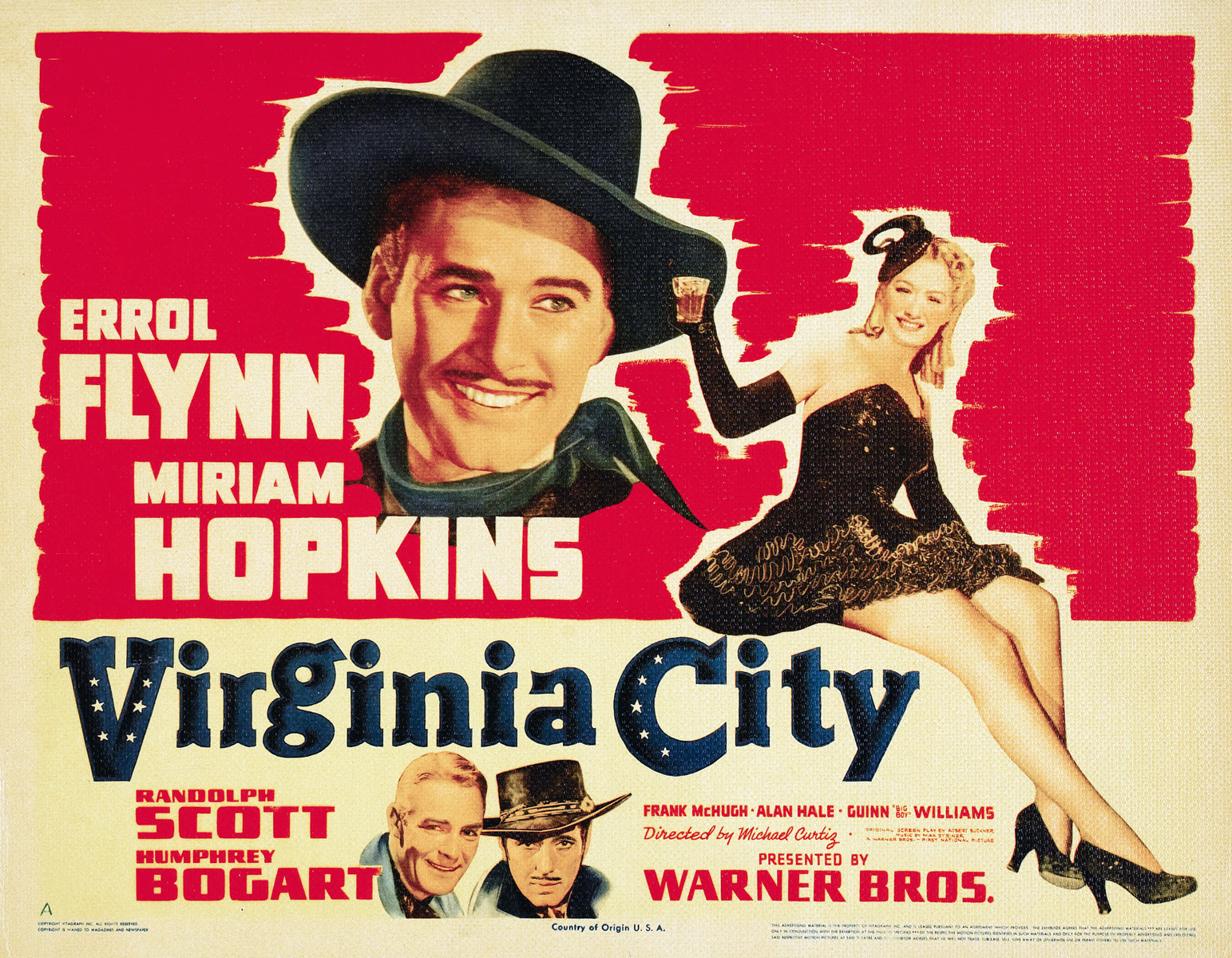
Rally ‘Round The Flag: Errol Flynn in VIRGINIA CITY (Warner Brothers 1940)


gary loggins's avatarcracked rear viewer

vc1

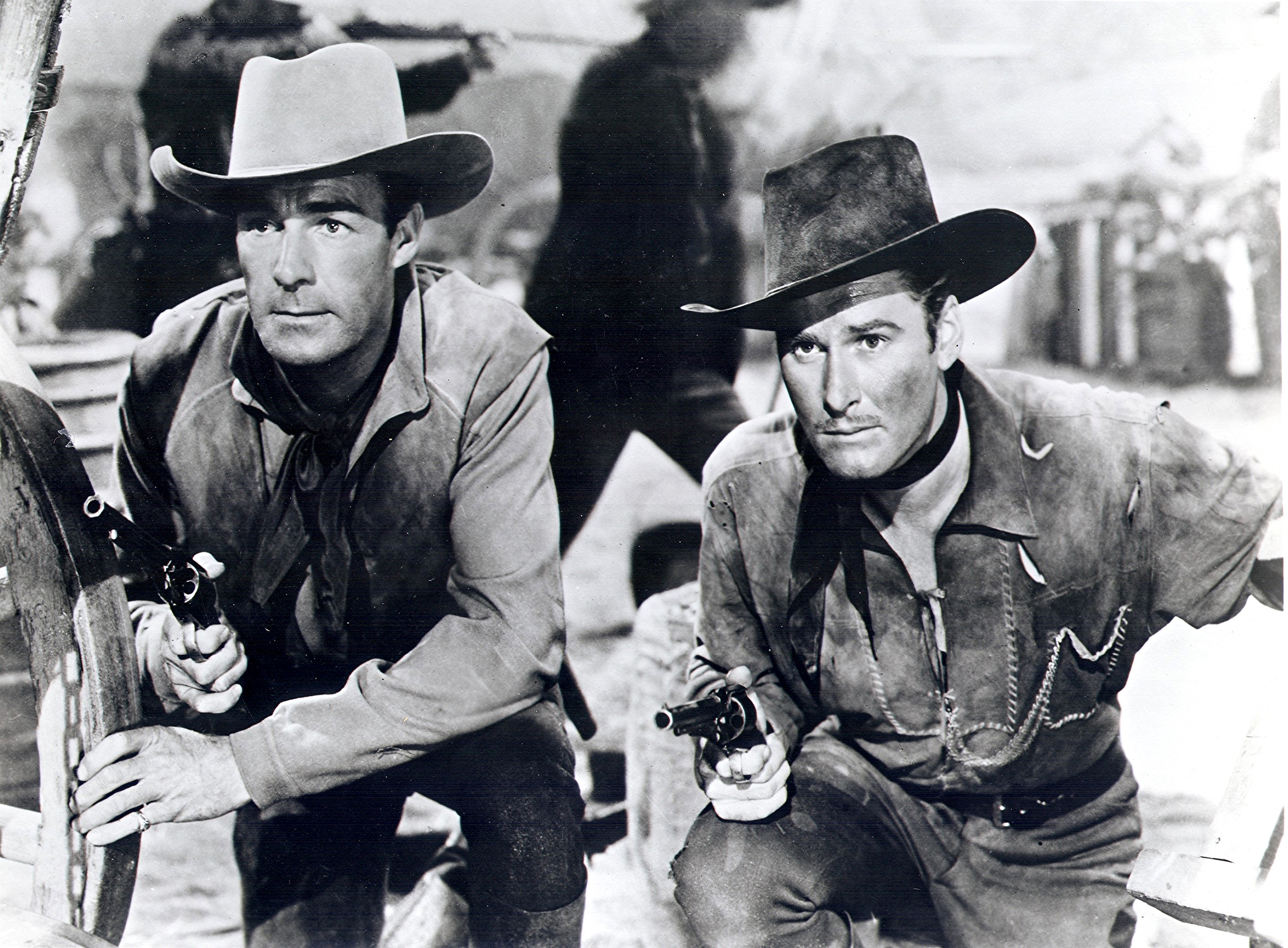
VIRGINIA CITY is a big, sprawling Western, filled with action, humor, and star quality. It’s the kind of movie they used to show around these parts every afternoon at 4 O’clock on DIALING FOR DOLLARS (George Allen was the local host), helping to spark my interest in classic films past, a flame which still burns bright today, two hours of pure entertainment, with square-jawed Errol Flynn going against square-jawed Randolph Scott backed by a Civil War setting and yet another sweepingly epic Max Steiner score.

vc2

We’re told “only the characters are fictional… The story is true” as we watch Union Captain Kerry Bradford (Flynn) and his two buddies Moose and Marblehead (Errol’s frequent co-stars/offscreen drinking compadres Alan Hale Sr and Guinn ‘Big Boy’ Williams) attempt to tunnel their way out of Libby Prison, aka ‘The Devil’s Warehouse’, when they’re caught by commanding Captain Vance Irby (Scott). He tells them Confederate troops…

View original post 689 more words

A Movie A Day #2: Blue Chips (1994, directed by William Friedkin)


blue_chips_movie_posterBlue Chips is a movie that will always make me think of England.

When I was a kid, I would spend every summer over in the UK.  When I flew over for the summer of ’94, the in-flight movie was Blue Chips.  I can still remember sitting in the back of the plane, trying to watch the movie on that tiny screen.  At the time, I did not pay much attention to Blue Chips.  It was about basketball, which was not something that I was interested in.  It also starred Nick Nolte, who, over the years, starred in a lot of the movies that I saw while flying over the Atlantic Ocean.  Try as I might, I could not understand a word that Nolte was saying.  It was impossible to separate his gravely voice from the drone of the plane’s engines.  I didn’t care much about Blue Chips.

Two months later, I was sitting in the back of my return flight when the flight attendant announced, “Our in-flight movie will be Blue Chips, starring Nick Nolte.”  Still not caring about basketball and still unable to understand a word that Nick Nolte was saying, I sat through Blue Chips for a second time.  What else was I going to do?  Step outside and go for a walk?

Looking back, I can understand why Blue Chips would be shown on a plane.  There’s nothing unconventional or controversial about Blue Chips.  It’s not going to start any fights or leave anyone offended.  Nick Nolte plays Pete Bell, a college basketball coach who, coming off of his first losing season, resorts to unethical measures to recruit three star players.  Ricky Roe (Matt Nover) is a farmboy from Indiana and his racist father wants the college to buy him a new tractor.  Penny Hardaway plays Butch McRae, whose mother (Alfre Woodard) wants a new house.  Neon Bordeaux (Shaq!) doesn’t want anything but still gets a new Lexus.   The corrupt head of the school’s booster club is named Happy and is played by J.T. Walsh.  Other than Happy Gilmore, has there ever been anyone in a movie named Happy who hasn’t turned out to be bad news?

Blue Chips was directed by William Friedkin, though you’d never guess that this by the numbers movie was from the same director who did The French ConnectionThe Exorcistor To Live And Die In L.A.  In his autobiography, The Friedkin Connection, he devoted just a few words to Blue Chips, saying, “It’s hard to capture, in a sports film, the excitement of a real game, with its own unpredictable dramatic structure and suspense. I couldn’t overcome that.”

Friedkin’s right but I’m always happy whenever I come across Blue Chips on cable because it reminds me of that long-ago summer in England.

For tomorrow’s movie a day, it’s another sports-related film that always makes me think about Britain: Alan Clarke’s The Firm.

blue-chips-nick-nolte

A Movie A Day #1: Stop Making Sense (1984, directed by Jonathan Demme)


stop_making_sense_poster_originalA pair of immaculate white sneakers, being worn by the lead singer of The Talking Heads, David Byrne, walk out onto a bare stage while an unseen audience applauds.  Byrne places a radio on the stage beside him and says, “I have a tape I want to play for you.”  Accompanied only by a drum machine and an acoustic guitar, Byrne launches into a performance of Psycho Killer that ends with him lurching across the stage like a marionette that is losing its strings.

So begins the greatest concert film of all time, Stop Making Sense.

As Psycho Killer comes to an end, Byrne is joined on stage by bassist Tina Weymouth.  While Byrne and Weymouth perform Heaven, the black-clad stage crew sets up a drum kit behind them.  Drummer Chris Frantz comes out for the third song, Thank You For Sending Me An Angel.  The fourth member of the Talking Heads, Jerry Harrison, appears on stage for Found A Job and is then followed by several touring members of the band, including legendary keyboardist Bernie Worrell, guitarist Alex Weir, percussionist Steve Scales, and backup singers, Lynn Mabry and Ednah Holt.  It’s not until the concert’s sixth song, Burning Down The House, that the entire band is on stage.

Pieced together from three separate shows performed at the Pantages Theater in Los Angeles, Stop Making Sense showcases one of the most important bands of the 80s at their absolute best.  Eschewing any candid footage of the band backstage and only occasionally showing any shots of the audience, Jonathan Demme keeps the focus on the music and David Byrne’s amazing showmanship.  Even more than the music, what really makes Stop Making Sense stand out is Byrne’s physicality.  During one instrumental passage, Byrne even runs around the stage in circles before jumping back to his microphone without missing a beat.

Though the entire band is in great form, Byrne is almost always the focus of attention.  The only time he’s not is when he goes backstage during a performance of Genius Of Love by Weymouth and Frantz’s side project, The Tom Tom Club.  During that time, Byrne is changing into the “big suit,” the costume that continues to define the Talking Heads to this day.

Along with Burning Down The House, highlights include Life During Wartime,

Swamp,

Once in a Lifetime,

and Stop Making Sense‘s most famous moment, David Byrne performing Girlfriend is Better while wearing the iconic “big suit.”

Stop Making Sense is a fun, exhilarating, and sometimes exhausting concert film and, given all the bad feelings that exist between Byrne and the other three members of the band, it’s probably as close as any of us will ever get to experiencing The Talking Heads live.

For tomorrow’s movie a day, I’ll be explaining why Blue Chips always makes me think of England.

Film Review: Finding Dory (dir by Andrew Stanton)


finding_dory

Finding Dory, the latest film from Pixar, tells the story of Dory (Ellen DeGeneres), a regal blue tang (for our readers in Vermont, that’s a fish) who suffers from short-term memory loss.  You may remember her from Pixar’s previous movie about fish, Finding Nemo.  In that movie, she helped a clownfish named Marlin (Albert Brooks) find his son, Nemo (voiced, in Finding Dory, by Hayden Rolence).  In the sequel, it’s Marlin and Nemo who are now helping Dory to find her parents.

Dory has spent years searching for her parents.  Of course, it would be easier if she didn’t suffer from short-term memory loss.  It seems that every time she sets out to track her parents down, she ends up getting distracted and forgets what she was doing.  However, while helping to teach a class about migration, Dory has a sudden flashback to her parents (voiced, quite charmingly, by Eugene Levy and Diane Keaton).  She sets out once again, determined to find her parents.  This time, Marlin and Nemo are accompanying her.  As Dory continually frets, she’s can’t do it alone because she can’t remember directions.

Though her memories are fuzzy and her flighty nature leads to some conflict with Marlin (who is just as cautious and overprotective of Nemo as he was in the first film), Dory eventually finds her way to where her parents were last seen.  And, in doing so, Dory discovers that she and her parents originally lived at a water park, the California Marine Life Institute.

(One of my favorite parts of the film is that apparently, Sigourney Weaver recorded several greetings and other messages that are played continuously over the Institute’s PA system.  “Hello, I’m Sigourney Weaver and welcome to the Marine Life Institute.”  Dory becomes convinced that Sigourney Weaver is some sort of God-like being who is leaving personal messages for her.  At one point, Dory exclaims, “A friend of mine, her name’s Sigourney, once told me that all it takes is three simple steps: rescue, rehabilitation, and um… one other thing?”)

Since this is a Pixar movie, Dory meets the usual collection of oddball and outcast sealife at the Institute, all of whom help her out while overcoming their own insecurities, providing properly snarky commentary, and hopefully bringing a tear or two to the eyes of even the most jaded of viewers.  Finding Dory is full of familiar voices, everyone from Idris Elba to Bill Hader to Kate McKinnon.  But, for me, the most memorable of all the voices (with the exception of Ellen DeGeneres herself) was Ed O’Neill’s.  O’Neill brought Hank, the bitter but ultimately good-hearted seven-legged octopus, to poignant life.  I imagine that, should there be another sequel, it will be called Finding Hank.

Finding Dory continues the annual tradition of Pixar films making me cry.  Finding Dory is an incredibly sweet and truly heartfelt movie but, at the same time, it’s also an extremely witty comedy.  This is one of those Pixar films where the joy comes not only from looking at the amazing animation but also from listening to truly clever dialogue being delivered by some of the best voice actors around.  DeGeneres does such a great job bringing Dory to life that, as the movie ended, my first instinct was to run out and buy a regal blue tang of my very own.  But then I read an article on Wikipedia, which explained why I shouldn’t do that.

(Basically, blue tangs may look cute but they have big, scary spikes that can cut up your hand.  As well, they don’t do well in captivity.  So, if you’re planning on getting a Dory of your very own, you might be better off just rewatching this movie…)

It’ll make you laugh.  It’ll make you cry.  Finding Dory is another great film from Pixar.