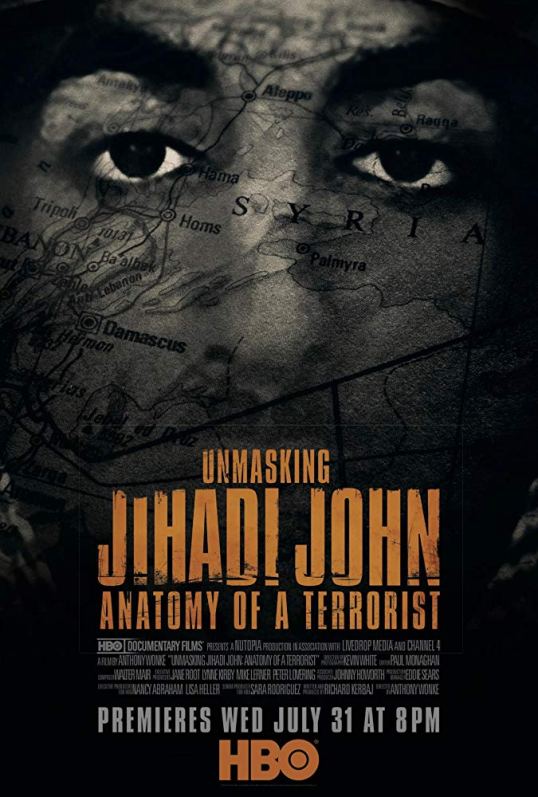
Documentary Review: Unmasking Jihadi John: Anatomy of a Terrorist (dir by Anthony Wonke)


Who was Jihadi John?

He was the black-clad terrorist who haunted the news in 2014 and 2015.  He was the faceless man with the London accent who was frequently filmed standing in the desert, taunting Barack Obama and David Cameron before then beheading a hostage.  In total, Jihadi John was filmed either beheading or directing others to behead 29 hostages.  Among his victims were American journalist James Foley and British aid worker David Haines.

Up until he was apparently blown up by a drone strike in 2015, Jihadi John was, for many of us in the West, the best-known member of ISIS.  When we heard the word “ISIS,” he was the one we pictured.  Because his face was always covered, his identity was unknown.  All we knew about him was that he spoke perfect English with a British accent.  He was like a creature sprung from a nightmare, a monster who materialized out of nowhere and taunted us for our inability to defeat him.  There was much speculation about who Jihadi John was.  Even after we found out that he was probably a Kuwait-born British citizen named Mohammed Emwazi, we still wondered how this man came to be standing in the desert, being filmed as he committed terrible crimes.

The new HBO documentary, Unmasking Jihadi John, is an investigation into the origins of terrorism.  The film attempts to reconstruct Emwazi’s early life as an outsider in the UK.  His teachers describe him as being quiet and somewhat forgettable.  Video from that period shows a skinny and awkward-looking teenager, one who covered his mouth whenever he spoke because he had once been taunted for having bad breath.  When he was ten, he wrote that he wanted to be a soccer player.  A few years later, he was caught on video, smiling while sitting in a computer lab.  And then, just a few years after that, he was in Syria, committing horrific acts of evil.  And make no mistake about it — the Emwazi who we see waving a knife while condemning the West is evil.  Evil comes in many disguises and will often try to justify itself by hijacking a religion or an ideology.  But in the end, evil is evil.

Because Emwazi was vaporized in 2015, he’s not around to explain just what exactly led him to join ISIS.  The film speculates that Emwazi initially joined because he was looking for both a surrogate family and a place where he actually belonged.  The documentary contains clips from several ISIS propaganda videos and what’s interesting is that the images that ISIS used — children playing in the streets, men working together to rebuild a city, and friends hugging each other — are many of the same images that one would expect to find in western advertising.  They’re seductive images, ones that offer up a promise of a better life as long as you follow orders and don’t question authority.  They were exactly the type of images designed to appeal to someone like Emwazi (and countless others), who had a need to feel as if they belonged to something bigger than themselves.

If the first half of the documentary focuses on Emwazi and the founding of ISIS, the second half deals with the aftermath of Emwazi’s actions.  Interviews, with the hostages who survived and the families of those who did not, drive home the pain that was caused by the actions of ISIS as a whole and Emwazi in specific.  It’s in those interviews that we are reminded that Emwazi’s evil cannot be excused by a turbulent childhood or misplaced idealism.  Towards the end of the documentary, the man who controlled the drone that fired the missile that ended Emwazi’s life is interviewed.  When we watch the grainy and coldly impersonal footage of Emwazi’s car blowing up, we feel no sympathy for the man who was called Jihadi John.   As to whether or not there’s joy to be found there, well, that’s up to the viewer to decide for themselves.

It’s a compelling documentary but it’s also frustrating, if just because it poses a question that may be impossible to answer.  Why does evil exist?  How can one go from being a normal, if awkward, teenager to being a savage murderer?  Like the rest of us, the documentary can only wonder why.

Film Review: Cold Pursuit (dir by Hans Petter Moland)


Released back in February (just in time for Valentine’s Day!), Cold Pursuit was this year’s Liam Neeson revenge flick.

This time, Neeson played Nels Coxman, a snow plow driver who speaks in a raspy tone of voice and tends to walk around with a thousand-yard stare on his face.  After his son is killed by gangsters, Nels sets out for revenge.  It turns out that Nels’s father was some sort of mob enforcer so both Nels and his brother (William Forsythe) have apparently inherited the “instinctively know how to kill” gene  So, while Nels’s wife (Laura Dern) stays at home and has a nervous breakdown, Nels heads out and starts killing folks.  Since the gangsters are led by an idiot named Viking (Tom Bateman), they all assume that they’re being targeted by a rival drug gang, one which is led by a Ute named White Bull (Tom Jackson).  So, while the two drug gangs are killing each other off, Nels is busy killing any stragglers that he comes across.  It all adds up to a lot of killing.

Cold Pursuit is different from other Liam Neeson revenge films by the fact that it’s an out-and-out parody of the genre.  So, while Neeson walks through the film with his usual glum expression and commits all the usual mayhem that we’ve come to expect from a vengeance-driven Neeson, everyone else plays their role as broadly as possible.  Tom Bateman leaves not a single piece of scenery unchewed in the role of Viking while Tom Jackson is stoic to the point of insanity in the role of White Bull.  Whenever a gangster gets killed, a title card appears, listing his name, his nickname, and his religion.  Meanwhile, two cops (Emmy Rossum and John Doman) prove to be comically ineffective.

And I will admit that I did laugh a few times while watching Cold Pursuit.  The scene where Neeson asks his brother to explain why everyone has a nickname made me smile.  Some of the murders are clever and the action scenes are frequently so over-the-top that you can’t help but be amused by them.

That said, Cold Pursuit didn’t really work for me.  I think the problem is that the filmmakers spent so much time trying to parody Neeson’s films that they didn’t consider that the majority of those films are themselves already parodies.  I mean, just watch The Commuter and tell me that film isn’t cheerfully winking at the audience.  Since Neeson’s screen persona hasn’t really been a serious one for close to ten years now, parodying it isn’t quite the subversive act that Cold Pursuit seems to think it is.  The difference between Neeson’s other films and Cold Pursuit is the difference between merely winking at an audience or pulling a gun on an audience while demanding, “LAUGH, DAMN YOU!”  Sometimes, the funniest jokes are the ones that you pretend you’re not making.

On the plus side, the film looks gorgeous.  It takes place in the Colorado mountains and makes great use of the frozen landscape.  And George Fenton’s score is nicely evocative and well-used in the film.  Finally, Liam Neeson is always fun to watch, even when it’s in a somewhat flawed film like this one.


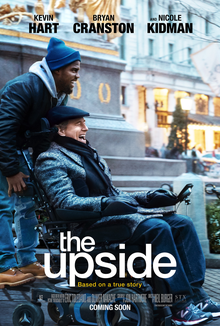
Film Review: The Upside (dir by Neil Burger)


There’s a lot of opera in The Upside.

That, in itself, is not a surprise.  The Upside is about a wealthy, emotionally repressed white man and, if there’s anything we’ve learned from the movies, it’s that wealthy, repressed white people always love opera.

Another things that we’ve learned from the movies is that wealthy, emotionally repressed white people always hire a streetwise person of color to help them learn to appreciate life.  This person  of color will inevitably not care for all of the opera and will then introduce the wealthy, emotionally repressed white person to their own type of music.  If the movie’s a comedy, that music will be rap.  If it’s a drama, that music will be jazz.  The Upside is a dramedy so the music of emotional liberation is Aretha Franklin.

There’s not a single cliche that goes unused in The Upside.  Actually, I take that back.  As opposed to so many other films of this short, Phillip (Bryan Cranston) does not start the film as a politically incorrect bigot, which means that we’re spared of any cringey scenes of Philip trying to bait Dell (Kevin Hart) by being casually racist.  Otherwise, every cliche imaginable is present in The Upside and it all gets to be a bit much after a while.  I’m sure that the film means well and there’s a part of me that felt a little bit guilty about not liking it but seriously, this is one of those movie’s that just keeps coming at you.

Phillip is a paraplegic who wants to die, though not before listening to a lot of opera.  Dell is an ex-con who needs to find a job so his parole doesn’t get revoked.  Yvonne (Nicole Kidman) is Phillip’s personal assistant.  She’s obviously in love with Phillip, though for some reason this fact is never acknowledged until the end of the film.

Together …. they solve crimes!

No, actually, they all become friends and learn the importance of celebrating life.  It’s a good lesson to learn, make no mistake.  But it’s just all so predictable that it’s hard not to resent just how thoroughly and blatantly the film insists on trying to manipulate you.  You get the feeling that the filmmakers didn’t have any faith in their audience’s capability to feel empathy.  Director Neil Burger did such a great job with Limitless but, with this film, he seems to have lost his sense of pacing.  The movie drags from one heartwarming cliche to another, without any hints of the type of quirky self-awareness that would help to make those cliches easier to digest.

Bryan Cranston’s a great actor but, perhaps realizing that he’s merely playing a more a benign version of Walter White, he seems a bit bored here while Nicole Kidman is sabotaged by a script that doesn’t allow her to do much other than reproachfully shake her head.  Kevin Hart, however, actually gives a pretty good performance, one that suggests that he actually has a lot of potential as a dramatic actor.  The character may be a stereotype but Hart at least brings a bit of energy to the film.

The Upside came out this January and it was actually a modest box office hit.  I imagine that a lot of people loved this film for the exact reason that I disliked it.  The film’s just too predictable for me to embrace The Upside.

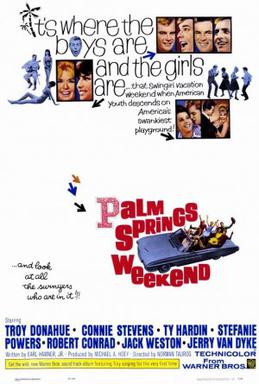
Film Review: Palm Springs Weekend (dir by Norman Taurog)


The 1963 film Palm Springs Weekend asks the question, “When is a beach film not a beach film?”

When it takes place in the freaking desert!

That’s right, Palm Springs Weekend takes place in the middle of the California desert.  There’s no ocean in sight nor are there any beaches on which to frolic.  Instead, there’s just a cheap motel and a swimming pool.  That said, Palm Springs Weekend pretty much follows the same formula as all of the beach films that were released in the early 60s.  A group of college students hop on a bus and head off for the weekend.  One student is wacky.  One student is rich, wild, and dangerous to know.  And, of course, one student is clean-cut, responsible, boring, asexual, and studious and all about doing the right thing.

Troy Donahue, the blandest teen idol of all time, plays the clean-cut student.  His name is Jim and he’s a college basketball star.  Even when he’s on the bus traveling to Palm Springs, he’s still got a book to study.  Jim’s the type who wears a suit and a tie to the pool.  He ends up falling in love with Bunny Dixon (Stefanie Powers) and the two of them spend a lot of time talking about sex in the most chaste way possible.  Bunny’s father (played by Andrew Duggan) is the chief of police and he doesn’t want any crazy college kids causing trouble in his town!  Well, it’s a pretty good thing that all he has to worry about is Troy Donaue asking his daughter if she wants to take a moonlight stroll in the middle of the desert.

(Trust me.  I’ve spent enough time in the desert to know that the last thing you want to do when you live near rattlesnakes is take a moonlight stroll.)

Jim’s best friend is Biff (Jerry Van Dyke).  Biff is the wacky college student, which means that he plays the ukulele and he gets all the comedic moments.  In this film, that amounts to getting babysitting an annoying boy and, at one point, falling into an extremely sudsy pool.  Luckily, Jim’s there to deliver CPR, which leads to soap bubbles floating out of Biff’s mouth and …. you know what?  I’m tired of writing about Biff.

Anyway, Biff and Jim really aren’t that important.  The entire film pretty much belongs to Robert Conrad and Connie Stevens, largely because they’re the only two actors who are allowed to break out of the trap of always either being bumbling and innocent or dramatic and self-righteous.  Robert Conrad plays Eric Dean, who is a spoiled rich kid who owns an expensive and fast car and who is basically a fun-loving sociopath.  Meanwhile, Connie Stevens plays Gail, who is a high senior and who is pretending to be a college student.  And while the film insists that we should somehow be disappointed in Gail because she’s acting wild and breaking curfew and doing more than just talking about whether or not it’s appropriate to kiss on the first date, she’s actually the most compelling character in the film because, at the very least, she’s actually setting her own rules and making her own decisions.  Since Palm Springs Weekend was made in 1963, it ultimately feels the need to try to punish Gail for thinking for herself but that doesn’t change the fact that she’s still a far more interesting character than the blandly innocent Bunny.  Gail’s a rebel.  Gail’s the future.  All hail Gail!

Anyway, Palm Springs Weekend is pretty forgettable and it’s never as much fun as any of AIP’s old Beach Party films.  That said, I’d still recommend it if you’re a history nerd like me.  It’s definitely a film of its time, a time capsule of an era.

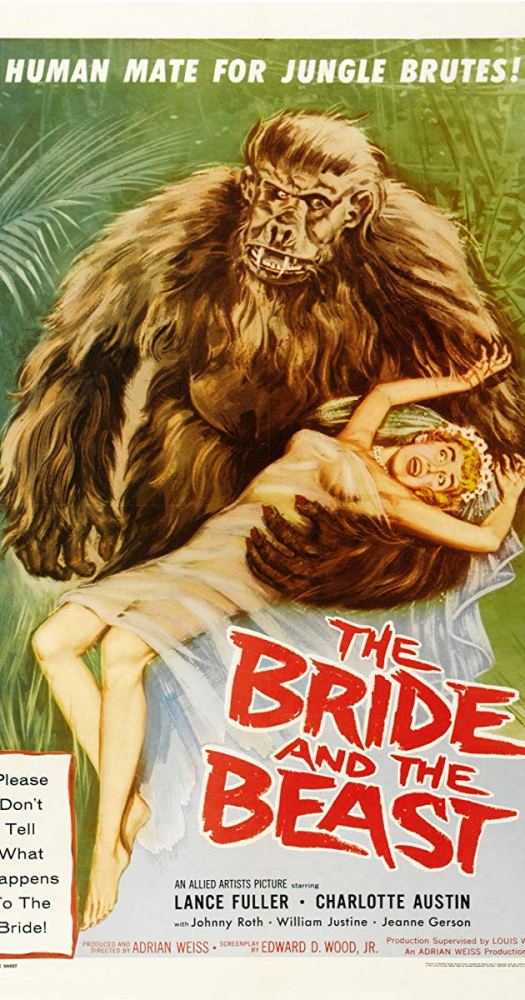
Jungle Boogie: Ed Wood’s THE BRIDE AND THE BEAST (Allied Artists 1958)


gary loggins's avatarcracked rear viewer

Reincarnation and past lives were popular themes in the 1950’s, mainly because of the success of THE SEARCH FOR BRIDEY MURPHY, which spawned a host of imitators. One of these was THE BRIDE AND THE BEAST, a bizarre take on the theme written by the legendary (for all the wrong reasons!) Edward D. Wood, Jr. In this incarnation of the reincarnation subject, we find a pretty young bride who improbably discovers she was once a fierce jungle gorilla!

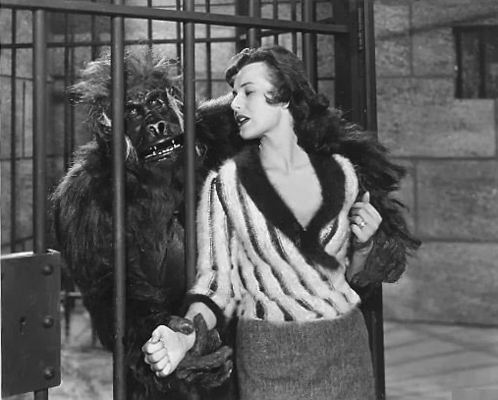
Big Game Hunter Lance Fuller and his new wife Charlotte Austin are honeymooning at his stately manor. She finds out he’s keeping a gorilla named Spanky in the basement to be shipped to a zoo, and gets a ‘sinister urge’ (sorry!) to see it. Charlotte goes ape over Spanky, and he obviously digs her, too. But worried Lance warns her to keep her paws off the big ape because he’s dangerous.

Later that…

View original post 521 more words

Film Review: The Hot Spot (dir by Dennis Hopper)


As befits the title, the 1990 film, The Hot Spot, is all about heat.

There’s the figurative heat that comes from a cast of characters who are obsessed with sex, lies, and murder.  There’s the literal heat that comes from a fire that the film’s “hero” sets in order to distract everyone long enough so that he can get away with robbing a bank.  And, of course, there’s the fact that the film is set in a small Texas town that appears to be the hottest place on Earth.  Every scene in the film appears to be drenched by the sun and, if the characters often seem to take their time from getting from one point to another, that’s because everyone knows better than to rush around when it’s over a hundred degrees in the shade.  As someone who has spent most of her life in Texas, I can tell you that, if nothing else, The Hot Spot captures the feel of what summer is usually like down here.   I’ve often felt that stepping outside during a Texas summer is like stepping into a wall of pure heat.  The Hot Spot takes place on the other side of that wall.

The Hot Spot is a heavily stylized film noir, one in which the the traditional fog and shadows have been replaced by clouds of dust and blinding sunlight.  Harry (Don Johnson) is a drifter who has just rolled into a small Texas town.  Harry’s not too bright but he’s handsome and cocky and who needs to be smart when you’ve got charm?  Harry gets a job selling used cars, though he actually aspires to be a bank robber.  Harry finds himself falling in love with Gloria (Jennifer Connelly), a seemingly innocent accountant who is being blackmailed by the brutish Frank Sutton (William Sadler).  Meanwhile, Harry is also being pursued by his boss’s wife, Dolly (Virginia Madsen), an over-the-top femme fatale who is just as amoral as Harry but who might be a little bit smarter.  Complicating matters is that, while Harry’s trying to rob a bank, he also ends up saving a man’s life.  Only Dolly knows that Harry isn’t the hero that the rest of the town thinks he is.  She tells him that she’ll keep his secret if he does her just one little favor….

The Hot Spot was directed by Dennis Hopper (yes, that Dennis Hopper) and, from the start, it quickly becomes apparent that he’s not really that interested in the film’s story.  Instead, he’s more interested in exploring the increasingly surreal world in which Harry has found himself.  The Hot Spot plays out at a languid pace, which allows Hopper to focus on his cast of small-town eccentrics.  (My particular favorite was Jack Nance as the alcoholic bank president who also doubles as the town’s volunteer fire marshal.)  The film is so hyper stylized that it’s hard not to suspect that every character — with the possible exception of Harry — understands that they’re only characters in a film noir.  For instance, is Dolly really the over-the-top femme fatale that she presents herself as being or is she just a frustrated housewife playing a role?  Is Gloria really an innocent caught up in a blackmail scheme or is she just smart enough to realize that the rules of noir requires her to appear to be Dolly’s opposite?  And is Harry being manipulated or is he allowing himself to be manipulated because, deep down, he understands that’s his destiny as a handsome but dumb drifter in a small town?  Do any of the characters really have any control over their choices and their actions or has everyone’s fate been predetermined by virtue of them being characters in a film noir?  In the end, The Hot Spot is more than just a traditional noir.  It’s also a study of why the genre has endured.

It’s a long and, at times, slow movie, one that plays out at its own peculiar pace.  As a result, some people will be bored out of their mind.  But if you can tap into the film surreal worldview and adjust to the languid style, The Hot Spot is a frequently entertaining and, at times, rather sardonic slice of Texas noir.

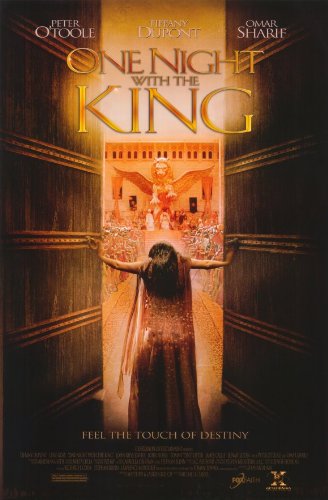
Film Review: One Night With The King (dir by Michael O. Sajbel)


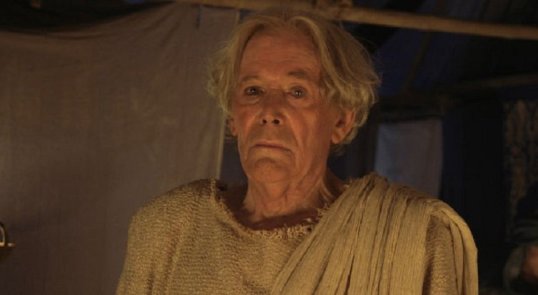
The 2006 Biblical film, One Night With The King, opens with God ordering King Saul to conquer and execute all of the Amalekites and their livestock.  However, as so often happened whenever God ordered him to do something, Saul manages to screw everything up.  He does conquer the Amalekites but he decides to keep their best livestock for himself and he also declines to execute the Amalekite king or his pregnant wife.  The prophet Samuel (played by an uncomfortably frail-looking Peter O’Toole) shows up and tells Saul that he’s screwed up for the last time.  Samuel goes off to execute the Amalekite king.  However, the queen escapes into the desert.

And that’s the last we see of her.  It’s also the last we see of O’Toole who, despite being top billed, has about a minute of screen time.

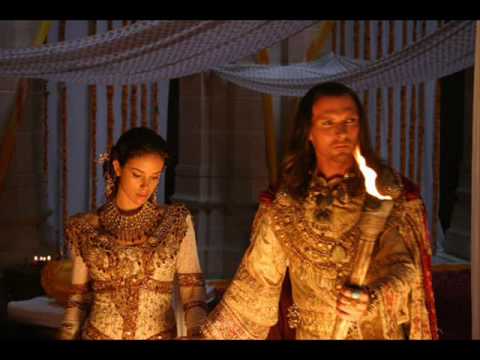
Jump forward several hundred years.  We are now in the city of Susa, Persia.  It’s the center of the known world.  We know this because characters tend to say stuff like, “We are living in the center of the known world.”  Xerxes (Luke Goss) is the king of Persia, a somewhat uncouth man who is obviously used to getting everything that he wants.  Xerxes is plotting on marching off to war.  However, his current wife is opposed to the war and refuses to attend Xerxes’s pre-war banquet.  Scandal!  Xerxes’s advisor, Prince Memucan (Omar Sharif, who co-starred with Peter O’Toole in Lawrence of Arabia), suggests that perhaps Xerxes should get a new wife.

Every female virgin in the city is brought to Xerxes’s palace so that, under the watchful eye of the king’s eunuch, Hegai (Tommy Lister, Jr.), they can compete for the chance to become queen.  Among the women is the beautiful Hadassah (Tiffany Dupont), who is the niece of one of the king’s scribes, Mordecai (John Rhys-Davies).  Hadassah does not tell the king that she’s related to Mordecai and instead says that her name is Esther.  With the help of Hegai, Hadassah soon emerges as the favorite to become the new queen.

Meanwhile, an evil man named Haman (Boo!  Haman!  Boo!) has shown up on the scene.  Haman (played by James Callas) is a descendant of the Amalekites that Saul failed to destroy.  (Dammit, Saul!)  A greedy astrologer, Haman (Boo!) has been appointed to the position of vizier by Xerxes.  Haman (hiss!) demands that all of the king’s servants bow before him.  However, because he has a pagan symbol sewn onto his clothes, Mordecai refuses to do so.  Driven by hate (Boo!), Haman makes plans to execute not only Mordecai but every other Jew in Persia.  With the king unaware of Haman’s intentions, only Hadassah can stop his plans but to do so, she’ll have to risk seeing the king unsummoned….


The story of Esther, Mordecai, the king, and the moment that Haman (Boo!) discovers that karma is a bitch has always been one of my favorites so I’ve always enjoyed One Night With The King whenever I’ve watched it.  Don’t get me wrong.  It has its flaws.  Though the film does a pretty good job of recreating the past on a low budget, it’s still one of those films that’s full of awkward exposition, cringe-worthy dialogue, and more than a few inconsistent performances.  (Sharif and O’Toole, for instance, both go through the motions, doing just enough to pick up a paycheck.)  At the same time, Luke Goss is properly rough-around-the-edges as the king and Tiffany DuPont is well-cast as Hadassah.  Tommy Lister, Jr. appears to be having a lot of fun in the role of the world’s most unlikely eunuch and, as a result, he’s entertaining to watch.  Visually, it’s a pretty film and the costumes are to die for, as they should be in any film about a royal romance.  And, even if the story is at times awkwardly told, it still reaches a deeply satisfying conclusion.

James Callas is convincingly evil and properly detestable as Haman (Boo!  Haman!  Boo!).  Haman is an archetype of evil, the ant-Semite whose evil legacy has continued to haunt the world in the centuries since he met his own fate.  Though the film at times spends too much time playing up the romance between the king and Hadassah (which, while nice to watch, is not the point of the source material), One Night With The King does include enough scenes of Haman (hiss!) ranting to make clear the link between Haman and the anti-Semitism of the Nazis and those modern day hate mongers who try to hide their bigotry behind claims that they are “only criticizing Israel.”  Haman’s evil makes his final fate all the more satisfying but the film leaves no doubt that, unless the world remains vigilant, there will always be new Hamans threatening to come to power.  That’s an important enough message to make up for many of the film’s missteps.

One Night With The King is a flawed, low-budget film.  But I like it.


Film Review: L.A. 2017 (dir by Steven Spielberg)


L.A. 2017 is the Steven Spielberg film about which you’ve probably never heard.

To a certain extent, that’s understandable.  Spielberg was only 24 when, in 1971, he directed L.A. 2017.  It was a film that he directed for television.  In fact, it was only his third directorial assignment.  As opposed to the huge budgets that we tend to associate with a typical Spielberg production, L.A. 2017 was made for about $300,000.  The entire film was shot in about 12 days.  In fact, with a running time of only a scant 69 minutes, L.A. 2017 hardly qualifies as a feature-length film.  L.A. 2017 has never been released on DVD or Blu-ray, making it a true oddity in Spielberg’s filmography.  Despite the fact that Spielberg has credited L.A. 2017 with opening a lot of doors for him, it’s an almost totally forgotten film.

Of course, some of that is because L.A. 2017 really isn’t a film at all.  Instead, it was an episode of a television show called The Name of the Game.  The show was about Glenn Howard (Gene Barry), a magazine publisher, and the reporters who worked for him.  L.A. 2017 was unique in that it was the show’s only excursion into science fiction.  In fact, from everything that I’ve read about the show, it appears that L.A. 2017 was nothing like any of the other episodes of The Name of the Game.  This episode was also unique because Spielberg directed it as if he was making a feature, as opposed to just another installment in a weekly series.  If not for the opening credits (which announce, among other things, that we’re watching a Robert Stack Production), one could easily imagine watching L.A. 2017 in a movie theater, perhaps as a double feature with Beneath The Planet Of The Apes.

L.A. 2017 opens with Glenn driving down a mountain road in California.  He’s heading to a pollution summit and, as he drives along, he awkwardly dictates an editorial into a tape recorder.  Glenn worries that society may have already ruined the environment to such an extent that the Earth cannot be saved.  As if to prove his point, Glenn starts to cough as he’s overcome by all of the smog in the air.  His car swerves into a ditch and Glenn is knocked unconscious.

Welcome to the future

When he wakes up, he finds himself being rescued by men wearing wearing protective suits and masks.  The sky is a sickly orange and an ominous wind howls in the background.  Glenn’s rescuers take him to an underground city where he discovers that, somehow, he has traveled through time.  The year is now 2017, which in this film looks a lot like the 70s except that everyone’s now underground and the landline phones are extra bulky.  (Needless to say, watching 1971’s version of 2017 in 2019 is an interesting experience.)  It turns out that the pollution got so bad that the surface of the planet became uninhabitable.  The U.S. is now run by a corporation that is headquartered in Detroit.  (Presumably, the Corporation is a former car company.)  The U.S. is also at war with England, for some reason.  No mention is made about what’s happened to Canada but, if Detroit’s still around, I assume at least some of Canada managed to survive as well.

The …. uh, Future.

Everyone in the future drinks a lot of milk and, when they’re not listening to cheerful announcements, they’re listening to the soothing music that the Corporation provides for them.  Everyone in the future is also very friendly.  We know this because everyone keeps assuring Glenn that he’s surrounded by friends.  In fact, everyone in the future refers to one another by their first name because “it’s friendlier.”  It’s also the law.  It turns out that there’s a lot of laws in the future.  In fact, the underground cities are pretty fascist in the way that they handle things.  There are constant announcements encouraging people to pursue a career in law enforcement and anyone who disagrees with the Corporation ends up in a straight jacket.  Glenn feels that maybe he’s been brought to the future so he can start a new magazine and challenge the status quo.  The Corporation disagrees….

This is what happens when you don’t go underground in the future.

Okay, so there’s nothing subtle about L.A. 2017.  From the villainous corporation to the heavy-handed environmental message, there’s nothing here that you haven’t seen in dozens of other sci-fi films.  But the lack of subtlety doesn’t matter, largely because Spielberg directs with so much energy and with such an eye to detail that it’s impossible not to get sucked into the story.  As opposed to the somewhat complacent Spielberg who has recently given us rather bland and safe blockbusters like Lincoln, The BFG, and The Post, the Spielberg who directed L.A. 2017 was young and obviously eager to show off what he could do with even a low budget and that enthusiasm is present in every frame, from the wide-angle shots of Glenn driving his car to the scenes of Glenn looking up at the shadowy executives and scientists who are staring down at him when he’s first brought to the underground city.  As opposed to the sterile vision of so many other future-set films, Spielberg’s future feels as if it’s actually been lived in.  When Glenn finds himself in a new world, it comes across as being a real world as opposed to just a narrative contrivance.

Of course, because L.A. 2017 was just one episode in a weekly series, Glenn couldn’t remain in the future and L.A. 2017 returns Glenn to the present in the most contrived and predictable way possible.  Still, L.A. 2017 remains an entertaining example of what a young and talented director can do when he’s determined to be recognized.  Watching the film, it’s easy to draw a straight line from Spielberg doing L.A. 2017 to doing Duel and then subsequently being hired for Jaws.

Incidentally, Joan Crawford is somewhere in this film.  Crawford worked with Spielberg when he directed her in the pilot for Night Gallery and she was one of his first major supporters in Hollywood.  Apparently, in L.A. 2017, she plays one of the people staring down at Glenn when he’s first brought into the underground city.  I haven’t found her yet but she’s apparently there somewhere.

Unfortunately, L.A. 2017 has never been released on DVD or Blu-ray but it is currently available on YouTube.

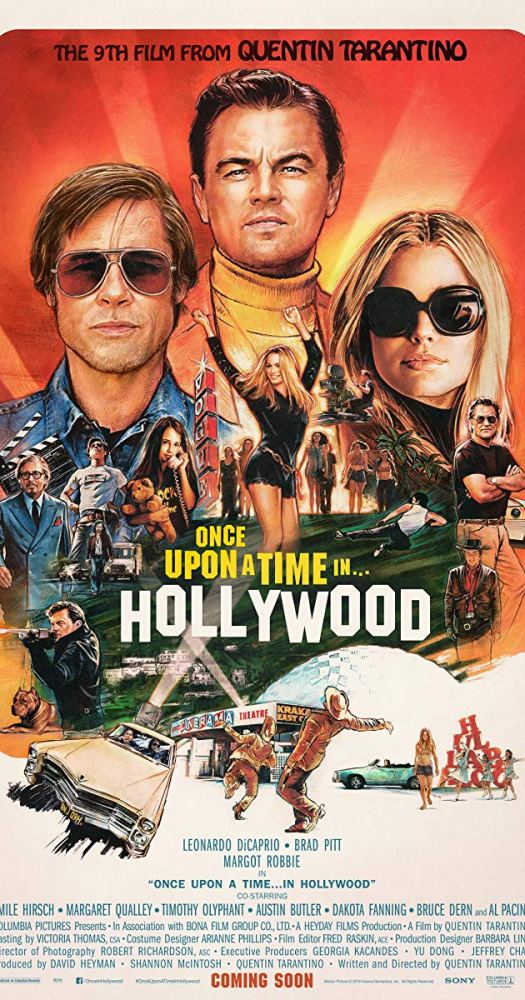
Boulevard of Broken Dreams: Quentin Tarantino’s ONCE UPON A TIME IN HOLLYWOOD (Sony/Columbia 2019)


gary loggins's avatarcracked rear viewer

If you’re as much of a movie/television/pop culture fanatic as I am (and if you weren’t, you probably wouldn’t be reading this blog!), I’m here to tell you you’re gonna ABSOLUTELY FUCKING LOVE this latest Quentin Tarantino epic!

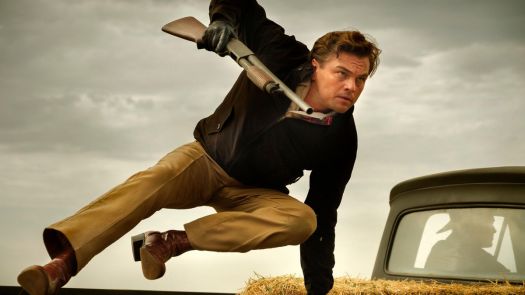
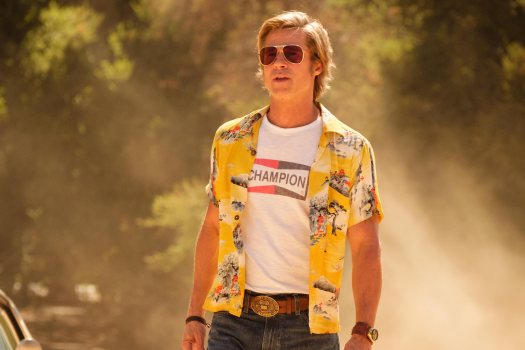
ONCE UPON A TIME IN HOLLYWOOD takes place in 1969, at the tail end of Tinseltown’s Glory Days, and the tail end of TV actor Rick Dalton’s career. Dalton (splendidly played by Leonardo DiCaprio) was the star of the late 50s/early 60s TV Western BOUNTY LAW (modeled after Steve McQueen’s WANTED: DEAD OR ALIVE), whose drinking problem has led him on the road to nowheresville, grabbing quick paychecks by guest starring as bad guys on episodic TV. He’s offered the chance to make some low-budget Spaghetti Westerns by producer Marvin Schwarsz (a bloated looking Al Pacino), bottom of the barrel stuff that’ll keep Rick’s name above the title.

Rick’s best bud Cliff…

View original post 529 more words

Film Review: Dumbo (dir by Tim Burton)


Tim Burton’s remake of Dumbo actually wasn’t that bad.

I know!  I’m as shocked as anyone.  Usually, I’m against remakes on general principle and I’m certainly not a fan of the current trend of doing live-action versions of classic animated films.  (There’s a reason why I haven’t seen the new The Lion King.)  Dumbo is one of my favorites of the old Disney films, one that’s always brought tears to my mismatched eyes so I was naturally predisposed to be critical of the remake.  Add to that, I’m not particularly a huge fan of Tim Burton, a director who too often seems to be coasting on his reputation for being a visionary as opposed to actually being one.

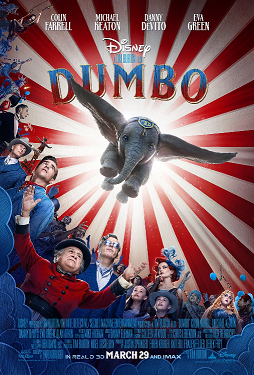
And yet, I have to admit that I enjoyed this new version of Dumbo.  To call it a remake is actually a mistake.  It’s a reimagining, as I suppose any live action remake of an animated film about a flying elephant, a talking mouse, and a group of sarcastic crows would have to be.  So, the crows are gone, which is understandable as I doubt you could get away with a bird named “Jim Crow” today.  And sadly, Timothy the Mouse is gone.  He’s been replaced by several human characters, including Colin Farrell as a one-armed, former equestrian, Eva Green as a French trapeze artist, and Danny DeVito as the rough-around-the-edges but good-hearted ringmaster.  However, Dumbo’s still present and he’s still got the big ears.  He can still fly, as long as he’s holding a feather.

Dumbo’s only a CGI elephant but he’s still adorable.  Of course, I should be honest that I’ve always loved elephants.  I even rode one at Scarborough Fair once!  It was like a totally bumpy and somewhat uncomfortable ride but, at the same time, it was also totally cool because I was on top of an elephant!  The other thing I love about elephants is that elephants form real families.  They love each other.  They look out for each other.  They mourn their dead, which is one of many reasons why ivory poachers are some of the worst people in the world.  Elephants may not fly but there’s a sweetness to them that makes the story of Dumbo and his mother extra poignant, regardless of whether it’s animated, CGI, or live-action.  Anyway, the remake’s version of Dumbo is absolutely lovable, from the minute he reveals his ears to the triumphant moment when he soars through the circus tent.

As a director, Tim Burton has always struggled with pacing.  Watching his films, you always dread the inevitable moment when he gets distracted by a red herring or a superfluous storyline because you know that, once it happens, the entire film is going to go off the rails.  Dumbo starts out slowly and it seems like forever before the baby elephant actually shows up.  Fortunately, once Dumbo does show up, Burton’s direction becomes much more focused.  The story stops meandering and, for once, Burton actually manages to maintain some sense of narrative momentum.

Visually, the film’s a feast for the eyes.  Even though it’s a live-action film, the sets and the costumes are all flamboyantly and colorfully over-the-top, giving the film the feeling of being a child’s imagination come to life.  I mean, when you’re making a film about a flying elephant, there’s no point in trying to go for gritty realism.  While the film does mention some real-world tragedies — Farrell lost his arm in World War I and his wife to Spanish Flu — Burton plays up the fantasy elements of the story.  He’s helped by Danny DeVito and Michael Keaton who both give cartoonishly broad performances.  Fortunately, they’re both good enough actors that they can get away with it.

So, the live-action reimagining of Dumbo is not that bad.  It has its slow spots and it really can’t match the emotional power of the original animated version.  But, with all that taken into consideration, it’s still an undeniably entertaining two hours.