Cleaning Out The DVR: Get Over It (dir by Tommy O’Haver)


“I wouldn’t play with that, Kelly,” Berke Landers (Ben Foster) says as Kelly Woods (Kirsten Dunst) playfully aims a crossbow at him.

Kelly laughs and tells him that it’s just a prop.

Berke suggests again that she should probably stop aiming it at him.

Kelly laughs and proceeds to fire an arrow straight into Berke’s arm.

The next scene, of course, is Berke in the back of an ambulance, groaning in terrible pain while Kelly apologizes and a paramedic repeatedly warns Berke not to look at his arm.  In most movies, that would seem like a pretty dramatic plot development and, at the very least, you would expect that Berke would try to avoid Kelly and perhaps have his arm in a sling for the rest of the film.  In the 2001 film, Get Over it, Berke recovers rather quickly, he and Kelly fall in love, and the film ends with Kelly making a joke about how she thought the crossbow was a prop.

That’s just the type of film that Get Over It is.  This is a film from the age when all teen comedies were very loosely based on Shakespeare and they usually had a three word name like She’s All That or Drive Me Crazy or …. well, Get Over It.  Ben Foster has the type of role that would usually go to Freddie Prinze, Jr.  Sisqo has the Usher rule of the supercool sidekick who raps over the end credits.  Shane West speaks with a British accent and steps into the Matthew Lillard role of the obnoxious teen celebrity.  Melissa Sagemiller is the girl who the main guy thinks he’s in love with while Martin Short plays the eccentric and overdramatic theater teacher.  And finally, Kirsten Dunst gets to play another version of her Bring It On role as the quirky and perky girl who wants to do the right thing.  Meanwhile, Zoe Saldana, Mila Kunis, Colin Hanks, Swoosie Kurtz, and Ed Begley, Jr. all have small parts.  It’s a good cast, if nothing else.

Get Over It centers around a high school production of a musical version of A Midsummer’s Night Dream.  Basketball star Berke auditions for the play because he thinks that it will convince his ex-girlfriend, Alison (Sagemiller) to take him back.  Instead, Alison ends up falling for the duplicitous Striker Scrumfeld (West), who has the exact type of personality that you would expect someone named Striker Scrumfeld to have.  Meanwhile, Berke is falling in love with Kelly, who is the sister of his friend, Felix (Colin Hanks).

It’s all very predictable but, at the same time, the cast is absolutely charming and there’s enough quirky humor to make it memorable.  I’ve watched Get Over It several times and, every time that I rewatch it, I’m always a little bit surprised to rediscover just how funny it actually is.  For instance, as Berke leaves Alison’s house after being dumped by her, Vitamin C and a marching band suddenly appear behind him and start to perform Love Will Keep Us Together until Berke finally loses it and starts screaming.  The musical production of A Midsummer’s Night Dream is the perfect parody of every pretentious high school play ever produced and Martin Short cheerfully throws himself into being the director for Hell.  Ben Foster is a bit too intense to be a romantic or, for that matter, comedic leading man but the rest of the cast is enjoyably laid back and fully embrace their quirky roles.

Get Over It may not be a classic but it is a fun 90 minutes.

Lisa Reviews An Oscar Winner: The Silence of the Lambs (dir by Jonathan Demme)


Oh, The Silence of the Lambs, I have such mixed feelings about you.

On the one hand, I’m a horror fan and Silence of the Lambs is a very important film in the history of horror.  Back in 1992, it was the first horror film to win the Academy Award for Best Picture!  It even made history by winning all of the big “five” awards — Picture, Director, Actor, Actress, and Adapted Screenplay!  It was the first film since One Flew Over The Cuckoo’s Nest and It Happened One Night to pull that off!

Beyond that, it’s one of the most influential films ever made.  Every erudite serial killer owes a debt to Anthony Hopkins’s performance as Hannibal Lecter.  Every competent but untested and unappreciated female FBI agent owes a debt to Jodie Foster’s performance as Clarice Starling.  Even though the whole criminal profiler craze probably owes more to Manhunter (a film to which Silence of the Lambs is a sequel, though that often seems to go unacknowledged) than to anything else, this Oscar winner still definitely played a part.  I mean, how many people watched Manhunter for the first time, specifically because Lecter mentioned the events in that earlier film in Silence of the Lambs?

Plus, this won an Oscar for Jonathan Demme, one of my favorite directors!  And while I’m sure Jodie Foster would have gone on to have a strong career regardless of whether she had played Clarice Starling or not, it’s generally acknowledged that Silence of the Lambs revitalized the career of Anthony Hopkins.  So for that, we should all be thankful.

And yet, it can be strange to watch Silence of the Lambs today.  All of the imitations (not to mention some ill-thought sequels and prequels) have lessened its bite.  I can only imagine how it must have freaked out audiences when it was first released but I have to admit that I was slightly disappointed the first time that I watched the film.  Looking back, I can see that disappointment was due to having been told that it were one of the scariest movies of all time but, because, I had seen a countless number of imitations, parodies, and homages, I felt as if I had already watched the film.  So, I wasn’t shocked when Lecter turned out to be ruthlessly manipulative and dangerously charismatic.  Nor was I shocked when he managed to escape and poor Charles Napier ended up strung up in that cage.  I’m sure that audiences in 1991 were freaked out, though.

Actually, as good as Foster and Hopkins and Scott Glenn are, I think the best performance in the film comes from Ted Levine, playing Buffalo Bill.  Seriously, Levine’s performance still freaks me out.  It’s the voice and the way he says, “Precious.”  Levine’s performance, I found to be a hundred times more frightening than Anthony Hopkins’s and I think it’s due to the fact that Hannibal Lecter was clearly an author’s invention while Levin’s Buffalo Bill came across like he might very will be hiding in an alley somewhere, waiting for one of your friends to walk by. (Interestingly enough, I had the same reaction when I first saw Manhunter.  Brian Cox did a good job as Lecter but he still came across as a bit cartoonish.  Meanwhile, Tom Noonan was absolutely terrifying.)  Levine has subsequently gone on to play a lot of nice guy roles.  He was a detective on Monk, for instance.  Good for him.  I’m glad to see he was able to escape being typecast.  Admittedly, I do kinda wonder how many serial killer roles he had to turn down immediately after the release of The Silence Of The Lambs.

Still, it’s a good film.  Time may have lessened it’s power but The Silence of the Lambs is still an effective and well-directed thriller.  It’s impossible not to cheer for Clarice.  It’s impossible not to smile at the fun that Anthony Hopkins seems to be having in the role of Lecter.  Jonathan Demme creates a world of shadows and darkness and still adds enough little quirks to keep things interesting.  (I especially liked Lecter watching a stand-up special in his cell.)  It’s the little details that makes the world of The Silence of the Lambs feel lived in, like Clarice’s nervous laugh as she gives a civilian instructions on what to do in case she accidentally gets trapped in a storage locker.  Even the film’s final one liner will make you smile, even though it’s the type of thing that every film seemed to feel the need to do nowadays.  It’s still a good movie, even if it no longer feels as fresh as it once may have.

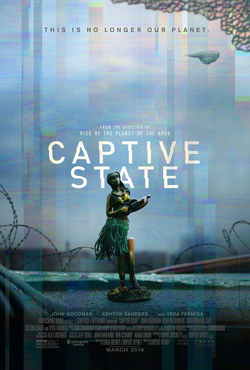
Icarus File No. 4: Captive State (dir by Rupert Wyatt)


Does anyone remember Captive State?

Captive State came out in March and, before it was released, it seemed like it had the potential to be something special.  The trailer looked good.  The cast was impressive.  Perhaps even more importantly, the film was directed by Rupert Wyatt, who did such a good job with Rise Of The Planet Of The Apes.  Surely, if anyone had the talent to create a convincing film about life under an alien dictatorship, it would be Rupert Wyatt!

In fact, my only reason for concern had to do with when the film was being released.  March seemed like a very strange time to be releasing a big “event” film.  Don’t get me wrong.  A March release isn’t as bad as a January or even a February release.  I mean, unless your film is a romantic comedy, you definitely do not want it to be released in either one of those two months.  Those months are where studios dump their worst films so that they can die a quiet death.  March, on the other hand, is when the studio releases films that have the potential to be a success but which they’re still not expecting to set the world on fire.

Of course, there have been exceptions to that rule, as both Wes Anderson (Grand Budapest Hotel) and Jordan Peele (Get Out) can tell you.  So, as Captive State’s release date approached, we were left to wonder.  Would this be another case of a film being better than it’s release date or would this be just another forgettable but not terrible movie that the studio probably spent a bit too much money on?

Captive State, sadly, turned out to be more of a case of the latter than the former.

The film opens with Chicago being invaded in 2019.  Significantly, unlike other recent invasion films, this one doesn’t spend too much time on the invasion itself or Earth’s initial attempts to fight back.  Instead, it jumps forward eight years, to 2027.  The aliens are in control of Earth, though the aliens themselves claim to only be “legislators” who are governing the planet for our own good.  While the majority of Earthlings just seem to be resigned to accepting being conquered as their new normal, there are a few resistors.  There’s also quite a few collaborators.  The tricky part of life in 2027 is figuring out who you can and can not trust.

There’s a lot of characters in Captive State and, at times, it can be difficult to keep track of how everyone’s related and who is working for who.  However, that seems to be intentional on the film’s part.  Rather than telling a conventional tale of alien conquest, Captive State sets out to be a serious exploration of what life would be like for the people living under the thumb of not just an intergalactic dictatorship but actually any dictatorship.  The Legislators rule by fear.  The collaborators have their own individual reasons for collaborating but, now that they’ve declared which side they’re on, there’s no going back for them.  One way or another, they’ve sealed their fate.  The same can be said for those in the rebellion.  Meanwhile, most people are just trying to not get caught in the crossfire.

And the thing is …. you want the film to work.  It’s an intriguing idea and how can you not respect that fact that Wyatt wanted to try to do something a little bit different with his story of alien invasion?  But sadly, the film never works the way that you’re hoping it will.  The film tries to do a lot in just 109 minutes.  In fact, it probably tries to do too much and, as a result, there’s little time to get to know the characters, the majority of whom come across as being underwritten and with murky motivations.  Captive State hinges on the actions of a detective played by John Goodman but the film itself doesn’t seem to be sure of who Goodman’s supposed to be.  Hence, the film’s final twist seems to come out of nowhere.  It’s hard not to feel that the ideal way for Captive State to have told its story would have been as a 10-episode miniseries on HBO.  Trying to stuff all of this into under two hours of running time just doesn’t work.

And it’s a shame, that it doesn’t.  Ambition should never be faulted.  If only the results, in this case, lived up to the ambition.

Previous Icarus Files:

  1. Cloud Atlas
  2. Maximum Overdrive
  3. Glass

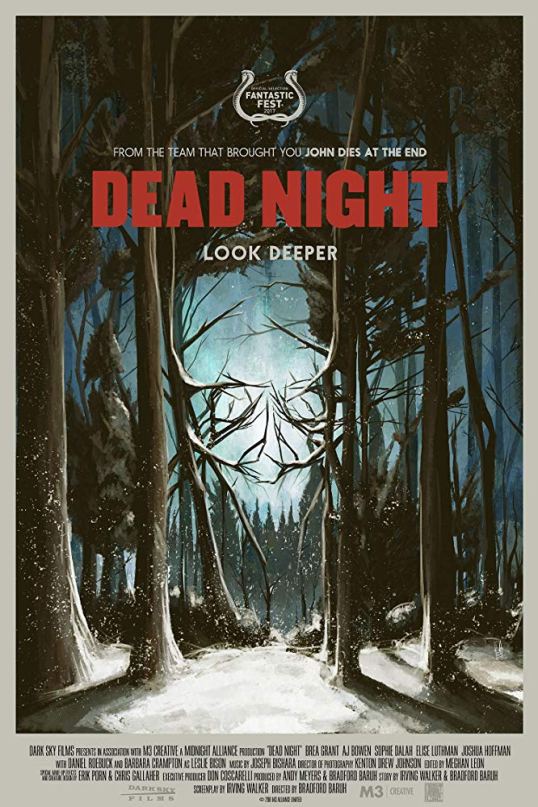
The TSL’s Horror Grindhouse: Dead Night (dir by Brad Baruh)


Hey, I’ve got an idea!  It’s Spring Break so why don’t we spend it in a cabin in the middle of a snow storm!?

Great idea!

Let’s go!

Oh, look — we’re at the cabin now and there’s some strange woman passed out front.  What should we do!?

Hey, let’s bring her inside!

Good idea!

Uh-oh, the woman’s inside and she’s alive but she’s acting kind of weird!

Hey, let’s eat dinner!

Now, in all fairness to the characters in 2018’s Dead Night, things are a bit more complex than that.  It’s not just that they decided to go up to a snowy cabin for Spring Break.  The cabin is actually supposed to be a therapeutic location.  James Pollack (AJ Bowen) is dying of cancer and it’s felt that the cabin will not only ease his pain but perhaps increase his life.  If nothing else, the wilderness will bring some sort of inner peace.  Accompanying James are his wife, Casey (Brea Grant) and their two teenage children, Jessica (Sophie Dalah) and Jason (Joshua Hoffman), and Jessica’s best friend, Becky (Elsie Luthman).

As for the mysterious woman who shows up out front of the cabin, they’re just trying to be nice when they invite Leslie Bison (Barbara Crampton) to stay in the cabin with them.  Even though Leslie can’t tell them how she ended up at their cabin, the Pollacks are not the type to just allow someone to die in the snow.  Really, we should all be more like the Pollacks, I guess.

Still, Leslie does turn out to be really obnoxious.  She makes inappropriate jokes.  She rudely asks which member of the family is dying.  She blows kisses at Jason and smirks when Jessica announces that they can’t eat until they’ve said grace.  In fact, the family is on the verge of kicking Leslie out when …. well, things happen.

What things?  We get some hints from a terrifically over the top true crime show, segments of which appear throughout the movie.  Hosted by Jack Sterling (Daniel Roebuck), the show deals with the question of how a perfect wife and mother like Casey Pollack could eventually go insane and chop up her family and friends with an ax.  Sterling tells us that, even though Casey called several people and told them that she had found a strange woman outside the cabin, the police were convinced that this was all just a part of an elaborate lie.

Hmmm….so, I guess we know what’s going to happen, right?

Well, no,  Not quite.  It turns out that the true story is a little bit different from what we might have seen on television.  For instance, Jack Steling’s show says nothing about the weird incident that happened in the early 60s, when a young woman got lost in the wood and was apparently impregnated with a piece of a tree….

If you go over to this movie’s imdb page, you’ll find a lot of angry reviews from people who felt that this movie didn’t have a real plot and that it was too gory but I don’t know.  I kind of liked it.  I mean, it’s a horror movie about people stuck in the middle of the woods.  What exactly are you expecting to get other than some nonsensical ax murders?  I mean, yes, the film doesn’t make complete sense but the cabin and the woods are both wonderfully creepy locations and the film also featured the great Barbara Crampton playing a …. well, I won’t spoil it.  Plus, I watch a lot of true crime television and I can tell you that this film’s satire of the particular genre is spot-on!

So, what can I say?  Suck it, imdb.  I kinda liked Dead Night.

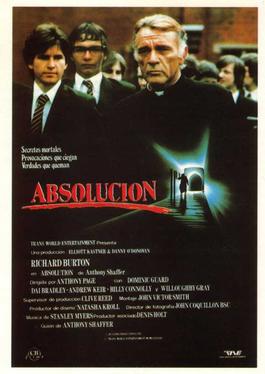
Mortal Sins: Absolution (1978, directed by Anthony Page)


Father Goddard (Richard Burton) is a stern and repressed teacher at a Catholic boys school.  Goddard is strangely obsessed with two of his students.  The intelligent and athletic Arthur Dyson (Dai Bradley) is a favorite of Goddard’s.  However, Goddard cannot stand Arthur’s best friend, Benji (Dominic Guard).  Benji wears a leg brace and takes a sarcastic attitude towards Goddard and the Catholic Church in general.  When Goddard finds out that Benji has been hanging out with a drifter named Blakely (Billy Connolly) and that Blakely is camping near the church, Goddard calls the police.  After the Blakely’s camp is destroyed and the drifter mysteriously vanishes, one of the boys goes to confession and tells the priest that he has murdered Blakely and hidden the body.  Is the boy telling the truth or is Goddard the victim of an increasingly complicated prank?

Written by Anthony Shaffer (who also wrote the classic The Wicker Man), Absolution is an extremely complicated mystery that sometimes seems like it’s trying to do too much at one time.  It starts out as a character study of an out-of-touch priest and then it becomes a coming of age story about Benji and his friendship with the free-thinking Blakely.  Then it turns into a murder mystery and a horror movie before finally settling on being an anti-Catholic tract.  The story does hold your interest because of the actors but that does not mean that it always makes sense.  The film’s central conspiracy is clever and complicated but also thoroughly implausible.

The man reason to watch the film is that Richard Burton gives one of his best performances as the self-loathing Father Goddard.  Burton had a famously mixed-record as a screen actor but Absolution makes good use of his tendency to ham it up.  Much of what motivates Goddard is left unclear in the movie, though it is subject of much speculation among his students.  Burton fills in the screenplay’s blanks with an intense performance as a man who has convinced himself that he has complete control when he actually has none at all.

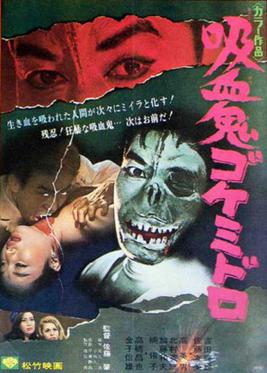
International Horror Film Review: Goke, Body Snatcher From Hell (dir by Hajime Soto)


The world’s ending and does it really matter?

The 1968 Japanese film, Goke, Body Snatcher From Hell (love that title!), opens with an airplane flying across a blood red sky.  Why has the sky changed colors?  The pilots aren’t sure and the passengers barely notice.  Indeed, the passengers are more concerned with their own problems.  There’s the arms manufacturer who is desperate to land his next big contract.  There’s the professor who views the world with professional detachment.  There’s the corrupt politician who only cares about increasing his own power.  There’s the terrorist who is traveling with a rifle hidden in the plane.  There’s the other terrorist who has a bomb and who may or may not be working with the first terrorist.  (It’s a dangerous world out there.)  And then there’s the American war widow, Mrs. Neal (Cathy Horan), whose husband has just been killed in Vietnam.

When a report comes over the radio that one of the passengers has bomb, the crew searches everyone’s bags.  “Why are you searching our bags!?” the arm manufacturer demands.  “There was a mix-up at the airport and we may have the wrong bag on this flight,” the co-pilot lies.  Finally, when the co-pilot and a stewardess come across a metal box in the back of the plane, they think that they’ve found their bomb.

Instead,they’ve found the first terrorist’s rifle.  He uses that rifle to hijack the plane and then he shoots out the plane’s radio.  Unfortunately, this couldn’t have happened at a worse time because it turns out that the Earth has just been invaded by aliens!

A UFO causes the airplane to crash on a uncharted island.  The rifle-toting terrorist is possessed, Thing-style, by one of the aliens.  The passengers start to bicker among themselves.  Who is to blame for the plane crash?  The terrorist or the pilots?  Who is to blame for the aliens invading, the aliens or the humans?  The professor theorizes that the aliens saw that Earthlings are constantly at war and they decided that this would be a great time to invade the planet.  In fact, as the professor goes on to speculate, perhaps we have brought this on ourselves.  Maybe we deserve to be invaded.  The humans on the island proceed to go out of their way to prove the professor correct.

Goke, Body Snatcher From Hell plays out like a pop art alien invasion film.  The colors are bright and vibrant.  The imagery is often surreal, with the alien literally oozing out of the forehead of the people that it has possessed.  By the end of the film, entire cities are full of shriveled up dead bodies while spaceships glow in the distance, their pulsating lights making them resemble the atomic mushroom clouds that have haunted Japanese horror and science fiction cinemas ever since World War II.  While the surviving passengers debate whether or not the Earth deserves to be saved, we get red-tinted inserts of assassination and war.  The passengers may not be sure whether or not Earth deserves to survive but it’s obvious the filmmakers have made up their minds and they, for one, welcome our new alien overlords.

How about you?


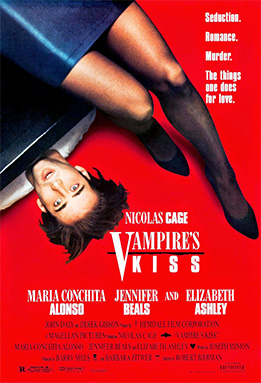
Horror Film Review: Vampire’s Kiss (dir by Robert Bierman)


Nicolas Cage plays the world’s biggest douchebag in the 1989 film Vampire’s Kiss.

Cage is playing Peter Loew, who is kind of like Patrick Bateman’s less successful cousin.  He’s got a nice apartment in New York City and he wears fairly nice clothes and he has this weird, stuffed-up way of speaking.  By night, Peter spends all of his time at the bars and the clubs, trying to get laid.  During the day, Peter goes to his job as a literary agent, where he sits around in his office and spends most of his time tormenting his secretary, Alva (Maria Conchita Alonso).

Peter has recently been tasked with finding the Heatherton Contract.  It’s a contract from 1963, one that was signed long before either Peter or Alva joined the company.  All Peter knows is that the contract is somewhere in a huge stack of files.  Harold Heatherton wants a copy of the contract so that he can frame it.  Peter wants the contract so that he can advance at his job and make even more money.  Alva just wants to be left alone.

“ALVA!” Peter spends his days yelling from the office.

“I hate my boss!” Alva says as she spend the morning crying in bed.

Yes, Peter is a jerk.  He maintains a toxic work environment.  He’s a misogynist.  He’s the type of asshole who screams at Alva to go find the Heatherton Contract and then stares at her backside as she walks back to her desk.  He’s a terrible human being and he’s steadily getting worse.  That’s because Peter is convinced that he’s turning into a vampire.  There’s even a lengthy scene where he stands in front of a bathroom mirror, moaning that he has no reflection.  Of course, we can see that he absolutely does have a reflection.

In his apartment and his office, he is often visited by Rachel (Jennifer Beals).  Rachel has fangs.  Rachel bites him in the neck.  Rachel sucks his blood.  But is Rachel there or is she a figment of his imagination?  Is he truly a vampire or is he like Patrick Bateman in American Psycho or the lead character in George Romero’s Martin?  He has become so consumed by his fantasies of being an all-powerful monster that he can no longer tell the difference between fantasy and reality?

Vampire’s Kiss is understandably best known for Cage’s demented performance.  Cage bulges his eyes, screams his lines, and spends a good deal of the film walking around with his shoulders hunched up.  This is the film for which Cage famously ate a live cockroach.  It’s undeniably watchable, though I think Cage made the mistake of playing Peter as being obviously unhinged even before he decided that he was a vampire.  The scenes where he obsesses over the Heatherton Contract start out as mildly amusing but become more disturbing as the film progresses and Peter grows more and more deranged.  From the moment that he started to chase the terrified Alva through the office, the film became so unpleasant that I just wanted it to hurry up and end.  On the plus side, Alva does get revenge though I think it would have been more effective (or maybe, just for me, more satisfying) if the film’s final action had been carried out by Alva herself.

Vampire’s Kiss is a film that has quite an enthusiastic cult following.  Having watched it, I can say that I’m not a member of that cult, though I can understand why Cage’s unhinged performance has fans.  The film is about 20 minutes too long and it reveals the truth about Cage’s “vampirism” far too early but, if nothing else, Cage really does throw himself into it.

Horror On The Lens: Carnival of Souls (dir by Herk Harvey)


Well, we’re nearly done with October and, traditionally, this is when all of us in the Shattered Lens Bunker gather in front of the television in Arleigh’s penthouse suite, eat popcorn, drink diet coke, and gossip about whoever has the day off.

Of course, after we do that, I duck back into my office and I watch the classic 1962 film, Carnival of Souls!

Reportedly, David Lynch is a huge fan of Carnival of Souls and, when you watch the film, it’s easy to see why.  The film follows a somewhat odd woman (played, in her one and only starring role, by Candace Hilligoss) who, after a car accident, is haunted by visions of ghostly figures.  This dream-like film was independently produced and distributed.  At the time, it didn’t get much attention but it has since been recognized as a classic and very influential horror film.

This was director Herk Harvey’s only feature film.  Before and after making this film, he specialized in making educational and industrial shorts (some of which we’ve watched this month), the type of films that encouraged students not to cheat on tests and employees not to take their jobs for granted.  Harvey also appears in this film, playing “The Man” who haunts Hilligoss as she travels across the country.

Enjoy Carnival of Souls!

And remember, don’t stop for any hitchhikers!

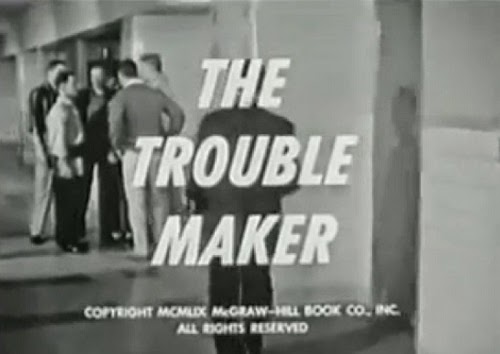
A Blast From The Past: The Trouble Maker (dir by Herk Harvey)


The 1959 short film, The Trouble Maker, tells the story of Mel Stone (played by Bret Waller).

Mel is the least popular student at his high school and it’s not hard to see why.  Mel is seriously creepy.  He spends all of his time sneaking through the hallways, following around the members of the football team and lying about the girls that they go to school with.  When Mel spots a member of the team “breaking training,” he starts spreading rumors and trying to make life difficult for everyone.

The title claims that Mel is a trouble maker but actually, he comes across like a total sociopath.  He even stalks the members of the football team outside of school, the better to collect gossip about them.  The film’s narrator encourages us to wonder why Mel is the way that he is and if there’s anything that we, as a group, can do to make Mel become a better person.  To be honest, it seems like the only solution to a problem like Mel is to frame him for a crime and send him to prison until his 21st birthday.  Admittedly, Mel would probably be even more dangerous once he got out but that’s why you move to a different town after graduating from high school.

The Trouble Maker was one of the many educational short films to be directed by Herk Harvey, who made a career out of films like this.  Today, of course, Harvey is best known for directing the seminal horror film, Carnival of Souls.  We’ll be sharing Carnival of Souls in an hour but, for now, enjoy The Trouble Maker and be sure to ask yourself….

What Would You Do?

The Things You Find On Netflix: Eli (dir by Ciaran Foy)


Eli (Charlie Shotwell) is a young boy who is allergic to everything outside.  As a result, he can’t venture out of the house unless he’s covered, head-to-toe, in protective gear.  Eli wasn’t always allergic, of course.  It’s just something that suddenly started.  Eli’s mother, Rose (Kelly Reilly) and her husband, Paul (Max Martini), are taking him to a special clinic run by Dr. Isabella Horn (Lili Taylor).  Because the clinic is sealed off from the outside, Eli can leave his plastic bubble.  Because the clinic is in a dark old building, we know that it’s either going to be haunted or run by some sort of cult.  In fact, it doesn’t take long before Eli is doubting not only Dr. Horn but his parents as well!  He keeps hearing voices that hiss, “Lie.”  And the only other patient at the clinic, a young girl named Haley (Sadie Sink), repeatedly tells him to be careful….

Eli is 98 minutes long and I lost interest after the first ten.  Basically, I was willing to give the film a chance but then a bunch of rednecks started to taunt Eli while he was walking around outside in his protective gear and I was like, “Yeah, okay.” Then they started throwing stuff at him and I was like, “Getting a little bit heavy-handed now.”  Then the suit got torn and Eli started screaming like he was about to die and the rednecks just stood there laughing and that’s when I said, “Okay, this is going to suck.”  There’s heavy-handed and then there’s just attacking your audience with a sledgehammer.  Sledgehammers give you a migraine.

Once Eli reaches the clinic, the film slows down to a glacial pace.  In theory, the slow pace should have helped to maintain an ominous atmosphere but …. eh.  To be honest, I’ve seen a lot of creepy clinics in a lot of creepy movies and there was nothing that special about this one.  It all leads to a big twist but, again, it wasn’t a particularly original twist and even the film’s attempt to blow my mind with a subversive ending just left me shrugging.  “Really?” I thought, “That’s what’s going to happen, huh?  Well, what can you do?”

Like a lot of bad movies, the script for Eli was included on the infamous Hollywood Black List.  The Black List is an annual list of the “best” unproduced screenplays in Hollywood.  A few good films have been made out of scripts on the Black List but, for whatever, the majority of Black List films always seem to turn out to be somewhat disappointing.  Broken City, for instance, was a Black List film.  So was The Beaver.  You can add Eli to the pile of mediocre Black List films.