Witchcraft VIII: Salem’s Ghost (1996, directed by Joseph John Barmettler)


Having killed off long-suffering hero Will Spanner in the previous installment, the Witchcraft franchise attempted to chart a new course with Witchcraft VIII: Salem’s Ghost.

In this movie, we meet an entirely new group of people who manage to raise the spirit of another dead and pissed off warlock.  Trying to repair their strained marriage, Sonny (Lee Grober) and Mary Anne (Kim Kopf) have moved to Massachusetts and have purchased a house that’s existed since colonial times.  Sonny and Mary Anne celebrate their first night in the house by getting covered in chocolate.  That’s one way to fix a marriage, I guess.

They soon meet their pushy new neighbors, Mitch (David Wells) and Gayle (Anthoni Stewart).  Mitch is so helpful that he even takes it upon himself to try to fix a leaky pipe in the basement.  However, when Mitch busts a hole in the wall, it not only leads to the basement getting flooded by a strange red light but Mitch also ends up possessed by the spirit of the warlock who previously owned the property.

Other than the presence of a dead warlock and all of the usual softcore sex scenes (which, in the 90s, were pretty much a mainstay of any direct-to-video horror film franchise), there’s nothing in Witchcraft VIII to really link it to any of the previous Witchcraft films.  (I did read that the house in Witchcraft VIII also appears in one of the other films but I’m too lazy and too sick of the Witchcraft films to go back and look for it.)  There’s no Will Spanner and no Detectives Lutz or Garner.  Instead, the entire film owes more to the Amityville franchise than the previous Witchcrafts.  Apparently, when the film went into production, it wasn’t even intended to be a Witchcraft film but instead, it was added to the franchise after filming was completed.

With all that in mind, Witchcraft VIII is not that bad, especially as far as low-budget, direct-to-video horror is concerned.  It doesn’t waste any time getting the action started and the actors actually do the best that they can with the material they’ve been given.  The dead warlock is played Jack van Landingham, who comes across as if he’s auditioning for a role in a pirate film, which is exactly the right approach to take when you’re appearing in a film like this.  Even the terrible special effects are more likely to inspire nostalgia than contempt.  Witchcraft VIII is dumb fun, even if it doesn’t include Will Spanner.  In fact, it’s nice to watch people deal with a warlock without having to listen to Will complaining all the time.

Financially, Witchcraft VIII failed to do as well as the previous Witchcraft films, which led to the end of plans to continue the franchise with a series of stand-alone films.  Instead, despite being dead, Will Spanner would return for Witchcraft IX.

International Horror Review: Lips of Blood (dir by Jean Rollin)


Few directors were as obsessed with memory as the great French filmmaker Jean Rollin and the 1975 cinematic memory poem, Lips of Blood, is one of his most personal works.

Frederic (played by Jean-Loup Philippe, a frequent Rollin collaborator) is at a reception for the launch of a new perfume.  After discussing how certain fragrances can bring back subjective memories of the past, Frederic notices a poster hanging on the wall.  The poster is a photograph of an old castle sitting on the beach.  As Frederic stares at the poster, he has a vision of himself as a child, approaching the same castle and meeting a young woman named Jennifer (Annie Belle).  Jennifer, who was apparently unable to go beyond the castle’s gates, allowed Frederic to get some sleep in the castle.  When Frederic woke up, he left the castle but he promised Jennifer that he would return and that he would help her to leave the castle.

Years later, Frederic is haunted by the vision.  He’s not sure if it’s dream or if it’s something that really happened.  When he discusses it with his mother (Nathalie Perrey), she insists that it was just a dream and that Jennifer doesn’t exist.  Even when Frederic says that he can’t remember anything about his childhood, his mother insists that he’s just imagining things.

But when Frederic starts to have visions of Jennifer beckoning him to come find her, is he imagining things or is she really trying to contact him?  When she leads Frederic to a cemetery, is Frederic going mad or is Jennifer trying to tell him something?  And, if this is all just in Frederic’s mind, why is he being followed by two mysterious girls who both have fangs and a taste for blood?  Why are strangers trying to kill him?  Even when Frederic is ruled to be mad and forcefully taken to an insane asylum, he remains obsessed with returning to the beach and finding that castle….

Lips of Blood has all the typical elements of a Rollin film.  Yes, there are vampires.  Yes, there is an old castle and yes, it’s on the same beach where it’s speculated that Rollin himself spent most of his childhood.  (That beach makes an appearance in nearly every Rollin film.)  Yes, the imagery is frequently sensual and erotically charged.  And yes, the film plays out as its own dreamlike pace.  Rollin is often described as being a director of vampire films but, at heart, Rollin was a surrealist and each one of his films creates its own unique world.  The world that Rollin creates in Lips of Blood is a rather melancholy one, one tinged with love, regret, and existential angst.  Frederic is wealthy and successful and leads what most people would consider to be a glamorous lifestyle.  Yet, he’s empty.  He’s haunted by the past and a promise that he failed to keep.

Indeed, throughout the film, there’s a palpable yearning for a simpler and more innocent world.  It’s present in every frame of Lips of Blood.  When Frederic visits the photographer who took the picture of the castle, the walls of her studio are decorated with vaguely political images, reminding us that the modern world can be a frightening and confusing place.  The world is full of people who are not only threatened by what Frederic saw in the castle but also by Frederic’s refusal to share their fear.  Frederic refuses to conform and therefore, society conspires to destroy not just him but also the glimpse he got into a world beyond our own.  By the end of the film, as he and another talk about getting in a coffin and allowing themselves to be swept out to sea in the hope of finding an isolated island, it’s impossible not to hope that they make it.

Lips of Blood is one of Rollin’s best and most personal films.  Never forget it.


A Blast From The Past: The Innocent Party (dir by Herk Harvey)


In this education film from 1959, two dim teenage boys decide to take a trip to the big city.  They pick up two girls, the engage in behavior “condemned by society,” and the next thing you know, everyone’s got Syphilis.

Yes, this is another educational film from the 50s, where the emphasis is less on practical advice (i.e., use a condom when having sex, especially with someone who you just met) and more on passing judgment on those who transgressed society’s norms.  I have to admit that one of the things that I like about these old films is just how bleak their worldview was.  If you screw up once, your life is over.  There’s nothing you can do to fix the problem.  There’s nothing you can do to redeem yourself.  You stepped out-of-line and now, you’ve got the same disease that killed Al Capone.  Take that, teenager!  The message of this particular film was considered to be so important that it was even filmed in color, which is quite a contrast to the harsh black-and-white aesthetic of most educational films of the period.  That, along with the smooth jazz on the soundtrack, is designed to let the target audience know that sex with random people is totally squaresville and not something that a responsible member of society does.  Why go to the city when you could join the student council or take part in any number of wholesome school activities?

This film was one of the many educational films to be directed by the great Herk Harvey.  In a career that spanned decades, Harvey directed hundreds of short, educational films that were designed to show “young people” how to properly behave.  Even if he wasn’t directing a film about VD, then he was probably doing a film about why gossip can be destructive to school spirit.

Harvey also directed one feature film and it’s one of the most important and influential horror films ever made, 1962’s Carnival of Souls.  We’ll be sharing that film here on the Lens later this month.  Until then, please enjoy The Innocent Party!


Insomnia File #46: Enter the Ninja (dir by Menahem Golan)


What’s an Insomnia File? You know how some times you just can’t get any sleep and, at about three in the morning, you’ll find yourself watching whatever you can find on cable or Netflix? This feature is all about those insomnia-inspired discoveries!

It’s been nearly a year since I did my last Insomnia File.  To be honest, as much as I enjoy writing these posts, I feel like the idea behind the Insomnia File format has become obsolete.  The days of people dealing with insomnia by randomly flipping through movies and infomercials have pretty much come to an end.  Now, if someone has insomnia, they’re more likely to binge an old show on Netflix.

That said, if you had insomnia at one in the morning last night and you didn’t feel like binging The Office for the hundredth time, you could have turned over to TCM and watched the 1981 film, Enter the Ninja.

What would you have gotten out of Enter the Ninja?  Five words: France Nero as a ninja.  Seriously, what more do you need?  Nero plays Cole, a former mercenary who goes off to Japan, trains to become a ninja, and then heads off for the Philippines, where his old mercenary friend, Frank (Alex Courtney), owns a farm.  Frank and his wife, Mary-Ann (Susan George) are having problems because evil businessman Charles Venarius (Christopher George, chewing up the scenery as the bad guy) is determined to force them off of their land.  Add to that, Frank is a pathetic drunk.

Soon, Cole is putting on his white ninja suit and fighting to protect the farm and also dealing with Venarius’s ninja, who just happens to be an old rival of Cole’s.  Cole is also carrying on an affair with Mary-Ann but that’s not big deal because Frank isn’t much of a man.  One of the most interesting things about Enter the Ninja is that it may be a martial arts film but it’s also a modern western and a domestic drama.  Cole could just as easily be a gunslinger, protecting the homesteaders.  Frank and Mary-Ann could just as easily be a couple on a daytime drama.  Instead, they’re all in a ninja film.

The main appeal of Enter the Ninja is Franco Nero, an actor who — in his prime — was one of the sexiest men to ever appear in the movies.  He spends a good deal of the film with his face covered but the important thing is that you can still see those beautiful blue eyes.  As usual, Nero gives a good performance with so-so material.  Nero brings his trademark intensity to the role and he does actually seem to care about whether or not his friends lose their farm.

Enter the Ninja was directed by the legendary Menahem Golan, a filmmaker who understood the importance of never letting the action slow down.  Enter the Ninja is dumb, over the top, and entertaining.  Plus, it’s got Franco Nero!  What else do you need at one in the morning?

Previous Insomnia Files:

  1. Story of Mankind
  2. Stag
  3. Love Is A Gun
  4. Nina Takes A Lover
  5. Black Ice
  6. Frogs For Snakes
  7. Fair Game
  8. From The Hip
  9. Born Killers
  10. Eye For An Eye
  11. Summer Catch
  12. Beyond the Law
  13. Spring Broke
  14. Promise
  15. George Wallace
  16. Kill The Messenger
  17. The Suburbans
  18. Only The Strong
  19. Great Expectations
  20. Casual Sex?
  21. Truth
  22. Insomina
  23. Death Do Us Part
  24. A Star is Born
  25. The Winning Season
  26. Rabbit Run
  27. Remember My Name
  28. The Arrangement
  29. Day of the Animals
  30. Still of The Night
  31. Arsenal
  32. Smooth Talk
  33. The Comedian
  34. The Minus Man
  35. Donnie Brasco
  36. Punchline
  37. Evita
  38. Six: The Mark Unleashed
  39. Disclosure
  40. The Spanish Prisoner
  41. Elektra
  42. Revenge
  43. Legend
  44. Cat Run
  45. The Pyramid

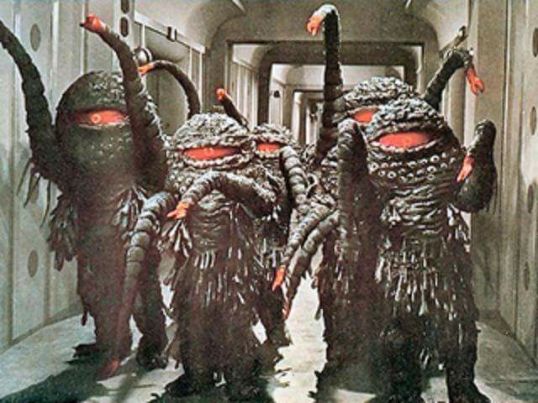
Horror Film Review: The Green Slime (dir by Kinji Fukasaku)


The Green Slime is here and it’s adorable!

The 1968 film, The Green Slime, is meant to be a hybrid of a horror movie and a sci-fi film.  One might even call it a forerunner to Alien if one wanted to run the risk of being ridiculed for the rest of one’s life.  It’s about an alien life form that manages to sneak into a space station.  Once it’s inside the space station, it starts to rapidly multiply and it turns out that everything that the humans do to try to stop it just causes more of the monsters to show up!

Seriously, that should be some major nightmare fuel but instead, the monsters are just too cute to believed.

Okay, maybe cute is the wrong word.  When Jeff and I watched this movie, I asked him if he could come up with a better term to describe the monsters than “cute.”  He suggested “cheap.”  And yes, the monster do look rather cheap.  It’s obvious that the monsters are made out of rubber and, half the time, their arms just seem to flail around at random.  That’s actually one of the things that makes them so cute!

It’s also one of the things that makes The Green Slime memorable.  Today, we tend to take it for granted that anything can be done via CGI so it’s interesting to see a film like this.  The Green Slime was originally released 52 years ago, long before CGI.  The special effects may look cheap but there’s an undeniable appeal to their quaintness.  The special effects are a lot like the monsters themselves.  They’re cheap.  They’re not particularly convincing.  But, in their own weird way, they’re definitely charming.

Of course, they’re not at all scary.  That’s a bit unfortunate as far as the film is concerned.  Remember how, in the Alien movies, you’re always scared to death that the alien is going to jump from out of nowhere because 1) the alien is absolutely terrifying to look at and 2) anyone caught by the alien is destined to die a terrible and agonizing death?  Well, that’s not the case with The Green Slime.  The Green Slime just kind of runs around and looks …. well, cute.

That said, The Green Slime cannot be allowed to make its way to Earth so the folks on the space station are going to have to figure out how to defeat it.  That’s not going to be easy because the two rival commanders (payed by Robert Horton and Richard Jaeckel) are currently both in love with the same woman.  Lisa Benson (Luciana Paluzzi) is the space station’s doctor and needless to say, she’s going to have her hands full.  If you’re a Bond connoisseur, you might recognize Luciana Paluzzi from Thunderball.  Myself, I was just happy that the doctor was a redhead named Lisa.  I could automatically relate to her.  Plus, there’s nothing more entertaining than hearing your name repeated over and over again.

The Green Slime was an American-Japanese co-production.  The cast is a mix of American and European actors while the film’s crew was predominantly Japanese.  Originally, The Green Slime was envisioned as being an American/Italian co-production and Antonio Margheriti was in talks to direct.  When that plan fell through, MGM moved the production to Japan and teamed up with the Toei Company.  One can only imagine what the film would have looked like if it had been directed by Marheriti.  One imagines that the aliens would have been a bit less cute.

Fortunately, cute they are!  The Green Slime fails as both a horror and sci-fi film because the aliens themselves never seem like a legitimate threat but I still like the film.  If nothing else, it pays tribute to the name Lisa and that’s definitely something that I can get behind.

Plus, the aliens are just adorable!

Horror on the Lens: The Little Shop of Horrors (dir by Roger Corman)


(It’s tradition here at the Lens that, every October, we watch the original Little Shop of Horrors.  And always, I start things off by telling this story…)

Enter singing.

Little Shop…Little Shop of Horrors…Little Shop…Little Shop of Terrors…

Hi!  Good morning and Happy October the 2nd!  For today’s plunge into the world of public domain horror films, I’d like to present you with a true classic.  From 1960, it’s the original Little Shop of Horrors!

When I was 19 years old, I was in a community theater production of the musical Little Shop of Horrors.  Though I think I would have made the perfect Audrey, everybody always snickered whenever I sang so I ended up as a part of “the ensemble.”  Being in the ensemble basically meant that I spent a lot of time dancing and showing off lots of cleavage.  And you know what?  The girl who did play Audrey was screechy, off-key, and annoying and after every show, all the old people in the audience always came back stage and ignored her and went straight over to me.  So there.

Anyway, during rehearsals, our director thought it would be so funny if we all watched the original film.  Now, I’m sorry to say, much like just about everyone else in the cast, this was my first exposure to the original and I even had to be told that the masochistic dentist patient was being played by Jack Nicholson.  However, I’m also very proud to say that — out of that entire cast — I’m the only one who understood that the zero-budget film I was watching was actually better than the big spectacle we were attempting to perform on stage.  Certainly, I understood the film better than that screechy little thing that was playing Audrey.

The first Little Shop of Horrors certainly isn’t scary and there’s nobody singing about somewhere that’s green (I always tear up when I hear that song, by the way).  However, it is a very, very funny film with the just the right amount of a dark streak to make it perfect Halloween viewing.

So, if you have 72 minutes to kill, check out the original and the best Little Shop of Horrors

What Lisa Watched Last Night #213: Is There A Killer On My Street? (dir by Jake Helgren)


Last night, I watched the latest “premiere” on the Lifetime Movie Network, Is There A Killer On My Street?

Why Was I Watching It?

I have to admit that Lifetime fooled me.  I thought this was a brand new movie, largely because it was listed as having been released in 2020.  When I saw that, I was like, “Well, there’s no way I’m going to miss a new Lifetime movie!  Especially one that isn’t a sentimental Christmas film!”

Well, it turns out that Is There A Killer On My Street has been around for at least two years.  It was originally released under the title The Neighborhood Nightmare, way back in 2018.  When Lifetime aired the movie, they changed the title and apparently, that was enough for this movie to reclassified as a 2020 release.

That said, I’m not angry at Lifetime.  The COVID-19 outbreak shut down a lot of productions and I can only imagine how many Lifetime movies were put on indefinite hold earlier this year.  So, Lifetime picked up an old movie and changed the title.  Big deal.  It was still new to the network, right?

Don’t worry, Lifetime.  I’ve got your back.

What Was It About?

It’s time for another round of sex and sin in the suburbs!  Having escaped from an abusive marriage, Lindsay Porter (Julie McNiven) and her teenage daughter have settled down in a beautiful house in a beautiful neighborhood.  (Seriously, there’s never been an ugly house in a Lifetime movie.)  Lindsay even starts to date her new neighbor, Dr. Stephen Lane (Trevor Donovan).  However, when strange things start to happen and eventually someone shows up dead, Lindsay is forced to consider how much she knows about not just Stephen but her neighbors as well!

What Worked?

I always love a good Lifetime sin-in-the-suburbs film and Is There A Killer In My Street had all the right ingredients.  Melodrama, murder, yoga, swimming pools, a good-looking cast, and a director who was willing to let everyone go just a little overboard.  This was an entertainingly sordid movie and that’s exactly what I was looking for on Friday night.

I will say that the film also did a surprisingly good job of keeping you guessing.  I thought I had figured out who the murderer would be just to then discover that I was totally wrong.  I’m usually really good at predicting who the murderer is going to be in a Lifetime whodunit so I have to give this film a lot of credit for keeping me on my toes.  I’ve seen a lot of these films and it’s always nice to discover that I can still be surprised.

What Did Not Work?

I could nitpick but screw that.  This movie was too much fun for nitpicking.  I mean, let’s be honest.  We’re all pretty much going to be stuck in our current bizarre situation for the forseesable future.  Films like Is There A Killer On My Street are going to be essential for keeping us entertained.

“Oh my God!  Just like me!” Moments

I appreciated that Lindsay and I both have red hair.  I share her struggle.

Lessons Learned

If you even have to ask whether or not there’s a killer on your street, you’re already in trouble.

The TSL’s Horror Grindhouse: Shriek of the Mutilated (dir by Michael Findlay)


“The shriek of the mutilated!”

Listen, if there’s noting else that can be said about this 1974 film, Shriek of the Mutilated is a brilliant title.  I mean, it’s not only catchy but it’s honest.  The mutilated do tend to shriek.  You see a title like that and how can you look away?  How can you not watch just to see if the film itself lives up to the title?  That’s the genius of the grindhouse right there.  Promise a lot in the title.  Even if the film fails to deliver, people will remember the title.  Let’s be honest — I could say right now, “Shriek of the Mutilated is the worst movie ever made,” and the only thing you would hear me say is “Shriek of the Mutilated.”

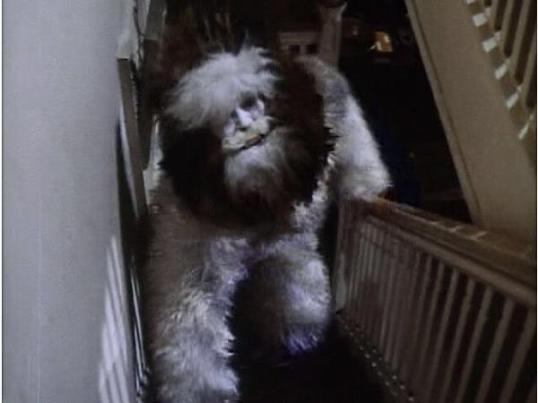
Anyway, as for the film itself, it’s an Abominable Snowman film.  There’s a lot of bigfoot films but Shriek of the Mutilated is one of the few films that I’ve ever seen about the Abominable Snowman.  I’ve always wondered what makes the Snowman so abominable.  I mean, did he just choose that name or was it forced upon him?  Abominable doesn’t sound like a compliment so I’m going to guess that the Snowman was named that by someone who he owed money to.  I imagine if the Snowman had his say, he’d prefer to be known as the “The Wonderful Snowman” or maybe “The Triumphant Snowman” but, because he must live his days in hiding, he’s been given no choice.  It just doesn’t seem fair to me.

If it seems like I’m padding out this review, that’s because there’s more to Shriek of the Mutilated than just the Abominable Snowman but if I tell you too much about the plot, I’ll be spoiling the film.  And before you say that there’s no way you’d ever watch this film in the first place so it doesn’t matter if I spoil it, allow me to point out that not only is Shriek of the Mutilated available on Prime but it’s also been included in a quite a few of those cheap Mill Creek box sets.  So, chances are, you will be watching Shriek of the Mutilated at some point in your life.  And I don’t want to spoil it for you.  I want you to watch this film and shake your head and say, “What the Hell was that all about?”

Basically, a professor recruits four of his students to come search for the Snowman with him.  The students agree, despite the fact that one of the professor’s former students warns them against it.  As he explains it, he had a bright future until he joined the professor on one of his quests.  Now, he’s the school janitor and he’s a drunk!  That’s why the Snowman is abominable by the way.  He ruins lives!

Anyway, the Snowman does kind of make an appearance but, far more important than the Snowman, is a plot twist that’s so silly and so stupid and so out-of-nowhere that it simply has to be seen to be believed.  The entire film has a kind of “make it up as you go along” feel to it and it wouldn’t surprise me if someone just randomly thought up the twist in the middle of filming.  And listen — the film looks incredibly cheap and the acting is terrible but that twist is such a “WTF” moment that I recommend watching the film just to experience it.

I also recommend the film just because of the Snowman.  Check him out:

Shriek of the Mutilated was directed by Michael Findlay, who was one of the pioneers of the grindhouse cicruit.  His best films — like the Flesh trilogy — achieve a sort of dream-like intensity.  Even his worst films, like this one, are entertainingly weird.  He also directed a film called Slaughter which achieved a certain infamy when the producer (without Findlay’s input) filmed some extra scenes, renamed the movie Snuff, and then advertised it as being an actual snuff film.  Tragically, Findlay was killed in a helicopter accident in 1978 but his wife, Roberta, continued to direct movies through the 80s.

Shriek of the Mutilated is a frequently inept movie but it’s also strange enough that everyone should watch it at least once.


Cinemax Friday: Witchcraft VII: Judgment Hour (1995, directed by Michael Paul Girard)


Warlock-turned-attorney-turned-police consultant Will Spanner is back for the 7th time in Witchcraft VII.  However, the usual witches and warlocks are nowhere to be seen.  Instead, this installment finds Will and the gang battling a vampire businessman who wants to take over the world’s blood supply.

As is typical of the Witchcraft films, all of the usual characters are present but they’re all played by different actors.  Will is now played by David Byrnes while April Breneman steps into the role of Will’s girlfriend, Kelli.  Detectives Garner and Lutz also return.  However, Garner (John Cragen) is now much younger and, as opposed to the previous film, has a full head of hair.  Meanwhile, Lutz, who was a man in the previous film, is now played by Alisa Christensen.  (In a later movie, it would be explained that this Lutz is supposed to be a relative of the original Lutz but that’s never mentioned in Witchcraft VII.)

Will is still tortured by his past and his powers but it’s less of a problem in this film because he’s not battling a warlock.  Instead, while he’s visiting friends in the hospital, he just happens to spot Rachel (Ashlie Rhey) coming back to life.  Rachel, who was the latest victim of vampire Martin Hassa (Loren Schmalle), is now a vampire who preys on joggers but only after having sex with them because this is a Witchcraft movie, after all.  It won’t be easy for Will to defeat Hassa because Hassa has a mansion full of frequently naked vampires.  In fact, it’s so difficult that Will ends up dead.

That’s right, Witchcraft VII was originally meant to be the end of the series.  Realizing that there was nothing left to do with Will Spanner, Witchcraft VII had him battle a vampire and then killed him.  The next Witchcraft film would not feature Will in any way.  However, you can’t keep a good warlock down so Will would eventually return in Witchcraft IX.

Witchcraft VII would not have been a bad film to go out on.  Even with its low budget and its softcore aesthetic, Witchcraft VII is better than the previous few Witchcraft films.  David Byrnes is the best Will Spanner since Charles Solomon and Loren Schmalle is a good villain.  Though it may seem strange that a film called Witchcraft wouldn’t actually feature any witches, the vampire angle actually brings some new energy to the franchise.  Will gets to go out a hero and the world is a little bit safer for joggers.

Unfortunately, nothing ever truly ends in the world of direct-to-video.  Witchcraft would return with Witchcraft 8, albeit temporarily without the character of Will Spanner.

International Horror Film Review: The Washing Machine (dir by Ruggero Deodato)


Yuri the pimp is dead and his body has been stuffed into a washing machine …. or has it?  The body’s missing.  Did the cat eat it?  Is someone lying about finding the body?  Or is there something else going on?

Those are the questions that are raised by the 1993 Italian film, The Washing Machine.  Directed by Ruggero Deodato (of Cannibal Holocaust and House on the Edge of the Park fame), The Washing Machine takes place in Budapest.  It tells the story of three sisters.  Vida (Katarzyna Figura) is a prostitute.  Ludmilla (Barbara Ricci) is a percussionist who often emerges from the shadows, carrying a triangle with her.  Maria (Ilaria BorellI), who is also known as Sissy, works with the blind.  They all live together in a rather nice, two-story building and they have a washing machine located on the first floor.  Yuri (Yorgo Voyagis) is Vida’s pimp and sometime lover.  When Via discovers that Yuri has a piece of jewelry with Sissy’s name on it, it leads first to a fight and then to makeup sex in the kitchen, all while Ludmilla watches from the staircase and plays the triangle.  Later, Ludmillas calls the police, claiming that she has discovered Yuri’s bloody body in the washing machine.

Inspector Stacev (Philippe Caroit) is sent over to investigate but, by the time he arrives, Yuri’s body has disappeared.  There’s a rather self-satisfied black cat wandering about.  “Did the cat eat the body?” I asked, just to then have another character in the film suggest the exact same thing.  Stacev isn’t sure whether or not Yuri is actually dead but then again, it quickly becomes apparent that Stacev is more interested in the three sisters than he is in solving the case of death of a pimp.  Despite the fact that Stacev has a loyal girlfriend named Irina (Claudia Pozzi), he is soon cheating on her with the sisters.  When Irina finds out, she commits suicide.  Stacev just shrugs it off.

So, you may have guessed that Inspector Stacev is not a particularly likable character.  Normally, that might be a problem but it fits right into The Washing Machine‘s chilly view of a world that’s defined and ruled by greed and lust.  Set and filmed in Budapest, The Washing Machine is full of shadowy and gothic images.  Every location looks as if it’s hiding a hundred secrets and every shadow seems like it’s on the verge of coming to life.  An atmosphere of continual menace haunts nearly every frame of The Washing Machine.  It helps, of course, to know something about the history of Hungary.  The Washing Machine is set just a few years after the collapse of Soviet-style communism in Eastern Europe.  The characters in The Washing Machine move, speak, and act like people who lived too long with secrets and paranoia as their most valuable possessions to give them up now.

I liked The Washing Machine.  The plot doesn’t make much sense but Deodato does such a good job of creating a sense of dread that it doesn’t have to make sense.  A work of existential horror, The Washing Machine takes place in a world that’s governed by chaos and where men like Yuri and Stacev arrogantly assume that their place in society will somehow protect them.  In the end, no one is innocent, no one is safe, and willful blindness is the downfall of everyone.