The Things You Find on Netflix: Rebecca (dir by Ben Wheatley)


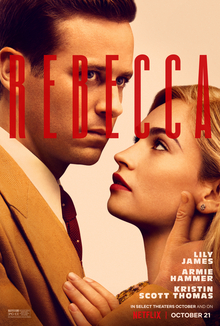
Ben Wheatley’s new film, Rebecca, is the second cinematic adaptation of Daphne du Maurier’s classic gothic romance.  It was first adapted by David O. Selznick and Alfred Hitchcock in 1940.  That Rebecca was the only Hitchcock film to win the Oscar for Best Picture, though Hitchcock himself reportedly felt that Rebecca was more indicative of Selznick’s style than his own.

Ben Wheatley, as one might expect from the brilliant director of A Field in England, takes his own idiosyncratic approach to the material.  From the start, he gets two things right when he casts Lily James as the second Mrs. de Winter and Armie Hammer as the enigmatic Maxim de Winter.  James and Hammer are ideal for these roles because they’re both so achingly pretty that they seem like they belong on the cover of a gothic romance.  That’s especially true of Armie Hammer, who has never been that interesting of an actor but who still has the type of chiseled screen presence that makes him ideally suited for roles like the one that he plays here.  He’s tall, handsome, a bit dull, and undeniably upper class.  He’s an appealing slab of beef and that makes him perfect for the role of Maxim de Winter.

Directing in vibrant color and taking advantage of the fact that the films stars two of the best-looking people working in the movies today, Wheatley brings an erotic charge to the story that was missing from Hitchcock’s more sedate (and Production code-restricted) version of the story.  When Maxim and the woman who will became the second Mrs. de Winter embark on their whirlwind romance on the French Riviera, there might as well be a title card that announces, “Yeah, they’re fucking.”  There’s nothing subtle about it but, at the same time, it provides a definite contrast to the second part of the film, in which Maxim and Mrs. de Winter return to the grand but chilly mansion of Manderley and Maxim goes from being charming and sensual to being cold and withdrawn.

It’s also at Manderley that we meet Mrs. Danvers (Kristin Scott Thomas), who is obsessed with preserving the memory of Maxim’s first wife, Rebecca.  Scott Thomas is perfect casting for Mrs. Danvers.  In fact, at first, she seems almost too perfect for the role.  She’s so imperious and passive aggressively hostile when we first meet her that I was worried that Scott Thomas wouldn’t be able to bring much more to the role beyond what she had already shown.  However, as the film progresses, Scott Thomas turns Danvers into a surprisingly vulnerable character, with the film suggesting that she’s as much of a victim of Rebecca’s toxic legacy as anyone else at Maderley.

Wheatley’s Rebecca is all about the journey of the second Mrs. de Winter and her transformation from being meek and somewhat mousey to being someone who refuses to be cast in anyone else’s shadow.  When Maxim says that Mrs. de Winter is no longer the innocent girl that he meet on the Riviera, Maxim is disappointed but Mrs. de Winter is not.  By the end of the film, the de Winters resemble none other than Henry and June Miller, searching the world for their place and casting seductive glances at the audience.

Visually, it’s a stunning film.  The colors are vibrant.  The sets are ornate.  The costumes are to die for.  That said, the film itself is never quite as engaging as it should be.  Despite the strength of the cast, the film still leaves the viewer feelings somewhat detached.  It’s all wonderfully produced by the film still feels more like an intellectual exercise than an emotional one.  Wheatley is a brilliant filmmaker but, when the second Mrs. de Winter announces that everything she’s been through is worth it because she’s found love, you don’t believe her and you don’t get the feeling that, deep down, Wheatley believes her either.  Instead, it’s hard not to feel that this version of Rebecca is a romance that doesn’t believe in love.  It’s interesting but it’s not particularly satisfying.
Horror on the Lens: The Terror (dir by Roger Corman, Francis Ford Coppola, Jack Hill, Monte Hellman, Dennis Jakob, and Jack Nicholson)


(As some of you may have noticed, I shared this movie last year as well.  I figured I might as well post it again this year.  Plus, it’s Boris Karloff, Jack Nicholson, and Dick Miller!  Why not post it again?)

Have you ever woken up and thought to yourself, “I’d love to see a movie where a youngish Jack Nicholson played a French soldier who, while searching for a mysterious woman, comes across a castle that’s inhabited by both Dick Miller and Boris Karloff?”

Of course you have!  Who hasn’t?

Well, fortunately, it’s YouTube to the rescue.  In Roger Corman’s 1963 film The Terror, Jack Nicholson is the least believable 19th century French soldier ever.  However, it’s still interesting to watch him before he became a cinematic icon.  (Judging from his performance here and in Cry Baby Killer, Jack was not a natural-born actor.)  Boris Karloff is, as usual, great and familiar Corman actor Dick Miller gets a much larger role than usual.  Pay attention to the actress playing the mysterious woman.  That’s Sandra Knight who, at the time of filming, was married to Jack Nicholson.

Reportedly, The Terror was one of those films that Corman made because he still had the sets from his much more acclaimed film version of The Raven.  The script was never finished, the story was made up as filming moved alone, and no less than five directors shot different parts of this 81 minute movie.  Among the directors: Roger Corman, Jack Hill, Monte Hellman, Francis Ford Coppola, and even Jack Nicholson himself!  Perhaps not surprisingly, the final film is a total mess but it does have some historical value.

(In typical Corman fashion, scenes from The Terror were later used in the 1968 film, Targets.)

Check out The Terror below!


Horror(-ish) Film Review: Hubie Halloween (dir by Steven Brill)


“Oh my God!” I said as I looked at what was new on Netflix, “A Halloween movie starring the guy from Uncut Gems!?  THIS IS GOING TO BE INTENSE!”

Of course, as I’m sure you already guessed, Hubie Halloween might as well be taking place in a totally different universe from Uncut GemsUncut Gems was an intense drama that starred Adam Sandler as a man so self-destructive that he literally seems to spend the entire movie just daring death to reach out and take him.  Hubie Halloween, on the other hand, is fairly laid back comedy featuring Adam Sandler playing yet another well-meaning manchild.  The film features supporting performances from all the usual Happy Madison suspects, like Kevin James, Rob Schneider, Steve Buscemi, Tim Meadows, Ben Stiller, Maya Rudolph, Keenan Thompson, and Colin Quinn.  It’s sentimental and it’s about thirty minute too long and the humor is often juvenile but also frequently funny.

Adam Sandler plays Hubie, who lives in Salem, Massachusetts with his mother (June Squibb).  Hubie is the town eccentric, the type of guy who thinks that he’s protecting the entire town but who mostly just gets on everyone’s nerves.  A lot of people make fun of Hubie (who they call Pubie).  Pete Landolfa (Ray Liotta) may be mourning the recent death of his father but he still finds time to toss Hubie into an open grave.  Not even Father Dave (Michael Chiklis) has much sympathy for Hubie.  Hubie is the type of guy who goes down to the local school to give a speech on Halloween safety, just for the students (and teachers) to respond by throwing all of their food at him.

One of the few people who is nice to Hubie is his new neighbor, Walter Lambert (Steve Buscemi).  However, Hubie suspects that Walter might be a werewolf and when people start to disappear over the course of Halloween, Hubie suspects that Walter’s responsible.  Meanwhile, the police (represented by a heavily bearded Kevin James) thinks that it might be Hubie, seeing as how everyone who has disappeared is also someone who has bullied him.

Then again, Richie Hartman (Rob Schneider) has just escaped from the local mental institution.  Could he possibly have something to do with the mysterious happenings in Salem!?

When Adam Sandler won his Indie Spirit Award for Uncut Gems, he infamously announced that, if he didn’t get an Oscar nomination, he would get back at the Academy by making the worst film of all time.  Well, Sandler was snubbed the Academy.  (Though Sandler deserved that nomination — and probably nominations for The Meyerowtiz Stories, Funny People, and Punch-Drunk Love as well — it’s pretty obvious that the Academy is never going to nominate the star of That’s My Boy and Jack and Jill.)  However, Hubie Halloween is certainly not the worst film ever made.  It’s actually a rather likable and sweet-natured comedy, one in which the humor is definitely juvenile but, in contrast to some of the other Happy Madison comedies, never really mean-spirited.  In many ways, it’s a perfect Netflix film.  It’s good enough to keep you entertained while, at the same time, you don’t necessarily have to really pay attention to every minute of the film to get it.  It’s the epitome of the type of film that you can watch while doing something else.

One of the main complaints that’s always lodged against Sandler is that he primarily just makes movies so that he can hang out with his friends and get paid for it.  There’s a certain amount of truth to that statement and that, more than anything, explains why Sandler’s filmography tends to be so frustratingly uneven.  The cast of Hubie Halloween looks like they had a lot of fun making it.  Fortunately, in this case, that sense of fun actually translates onto the screen.  Steve Buscemi, June Squibb, and particularly Ray Liotta all seem to be having a ball getting to parody their own dramatic images.

Admittedly, Hubie Halloween is not a film that sticks with you.  It won’t make you laugh as much as Happy Gilmore and it won’t leave you stunned like Uncut Gems.  But, for what it is, it’s just likable enough to be entertaining.


Witchcraft XI: Sisters in Blood (2000, directed by Ron Ford)


Warlock-turned attorney-turned-police consultant Will Spanner is back for the 11th Witchcraft film.  This time he’s played by James Servais.  Working again with Lutz (Stephanie Beaton) and Garner (Mikul Robins) of the LAPD, Will is investigating yet another attempt to perform a ceremony that will bring Satan back to Earth.  Why is every Satanic ceremony so elaborate that it always gives Will, Lutz, and Garner time to investigate and disrupt it?  That seems short-sighted on Satan’s part.

This time, the head Satanist is a drama professor who is putting on a production of MacBeth and who convinces the three actresses playing the witches to really get into their roles by performing a “fake” magic ritual.  Unfortunately, the ritual is real and the actresses are possessed by the spirits of three actual witches.  Because they have to find a stone that will help to bring a demon into the world who will then bring Satan into the world as well (See what I mean about foolishly complex rituals?), the three actresses are soon going on a sex-fueled murder rampage across campus.  One of the possessed actresses is also the sister of Will’s long-suffering girlfriend and now-fiancée, Kelly (Wendy Blair).  That makes it even more important than usual that Will prevent Satan from coming into the world.

As easy as it is to make fun of the Witchcraft films for their grade-Z production values and the often less than impressive performances of the actors involved, it’s hard not to appreciate their loyalty to the idea behind the entire franchise.  With only a few exceptions, every film has dealt with Will coming to terms with being a warlock.  Even though the actors change frequently, just the fact that nearly every Witchcraft installment features the same characters does a lot to distinguish Witchcraft from other direct- to-video horror franchises.  Will and Kelly finally getting engaged would probably be more meaningful if they had been consistently been played the same actors over the last several films (and if Witchcraft XI spelled Kelli’s name correctly) but it still rewarded the viewers who had stuck with the franchise up to its eleventh installment.  (Unfortunately, this movie would also be Kelly’s final appearance in the series.  The character is never mentioned in any of the films following this one.)

Otherwise, Witchcraft XI features some of the worst acting in the series up to this point and the plot is incoherent even by Witchcraft standards.  Supposedly, this was one of the most financially successful of all the Witchcraft movies, probably because of three possessed and often topless co-eds.  Will Spanner would return, though unfortunately without Lutz, Garner, or Kelly, in Witchcraft XII.

Horror On The Lens: The Dead Don’t Die (dir by Curtis Harrington)


For today’s horror on the lens, we have a 1975 made-for-television movie called The Dead Don’t Die!

The Dead Don’t Die takes place in Chicago during the 1930s.  George Hamilton is a sailor who comes home just in time to witness his brother being executed for a crime that he swears he didn’t commit.  Hamilton is convinced that his brother was innocent so he decides to launch an investigation of his own.  This eventually leads to Hamilton not only being attacked by dead people but also discovering a plot involving a mysterious voodoo priest!

Featuring atmospheric direction for Curtis Harrington and a witty script by Robert Bloch, The Dead Don’t Die is an enjoyable horror mystery.  Along with George Hamilton, the cast includes such luminaries of “old” Hollywood as Ray Milland, Ralph Meeker, Reggie Nalder, and Joan Blondell.  (Admittedly, George Hamilton is not the most convincing sailor to ever appear in a movie but even his miscasting seems to work in a strange way.)

And you can watch it below!

Enjoy!

Witchcraft X: Mistress of the Craft (1998, directed by Elisar Elisar Cabrera)


In the tenth entry in the ludicrously long-running Witchcraft series, conflicted warlock Will Spanner does not appear.  Fortunately, it’s not because he’s dead again.  Instead, it’s just because Will lives in New York and Witchcraft X: Mistress of the Craft takes place in London.

Instead, Witchcraft X focuses on Detective Lucy Lutz (Stephanie Beaton, returning to the role after playing it in the previous film).  Focusing on Detective Lutz actually makes sense, just because Stephanie Beaton was one of the better actresses to regularly appear in direct-to-video horror movies and she was also probably the main reason why many people were watching the Witchcraft films to begin with.  It certainly wasn’t for the special effects or the plots.

In this film, Detective Lutz has been summoned to London because a cult leader named Hyde (Kerry Knowlton) has been arrested by Interpol.  Hyde is wanted for a series of murders in Los Angeles and the London police cannot wait to send him back to the United States where he’ll be executed for sure.  (Jokes on them.  California has one of the slowest death rows in the country.)  But before Hyde can be sent back to L.A., they need to fly Lutz over so she can brief them on Hyde’s crimes.  I guess email was still a luxury in 1998.

No sooner has Lutz arrived than a vampire named Raven (Eileen Daly) is breaking Hyde out of custody so that Hyde can help her conduct one of those occult ceremonies that every single Witchcraft film seems to revolve around.  Raven has an army of frequently naked female vampires to help her out.  Lutz only has Interpol agent Chris Dixon (Sean Harry) and paranormal expert Celeste (Wendy Cooper) to help her out.

I liked that this movie tried to do something different with the franchise without totally abandoning the characters.  Even though neither Will nor Garner appears in Witchcraft X, they’re mentioned by Lutz so it’s not like Witchcraft VIII where Will’s existence was totally ignored.  Detective Lutz is a good heroine and Stephanie Beaton is an appealing actress.  I also liked that the film took place in London and that, like Witchcraft VII, it involved vampires instead of the usual shady warlocks.  The dialogue is really clunky, none of the other actors are as good as Beaton, and the film looks like it was shot with a camcorder and then edited by someone using a VCR  but that’s pretty much par for course for a Witchcraft film.

It’s easy to imagine the Witchcraft series going forward with just Detective Lutz as the lead character.  That didn’t happen, though.  Will Spanner would return for Witchcraft XI.

Horror On The Lens: Invasion of the Saucer Men (dir by Edward Cahn)


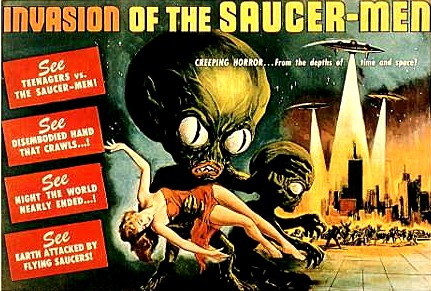
Invasion of The Saucer Men

The poster above pretty much epitomizes everything that I love about old B-movies.  Between the aliens and the poster’s promise that we’re being given the chance to “SEE (the) night the world nearly ended…!,” it’s hard to resist the temptation to give Invasion of the Saucer Men a chance.

First released in 1957, Invasion of the Saucer Men is, in many ways, a standard alien invasion film.  Aliens land in a small town and cause a lot of inconvenience for a bunch of all-American teenagers who are just looking for a place to make out.  What sets Invasion of the Saucer Men apart is that it’s meant to intentionally humorous and the aliens totally kick ass.

So, here is today’s edition of Horror On The Lens: Invasion of the Saucer Men!

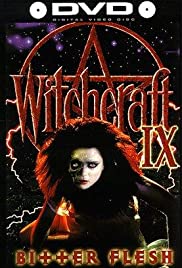
Witchcraft IX: Bitter Harvest (1997, directed Michael Paul Girard)


Will Spanner (played, for a second time, by David Byrnes) returns in Witchcraft IX!

Will is still the son of a warlock, he’s still dead, and his girlfriend is still named Kelli (she’s played, this time, by Leah Kourtne Ballantine) but otherwise, the continuity of the entire franchise gets seriously twisted in Witchcraft IXWitchcraft VII ended up with Will dead and everyone knowing that Will was dead.  This was followed by Witchcraft VIII, which was a stand-alone film about a different warlock.  Witchcraft IX then begins with no one knowing that Will is dead and an imposter Will living with Kelli and regularly choking her during sex.  Will’s ghost roams the city, trying to get anyone to listen to him.  Though Will was clean-shaven when he died, ghost Will has a beard.

While Will is trying to find someone who can hear him, Detective Lutz (Stephanie Beaton) and Garner (Mikul Robins) are investigating yet another series of ritualistic homicides.  This time, the homicides are connected to an Egyptian cult as opposed to a Satanic one.  Usually, Lutz and Garner would turn to Will for help but, because imposter Will is a jerk, they don’t want anything more to do with him.  Of course, in Witchcraft VII, Lutz and Garner saw Will die but apparently, they’ve forgotten about that and think that he’s still alive.  See how confusing this is?

Will finally does find someone who can hear his voice.  She’s a prostitute named Sheila (Landon Hall) and soon, Will is using her to deliver messages to Lutz, Garner, and Kelli.  He even enters her body at one point.  Witchcraft IX is basically a softcore version of Ghost, with an Egyptian cult thrown in for good measure.

Whatever other flaws they may have had, the previous Witchcraft films all did try to maintain a recognizable continuity.  That’s what made them stand out when compared to other direct-to-video franchises.  Even though the actors changed, Will always remained the same character with the same problems.  In Witchcraft IX, all of that continuity gets tossed out the window.  The one emotionally effective moment of the entire franchise, Will dying and being mourned by everyone who cared for him, is retconned into nothing.

Witchcraft IX suffers from its low budget and its impossible to follow plot but Landon Hall and Stephanie Beaton are surprisingly good as Sheila and Lutz and David Byrnes is a passable hero.  Though Will does come back to life at the end of this one, he would still be absent in the next film.  In Witchcraft X, Detective Lutz would finally get a story all of her own.

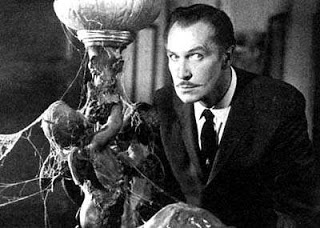
Horror On The Lens: The House On Haunted Hill (dir by William Castle)


The original The House on Haunted Hill is a classic and one that we make it a point to share every Halloween.  And since October is halfway over, now seems like the perfect time to do so!

Be sure to check out Gary’s review by clicking here!

Enjoy Vincent Price at his best!

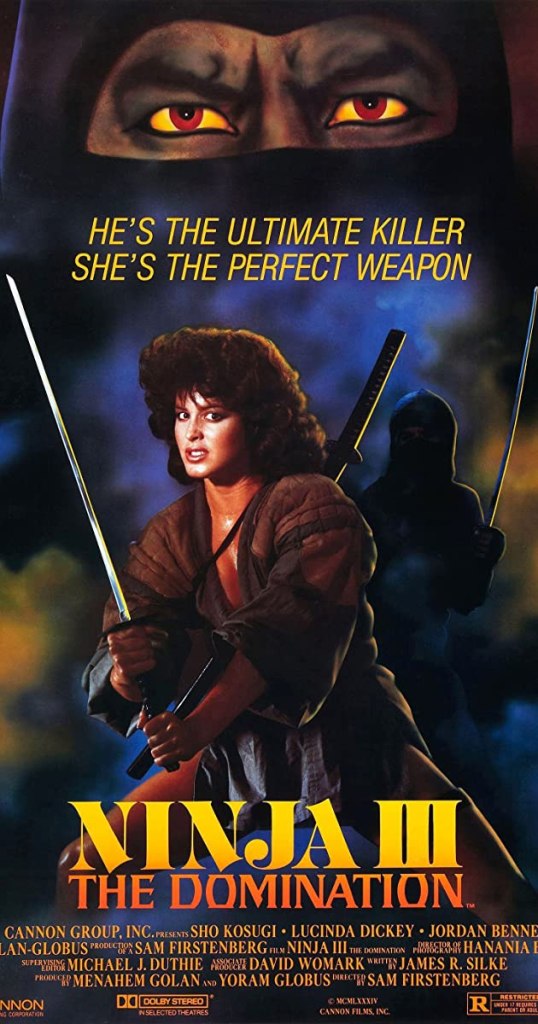
The TSL’s Horror Grindhouse: Ninja III: The Domination (dir by Sam Firstenberg)


This 1984 film is brilliant.

Basically, it tells the story of Christie Ryder (Lucinda Dickey), who appears to have everything that someone could want out of life.  Not only does she have a really nice place to live but she also repairs phone lines for a living!  (That might not sound glamorous but she lives in California, which means that there’s always a nice view when she’s working.)  She also teaches an aerobics class because this film is from 1984 and, in 1984, everyone taught their own aerobics class.  At least, that’s the impression that I’ve gotten from watching movies of the era.

Christie only has one problem.  She’s been possessed.  She hasn’t been possessed by any ordinary old demon, either.  Instead, she’s been possessed by a dead ninja.  Hanjuro (David Chung) came to America because there were some people on a golf course who needed to be killed.  Unfortunately, no sooner had he killed everyone on the back 9 then he found himself surrounded by cops.  It took a lot of bullets to take down Hanjuro but down he went.  However, his spirit went up and entered Christie’s body.

Now, Christie spends her time teaching aerobics, working on phone lines, and murdering everyone who Hanjuro feels has wrong him.  Hanjuro wants to kill all of the cops who shot him.  Unfortunately, one of those cops, Billy Secord (Jordan Bennett), is now dating Christie.  Once Billy finally figures out why Christie is acting so strangely, he takes her to an exorcist (James Hong) who explains that it’s going to take more than just an ordinary exorcism to defeat the ninja lurking within Christie.  It’s going to require the help of another ninja, the noble Goro Yamada (Sho Kosugi).  It’s time to go to Japan!

I may not be a huge ninja movie fan (unless, of course, they feature Franco Nero) but I have to say that I absolutely loved Ninja III.  That really shouldn’t come as a surprise.  This film is such an utterly weird mishmash of tones and genres that there’s no way that I couldn’t love it.  It starts out as a typical kung fu film, just to suddenly turn into The Exorcist before then becoming Flashdance before returning to being The Exorcist.  Finally, for the last few minutes of the film, it transforms back into a kung fu film.  As I watched the film, I found myself thinking about all of the other films throughout history that could have been livened up by a demonic or spiritual possession subplot.  For that matter, think about how much more crazy The Exorcist would have been if Father Karras and Father Merrin had been Ninja Karras and NInja Merrin.

Anyway, in all seriousness, Ninja III is exactly what an exploitation film should be.  It’s unapologetically strange and over-the-top and it makes absolutely no apologies for being what it is.  It’s a film that says, “I’m here to tell a story about a woman possessed by a dead ninja and if that’s not good enough for you, you need to figure out what’s wrong with your heart.”  Ninja III is brilliant, wonderful, and definitely a film that you must watch this October.  It’s on Prime so go watch it.  Do it now.