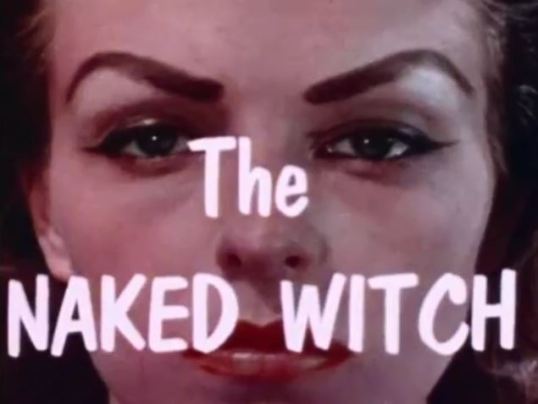
The TSL’s Grindhouse: The Naked Witch (dir by Larry Buchanan)


The 1964 film, The Naked Witch, opens with a prologue that explains the role of witchcraft throughout the ages. That, in itself, is not surprising. A lot of supernaturally-themed films opens with a prologue that’s designed to give the film some sort of historical basis. It’s one of the oldest tricks in the book. Give your cheap film some credibility by claiming that it’s “based on a true story.”

What sets The Naked Witch apart is that the prologue just goes on and on. For ten minutes, we stare at Bosch paintings while an officious sounding narrator discusses the history of witchcraft. The paintings are effectively macabre but it all goes on for so long that you can’t help but get the feeling that the prologue was mostly added to pad out the running time. It’s almost as if director Larry Buchanan was basically admitting that he didn’t really have enough of an actual story to justify a feature-length running time. Of course, this shouldn’t come as a shock to anyone who is familiar with Larry Buchanan’s filmography.

Once the narration finally ends, we find ourselves watching The Student (Robert Short) as he drives through central Texas. The Student suddenly takes over the narration, telling us that he’s driving through the Texas German Counties. He’s visiting towns and counties that were founded by German settlers. The townspeople all have German names. Most of them still speak German in private. They all dress like they’ve just returned from a night at a Munich beer hall. Interestingly enough, these counties and towns do actually exist, though I’ve never seen anyone casually wearing lederhosen or a dirndl in Central Texas. Of course, this film was made a bit before my time so maybe that used to be a tradition back in 1964. Maybe people stopped doing it after The Naked Witch came out. Or, even more intriguingly, maybe people stopped doing because The Naked Witch came out. We’ll probably never know for sure.

Anyway, the Student is kind of an idiot because he manages to run out of gas while driving out in the middle of nowhere. I guess it didn’t occur to him to fill up the tank before trying to drive through a largely empty stretch of land. Leaving his car behind, he manages to walk to the real-life town of Luckenbach, Texas. He’s shocked to discover the none of the townspeople want to talk about long-dead witch that was supposedly buried in town. Why, it’s almost as if the people of Luckenbach understand that it’s not a good idea to brag about living under the threat of a supernatural curse.

Largely due to the Student’s stupidity, the Witch (played by Libby Hall) comes back from the dead. She’s naked, which I imagine was probably the film’s main selling point back in 1964. The Witch wants revenge on the descendants of the people who put her to death. The Students just wants to hook up with The Witch.

And that’s really pretty much it. Even by the admittedly low standard set by Larry Buchanan’s other films, the plot of The Naked Witch is pretty much impossible to follow. It’s incoherent and yet, strangely enough, that incoherence sometime works in the film’ favor. The atmospheric Texas landscape, when combined with the overly theatrical performance of Libby Hall, gives the film a dream-like feel. Even the fact that the film features three separate narrators all contribute to the movie’s surreal style. At its best, The Naked Witch is an existential mood piece. At its worst, it’s just a really bad, zero-budget drive-in movie.

The Naked Witch is an odd film but, if you’re looking for a ten minute history on witchcraft followed by a Texas travelouge, the film might be for you.
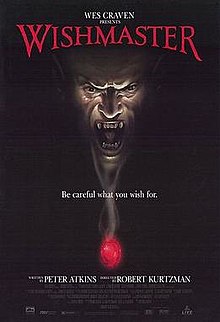
Horror Film Review: Wishmaster (dir by Robert Kurtzman)


Do you all remember Wishmaster?

Played by Andrew Divoff, the Wishmaster was a genie (or a djinn) who made his film debut in the 1997 film of the same name. The Djinn’s schtick is to randomly approach people and say something like, “Would you like to be rich?” or “Would you like all of your enemies to suffer?” He grants wishes but he does so in ironic ways. So, if you say want to be rich, you might very well turn into someone named Rich who is on the verge of getting hit by a bus. If you say that you want to escape from your mundane life, you might end up in a straight-jacket under water, struggling to perform one of Harry Houdini’s signature escapes.

I rewatched Wishmaster a few months ago and what I immediately discovered was the the Djinn wasn’t really that good at his job. He pretended to be clever in the way that he would fool humans but, honestly, it often seemed less like he was tricking people and more like he really wasn’t playing fair. Take the security guard who made the mistake of wishing for an escape. As I just mentioned, The Djinn immediately put him underwater in a straight-jacket. But the guard’s wish was not to have to escape. The guard’s wish was to simply escape. So, putting him in a life-and-death situation and telling him to figure it out for himself wasn’t fulfilling the guard’s wish. It just seemed like the Djinn wanted to drown someone and he decided to use his wish-granting job as an excuse.

The guard, by the way, was played by Tony Todd, one of the many horror icons who appeared in small roles in Wishmaster. (Today, Tony Todd is best known for the Final Destination films but, when Wishmaster came out, he was known for playing the Candyman.) Among the other cameos:

From Phantasm, Angus Scrimm provided the narration while Reggie Bannister played an unlucky pharmacist.

From Friday the 13th, Kane Hodder played a security guard who made the mistake of saying that he wished he could see the Djinn try to walk straight through him.

Day of the Dead’s Joseph Pilato played a crane operator.

John Carpenter vet George “Buck” Flower played an angry homeless man.

Sam Raimi’s brother, Ted Raimi, showed up long enough to get crushed by a crate.

And finally, Robert Englund played the somewhat pretentious professor who was responsible for bringing the Djinn to America in the first place.

As you can probably guess by looking at all of the cameos, Wishmaster is not a film that’s meant to be taken seriously. It’s often deliberately campy. Wes Craven may have produced it and was undoubtedly responsible for recruiting many of the actors who appeared in it but the film’s direction was handled by special effects maestro, Robert Kurtzman and he puts more emphasis on the visual effects than on any sort of serious exploration of the somewhat random series of events that make up the film’s storyline. Of course, when seen today, the film’s special effects look a bit cheap but, for many viewers (like me!), that’s actually a part of the film’s grisly charm.

Wishmaster does have a plot but it’s not particularly important. The Djinn tries to make Alexandra (Tammy Lauren) make three wishes so that he can unleash the forces of Hell. Why he spends all of his time granting wishes to other people instead of just concentrating on Alex is never really explained. It may be an often dumb movie but it’s also undeniably entertaining when taken on its own terms. Andrew Divoff is enjoyably sinister as the Djinn, playing the character with a sarcastic wit to go along with his evil schemes. It’s a fun movie to watch, even if it does feel like it was basically slapped together in a handful of days.

You should always be careful what you wish for but Wishmaster is still an entertaining piece of 90s horror.

(Author’s Note: Wow, this is embarrassing.  Right after I posted this review, I discovered that I previously reviewed Wishmaster in 2018!  Whoops!  Well, it’s nice to see that my thoughts on the film have remained consistent. — LMB)

Sssssss (1973, directed by Bernard L. Kowalski)


Will that be seven S’s or only six?

College student David Blake (Dirk Benedict) gets a job working as an assistant to Dr. Carl Stoner (Strother Martin).  Dr. Stoner is an expert on reptiles and he is very concerned that man will not be able to survive if the Earth suffers any sort of environmental change.  When he hires David, he only has two requirements for the young man.  David is not to date Stoner’s daughter, Kristina (Heather Menzies) and David has to take an injection every day of a serum that will protect him from snake venom, or so Carl says.

What David doesn’t know is that Carl is a damn liar and his plan for saving humanity is to turn people into Snakemen!  Snakes can survive anything so why wouldn’t human want to be more like them?  Soon, David’s face is getting scaly and Kristina is discovering what really happened to her father’s previous assistant.

Sssssss tries to take its story seriously and the snake makeup is cool and creepy but the movie itself moves too slowly.  It makes the mistake of worrying about convincing us that the story is plausible when it should just be focusing on snake action.  There are some good scenes, like when Kristina tracks down David’s predecessor and Strother Martin is convincing as the mad scientist.  If you thought Strother Martin was just capable of playing outlaws and corrupt cops, this movie may surprise you.  I also liked the ending, which only seems ambiguous.  It’s easy to see what’s going to happen after the end credits roll.

Richard Zanuck and David Brown produced this film.  It did well enough at the box office that they decided to produce another nature-gone-mad movie.  That one was named Jaws.

A Blast From The Past: The Procrastinator (dir by Herk Havey)


Goddammit, Jean let everyone down again!

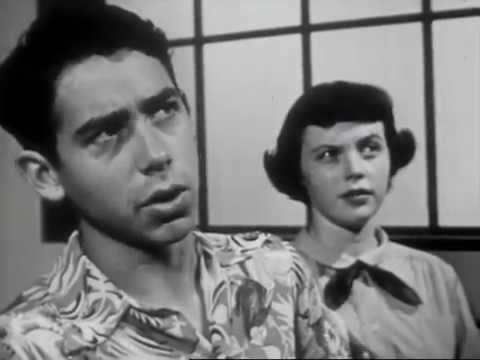
Jean is at the center of The Procrastinator, a short educational film from 1952.  Jean has a history of putting stuff off and letting down her friends, her parents, her peers, and probably the entire state of Kansas as well.  Still, despite the fact that Jean has repeatedly shown that she can’t be trusted with any responsibility, her fellow students decide to give her some responsibility.  When Jean continues to procrastinate, they all get mad at her but you know what?  Is it really Jean’s fault that they gave her a job that she obviously couldn’t handle?

What I’m saying is stop being so judgmental!  Everyone has their own way.  Some people get things done early.  Some people wait until the last minute.  And then there are people like me who make plans to do everything early but who still end up waiting until the last second regardless.  For example, my original plan for this year was to write all of my Horrorthon reviews in May and June and then spend October in a state of blissful relaxation.  Needless to say, that didn’t happen.  But, to be honest, I kind of enjoy the pressure of having to get things done at the last minute.  I do my best work under pressure, I think.

Now, if you’re wondering why I’m sharing this video in October, it’s because this film was directed by Herk Harvey.  Harvey made a career out of directing short educational films but, to horror audiences, he’s best known for directing a classic horror film called Carnival of Souls.  Carnival of Souls is a film that I’ll be sharing in a few days.  On the surface, The Procrastinator may not appear to have much in common with Carnival of Souls.  However, I think you can compare Jean’s refusal to do things in a timely fashion to Candace Hilligoss’s refusal to accept the reason for why she keeps seeing ghosts following her everywhere she goes.  So, in way, both of these films take place in the same universe.  Call it the Herkiverse.

Watch and decide for yourself!

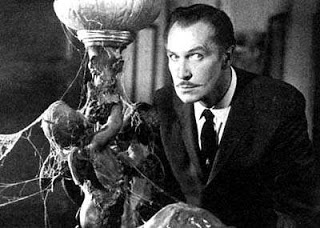
Horror On The Lens: House On Haunted Hill (dir by William Castle)


The original The House on Haunted Hill is a classic and one that we make it a point to share every Halloween.  And since October is nearly over, now seems like the perfect time to do so!

Be sure to check out Gary’s review by clicking here!

Enjoy Vincent Price at his best!

The TSL’s Grindhouse: Mulberry Street (dir by Jim Mickle)


Rats are the freaking worst, aren’t they?

Seriously, I can see the good in almost all of the creatures of the world but I hate rats and I hate cockroaches and I hate both of them for the exact same reason. They’re just so dirty! I mean, they are two of the filthiest animals on the planet. Look up the source of any plague that nearly wiped out humanity in the pre-modern era and rats are somehow going to be to blame. I’m very proud to say that there has never been a single rat or a mouse in any home in which I’ve ever lived. (When I was in college, however, I did once see a mouse running from classroom to classroom. Consider that. I keep my home cleaner than the average college.)

Mulberry Street is a horror film from 2006 that gives us an entirely new reason to dislike rats. Not only do they spread the Bubonic Plague but they also turn people into human/rat/zombie hybrids! At least, that’s what happens in this film. Set in New York City during one very long and very hot summer day, Mulberry Street imagines a world in which the rats get tired of hiding in the subways and they finally take over Manhattan. People are bitten. People are transformed into humanoid rats. People go crazy and attempt to infect other people. It get wild out there. They say you can see anything in New York and apparently, you can. Unfortunately, the cost of seeing is turning into a rat. That kind of sucks.

Casey (Kim Blair) has just returned from serving her country in Iraq and she would rather not be turned into a rat. Her father, Clutch (Nick Damici), is an ex-boxer and he would also rather not turn into a rat. In a world dominated by rats, what are the ratphobic to do? Clutch, Casey, and a handful of others barricade themselves inside their apartments and they try to survive the night while the rats scratch at the door.

Yes, Mulberry Street is yet another zombie film. I mean, they may be rat hybrids as opposed to being the undead but, in the end, they might as well be a zombies. However, Mulberry Street works better than the average zombie film because it was shot guerilla-style on the streets of New York City. There’s a raw authenticity to Mulberry Street, with its jittery camerawork and it’s cast of talented but unknown actors. The threat feels real. The struggle to survive feels real. The fears feels real. At no point are you confident that Casey, Clutch , and their friends are going to survive the night. Mulberry Street feels as real as any film featuring human/rat hybrids can. Even before the rats attack, Mulberry Street presents us with a New York that feels sick and dying. In the end, the rats are just the next logical step. The city has devolved to such an extent that an attack of zombie rats feels predestined.

Mulberry Street was well-directed by Jim Mickle. Mickle would go on to direct Cold in July, one of the best modern noirs to be released over the past few years. Be sure to check out both films.

The Disappearance of Flight 412 (1974, directed by Jud Taylor)


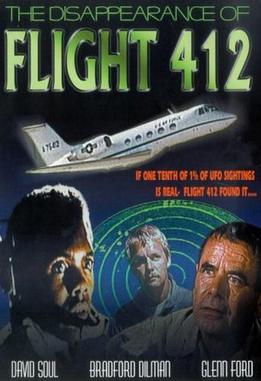
Because of recent electrical surges aboard its aircrafts, the commander of the Whitney Air Force Base 458th Radar Test Group sends a four-man crew up in Flight 412 to try to figure out what’s happening.  Colonel Pete Moore (Glenn Ford) and Major Mike Dunning (Bradford DIllman) assume that it will just be a routine flight.  Instead, they find themselves at the center of a government cover-up when Captain Bishop (David Soul) and the other members of the crew spot what appears to be a UFO.  When two jets are sent out to intercept the object, the jets vanish.

Suddenly, Flight 412 is ordered to land at a seemingly deserted military base in the desert.  When they do, the airplane is impounded and the crew is forced to undergo an 18-hour debriefing led by government agents.  The agents demand that the crew members sign a statement saying that they didn’t see anything strange in the air before the jets vanished.  Until all four of the men sign the release, the crew of Flight 412 are officially considered to be missing and will not be released until they agree to deny what they saw.

Meanwhile, Col. Moore tries to learn what happened to his men but the government, led by Col. Trottman (Guy Stockwell), is not eager to tell him.

This movie was made-for-television, at a time when people claiming to have been abducted by aliens was still a relatively new phenomenon.  It was also made during the Watergate hearing and in the wake of the release of the Pentagon Papers, so the film’s sinister government conspiracy probably felt relevant to viewers in a way that it wouldn’t have just a few years earlier.  I appreciated that the movie took a semi-documentary approach to the story but that it tried to be serious and even-handed.  The film shows how witnesses can be fooled or coerced into saying that they saw the opposite of what they actually did see.  Unfortunately, The Disappearance of Fight 412 is ultimately done in by its own cheapness.  The overreliance on familiar stock footage doesn’t help the film’s credibility and there’s too many familiar faces in the cast for the audience to forget that they’re just watching a TV movie.  The Disappearance of Flight 412 doesn’t really succeed but it is still interesting as an early attempt to make a serious film about the possibility of alien abduction and the government covering up the existence of UFOs..  Three years after this film first aired, Steven Spielberg would introduce these ideas to an even bigger audience with Close Encounters of The Third Kind.

Horror Scenes That I Love: The Final Scene of The Birds


From 1963’s The Birds and directed by Alfred Hitchcock, this is one of the best horror endings ever.

The birds have won. Or, at least they have until Birdemic….

International Horror Review: The Mark of the Wolfman (dir by Enrique López Eguiluz)


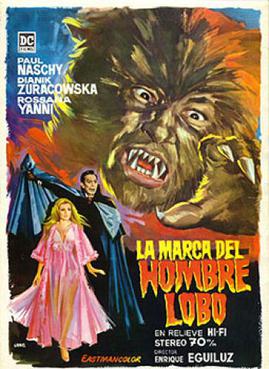
The 1968 Spanish film, The Mark of the Wolfman, is a strange one.

Just try to keep this straight:

In Eastern Europe, two gypsies accidentally bring back to life a feared werewolf named Imre Wolfstein.  (Beware any supernatural creature who has an ironic name.)  Wolfstein proceeds to terrorize the countryside, attacking both the good and the bad alike.  He also finds the time to attack a Polish nobleman named Waldemer Danisky (Paul Naschy).  Danisky survives the attack but now he’s a werewolf!  Unlike Wolfstein, Danisky is not happy about being a werewolf, especially when he discovers that he’s been killing innocent people while transformed.  So, Danisky decides to go to a local scientist named Dr. Janos Mikhelov (Julian Ugarte).  Unfortunately, it turns out that Dr. Mikhelov is a vampire and so is his wife!  They’ve got special plans for both of the werewolves!

The Mark of the Wolfman was the first of many films in which Naschy would play Count Danisky.  They were extremely popular in Europe and Paul Naschy became a big star in Spain.  In fact, he was sometimes called the Spanish Lon Chaney and given that Naschy often talked about how The Wolf Man (starring Lon Chaney, Jr.) was one of his favorite films when he was a child, that undoubtedly brought him a lot of pleasure.  And indeed, Naschy’s performance as Danisky did owe a bit to Lon Chaney Jr’s performance as Larry Talbot.  They’re both tortured souls, desperately seeking an escape from their curse and continually being brought back to life against their will.  The main difference between the two was that Danisky never got quite as whiny as Talbot.  Whereas Lon Chaney Jr. played Larry Talbot as being just a big dumb lug, Naschy played Danisky as being a far more aggressive character.  Danisky wasn’t just depressed over being a werewolf.  He was pissed off about it.

The plot of Mark of the Wolfman may sound complicated but, by the standards of Naschy’s other films, it’s actually rather straight-forward and uncomplicated.  Of course, it can be difficult for an American to judge Naschy’s films because many of them were never released here in the United States and those that were can usually only be found in poorly dubbed and crudely edited versions.  For instance, Mark of the Wolfman was released in the United States as Frankenstein’s Bloody Terror, despite the fact that neither Frankenstein nor his monster were anywhere to be found in the original film.  However, the distributors needed a film to go on a double bill with another Frankenstein movie.  To justify the title change, narration was added to the start of the film that established that Wolfstein was a descendant of Frankenstein.  Apparently, the price for playing God was to be cursed with lycanthropy.  It’s actually kind of charming in a drive-in sort of way.

Even if you know nothing about the subsequent career of Paul Naschy or the many sequels that followed this film, The Mark of the Wolfman holds up well as an entertaining horror film.  It’s only 88 minutes long and it manages to pack drunken gypsies, tortured werewolves, devious vampires, and a dungeon into its brief running time.  As a result, it’s never boring. Visually, the film is a treat, with the camera swiftly moving across the wilderness or tracking through gothic castles.  (Mark of the Wolfman was originally filmed in 3D and, watching the film, I found myself thinking that it probably looked pretty damn impressive to audiences in 1968.)  Because the version that I saw was badly dubbed into English, it wasn’t always easy to judge the performances but Naschy played Danisky with a properly haunted look.

The Mark of the Wolfman is an enjoyable work of Spanish horror, one that undoubtedly helped to revitalize Spanish horror just as assuredly at the Blind Dead and Jess Franco.

Insomnia File #50: Zola (dir by Janicza Bravo)


What’s an Insomnia File? You know how some times you just can’t get any sleep and, at about three in the morning, you’ll find yourself watching whatever you can find on cable or Netflix? This feature is all about those insomnia-inspired discoveries!

If you were having trouble getting to sleep around two a.m. on Monday morning, you could have turned over to Showtime 2’s west coast feed and watched Zola.

Zola tells the story of Zola (Taylor Paige), a Detroit waitress and part-time stripper who is invited to go down to Florida by another stripper, Stefani (Riley Keough).  Stefani assures Zola that they’re just going to have a good time and make some money dancing in the clubs.  Instead, it turns out that they’re going to Florida with Stefani’s roommate, X (Colman Domingo, showing compelling flashes of charisma and danger), and her simple-minded but loyal boyfriend, Derrek (Nicholas Braun).  It also turns out that X is actually a Nigerian named Abegunde Olawale and that he is Stefani’s pimp.  It doesn’t take long for Zola to grow annoyed with everyone else on the road trip but, unfortunately, she’s already stuck in Tampa with them.  That’s the problem with going on a road trips with perfect strangers.  The trip grows stranger and more violent with each passing hour.  In fact, it gets so strange that, when Zola eventually tells her story on twitter, the thread goes viral.  And then this movie is made, with a disclaimer that states that most of the story is based on fact.

Zola made quite a splash when it premiered at Sundance in 2020.  Audiences either loved or hated its extreme stylization and rather crass cast of characters.  While the film was originally scheduled to be released in 2020, that release was delayed by the COVID pandemic.  At a time when people were scared to go outside and be near even their closest relatives or friends, I guess someone decided that it wasn’t the right time to release a movie about going on a cramped road trip with two morons and a psychotic pimp.  The film was finally released earlier this year.  It got good critical notices, though audiences seemed to be slightly less enamored with it.

Speaking for myself, I was both impressed and annoyed with Zola.  On the one hand, you have to respect a film that’s willing to run the risk of alienating the audience in order to tell its story.  Zola is violent, vulgar, and frequently funny.  It’s also frequently disturbing, with Zola continually finding herself in a bad situation from which she can’t escape.  Taylour Paige brings a lot of inner strength to the role of Zola.  When Zola gets annoyed, she doesn’t hide it.  When Zola says she’s not going to do something, she means it and she says it with such confidence that even X respects her.  She and Stefani also have an interesting relationship, one that will ring true to anyone who has ever had that one friend who simply cannot stop messing up her life.  The film embraces its characters and their activities, refusing to pass judgment or to sentimentalize.  You have to admire the film’s commitment.  At the same time, the film is occasionally a bit annoying.  It’s so extremely stylized and Stefani is so loud and crass that it can sometimes be tough to take.  This is a film that benefits from being watched at home as opposed to in theater, if just because you can hit pause whenever you feel a migraine starting to come on.  (Poor Zola, meanwhile, is stuck in the back of X’s car, listening to Stefani and Derreck and realizing that she’s pretty much stuck with all of them.)  Zola was produced and distributed by A24 and it is indeed very much an A24 film, loud, frustrating, paranoia-inducing, and occasionally compelling.

Zola is only 90 minutes long but it packs a lot into those minutes.  It’s not a boring film.  At the same time, it’s never quite as subversive as something like Spring Breakers.  Instead, it’s just an energetic recreation of the road trip from Hell.

Previous Insomnia Files:

  1. Story of Mankind
  2. Stag
  3. Love Is A Gun
  4. Nina Takes A Lover
  5. Black Ice
  6. Frogs For Snakes
  7. Fair Game
  8. From The Hip
  9. Born Killers
  10. Eye For An Eye
  11. Summer Catch
  12. Beyond the Law
  13. Spring Broke
  14. Promise
  15. George Wallace
  16. Kill The Messenger
  17. The Suburbans
  18. Only The Strong
  19. Great Expectations
  20. Casual Sex?
  21. Truth
  22. Insomina
  23. Death Do Us Part
  24. A Star is Born
  25. The Winning Season
  26. Rabbit Run
  27. Remember My Name
  28. The Arrangement
  29. Day of the Animals
  30. Still of The Night
  31. Arsenal
  32. Smooth Talk
  33. The Comedian
  34. The Minus Man
  35. Donnie Brasco
  36. Punchline
  37. Evita
  38. Six: The Mark Unleashed
  39. Disclosure
  40. The Spanish Prisoner
  41. Elektra
  42. Revenge
  43. Legend
  44. Cat Run
  45. The Pyramid
  46. Enter the Ninja
  47. Downhill
  48. Malice
  49. Mystery Date