Rick Murphy (Scott Glenn) is a punch-drunk boxer who is hired to return an ancient sword to Japan so that it can be returned to its rightful owner, the honorable Toru (Toshiro Mifune). Once in Japan, Rick becomes involved in a battle between Toru and his corrupt brother, Hideo (Atsuo Nakamura). Hideo demands that Rick work as an undercover spy in Toru’s martial arts school or be beheaded. Rick decides to keep his head and be a spy but he soon finds himself truly wanting to learn the ways of the Bushido.
A martial arts film is the last place most people would expect to find Scott Glenn and considering how miscast Glenn is, that’s understandable. Scott Glenn feels very out-of-place as both a boxer and a modern-day samurai. Scott Glenn is a very good actor but the role of Rick Murphy called for someone who could mix comedy with drama and be convincingly desperate. That’s not Scott Glenn. Who would have been better in the role? Tom Berenger was already acting in 1982. Or maybe even someone like Jan-Michael Vincent. Vincent was a B-actor but, deep down, The Challenge is a B-movie.
The good thing is that the action often does make up for Glenn’s miscasting. John Frankenheimer struggled with making the human drama compelling but he knew how to film a good fight. John Sayles’s script is pulpy without ever being disrespectful to Japanese culture and, as always, Mifune looks like he could battle and defeat the entire world if he wanted to.
One final note: Steven Seagal worked behind-the-scenes on the film but we won’t hold that against it.
Released in 1999, The Straight Story is one of the greatest films ever made about America.
Alvin Straight (Richard Farnsworth) is an elderly veteran of World War II. He lives in Iowa, a kind but rather taciturn man who doesn’t have time for doctors and would rather live on his own terms. That said, when his daughter (Sissy Spacek) finally does manage to drag Alvin to a doctor, he’s told to stop smoking and to start using a walker to get around. Alvin refuses, though he does start using two canes. Alvin is an old man. He’s lived a long time and, in his opinion, he knows best about what he needs to do.
For instance, when Alvin hears that his long-estranged brother Lyle (Harry Dean Stanton), has had a stroke, Alvin decides that he need to go Wisconsin to see him. The only problem is that Alvin can barely see and he can’t walk and there’s no way anyone is going to give him a car or even a driver’s license. His solution is to ride a lawnmower from Iowa to Wisconsin.
It’s based on a true story and if The Straight Story sounds like a film that will make you cry, it is. Richard Farnsworth was terminally ill when he was offered the role of Alvin and he accepted because he admired Alvin’s determination to live life his own way. As portrayed in the film, Alvin is not one to easily betray his emotions. He grew up as a part of that stoic generation. He saw his share of violence and death while he was serving during World War II and one gets the feeling that his attitude has always been that, if he could survive that, he can survive anything. (The closest Alvin gets to becoming openly emotional is when he meets another veteran in a bar and it becomes obvious that the two of them share a bond that, as people who seen and survived war, only they can really understand.) Farnsworth so completely becomes Alvin Straight that it’s easy to forger that he was a veteran actor who had a long career before starring in The Straight Story. Alvin may not show much emotion but Farnsworth communicates so much with just the weariness in his eyes and his slow but determined gait that we feel like we know everything about him.
The film follows Alvin on his way to Wisconsin. Along the way, he meets various people and, for the most part, they’re all good folks. Even the runaway hitchhiker (Anastasia Webb) turns out to be a kind soul. When Alvin momentarily loses control of his lawn mower, a group of stranger run out to help him. They don’t know who he is or why he was riding his lawnmower down the street. All that matter is that, at that moment, he’s a person who needs help. The Straight Story celebrates both the beauty and the people of America. It’s one of the most sincere and life-affirming films ever made, one that contains not a trace of cynicism and which is all the better for it. And while many people might be shocked to discover that this film was directed by David Lynch, the truth of the matter is that a strong love for America and Americana runs through all of Lynch’s films. Lynch was an artist who believed that people could surprise you with their kindness and that’s certainly the case with The Straight Story.
The Straight Story was the only one of David Lynch’s films to receive a G-rating. It was also the only film that Lynch made for Disney. It’s interesting to look at Lynch’s filmography and see this heartfelt and deeply touching film sitting between Lost Highway and Mulholland Drive. But The Straight Story really does feature David Lynch at his best. It also reveals him as a filmmaker who could do something unexpected without compromising his signature vision. There’s a lot of beautiful, Lynchian images in The Straight Story. But there’s also a lot of heart.
The Sundance Film Festival is currently underway in Utah. For the next few days, I’ll be taking a look at some of the films that have previously won awards at Sundance.
First released in 1990, Longtime Companion was one of the first mainstream feature films to deal with the early days of the AIDS epidemic.
The film follows a group of friends and lovers over the course of ten years. The film opens with a crowded and joyous 4th of July weekend at Fire Island. Willy (Campbell Scott) is a personal trainer who has just started a relationship with an entertainment lawyer who, due to his beard, is nicknamed Fuzzy (Stephen Caffrey). Willy’s best friend is the personable and popular John (Dermot Mulroney). David (Bruce Davison) and Sean (Mark Lamos) are the elder couple of the group. Sean writes for a soap opera and one of Fuzzy’s clients, Howard (Patrick Cassidy), has just landed a role on the show. He’ll be playing a gay character, even though everyone warns him that the role will lead to him getting typecast. The group’s straight friend is Lisa (Mary-Louise Parker), an antique dealer who lives next door to Howard and who is Fuzzy’s sister. The film takes it times showing us the friendships and the relationships between these characters, allowing us to get to know them all as individuals.
Even as the group celebrates the 4th, they are talking about an article in the New York Times about the rise of a “gay cancer.” Some members of the group are concerned but the majority simply shrug it off as another out-there rumor.
The movie moves quickly, from one year to another. John, the youngest of them, is the first member of the group to die, passing away alone in a hospital room while hooked up to a respirator. (The sound of the respirator is one of the most haunting parts of the film.) Sean soon becomes ill and starts to dramatically deteriorate. It falls to David to take care of Sean and to even ghostwrite his scripts for the soap opera. Howard’s acting career is sabotaged by rumors that he has AIDS while Willy and Fuzzy tentatively try to have a relationship at time when they’re not even sure how AIDS is transmitted. At one point, Willy visits a friend in the hospital and then furiously scrubs his skin in case he’s somehow been infected. When one member of the group passes, his lover is referred to as being his “longtime companion” in the obituary. Even while dealing with tragedy and feeling as if they’ve been shunned and abandoned to die by the rest of America, the characters are expected to hide the details of the lives and their grief.
It’s a poignant and low-key film, one that was originally made for PBS but then given a theatrical release after production was complete. Seen today, the film feels like a companion piece to Roger Spottiswoode’s And The Band Played On. If And The Band Played On dealt with the politics around AIDS and the early struggle to get people to even acknowledge that it existed, Longtime Companion is about the human cost of the epidemic. The film is wonderfully acted by the talented cast. Bruce Davison was nominated for an Oscar for his sensitive performance as David. If not for Joe Pesci’s performance in Goodfellas, it’s easy to imagine that Davison would have won. The scene where he encourages the comatose Sean to pass on will make you cry. Interestingly, when David gets sick himself, it happens off-screen as if the filmmakers knew there was no way the audience would have been able to emotionally handle watching David suffer any further.
Longtime Companion played at the 1990 Sundance Film Festival, where it won the Dramatic Audience Award.
One of my favorite scenes from TV’s King of the Hill occurs in an episode in which Hank and Peggy are celebrating their wedding anniversary. They’ve sent Bobby and Luanne away for the weekend. They have the house to themselves but, after their anniversary party, Peggy is feeling depressed. She tells Hank that, for the first time ever, she feels old and she regrets all the dreams that she had that have yet to come true, like inventing and selling her own barbecue sauce.
Trying to cheer her up, Hank says, “C’mon, Peg. We got the house to ourselves for weekend …. and I rented an R-rated movie!”
Peggy looks up, briefly hopeful that Hank did something romantic. “What movie?” she asks.
Hank hesitates, glances down at the floor, and says, “Uhmm …. Platoon.”
It’s funny because it’s true. Just about every man that I know loves Platoon. First released in 1986 and reportedly based on Oliver Stone’s own experiences as an infantryman in Vietnam, Platoon is often cited as being one of the greatest war films ever made. Oddly enough, the film has an anti-war and anti-military message but, in my experience, those who love it talk more about the battle scenes than any message that Stone may have been trying to impart about the futility of war. Pauline Kael once wrote that Oliver Stone had left-wing politics but a right-wing sensibility and I think you can definitely see that in Platoon. Despite all of the characters talking about how pointless the war is and how much they resent being forced to risk their lives for no apparent purpose, the film’s energy comes from the scenes of Chris Taylor (Charlie Sheen) stalking through the jungle and, towards the end, losing his mind and giving himself completely over to the adrenaline that comes from being trapped in the middle of a battle. Throughout the film, we hear Taylor’s rather pedantic thoughts on the military and his fellow soldiers but it’s hard not to notice that his actions and his dialogue are usually far less eloquent. Taylor may be a rich intellectual (and wow, is Charlie Sheen ever unconvincing when it comes to portraying that part of Taylor’s personality) but when he’s in the jungle, he’s just fighting for survival.
The film’s plot centers around the conflict between two sergeants, the peace-loving Elias (Willem DaFoe) and the war-loving Barnes (Tom Berenger). Taylor has to decide which one of the two to follow. The pot-smoking Elias loves his men and goes out of his way to protect them. The beer-drinking Barnes has a much harsher view of the world but, at the same time, he’s the type of scarred warrior who seems immortal. One gets the feeling that he’ll never be defeated. The rest of the platoon is full of familiar faces, with everyone from John C. McGinley to Francesco Quinn to Tony Todd to Forest Whitaker to Johnny Depp to a baby-faced Kevin Dillon showing up. (Dillon is especially frightening as a psycho who has, for some reason, been nicknamed Bunny.) The majority of the platoon is dead by the end of the film. Even with the leadership of Elias and Barnes, the soldiers are stuck in a winless situation. As Taylor points out, the Americans aren’t just fighting the enemy. They’re also fighting each other.
Platoon is certainly not my favorite of the film nominated in 1986. I would have gone with A Room With A View. (Blue Velvet, which is as influential a film as Platoon, was not even nominated.) That said, I can’t deny the power of Platoon‘s combat scenes. Though Stone’s script is didactic and Taylor’s narration is awkwardly deployed throughout the film, Stone’s direction definitely captures the fear and dread of being in a strange place with no idea of whether or not you’re going to survive. Stone is critical of the military (at one point, an officer calls an air strike on his own men) but seems to love the soldiers, even the ones who have pushed over to the dark side.
Platoon was not the first Best Picture nominee to be made about the Vietnam War. The Deer Hunter, Coming Home, and Apocalypse Now were all released first. But both The Deer Hunter and Apocalypse Now are surreal epics that seem to take place in a dream world. Coming Home, which has a script that somehow manages to be even more didactic than Platoon‘s, focuses on the war back home. Platoon is far more gritty and personal film. Watching Platoon, you can smell the gunpowder and the napalm and feel the humidity of the jungle. I can understand why it won, even if I prefer to watch Helena Bonham Carter and Julian Sands fall in love.
Topper Harley (Charlie Sheen) is back but instead of being a knock-off of Tom Cruise, he’s now Sylvester Stallone.
When two separate teams of U.S. soldiers fail to rescue a group of hostages who are being held by Saddam Hussein (Jerry Haleva, who built an entire career out of his resemblance to the Iraqi dictator), it not only embarrasses America but threatens the reelection campaign of President Tug Benson (Lloyd Bridges). President Benson can get away with throwing up on the Japanese ambassador and knocking over all the other Presidents with a shovel (though Gerald Ford falls on his own) but he can’t survive a hostage crisis. Colonel Denton Waters (Richard Crenna) and Michelle Huddleston (Brenda Bakke) attempt to recruit Topper Harley from the Buddhist monastery, where he’s been living since the disappearance of Ramada (Valeria Golino). Topper refuses to help with a third mission but, after Water is captured by Saddam, Topper does decide to lead the fourth mission. Working with Ryan Stiles and Miguel Ferrer, Topper heads into the jungle to save Colonel Waters, reunite with Ramada, and discover his destiny.
The sequel to Hot Shots! is more of the same, a non-stop cavalcade of jokes, movie references, and deadpan one liners. There are enough laugh out loud moments to make up for the jokes that don’t work. I’ll always like the moment when Charlie Sheen sees Martin Sheen on another patrol boat. (“Loved you in Wall Street!”) It’s a movie made in the vein of Airplane! but the jokes aren’t as timeless as in that classic. Everyone remembers Rambo enough to get the main joke and the interrogation scene in Basic Instinct has left enough of an impression that Topper’s “I know what to get your for Christmas,” comment to Michelle still draws a chuckle but do you remember Body of Evidence and the first President Bush vomiting at a state dinner? Not all of the jokes have aged well but Charlie Sheen does a decent Rambo impersonation and Lloyd Bridges’s dim bulb President is one of the more relatable parts of the movie. Fortunately, jokes about Saddam Hussein getting flattened by a piano will always be funny.
Like Woman of the Hour, Hit Man is a Netflix film that was critically acclaimed when it was released but which didn’t get much of an Oscar push during Awards Season.
The majority of the film’s acclaim was for Glen Powell, who plays Gary Johnson. Gary is a psychology professor at the University of New Orleans. When we first see him, he’s not exactly the most dynamic professor on campus. In fact, he’s so mild-mannered that most of his students would probably be stunned to learn that he has a side job working for the New Orleans Police Department. He helps them set up sting operations, advising a cop named Jasper (Austin Amelio) on how to pretend to be a hit man. Jasper, being kind of a douchebag, doesn’t really appreciate the advice. However, when Jasper gets suspended for beating a suspect, Gary is quickly recruited to take Jasper’s place as the department’s fake killer.
To his surprise, Gary turns out to be very good at pretending to be a professional killer. Using his academic skills, he gets a read on the person who wants to hire him and then he shapes his persona to appeal to that person’s needs. The best part of the film are the montages where we see Gary taking on identity after identity. Soon, Gary is the NPD’s best undercover cop, even if he’s technically not even a part of the force. He even becomes a better psychology professor as pretending to be someone else allows him to loosen up in his real life as well. But then he meets a woman (Adria Arjona) who wants to have her abusive husband killed. For the first time, Gary tries to talk someone out of committing a murder.
And through it all, Glen Powell gives an excellent and charismatic performance as not only Gary but also all the different killers that he pretends to be. If nothing else, this film proves that Glen Powell is not just a likable actor. He’s a legitimate film star, capable of creating a believable character and getting the audience to care about what happens to him. Powell gets good support from both Arjona and Austin Amelio and the various actors who pop up as people who want to hire a hit man all make a strong impression as well. But, make no mistake about it, Hit Man is a showcase for Glen Powell. Just as he did with Matthew McConaughey in Dazed and Confused, Richard Linklater introduces audiences to a film star in Hit Man.
That said, I have to admit that, outside of Powell’s performance, I was a little bit dissatisfied with the direction that Hit Man took its story. There are eventually two actual murders in Hit Man. One of the murders occurs offscreen and can at least be justified by what we know about the victim. The other murder takes place onscreen and, even though the victim isn’t particularly likable, it still feels a bit drawn out and out-of-place in what had otherwise been a fairly breezy comedy.
Narrative flaws aside, Hit Man is worth seeing for Powell’s movie star performance.
Charles Bronson plays a boat captain named Joe Martin who seems be living the good life in the south of France. He has a great job renting out boats to tourists! He has great luck beating his friends out of big stacks of cash in poker. He has a beautiful wife (Liv Ullman), and most importantly, he has about the biggest biceps I’ve seen in a movie not starring Arnold Schwarzenegger. This idyllic existence falls apart when some men from his past show up and force him to use his boat to help them smuggle drugs. It seems these guys feel like Martin owes them something since they had to go to prison for killing a cop, while ace driver Martin, escaped. As you might expect, nobody’s plans go as expected and much action ensues!
The first thing that stands out in this film is the cast, that includes James Mason, Liv Ullman, Michael Constantin, and Jill Ireland. Bronson’s European films uniformly had tremendous casts and this one is no different. Even with these well known actors, Jean Topart as the villainous Katanga, is a real standout. Second, this is the first of three films that Bronson completed with director Terence Young, who is most famous for kicking off the James Bond franchise with DR. NO, THUNDERBALL, and FROM RUSSIA WITH LOVE. Young knows how to stage action scenes, and with the help of famous French stuntman Remy Julienne, the two men cook up some impressive car stunts and chase sequences. Finally, Bronson himself exudes charisma and is in maximum physical condition in this film. In a career defined largely by his supreme conditioning, this may be Bronson’s most impressive physical performance.
Charles Bronson became an international superstar when he went to Europe in 1968, where he made a series of good films with great international casts. COLD SWEAT doesn’t come together quite as well as some of his other European films like RIDER ON THE RAIN, VIOLENT CITY & RED SUN, but it’s still a fun film with good action sequences and an impressively pumped up Charles Bronson. And the film has never looked better. After decades of shabby VHS and DVD copies, Kino Lorber put out a very nice blu ray in 2019. It’s nice seeing the movie in such a high quality presentation.
The Sundance Film Festival is currently underway in Utah. For the next few days, I’ll be taking a look at some of the films that have previously won awards at Sundance.
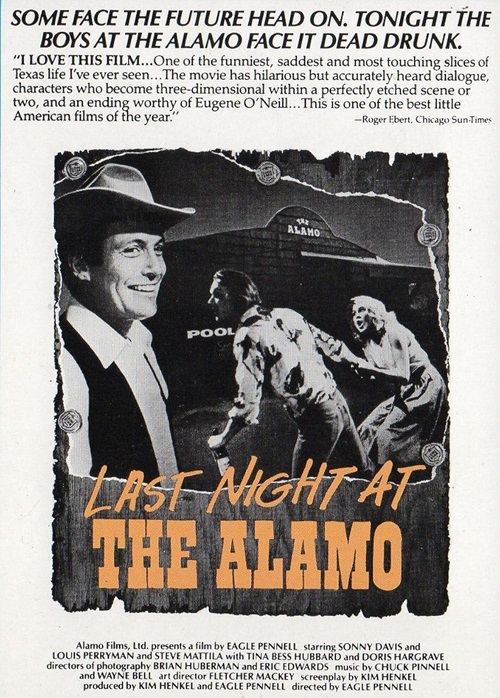
1983’s Last Night At The Alamo is the epitome of an indie film. Filmed in black-and-white and populated with performers who possess a raw authenticity, Last Night of the Alamo takes place over the course of one long day and night.
A seedy Houston bar known as The Alamo is set to close down and the regulars come by for their final drinks. It’s definitely a blue collar bar, a place where the conversations are loud and it seems like there’s always a possibility that a fight could break out at any minute. Claude (Lou Perryman) shows up after getting kicked out by his wife and spends a good deal of the movie yelling and cursing into a telephone. Ichabod (Steve Mattila), a young exterminator, spends almost the entire movie arguing with his girlfriend, Mary (Tina-Bess Hubbard). Steve (J. Michael Hammond) is an adult who still has the personality of a high school bully. For all the arguing and the taunting and the cursing that one hears over the course of the film, it’s also obvious that the regulars at the Alamo have formed a community of sorts. No one is surprised when Claude starts yelling into the telephone. That’s just Claude being Claude and he’s allowed to have his breakdown in peace. As long as he doesn’t interrupt anyone else’s drinking, he’ll be tolerated. It’s a very Texas attitude but then again, Last Night At The Alamo is a very Texas film.
It was written by Kim Henkel, who is probably best-known for writing the screenplay for the original Texas Chainsaw Massacre. (Henkel also appears in the film.) Director Eagle Pennell was one of the pioneers of the Texas film scene, making independent films about life in his home state. (Robert Redford has said that one of the main reasons he started the Sundance Film Festival was because he was impressed with Pennell’s films and wanted to create something that would bring attention to indie filmmakers like Pennell.) Much like many of the characters in Last Night At The Alamo, Pennell struggled with alcoholism and his promising career fizzled out as a result. He died at the age of 49. Legend has it that, shortly before his death, he was seen standing on a Houston streetcorner with a sign asking for either “a rich woman or a warm beer.” Again, it’s a very Texas story.
The majority of the characters in Last Night At The Alamo look up to the bar’s best-known regular, Cowboy Regan (Sonny Carl Davis). Cowboy is handsome and friendly, with a quick smile and a confident manner that makes him stand-out amongst the regulars at the Alamo. He presents himself as being successful and connected and he claims that he has a friend in Austin who is going to save The Alamo from demolition. Deep down, Cowboy is just as desperate as everyone else at the bar but he does a far better job of hiding it. The others look up to him not so much because they believe his stories but because they want to believe them.
It’s an almost plotless film but it does a great job of capturing my home state, with its blue collar culture and its frequent embrace of hucksters like Cowboy. Watching the film, one can see why it’s a favorite of Richard Linklater’s. It’s a melancholy film in many regards. Most of the characters don’t have much going for themselves. But they do have their bar and they have the community that they bult for themselves. The Alamo may be closing but life will continue just as surely as Ichabod and Mary will start and end every day yelling at each other.
Last Night At The Alamo was a prize winner at the 1984 Sundance Film Festival, winning the Dramatic Jury Prize. It can be found, in all of its grainy black-and-white glory, on YouTube.
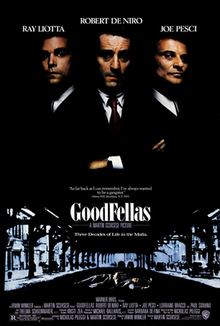
First released in 1990 and continuously acclaimed ever since, Goodfellas did not win the Oscar for Best Picture.
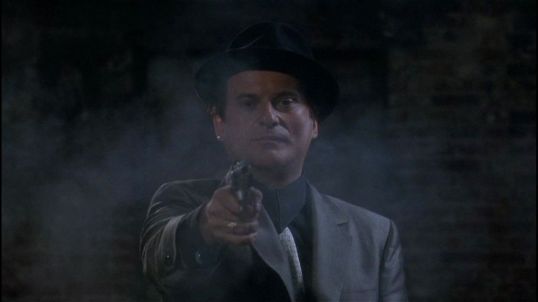
I’m always a bit surprised whenever I remember that. Goodfellas didn’t win Best Picture? That just doesn’t seem right. It’s not the other films nominated that year were bad but Goodfellas was so brilliant that it’s hard to imagine someone actually voting for something else. Seriously, it’s hard to think of a film that has been more influential than Goodfellas. Every gangster film with a soundtrack of kitschy tunes from the 6os and 70s owes huge debt to Goodfellas. Every actor who has ever been cast as a wild and out-of-control psycho gangster owes a debt to Joe Pesci’s performance as Tommy DeVito. When Ray Liotta passed away two years ago, we all immediately heard him saying, “I always wanted to be a gangster.” Robert De Niro’s Jimmy Conway remains the epitome of the ruthless gangster. For many, Paul Sorvino’s neighborhood godfather redefined what it meant to be a crime boss. Lorraine Bracco made such an impression as Karen Hill that it somehow seemed appropriate that she was one of the first people cast in The Sopranos, a show that itself would probably have not existed if not for Goodfellas. Frank Sivero, Samuel L. Jackson, Tobin Bell, Debi Mazer, Vincent Gallo, Ileana Douglas, Frank Vincent, Tony Sirico, Michael Imperioli, Tony Darrow, Mike Starr, Chuck Low, all of them can be seen in Goodfellas. It’s a film that many still consider to be the best of Martin Scorsese’s legendary career. Who can forget Robert De Niro smoking that cigarette while Sunshine of Your Love blared on the soundtrack? Who can forget “Maury’s wigs don’t come off!” or “Rossi, you are nothing but whore!?” Who can forget the cheery Christmas music playing in the background while De Niro’s Jimmy Conway grows more and more paranoid after pulling off the biggest heist of his career?
Plus, it’s a Christmas movie!
And yet, it did not win Best Picture.
Myself, whenever I’m sitting behind a garbage truck in traffic, I immediately start to hear the piano coda from Layla. For that matter, whenever I see a helicopter in the sky, I flash back to a coke-addled Henry Hill getting paranoid as he tries to pick up his brother from the hospital. Whenever I see someone walking across the street in the suburbs, I remember the scene where Henry coolly pistol-whips the country club guy and then tells Karen to hide his gun. I always remember Karen saying that she knows that many of her best friends would have run off as soon as their boyfriend gave them a gun to hide but “it turned me on.” It would have turned me on as well. Henry might be a gangster and his friends might be murderers but he doesn’t make any apologies for who he is, unlike everyone else in the world.
But it did not win Best Picture.
How many people have imitated Joe Pesci saying, “How am I funny?” How many times did Pesci and Frank Vincent have to listen to people telling them to “go home and get your fucking shinebox?” A lot of people remember the brutality of the scene where Pesci and De Niro team up to attack Vincent’s crude gangster but I always remember the sound of Donavon’s Atlantis playing on the soundtrack.
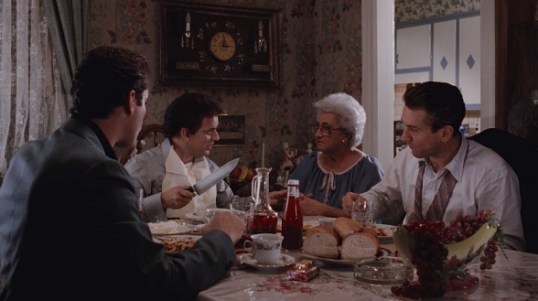
And then there’s Catherine Scorsese, showing up as Tommy’s mom and cooking for everyone while Vincent struggles to escape from the trunk of a car. “He is content to be a jerk,” Tommy says about Henry Hill. Just a few hours earlier, Tommy was apologizing to Henry for getting blood on his floor.
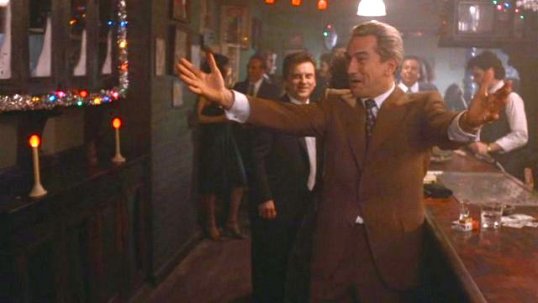
Goodfellas is a fast-paced look at organized crime, spanning from the 50s to the early 80s. Ray Liotta plays Henry Hill, who goes from idolizing gangsters to being a gangster to ultimately fearing his associates after he gets busted for dealing drugs. It’s a dizzying film, full of so many classic scenes and lines that it feels almost pointless to try to list them all here or to pretend like whoever is reading this review doesn’t remember the scene where the camera pans through the club and we meet the members of the crew. (“And then there was Pete The Killer….”) Goodfellas is a film that spend two hours showing us how much fun being a gangster can be and then thirty minutes showing us just how bad it can get when you’re high on coke, the police are after you, and you’ve recently learned that your associates are willing to kill even their oldest friends. No matter how many times I watch Goodfellas, I always get very anxious towards the end of the film. With the music pounding and the camera spinning, with Henry looking for helicopters, and with all of his plans going wrong over the course of one day, it’s almost a relief when Bo Dietl points that gun at Henry’s head and yells at him, revealing that Henry has been captured by the cops and not the Gambinos. Karen desperately running through the house, flushing drugs and hiding a gun in her underwear, always leaves me unsettled. It’s such a nice house but now, everything is crashing down.
There’s a tendency to compare Goodfellas to The Godfather, as their both films that re-imagine American history and culture through the lens of the gangster genre. I think they’re both great but I also think that they are ultimately two very different films. If The Godfather is sweeping and operatic, Goodfellas is the film that reminds us that gangsters also live in the suburbs and go to cookouts and that their wives take care of the kids and watch movies while the FBI searches their home. If The Godfather is about the bosses, Goodfellas is about the blue collar soldiers. The Godfather represents what we wish the Mafia was like while Goodfellas represents the reality.
Goodfellas is one of the greatest films ever made but it lost the Best Picture Oscar to Dances With Wolves, a film that left audiences feeling good as opposed to anxious. To be honest, Martin Scorsese losing Best Director to Kevin Costner feels like an even bigger injustice than Goodfellas losing Best Picture. One can understand the desire to reward Dances With Wolves, a film that attempts to correct a decades worth of negative stereotypes about Native Americans. But Scorsese’s direction was so brilliant that it’s truly a shame that he didn’t win and that Lorraine Bracco didn’t win Best Supporting Actress. It’s also a shame that Ray Liotta wasn’t nominated for playing Henry Hill. At least Joe Pesci won an Oscar for redefining what it meant to be a gangster.
Goodfellas is proof that the best film doesn’t always win at the Oscars. But it’s also proof that a great film doesn’t need an Oscar to be remembered.
There are a lot of reasons why it’s hard to take Top Gun seriously but, for me, the biggest problem is that I’ve seen Hot Shots! Directed by Jim Abrahams, Hot Shots! does for Top Gun what Airplane! did for disaster movies.
Charlie Sheen plays Topper Harley, the hot shot Navy Pilot who is haunted by the death of his father. (“I’ve even got my father’s eyes,” Topper says before revealing that he carries them around in a cigarette case.) Topper has left the Navy and is living in a teepee with the Old One. Command Block (Kevin Dunn) asks Topper to return to the Navy to take part in Operation Sleepy Weasel. Topper puts on a leather jacket and hops on a motorcycle. The Old One tells Topper to pick up some batteries for his walkman.
Cary Elwes plays Kent Gregory, who says that Topper is not safe in the air. Valeria Golino plays Ramada, the psyciatrist who helps Topper deal with his father issues. Jon Cryer is Washout, who has wall-eyed vision. Kristy Swanson is Bo, the only female pilot. William O’Leary is the pilot who has the perfect life and wife but who everyone calls “Dead Meat.” And finally Lloyd Bridges is Admiral Tug Benson, who has never successfully landed a plane and who has suffered and recovered from almost every war wound imaginable. Tug is clueless but he loves America and his admiral’s hat.
Hot Shots! is one of the better parody films to come out in the wake of Airplane! Charlie Sheen’s limitations as a dramatic actor actually made him a good comedic actor and Cary Elwes does a decent Val Kilmer imitation. Some of the jokes have definitely aged better than others. In 1991, Valeria Golino singing on a piano automatically brought to mind Michelle Pfieffer in The Fabolous Baker Boys but does anyone remember that film (or that scene) in 2025? (The 9 1/2 Weeks scene is even more of a distant memory to most but Valeria Golino is so appealing in those scenes that most viewers — well, most male viewers — won’t mind. In this case, the parody is far more successful than the original.) Hot Shots! is at its best when imitating Top Gun‘s kinetic, music video-inspired style. The mix of quick-cut editing and ludicrous dialogue is hard to resist. After watching Charlie Sheen dance on his motorcycle and Cary Elwes explain what a chafing dish is for, it’s hard to take Top Gun seriously ever again.
 Rick Murphy (Scott Glenn) is a punch-drunk boxer who is hired to return an ancient sword to Japan so that it can be returned to its rightful owner, the honorable Toru (Toshiro Mifune). Once in Japan, Rick becomes involved in a battle between Toru and his corrupt brother, Hideo (Atsuo Nakamura). Hideo demands that Rick work as an undercover spy in Toru’s martial arts school or be beheaded. Rick decides to keep his head and be a spy but he soon finds himself truly wanting to learn the ways of the Bushido.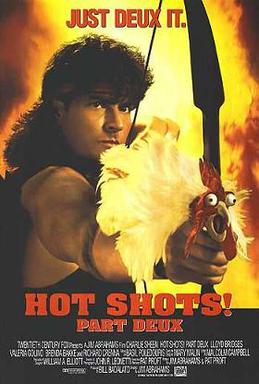


 Through the Shattered Lens