Ghosts of Sundance Past: Waiting For The Moon (dir by Jill Godmilow)


The Sundance Film Festival is currently underway in Utah.  For the next few days, I’ll be taking a look at some of the films that have previously won awards at Sundance.
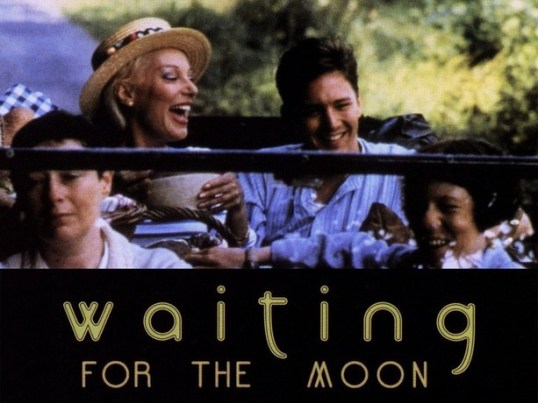
First released in 1987, Waiting For The Moon is a lowkey and fictionalized account of the relationship between Gertrude Stein (Linda Bassett) and Alice B. Toklas (Linda Hunt).

The film takes place in 1936, almost entirely at the home that Stein and Toklas shared in France.  Back in the years immediately following World War I, their home was a stopping spot for almost every writer who no longer felt at home in the conventional world.  It was the place where the members of the so-called Lost Generation met to socialize and discuss their art.  (Ernest Hemingway memorably wrote about visiting Stein and Toklas in A Moveable Feast.)  However, Waiting For The Moon takes place long after those exciting years.  Gertrude and Alice are now living a rather comfortable and settled life.  Occasionally, someone will stop by.  Hemingway (played by Bruce McGill) shows up.  Picasso stops by for a visit, though we only hear him.  But, for the most part, the film focuses on Gertrude and Alice.  The film follows them as they bicker like the old married couple that they essentially are, even if society in 1936 wasn’t willing to acknowledge it.  Alice proofreads Gertrude’s latest writing.  Gertrude waits for word from her doctor.  They talk about old times and old friends.  At one point, an aspiring writer named Henry Hopper (Andrew McCarthy) pays the two women a visit and, for a day at least, it’s like old time.  Henry is earnest and idealistic and full of plans for the future.  Unfortunately, he’s also planning on fighting in the Spanish Civil War and it doesn’t take a genius to guess that probably won’t go well.  Indeed, we learn that several of Gertrude and Alice’s old acquaintances are now fighting and dying in the Spanish Civil War.  For the so-called Lost Generation, the battle against Franco is a chance to find themselves but students of history already know how the war is going to end.  For that matter, students of history will also realize that World War II is right around the corner.  (Needless to say, the film itself offers up not a hint of the controversy that would surround Stein’s activities during the Vichy regime,)

Waiting For The Moon is a deliberately paced film, which is a polite way of saying that it’s a bit on the slow side.  That said, the scenery is beautiful and both Linda Hunt and Linda Bassett give good performances as the film’s versions of Alice and Gertrude.  Bruce McGill steals the film as the blustery Hemingway.  I’m sure Ernest would have approved.  (Could Ernest Hemingway ever be played as being anything other than blustery?)  The film captures the daydream that I think captures the fancy of many aspiring writers, the idea of being in a place where your thoughts are the center of life and all of your friends understand what it’s like to be a creative soul.

Waiting For The Moon won the Dramatic Grand Jury Prize at the 1987 Sundance Film Festival.  It’s not an easy film to find.  On Amazon, a copy on DVD runs about $52.00.  I was fortunate enough to find a copy at Half-Price Books.
 

Lisa Marie Reviews An Oscar Nominee: Born On The Fourth of July (dir by Oliver Stone)


In 1989, having already won an Oscar for recreating his Vietnam experiences in Platoon, director Oliver Stone returned to the war with Born On The Fourth Of July.

Based on the memoir of anti-war activist Ron Kovic, Born on the Fourth of July stars Tom Cruise as Kovic.  When we first meet Kovic, he’s growing up on Long Island in the 50s and 60s.  He’s a clean-cut kid from a nice family.  He’s on the school wrestling team and he’s got a lot of friends.  When he was just 15, he heard John F. Kennedy telling people to ask what they can do for their country and he was inspired.  He decided he wanted to join the Marines, despite the fact that his father (Raymond J. Barry) was still haunted by the combat that he saw in World War II.  (In one of the film’s better scenes, a young Kovic notices that the elderly veterans marching in the Independence Day parade still flinch whenever they hear a firecracker.)  He enlists in the Marines after listening to a patriotic speech from a recruiter (played by Tom Berenger).  Ron runs through the rain to attend his prom and has one dance with Donna (Kyra Sedgwick), on whom he’s always had a crush.  There’s nothing subtle about the way that Stone portrays Kovic’s childhood.  In fact, one might argue that it’s a bit too idealized.  But Stone knows what he’s doing.  The wholesomenss of Kovic’s childhood leaves neither him nor the viewer prepared for what’s going to happen in Vietnam.

Vietnam turns out not to be the grand and patriotic adventure that Kovic thought it would be.  After Sgt. Kovic accidentally shoots one of his own men in a firefight, he is ordered to keep quiet about the incident.  After he is wounded and paralyzed in another firefight, Kovic ends up in a Hellish VA hospital, surrounded by men who will never fully recover from their mental and physical wounds.  Kovic is eventually returns home in wheelchair.  The film then follows Kovic as he goes from defending the war in Vietnam to eventually turning against both the war and the government.  At one point, he ends up with a group of disabled vets in Mexico and there’s a memorable scene where he and another paraplegic (Willem Dafoe) attempt to fight despite having fallen out of their chairs.  Eventually, Kovic returns to America and turns his anger into activism.

There’s nothing subtle about Born On The Fourth Of July.  It’s a loud and angry film and Oliver Stone directs with a heavy-hand.  Like a lot of Stone’s films, it overwhelms the viewer on a first viewing and it’s only during subsequent viewings that one becomes aware of just how manipulative the film is.  Tom Cruise gives a good performance as Ron Kovic but his transformation into a long-haired, profane drunk still feels as if it happens a bit too abruptly.  A good deal of the film centers on Kovic’s guilt about accidentally killing one of his men but the scene where he goes to the soldier’s family and asks them for forgiveness didn’t quite work for me.  If anything, Kovic came across as being rather self-centered as he robs the man’s mother and father of the belief that their son had at least died heroically in combat as opposed to having been shot by his own sergeant.  Did Kovic’s need to absolve himself really give him the right to cause this family more pain?  Born on the Fourth Of July is an effective work of agitprop.  On the first viewing, you’ll want to join Kovic in denouncing the military and demanding peace.  On the second viewing, you’ll still sympathize with Kovic while also realizing that he really owes both his mother and father an apology for taking out his anger on them.  By the third viewing, you’ll be kind of like, “Wow, I feel bad for this guy but he’s still kind of a jerk.”  That said, when it comes to making an effective political film, Adam McKay could definitely take some lessons from Oliver Stone.  Born On The Fourth of July is at its best when it simply captures the feeling of living in turmoil and discovering that the world is not as simple a place as you once believed.  As idealized as the film’s presentation of Kovic’s childhood may be, anyone who has ever felt nostalgia for an earlier and simpler world will be able to relate.

Oliver Stone won his second Best Director Oscar for Born On The Fourth Of July.  The film itself lost Best Picture to far more genteel version of the past, Driving Miss Daisy.


Neighbors (1981, directed by John G. Avildsen)


Uptight suburbanite Earl Keese (John Belushi) is paranoid about his new neighbors, Vic (Dan Aykroyd) and Ramona (Cathy Moriarty).  Ramona continually tries to seduce Earl (and everyone else) while Vic is loud and obnoxious, always telling off-color jokes and insinuating that Earl is less of a man than he is.  Earl thinks that there’s something mentally wrong with Vic but Earl’s wife and daughter (played respectively by Kathryn Walker and Lauren-Marie Taylor) love both Vic and Ramona.  Over the course of one very long night and morning, Earl grows more and more suspicious even as he starts to feel truly alive for the first time in several years.

Based on a novel by Thomas Berger, Neighbors is an unfortunate attempt at dark comedy that also turned out to be the final film appearance of John Belushi.  It’s appropriate that Belushi’s final film featured him with his comedic partner and best friend, Dan Aykroyd, though I think most of their fans would rather remember them for The Blues Brothers than Neighbors.  Originally, Aykroyd was cast as Earl while Belushi was meant to play Vic but the two actors decided to switch roles at the last minute.  It takes a while to get used to seeing Belushi as an uptight character who worries about the neighbor’s dog digging up his flower garden but Belushi actually does give a good performance as Earl, revealing that he had more range as an actor that most suspected.  Aykroyd and Moriarty also give good performances, though Aykroyd’s performance is not as much a departure as Belushi’s.  Earl is an amiable eccentric with several out-there beliefs, which also sounds like a good description of Dan Aykroyd.

Why, despite the talented cast, does Neighbors fail?  Director John G. Avildsen was the wrong choice to direct the film.  From the first shot of Earl and Vic’s two houses sitting on a hill and looking like left-over sets from The Addams Family, Avildsen directs in a cartoonish manner that is not appropriate for a comedy-of-manners.  The book’s humor comes from Earl becoming progressively more and more unstable but, in the movie, Earl seems to be unhinged from the start.  Bill Conti’s musical score drives him every point with a thudding obviousness.  Conti’s style was perfect for the soaring anthems of Rocky but not for a comedy like Neighbors.

Unfortunately, this would be Belushi’s final film.  Neighbors was released in December of 1981.  John Belushi died four months later.

Film Review: The Cardinal (dir by Otto Preminger)


The 1963 film, The Cardinal, opens with an Irish-American priest named Stephen Fermoyle (Tom Tyron) being instituted as a cardinal.

In a series of flashbacks, we see everything that led to this moment.  Stephen starts out as an overly ambitious and somewhat didactic priest who, over the years, is taught to be humble by a series of tragedies and mentors.  It’s a sprawling story, one that encompasses the first half of the 20th Century and, as he did with both Exodus and Advice and Consent, Preminger tells his story through the presence of several familiar faces.  Director John Huston plays the cardinal who takes an early interest in Stephen’s career.  Burgess Meredith plays a priest with MS who teaches Stephen about the importance of remaining humble and thankful.  When Stephen is in Europe, Romy Schneider plays the woman for whom he momentarily considers abandoning his vows.  When Stephen is assigned to the American South, Ossie Davis plays the priest and civil rights activist who teaches Stephen about the importance of standing up for those being oppressed.  In the days leading up to World War II, Stephen is sent to Austria to try to keep the local clergy from allying with the invading Nazis.  Stephen also deals with his own family drama, as his sister (Carol Lynley) runs away from home after Stephen counsels her not to marry a good Jewish man named Benny (John Saxon) unless Benny can be convinced the convert to Catholicism.  Later, when his sister becomes pregnant and Stephen is told that she’ll die unless she has an abortion, Stephen is forced to choose between his own feelings and teachings of the Church.  Along the way, performers like Dorothy Gish, Cecil Kellaway, Chill Wills, Raf Vallone, Jill Haworth, Maggie McNamara, Arthur Hunnicut, and Robert Morse all make appearances.

All of the familiar faces in the cast are used to support Tom Tryon and Tryon needs all the support that he can get.  Despite Otto Preminger’s attempts to make Tom Tyron into a star, Tryon eventually retired from acting and found far more success as a writer of the type of fiction that Stephen Fermoyle probably would have condemned as blasphemous.  Tryon gives a stiff and unconvincing performance in The Cardinal.  The entire film depends on Tryon’s ability to get us to like Stephen, even when he’s being self-righteous or when he’s full of self-pity and, unfortunately, Tryon’s stiff performance makes him into the epitome of the type of priest that everyone dreads having to deal with.  Tryon gives such a boring performance that he’s overshadowed by the rest of the cast.  I spent the movie wishing that it would have spent more time with John Saxon and Burgess Meredith, both of whom give interesting and lively performances.

The Cardinal is a long and rather self-important film.  The same can be said of many of Preminger’s films in the 60s but Exodus benefitted from the movie star glamour of Paul Newman and Eva Marie Saint and Advice and Consent was saved by an intelligent script.  The Cardinal, on the other hand, is a bit draggy and makes many of the same mistakes that many secular films make when they try to portray Catholicism.  Oddly enough, The Cardinal received more Oscar nominations than either Exodus or Advice and Consent.  Indeed, Preminger was even nominated for Best Director for his rather uninspired work here.  Considering the number of good films for which Preminger was not nominated (Anatomy of a Murder comes to mind), it’s a bit odd that The Cardinal was the film for which he was nominated.  (Of course, in 1944, the Academy got it right by nominating Preminger for his direction of Laura.)  The Cardinal is largely forgettable, though interesting as a type of self-consciously “big” films that the studios were churning out in the 60s in order to compete with television and the counterculture.

Film Review: Exodus (dir by Otto Preminger)


First released in 1960 and based on a novel by Leon Uris, Otto Preminger’s Exodous is two films in one.

The first half of the film takes place in Cyprus in the days immediately following World War II.  A young war widow named Kitty (Eva Marie Saint) is sightseeing when she learns of the Karaolos Internment Camp, where the British are interning thousands of Jewish refugees who demand to be allowed to go to the land that will eventually become the State of Israel.  Kitty visits with General Sutherland (Ralph Richardson), who oversees the camp and who is rumored to secretly be Jewish because of his relatively benevolent attitude towards the internees.  Disgusted by the anti-Semitism displayed by many of the British officers (one of whom is played by Kennedy in-law Peter Lawford), Kitty volunteers at the camp and learns about the Holocaust from those who survived it.  She also meets Ari Ben Caanan (Paul Newman), a former officer in the British army.  Ari manages to get control of a cargo ship, one that is renamed Exodus.  Six hundred refugees stage a hunger strike, vowing that they will willingly starve to death rather than be returned to Europe.

The second part of Exodus takes place in what will become the modern State of Israel.  It follows Ari, Kitty, and several of the passengers of the Exodus as they adjust to life and continue to fight for a land of their own, despite the opposition of the British and much of the rest of the world.  Karen (Jill Haworth) is a young woman who searches for her father, a brilliant man who has been driven into a nearly catatonic state by the horrors of the Holocaust.  Dov Landau (Sal Mineo) is an explosives expert who survived Auschwitz as a Sonderkommando and who was repeatedly raped by the guards at the camp.  Dov joins the Irgun, a paramilitary organization that the British consider to be terrorists.  Leading the Irgun is Ari’s uncle, Akiva (David Opatoshu), and Dov soon finds himself being targeted by both the British and the Arabs who, despite the moderating efforts of men like Taha (John Derek, who would later direct Ghosts Can’t Do It), want to violently force the Jews out of the land.

Legend has it that, after a private screening on Exodus, comedian Mort Sahl turned to director Otto Preminger and said, “Otto, let my people go.”  And it’s true that Exodus is a very long film.  Preminger, who started out making film noirs like Laura, spent the latter part of his career making “important” epics and, like many Golden Age directors struggling to compete with television and the 60s counterculture, he tended to make long, star-studded films that dealt with current events and which pushed the envelope just enough to be controversial without actually being radical.  However, I would argue that the three-hour running time of Exodus is justified.  To understand why Ari, Dov, Karen, and the other passengers of the Exodus would rather risk their lives by staying in what will become the State of Israel, one has to understand both what they went through to get there and also the anti-Semitism that they faced even in post-World War II Europe.  If Exodus were made today, it would be a mini-series.  Since it was made in 1960, it was instead a 3-hour film with an intermission.

Exodus holds up relatively well, with the sprawling action anchored by the presence of a cast of familiar faces.  Paul Newman and Eva Marie Saint bring a good deal of movie star glamour to scenes that would have otherwise just been dry exposition.  The film’s heart truly belongs to Jill Haworth and Sal Mineo, both of whom bring two life characters who have very differing views of the world.  Karen remains an optimist, one who is convinced that people can live together.  Dov, fueled by his own guilt and anger, has no room for negotiations and compromises.  Mineo received his second and last Oscar nomination for his performance in Exodus, though he lost to Peter Ustinov’s showy turn in Spartacus.  Exodus itself was clearly made with a hope for Oscar glory.  While Exodus did pick up a handful of nominations, it was left out of the five movie Best Picture slate.  The Academy only had room for one historical epic and they went for John Wayne’s The Alamo.  The eventual winner was The Apartment, the best of the nominated films.  (Indeed, even if Exodus had taken the Alamo’s spot, The Apartment would still be the best of the nominees.)  The Oscars aside, Exodus remains a good example of the type of epic filmmaking that once defined the Hollywood studios.

The Art Of War (2000, directed by Christian Duguay)


In The Art of War, Wesley Snipes plays Neil Shaw, an UN operative who is framed for the assassination of a Chinese diplomat and who must uncover the real conspiracy while also proving his innocence.  Proving his innocence means engaging in a lot of conflict while using investigation techniques that were cribbed from the Mission Impossible films.

Featuring a lot of war but not much art, The Art of War has a few good action scenes and an overly convoluted storyline that sometimes makes the film feel like a retread of another film in which Snipes was framed for a crime he did not commit, U.S. Marshals.  It’s hard to take seriously any action hero who works for the United Nations but Wesley Snipes is credible in the action scenes and he could deliver a one-liner with the best of them.  (Of all the bad things you can say about the IRS, the worst is that it put one of our best action stars in prison.  Unforgivable!)  The supporting cast is good, featuring Donald Sutherland, Maury Chaykin, Anne Archer, and Michael Biehn.  The final battle between Snipes and the person who is revealed to be the main villain is exciting but, overall, The Art of War is overlong and overcomplicated.  Neil Shaw is cool but he’s no Blade.

#SundayShorts with WEDLOCK (1991)!


Since Sunday is a day of rest for a lot of people, I present #SundayShorts, a weekly mini review of a movie I’ve recently watched.

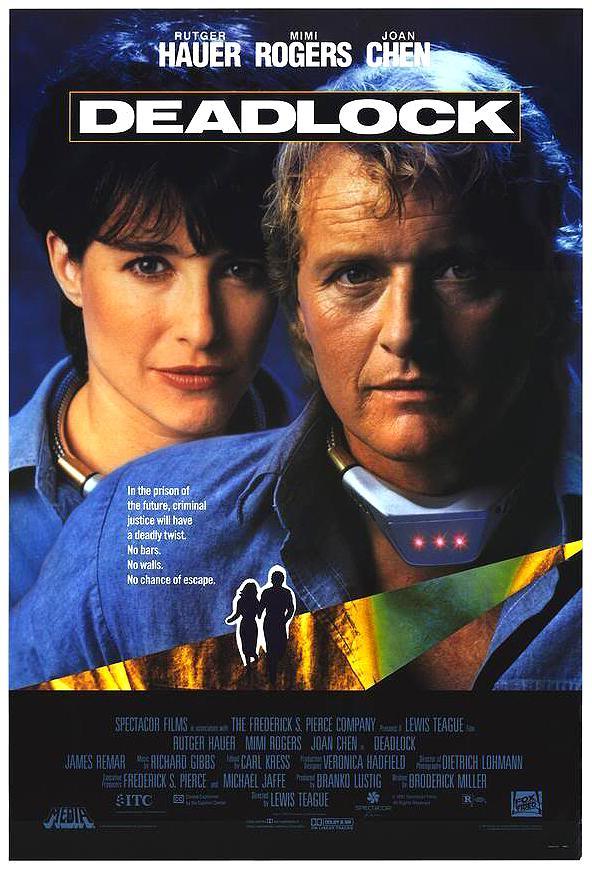
Master diamond thief Frank Warren (Rutger Hauer) pulls off a big job with the help of his fiancé Noelle (Joan Chen) and his best friend Sam (James Remar). Unfortunately, after the job is finished, Noelle unceremoniously ends her courtship with Frank when she shoots him multiple times because she’s now hooked up with Sam. The next time we see Frank, who somehow survived the close-range shootings, he’s on a bus to a prison called Camp Holliday, which is run by Warden Holliday (Stephen Tobolowsky). Camp Holliday is a high-tech prison where each inmate is gifted a collar containing an explosive device that also happens to be electronically connected to another inmate. As long as the two prisoners are within 100 yards from each other, it’s all good. If they are separated by more than 100 yards, their collars will explode leaving a bloody nub where their head used to be. And since nobody knows who their “wedlock partner” is, trying to escape is not a strong option. One day fellow prisoner Tracy Riggs (Mimi Rogers) comes to Frank and tells him that she’s his wedlock partner. Through a variety of circumstances, the two are able to escape, but they still must maintain their 100-yard proximity as the authorities try to track them down. Meanwhile, Sam and Noelle, and even Warden Holliday, have all teamed up to try to find where Frank stashed the diamonds prior to heading to prison. And what about Tracy, who’s side is she really on?

I didn’t have the Home Box Office channel when I was growing up, so I wasn’t aware of this film until it premiered on home video as “DEADLOCK.” Of course, being a huge fan of Rutger Hauer, I rented it as soon as possible. The key to lower budget, made-for TV movies working will always be tied to three things: an entertaining premise, a game cast, and a director who can put the movie together. I’m happy to report that WEDLOCK has each of these things. Even though we had seen exploding neck collars in prison before in THE RUNNING MAN (1987), I like the way this film ties one prisoner’s fate to another’s. That extra dimension makes for some exciting moments in the film. Rutger Hauer is especially good in WEDLOCK. If any other actor was in the lead, I honestly doubt I would have enjoyed it as much, but with him it becomes a fun movie. And the fact that he’s tied to the beautiful Mimi Rogers for most of the movie makes it that much more fun. The remainder of the cast goes pretty far over the top, but that’s okay because subtle character portrayals are not part of the equation in these types of movies. James Remar and Joan Chen are fun as the initial betrayers and current pursuers, Basil Wallace is effectively evil as a bully and fellow inmate, and Stephen Tobolowsky is his usual fun self as Warden Holliday.  Director Lewis Teague has a pretty nice resume of interesting films leading up to WEDLOCK, including ALLIGATOR (1980), FIGHTING BACK (1982), CUJO (1983), CAT’S EYE (1985), and NAVY SEALS (1990). He does a fine job here, as the movie has many well executed scenes that play out at a nice pace. Overall, I’ve always been a fan of low budget action movies that are done well. This one fits the bill for me.  

Five Fast Facts:

  1. Rutger Hauer and Joan Chen worked on 3 films together, including WEDLOCK. I have a soft spot in my heart for their film THE BLOOD OF HEROES (1989) and recommend it. I thought their other movie, PRECIOUS FIND (1996) was pretty bad. I watched it one time in the 90’s and haven’t watched it since.
  2. WEDLOCK received a Primetime Emmy nomination for “Outstanding Individual Achievement in Sound Editing for a Miniseries or a Special.”
  3. Even though WEDLOCK was set “in the future,” early in the film we see a movie theater marquee showing the Steven Seagal movie MARKED FOR DEATH (1990). I found that interesting considering that Basil Wallace is a bad guy in WEDLOCK, and he played twin brother bad guys in MARKED FOR DEATH. Danny Trejo also has small parts in both WEDLOCK and MARKED FOR DEATH.
  4. Mimi Rogers starred in another film in 1991 called THE RAPTURE. It’s a thought-provoking film that some people love, and some people hate. I personally found it intriguing, and it features a really strong performance from Rogers.
  5. In 1995, the film DEADLOCK 2 was released. It’s not a sequel as it doesn’t build on the events of the first film or bring back any of the characters, but it is set in a world of exploding prison collars. The film stars Esai Morales and Nia Peeples.  

When I rented the film in the early 90’s, it was called DEADLOCK. I’m sure I owned it on VHS at one point in my life.

Check out the trailer below:

Ghosts of Sundance Past: In The Company Of Men (dir by Neil LaBute)


The Sundance Film Festival is currently underway in Utah.  For the next few days, I’ll be taking a look at some of the films that have previously won awards at Sundance.

1997’s In The Company of Men is a film about two guys playing a series of very viscous jokes.

Howard (Matt Malloy) and Chad (Aaron Eckhart) are two mid-level executives who have been sent to work at a branch office for six weeks.  While Chad is talkative and aggressive, Howard is much more meek and often seems to be in awe of the far more confident Chad.  What the two men have in common is a lot of resentment and bitterness towards women.  Chad suggests that they should both date a woman at the same time and fool her into falling for both of them.  Then, they’ll both dump her at the same time.  Chad has even picked out a victim, Christine (Stacy Edwards), a deaf and introverted co-worker.

That Chad would come up with such a cruel scheme really isn’t a surprise.  From the first minute that we see Chad, we think we can tell what type of person he is.  Because this is a movie, we hold on to hope that Chad will somehow reveal that he’s not as bad as he seems but, in the end, the whole point of the film is that Chad is not only as bad as we initially think he is but he’s actually even worse.  Howard, on the other hand, comes across like a rather mild-mannered guy, the stereotypical nerdy mid-level manager who no one ever notices.  Howard could never come up with a scheme like this on his own but, once Chad suggests it, Howard agrees.  Howard is a natural follower.  He looks at Chad and he sees who he wants to be.  Chad looks at Howard and sees someone who he can easily manipulate.

Chad and Howard set their plan in motion and yes, it is difficult to watch as they both pretend to be falling in love with the sensitive Christine while making cruel fun of her behind her back.  Again, we know that at least one of the men is going to have second thoughts and try to back out of the plan.  We know this because we’re watching a movie.  We spend most of the movie hoping that Chad is going to be the one to find his conscience because Aaron Eckhart is the more charismatic of the two men and Chad is the one with whom Christine seems to be truly falling in love.  Instead, it’s Howard who falls in love with Christine while Chad remains as sociopathic as ever.  By the end of the film, Chad reveals just how manipulative he truly is and Howard discovers that Christine was not the only victim of Chad’s joke.

In The Company Of Men is not an easy film to watch.  The comments that Chad and Howard make are shockingly cruel, though one gets the feeling that they’re probably an accurate reflection of what men like Chad and Howard sound like when they’re in private.  Director Neil LaBute doesn’t make any effort to soften or excuse their misogyny.  It’s a testament to the talents of Eckhart, Malloy, and Edwards that we stick with the film.  In the end, In The Company Of Men is an unsettling portrait of misogyny and toxic masculinity, one that is made all the more disturbing by Aaron Eckhart’s charismatic performance as a truly despicable person.  The film uses Eckhart’s middle-American good looks to subversive effect and, even when he’s playing such a hateful character, there’s something undeniably fascinating about him.  You watch his performance of Chad and you’re almost desperate to find some sort of good inside of him.  It’s not there, though.  That’s what is truly frightening about In The Company Of Men.

As the 1997 Sundance Film Festival, In The Company Of Men won the Filmmaker’s Trophy.

Lisa Marie Reviews An Oscar Nominee: Reds (dir by Warren Beatty)


In the 1981 film Reds, Warren Beatty plays Jack Reed, the radical journalist who, at the turn of the century, wrote one of the first non-fiction books about Russia’s communist revolution and then went on to work as a propagandist for the communists before becoming disillusioned with the new Russian government and then promptly dying at the age of 32.

Diane Keaton plays Louise Bryant, the feminist writer who became Reed’s lover and eventually his wife.  Louise found fame as one of the first female war correspondents but then she also found infamy when she was called before a Congressional committee and accused of being a subversive.

Jack Nicholson plays Eugene O’Neill, the playwright who was a friend of both Reed and Bryant’s and who had a brief affair with Bryant while Reed was off covering labor strikes and the 1916 Democratic Convention.

Lastly, Maureen Stapleton plays Emma Goldman, the anarchist leader who was kicked out of the country after one of her stupid little dumbass followers assassinated President McKinley.  (Seriously, don’t get me started on that little jerk Leon Czolgosz.)

Together …. well, I was going to say that they solve crimes but that joke is perhaps a bit too flippant for a review of RedsReds is a big serious film about the left-wing activists at the turn of the century, one in which the characters move from one labor riot to another and generally live the life of wealthy bohemians.  Reed spends the film promoting communism, just to be terribly disillusioned when the communists actually come to power in Russia.  For a history nerd like me, the film is interesting.  For those who are not quite as obsessed with history, the film is extremely long and the scenes of Reed and Bryant’s domestic dramas often feel a bit predictable, especially when they’re taking place against such a large international tableaux.  At its best, the film is almost a Rorschach test for how the viewer feels about political and labor activists.  Do you look at Jack Reed and Louise Bryant and see two inspiring warriors for the cause or do you see two wealthy people playing at being revolutionaries?

Reds was a film that Warren Beatty spent close to 20 years trying to make, despite the fact that the heads of the Hollywood studios all told him that audiences would never show up for an epic film about a bunch of wealthy communists.  (The heads of the studio turned out to be correct, as the film was critically acclaimed but hardly a success at the box office.)  It was only after the success of the 1978, Beatty-directed best picture nominee Heaven Can Wait that Beatty was finally able to get financing for his dream project.  He ended up directing, producing, and writing the film himself and he cast his friend Jack Nicholson as O’Neill and his then-romantic partner Diane Keaton as Louise Bryant.  (Gene Hackman, Beatty’s Bonnie and Clyde co-star, shows up briefly as one of Reed’s editors.)  One left-wing generation’s tribute to an early left-wing generation, Reds is fully a Warren Beatty production and, for his efforts, Beatty was honored with the Oscar for Best Director.  That said, the Reds lost the award for Best Picture to another historical epic, Chariots of Fire.  Chariots of Fire featured no communists and did quite well at the box office.

The film is good but a bit uneven, especially towards the end when we suddenly get scenes of Louise Bryant trudging through Finland as she attempts to make it to Russia to be reunited with Reed.  The film actually works best when it features interviews with people who were actual contemporaries of Reed and Bryant and who share their own memoires of the time.  In fact, the interviews work almost too well.  The “witnesses,” as the film refers to them, paint such a vivid picture of the Reed, Bryant, and turn of the century America that Beatty’s attempt to cinematically recreate history often can’t compete.  One can’t help but feel that Beatty perhaps should have just made a documentary instead of a narrative film.

(Interestingly enough, many of the witnesses were people who were sympathetic to Reed’s politics in at the start of the century but then moved much more to the right as the years passed.  Reed’s friend and college roommate, Hamilton Fish, went on to become a prominent Republican congressman and a prominent critics of FDR.)

That said, Jack Nicholson gives a fantastic performance as Eugene O’Neill, adding some much needed cynicism to the film’s portrayal of Reed and Bryant’s idealism.  Keaton and Beatty sometime both seem to be struggling to escape their own well-worn personas as Bryant and Reed but Beatty does really sell Reed’s eventually disillusionment with Russia and the scene where he finally tells off his Russian handler made me want to cheer.  Fans of great character acting will want to keep an eye out for everyone from Paul Sorvino to William Daniels to Edward Herrmann to M. Emmet Walsh and IanWolfe, all popping up in small roles.

Reds is not a perfect film but, as a lover of history, I enjoyed it.


The Challenge (1982, directed by John Frankenheimer)


Rick Murphy (Scott Glenn) is a punch-drunk boxer who is hired to return an ancient sword to Japan so that it can be returned to its rightful owner, the honorable Toru (Toshiro Mifune).  Once in Japan, Rick becomes involved in a battle between Toru and his corrupt brother, Hideo (Atsuo Nakamura).  Hideo demands that Rick work as an undercover spy in Toru’s martial arts school or be beheaded.  Rick decides to keep his head and be a spy but he soon finds himself truly wanting to learn the ways of the Bushido.

A martial arts film is the last place most people would expect to find Scott Glenn and considering how miscast Glenn is, that’s understandable.  Scott Glenn feels very out-of-place as both a boxer and a modern-day samurai.  Scott Glenn is a very good actor but the role of Rick Murphy called for someone who could mix comedy with drama and be convincingly desperate.  That’s not Scott Glenn.  Who would have been better in the role?  Tom Berenger was already acting in 1982.  Or maybe even someone like Jan-Michael Vincent.  Vincent was a B-actor but, deep down, The Challenge is a B-movie.

The good thing is that the action often does make up for Glenn’s miscasting.  John Frankenheimer struggled with making the human drama compelling but he knew how to film a good fight.  John Sayles’s script is pulpy without ever being disrespectful to Japanese culture and, as always, Mifune looks like he could battle and defeat the entire world if he wanted to.

One final note: Steven Seagal worked behind-the-scenes on the film but we won’t hold that against it.