If there’s one type of genre film I always will end up watching (sometimes to my regret if they turn out to be awful) it will be the apocalyptic-themed film. It doesn’t matter if the apocalypse about to hammer down on the planet in the film is nuclear war, some cosmic event, zombies, the Rapture, etc. As long as the world is in the brink of snuffing out I will watch it.
To find out last year that Steven Soderbergh was going to make his next big project just such an apocalyptic film was exciting. He was to take the worldwide, multi-subplot storyline and a huge cast like he did with Traffic and substitute an lethal pandemic virus for the drug war. It’s cast was to include Matt Damon, Marion Cotillard, Kate Winslet, Gwyneth Paltrow, Laurence Fishburne, John Hawkes and Jude Law to name a few. The film was going to be filmed around the world to truly give it that international feel to it.
Contagion will have a release date of September 16, 2011 and if any film really could benefit from a really great viral marketing it would be this.
In 2009, we saw the first film in what Warner Bros. hoped would be the start of a new film franchise in Guy Ritchie’s Sherlock Holmes starring Robert Down, Jr. in the titular role with Jude Law playing his intrepid assistant, Dr. Watson. The film did quite well in the box-office that a sequel was greenlit right away and here we are just five months from the premiere of the follow-up film, Sherlock Holmes: A Game of Shadows.
The first film introduced the character of Sherlock Holmes to the public who really didn’t know much of the iconic character. That film also introduced the one person who would become Holmes equal in intellect and deductive reasoning but without the moral center: Dr. James Moriarty. This arch-foil for Holmes is to be the main antagonist for the sequel and whoever decided to cast Jared Harris in the role of the good Dr. Moriarty should get a raise. Harris has always been one of those character actors who disappears into his roles in every film he has done but never seem to get any glory. Hopefully, once people have seen him in A Game of Shadows, this will change and he joins the likes of Mark Strong, Anthony Hopkins and others who toiled in relative obscurity until finally hitting it big as a charming villain in a major film.
New to the sequel will be Noomi Rapace just fresh off of her stand-out role as Lisbeth Salander in the film adaptation trilogy of Stieg Larsson’s Millenium Trilogy. Also, joining the returning cast is Stephen Fry as Sherlock’s brother Mycroft Holmes. The film, as shown in the trailer, looks to ramp up the action and bring Holmes and Watson on a whirlwind tour of Europe.
Sherlock Holmes: A Game of Shadows is set for a December 16, 2011 release date.
If there was ever a Marvel Comics character who was perfectly suited to star in a grindhouse film it would be Frank Castle aka The Punisher. He’s a character who takes the term anti-hero past its limits and who makes other film vigilantes seem like sissy, choir boys. In December 2008 Lionsgate released a sort of reboot of The Punisher by Jonathan Hensleigh and starring Thomas Jane in the titular role. This time around the role of Frank Castle goes to Ray Stevenson (The Other Guys, Thor, Kill the Irishman) with German-filmmaker Lexi Alexander taking on the director’s reins.
Punisher: War Zone takes much of the characters in the film from story-arcs found in the Marvel Knight’s Punisher MAX series which took the character and his stories into a darker realm of violence. This latest film definitely owes much of it’s darker and more violent tone from that comic book line while at the same time creating a look which brings to mind the garish and over-the-top grindhouse action films of the early 80’s. The film quickly establishes who the Punisher is and what motivates him to take on and kill (heavy emphasis on kill) the criminal underworld of the city. In an opening sequence that probably out-violences every other film released in 2008, the Punisher wipes out a gathering of mobsters in every bloody way as possible. Blood and gore flows and splatters a-plenty in the first 10-15 minutes of this film.
There’s a semblance of a story which involves Castle mistakenly killing an undercover FBI agent which causes him a momentary crisis of conscience, but it really doesn’t last too long as there are more criminals to kill, main and blow up. If there’s one thing the Punisher knows how to do best it’s those three things. Ray Stevenson in the title role doesn’t get to emote much, but does a great job in showing the characters ice-cold ruthlessness paired with a sort of dead-man walking persona which rings true to how the Punisher has been written up of late. His Frank Castle is dead inside and only when he’s the Punisher does he even show any sort of life (even if it’s the barest hint). His foil this time around brings one of the Punisher’s earliest arch-enemies in the disfigured mobster (caused by the Punisher) Jigsaw (played with over-the-top campy relish by Dominic West). Where Castle is deadly serious to the point of morbidity his opposite was all garish with a liberal dose of crazy.
Punisher: War Zone really dispenses with any complexities to it’s plot and just finds reasons and excuses for the Punisher to go on another killing spree against criminals that for some it might not be enough. As a lover of grindhouse and exploitation films what this film offers was enough and really goes a long way in entertaining in such an 80’s fashion. It’s a film that revels in its violent absurdities and campy storytelling. Even the acting by all in the film passes the line of campy and into a sort of Looney Tunes level which makes the extreme violence and gore of the killings more cartoonish than realistic. This was a film that celebrated it’s grindhouse roots from the actors, the filmmakers all the way down to it’s cinematographer and art directors. It’s disposable entertainment and it knows it so doesn’t bother to try and hide that fact and just tries to entertain in every manner possible and then some.
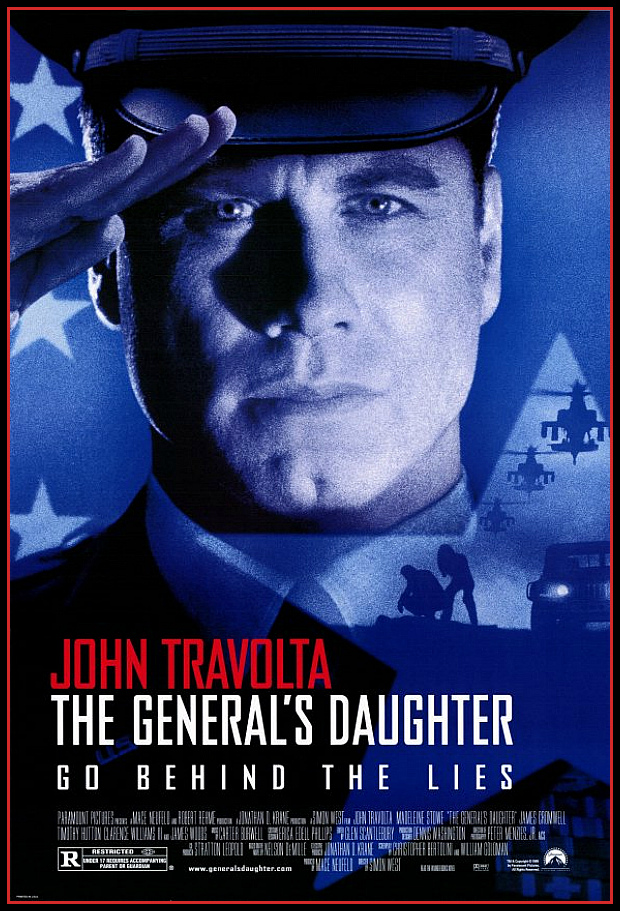
The time around the late 1990’s saw a slew of filmmakers who seemed to have been influenced by the filmmaking style of one Michael Bay. In 1998 one such film which had a certain Michael Bay look to it was the crime thriller The General’s Daughter by filmmaker Simon West (fresh off his success from the previous year’s Con-Air). This film adaptation of the Nelson DeMille novel of the same name starred John Travolta when he was still enjoying the second renaissance of his career brought on by his role in Pulp Fiction.
The General’s Daughter was pretty much a crime procedural wrapped around the secretive and insular world of military life. It has Chief Warrant Officer Paul Brenner (played by Travolta) of the Army’s CID investigating what seems to be the apparent rape and murder of a female officer who also happens to be the daughter of the base’s commandant and political-minded general. Brenner’s soon joined by another CID agent, Sara Sunhill (Madeleine Stowe), who must now navigate the insular world which makes up the officer ranks of the military. They find suspects cropping up faster than they could handle and the one prime suspect in base psychologist Col. Moore (James Wood in an over-the-top performance) has secrets about the victim that could jeopardize the lives and career of not just most of the officers on the base but the victim’s own father. This set-up and the basic understanding of the plot should make for a great thriller, but the by-the-numbers direction by Simon West and the over-the-top performances by too many of the characters in the film sinks The General’s Daughter before it could soar.
The story in of itself really has nothing to drag down the film. From the beginning the screenplay does a great job in tossing red herrings to keep the true murderer secret until the very end. It’s these red herrings which manages to bring out the ultimate reason as to the death of Capt. Elisabeth Campbell (Leslie Stefanson) and how a traumatic event in her past became the one major link which would lead to her death early in the film. It’s how these events were acted out which brings down the script. It’s been said that great performances could raise a mediocre script, but the same could be said for the opposite. Very average to bad performances could drag down a great script.
Travolta’s performance was good enough most of the time. He’s especially good when pouring on the Southern charm to try and gain an advantage over those he’s interacting with, but when he suddenly switches over to tough Army investigator that he goes from just beyond campy to over the line into full-blown camp. The same could be said for pretty much everyone in the film from Stowe’s character who manages to just stand around doing nothing but act as a sort of “gal Friday” for Travolta’s character until the very end when she suddenly becomes a crack investigator to help move the plot along. Clarence Williams III really hams it up as the base general’s right-hand man and one would wonder if he realized he wasn’t actually in a grindhouse or exploitation film when it was time to act.
Despite the performances dragging the film down I must admit that The General’s Daughter was quite watchable and entertaining to a certain level. It’s the film’s inadequacies which also makes it quite a disposable fare that should’ve been more. One wonders how the film would be done today with a different set of actors and a filmmaker who knew the nuances of how to navigate around a thriller. Until the inevitable remake from Hollywood gets greenlit (the way things get remade now it’s bound to happen) it’s this version of The General’s Daughter that’d be on record and it’s a film that has too many bad performances for a great screenplay to overcome. A film that ultimately remains mildly entertaining but forgettable in the end.
Just been watching The Social Network on Starz and I couldn’t help but think back to this important scene from one of my favorite films of all-time. It was the film which propelled Arnold Schwarzenegger from just being a bodybuilding icon but into superstar film icon. The scene occurs during the part of the film where Conan has just gone through years of becoming the best pit-fighter in all the lands and now repaing the accolades from other warriors, warlords and women. One of the warlords (looking like a Mongol horselord) asks the important question that everyone should be asking: “What is best in life?”
The scene finishes with Conan answering this important life question. An answer which actually has it’s roots from a much more detailed quote from the greatest conqueror in history: Genghis Khan. A quote that goes like so…
“The greatest pleasure is to vanquish your enemies and chase them before you, to rob them of their wealth and see those dear to them bathed in tears, to ride their horses and clasp to your bosom their wives and daughters.” – Genghis Khan
Conan’s answer is quite similar but has been simplified for the film, but still retains it’s impact. This is a life lesson everyone should live by. Mark Zuckerberg definitely lives by them.
The latest season of the British sci-fi series Torchwood finally arrives with much fanfare with it’s fourth season. Simply called Torchwood: Miracle Day the series moves from it’s usual haunts in and around Cardiff in the United Kingdom to a location that should bring with it some advantages and disadvantages to new fans and returning loyal ones. As someone who has just recently begun and caught up to watching the first three seasons to this series I must admit that I seem to be more excited about this newest season. The first three seasons for this Torchwood neophyte was a mixture of awesome and tedious (the last season was more of the former than the latter), but in the end I really bought into the series despite some of the latter.
“The New World” heralds in the fourth season of this series with the introduction of several new cast members to the Torchwood team in Mekhi Phifer as the up-and-coming CIA operative Rex Matheson who becomes well-acquainted with the sudden arrival of “Miracle Day” to the world. It’s during this sequence that we also get to meet Alexa Havins’ CIA analyst Esther Drummond who first brings up the topic of the Torchwood team to Matheson. Their conversation’s shortlived as Matheson meets with what seemed to be quite the fatal-accident on the road, but as the premiere episode soon states clearly the world’s suddenly forgotten the concept of death. It’s not just through Matheson we see this event occur first-hand but in another new character to the series in the form of convicted pedophile-murderer Oswald Danes (played with a level of creepiness by Bill Pullman) whose execution by lethal injection becomes railroaded by “Miracle Day”.
All that occurs within the first five to seven minutes before we even get to meet any of the returning cast members and really shows that the series’ showrunner Russell T. Davies wants to give these American characters their introduction before bringing in the regulars. When I say regulars I mean just the two surviving members of the Torchwood Institute which fans last saw being destroyed in the climactic episodes of season three’s Torchwood: Children of Earth. There’s Gwen Cooper (Eve Myles in the returning role) now in hiding with her husband Rhys Williams (Kai Owens) and their young daighter Anwen in a remote British seaside cottage. It’s been almost a year since the events of Children of Earth and these three live in constant paranoia from those they believe will soon come hunting for them for what they know of the Torchwood Institute.
The favorite of fans don’t make his appearance until a third of the way through the episode, but it was quite an appearance. The 51st-century ex-conman and immortal Capt. Jack Harkness (played by John Barrowman with his usual dashing flair) has been trying to keep the knowledge of Torchwood and those survivors from the Institute from the very shadowy figures Gwen has gone into hiding from. It’s during one such attempt to do this task that he encounters the intrepid sleuth in Esther Drummond who thinks Torchwood might be a link to the event being called “Miracle Day” sweeping the world. The rest of the episode does a great job in bringing together the surviving members of Torchwood (albeit somewhat reluctantly) with the CIA’s Matheson and Drummond who want to know just what the hell is going on in the world.
The episode doesn’t lack for action as we see running gunfights between a speeding jeep on a sandy beach as a helicopter with gunmen try to kill Harkness and his new team. There’s even a great use of special effects in a sequence where we first see the disadvantage of not being able to die as a body blown-up and barely together still clings to life in a hospital morgue. These two sequences and the slicker production value that could be seen in the episode really reinforces the fact that this latest Torchwood season has moved from being just a British series and into an American one as well.
This slicker look may throw some loyal fans off as being too Hollywood, but the show still felt and sounded like a Torchwood episode. The writing by Russell T. Davies for the premiere episode was great as he was able to balance the jarring introduction of American characters and their attitudes to what had been a British cast with their own distinct quirks and mannerisms. One thing I truly got from this episode which I rarely got from past seasons was the epic feel to the story. This epic tone was what made Children of Earth such a great third season, but even then there were times when the season sometimes fell back to being very regional in scope. Miracle Day really acts like a story where it’s not just the UK that these events are occurring but America and the rest of the world. It will be interesting to see how Davies and his writers are going to be able to continue to build on this international scope as the season goes along.
Torchwood: Miracle Day made for a fun and fast-moving premiere with “The New World”. It was able to bring back the recurring cast members from the previous three seasons in addition to introducing a new band of cast mates who look to be quite unlike the previous members have encountered in the past. I may not have been quite the lover of British sci-fi tv series in the past, but this latest Torchwood season does a great job in making me fall in love with it and I’m sure doing the same thing to like-minded individuals as myself. The loyal, regular fans may need to make room on the bandwagon for us Torchwood neophytes because there’s going to be a lot of us.
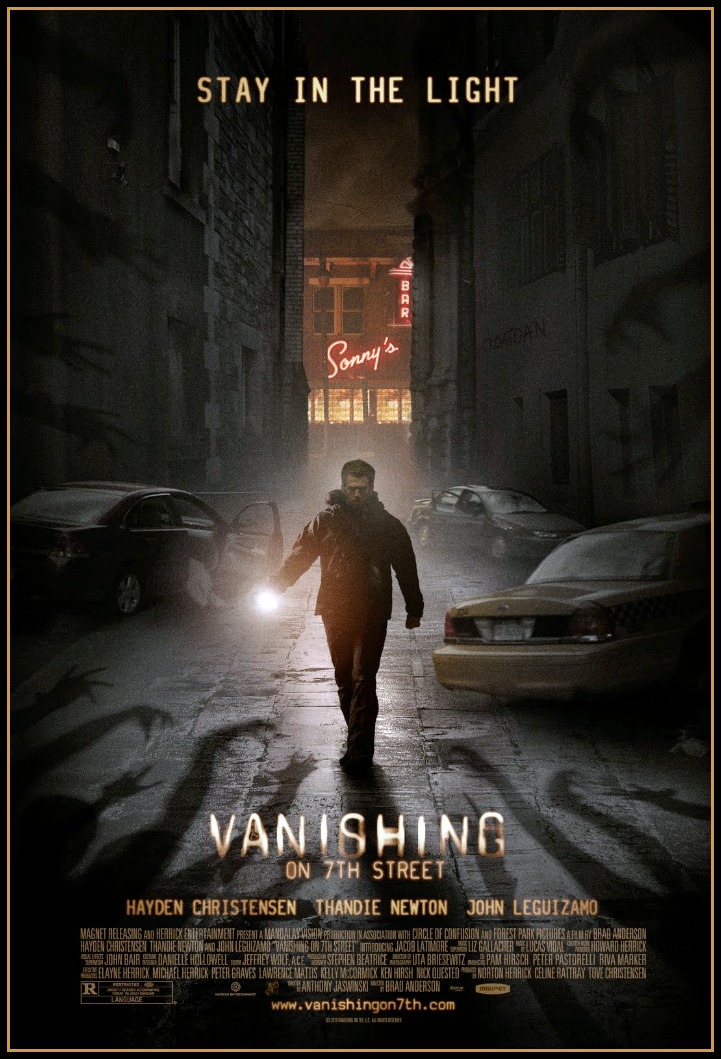
In the genre world of horror and thrillers there’s been one name who always seem to be on the verge of breaking out. He has done some exceptionally well-crafted horror and thrillers which never could get a mainstream audience to commit to but always gathering a cult-following upon their release. He has done some wonderful work as a TV director for such acclaimed shows as Fringe, Treme, Boardwalk Empire and The Wire. His best known work was a thriller collaboration with Christian Bale in The Machinist. While it’s a film more well-known for the extremes an actor was willing to go for to make their performance as authentic as possible it was also a film which showed style and talent in it’s filmmaker. The person I speak of is Canadian filmmaker Brad Anderson whose latest film was another low-budget horror-thriller which looks to be gaining a cult-following once again despite not being well-received by the mainstream critics. Vanishing On 7th Street was a film using the screenplay of Anthony Jaswinski which puts an interesting, claustrophobic and, at times, entertaining twist on the oft-used and well-ridden post-apocalyptic genre.
The film begins with film projectionist Paul in his projection booth reading up on the lost colony of Roanoke and the mysterious word left behind: CROATOAN. It’s through his point of view that we first see the beginning of what could be the end of the world as lights begin to flicker then go out throughout the theater and the mall it’s located in. Paul investigates this event only to discover sets of clothing and accessories where theater patrons and employees used to be in. With each passing moment the darkness — punctuated by just the flashlights of Paul and a lone mall security guard — becomes to take on an ominous tone before the film sudden moves ahead three days into what would become the major setting for the film: a lit bar on a deserted and darkened stretch of 7th Street in Detroit, Michigan.
We meet the rest of the main cast in this bar. There’s Luke who used to be a TV anchorman who discovers to his horror just what might have been the cause of the disappearance of most everyone in the world as he tries to find his girlfriend at the TV station they both worked at. It’s in these flashbacks to Luke’s early experience with the dark apocalypse that we see some of the most perfectly shot scenes of a major city devoid of life. An urban setting where the sudden disappearance of people during the power outage the night before has caused an eerie detritus of crashed vehicles, empty clothing and, in a sudden and violent sequence, a lone airline crashing in the background. It’s through Luke and the lone survivor in the bar, a 12-year old boy named James (Jacob Latimore), that we begin to try and piece together just what might have caused the event which continues to plague those left behind for the last three days.
The film posits the basic concept that darkness itself was the culprit for the disappearance of everyone and what continues to stalk those still left behind, alive and desperate for answers. While the film never really give definite answers as to the cause the two other characters in the back outside of Luke and James bring their own theories. There’s Rosemary (Thandie Newton), the distraught mother searching for her infant son, who thinks what’s going on around them is the the prophecized Rapture and those left behind were those who have sinned and were now being tormented for whatever sins they might have committed. On the other side is Paul from the beginning of the film who Luke rescues from an illuminated bus stop shelter who believes the very thing which caused the disappearance of the Roanoke colony during the 16th-century has now returned on a global-scale. His reasonings run the gamut of scientific causes from wormholes, black holes, gamma ray burst, nanotech gone amok and even an accident from a particle collider.
The audience are left to decide amongst themselves which explanation holds merit since neither one has enough backing to be the true answer. Vanishing On 7th Street leaves much of the questions raised by the dark apocalypse around these surviving characters to be left ambiguous and unanswered which at times becomes a detriment to the narrative as a whole. It’s a testament to Brad Anderson’s direction that the film was able to move past the apparent weaknesses in Anthony Jaswinski’s script and deliver a taut thriller (the film never truly gets to the level of horror) that just builds and builds with tension from beginning to an end that seemed almost too rushed.
With a low-budget and minimal cast the film tries to create some of the tension in the film be a construction of the differences between the four main characters. The actors were pretty game to try and make their characters more complex than what the script have provided, but in the end they still seem too basic for anyone of them to become sympathetic for the audience to truly care for their well-being. The film has to finally rely on just them as the last people on the planet as the main crux for the audience to latch onto. All the actors involved never become too cartoonish or stereotypical in their performance, but some of their decision-making in the middle and latter section of the film were too horror-typical, but they do add to the film’s many scenes of mounting terror as characters drop flashlights, lose light sources and other such problems with the living shadows in the darkness creeping up to try and take those still left. These scenes do look to be too stereotypical of other horror films but under Anderson’s direction there’s a palpable sense of claustrophobia and menace in these shadows.
What truly sells the film despite these flaws outside of Anderson’s direction would be the minimalist score by first-time film composer Lucas Vidal. His composition for the film were at once ominous and haunting. At times his score shows off hints of influences from the more doom-laden scores of Philip Glass. The other component of the film which definitely added to the atmosphere of inevitable doom to the film was Uta Briesewitz cinematography which made great use of darkness and solitary light sources to create islands of safety in a sea of encroaching terror we never truly comprehend. It’s the trifecta of Anderson’s directing, Vidal’s minimalist doom orchestration of a score and Briesewitz’s cinematography which gives Vanishing On 7th Street enough reasons to be a film which stands out as a fine piece of genre filmmaking despite weaknesses in the script.
Brad Anderson truly seem to be a filmmaker destined to remain in the fringes of mainstream cinema. His Vanishing On 7th Street continues to be another example of his great work in the horror-thriller genre. Despite same flaws which could turn off some of those who see this film it doesn’t diminish the fact that even at it’s worst this film was still an entertaining piece of post-apocalyptic work which brings some new ideas into the genre. Maybe a stronger treatment of the script would’ve made for a near-perfect thriller and one which could’ve had more horror to it, but Anderson was able to make a good enough film with an average script that I think deserves for this film to be seen by more people. For every horror remakes we get from Michael Bay’s Platinum Dunes to the latest in the Saw-like torture porn horror it’s good to see that such films as Vanishing On 7th Street exist to be the solitary beacon of light in a sea of cookie-cutter, by-the-numbers horror films that seem to dominate each film year after the other.
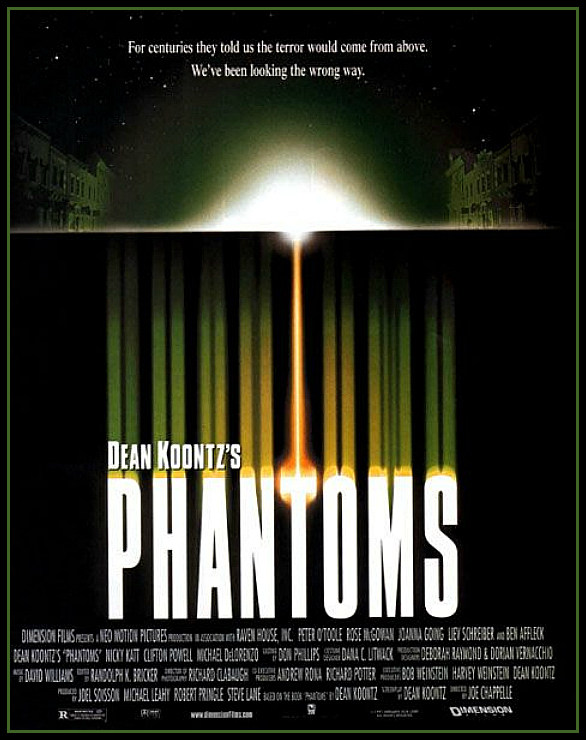
If there was ever an actor in the last twenty years who has suffered ridicule regarding his body of work it would be Ben Affleck. Nevermind the fact that he has actually done very good work as an actor. People tend to view his acting work through some very bad film projects which the online film bloggers (and trolls) have lambasted year after year. One such film which has gained a cult following for all the reasons is the 1998 horror film Phantoms which was adapted from the Dean Koontz horror novel of the same name. This was a film which came out of nowhere and which no one really saw when it first hit the theaters. There’s a reason for this and the main reason for this being that the film was really awful though not without some entertaining bits.
Phantoms starred Ben Affleck in a role that really seemed more suited for an older actor. His Sheriff Hammond in the novel was much older and fit the backstory told in both novel and film that never truly fit Affleck’s youthful appearance and mannerism. He’s joined in this Joe Chappelle production by classically-trained veteran actor Peter O’Toole (who must’ve really needed the money to sign up for this film) in the role of Dr. Exposition dump aka Timothy Flyte who ends up explaining to the surviving cast of characters the very danger facing them in the abandoned town of Snowfield. Rounding out the cast is Liev Schrieber as the creepy Deputy Stu Wargle who becomes a sort of plot device as the film moves forward. To add to this mix are Joanna Going and Rose McGowan as sisters who first discover that their town has just gone through a terrible event.
The novel this film was based on was pure scifi-horror pulp which stressed one’s suspension of disbelief, but was quite entertaining from beginning to end. Dean Koontz is like the generic fast-food version of Stephen King. This film adaptation borrows heavily from films such as Carpenter’s The Thing and the remake of The Blob. This wouldn’t have been a bad thing since the film’s story does bring into it an interesting concept of an ancient enemy which might or might not have been responsible for unexplained mass disappearances of people and animals throughout history going back to prehistoric times.
What Phantoms ends up doing which ruins the film as a whole was to rush through the narrative it was adapting it. The film pretty much goings through a checklist of all the major scenes in the novel, takes those scenes and truncates them to fit uncomfortably into a 90+ minute film. Some of these scenes could’ve been extended a few more minutes to add to a sense of grandiose to a film that needed it despite it’s B-movie foundation. One such scenes would be the arrival of a special Army unit designed to combat unexplained events, but the film treats this sequence from their arrival right up to their untimely demise in less than 15 minutes. I think in the hands of a much more capable filmmaker these scenes would’ve made the film much more entertaining.
Phantoms was a horror film that could’ve become a 90’s cult-classic if it had been given the proper time and effort from it’s producers, but seeing that it was the Weinsteins of Miramax and Dimension Films this final product was probably the best Joe Chappelle could’ve come up with. Weinsteins during the 1990’s were more concerned of pushing their Oscar-baiting film productions than actually giving time and effort to all their films. If there was any reason to see Phantoms it would be to see just why it kept being mentioned in Kevin Smith’s Jay and Silent Bob Strike Back. Other than that there’s really no reason to see it unless there’s nothing else on.
It is now just minutes since the 4th of July finally arrives in the US once more (at least on the West Coast since the East Coast has been celebrating the 4th of July for 3 hours now). What better way to celebrate the arrival of another 4th of July than to pick the song of the same name for today’s latest “Song of the Day”.
Soundgarden’s Superunknown album from 1994 may be part of the grunge scene which sprouted during the early 1990’s but this album has more metal about it than the grunge espoused by the disciples of Cobain. The song I picked for today I consider the best in the album which contains other classics. “4th of July” is such a heavy song that so many casual fans of the album fail to miss the heavy influence of early Black Sabbath in the song. They also fail to realize just how un-grunge it is with its dark lyrics (not emo mind you, but dark in a palpable sense). “4th of July” becomes an accidental introduction for newbie metal fans to the world of doom metal.
This song is the very definition of heavy and doom. From the heaviness in the guitar riffs to the subdued, but evocative way Cornell sings the dark lyrics (lyrics I always thought of someone just experiencing and living through the aftermath of a nuclear war). But in the end this song really shows it’s Black Sabbath and doom metal pedigree from the sludge-like sound coming out of the bass guitar chords.
“4th of July” once heard cannot be unheard. It’s a song that grabs one by the throat, doesn’t let go until the final doom-laden lyric and note has finally faded into the air.
HAPPY 4th of JULY!
4th of July
Shower in the dark day Clean sparks driving down Cool in the waterway Where the baptized drown Naked in the cold sun Breathing life like fire Thought I was the only one But that was just a lie
Cause I heard it in the wind And I saw it in the sky And I thought it was the end And I thought it was the 4th of July
Pale in the flare light The scared light cracks & disappears And leads the scorched ones here And everywhere no one cares The fire is spreading And no one wants to speak about it Down in the hole Jesus tries to crack a smile Beneath another shovel load
And I heard it in the wind And I saw it in the sky And I thought it was the end And I thought it was the 4th of July
Now I’m in control Now I’m in the fall out Once asleep but now I stand And I still remember Your sweet everything Light a Roman candle And hold it in your hand
Cause I heard it in the wind And I saw it in the sky And I thought it was the end And I thought it was the 4th of July
Wonderful news was announced during the first day of Anime Expo 2011. While I wasn’t able to figure out a way to attend I was still able to read up on announcements made during the industry panels being held at the convention. One such panel was the Aniplex Industry Panel where they made two major announcements.
First, was that the anime series Blue Exorcist will be released in the US in a four-volume DVD. There’s no word on whether this will also include a release in Blu-Ray format.
The second major announcement was one that should excite anime fans throughout the US. The very popular mahou shoujo anime series, Puella Magi Madoka Magica, will also get a dvd release for the US market. While the panel gave more details on the Blue Exorcist release announcement not much about the Puella Magi Madoka Magica US release was given. The good thing is that Aniplex of America has already put up the official website for Puella Magi Madoka Magica though at the moment it’s still more of a “coming soon” and “under construction” welcome page.
I’m sure more details will come out about the home video release in the US for this mahou shoujo series. I also hope that it’s original Japanese-language w/ English subtitle option gets a 5.1 surround sound mix.