I don’t know a damn thing about baseball but I do know that the Rangers are going to the World Series and the Rangers are apparently from my hometown. Oh, and the Ranger Josh Hamilton is apparently not the same guy as the actor Josh Hamilton.
Anyway, for now, I will also extend hearty congratulations to Arleigh because his team is apparently going to the World Series as well. I learned today that apparently, San Francisco’s team is called the Giants and not the Phillies. Apparently, the Phillies are actually Philadelphia’s team. Actually, that makes a bit more sense. I also found out that the Giants have a player with the exact same name as the former lead singer of the Beach Boys.
Anyway, congratulations to the Rangers (who I guess are now my team) and the Giants. The song below is dedicated to both teams and to baseball fans everywhere…
Earlier this week, I discovered that, without warning, the Regal Keystone Park 16 had closed its door for good.
The Regal was not my favorite movie theater in the Dallas/Ft. Worth metroplex. That honor would have to be jointly awarded to the Dallas and Plano Angelikas. In fact, if anything, the Regal was somewhat trashy. It was located right off of Central Expressway (which meant that traffic both entering and leaving theater was insane) and it sat directly across the street from a free clinic. Whenever I went to the Regal, I was always very much aware of the constantly patrolling police cars. There always seemed to be something dramatic happening at the apartments across the street from the theater.
Despite the police presence, I could always count on being accosted by one at least one homeless person. Most of the time they would just ask for money though other times they just wanted to tell me about who was actually in charge of the world. Most of the time, it seemed to be the Vatican. I would smile politely and hope they were too busy ranting to notice the St. Vitus medal around my neck.
One of the few times I actually made the mistake of going to the Regal by myself, I was greeted in the parking lot by a bearded, foul-smelling man who was about a foot taller than me and who outweighed me by over a hundred pounds. He started walking towards me as soon as I got out of my car and even though I quickened my pace, he quickly caught up to me. Walking less than a couple of inches behind me, he loudly asked me if I liked to perform a certain sexual act. He kept following me, asking me this all the way to the theater doors but he didn’t step inside the theater after me. The whole time this was going on, the parking lot was filled with other filmgoers who heard what the man asked and saw how quickly I was walking away from him. Not one of them said a word or, as far as I know, even called the police. That’s the type of theater that the Regal was.
(Incidentally, I called the police as soon as I got inside the theater. I’m not sure what happened exactly but the man wasn’t there when I left two hours later. The movie I saw, by the way, was Lakeview Terrace, starring Samuel L. Jackson.)
Still, I’m going to miss going to the Regal. For one thing, it was close to where I live now and it was close to where I lived previously. So, even if it was by default, it was kind of my theater. As trashy as the outside was, the inside was usually pretty clean. Plus, I went enough times that I got to know — at least on a visual level — most of the people who worked there. For instance, there was the elderly gentleman who — no matter what time of day I went to the Regal — always seemed to be working behind ticket table. Usually, he’d end up giving us tickets to the wrong movie but he seemed like a nice old man and he always had a smile ready for me whenever he saw me stepping through the front doors. I’m going to miss him.
No, the Regal wasn’t perfect but it’s a place where I spent a lot of hours and I’ve got a lot of memories of that place. To an extent, I’m not surprised that it closed its doors. It was, obviously, located in a terrible neighborhood and often times it did so little business that me and whoever I had come with would end up watching our movie in an empty theater. That’s good for those of us who like to have sex while watching movies but, as a question of simple economics, it’s not a formula for success. Still, I would have liked a chance to say goodbye.
On Friday, me and my sister Erin drove down to the old Regal, specifically to take some pictures for this little memorial. Unfortunately, no sooner had Erin take a few pictures before we were confronted by some fat asshole in a golf cart who wanted to know why we were taking pictures.
To be honest, I have issues with authority on a good day and Friday was not, at that point, a very good day. So, as Erin put the lens cap back on her camera, I sensibly replied, “I really don’t think that’s any of your fucking business.”
“Some people take pictures because they want to case a place before they rob it,” Mr. Fascist-On-A-Golf-Cart replied.
At this point, Erin had unlocked her car and was attempting to lead me over to it. However, as I retreated, I politely replied, “Your mother sucks cock in Hell, Karras.”
That shut the pig up. I’m still wondering if he realized I was merely quoting The Exorcist or if he thought maybe I actually was possessed.
Anyway, the pictures in this post were all taken by Erin Nicole Bowman on Friday and I thank her for both helping me pay tribute to the Angelika and for keeping me out of jail.
Here, in alphabetical order, is as complete a list as possible of every film I saw at the Regal Keystone Park 16, starting with Iron Man on June 10th, 2008 and ending with Secretariat on October 12th, 2010.
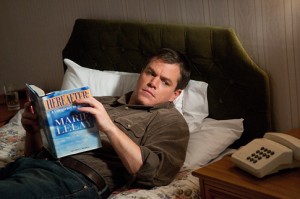
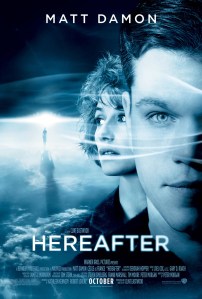
Hereafter is a very serious film about a very serious topic, death. Following three separate but ultimately connected stories, the film attempts to explore death and the question of what happens after death from three different angles — intellectually, emotionally, and spiritually. I really wanted Hereafter to be a great film. So did the film’s makers, which is precisely why Hereafter fails.
The intellectual consideration of death is represented by the character of Marie (Cecile De France), a French journalist who, at the start of the film, drowns in a tsunami and is, for a few minutes, clinically dead. Before she is eventually revived, she has a classic near-death experience: the bright light, the people waiting to greet her, the whole deal. After this experience, Marie is compelled to investigate whether or not there truly is such a thing as an afterlife. As she does so, Marie finds herself shunned by her resolutely secular friends and grows increasingly distant from her skeptical (and rather condescending) boyfriend.
The emotional response to death is represented in the story of twin brothers, Marcus and Jason (played by Frankie and George McLaren). The two boys live in London with their drug-addicted mother and share a strong (and, to be honest, kinda creepy) bond. Jason, while simply trying to return home with some drugs for his detoxing mother, is roughed up by some bullies and ends up running out into the middle of the street. Naturally, since this is a movie, Jason is hit by a truck as soon as he steps off the curb. Jason is killed and Marcus is taken away by social services and put into a foster home. Marcus continues to carry Jason’s cap with him and soon starts tracking down local English psychics in an attempt to talk to his brother again.
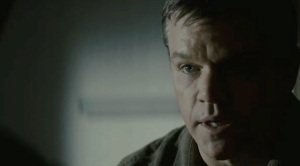
Finally, the spiritual aspect is detailed in the film’s most interesting story. This story features Matt Damon as George Lonegan, a psychic who can speak with the dead. After years of being a minor celebrity, George burned out and went into a self-imposed exile. He now works at a factory while his brother (Jay Mohr, who looks incredibly puffy in this movie) keeps trying to find ways to convince George to get back into the business of talking to dead for fun and profit. After George reluctantly gives a reading to Richard Kind, he finds himself being dragged back into his old life.
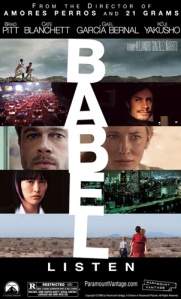
A lot of viewers and critics have compared Hereafter to Alejandro González Iñárritu’s 2006 masterpiece, Babel. Both films follow three separate but connecting stories and both films are concerned with the theme of death and how it connects us all. As well, Babel featured Brad Pitt in a serious role and Hereafter features Matt Damon. The main difference, however, is that Babel was a great film but Hereafter is basically an uneven mess.
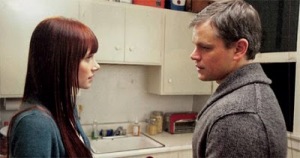
Whereas Babel featured three strong stories, Hereafter features 1 compelling story (that would be Damon’s) which is compelling solely because Matt Damon is a talented enough actor that he can apparently perform miracles. He’s probably about as likable as he’s ever been in the role of George but he also wisely plays the role as being just a little bit off. Even though the film makes the mistake of never really going into the details of just what exactly caused George to give up being a psychic, Damon is so good in the role that you’re willing to take him at his word that he had a good reason. Probably the highlight of the film (and one of the few sections to really inspire any sort of real emotional response) is an extended sequence where Damon befriends and the manages to alienate an insecure, single woman played by Bryce Dallas Howard. Damon and Howard have a scene that involves eating while blind-folded that manages to be both powerfully erotic and wonderfully romantic at the same time. If the entire film had been about them, Hereafter would have been a much better movie.
Unfortunately, we’ve got to slog through two other stories.
Cecile La France gives an excellent performance as Marie and the opening tsunami scene is truly terrifying. For someone like me, who cannot swim and risks having a panic attack if she even stands near the deep end of a swimming pool, the tsunami scene was almost impossible to watch. I had to put my hands in front of my eyes and watch the scene through my fingers. However, once she drowns, Marie sees a vision of the afterlife that — as a harbinger of things to come — is rather dull. I mean, with everything that can supposedly be done in movies today, the best that Hereafter can give us is a bland white light. Once Marie returns to Paris and starts her investigation, La France remains a sympathetic presence and the film actually does a pretty good job of showing just how condescending most supposedly “liberal” men are whenever a woman starts to stray from the established orthodoxy. But, unfortunately, her story is just never that interesting. Marie decides to write a book about the afterlife. As a writer myself, I have to say that there is nothing more boring than watching someone else write.
As for Marcus, I was shocked just how little I cared about him or his attempts to contact his brother. I come from a very close family and I have a very strong bond with all three of my sisters and, among them, I am notorious for crying at any movie that deals with that sort of sibling bonding. Yet I sat through the saga of Marcus and Jason without shedding a tear and I felt terrible about it. I really wanted to cry. I really wanted to have some sort of emotional response to the story but I just never believed it. I hate to say this but honestly, a lot of this was due to the fact that the McLaren twins are such bad actors. Director Clint Eastwood has said that he specifically cast them because they weren’t professional actors and therefore, they wouldn’t introduce any false “sentimentality” into the mix. But dammit, it was a sentimental story. Sentiment is not necessarily a bad thing and just because something is sentimental, that doesn’t make it false.
So, what exactly went wrong with Hereafter? The film opens strongly with a terrifying tsunami and the final 30 minutes are also undeniably touching (if also a bit contrived). It’s everything that happens in between those two points that ruins Hereafter. Director Eastwood, obviously looking to avoid that dreaded curse of being sentimental, keeps the whole film very low-key and realistic. Other than the opening tsunami, there are no big wow moments but to be honest, isn’t that what movies are for? If you’re going to make a movie that specifically shuns the wow moment, you better have something compelling (a perfect script or an entire cast giving a compelling performance as opposed to just a handful of them) to take its place. Hereafter doesn’t and, as a result, the movie drags. This, honestly, has got to be one of the slowest, most boring movies I’ve ever seen. If director Eastwood’s westerns and actions films can all be seen as homages to Sergio Leone and Don Siegel, I think Hereafter must be an homage to some of Andy Warhol’s intentionally dull films. Whereas Warhol, at the very least, gave us Joe Dallesandro to look at, Eastwood gives us Jay Mohr. It’s not a fair trade.
I don’t know how much of Hereafter should be blamed on Eastwood and how much should be blamed on the script written by Peter Morgan. Here’s a quote from Morgan that appeared in The Hollywood Reporter:
“It’s quite spiritual material, and quite romantic, too. It’s the sort of piece that’s not easy to describe and in the hands of different filmmakers could end up as wildly different films. Quite unlike some of my other material, which I think there were only certain ways that you could shoot it. It’s really not just another boring Hollywood movie with the same old boring Hollywood actors, although I see the point that the public and sick of paying $10.00 to see a movie with same old faces and the same gramma of story telling.”
And to that, all I can say is “Shut up, Peter Morgan!”
This is not spiritual material as much as it’s just a bunch of vaguely New Age platitudes being delivered by a mainstream screenwriter who apparently doesn’t have the guts to come down either firmly for or against an afterlife. This is the type of feel-good BS that leads to thousands of people every year giving up their life savings to some fraud who claims he can deliver messages from beyond. Morgan’s script goes out of its way not to actually define the afterlife. Is it heaven or is it Hell? Is there a God? Do the worthy go to Heaven? Are souls saved? Or are they just ghosts who are waiting for us to be willing to let them go? These are all questions that would have been considered by a good film but Hereafter doesn’t consider them. Oh, don’t get me wrong. It pretends to bring them up but only so the movie can shrug and go, “I guess nobody knows.” And to that I say, either take a position or don’t expect everyone else to pay money just to listen to you duck the question because you’re too scared of alienating mainstream critics or audiences.
(Myself, I do believe that those who love us are always with us in some way even if I don’t believe in a literal afterlife. And while I know that answer might seem vague, you should also consider that I’m not the one spending millions of dollars to make a movie celebrating that vagueness.)
Morgan’s script also make its a point to incorporate real-life events into his contrived narrative. As a result, the London Subway bombings and the Thailand Tsunami are both used as convenient plot points in much the same way that The Curious Case of Benjamin Button used Hurricane Katrina. I felt it was ghoulish when Button did it and, the more I think about it, it’s equally ghoulish in Hereafter. It’s hard not to feel that the film’s saying, “Too bad all those real people died but what’s important is how these events impacted the lives of a bunch of fictional characters.”
Hereafter’s main problem is that it simply tries too hard to be great. You get the feeling that every scene and line has been calculated to make you go, “Wow, what genius!” As a result, even the scenes that work still somehow feel very dishonest. The end result is a very insincere film about some very sincere concerns.
At the same time, it’s not, as so many are rabidly insisting, a great film either.
It’s a good film that takes a lot of liberty with the truth and, in the process of telling the “story” about the founding of Facebook, reveals that screenwriter Aaron Sorkin doesn’t really get the whole Internet thing.
David Fincher directs like a man who still can’t believe he didn’t get an Oscar for The Curious Case of Benjamin Button. In other words, he doesn’t do anything that might be too far out of the mainstream. Face it, folks. The man who directed Fight Club has grown up. And, as they say, when you grow up, your heart dies.
The main problem with The Social Network is that it is essentially a very mainstream movie being made about a grindhouse topic. Hackers, like the best grindhouse directors, do what they do because 1) they can and 2) it’s a way of telling the rest of the mainstream world to fuck off. Unfortunately, both Sorkin and Fincher are members of that mainstream world so instead of celebrating Facebook and the Internet as a revolution, they instead try to convince us that the only reason Facebook exists is because the founder’s heart was broken by his ex-girlfriend.
That ex-girlfriend is portrayed by Rooney Mara, who will be playing Fincher’s version of the girl with the dragon tattoo. The film presents her as being a shallow bitch but then again, the film presents every woman in the world as being a shallow bitch. Then again, this is a mainstream movie and the mainstream hates women who actually think for themselves. Certainly, that’s been the case with everything else that Aaron Sorkin has ever written.
Still, Mara is presented as just being insensitive and not evil or crazy. If the movie has a villain, it’s Sean Parker (played by Justin Timberlake) who is presented as being the evil Iago-like figure who ruined Facebook. If anything, the film mostly seems to hate him because Parker co-founded Napster and therefore cost the mainstream media a good deal of money.
Admittedly, it’s a well-acted movie. Both Jesse Eisenberg and Andrew Garfield are excellent as the soon to be estranged founders of Facebook. Armie Hammer actually plays two characters — twin brothers — and he creates two unforgettable and unique characters. Justin Timberlake is a bit less convincing as Sean Parker but then again, by the film’s logic, Parker is less a human being and more a demon sent from Hell to keep David Geffen from getting another few thousand. Finally, Rooney Mara does what she can with a demeaning and insulting role. I didn’t see any signs of Lisbeth Salander in her performance but then again, this isn’t a film about strong women. It’s a movie about weak little boys.
Anyway, to return to my original point, the Social Network is a good film. It’s well-acted, it looks pretty, the story moves quickly, and Trent Reznor’s score is excellent. Unfortunately, the movie’s being presented to us as a great film and anyone who disagrees is running the risk of being lynched by the same obnoxious fascists who, last year, demanded that everyone bathe in their own cum while watching Avatar. The main reason these people are so over-the-moon about this movie is that it’s the epitome of the type of film that pats the viewer on the back for being so smart without actually requiring that viewer to prove it.
So, if you watch this movie, realize that you keep your mind open at your own risk.
This film was originally titled Lisa, Lisa. Isn’t that just a great title? Seriously, how can you go wrong with a title like Lisa, Lisa? Just say it a few times. Lisa, Lisa. What a great name.
Anyway, this trailer is just pure exploitation and the narrator really loves saying “Axe” repeatedly. Still, I think he would have been happier saying, “Lisa, Lisa…”
“The film that could only be made in South America…where life is cheap!” I’ve never actually seen Snuff though I’ve read a lot about it. Apparently, this was originally a film called Slaughter. It was made by pornographic pioneers Roberta and Mike Findlay. Anyway, the film was bought by another distributor who tacked on some footage of one of the actresses supposedly being killed on camera. Snuff was then advertised as being an actual snuff movie and, of course, a bunch of dumbfugs believed that it actually was.
This is a movie I’ve been meaning on reviewing for a while. Olga’s Girls is from 1964 and the trailer — like all good grindhouse trailers — makes the film seem a lot more sordid and explicit than it actually is. The actual film is almost quaint.
4) The Syndicate: A Death In The Family
“The Underworld touches everyone…even you.” I love the shameless melodrama of this trailer and the serious tone of the narrator. I also love the swinging crime music. This Italian film is apparently not available on DVD.
5) The Weird World of LSD
“To fly a giant bird!” MK-Ultra much? This is another film I haven’t actually seen and I’ve had next to no success in tracking down a copy. Why is LSD always so much more fun in the movies than in real life? Seriously.
As I said in an earlier post, Europe’s art films are often repackaged as America’s grindhouse and exploitation films. 1981’s Possession is a perfect example of that. People either love or hate this film. It gave me nightmares but I still think its one of the best (and most important) films ever made. Everyday, when faced with adversity, I ask myself — “What would Isabelle Adjani do?”
Seeing as how we’re coming up on Halloween (yay!), how about a little Warren Zevon? I love Werewolves of London but I think everyone on the planet has already heard that song a few thousands times. So, how about Excitable Boy?
By the way, the video today features scenes from Mary Harron’s American Psycho and was originally posted to Youtube by a person who goes by the name of TonyFuckingMagnum.
Well, he went down to dinner in his Sunday best Excitable boy, they all said And he rubbed the pot roast all over his chest Excitable boy, they all said Well, he’s just an excitable boy
He took in the four a.m. show at the Clark Excitable boy, they all said And he bit the usherette’s leg in the dark Excitable boy, they all said Well, he’s just an excitable boy
He took little Susie to the Junior Prom Excitable boy, they all said and he raped her and killed her, then he took her home Excitable boy, they all said Well, he’s just an excitable boy After ten long years they let him out of the Home Excitable boy, they all said And he dug up her grave and built a cage with her bones Excitable boy, they all said Well, he’s just an excitable boy
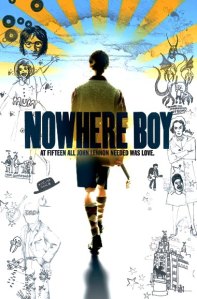
At first glance, Sam Taylor-Wood’s Nowhere Man sounds just a little bit too cutesy. The movie, which covers the youth of John Lennon, starts with the death of John’s Uncle George, covers both his attempts to reconcile with his mother Julia (portrayed here as being bipolar) and his troubles relationship with the aunt who actually raised him, details how John came to form his own band (The Quarrymen) and first met Paul McCartney and George Harrison, and ends with John preparing to leave for Germany. Yet the movie works surprisingly well and, by the end, is actually quite touching regardless of whether you idolize John Lennon or if you think Imagine is one of the most overrated songs of all time. By refusing to indulge in any easy sentimentality about either John Lennon or the iconic figure he would eventually become (the word “Beatles” is never uttered at any point in the film), Taylor-Wood crafts a touching coming-of-age story about an alienated teenager trying to find peace with his dysfunctional existence. The fact that the teen is going to grow up to be the John Lennon is secondary to the plot.
The film works mostly because of the cast. The young John Lennon is played by Aaron Johnson who, earlier this year, was the lead in Kick-Ass. I have to admit that I didn’t care much for Johnson in Kick-Ass. His performance seemed generic and bland and he was overshadowed by Nicolas Cage, Chloe Grace Moretz, Mark Strong, Christopher Mintz-Plasse, and just about everyone else in the movie. Here, however, Johnson gives a strong, sympathetic performance as a character who often comes across as being neither. He both manages to capture the young Lennon’s sensitivity as well as his anger and cocky arrogance.
However, the movie truly belongs to the two actresses playing Lennon’s aunt and mother, Kristen Scott Thomas and Anne-Marie Duff. Scott Thomas has an especially difficult job as her character is far less flamboyant and, at first sight, a lot less interesting as Duff’s. However, as the film progresses, Scott Thomas starts to subtly reveal the dry humor that lies underneath her character’s serious expression. As for Duff, she dominates the film as surely as Julia dominated her son’s life. Duff doesn’t resort to any of the easy (and insulting) clichés that are usually used to represent bipolar disorder on film. Instead, she captures both the exhilarating high of being manic along with the constant fear of the depressive episode that we always know is destined to follow. It’s a spot-on performance that elevates this film above the standard coming-of-age story.
Wisely, neither the director nor her actors ever get caught up in the fact that their film is about the John Lennon. There’s no portentous foreshadowing or awkwardly staged moments designed to specifically make you go, “Hey, that’s John Lennon!” Even the first time that Lennon meets Paul McCartney and, later, George Harrison is handled in a casual, off-hand manner. Taylor-Wood has enough faith in her audience to believe that we’ll be able to understand the importance of John being introduced to a younger guitar player named Paul without bashing us over the head with the fact that this is the Paul McCartney. As such, while you’re always aware that this is a movie about John Lennon, you can also see the movie as simply being the story of an alienated teenager who finds salvation through music.
Old school Italian horror films are, often times, a collection of “what the fuck” moments. Here’s one of my favorite “what-the-fuck” moments from one of the ultimate “what-the-fuck” movies, 1980’s Burial Ground: The Nights of Terror.
(By the way, contrary to rumor, Peter Bark, who plays the kid in this clip, was not a midget. He was just a really ugly 16 year-old.)
Four years ago, I was in Recycle Books in Denton, Texas and I came across a book called something like “Unknown Legends of Rock and Roll.” The book came with a CD that featured music by some of the bands featured in that book. The first song on that CD (and my personal favorite) was Smashed Blocked, a song from a band called John’s Children.
While the goth ballerina side of me will always have a special place in my heart for Suspiria and its two sequels, I think that 1982’s Tenebraemay very well be director Dario Argento’s best film. Certainly, it was (to date) his last truly great film before he entered the current, frustratingly uneven stage of his career.
Tenebrae was a return to Argento’s giallo roots after the supernatural-themed horror of Suspiria, Zombi, and Inferno. It was also the work of an audaciously confident director. That confidence is fully on display in the scene below in which the film’s killer menaces a journalist and her lover. Featuring a truly impressive tracking shot in which the camera appears to literally swoop in, out, and over a journalists house without a single cut, the scene ends with one of Argento’s more memorable murders.