Occasionally, I like to do a little thing that I call “Let’s second guess the Academy.” This is when we look at the films that have won Academy Awards in the past and we ask ourselves, “Should that film have won?”
For this latest edition of Let’s Second Guess the Academy, let’s take a look at 1993. The 1993 Academy Awards were dominated by Schindler’s List. Steven Spielberg’s powerful Holocaust drama won both best picture and best director. It remains the film by which all other Holocaust dramas are judged.
But did Schindler’s List deserve to win? Or would you have preferred to see one of the other four nominees win the title of Best Picture of 1993? Let us know by voting below!
Now, here comes the fun part. Let’s say that Spielberg never got around to directing Schindler’s List. And maybe The Piano never played in the states and The Fugitive bombed at the box office. Let’s say that none of the five best picture nominees had been eligible to be nominated in 1993. Which five films would you have nominated in their place?
Below, you can vote for up to five alternative nominees.
On January 1st, 2009, a young man named Oscar Grant was executed in Oakland, California. Grant was returning home from celebrating the New Year’s in San Francisco when he and several other young black man were pulled off a train by the Bay Area Rapid Transit Police. According to the police, Grant had been involved in a fight on the train. In a moment that was recorded by several cell phones (and later broadcast across the world), Grant was shot in the back by a BART policeman. According to the police, Grant had been resisting arrest and his executioner had meant to use his taser but had grabbed his gun by mistake.
The death of Oscar Grant made the news even down here in Texas and I can still remember discussing it with my friends. As a bunch of good, white liberals (and yes, believe it or not, I was once a little bit liberal, though even back then I was, at heart, more of a civil libertarian than anything else), we were all properly outraged by what happened. At one point, I declared that this proved that police hide behind the power of their tasers. We all agreed that it was a terrible thing that had happened and that the cop involved needed to be held responsible.
Only recently did I realize that, even as fashionably outraged as me and my friend were and even though we did feel that this was a classic case of police overreactions, we also automatically assumed that the cop was telling the truth when he said that he meant to grab for his taser. For all of our righteous indignation, we — as a bunch of white people who had spent most of our time living in white neighborhoods and white towns — still had a hard time accepting the idea that a white police officer had intentionally executed a black man. As outraged as we were, we were assumed that we were angry about an aberration. As such, we assumed that the shooter would be held responsible and we went on with our comfortably sheltered lives. Needless to say, we were incredibly naive. While the death of Oscar Grant made national news, it made far less news when the man who shot him was eventually sentenced to only two years in prison. (He was paroled after 8 months.)
I’ve been thinking about Oscar Grant (and the way that my friends and I initially reacted to the news reports of his death) ever since I saw Fruitvale Station, a devastating independent film that also marks the directorial debut of Ryan Coogler.
Starting in the early morning hours and ending in the first hours of 2009, Fruitvale Station follows Oscar Grant (played, in an award-worthy performance by Michael B. Jordan) as he lives the final day of his life. In between doing such every day things as buying a birthday card for his mother (played, in a luminous performance, by the great Octavia Spencer) and picking up his daughter from daycare, Oscar worries about how he’s going to pay his rent and struggles against the temptation to return to his former life of dealing drugs.
While we watch the film knowing what Oscar doesn’t — that this is the last day of his life — the film itself manages to be a lot more than just a recreation of a tragic event. There’s a vibrancy and sense of hope to the scenes where Oscar drives through Oakland or hangs out with his family. That vibrancy makes the film’s inevitable conclusion all the more powerful and devastating.
As for the actual shooting, Fruitvale Station leaves it to the audience to decide whether Oscar was intentionally executed or if he was shot by a cop who thought he was holding a taser. As the cop who shot Oscar, Chad Michael Murray is only on-screen for a split second. As the other cop on the scene, Kevin Durand (who played Martin Keamy on Lost) shouts and bullies as only Kevin Durand can do. If the film leaves it ambiguous about whether or not Oscar was intentionally shot, it’s not ambiguous about the fact that Oscar was killed because, as a black man, he was automatically viewed as being a potential threat by the white police officers. Whether the intention was to tase him or to shoot him, the ultimate goal was to reassert the authority of the police.
As Fruitvale Station makes clear, the shooting was both an individual tragedy and a piece of the larger tragedy that’s still being played out across this country. The film’s triumph is that it makes Oscar Grant into both a compelling individual and a powerful symbol of the struggle that many Americans face as they try to survive under a system that’s been designed to keep them down.
So, have you seen Fruitvale Station? If you haven’t, you need to. It’s one of the best films of 2013.
Today’s dance scene that I love comes from the 2009 musical Nine.
To be honest, Nine is a terrible film that almost plays like it was specifically designed to parody flashy but superficial musicals. However, Nine is meant to be taken seriously and that’s is its greatest failure. Cinema Italiano is one of Nine’s better-known songs, despite the fact that, in many ways, it epitomizes a lot of what’s wrong with the film as a whole. For one thing, it’s obvious, from the lyrics, that the song’s writer knows very little about Italian cinema. (If anything, it sounds like the song was meant to describe the French new wave.)
And yet, I have to admit that I love the scene where Kate Hudson performs Cinema Italiano. I think it’s because, even though Hudson is not a great singer, she so throws herself into her performance that she wins the viewers over. This is the epitome of a guilty pleasure, a scene that I shouldn’t love and yet I do.
Last night, before going on vacation, I watched the SyFy original movie, Ghost Shark.
Why Was I Watching It?
Every Saturday night, I watch and live tweet a SyFy movie with the Snarkalecs. Last night, we watched Ghost Shark. Seeing as Ghost Shark was going to be my last SyFy film to watch before going on vacation, I knew that both the film and the snarkiness would have to keep me satisfied for the next two weeks. Fortunately, both Ghost Shark and the Snarkalecs came through brilliantly!
What Was It About?
One of my huge problems with Sharknado is that, despite the title, there really wasn’t much tornado action. However, Ghost Shark lives up to its title. It’s called Ghost Shark and, by God, that’s what it’s about!
In short, a shark is killed by a bunch of rednecks who look like they’ve wandered over from an unaired episode of Duck Dynasty. However, the shark comes back and, as you might guess, it’s looking for vengeance. As a ghost, the shark has the ability to manifest itself out of any body of water and soon, it’s popping up in toilets, swimming pools, sinks, water slides, and an open fire hydrant. (As the film’s brilliant tagline put it — “If you get wet, you die.” Seriously, I would be so dead.) It’s up to Ava (Mackenzie Rosman) and the town drunk (Richard Moll) to figure out how to stop the Ghost Shark!
What Worked?
Even if I hadn’t known beforehand, I would have guessed that Griff Furst had directed Ghost Shark. Of all the directors who regularly direct films for the SyFy network, Furst is one of the best. Along with making good use of his trademark Louisiana locations, Furst also knows how to maintain the perfect balance of excitement and humor.
It should also be noted that Ghost Shark is one of the few films where you really can’t predict who is going to survive and who is going to end up as sharkbait. One reason why the ghost shark is an effective monster is because he will literally eat anyone, even characters who — in other films — would automatically be spared of any danger.
On a personal note, I have to say that the Snarkalecs were on fire last night. Kelly Thul, in particular, earned a spot in the hall of fame for commenting, about two characters who had just gotten the upper halves of their bodies chomped off by the ghost shark, “They’re waisted!”
What Did Not Work?
It all worked. Seriously, this was the best SyFy film since End of the World. And, in case you were curious, it’s a hundred times better than Sharknado.
“Oh my God!” Just Like Me Moments
At one point, one future victim said, “It’s too hot to be a virgin” and if I had a dollar for every time I’ve used those exact same words, I would be one rich redhead.
Also, I related to the scene where the sprinklers go off in the local museum and end up soaking every character there. Museums always get me wet too. What can I say? I love history.
If Luis Buñuel had ever made a slasher film, it would probably have been a lot like You’re Next.
You’re Next tells the story of the ill-fated Davison clan. Paul (Rob Moran) has recently retired from his job as a defense contractor and now, he and his wife, Aubrey (Barbara Crampton) are looking forward to celebrating their anniversary at their isolated vacation home. Soon after they arrive at the house, Aubrey is convinced that she can hear someone else in the house. However, since the frail Aubrey is obviously emotionally unstable, Paul dismisses her concerns.
Over the course of the day, Paul and Aubrey’s children arrive at the house. Though, in the best tradition of all troubled families, the Davisons attempt to maintain a facade of peace and harmony, it quickly becomes clear that each member of the family is dealing with his or her own issues and petty jealousies.
For instance, oldest son Drake (Joe Swanberg) obviously feels that he’s superior to his siblings. His wife, Kelly (Margaret Laney), is just as obviously unhappy with their marriage.
Crispian (A.J. Bowen) is a neurotic academic who is struggling financially and is viewed as being a weakling by the rest of his family. His girlfriend, Erin (Sharni Vinson) has a secret in her past that will become unexpectedly important as the day progresses.
Daughter Aimee (played by Amy Seimetz, who was so good earlier this year in Upstream Color) tries so hard to be cheerful that you know that she has to be secretly be on the verge of having a nervous breakdown. Her boyfriend, Tariq (Ti West), is a struggling filmmaker who is scandalized to discover that Drake prefers to watch commercials as opposed to documentaries.
Finally, there’s the youngest son, Felix (Nicholas Tucci). Felix appears to be the most well-adjusted of all of the Davison children but his quiet girlfriend Zee (Wendy Glenn) is a different story.
Once the family has gathered together for the anniversary dinner, the bickering begins. What the family don’t realize is that a group of men (all of whom wear animal masks) have previously slaughtered the neighbors and have now surrounded the Davison house. The bickering is interrupted by a brutal attack that leaves one dead, one seriously injured, and the rest of the family fighting for their lives.
You’re Next starts out as an effective but rather standard home invasion film (think of The Strangers or even Michael Haneke’s Funny Games) but the film features two twists which set it apart.
The first twist is that Erin turns out to be as effective and determined a killer as the men laying siege to the house. I’ve sat through a lot of horror movies and I love movies where women get to kick ass and I can tell you, without fear of contradiction, that there’s probably no other horror heroine who kicks as much ass as Erin. As played by Sharni Vinson, Erin is destined to become an iconic character in the history of horror.
The other twist is one that I can’t tell you about because it’s this twist that literally turns the entire film upside down. What I can tell you is that this twist forces you to reconsider everything that you’ve seen up until that point. Most impressively, director Adam Wingard reveals this twist to us long before he reveals it to the film’s characters. As such, just when the viewer is getting used to the idea of You’re Next being just another home invasion film, a whole new element of suspense is added to the story.
Some reviewers have referred to You’re Next as being a comedy. I disagree, if just because the film’s violence is too brutal and the gore is too graphic for this film to be considered anything other than primarily a horror film. That said, there is a strain of dark humor that runs through the film and occasionally provides a much needed relief from the nonstop tension onscreen. A good deal of the film’s humor comes from just how incredibly screwed-up the Davison family is, even before they find themselves under attack. This is a family of people who, even while they’re trying to plot their escape from the house, can not resist getting into argument about who can run the fastest.
Ultimately, You’re Next works as both a brutally effective horror film and as a satirical portrait of an All-American family that’s secretly so dysfunctional that — even if they weren’t being attacked by masked men with crossbows — they probably would have eventually ended up killing each other anyway. It’s a genre film that manages to transcend the rules of genre even while embracing them. In a year that, so far, has been dominated by surprisingly intelligent and effective horror films, You’re Next is one of the best.
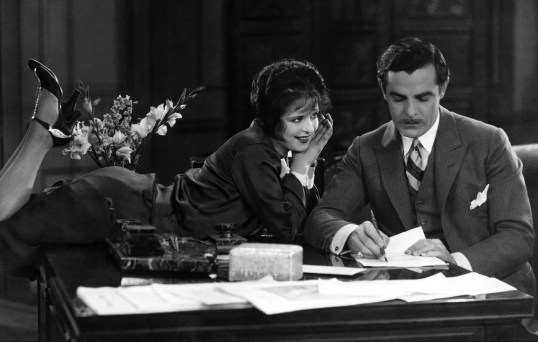
If I could be any character from a silent film, I would want to be Betty Lou Spence, the heroine of the classic 1927 film, It.
As played by the beautiful Clara Bow, Betty has It. What is It, you may ask? That’s the question that this film sets out to answer. The movie starts out with a title card that read, “That quality possessed by some which draws all others with its magnetic force. With ‘It’ you win all men if you are a woman and all women if you are a man. ‘It’ can be a quality of the mind as well as a physical attraction.” Throughout the film, every man who sets his eyes on Betty automatically says that she has “it.” Though the film never explicitly says so, it’s pretty obvious that “It” is a combination of sensuality, intelligence, and inner strength.
It is sex.
And yes, since she’s played by Clara Bow, Betty Lou Spencer definitely has ‘it’ and she knows what to do with it as well.
However, one thing that Betty doesn’t have is a lot of money. Instead, she’s a proud and poor shopgirl who sets her sights on her wealthy and handsome employer, Cyrus Waltham (played by Antonio Moreno). Realizing that the uptight Cyrus will never notice her while at work, Betty accepts a date with Cyrus’s irresponsible best friend Monty (William Austin). Knowing that Cyrus and his girlfriend will also be there, Betty asks Monty to take her to a fancy restaurant. While Monty orders their food, Betty stares shocked at the high prices on the menu. Why just the appetizers cost $2.00!
Ah, 1927.
Eventually, Betty does manage to get Cyrus’s attention. After spending a day slumming with her down on Coney Island, Cyrus attempts to kiss Betty. Betty responds by slapping him and telling him, “So, you’re one of those minute men — the minute you meet a girl, you think you can kiss her!”
The next day, things get a bit more complicated when Betty discovers that two social workers have shown up at the apartment of her best friend, Molly (Priscilla Bonner). Molly is a single mother and the social workers have shown up to take away her baby. Betty boldly steps forward, claiming that she is the baby’s true mother and that, since she has a job, the social works have no reason to take away her baby.
One of the snooty social workers (who, needless to say, does not have it) stares down here nose at Betty and asks, “And where is your husband?”
Betty stares straight back at her and replies, “That’s none of your business.”
Seriously, nobody tells Betty Lou Spence what to do.
Since this movie was made in 1927, everyone is scandalized. Cyrus, obviously miffed that he couldn’t even get a kiss from an unwed mother, dumps her. Betty responds by quitting her job. A title card informs us that Betty may have needed the money but her pride was far more important to her. What makes this movie unique, especially when compared to even some contemporary films, is that Betty is not punished for putting her pride before money or romance. Instead, the film celebrates her independence.
The rest of the film deals with her getting her own brand of vengeance on Cyrus. In the end, Betty gets her man but she gets him on her own terms. Again, take a minute to consider that this film, made nearly 90 years ago, not only features a liberated woman but celebrates her as well.
After this film, Clara Bow became known as the “It Girl,” and it’s easy to see why. In the role of Betty Lou Spence, Bow epitomizes the perfect combination of outward sensuality and inward strength. Whether she’s sarcastically telling off a rude customer, defending her best friend, or saving the life of her romantic rival, Clara Bow epitomizes both sex and independence. In the end, she pursues her man not out of obligation but out of desire. When she does find her happy ending, she finds it on her own terms.
Those of us in 2013 have a lot to learn from the It Girl of 1927.
However, though I’ll be away for two weeks, I’m not going to let that stop me from sharing my thoughts here on the Shattered Lens. What can I say? I love film, I love this site, and, most importantly, I love our readers.
Now, if you know me, you know that I also love to dance.
So, I figured, why not combine my greatest loves? For then next two weeks, I will be sharing a special set of scenes that I love. These are some of my favorite dance scenes.
I’d like to start things off by sharing a scene from my favorite film of 2012. This deliriously romantic dance scene comes from Joe Wright’s brilliant adaptation of Anna Karenina and features Keira Knightley and Aaron Taylor-Johnson.
“Starring Academy Award nominee Jack Nicholson…” Actually, this film features at least 3 Academy Award nominated performers — Nicholson, Bruce Dern, and Diane Ladd.
2) Cry Baby Killer (1958)
Speaking of Jack Nicholson, here’s proof that even the most iconic stars had to start somewhere. This was Nicholson’s film debut.
3) The Delinquents (1957)
This juvenile delinquent film was directed by Robert Altman, who would later direct films like M*A*SH, Nashville, The Player, Short Cuts, Gosford Park, and The Company.
4) The Cool and the Crazy (1958)
The 50s were a wild time to be a teenager, apparently.
5) The Narcotics Story (1958)
“It’s a story of the young and innocent…” They’re young and innocent only be the standards of the decadent 50s!
6) The Pusher (1960)
And, of course, you can’t have the narcotics story without …. The Pusher!
 Occasionally, I like to do a little thing that I call “Let’s second guess the Academy.” This is when we look at the films that have won Academy Awards in the past and we ask ourselves, “Should that film have won?”