A Movie A Day #146: The Dogs of War (1981, directed by John Irvin)


Jamie Shannon (Christopher Walken) is a professional mercenary who is hired, by a British businessman, to overthrow the government of Zangaro.  Though Zangaro is currently ruled by a ruthless dictator, Shannon’s employers want to replace him with someone even worse, all so they can get their hands on the country’s platinum mines.  After Shannon is captured and tortured by the government, he wants nothing else to do with Zangaro.  Instead, he wants to return to New York and propose to his ex-wife (JoBeth Williams).  But, when she turns down his proposal, Shannon and his mercenary army return to Zangaro.

Before winning an Oscar for The Deer Hunter and becoming one of our most popular character actors, Christopher Walken was a finalist for the role of Han Solo in Star Wars.  If not for George Lucas’s decision to hire Harrison Ford to read lines for the actors at the auditions, Christopher Walken’s career could have developed far differently.  The Dogs of War, which was Walken’s first big film after the high of The Deer Hunter and the low of Heaven’s Gate, features Walken playing a character who has much in common with George Lucas’s original conception of Han Solo, an amoral mercenary who will work for anyone who pays him.  Walken is almost too good as Jamie, playing the part as being so aloof and ruthless that it is sometimes hard to feel any sympathy for him at all.  If he had taken that approach to playing Han Solo, audiences would have really been shocked when Han returned to attack the Death Star.  They would probably be worried that he had returned because the Empire offered him a thousand credits to kill Luke.

The Dogs of War has an intriguing premise but it’s a very slow movie that gets caught up in all the minutia that goes into staging a coup.  It’s exciting when Walken and his mercenaries finally attack the dictator’s compound but it takes forever to get there.  The book, by Frederick Forsyth, is a well-written page turner but the film adaptation largely falls flat.

A Movie A Day #145: The Incredible Hulk: A Death In The Family (1977, directed by Alan J. Levi)


Following the events of The Incredible Hulk and with the world convinced that he is dead, Dr. David Banner (Bill Bixby) is hitchhiking his way across California, hoping to reach a hospital where research is being done on the effects of gamma radiation.  When he stops off in an orange grove, he spots a young, crippled woman named Julie (Laurie Prange).  When Julie faints, David carries her back to her mansion.  It turns out that, after the mysterious death of her father, Julie stands to inherit millions.  David suspects that her doctor (played by William Daniels) may be poisoning her and he gets a job working on the grounds of her mansion.  At first, David thinks that his biggest problem is going to be the head groundskeeper (Gerald McRaney), who is jealous of David’s relationship with Julie.  But, actually, it’s Julie’s stepmother (Dorothy Tristan) that David has to watch out for.  When David tries to protect Julie and a bitter hermit (John McLiam) from the stepmother’s evil plans, he soon finds himself being pursued through the swampland by both men with guns and tabloid journalist Jack McGee (Jack Colvin).  They are all making David Banner angry and they’re about to discover that they wouldn’t like David Banner when he’s angry.

This was the second pilot for The Incredible Hulk.  It aired a week after the first pilot and, like that one, it was also given a theatrical release in Europe.  While the first movie established David Banner’s backstory and explained why he transformed into the Hulk whenever he bumped his head on a door frame or twisted his ankle, A Death in The Family is more typical of the series that would follow.  Like every subsequent episode, A Death In The Family opens with David Banner finding an odd job and ended with him walking down the road with his thumb stuck out.  In between, Banner helps a special guest star.

Watching the second pilot, it’s easy to see why CBS took a chance on The Incredible Hulk even though, at the time, comic book adaptations were considered to be a risk.  Both Bill Bixby and Lou Ferrigno really throw themselves into playing Banner and his alter ego and the show takes the idea seriously.

There’s nothing special about the pilot’s story.  The stepmother and the doctor are obviously guilty from the start.  But the plot (and the 90 minute running time) does allow for four appearances by the Hulk.  David Banner even gets attacked by a grizzly bear, which brings the Hulk right out.  David Banner always had the worst luck with wild animals and barbed wire.  The Hulk, though, just throws the grizzly bear over into the next pond.  The bear is not harmed.  The Hulk may have been angry but he was never really dangerous.

Finally, for the record, Death In the Family featured the first of many aliases that David Banner would assume over the next four years.  This time, he’s David Benton.

A Movie A Day #144: The Incredible Hulk (1977, directed by Kenneth Johnson)


It may seem hard to believe now but there was a time when comic book adaptations were considered to be a risky bet at best.  In 1977, Marvel Comics sold the television rights for four of their characters to Universal Productions. This led to three unsuccessful pilots (one for Dr. Strange and two for Captain America), a Spider-Man series that lasted for two seasons, and The Incredible Hulk.  As opposed to the other Marvel adaptations, The Incredible Hulk series was popular with fans and (some) critics and ultimately lasted for four seasons.
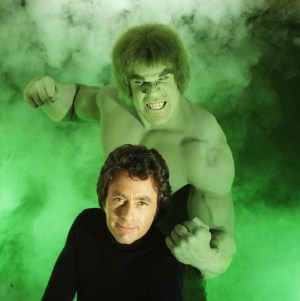
It all started with a 90 minute pilot that aired in 1977.  Haunted by the car accident that caused the death of his wife and his inability to rescue her, Dr. David Banner (Bill Bixby) is researching why, in times of extreme stress, ordinary people can suddenly experience moments of super human strength.  What he theorizes is that it is a combination of body chemistry and gamma radiation caused by sun spots.  Eager to test his theory, David straps himself into a chair and zaps himself with gamma radiation.  At first, it seems as if nothing has changed.  But when David’s driving home, he gets a flat tire.  When he struggles to change the tire, in the middle of a hurricane nonetheless, David gets mad.  Suddenly, his eyes turn green and soon so does the rest of him as David Banner is transformed into the Incredible Hulk (Lou Ferrigno, except for one shot where the Hulk is played by Richard Kiel).  The Hulk runs through the woods, accidentally scaring a girl and getting shot by a hunter.  When the Hulk falls asleep, he transforms back into David, who has no memories of what he did while he was the Hulk.  While David and his colleague, Elaina Marks (Susan Sullivan), investigate what happened to him, tabloid reporter Jack McGee (Jack Colvin) tries to uncover the results of David and Elaina’s research.

Other than introducing the Hulk and giving Banner a backstory, the pilot didn’t have much in common with the series that followed.  Along with being a comic book adaptation, the series was also a remake of The Fugitive.  With everyone convinced that the Hulk had murdered both him and Elaina, David was always on the run and trying to find a way to cure his condition.  Every episode would begin with David working a new odd job and getting involved in a new situation and almost every episode ended with David hitchhiking while the show’s famous piano theme played over the final credits.  Because David was always either getting beaten up or tangled in barbed wire, the Hulk would show up twice an episode.  David Banner just couldn’t catch a break.

The pilot seems to take forever to get going, devoting a lot of time to David and Elaina doing research.  In those days before the success of The Dark Knight and the MCU legitimized comic books as a cultural force, The Incredible Hulk was determined to show that it was not just a show for kids.  Today, the pilot is too slow-paced and self-consciously serious but still contains the elements that made the show itself became a success.  Bill Bixby takes his role seriously and Lou Ferrigno is the perfect choice for the Hulk.  Decades after they first aired, the Hulk-transformation scenes are still undeniably cool.  It was also during the pilot that Dr. Banner uttered those famous and oft-parodied words: “Mr. McGee, don’t make me angry.  You wouldn’t like me when I’m angry.”

As of this week, reruns of The Incredible Hulk are now being shown, daily, on both H&I and the El Rey network.  I will be watching.

A Movie A Day #143: The Bull of the West (1972, directed by Jerry Hopper and Paul Stanley)


Welcome to the American frontier.  The time is the 1880s and men and women everywhere are heading out west in search of their fortune.  While stowing away on a train, veteran cowboy Johnny Wade (Brian Keith) meets the naive Steve Hill (Gary Clarke) and becomes a mentor to the younger man.  Johnny teaches Steve how to shoot a gun and, when they get off the train at Medicine Bow, Wyoming, they get jobs working on the ranch of Georgia Price (Geraldine Brooks).  When Georgia and Johnny plot to overgraze the land, Steve must decide whether he’s with them or with a rival rancher, Judge Garth (Lee J. Cobb).
At the same time, Ben Justin (Charles Bronson) has arrived in town with his son, Will (Robert Random), and his new wife (Lois Nettleton).  Ben is determined to start his own ranch but, because of his taciturn and stubborn personality, he alienates the Cattleman’s Association, which led by Judge Garth and Bear Suchette (George Kennedy).  Will wants to help his father but Ben keeps pushing him away.  It’s up to Judge Garth’s foreman, the Virginian (James Drury), to bring the family together.

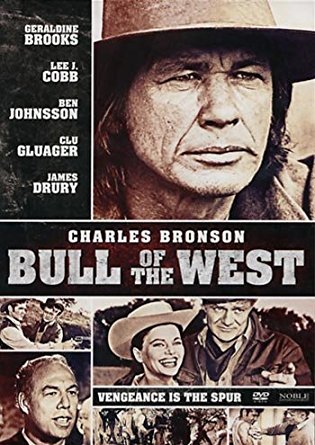
Just like The Meanest Men In The West, The Bull of the West was created by editing together footage from two unrelated episodes of The Virginian.  It works better for the Bull of the West because the two episodes had similar themes and the footage mixes together less awkwardly than it did in The Meanest Men In The West.  But Bull of the West is still just a TV show edited into a movie.  The main reason to see it is because of all the familiar western faces in the cast.  Along with Bronson, Keith, Cobb, and Kennedy, keep an eye out for Ben Johnson, DeForest Kelley, and Clu Gulager.

A Movie A Day #142: The Meanest Men In The West (1978, directed by Sam Fuller and Charles S. Dubin)


The Meanest Men In The West may “star” Charles Bronson and Lee Marvin and Sam Fuller may be credited as being one of the film’s two directors but don’t make the same mistake that I made.  Don’t get too excited.

There was once a TV western called The Virginian.  Starring James Drury as a ranch foreman, The Virginian ran for nine seasons on NBC.  A 1962 episode, which was written and directed by Sam Fuller, featured Lee Marvin as a sadistic outlaw who kidnapped The Virginian’s employer, a judge played by Lee J. Cobb.  Five years later, another episode features Charles Bronson as a less sadistic outlaw who kidnapped the Judge’s daughter.

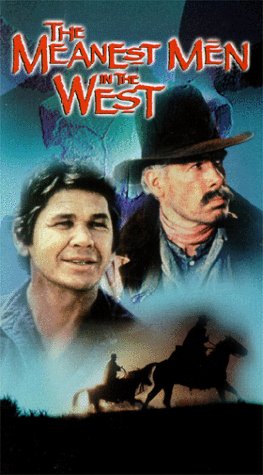
The Meanest Men In The West mixes scenes from those two episode with western stock footage, a bank robbery that originally appeared in The Return of Frank James, an intrusive voice-over, and an almost incoherent prologue, all in order to tell an entirely new story.  Now, Charles Bronson and Lee Marvin are brothers and rivals.  After Marvin snitches on Bronson’s plan to rob a bank, Bronson blames his former friend, The Virginian.  In order to get the Virginian to come to his hideout, Bronson kidnaps Cobb’s daughter.  The Virginian manages to convince Bronson that he didn’t betray him, just to arrive back at the ranch and discover that Cobb has been kidnapped.  Meanwhile, Bronson and his gang set off after Marvin and his gang.  It ends with Charles Bronson, in 1967, shooting at Lee Marvin, who is still in 1962.

The Meanest Men In The West is so clumsily edited that the same shot of Charles Bronson holding a gun is spliced into a dozen different scenes.  Filmed on different film stocks, the Bronson scenes and the Marvin scenes look nothing alike and, since the two episodes were filmed five years apart, James Drury literally ages backwards over the course of the film.

The Meanest Men In The West is for Charles Bronson and Lee Marvin completists only.  I think Bronson and Marvin are two of the coolest individuals who ever existed and even I had a hard time making it through this one.  If you do watch it, keep an eye out for a young Charles Grodin, thoroughly miscast as a tough outlaw.

A Movie A Day #141: Breakheart Pass (1975, directed by Tom Gries)


California.  The 1870s.  Sheriff Pearce (Ben Johnson) boards a train with his prisoner, an alleged outlaw named John Deakin (Charles Bronson).  The train is mostly full of soldiers, under the command of Major Claremont (Ed Lauter), who are on their way to Fort Humboldt.  The fort has suffered a diphtheria epidemic and the soldiers are supposedly transporting medical supplies.
However, it’s not just soldiers on the train.  There’s also Gov. Fairchild (Richard Crenna) of Nevada, his fiancée (Jill Ireland), the Reverend Peabody (Bill McKinney), and a conductor named O’Brien (Charles Durning).  As the train continues on its journey, it becomes obvious that all is not as it seems.  People start to disappear.  A man is thrown from the train.  Two cars full of soldiers are separated from the train and plunge over a cliff.  There is also more to Deakin than anyone first realized and soon, he is the only person who can bring the murderers to justice.

In both real life and the movies, Charles Bronson was the epitome of a tough guy, so it’s always interesting to see him playing a more cerebral character than usual.  There are some exciting and surprisingly brutal action scenes, including a scene where Bronson fights a cook (played by former professional boxer Archie Moore) on top of the speeding train, but Breakheart Pass is more of a murder mystery than a typical action film.  If Louis L’Amour and Agatha Christie had collaborated on a story, the end result would be much like Breakheart Pass.  Bronson spends as much time investigating as he does swinging his fists or shooting a gun.  It’s not a typical Bronson role but he does a good job, showing that he could think as convincingly as he could kill.  Acting opposite some of the best character actors around in the 70s, Bronson more than holds his own.

Apparently, back in 1975, audiences were not interesting in watching Bronson think so Breakheart Pass was a disappointment at the box office and it is still not as well known as Bronson’s other films.  However, even if you’re not already a fan of the great Bronson, Breakheart Pass is worth discovering.

A Movie A Day #140: The Rescue (1988, directed by Ferdinand Fairfax)


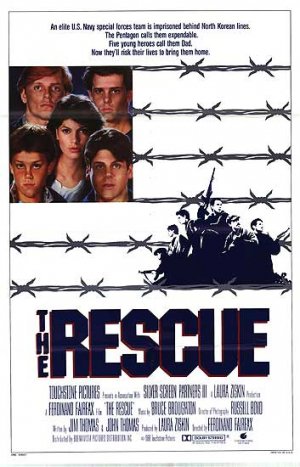
A group of Navy SEALs enter North Korea on a mission to destroy a submarine that has fallen into Kim Il-sung’s hands.  They destroy the submarine but are captured before they can safely cross the border back into South Korea.  With the SEALs facing a show trial and probable public execution, Admiral Rothman (James Cromwell) draws up a plan to rescure them.  The U.S. government, not wanting to escalate the situation, shoots down the plan.  (Americans giving up?  Is Carter still president?)  However, Rothman’s nerdy son, Max (Marc Price), gets a hold of the plan.  Before you can say “Why didn’t anyone else think of this?”, he and the children of the SEALs are sneaking into North Korea and rescuing their fathers!
This is a pure 1980s film.  Like Red Dawn, it shows that America is such a great country that even our teenagers are stronger than the average well-armed communist.  Of the actors playing the rescuers, the best known is Kevin Dillon.  He plays the rebel who smokes cigarettes and rides a motorcycle.  Though their relationship may be strained, his father (Edward Albert) is still happy when Dillon suddenly shows up in North Korea.  Soon, father and son are working together to blow up America’s enemies.  This movie’s about as dumb as they come and it’s another example of Hollywood presenting North Korea as just being the junior varsity version of China but it’s also undeniably entertaining, especially if you don’t care about things like plausibility.  Watch it the next time that Kim Jong-un threatens to blow you up.  Who needs Chuck Norris when you’ve got Kevin Dillon?


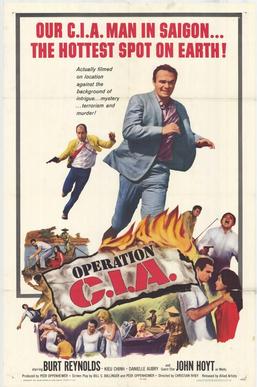
A Movie A Day #139: Operation C.I.A. (1965, directed by Christian Nyby)


Saigon, South Vietnam.  A CIA agent stands on a street corner when a young man parks his scooter in front of him.  The young man runs away and the scooter explodes, killing the agent.  Another agent, Mark Andrews (Burt Reynolds), is sent to Saigon to find out why the first agent was killed.  From the minute he arrives, Mark finds himself in the middle of a web of betrayal, intrigue, double agents, and a communist plot to assassinate the American ambassador.  Only Mark can prevent the assassination but first, he is going to have to survive a series of death traps.  He will also have to wrestle a boa constrictor.  If you have ever wanted to see Burt Reynolds wrestle a boa constrictor, this is the movie for you.

This low-budget James Bond rip off would be forgotten if not for three reasons.

First, this was one of the few American films to be made about the Vietnam War during the time of America’s involvement in that conflict.  Operation C.I.A. was released in September, a month after the passage of the Gulf of Tonkin Resolution.  Soon, the Vietnam War would become so unpopular that very few mainstream movies would even acknowledge it.  Originally, Operation C.I.A. was going to be filmed on location but, because of the rising hostilities, filming was instead done in Thailand, with Bangkok filling in for Saigon.  That Bangkok and Saigon had absolutely nothing in common was not considered to be a problem.

Secondly, this was one of the few films to be directed by Howard Hawks’s longtime editor, Christian Nyby.  Nyby is credited as directing The Thing, though many assume that Hawks actually directed that film.  Post-Thing, Nyby had an undistinguished directorial career, working mostly in television.  The black-and-white Operation C.I.A. has little in common with The Thing but it could pass for an episode of I Spy.

Finally, Operation C.I.A. was Burt Reynolds’s first starring role.  Burt is miscast as an American James Bond and he spends the majority of the movie looking stiff and uncomfortable.  The first time that Sean Connery left the role of James Bond, Burt Reynolds was one of the actors considered to replace him.  Judging from Operation C.I.A., everyone should be happy that George Lazenby got the role instead.

Especially Burt.

A Movie A Day #138: Navajo Joe (1966, directed by Sergio Corbucci)


Duncan (Aldo Sambrell) and his gang are the most ruthless and feared outlaws in the old west.  When first seen, they are destroying a Navajo village and shooting everyone that they see.  Duncan even steals a pendant from a young Indian woman.  When that woman’s husband, Joe (Burt Reynolds), discovers what has happened, he sets out for vengeance.  With Ennio Morricone’s classic score playing in the background, Joe kills one gang member after another.  When Duncan and his gang lay siege to the town of Esperanza, Joe approaches the townspeople and offers to defend them.  His price?  “One dollar a head from every man in this town for every bandit that I kill.”
Following in the footsteps of his friend and fellow television star, Clint Eastwood, Burt Reynolds went to Italy in the 1960s and made a spaghetti western.  Navajo Joe was his second starring role, after Operation CIA.  Reynolds has always described Navajo Joe as being one of the worst movies ever made but, with the excepton of Deliverance, Burt says that about every film that he has ever made.  (Burt has also complained that the wig he wore in Navajo Joe made him look like Natalie Wood, which is true.)  While it never reaches the height of some of Sergio Corbucci’s other westerns, Navajo Joe is a frequently exciting movie, featuring one of Morricone’s best scores and a lead performance that is never as bad as Burt claims it was.  At first, it is strange to see Burt Reynolds playing such a grim and stoic character but, by the time he is throwing dynamite at Duncan’s gang, he has grown into the role and proven that he could actually play something other than a giggling good old boy.  As usual for a Corbucci western, both the outlaws and the greedy and ungrateful townspeople stand in for capitalism run amok. Like many spaghetti protagonists, Joe is an outsider who fights to save a town full of cowardly people who will never accept him.  As Joe explains, his ancestors were in America long before any of the townspeople’s ancestors.  America is his land but the forces of progress and greed are robbing him of his home.

Navajo Joe may not be a classic but it’s a solid western featuring one of Burt Reynolds’s most underrated performances.  If you have ever wanted to see Burt Reynolds smile while scalping a man, Navajo Joe is the film to see.

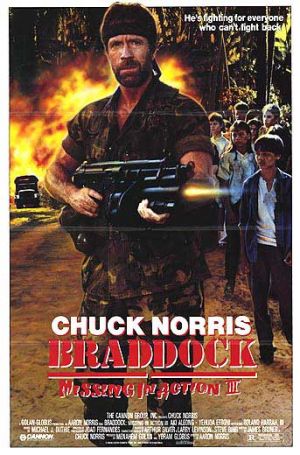
A Movie A Day #137: Braddock: Missing in Action III (1988, directed by Aaron Norris)


Chuck Fucking Norris, dude.  Chuck Norris is so cool that continuity bends to his will and thanks him for the opportunity.

Need proof?

Just watch Braddock: Missing in Action III.

The third Missing in Action film starts in 1975, with the fall of Saigon.  The communists are taking over.  The Americans are fleeing Vietnam.  Colonel James Braddock (Chuck FUCKING Norris) is determined to bring his Vietnamese wife to America with him but, when she loses her papers and is not allowed to make her way to the American embassy, Braddock believes that she had been killed. (Keep an eye out for Keith David as the Embassy guard.  Only Chuck Norris could overshadow Keith David in a movie.)  Heartbroken, Braddock returns to the United States.

Every fan of the Missing in Action franchise knows better.  We all know that Chuck was in a POW camp when Saigon fell.  In Missing in Action 2, he and his fellow prisoners did not even know if the war had ended.  Also, Chuck mentioned having a wife waiting for him back in the United States.  What gives?

I can think of only two possible explanations.

Either Chuck Norris and Cannon Films did not care about continuity

or

Chuck Norris is so cool that, in order to prevent his collected coolness from knocking the Earth off of its axis, the U.S. Army split Chuck’s coolness in half by creating a clone.  One clone spent ten years in a POW camp.  The other clone escaped during the Fall of Saigon but had to leave behind his wife.

Thirteen years later and back in the U.S., Chuck is contacted by Reverend Polanski (Yehuda Efroni), who tells him that his wife is still alive in Vietnam and that he has a 12 year-old son.  Chuck’s boss at the CIA tells him that, under no circumstances, is Chuck to go to Vietnam.

Anyone who thinks they can tell Chuck Norris what do is a fool.

Chuck goes to Vietnam and is reunited with his wife and son.  Unfortunately, when Chuck tries to get his new family out of the country, they are captured by sadistic General Quoc (Aki Aleong).  Again, Braddock must escape from a Vietnamese prison camp.

Braddock: Missing in Action III was co-written by Chuck Norris and it was directed by his brother, Aaron.  It’s a Norris production all the way, which means a lot of heroic shots of Chuck and a lot of bad guys wondering why Chuck is so much better than them.

Braddock was released four years after the first Missing in Action but, more importantly, it was released two years after Oliver Stone’s Platoon changed the way that movies dealt with the war in Vietnam.  By the time that Braddock came out, films in which lone American refought and single-handedly won the war were no longer in fashion.  Braddock was a flop at the box office and it ended the franchise.  However, continuity errors aside, Braddock is actually the best of the Missing in Action films.  It features Chuck’s best performance in the series and Chuck searching for his wife and child gives Braddock more emotional weight than the first two Missing in Action films. Maybe Chuck should have co-written and selected the director for all of the films he made for Cannon.

Chuck Norris, dude.

Chuck Fucking Norris.