 When two aging fishermen (Thomas Mitchell and John Qualen) attempt to buy a new boat, they run into a problem with local mobster, Harold Goff (John Garfield). As Goff explains, if they do not pay him $5.00 a week, something bad could happen to their boat. When one of the fisherman’s daughter (Ida Lupino) falls in love with Goff, she makes the mistake of letting him know that her father is planning on giving her $190 so that she can take a trip to Cuba. When Goff demands the money for himself, the fishermen attempt to go to the police, just to be told that there is nothing that the authorities can do. Goff tricked them into signing an “insurance” contract that allows him to demand whatever he wants. The two fishermen are forced to consider taking drastic measures on their own. Out of the Fog is an effective, early film noir, distinguished mostly be John Garfield’s sinister performance as Harold Goff.
Out of the Fog is also memorable as an example of how Hollywood dealt with adapting work with political content during the production code era. Out of the Fog was based on The Gentle People, a play by Irwin Shaw. In the play, which was staged by The Group Theater in 1939, Harold Goff was obviously meant to be a symbol of both European fascism and American capitalism. In the play, the two fisherman had Jewish names and were meant to symbolize those being persecuted by the Third Reich and its allies. In the transition for stage to film, Jonah Goodman became Jonah Goodwin and he was played by the very talented but definitely not Jewish Thomas Mitchell. The play ended with Harold triumphant and apparently unstoppable. Under the production code, all criminals had to be punished, which meant the ending had to be changed. Out of the Fog is an effective 1940s crime thriller but, without any political subtext, it lacks the play’s bight.
One final note: while Out of the Fog had a good cast, with up and comer John Garfield squaring against old vets Thomas Mitchell and John Qualen, the original Broadway play’s cast was also distinguished. Along with contemporary film stars Sylvia Sidney and Franchot Tone, the play’s cast was a who’s who of actors and directors who would go on to be prominent in the 1950 and 60s: Lee J. Cobb, Sam Jaffe, Karl Malden, Martin Ritt, and Elia Kazan all had roles.
 Welcome to the Old West. Hannibal Heyes (Pete Duel) and Kid Curry (Ben Murphy) are two of the most wanted outlaws in the country, two cousins who may have robbed trains but who also never shot anyone. After being promised a pardon if they can stay out of trouble for a year, Heyes and Curry have been living under the names Joshua Smith and Thaddeus Jones.
 Three Detroit auto workers (played by Harvey Keitel, Yaphet Kotto, and Richard Pryor) are fed up.
 Missouri during the Civil War. All young men are being forcibly constricted into the Union army, leaving those who want to avoid service with only two options: they can either disguise themselves as a woman and hope that the soldiers are fooled or they can head out west. Drew Dixon (Barry Brown) opts for the latter solution but his plans hit a snag when he’s robbed and pistol-whipped by Jake Rumsey (Jeff Bridges). When Drew coincidentally meets Jake for a second time, he immediately attacks him. Jake is so impressed that he insists that Drew join his gang of thieves.
 Rodney Dangerfield. He didn’t get no respect but he did smoke a lot of weed.
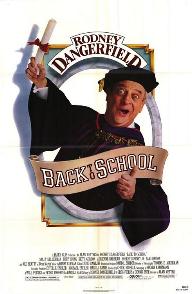 Thornton Melon (Rodney Dangerfield) started with nothing but through a combination of hard work and chutzpah, he started a chain of “Tall and Fat” clothing stores and made a fortune. Everyone has seen his commercials, the one where he asks his potential customers, “Do you look at the menu and say, ‘Okay?'” He has a new trophy wife named Vanessa (Adrienne Barbeau) and a chauffeur named Lou (Burt Young). Thornton never even graduated from high school but he gets respect.
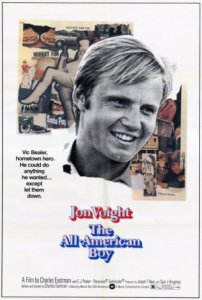 Vic “The Bomber” Bealer is an amateur boxer who appears to be poised to escape from life in his dreary hometown. He is such a good fighter that he is on the verge of making the U.S. Olympic Team and he is so good-looking that everyone, from his teenage girlfriend (Anne Archer) to his gay manager (Ned Glass) to a woman he meets at a gas station, automatically falls in love with him. However, after his girlfriend tells him that she is pregnant, Vic abandons both her and boxing. When she leaves town to have an abortion, Vic starts boxing again but then he learns that she may not have actually had an abortion and Vic leaves for Los Angeles, to see both her and his son.
 In this cop film, Robert Duvall plays Eddie Ryan, a tough New York detective who gets suspended from the force when he is accused of tossing a Puerto Rican suspect off of a roof. Eddie’s innocent but, because he spends all of his time talking about how much he hates Puerto Ricans and using Archie Bunker-style racial slurs, everyone assumes that he is guilty. Eddie is suspended from the force but then his former partner is killed while investigating an operation to smuggle guns to, you guessed it, Puerto Rico. Suspended or not, Eddie is going to track down the man who killed his partner. If that puts everyone from his girlfriend, Maureen (Verna Bloom), to NYC pedestrians in danger, that’s just the way it has to be.
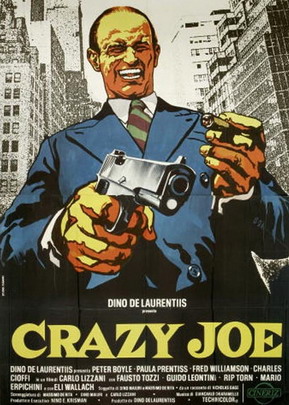 Crazy Joe (Peter Boyle) is a gangster with a chip on his shoulder and a self-taught intellectual who can (misquote) Sartre and Camus with the best of them. Sick of being taken for granted, Joe and his brother, Richie (Rip Torn), attempt to challenge the Mafia establishment. The mob sets Joe up and gets him sent to prison. While doing time, Joe befriends a Harlem gangster named Willy (Fred Williamson). Refusing to associate with the other Italian prisoners, Joe allies himself with the black inmates and even helps to start a riot over the prison’s inhumane conditions. When he is released, Joe hits the streets of New York with a vengeance, now backed up by Willy and his criminal organization.
 Through the Shattered Lens