The Films of 2021: Dear Evan Hansen (dir by Stephen Chbosky)


Last night, I finally watched Dear Evan Hansen.

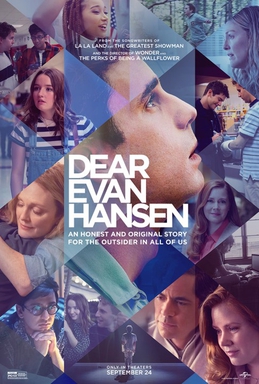
Dear Evan Hansen is the film adaptation of the Tony-award winning Broadway musical of the same name.  Recreating his stage role, Ben Platt plays Evan Hansen, a teenager who suffers from social anxiety and who is mistaken for having been the best friend of Connor Murphy (Colton Ryan), a troubled classmate who committed suicide after stealing a letter that Evan had written to himself.  (Somewhat awkwardly, it was also a letter in which Evan somewhat obliquely wrote about the crush that he had on a member of Connor’s family.)  When the letter is subsequently found on Connor’s body, it’s assumed that it’s a suicide note that Connor meant for Evan.  Evan, who is in love with Connor’s sister, Zoe (Kaitlyn Dever), allows everyone to believe that he and Connor were friends.  Connor’s mother, Cynthia, (Amy Adams) and his stepfather (Danny Pino) adopt Evan as a sort of replacement for their dead son.  Cynthia views Evan as being the only way that she’ll ever understand what Connor was going through and Evan continually reassures that Murphys that Connor really did love all of them and that he was trying to change his life for the better.  With the Murphys now treating Evan as a member of their own family, Evan’s mother (Julianne Moore) feels that her son is now ashamed of her.  And Evan’s classmate, Alana (Amandla Stenberg), launches a movement to raise money to preserve the apple orchard where Evan claims that he and Connor spent all of their time together.

As a musical, Dear Evan Hansen was very popular.  As a film, it doesn’t work and it doesn’t work for all the reasons that everyone assumed that it wouldn’t work.  Believe me, I wanted it work.  From the minute that the trailer first dropped, the reaction to the film has been so overwhelmingly negative that I was really hoping that the film itself would turn out to be an overlooked gem.  I was really hoping that this would be one of those underappreciated films that just needed a few brave champions.  Instead, it turned out to be not terrible in the way that Cats was terrible but still too flawed to be considered a success.

First off, the plot itself doesn’t transition well from the stage to film.  There’s too many holes and there’s too many places in the story where you find yourself wondering why you should care about Evan and his problems.  Those plot holes may not have been as big of a problem when the story was presented on the stage because watching any story play out against an artificial backdrop requires a certain suspension of disbelief.  But, on film, seeing Evan attending an actual school and walking down an actual street and visiting an actual house, you’re much more aware of how inauthentic the story feels.  Evan’s actions rarely make sense and it’s difficult to accept that anyone, even Connor’s emotionally desperate parents, would believe the stories that Evan concocts about his friendship with Connor.  On stage, you could perhaps accept that Zoe would buy that Evan and Connor were friends who confided in each other despite the fact that Evan doesn’t seem to know anything about Connor’s family or home life.  On screen, especially when one considers the fierce intelligence that Kaitlyn Dever brings to the role of Zoe, it’s a bit more difficult to believe.

The other big problem with the film is Ben Platt is too old for the role of Evan.  Platt first played the role in 2015, when he was 23.  He won a Tony and certainly, he deserves a lot of credit for creating the role from the workshop phase all the way to Broadway.  Now, however, he’s 28 and he looks considerably older.  So much of what Evan does is acceptable only if you believe that he’s an immature 17 year-old who is desperately looking for a place and a family where he belongs.  The same actions go from being poignant to being creepy when they’re done by someone who appears to be in his mid-30s.  While Platt has a great singing voice and shines in the musical numbers, he’s a bit too mannered when he just has to recite dialogue.  He’s still giving a stage performance, even though he’s now playing the role on film and everyone around him is giving a film performance.  Platt’s talent is undeniable but he’s miscast here and casting him opposite performers who can actually still pass for teenagers doesn’t help the situation at all.

(When I watched the film, I thought that obvious age difference between Ben Platt and Kaitlyn Dever occasionally made the scenes between Evan and Zoe uncomfortable to watch.  Then I did some research and discovered that Dever is only three years younger than Platt.  It’s just that Dever still looks like a teen while Platt looks very much like an adult.  And there’s no shame in looking your age.  Someone just needs to cast Platt in an adult role.)

In Platt’s defense, the film doesn’t really make perfect use of any of the members of its talented cast.  Amy Adams is such a good actress but the film casts her as a stereotypically flakey rich suburbanite who flitters from one trend to another.  Julianne Moore and Amandla Stenberg are similarly wasted, playing characters who have potential but who are never quite given as much to do as they deserve.  Of the cast, Kaitlyn Dever is the stand-out, even though Zoe is a bit of an inconsistent character.  Initially, she seems like the one person willing to call out everyone on their BS and then, just as suddenly, she’s oddly forgiving of someone who essentially manipulated her emotions for his own benefit.

Not surprisingly, Dear Evan Hansen works best when people are singing.  Ben Platt and Colton Ryan bring so much energy to Sincerely, Me that I briefly had hope that the film was turning itself around.  Unfortunately, that wasn’t the case but still, it’s a good production number.  Unfortunately, the rest of the movie doesn’t really live up to it.
A Blast From The Past: The Other Fellow’s Feelings (dir by Arthur H. Wolf)


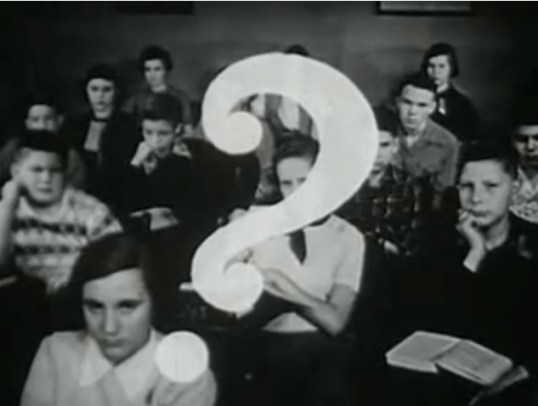
Why is Judy crying in class?

She says it’s because Jack “won’t stop teasing me.”  Is Jack to blame or does Judy need to toughen up?  Should Jack’s classmates have said, “Lay off?”  Should Judy’s friends have tattled to the teacher?  Should Judy have teased Jack back?  What would you do?

This short film from 1951 considers all of those issues and yet, it’s hard not to feel that the ultimate message is that Judy needs to stop taking everything so personally.  Sorry, movie.  Sorry, judgmental narrator.  I disagree.  Myself, I think the skinny kid with the glasses should have followed through with his threat to beat Jack up.  Up until I was 12, I had a really severe stutter so I know what Judy was going through.  Fortunately, in my case, I also had three older sisters and a bunch of overprotective cousins that were always looking after me.  Judy doesn’t seem to have that type of support system.  To be honest, in most cases like this, I put the blame on the teachers.  Jack and Judy are sitting up at the front of the class so there’s really no excuse for no one noticing what was going on.

This short film is another one that feels like a Herk Harvey production but it was actually directed by Arthur Wolf.  My favorite shot is the entire class staring at the camera while the narrator asks, “What would you do?”  Seriously, someone’s in a lot of trouble once these kids come to a consensus on who is to blame.

From 1951, it’s time to consider …. The Other’s Fellow’s Feelings.

Scene That I Love: Faye Dunaway in Bonnie and Clyde


Today, the Shattered Lens wishes a happy 81st birthday to the one and only Faye Dunaway.  In honor of this day, I want to share a scene that I love from 1967’s Bonnie and Clyde.

Now, Bonnie and Clyde was not Dunaway’s first film.  After appearing on Broadway, she was cast as a hippie kidnapped in a forgettable crime comedy called The Happening.  Otto Preminger, who could always spot talent even if he didn’t always seem to understand how to persuade that talent to work with him, put her under contract and featured her as the wife of John Phillip Law in his legendary flop, Hurry Sundown.  (Dunaway later said she had wanted to play the role of Michael Caine’s wife, a part that went to Jane Fonda and she never quite forgave Preminger for giving her a less interesting role.)  Dunaway reportedly did not get along with Preminger and didn’t care much for the films that he was planning on featuring her in.  One can imagine that she was happy when Warner Bros. bought her contract so that she could star opposite Warren Beatty in Bonnie and Clyde.  

Despite the fact that the real-life Bonnie Parker was notably shorter and certainly nowhere as glamorous as as the actress who was selected to play, Faye Dunaway proved to be the perfect choice for the role.  Bonnie and Clyde proved to be a surprise hit and an Oscar contender.  It made Dunaway a star, a fashion icon, and it resulted in her first Oscar nomination.  Dunaway would go on to appear in such classic 70s films as Chinatown, The Towering Inferno, Three Days of the Concord, and Network before her unfortunate decision to star as Joan Crawford in Mommie Dearest would slow the momentum of her career.  Unfortunately, she would later become better known for having a difficult reputation and for engaging in some very public feuds, with the press often acting as if Dunaway was somehow uniquely eccentric in this regard.  (To Hollywood, Dunaway’s sin wasn’t that she fought as much as it was that she fought in public.)  Though Dunaway’s career has had its ups and downs, one cannot deny that when she was good, she was very, very good.  

In this scene, from Bonnie and Clyde, Bonnie Parker (played by Faye Dunaway) writes a poem and tries to craft the future image of Bonnie and Clyde.  Though it has none of the violence that made Bonnie and Clyde such a controversial film in 1967, this is still an important scene.  (Actually, it’s more than one scene.)  Indeed, this scene is a turning point for the entire film, the moment that Bonnie and Clyde goes from being an occasionally comedic attack on the establishment to a fatalistic crime noir.  This is where Bonnie shows that, unlike Clyde, she knows that death is inescapable but she also knows that she and Clyde are destined to be legends.

(Of course, Dunaway and Beatty — two performers who one epitomized an era but only work occasionally nowadays — are already legends.)

Music Video of the Day: I Want Your Love by Chic (1979, directed by ????)


I can relate to the title of this song, as I think almost everyone can.  The love of the title doesn’t just have to refer to romantic love.  It can also just mean being loved as in being appreciated or admired or praised or …. well, really whatever you mean for it to mean.  There’s all sorts of love out there.  Everyone wants to be loved and sometimes, that mean exhausting yourself trying to see every movie released in one year in just two weeks.  Not that I’m speaking from personal experience, of course…. heh heh…. 

Watching this video, I found myself a bit upset with myself for having never learned how to play the violin.  It’s a neat little instrument and there’s no way you can’t look transcendent while playing it.  Oh well.  We’ll chalk that up as missed opportunity, I guess.  To be honest, I have a feeling I’d end up putting out someone’s eye with that big bow that they use so I guess it’s for the best that I never learned.

Good song, though.  You can dance to it.  You can laugh to it.  You can cry to it.  This song came out in 1979 and, as we all know, the 70s were the best!

Enjoy!

I want your love
I want your love
I want your love
I want your love


Do you feel like you ever want
To try my love and see how well it fits?
Baby, can’t you see when you look at me
I can’t kick this feelin’ when it hits


All alone in my bed at night
I grab my pillow and squeeze it tight
I think of you and I dream of you all of the time
What am I gonna do?


I want your love
I want your love
I want your love
I want your love


I want your love
I want your love
I want your love
I want your love


Sometime, don’t you feel like you
Never really had a love that’s real?
Well, here I am and who’s to say
A better love you won’t find today


Just one chance and I will show you love
Like no other, two steps above
On your ladder I’ll be a peg
I want your lovin’, please don’t make me beg


I want your love
I want your love
I want your love
I want your love


I want your love
I want your love
I want your love
I want your love


I want your love
I need your love
I’ll share my dreams and make you see
I’m really there, your love I need


I want your love
I need your love
Just like the birds need sky above
I’ll share my dreams and make you see
I’m really there, your love I need


I want your love
I want your love
I want your love
I want your love


I want your love
I want your love
I want your love
I want your love

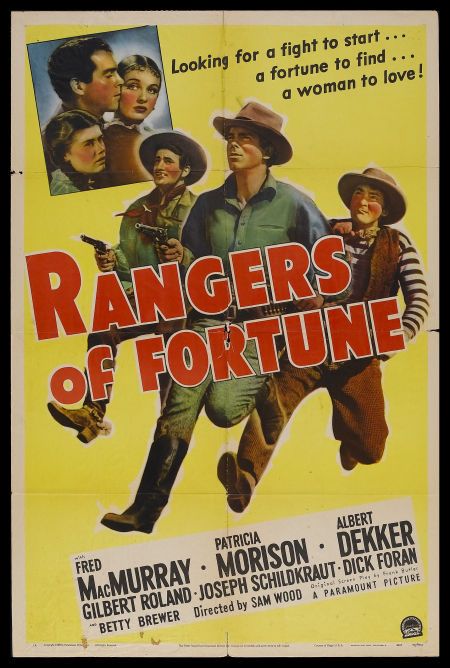
Rangers of Fortune (1940, directed by Sam Wood)


After narrowly avoiding execution by a firing squad in Mexico, three good natured outlaws head back to Texas.  Gil (Fred MacMurray) is their leader, a former army officer.  Antonio (GIlbert Roland) is the charming caballero.  George (Albert Dekker!) is the punch-drunk former prizefighter who provides comedic relief.  When they reach Texas, they meet and become involved in the efforts of a newspaper publisher (Brandon Tynan) and his daughter (Betty Brewer) to free their hometown from the control of an aristocratic landowner named Col. Rebstock (Joseph Schildkraut), who rules the town with the help of a sadistic group of cowboys.  It turns out that the three outlaws aren’t so bad while the respectable and wealthy Col. Rebstock is as bad as they come.

Rangers of Fortune is a standard 1940’s western programmer, though it’s distinguished by a better than usual cast and the quick-paced direction of Sam Wood.  It starts out almost as a comedy, with MacMurray, Roland, and Dekker cracking jokes and getting the better of almost anyone that they come across.  The screenwriter of Rangers of Fortune, Frank Butler, also wrote some of Bing Crosby and Bob Hope’s road films and he’s just as good as coming up with comedic dialogue for the team of MacMurray, Roland, and Dekker as he was for Hope and Crosby.

But the movie takes a serious turn once MacMurray, Roland, and Dekker cross the Texas border and they discover that Col. Rebstock will do almost anything and kill just about anyone to keep his hold on the town.  Even a successful scheme to install Gil as sheriff just leads to more innocent people dying.  When Rangers of Fortune turns dark, it turns very dark, with characters, who we usually don’t expect to die in a film like this, meeting a violent end.  Though it won’t convert any skeptics, it’s an interesting film for those who are already fans of old Hollywood westerns.

Rangers of Fortune has never gotten a proper video release but it is on YouTube.  Unfortunately, the copy uploaded to YouTube was in terrible condition so it’s difficult to fairly judge the film’s production values.  However, even on a damaged print, the natural authority of Fred MacMurray’s lead performance comes through and Joseph Schildkraut is as good a villain as always.  Patricia Morrison plays the prettiest girl in town and, even on YouTube, it’s easy to see why every man in town is competing for her attentions.  Seeing Albert Dekker, usually cast as intelligent and often conniving character, playing dumb is also an interesting experience, even on a bad print.  Hopefully, someday, Rangers of Fortune will get a decent restoration.

AMV of the Day: If U seek Amy (Shiki)


Now seems like a good time for another AMV of the Day, especially one featuring music from Britney!

Anime: Shiki

Song: If U Seek Amy (Britney Spears)

Creator: Sociopath HatterAmv

(As always, please consider subscribing to this creator’s YouTube channel!)

Past AMVs of the Day

The Covers of Detective Short Stories


Throughout the 30s and the 40s, Detective Short Stories offered readers 12 stories for ten cents.  That seems like a pretty good deal to me!  Today, of course, issues of the magazine cost a lot more but they are still highly sought after by collectors for their covers.

Below is just a small, chronological sampling of the covers of Detective Short Stories!

August 1937 Artist Unknown

November 1937, by John Walter Scott

February 1938, Artist Unknown

July 1938, by John Walter Scott

January 1939, by John Walter Scott

June 1939, by John Walter Scott

September 1939, Artist Unknown

April 1941, by John Walter Scott

September 1941, Artist Unknown

October 1947, by Mat Kauten

Music Video of the Day: Jive Talkin’ by The Bee Gees (1975, dir by ????)


Yes, everyone, I am still in a 70s-type of mood.  I imagine this will be the case for the rest of January.  Once February comes around, I’ll probably be in a Canadian mood so get ready for a lot of songs off of the Degrassi soundtrack.

Anyway, this video is for Jive Talkin’, which was I guess one of the Bee Gees’s earliest disco songs.  (Apparently, they were originally a non-disco band, which I just can’t imagine what that was like.  Yes, I know that it would be very easy for me to listen to their non-disco music.  That’s not the point.  The 70s are all about disco and dancing.  The 70s didn’t need any folk rock.)  Jive Talkin’ is one of those songs that feels like it should have been written for the Saturday Night Fever soundtrack but it actually came out two years before that film appeared in theaters.  That said, it does appear in Saturday Night Fever.  Unfortunately, the song did not appear in Stayin’ Alive.  That’s a shame since that film was all about jive and I think Frank Stallone could have done wonders with it.

Enjoy!

It’s just your jive talkin’
You’re telling me lies, yeah
Jive talkin’
You wear a disguise
Jive talkin’
So misunderstood, yeah
Jive talkin’
You really no good
 
Oh, my child
You’ll never know
Just what you mean to me
Oh, my child
You got so much
You’re gonna take away my energy
 
With all your jive talkin’
You’re telling me lies, yeah
Good lovin’
Still gets in my eyes
Nobody believes what you say
It’s just your jive talkin’
That gets in the way
 
Oh my love
You’re so good
Treating me so cruel
There you go
With your fancy lies
Leavin’ me lookin’
Like a dumbstruck fool
With all your
 
Jive talkin’
You’re telling me lies, yeah
Jive talkin’
You wear a disguise
Jive talkin’
So misunderstood, yeah
Jive talkin’
You just ain’t no good
 
Love talkin’
Is all very fine, yeah
Jive talkin’
Just isn’t a crime
And if there’s somebody
You’ll love till you die
Then all that jive talkin’
Just gets in your eye
 
Jive talkin’
You’re telling me lies, yeah
Good lovin’
Still gets in my eyes
Nobody believes what you say
It’s just your jive talkin’
That gets in the way
 
Love talkin’
Is all very fine, yeah
Jive talkin’, just isn’t a crime
And if there’s somebody
You’ll love till you die
Then all that jive talkin’
Just gets in your eye, yeah yeah
 
Oh jive talkin’
Jive talkin’
Oh jive talkin’