Film Review: To Die For (dir by Gus Van Sant)


The 1995 satire, To Die For, is a very clever film about some seriously stupid people.

Of course, you could debate whether or not Suzanne Stone-Maretto (Nicole Kidman) is actually dumb or not.  Suzanne may not know much about anything that isn’t on TV but she does have a natural understanding for what makes a good story.  She knows exactly the type of story that the public wants to hear and she does a good job of faking all of the right emotions.  As she proves throughout the course of the film, she’s also very good at convincing people to do stuff.  Whether it’s convincing the local television station to put her on the air as a weather person or convincing two teenagers to murder her husband, Suzanne always seems to get what she wants.

Of course, what Suzanne really wants is to be a celebrity.  She wants to be a star.  As she explains it, that’s the greatest thing about America.  Anyone can become a star if they just try hard enough and find the right angle.  If the film were made today, Suzanne would be a social media junkie.  Since the movie was made in 1995, she has to settle for talk shows and murder.

So maybe Suzanne isn’t that dumb but her husband, Larry (Matt Dillon) …. well, if we’re going to be honest, Larry’s more naive than dumb.  He’s the favored son of a big Italian family and it’s obviously never occurred to him that a woman would possibly want something more than just a husband and a lot of children.  He thinks it’s cute that Suzanne’s on TV but he’s also fully convinced that she’s going to eventually settle down and focus on starting a family.  It never occurs to him that his wife would be willing to sacrifice him on her way to stardom.

Of course, if you really want to talk about dumb, just check out the teenagers who Suzanne recruits to kill her husband.  They’ve been appearing in a documentary that Suzanne’s been shooting.  The documentary’s title is “Teens Speak Out,” which is something of an ironic title since none of the teens that Suzanne interviews really has anything to say.  Lydia (Allison Folland) is just happy that the “glamorous” Suzanne is pretending to care about her.  Russell (Casey Affleck) is the type of grinning perv who drops a pen just so he can try to get a peek up Suzanne’s skirt while he’s on the floor retrieving it.  And then there’s Jimmy (Joaquin Phoenix), with his flat voice and his blank stare.  Jimmy is briefly Suzanne’s lover before he ends up in prison for murdering her husband.  It doesn’t take much to convince Jimmy to commit murder, either.  Apparently, all you have to do is dance to Lynard Skynard while it’s raining outside.  Media interviews with Lydia, Jimmy, Suzanne, and Larry’s sister (Ileana Douglas) are sprinkled throughout the film and Jimmy continues to insist that he will always love Suzanne.

As for Suzanne, she’s got stardom to worry about….

Though the subject matter is a bit familiar and the film, made before the age of Twitter and Instagram, is a bit dated, To Die For‘s satire still carries a powerful bite.  One need only watch A&E or the Crime and Investigation network to see that Suzanne was absolutely correct when she decided that killing her husband would make her a star.  If To Die For were made today, you could easily imagine Suzanne leveraging her infamy into an appearance on Dancing With The Stars and maybe Celebrity Big Brother.  At the very least. she could get her own house hunting show on HGTV.  Delivering her often sociopathic dialogue with a perky smile and a positive attitude, Nicole Kidman is absolutely chilling as Suzanne.  Meanwhile, Joaquin Phoenix’s blank stare will continue to haunt you long after the film ends.

And speaking of endings, To Die For has a great one.  You’ll never hear Season of the Witch the same way again!

Film Review: One Potato, Two Potato (dir by Larry Peerce)


The 1964 film, One Potato, Two Potato, is the story of two people who fall in love.

Julie Cullen (Barbara Barrie) was previously married to Joe (Richard Mulligan).  She’s divorced now and raising her daughter, Ellen (Marti Mericka), on her own.  Ellen was barely a year old when Joe abandoned his family and she’s never known her father.  Perhaps that’s for the best because, as we later see firsthand, Joe was an immature and abusive man.

Frank Hamilton (Bernie Hamilton) is quiet, responsible, and mild-mannered.  For the majority of the movie, the only time that we see Frank show any emotion is when he’s playing football with coworkers.  However, he’s obviously a sensitive and intelligent man.  He and Julie begin a relationship, tentatively at first.  But soon, they’re very much in love and planning to get married.

And really, there’s nothing unusual about either one of them.  They’re two genuinely nice people who met and fell in love.  The only thing that sets their romance apart from so many other romances is that Julie’s white and Frank’s black.  For that reason, Frank and Julie get harassed by the police when they try to enjoy a romantic stroll at night.  For that reason, Frank’s parents (played by Robert Earl Jones and Vinette Carroll) object to their relationship, saying that all the love in the world can’t overcome prejudice.  For that reason, when Frank and Julie do get married, hardly anyone comes to the wedding and the one bridesmaid glares at them throughout the ceremony.  Frank and Julie end up living on a farm with Frank’s parents, in love but practically isolated from the world.  (Tellingly, the “friend” who first introduced them doesn’t want to visit them after they marry.)  When Joe suddenly shows up and discovers that Julie has not only remarried but that her new husband is black, he goes to court and demands custody of his daughter.

It’s interesting think that, in 2019, it’s very easy to take interracial relationships (not to mention interracial marriages) for granted.  And yet, it wasn’t until 1967 (three years after the release of One Potato, Two Potato), that the U.S. Supreme Court officially ruled that laws against interracial marriage were unconstitutional.  One Potato, Two Potato was an early independent film, precisely because none of the major studios were willing to deal with an issue as controversial as interracial marriage.  (When the studios finally did deal with it, the end result was Guess Who’s Coming To Dinner, a film that was as safe and mild as One Potato, Two Potato was brave and angry.)  Barbara Barrie did win the best actress award at Cannes and the film itself received an Oscar nomination for Best Original Screenplay but otherwise, it’s a sadly neglected piece of film history.  If I hadn’t recorded it off of TCM, I probably never would have seen or even heard of this film.

And that would have been a shame because, along with being a valuable historical document, One Potato, Two Potato is a compelling and heartbreaking drama.  The film approaches its subject matter with a maturity and an honesty that probably stunned audiences back in 1964.  This film refuses to give into any of the well-intentioned clichés that often dominated films about racism in the 60s and 70s.  There are no sympathetic whites (à la Gregory Peck in To Kill A Mockingbird) willing to argue for Frank and Julie’s right to raise Ellen.  (In fact, the lawyer that they hire gets angry when Frank first approaches him and advises them to leave the state.)  It does Frank no good to be dignified and patient.  The racism in One Potato, Two Potato does not come from a handful of ignorant souls.  Instead, it’s built into the very system to which Frank and Julie are now having to appeal.

One Potato, Two Potato is also a rarity in that it’s a film that allows a black man to get angry about the way he’s being treated, even if it means making whites in the audience uncomfortable.  One need only compare the hopeful ending of Guess Who’s Coming To Dinner with the heart-breaking conclusion of One Potato, Two Potato.  Whereas Guess Who’s Coming To Dinner highlighted Sidney Poitier saying, in his dignified manner, that he has no interest in fighting the battles of the past, One Potato, Two Potato finds a distraught Bernie Hamilton watching a western and finally breaking down as he yells, “Kill that white bastard!”

One Potato, Two Potato ends with a title card that informs us that the story that we’ve seen is fictional but that the laws and the issues discussed in the film are real.  55 years after it was released, One Potato, Two Potato remains a compelling drama and an important historical document.


Film Review: Before I Fall (dir by Ry Russo-Young)


One of my favorite films of 2017 was Before I Fall, which was kind of a combination of Mean Girls, Groudhog Day, and Happy Death Day.  Two years later, it remains one of my favorite movies, even if I do end up crying whenever I watch it.

The film begins with an ordinary teenager named Samantha Kingston (Zooey Deutsch) waking up on February 12th.  We follow her throughout her day and watch her deal with family, friends, teachers, and all the drama that goes along with all of that.  We meet her boyfriend, Rob (Kian Lawley) and we automatically know that she needs to dump his jock ass.  (Whenever we hear him glibly say, “Love ya,” it’s like nails on a chalkboard.)  We all know that Sam should be with Kent (Logan Miller), who is sweet and sensitive and gives her a white rose for Cupid’s Day.  We also meet and get to know her friends, Allie (Cynthia Wu), Elody (Medalion Rahimi), and especially Lindsay (Halston Sage).  While being a close friend to Sam, Lindsay is still the stereotypical popular, mean girl, the one who decides who is accepted and who is destined to forever to be an outsider.  Sam, on the other hand, is not a mean girl (or, at the very least, she’s a not-as-mean girl).  Instead, she’s the girl who simply goes along with what everyone else is doing.  She may not instigate any bullying but she doesn’t do anything to stop it either.

February 12th was the night that Sam had been planning on losing her virginity to Rob but Rob pretty much ruins that by getting drunk and acting like an asshole.  Instead, at a party at Kent’s house, Sam watches as Lindsay humiliates an outsider named Juliet (Elena Kampouris).  After leaving the party, Sam, Lindsay, Elody, and Allie drive down a dark road.  They listen to music.  They talk about how stupid everyone at the party was.  And, eventually, the car crashes and….

Suddenly, Sam’s waking up in her bedroom!  And it’s February 12th all over again!  That’s right, Sam is in a time loop, destined to continually relive the final day of her life until she makes things right.  In the 2010 novel that this film is based on, author Lindsay Olivier makes it pretty clear that each time Sam relives her day, she’s going through another stage of grief, moving from denial to acceptance.  While the film doesn’t make that point quite as clearly as the book, it does do a good job of showing us how, each time that Sam is forced to relive that day, she comes out of it as a changed person.  She discovers that Rob wasn’t worthy of her love and that Kent was.  She discovers that her family wasn’t as terrible as she assumed.  And, perhaps most importantly, she learns that being a friend does not mean excusing casual cruelty.

Watching Before I Fall is always an emotional experience for me.  A lot of it is because I can relate to Sam.  In many ways, back in high school, I was Sam.  But, even beyond that, the theme of Before I Fall is universal.  It doesn’t matter how old you are or what your background may be.  It doesn’t matter if you were popular in high school or if you were one of the outsiders.  Everyone — every single one of us — has done something that they regret.  All of us have one day that we wish we could travel back to and do things differently.

Well-directed by Ry Russo-Young and featuring a lot of beautiful Canadian scenery (the film was shot in British Columbia and Vancouver), Before I Fall is a poignant and touching film.  Zooey Deutch, Halston Sage, Cynthia Wu, and Medalion Rahimi are all believable as longtime friends and, to the film’s credit, no one — not even Lindsay — can be reduced to a mere stereotype.  Before I Fall is a film about regret, denial, anger, acceptance, and finally, peace.  No wonder it makes me cry.

Film Review: The Butterfly Effect 2 (dir by John R. Leonetti)


http://www.youtube.com/watch?v=jHg7L35MLqY

“Hey, everyone!  Let’s remake The Butterfly Effect, just without any of the goofiness that made the first film so enjoyable!”

That would seem to be the logic behind 2006’s The Butterfly Effect 2.  Since the first Butterfly Effect was a minor hit (I saw it in the theaters!), it was inevitable that there would be a sequel.  And since the first Butterfly Effect is currently on Netflix, it’s also inevitable that the sequel would follow it.

Anyway, Butterfly Effect 2 is just like Butterfly Effect except, instead of a guy trying to fix his entire screwed-up childhood, the sequel is about an office worker named Nick (Eric Lively) who has just had a really bad year.  His girlfriend and his two best friends were killed in a traffic accident.  He lost a big promotion at work.  His apartment is a mess and he keeps having these hella icky nosebleeds.  Agck!  Nick, however, discovers that if he stares at an old picture, he can be transported back to the moment that the picture was taken.

Since Nick obviously didn’t see the first movie, he proceeds to start changing the past.  He prevents the deaths of all of his friends but now, in the new timeline, he actually has to work with them and this results in him getting fired.  He then goes back in the past to keep a jerk from getting a promotion but this leads to Nick getting the promotion instead, breaking up with his girlfriend, and becoming an ennui-stricken bachelor.  Apparently, being a wealthy bachelor means doing business with organized crime because Nick soon has people trying to kill him.  Maybe there’s no way to create a perfect present, the film suggests.

And the film might be right but that doesn’t make it any less boring to sit through.  The Butterfly Effect 2 is just never as much fun as the first film.  It lacks the goofy charm of Ashton Kutcher and most of the timeline changes are rather dull.  The sequel never matches the glory of Ashton Kutcher waking up to discover that he’s gone from being a disheveled psych major to being a clean-cut, sweater-wearing frat boy.

The Butterfly Effect 2 was directed by John Leonetti, who would later direct the genuinely creepy Annabelle.  Of course, he also directed the absolutely awful Wolves at the Door.  As for The Butterflyn Effect 2, it’s not creepy but it’s also not awful enough to be memorable.  More than anything, it’s a bland movie.  It’s just kind of there, floating in direct-to-video, Netflix limbo.

Film Review: The Butterfly Effect (dir by Eric Bress and J. Mackye Gruber)


How many different ways can Ashton Kutcher fuck up time and space?

That’s the question asked in the gloriously silly The Butterfly Effect, a film that was a minor hit back in 2004.  Ashton plays Evan Treborn, a disheveled college student who is studying how memory works.  All through his life, Evan has suffered from seizures that are triggered by stress.  Evan has a lot of stress because apparently, there’s not a single bad thing that didn’t happen to him when he was a child.

Crazy father who tried to strangle Evan before being gunned down in front of his son’s terrified eyes?  Yep.

Sexual molestation at the hands of a suburban drunk?  Yep.

A best friend who blew up not only a mailbox but also a mother and a baby?  Yep.

A dog that was set on fire by a neighborhood bully?  Yep.

Another friend who was driven into a catatonic state by all the madness around him?  Yep.

A girlfriend who, due to family tragedy, had to move away?  Yep.

However, things seem to be getting better for Evan.  Now, he’s a psychology major with a bright future.  His professors love him.  He’s even got a roommate named Thumper (played, somewhat inevitably, by Ethan Suplee).   And, as he’s soon to discover, he possesses a special power.  All he has to do is read his old journals and, for a limited time, he can go into the past and change his history.

Of course, it turns out that changing history is a lot more complicated than it looks.  Evan goes back into the past and confronts the pervy suburban drunk.  He then goes back to the present and discovers that he’s now a shallow frat boy who is hated by both his professors and Thumper!  Even worse, he eventually ends up in prison for killing a man.  Going back into the past and saving his dog leads to his friend Lenny (Elden Hansen) spending the rest of his life imprisoned.  Another trip to the past results in Evan waking up as a double amputee.  Depending on what Evan does, his friend Kayleigh (Amy Smart) either becomes a shallow sorority princess or a drug-addicted prostitute.  Meanwhile, Kayleigh’s brother (William Lee Scott) goes from being a psychotic murderer to a clean-cut religious guy.

Thumper never changers, though.  Thumper endures.

This, of course, is a lot of pressure to put on any character played by Ashton Kutcher and soon, Evan is having nosebleeds and migraines.  Every time he changes the past, his brain is flooded with 20 years worth of new memories.  His brain might explode before he can fix all the damage that he’s done….

Watching The Butterfly Effect is an odd experience because, on the one hand, the premise is genuinely intriguing but, on the other hand, the film stars the reliably goofy Ashton Kutcher.  Ashton grows a beard and doesn’t wash his hair for the first half of the movie, which is the film’s way of letting us know that we’re meant to take him seriously but it doesn’t change the fact that he’s still Ashton Kutcher.  Even when playing the most dramatic of scenes, Ashton tends to deliver every line as if it’s the set up for a punch line.  It’s not surprising that the best part of The Butterfly Effect is when Ashton wakes up and discovers that he’s now a frat boy.  Those scenes are intentionally funny and they take advantage of what Ashton Kutcher is actually good at.

At the same time, it’s hard not to get into The Butterfly Effect.  It’s a mess but it’s a likable mess and it’s undeniably enjoyable to see how everyone’s life changes as a result of Ashton’s constant meddling.  (William Lee Scott especially has fun, switching between being full-blown psycho and full-blown religious.)  The Butterfly Effect may be dumb but it’s fun.  It’s a film that’s best watched with your snarkiest friends.

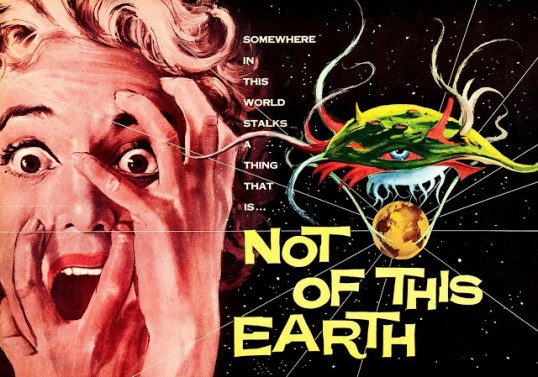
Film Review: Not Of This Earth (dir by Roger Corman)


Originally released in 1957, Roger Corman’s Not Of This Earth is about a man named Mr. Johnson (played, in a nicely creepy performance, by Paul Birch).

At first glance, Mr. Johnson may look like your typical dark-suited, 1950s businessman but, on closer examination, there’s definitely something off about him.  Why does he always wear those dark sunglasses?  Why is he so sensitive to loud noise?  Why does he move stiffly, as if he’s still getting used to his ody?  And when he speaks, why is his tone always so formal and correct?  Never trust anyone who doesn’t use a contraction or two.  Why is it that Mr. Johnson seems to spend all of his time in his mansion, only venturing outside so that he can visit the local blood banks?

Could it be that Mr. Johnson is …. not of this earth!?

Well, yes, of coursem he’s an alien.  I mean, it says so right in the title of the movie!  It turns out that Mr. Johnson comes from a planet called Davanna.  The inhabitants of Davanna are dying of a mysterious blood disease so he’s been sent to Earth so that he can run tests on human blood.  Needless to say, Mr. Johnson is under constant pressure from his bosses back home.  They expect Johnson to find a cure but there’s only one problem.  Human blood is sometimes hard to come by.

Oh sure.  Johnson can always go to the local doctor (William Roerick) and get a transfusion.  But, unfortunately, Johnson is often forced to deal with his need for blood by murdering anyone who happens to be near the house, whether it be a teenager or a vacuum cleaner salesman.  Like a vampire, Johnson drains them of their blood before retreating to the safety of his mansion.

Paul Birch gives a wonderfully odd performance in the role of Mr. Johnson, playing him in such a way that suggests that Mr. Johnson is still not quite comfortable with his human disguise.  When he starts speaking with his stilted and awkward syntax, he’s like a man who has just learned how to speak another language.  On the one hand, it’s tempting to feel sorry for Mr. Johnson because he’s desperately trying to save his people.  On the other hand, he does end up killing a lot of people.

Beverly Garland and Morgan Jones play Nadine and Harry, a nurse and a policeman who stumble across the truth of Mr. Johnson’s origins.  Beverly Garland was one of those confident, no-one-is-going-to-conquer-my-planet actresses who could elevate any film by her presence alone and, as this film shows, if you’re trying to stop the aliens from stealing all of Earth’s blood, Beverly Garland was someone who you would want on your side.

With the exception of a scene featuring Dick Miller as a slick salesman, director Roger Corman plays the material straight and the end result is a quickly paced and, at times, genuinely creepy little sci-fi/horror hybrid.  Corman makes good use of his low-budget and even the film’s cheap look ultimately works to its advantage.  The stark black-and-white cinematography perfectly captures the harshness of Mr. Johnson’s mission.  This an effective and enjoyable B-movie.

Finally, since this is a Roger Corman production, be sure to look for all of the usual suspects.  As mentioned above, Dick Miller plays a salesman.  (Before becoming an actor, Miller actually did work as a door-to-door salesman and he ad libbed the majority of his dialogue.)  Jonathan Haze appears as one of Mr. Johnson’s servants.  And, of course, the film was written by Corman’s longtime collaborator, Charles B. Griffith.  Three years after making Not Of This Earth, Corman, Haze, Miller, and Griffith would collaborate on the somewhat more light-hearted Little Shop of Horrors.

http://www.youtube.com/watch?v=ESiPZwKgIuQ

Film Review: This Is Not A Test (dir by Fredric Gadette)


This Is Not A Test opens with Deputy Dan Colter (played by Seamon Glass) out on patrol.  Suddenly, an alert comes across the radio.  Missiles have been launched.  They’re heading for the United States.  War is imminent.  This is not a test.

Deputy Colter proceeds to set up a road block.   Every motorist who approaches is ordered to pull over to the side of the road and not go anywhere.  Among those who pull over to the side of the road are a young woman and her grandfather, a truck driver, a couple who have a small dog, and a nervous young man in a suit.  Colter explains to them what’s going on.  He tells them that they can’t leave.  He has his orders.  This is not a test.  This is a real emergency.  And since Colter is the only available man in uniform, that means that he’s in charge.  When the young woman expresses some doubts to her grandfather, the old man tells her that they have to do what they’re told.

Colter has a plan for surviving the war.  He says that they can all get in the back of the truck driver’s big rig.  He estimates that they’ll have to stay there for two weeks or so.  Under his orders, everyone starts to unload the truck.  Of course, not everyone thinks that the truck is going to provide adequate protection but there aren’t any other options available.  A few people get upset when Colter announces that, for reasons of safety, they can’t take any alcohol into the truck.  Of course, considering that one of the people at the road block is a psychotic, knife-wielding murderer, the alcohol might be the least of their concerns.

As the group tries to create a shelter, they’re also forced to deal with not only a group of rather mild-mannered looters but also the fact that Colter, himself, doesn’t seem to be particularly stable.  Colter is enjoying his authority a bit too much, especially when it comes to judging whether they have room in the truck for the couple’s dog or not.  One almost gets the feeling that Colter’s looking forward to being the sole man in charge after the bombs drop….

Over the police radio, reports continue to come in.  The missiles are getting closer.  This is not a test….

This Is Not A Test is an extremely low-budget film from 1962.  It was cast with unknown, largely amateur actors and the whole film has a grainy, almost dream-like feel to it.  (It would appear that this night-set film was actually filmed at night, which means that the visuals are often as dark as the film’s storyline.)  The film gets off to a rough start, with a lot of clumsy dramatics but, as things progress, the film develops a very convincing atmosphere of impending doom.  The film emphasizes the fact that no one has the slightest idea what to do and Deputy Colter soon proves himself to be an aspiring dictator.  Though most of the actors give rather stiff performance, Seamon Glass makes the aspiring fascist into a very believable and recognizable character.

The low-budget and the amateurish acting aside, This Is Not A Test deserves a lot of credit for following its dark storyline through to its natural conclusion.  There is no exit.  There is no escape.  This is not a test.


Song of the Day: Candy (by Red Velvet)


Red Velvet Candy

Just a day before that hallmark of all Hallmark days. Usually there’ll be a flood of Valentine’s related postings and this latest Song of the Day will not be an exception.

Today’s Song of the Day: K-Pop Edition sees the return of one of my favorite K-Pop girl groups: Red Velvet. Seen by many K-Pop fans as the younger SM Entertainment sister group to SM’s main girl group, Girls Generation (aka SNSD), Red Velvet has managed to forge their own success with a unique sound that balances their dual concept of girl crush (Red) and sultry, mature (Velvet).

The previous two Red Velvet entries as Song of the Day sees example of the group under both concepts. There’s “Be Natural” which is their first “Velvet” concept. Then a little later there’s “Ice Cream Cake” which is them in their “Red” aka girl crush concept.

With today’s Song of the Day, we have Red Velvet’s lush ballad from their Ice Cream Cake mini-album: “Candy.”

It’s a track that’s well-suited for all the happenings today and for the rest of the week as even the most jaded will try to find a semblance of romance, if just for a couple days or so. A song that talks about both the effect that love has on couples. An emotion that’s both heartwarming and bittersweet as the emotional aspect of love can also lead to an overwhelming fear of that attachment fading that ultimately leads to separation.

“Candy” being the title is the group’s play on words as the whole Ice Cream Cake mini-album’s songs has done. The title may be about something sweet and enjoyable, but the lyrics definitely shows that it is a bit more than a sweet confection.

Film Review: Ladybug Ladybug (dir by Frank Perry)


Long before he played the long-suffering Mr. Feeney on Boy Meets World, William Daniels made his film debut as another school principal in the 1963 film, Ladybug Ladybug.

In Ladybug Ladybug, Daniels plays Mr. Calkins and he’s got a lot more to worry about than just some unstable student with an unhealthy fixation on a girl that he’s gaslighted into loving him.  No, Mr. Calkins has to deal with the very real possibility that a nuclear war might break out at any second.  One day, when an imminent nuclear attack warning signal goes off, no one can be sure whether or not it’s real or if it was an accident.  However, Mr. Calkins takes no chances.  He dismisses school for the day and tells all of the students to go home.

However, there’s a problem.  The school is in a rural area and most of the students live several miles away.  Because it’s early in the day, there aren’t any school buses running.  The children will have to walk home.  To make sure that the kids get to safety, they’re divided into groups.  A teacher is assigned to each group, tasked with keeping the children calm and making sure they reach their houses.

It’s a long walk and the countryside is deathly quiet.  Some of the children talk about what’s going to happen if there really is a war.  Others, being too young to understand the seriousness of the situation, treat it all like a game.  As each child reaches their house, they have to deal with parents who are more concerned about why their child has come home early than the fact that there might be a war about to break out.

Back at the school, Mr. Calkins and a few remains teachers wait.  One teacher tries to clean up her classroom, all the while realizing that there’s a chance that the classroom will never be used again.

And we, the viewers, keep waiting for a bomb to drop or, at the very least, some sort of clarification about what’s really happening.  We wait in vain.  The film’s ending is harrowing but, at the same time, ambiguous.  Is the world ending or are the children going to wake up in the morning and head back to school?  It all depends on how you interpret the film’s final few moments.

Of course, by the time we reach that ending, a group of children has already taken cover in a bomb shelter.  Unfortunately, their self-appointed leader has decided that there’s not room for all the children, which means that one girl ends up getting kicked out.  Wandering around outside, she finds an old refrigerator to hide in.  Your heart sinks as you watch her climb in and close the door behind her….

Ladbybug Ladybug is a grim film.  At times, it runs the risk of being a bit too grim.  The film definitely gets across its point but it’s so relentlessly depressing that it’s a bit difficult to sit through.  Of course, Ladybug Ladybug was filmed around the same time as the Cuban Missile Crisis so, for many viewers in 1963, the film was less an allegory and more just a record of the feelings and fears that they had to deal with every single day.  Towards the end of the film, when one of the children desperately starts to yell, “Stop!  Stop!  STOP!,” he was undoubtedly speaking for an entire generation that grew up under the shadow of mutually assured destruction.

Ladybug Ladybug was one of the many nuclear war-themed films to be released in the early 60s.  One could easily imagine it as being a companion piece to Fail Safe.  While President Henry Fonda is debating whether or not to sacrifice New York, the children are simply trying to get home.

Film Review: Like A Country Song (dir by Johnny Remo)


So, stop me if this sounds familiar.

You’ve got an old country boy named Bo (played by Billy Ray Cyrus) who, years ago, reacted to a family tragedy by abandoning his wife and son.  He’s spent the last decade on the road, drinking and doing drugs and basically being totally irresponsible.  Now, he’s returned home and he’s trying to be sober and he’s hoping that he might even be able to reconnect with his family.

And then you’ve got Jake (played by Joel Smallbone), who is an up-and-coming country music star.  He’s cocky.  He’s arrogant.  He’s still in love with his ex.  He’s returned home because he’s lost.  He’s also Bo’s son.  Years ago, his mother (Jennifer Taylor), told him that Bo was dead.

So, now, Bo and Jake are both wandering around the same town.  Do you think there’s a chance that Bo and Jake might meet each other?  And maybe Bo’s going to see that Jake is heading down the exact same bad road that Bo’s spent the last few years traveling?

Does that sound just like a country song?

Superficially, yes.  However, there are a few differences.  For one thing, 2014’s Like A Country Song was rated PG-13 and clearly made for a family audience.  That means there’s far less sex in this movie than you’ll find in the average country song.  This is one of those films were characters are described as being wild but they’re also rather chaste.  Jake’s ex (and perhaps future) girlfriend, Becca (Kerry Knuppe), is too busy volunteering to feed the homeless to spend much time doing anything else.

Also, since this is a faith-based film, there’s considerably less cursing to be found here than in the mildest of country music.  I may be mistaken but I don’t think I even heard a single “damn” in the film.  Trust me, I’ve spent a lot of time around country folk and even the most religious of them can turn profanity into an art form.  If you really want to attend a symposium on creative ways to use the f-word in casual conversation, go hang out with a bunch of retirees in Arkansas.

Traditionally, this would be the point of the review where I write about how, despite being from Texas, I’m not a huge fan of country music but actually the music in Like A Country Song isn’t that bad.  Say what you will about Billy Ray Cyrus, he can sing.  So can Joel Smallbone, for that matter.  Neither one is a bad actor, either.  They’re believable as father and son, except for a few instances where Smallbone’s native Australian accent breaks through.

Anyway, this is one of those films that won’t surprise you but it deserves some points for 1) being exceedingly pleasant and 2) not being as preachy as some of the other faith-based films out there.  Though the film was made on an obviously low-budget, it makes good use of its country setting and the cast does their best to bring some life to the material.  It’s a good-natured movie and sometimes, that’s enough.